Abstract— Cement concrete paving blocks are precast
hard products complete out of cement concrete. The product is made in various sizes and shapes like square, round, Zig Zag and rectangular blocks of different dimensions with designs for interlocking of adjacent tiles blocks. In our project industrial waste materials like quarry dust and foundry sand are used as partial replacement of fine aggregate and Fly ash with using coconut fibre for partial replacement of cement. Industrial waste materials and fly ash with coconut fibre will be replaced in various mix proportions and also asses the compressive strength of paving blocks over different time intervals. Finally we compare the quarry dust, foundry sand and fly ash and coconut fibre with normal mix of our paving blocks and cost analysis also will be done.
Key words:
Quarry dust, foundry sand, fly ash,
coconut fibre
I .INTRODUCTION:
Cement concrete paving blocks are precast solid product made out of cement concrete. Concrete pavement blocks are ideal for medium traffic roads, sidewalks, garden paths and public areas and it has excellent durability skid resistance, high strength, choice of colours, elegant appearance and factory controlled quality.
Various waste materials and industrial by products can be utilized as alternatives in the manufacturing of paver blocks.The function of the fine aggregate is to assist in producing workability and uniformity in the mixture. The river deposits are the most common source of fine aggregate. Now-a-days the natural river sand has become scarce and very costly. Hence we are forced to think of alternative materials. The Quarry dust and foundry sand may be used in the place of river sand partly.
Industrial waste materials and fly ash with coconut fibre will be replaced in various mix proportions and also asses the compressive strength of paving blocks over different time intervals. Partial replacement of fine aggregate in different percentage as like 15%, 20% and 25% of quarry dust
and also added foundry sand in different percentage as like 15%, 20% and 25%.Partial replacement of cement in different percentage as like 30%, 40%and50% of fly ash and also added
coconut fibre in different percentage as like 0.5% and 1.0% in volume of concrete. The compressive strength has been determined at the end of 7 and 28 days and water absorption test has been determined at 7 and 28 days.
A comparatively good strength is expected when sand and cement is replaced partially with or without concrete admixtures. It is proposed to study the possibility of replacing sand and cement with locally available crusher waste without sacrificing the strength and workability of concrete.
A.Literature Review:
Kumbhar [8] investigated the various mechanical properties of concrete containing used foundry sand. Concrete was produced by replacing natural sand with UFS in various percentages (10%, 20%, 30% and 40%). Based on the test results they concluded that (i) workability goes on reducing with increase in UFS content; (ii) At 28-days, Compressive strength, splitting tensile strength and flexural tensile strength for different replacement levels of UFS is increased whereas flexural tensile strength goes on reducing for UFS content more than 20%; (iii) At 28-days, the modulus of elasticity values increases with replacement of UFS up to 20%. They also concluded that the UFS can be utilized as a replacement to regular sand in concrete up to about 20%.
Prof. Jayeshkumar Pitroda studied that the replacement of cement with fly ash in the proportion of 10%, 20%, 30% & 40% by weight for the grade of M25 & M40. Research concluded that the compressive strength reduces when the cement isreplaced with fly ash. As fly ash percentages increases compressive strength and split tensile strength decreases.
Volume-5 Issue-1
International Journal of Intellectual Advancements
and Research in Engineering Computations
Partial replacement of cement and fine aggregate by recyclable
materials in paver blocks
Sanjith.S1, Senthurvasen.K.E2, Thrni.R 3, Vishnuprasad.K4, Dhivya.B5
1234
(UG students, Civil engineering department, Nandha Engineering College, Erode)
5
(Assistant Professor, Civil engineering department, Nandha Engineering College, Erode
)
E – Mail:
[email protected]
Muhit et al. [6] determined that passing from 200 mm sieve is used as cement replacement whereas retaining from 100 mm sieve is used as sand replacement. Cement was replaced with stone dust in percentage of 3, 5, and 7 percent. Similarly, sand was replaced with stone dust in percentage of 15 to 50 with an increase of 5 percent. Test result gives that compressive strength of mould with 35% of sand and 3% of cement replacing dust increases to 21.33% and 22.76% in that order compared to the normal mortar mould at 7 and 28 days for tensile strength which increased to 13.47%.
B. Objective of the Present Study:
1. To study the effect on the properties of paver block by partially replacement of cement by used fly ash with coconut fibre the different percentage.
2. To study the effect on the properties of paver block by partially replacement of sand by used quarry dust and foundry sand the different percentage.
3. To study the effect on compressive strength and water absorption by partial replacement of sand and cement in paver blocks.
4. To development of low-cost interlocking concrete paver block
C. Design Mix Materials:
In paver block different types of material are used. The mixed materials are cement, fine aggregate, coarse aggregate, fly ash, foundry sand, coconut fibre and quarry dust.
Fig 1.3 Mix material paver block
II. MATERIAL SPECIFICATION
A. Cement:
Cement basically acts as a binding material that holds all the other components of the block. For making paver block ordinary Portland cement is used. It also imparts strength necessary to the blocks. Cement is added to fly ash and coconut fibre in the required ratio and the final mixture is thus made and water is added only for the wetness of mixture.
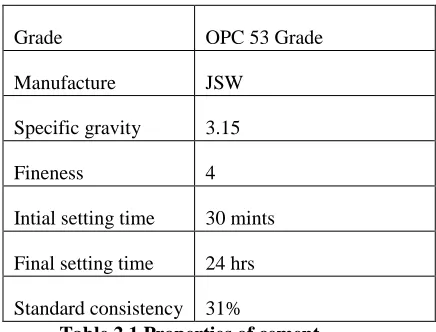
Particulars Values
Grade OPC 53 Grade
Manufacture JSW
Specific gravity 3.15
Fineness 4
Intial setting time 30 mints
Final setting time 24 hrs
Standard consistency 31%
Table 2.1 Properties of cement
B Foundry Sand:
Foundry sand is high-quality uniform silica sand that is used to make moulds and cores for ferrous and nonferrous metal castings. Foundry sand consists primarily of silica sand, coated with a thin film of burnt carbon, residue and dust. Foundry Sand can be used as a partial replacement of Sand or as a partial replacement of fine aggregates and as a supplementary addition to achieve different properties of concrete Foundry sand can be used in concrete to improve its strength and other durability factors. The foundry sand is a mixture of several elements that combine features of giving perfect workability of the mixture that comprises the molding box.
Table 2.2 Properties of foundry sand
Fig 2.2 Foundry sand Chemical composition of foundry sand:
C. Quarry Dust:
Quarry Rock Dust can be defined as residue, tailing or other non-voluble waste material after the extraction and processing of rocks to form fine particles less than 4.75mm. Usually, Quarry Rock Dust is used in large scale as a surface finishing material in the highways and also used for manufacturing of hollow blocks and lightweight concrete prefabricated Elements.
Particulars Values
Specific gravity 2.57
Fineness 2.4
Particulars Values
Specific gravity 2.70
Fineness 2.5
Constituent Percentage value
SiO2 83.93
Al2O3 0.021
Fe2O3 0.950
CaO 1.03
MgO 1.77
SO3 0.057
Table 2.3 Properties of quarry dust
Fig 2.3 Quarry dust
D. Fine Aggregate:
Fine aggregate is a naturally occurring granular material composed of finely divided rock and mineral particles.Fine aggregate can be naturally or crushed. The specification required that it should consists of hard, dense, durable, uncoated fragments and shall be free from impurities such as dust, clay, silt, mica and organic matter, soft and flaky particles. Those fractions from 4.75 mm to 150 microns are termed as fine aggregate. The river sand is used as fine aggregate conforming to the requirements of IS: 383-1970
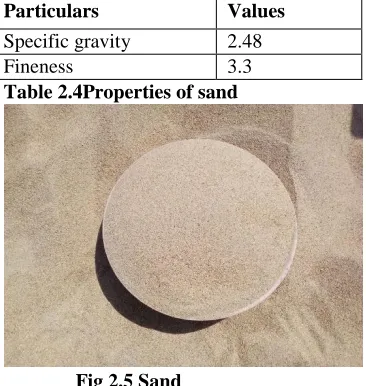
Particulars Values
Specific gravity 2.48
Fineness 3.3
Table 2.4Properties of sand
Fig 2.5 Sand
E. Coarse Aggregate:
Locally available coarse aggregates having the maximum size of 10mm to 20mm were used in the present work. Locally available crushed coarse aggregates of nominal size 12mm were used in this work. The 12mm aggregates were first sieved and then it was washed to remove dust and dirt and was dried to surface-dry condition.
Particulars Values
Specific gravity 2.7
Table 2.5 Properties of Coarse aggregate
Fig 2.5 Coarse aggregate
F. Water
Water conforming to the requirements of IS 456-2000 is found be satisfactory for making concrete. In the present investigation, portable drinking water available in the industrial company was used for mixing and curing the paver block.
G.Fly Ash:
Fly ash is define as the finely divided residue resulting from the combustion powdered coal, which is transported from the firebox through the boiler by flue glass.Fly ash is a by product of coal fired electric plants.The fly ash used in the work was of class C.Specific gravity of fly ash is 2.97
Fig 2.7 Fly ash Chemical composition of fly ash:
Constituent Percentage value
SiO2 61.73
Al2O3 26.97
Fe2O3 3.74
CaO 2.60
TiO2 1.56
K2O 1.49
MgO 0.93
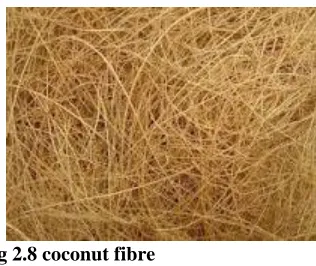
H.Coconut Fibre:
Fig 2.8 coconut fibre
III DESIGN MIX METHODOLOGY:
By using this standard mix (M40 Grade) 80 mm paver blocks. M40 Grade ratio is 1:1.2:2
Table 3.1 Partial Replacement of Cement OPC 53 Grade By Used Fly ash with coconut fibre in Standard Concrete Paver Block.
M40 Grade Cement(%) Used Fly
ash(%)
Used Coconut fibre
A0 100 0 0
A1 70 30 0.5%
A2 60 40 0.5%
A3 50 50 0.5%
A4 70 30 1.0%
A5 60 40 1.0%
A6 50 50 1.0%
Table 3.2 Partial Replacement of fine aggregate By Used Foundry sand and Quarry dust in Standard Concrete Paver Block.
M40 Grade Sand (%) Used foundry
sand(%)
Used quarry dust(%)
A0 100 0 0
A1 70 15 15
A2 60 20 20
A3 50 25 25
A4 70 15 15
A5 60 20 20
A6 50 25 25
IV..EXPERIMENTAL METHODOLOGY:
Paver block concrete contains cement, fine aggregate, Coarse aggregate, Foundry sand, quarry dust and Fly ash with coconut fibre in the bottom layer of paver block and in the top layer of paver block only a mixture of cement and fine aggregate is used. Partial replacement of cement to the different percentage of coconut fibre is 0.5% and 1.0% by used fly ash ,quarry dust and foundry sand in concrete paver block. For compression test there were four numbers of paver block has been cast and for water absorption three blocks were cast. At the time of casting water added only for the wet purpose of the mix. After about 24 h the specimens were placed at safe place and water curing was continued till the respective specimens were tested
after 7 and 28 days for compressive strength and water absorption tests.
V.COMPRESSION STRENGTH:
Concrete is strong in compression and in construction also concrete is mainly used in compression stength. The compression strength value of normal paver block and paver block with foundry sand, quarry dust,and fly ash with coconut fibre.
It is observed that the compressive strength of concrete paver block is increasing with increase foundry sand, quarry dust ,fly ash with coconut fibre content to compare the normal paver block at 7 days.It is observe that 30% of both foundry sand ,quarry dust and fly ash 1.0 % of coconut fibre maximum strength is obtained.
VI.WATER ABSORPTION TEST :
The paver blocks after casting were immersed in water for 7 and 28 days curing. They were then weighted and this weight was noted as the wet weight of the paver block. These specimens were then oven dried at the temperature 110 c0 the mass became constant and again weighed. This weight was noted as the dry weight of the paver block.
VII.TEST RESULT:
Compressive strength of concrete paver blocks mix (N/mm2) at 7 days.
Mix Proportions 7 Days
A0 25
A1 23.6
A2 26.7
A3 30.02
A4 36.5
A5 41.5
A6 37
Table 7.1 compression strength at 7 days
Chart 1.1 compression strength
Series1 0
50
A0 A1 A2 A3 A4 A5 A6
Water Absorption of Concrete Paver Block at 7 Days Mix proportion 7 Days
A0 3.15
A1 3.06
A2 3.00
A3 3.30
A4 3.16
A5 3.45
A6 2.60
Table 7.2 Water Absorption at 7 days
Chart 1.2 Water Absorption Value
VIII CONCLUSION:
From this study the following conclusion can be drawn: 1.) From this test, even though at extent of 40 % replacement of cement and fine aggregate we got compressive strength 41.5 N/mm2. So it’s beneficially for general application as like footpath, parking, and street road.
2.) By increasing proportions of replacement, Water absorptions is also decreased with increasing of compressive strength. At maximum replacement 40% with 1% of coconut fibre , water absorption is 3.45% & compressive strength 41.5 N/mm
REFERENCES:
[1]. Rafat Siddiquea, Geert de schutterb lbert Noumowe ffect of used foundry sand on the mechanical properties of concrete onstruction and uilding materials olume 23,Issue 2, February 2009, Pages 976-980.
[2] Tarun R.Naik, udolph N. raus ruce . amme and ethullah canpolat ffects of ly sh and oundry sand on performance of rchitectural precast concrete 2012 American Society of Civil Engineers.
[3] IS 7245:1974 Specification for concrete pavers.
[4] Devesh Meena., (2003), Compressive strength & Pull-out force of concrete in corpora ting quarry dust and mineral admixtures. Rilem proceeding of the International Conference on Advances in concrete structure, Xuzhou, China.
[5] Indian standard fine aggregate confiriming to IS383:1970.
[6] Kshitija Nadgouda“ oconut ibre einforced oncrete” in Proceedings of Thirteenth I International Conference, 14th September 2014, Chennai, India, ISBN: 978-93-84209-51
3.15 3.06 3 3.3 3.16 3.45
2.6
0 1 2 3 4
A0 A1 A2 A3 A4 A5 A6