Dungus et al. World Journal of Engineering Research and Technology
THE EFFECTIVENESS OF THE MANAGEMENT OF BASIC
LABORATORY AND INTEGRATED PRACTICAL RESEARCH
UNIMA USING MODEL CIPP
Rosiah Pulukadang and Ferdy Dungus*
Lecturer of Fuculty of Mathematics and Sciences Manado State University, Indonesia.
Article Received on 22/09/2018 Article Revised on 11/10/2018 Article Accepted on 01/11/2018
ABSTRACT
The laboratory became an important means for the development of the
science of MIPATEKS so that the need to continue to be developed for
the sake of its existence prior to the development of science. This
research aims to know the effectiveness of the implementation of the
practical Loboratorium basic and Integrated Research. This research
uses evaluation methods with model Cotex, In put, Proces, and Produc (CIPP). The
instruments used in this study using interview techniques, observation, documentation and
study of the now. The research results it is recommended that: a. the procedures the
implementation of teaching and research in the basic and Integrated Research Loboratorium
need to gain an understanding of the use of the laboratory. Basic Laboratory SOP
socialization and Integrated Research among UNIMA needs to be done, so that students and
professors more knowing. b. the Practical nature of learning can be made by the respective
groups of courses according to the purpose of lectures, and should be reported on in charge of
Basic Laboratory research and Integrated Research, c. research conducted by the student must
create a sheet of collaboration between researchers and the person in charge, to the utilization
of tools and materials will be reported. d. research conducted by Professor good for research,
or the devotion and enlightenment science must apply on the Manager and the person in
charge of laboratory research and Integrated Basis. e. Researchers from outside the College,
such as teachers and the general public, can apply for a recommendation inviting
establishments of origin. f. need for the addition of a number of tools for the development of
science MIPATEKS in the laboratory base and Integrated Research Unima.
World Journal of Engineering Research and Technology
WJERT
www.wjert.org
SJIF Impact Factor: 5.218*Corresponding Author Ferdy Dungus
Lecturer of Fuculty of
Mathematics and Sciences
Manado State University,
KEYWORDS: Management of Basic Laboratory Research, Integrated & Socialization SOP for users.
1. INTRODUCTION
Practical work is inseparable from the learning sciences, and science. Therefore, learning by
theory alone is not enough. Students need practical to solve problems mainly are closely
related to our daily lives. This is the reason why the concept is important, there should be
described through practical work. Based on the hard lessons, if only explained using theories
students will only remember it in a short period of time. On the other hand, other problems
will also appear, many students encounter errors of perception in understanding (Sanjaya
Wina, 2006).
High School students ability to analyze, evaluate, and synthesize the learning experience of
students may need to be taken into account in future study. For example, it is known that
students who reflect the often appear to report on this in the form of description and not the
evaluation (Joke h. van Velzen, 2017; 6). It is important to remind that the change of concept
is usually considered as a process that requires a significant amount of time to succeed. In
this perspective, it is interesting to see brief pedagogic treatment (less than 45 minutes) we
can create a difference, even if the long development time less secure (Patrice Potvin, _ Erik
Sauriol, and Martin Riopel, 2017: 22.)
The end of the process of learning is the acquisition of a student learning outcomes. The
results of student learning in class collected in the set of results of the study class. All the
results of the study are the result of an interaction of a follow up study and follow his
teachings. The teacher, teaching at the action end with the process of student assessment,
whereas the learning outcomes of students, is the end of the episodes and the learning process
(Dimyati and Mudjiono, 2009:3). According to Sudjana Nana (2001), the results of the study
are the skills possessed students after he accepted their learning experience. The results of the
learning events can appear in a variety of types of change or prove one's behaviour.
Wahidmurni, et al. (2010:18) tells us that someone can be said to have succeeded in learning
if he is able to show any change in himself. The changes of which in terms of the ability of
his thinking, his skill, or his attitude against an object. Hamalik (2006:155), gives an
overview of the acquired learning outcomes that can be measured through progress gained
of behavior in the students that can be observed and measured through changes in attitudes
and skills. These changes can mean the onset of improvement and development of better
compared to before.
Katili, (2013:2) describes the laboratory is a room where the practice of activities or research
that is supported by the existence of a set of laboratory instruments and the existence of a
complete laboratory infrastructure. Budiyono, (2009:9) is a place where laboratory
experiments and investigations carried out. The laboratory can be a place of enclosed space,
the room or open space, gardens for example where the experiment took place and doing
research. In laboratory students acquire data or information derived from the original object
or produced, and process how to learn the IPA as it should be. Katili (2013:2) Lab is a place
to experiment and investigation, it can constitute a closed space, rooms, or open space, such
as the garden. In terms of limited laboratory is a room where the experiment and
investigation. Budiyono (2009:10) Lab the laboratory is a real special place equipped with the
tools and materials to conduct real experiments or good teaching physics, chemistry, or
biology. Hadi santoso (2008:25) is a real Laboratory for experimental or practical activities
that come with the equipment or the real ingredients. Yusnita (2012) real lab is a way of
presenting lessons, where students experiment with experience and proves himself something
to learn. Learning with the method this experiment students were given the opportunity to
experience yourself or do it yourself, follow a process, observing an object, analyze, draw
conclusions and prove themselves on an object, the State, or the process of something.
Therefore, students are required to experience yourself, find the truth or try to find a law or
evidence. So the reason all the branches of the natural sciences (physics, chemistry and
biology) rely on laboratory experiments. Students studying natural sciences based on
experimentation. So the approach of learning to do in laboratory experiments to improve
learning and drawing conclusions or process that had befallen him. (Mehmet Erkol, Mustafa
Kisoglu, and Erdogan Buyukkasap, 2010:2310-2314).
Jaya Hendra, (2012:2) the virtual Laboratory is defined as an interactive environment to
create and experiment simulation: a playground for experimenting. It consists of domain
dependent simulation program, experimental units called objects that include data files, a tool
that operates on objects, and reference books. Hadi Santoso (2008:26) virtual labs is a
software which is run by the hardware or called by the computer. All the equipment needed
be used to support the system practical running conventionally. The virtual laboratory is
commonly referred to with the Virtual Laboratory or V-Lab. Improve the skills of creative
thinking and problem solving are scientific, developing skills in the field of ICT without
neglecting knowledge about laboratories, not have to incur the actual practical equipment,
sometimes the price is not affordable, and practical work can be done when only (Putri,
2013:2). Yuniarti, dkk (2012:3) in his research stating that the virtual laboratory is cheaper,
safe and suitable use by students who have a visual learning style because students can
explore virtual laboratory according speed and his needs. Sukardi 2012). The results showed
that there is a problem-based learning, influence through experiments with real and virtual
laboratories towards achievement of learning. There is the influence of learning achievement
against learning style, and there is no interaction between problem-based learning through
experimentation with real and virtual laboratory with learning achievement against learning
style, there is interaction.
Naba Hamida (2013). The results of the research show that there are influences learning
method using virtual labs and STAD STAD use real lab against the achievements of the
student learning material on the cognitive aspects of colloidal systems and there is no
influence the learning method using virtual labs and STAD STAD using real laboratory on
affective achievement. There is the influence of student's creativity high and low learning
achievement of students against the material of cognitive aspects of either colloid or
affective. There is no interaction between the learning method using virtual labs and STAD
laboratory student creativity with real high and low learning achievement of students against
the material of cognitive aspects of either colloid or affective.
The study revealed that students in the two groups study strategy group (STAD and LTM)
has a high academic performance mean values compared with students in a group of
individual computer instructions. STAD and study with teaching strategies koperatif model
were found to be more effective in increasing student academic achievement, motivation, and
Retention in physics more individual computer instructions. When hospitality was founded,
students are motivated to learn and more confidence to ask questions of each other to better
understand the tasks that you are learning. (Gambari Amosa Isiaka, 2015:10).
This research aims to: to know the process management in the laboratory base and Integrated
2. RESEARCH METHODS
The methods used in this research is a method of evaluation of the program with the
qualitative approach. Through evaluation methods are expected to give an assessment of the
effectiveness of the program, about the management of the programme, the advantages and
limitations of the program being implemented.
Design research is a draft Act to obtain data through to conclusion. This research follows the
evaluation model design Stufflebeam i.e.
CIPP model to provide a general overview about the evaluation process from the early stages
of the activity to taha alhir activities.
CIPP model can be described as shown in Figure 1.
Basic
Lab.
&
Integrated.
Research
Figure 1: Program Evaluation Research Design
Research instrument is the written guidelines about interviews, observations, or a list of
questions, which dipersiapankan to obtain information from the respondent. Responen in this
study consists of: a. Implementing practical-activity, Professor b. Technician or energy
Institution Laboran education (PLP), c. students.
Data Analysis Techniques
This evaluation research using qualitative analysis techniques and descriptive analysis.
Qualitative analysis technique is done by organizing the data, outlining the data into units, do
sistesa, menyususn into patterns, sorting out which ones are essential and that will be studied,
and make conclusions which can be submitted to the others. The data in this research is
quantitative descriptive analysis will use in the form of a percentage.
contex focus Data
Analysis decision
In put
focus Data
Analysis
decision
Proces
focus Data
Analysis
decision
Produc focus
Data Analysis
decision
3. RESULTS AND DISCUSSION Component Context
Results of the study on the components of the context shows that the basic laboratory
research and Integrated UNIMA does not yet have all the academic document that should be
owned by the laboratory in college. For example, he has not a permanent institutional
structure of the leadership of the College until in the laboratory. Haven't owned recruitment
mechanism remains the Manager of good teaching units for teaching learning and teaching
research. Academic activities in the implementation of practical and research is carried out
independently by the course lecturer. Manager of laboratory Education Institution is only 1
person who is skilled, berkualifkasi other 2 people have not followed the training laboratory.
The number of PLP with 1 qualifying skilled yet capable of serving all courses that carry out
practical work and research.
Vision: making the basic Laboratory research and Integrated a superior quality And Unima in
organizing the study of the SCIENCES and the development of mathematics,
science-technology and Health that can be taken into account both the present national and
international level.
Goals: 1. Joint majors and programs of study produce a well-educated workforce and undergraduate science expert, skilled, intelligent, independent, dignified as well as
professionals in the fields of math and science in both the educational and non-educational
competences. 2. Generate a work of research, Science and Technology products and scientific
works product learning in mathematics and science. 3. Make Basic Laboratory and research
Integrated Service Center of Unima, training, consultation and services in the field of
learning and application of mathematics science and science-technology.
Target: 1. Basic Laboratory Research and realization of Integrated Unima as higher education institutions accountable in governance is good (good governance), efficient and
effective. 2. Implemented the results of the research and study of Berdasis Basic Laboratory
research and science development to Integrated Math and science learning devices supported
with quality, innovative and research-based. 3. To achieve the institution profile the reputable
and accredited UNIMA. 4. Thoroughly in the preparation and service of academic
administration of ICT-based (online). 5. Realization of cooperation networks both nationally
and internationally. 6. To achieve the role of public services in the areas of math, science and
Component Input a. Student
Results of the study found that students who use Lab Basic practical and Integrated Research
can be grouped as follows: 1. consist of Department of physics, physics education Prodi,
Prodi physical science, Physics namely the concentration Geothermal. 2. Chemistry
Department consists of Chemical Education Prodi, Prodi and concentration of Pharmaceutical
Chemistry, 3. Biology majors consist of Prodi Biology education, biological sciences, and
Prodi. The Department of Education and Science.
From the results of research on some of the students have never been followed since
Teaching in junior and Senior High School. therefore many students who have the ability or
skills that are lacking in carrying out practical work. The complete data on the State of
practical experience before College can be seen in Table 1.
Table 1: Experience Teaching Students since SMA/K. No. Department/Study Program Number of
Students Ever attended Practicum Never attended Practicum 1 2 3 4 Chemystry Department
A. Chemystry Study Program Education
B. Chemystry Study Program C. Pharmasy Study Program Physics Department
A. Physics Study Program
Education
B. Physics Study Program
C. Geothermal Study Program
Biology Department:
A. Biology Study Program
Education
B. Biology Study Program
90 25 30 120 15 95 125 40 40 10 15 50 5 60 75 25 50 15 15 70 10 30 50 15
From the results of research, the Sciences admissions process practicum in the laboratory
base and Integrated Research can be divided into three categories, namely: a. pass the
selection result SMBPTN, b. pass the line of invitations and c. pass the local selection (B2P).
Based on the results of this selection should be made kuoata of Sciences admissions. The
process of recruitment of students of Sciences should pay attention to the availability of
selection and invitation SMBPTN more ready to follow lectures both in the lecture hall or
Laboratory practical.
b. Lecturer
Lecturer is a very important part in the process of lectures in college. Principal Lecturer
assignment reflected in Act No. 14 of the year 2005. Lecturers are professional educators and
scientists with the principal task of transforming, developing and disseminating knowledge,
technology and the arts through education, research and community service. Based on the
research results obtained data Sciences professors who carry out practical work can be
grouped as follows:
Table 2: Professors who carry out practicum in Laboratorium Basic Research Integrated.
No Department Practicum Lecture /Lesson Practicum Notes 1
2 3
Chemistry Physics Biology
5 1 3
3 - 2
S1 & S2 S1 S1 & S2
Based on data of Table 2. above then look that not many Physics Professor using Basic
Laboratory Research & integrated. This situation occurs because most of the equipment in the
laboratory teaching of Basic Research on more Integrated & analysis teaching chemistry and
biology. Physics lab course is not yet available, if there is the nature of the use of practical
Physics integrated with practical chemistry, such as Core Physics topics and for Atomic
Physics. This experiment can be used jointly by both Departments of physics and Chemistry
Department.
c. Power Technician (Pranata Labs have)
Workforce Institution Laboran education (PLP) currently amounts to 1 people with education
level S1 and Chemical Education backgrounds, so that in the future it would be better if it can
be adapted to the development of Basic Laboratory research and integrated, where necessary
the PLP power placement in accordance with the mission and vision of the basic
Labaratorium and Penelittian research and development on Integrated Science and
MIPATEK science, then it needs to be to the fore adoption PLP power behind undergraduate
education physics education /Physical Science, Undergraduate Biology Education/Biology.
This condition is necessary to meet the needs of teaching of biology majors, and Department
Sport (FIK), is in need of practical Laboratory for the development of Sciences and health
sciences disciplines.
The Contents of the Program d. means of infrastructure repair
Basic Laboratory facility and Integrated Research UNIMA in principle consists of 2 units of
2-storey building. Building A place of research and Practical implementation in the 1st floor,
with a student capacity of 75 people. Some seats are available and practical preparation of 1,
and a leadership laboratory. Building A 2nd floor there are two lecture hall with power
tamping each room of 50 people. On the second floor space currently 2 used as a lecture from
the Department of physics, Department of Chemistry and Pharmaceutical Studies Program.
Building B 1st floor there are 4 rooms and used the Lecture Hall biology majors, and the
Department of Mathematics. On the 2nd floor of building B in use as a Biology lab. Other
facilities are each equipped with a number of lecture room seats fit power tamping. All of the
rooms are not equipped with air conditioning because air campus was pretty fresh.
e. Management
Mekanisma the use of a room adapted to the schedule of courses per Department. Most
courses use lectures are biology majors, followed by the Department of Chemistry and
Pharmaceutical Studies Program. Specifically for the practical every lecturer is responsible
for the implementation of practical subjects according dikuliahkan. The mechanism of
practical teaching guidelines accordingly arranged. For practical implementation procedure
follow the SOP Practical Laboratory research and Integrated Basis.
The components of the process of Planning a.
The results of the valuation shows a lab practical activities planning basic and Integrated
Research planned by the majors and programs of study respectively. The results of this
planning and then delivered on practical implementation of the Manager of each Department
and of project studies. The results of this planning individual departments and Prodi adjusted
to not mutually bertumpukkan with majors and programs of study to another. Almost can say
in drafting the plan of praktiukum no problems encountered due to all the team can customize
the schedule of activities the use of practical work in the laboratory.
Other things that can be dmenjadi constraint is on the implementation of Scientific research
be done in collaboration between the scientific development interests of Sciences pemamgku
science and health. Collaborative preparation of development plans need to be made jointly to
determine priorities for research and the application of scientific knowledge. Until the results
of the evaluation of the perceptual differences still occur between some courses for scientific
development together. Still more dominant partially through the development of programs of
study, not to see how the development of collegial scientific groups.
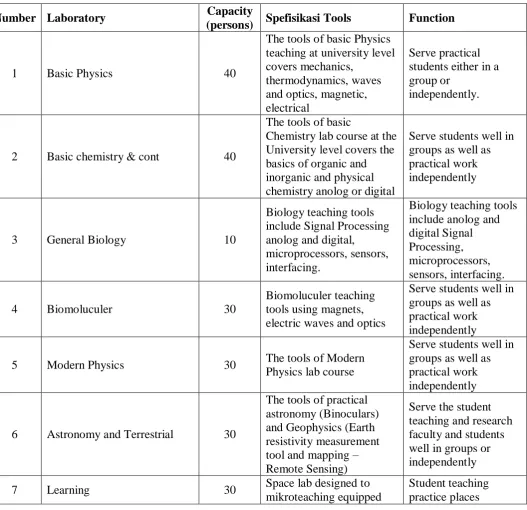
The development plan of the laboratory Sciences and science as in Table 3.
Table 3: Development S-2 Program Laboratory Sciences and Science Education.
Number Laboratory Capacity
(persons) Spefisikasi Tools Function
1 Basic Physics 40
The tools of basic Physics teaching at university level covers mechanics,
thermodynamics, waves and optics, magnetic, electrical
Serve practical students either in a group or
independently.
2 Basic chemistry & cont 40
The tools of basic
Chemistry lab course at the University level covers the basics of organic and inorganic and physical chemistry anolog or digital
Serve students well in groups as well as practical work independently
3 General Biology 10
Biology teaching tools include Signal Processing anolog and digital,
microprocessors, sensors, interfacing.
Biology teaching tools include anolog and digital Signal Processing, microprocessors, sensors, interfacing.
4 Biomoluculer 30
Biomoluculer teaching tools using magnets, electric waves and optics
Serve students well in groups as well as practical work independently
5 Modern Physics 30 The tools of Modern
Physics lab course
Serve students well in groups as well as practical work independently
6 Astronomy and Terrestrial 30
The tools of practical astronomy (Binoculars) and Geophysics (Earth resistivity measurement tool and mapping – Remote Sensing)
Serve the student teaching and research faculty and students well in groups or independently
7 Learning 30 Space lab designed to
mikroteaching equipped
Number Laboratory Capacity
(persons) Spefisikasi Tools Function with media studied physics
school for all topics and teaching aids like OHPS and LCD are installed permanently.
teaching, and research on learning models
8 Computer 30
40 computer accompanied server equipped with the internet network
Serve practical students, where the student
menyelesaiakan the tasks learning
computer-based media.
9 Workshop 40
Tools-workshop for the manufacture of the media learning MIPATEK its not a computer-based
Workplace professors and students to develop media learning MIPATEK
10 Material physics – chemistry
of Microscopic & materials
Tools materials science laboratory-scale research (list attached)
The means of research faculty and students
In addition to laboratory MIPATEKS and educational Sciences at the top, Base and research
laboratory of UNIMA, UNIMA has a Department of physics physics laboratory that strongly
support the research for the control level in the field of the study of physics. Physics
laboratory that there is currently a computational physics laboratory, laboratory of Physics of
the Earth, electronic and Instrumentation Laboratory, physics laboratory material. Some of
the main equipment owned by the physics laboratory among other things is; 1) X-RF (x-ray
Fluorescent) Minipal-4 series of PAN-Analytical capability analysis of elements Na to
Uranium, 2) space laboratory Integrated UNIMA & Basis including the equipment located in
the complex of Engineering UNIMA. UNIMA-run in coordination of Engineering Dean
UNIMA. The existence of integrated laboratory with adequate number of managers, their use
of proper laboratory equipment will strongly support the holding of S-2 Program of Sciences
Education & MIPATEKS.
b. Implementation
Based on the results of the evaluation of the nature of the planning component authors have
partially, then the impact is the process of the implementation of the activities also still
partial. This raises the interest of easy arrogance courses that feel is most dominant in the use
of tools or materials teaching as well as research. Schedule the implementation of practical
activities of the lectures can be implemented respectively Prodi, but the use of facilities and
Evaluation results showed that Prodi chemical education and the Chemical Sciences more
dominant using Basic Laboratory research and Integrated. Other courses that use of Basic
Laboratory research and more Integrated in the teaching in the first year. Some of the
praktkum tool can be used to research level thesis, thesis even dissertation. For the use of the
research thesis, thesis and dissertation setting it should be through the responsible Laboratory
base and Integrated Research.
c. Assessment
The assessment process conducted in the lecture activities can be divided into two things. The
first assessment of the learning outcomes students carry out practical work, and second, the
assessment of research or thesis students. Assessment of student learning outcomes-based
practical-it is recommended to use some aspects of assessment such as performance
assessment, an assessment of the project, the assessment of the written test and the portfolio.
Performance assessment is carried out in order to measure the work done by the students
through the stages of the process of the practical work done. This assessment allows students
showed the work to its full potential.
How that is done in a real laboratory associated with the assessment of performance.
Performance assessment process has several advantages that are relevant to the physics
concept, such as planting experiment, observe, analyse and report on the results of the
analysis. (Ferdy Dungus 2015) Portfolio assessment is done so that the students can gather all
the learning activities in the form of a well-ordered reports, starting from the beginning of the
practical activities to complete. Assessment assessment includes a quiz that was intended
when practical, data collection, reporting and final report of activities of the teaching. A
written assessment was intended to be able to tell from the beginning student activities which
includes knowledge until completion is done through a written test.
Results of the Component
The evaluation on landscape shows that student learning outcomes in particular which using
Basic laboratory research and Integrated in accordance with what is expected in the practical
work. There are some notes in a review of practical completion students between the
implementation of the electronic systems in the process of the service admistrasi in the
laboratory. (Anastasia Papanthymou1 & Maria Darra1, 2018; 12) For administrative staff and
services that are essential and effective and satisfying or create problems for students. Thus, it
is possible to set priorities and take measures and action to address the weaknesses, improve
the quality of services provided and to improve student satisfaction.
4. CONCLUSIONS
Pay attention to the results of the evaluation then it can be inferred that the holding of
practical Laboratory research and Integrated Basis are as follows: a. the procedures the
implementation of teaching and research in the basic and Integrated Research Loboratorium
need gain an understanding of the users of the lab. Basic Laboratory SOP socialization and
Integrated Research among UNIMA needs to be done, so that students and professors more
knowing.
b. the Practical nature of learning can be made by the respective groups of courses in
accordance with the objectives and associated matakuliah. Planning activities to the
implementation of activities and reporting should be reported on in charge of Basic
Laboratory research and Integrated.
c. research conducted by the student must create a sheet of collaboration between researchers
and the person in charge, to allow good utilization of tools and materials will be accountable.
The complete reference to the Standard Operational procedure for the utilization of Basic
Laboratory research and Integrated.
d. research conducted by Professor good for research, or the devotion and enlightenment
science must apply on the Manager and the person in charge of laboratory research and
Integrated Basis.
e. Researchers from outside the College, such as teachers and the general public, can apply
with the inclusion of recommendation instasi of origin.
REFERENCES
1. Anastasia Papanthymou1 & Maria Darra1, Assessment of the Quality of Electronic
Administrative Services in a Greek Higher Education Institution: Α Case Study.
International Journal of Higher Education, 2018; 7(2).
2. Budiyono. The Application Of Real And Virtual Laboratory On Learning Physics
http://eprints.uns.ac.id/8200/1/156242308201011351.pdf (accessed on 02 March 2014 at
18.55 Wita), 2009.
3. Dimyati dan Mudjiono. Learning and learning. Jakarta: Rineka Cipta, 1999.
4. Dungus Ferdy 2015. The Influence of Learning Application Model and Assessment
Techniques Toward Basic Physics I1 Learning Achievement (An Experiment of
Department Physics of Fmipa Unima) Jurnal IJSRP, 2015; 5(10): ISSN 2250-3153.
5. Jaya, Hendra. Development of Virtual Laboratory for Teaching Activities and facilitating
character education at CMS. Students in Education Journal, 2012; 2(1).
6. Katili, Sundoro. The analysis of the means and the intensity of use of the physics
laboratory as well as its contribution to the Learning Outcome SMAN in Jembrana
Regency. e-journal. http://pasca.undiksha.ac.id/ejournal/index.php/jurnal_ipa/article/view
File/795/580. (Retrieved may 05, 2014 at 19.00), 2013.
7. Hamida, Naba. The study of comparisons of the use of Virtual and Real Laboratory
Laboratory in Pembelaajran Student Teams Achievement Division (STAD) of Learning
Achievement in terms of the creativity of students in the subject matter Colloid Even
Semester Class XI SMA Negeri 1 Banyudono Years 2011/2012. e-journal of chemical education courses the University Eleven Maret. ISSN: 2337-9995, 2013; 2(2).
8. Isiaka Amosa Gambari, Effects Of Computer-Assisted Stad, Ltm And Ici Cooperative
Learning Strategies On Nigerian Secondary School Students’ Achievement, Gender And
Motivation In Physics. Journal of Education and Practice www.iiste.org.ISSN 2222-1735
(Paper) ISSN 2222-288X (Online), 2015; 6(19).
9. Joke H. van Velzen Measuring senior high school students’ selfinduced self-reflective
thinking, The Journal of Educational Research, 2017; 110(5): 494-502.
10.Muldjiono, dan Dimyati. Learning and learning.Jakarta: Reneke Cipta, 1999.
11.Mehmet Erkol, Mustafa Kisoglu, and Erdogan Buyukkasap The Effect of implementation
of science writing heuristic on students’ achievement and attitudes toward laboratory in
introductory physics laboratory. Procedia Sosial and Behavioral Sciences, 2010; 2: 2310-2314.
12.Oemar, Hamalik. Teaching And Learning Process. Jakarta: PT Bumi Aksara, 2011.
13.Patrice Potvin, Erik Sauriol, dan Martin Riopel, 2017 Experimental Evidence of the
Superiority of the Prevalence Model of Conceptual Change Over the Classical Models
and Repetition. Journal of Research In Science Teaching, 2015; 52(8): 1082–1108.
14.Puspita, Rani. Application of Information System of Virtual Lab on Laborarotium
15.Putri, Anna. Development of Virtual Laboratory on the material with the analysis of
Kinematics Vectors in Physics Learning in class XI high school. Journal of Pillar of Physics Education State University of Padang, 2013; 1: 23-29.
16.Sanjaya, Wina. Learning Strategies. Bandung: Prenada. Media Group, 2006.
17.Santoso, Hadi. The influence of the use of Real Laboratory and laboratory Virtual Learning Physics Reviewed from the critical thinking ability of students.Surakarta: Universitas Sebelas Maret. Skripsi. http://eprints.uns.ac.id/5203/1/130910508201004201.
pdf (Diakses pada 02 September 2014 pukul 18.00 Wita), 2009.
18.Sudjana, Nana. Assessment Of The Results Of The Process Of Teaching And Learning
Bandung: Remaja Rosdakarya, 2001.
19.Sugiyono. Methods of educational research: Quantitative, qualitative Approach, and R&D. Bandung: Alfabeta, 2013.
20.Sukardi. Problem-based learning through experimentation with real and virtual laboratory
laboratory in terms of creativity and learning style. e-journal of postgraduate courses, University Eleven Maret. ISSN: 2252-7893, 2012; 1(2).
21.Yuniarti, dkk. Development of Virtual Laboratory As A Computer-Based Learning Media
On Breeding Material Of The Virus. Unnes Journal of Biology Education ISSN 2252-6579, 2012; 1.
22.Yusnita, Selvi. The influence of Virtual and Real Application of Lab-based Cooperative
Learning Activity and results Against student learning on the subject of thermodynamics.
Terrain: UNIMED. Thesis. http://digilib.unimed.ac.id/UNIMED-Master-1309/1309.
(accessed December 22, 2014 at 16.00 WITA), 2012.