Page 330
TEACHER TRAINING IN DESIGNING PROFESSIONAL E-PORTFOLIO Anelly Kremenska
Sofia University “St. Kliment Ohridski”, Faculty of Biology, Sofia, Bulgaria
Abstract
Introducing technologies through teacher training qualifications is a widely used means for further professional development. This work presents a course designed for teachers of English as a Foreign Language to train them in using available technologies in preparing an electronic version of their teacher portfolio. The paper discusses the topics covered by such training, the tasks designed to be realized as blended learning, and the preliminary results of the pilot training.
Key words: teacher training, blended learning, teacher qualification, e-portfolio
INTRODUCTION
Introducing technologies in all aspects of education is widely recognized as a leading tendency, as a reflection to the rapid advances and impact they have in all aspects of life today. At the same time, providing an easily accessible, well-organized portfolio in teaching profession is an inseparable part of teaching practice, professional development and attestation process. In order to provide flexible support for teachers to effectively employ adequate technologies for designing, storing and presenting artefacts to provide compelling proof of their practice and development, a training in E-Portfolio as an Attestation Instrument (for teachers of a foreign language) was designed and piloted. The training is part of the initiative for in-service qualifications featuring the Regulations of the Ministry of Education of Republic of Bulgaria (Bulgarian Ministry of Education and Science, 2016), introduced in 2016. This paper presents the design of such a course, targeting teachers of a foreign language and aiming at clarifying the structure, possible contents and appropriate technologies to be used for a language teacher professional portfolio. The focus is on designing an electronic version of such a portfolio in compliance with Decree 12 “on the status and professional development of the teachers, headmasters, and other pedagogical specialists“ [ibid.], in particular, and following the general directions in respective EU documents in the field (such as EPOSTL (Newby, et al., 2007) (Newby, et al., 2010)).
1. THE TRAINING
The qualification training was especially designed to support schoolteachers of foreign languages, in order to provide them with relevant competencies to select and present proofs for their professional portfolio taking into consideration the specifics of language teaching. As the focus is on the principles of matching the description of the competencies (app 24 of the Decree) with suitable documents and products, which in turn to be presented in an appropriate electronic form, the course could be useful for teachers of other humanity subjects as well. The goal is gaining practical skills in analyzing own practice and presenting appropriate evidence for the achievements by using technology efficiently, through interactive training. The expected products are a portfolio in a chosen electronic form, e.g. a presentation or website. The following criteria for completion are set: the portfolio to have all required elements, including a teaching philosophy, and the design to be adequate to the technology used.
Page 331
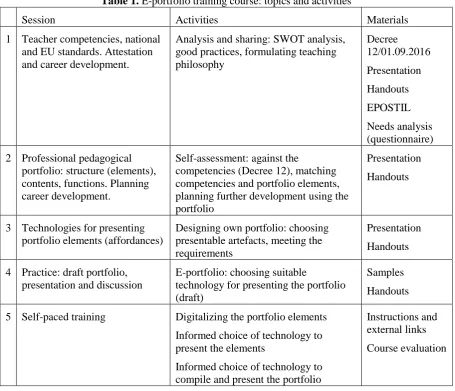
to the required competencies, the choice of artefacts for adequate proof of each competency, and the most appropriate technology to present these artefacts in an electronic form (table 1). The topics in the table represent four 2-hour face-to-face sessions for blended learning delivery. Each session features a theoretical part, followed by activities for practice, as well as further reading and self-paced activities for out-of-class individual work.
Table 1. E-portfolio training course: topics and activities
Session Activities Materials
1 Teacher competencies, national and EU standards. Attestation and career development.
Analysis and sharing: SWOT analysis, good practices, formulating teaching philosophy Decree 12/01.09.2016 Presentation Handouts EPOSTIL Needs analysis (questionnaire)
2 Professional pedagogical portfolio: structure (elements), contents, functions. Planning career development.
Self-assessment: against the
competencies (Decree 12), matching competencies and portfolio elements, planning further development using the portfolio
Presentation
Handouts
3 Technologies for presenting portfolio elements (affordances)
Designing own portfolio: choosing presentable artefacts, meeting the requirements
Presentation
Handouts
4 Practice: draft portfolio, presentation and discussion
E-portfolio: choosing suitable
technology for presenting the portfolio (draft)
Samples
Handouts
5 Self-paced training Digitalizing the portfolio elements
Informed choice of technology to present the elements
Informed choice of technology to compile and present the portfolio
Instructions and external links
Course evaluation
Page 332
the third area is envisioned to provide insights as to how to practically choose relevant artefacts illustrating a particular competency, as well as how to make the most of the available artefacts. In addition, the clear presentation of the artefacts in terms of choosing appropriate media to make the most efficient evidence of each artefact is also discussed. The forth group of topics includes brief presentation of easy-to-use, freely available and accessible tools to present these artefacts, as well as criteria to be applied to making informed choice of a technology. The design of the training is grounded in the documents mentioned above, which ensures its currency and relevance to the language teacher needs. It also takes into consideration the specifics and tendencies of Bulgarian education, found in literature as preliminary research was conducted (Kremenska, 2017) (Dimitrova & Tashevska, 2007) (Hadjiali & Kolarova, 2007). In addition, it builds upon own practice in training foreign language teaching professionals in different contexts (Kremenska, 2013) (Kremenska, et al., 2013) (Yaneva, et al., 2011).
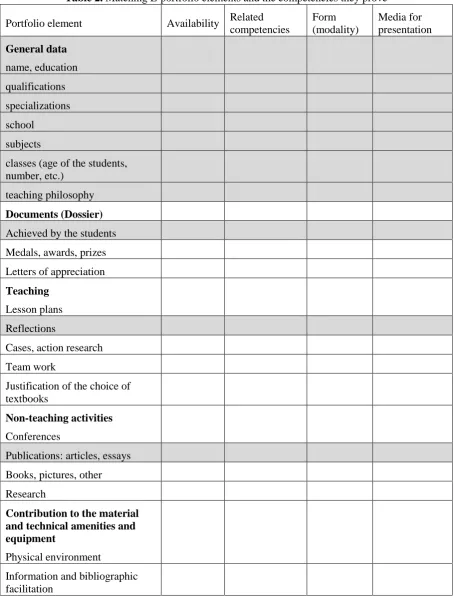
Two types of activities were prepared: the first were to be done during the face-to-face sessions, and the second were for self-paced study, listed in a handout as 5 activities, with 3 tasks each. The former included brainstorming, discussions, group work, reflections on own practice, sample SWOT analysis of own practice, as well as practice using different technologies. The latter featured instructions for step-by-step work with prepared in advance online resources. Figure 2 shows a sample activity, Activity 1, for analysis and sharing good practices. Task 1 is to be done during the face-to-face session and requires performing the previously mentioned SWOT analysis, taking into consideration the requirements Decree 12 poses, as well as the ones listed in EPOSTIL. Task 2 is for individual work after the session and involves writing a 300-word reflection, based on the previous task results, as to how to make the most of the strengths and minimize the weaknesses, as well as what competencies have to be improved in order to do this. For each task, the required product is identified: a file (using a template) and a file of text, respectively. Another sample activity, aiming at making a correspondence between the elements of the portfolio and the competencies they prove, is given in table 2.
Page 333
Table 2. Matching E-portfolio elements and the competencies they prove Portfolio element Availability Related
competencies
Form (modality)
Media for presentation
1. General data name, education
- qualifications
- specializations
- school
- subjects
- classes (age of the students, number, etc.)
- teaching philosophy
2. Documents (Dossier) - Achieved by the students
- Medals, awards, prizes
- Letters of appreciation
3. Teaching - Lesson plans
- Reflections
- Cases, action research
- Team work
- Justification of the choice of textbooks
4. Non-teaching activities - Conferences
- Publications: articles, essays
- Books, pictures, other
- Research
5. Contribution to the material and technical amenities and equipment
- Physical environment
- Information and bibliographic facilitation
Page 334
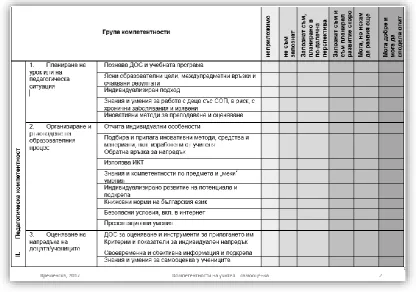
available online. In addition, 10 handouts were prepared to support the activities, such as a SWOT analysis chart, competencies self-check, matching competencies and portfolio elements chart, lesson plan template, etc. Figure 2 shows a snapshot of one of the handouts, presenting a competency self-check grid: the left-hand columns contain the respective group, competency and criteria, while the right-hand ones give a scale of assessing own development. The scale features the following statements: does not apply to my practice; I do not know about this competency; I know about this competency and plan on developing it in future; I know about it and have planned to start developing it soon; I would like to improve this competency; I am confident I have mastered it and can share my experience. Separate handouts contain the bibliography and the instruction for the activities (both face-to-face and out-of-class ones). In addition to these, two questionnaires for assessing participants’ background computer literacy and teaching context, and their satisfaction with the training. These are presented in more detail in part 2 of the article.
Fig. 2. Handout for teacher training in designing e-portfolio - example
2. RESULTS OF A PILOT TRAINING
The pilot training was conducted in the beginning of 2017, with 23 teachers of English as a Foreign Language from Burgas region schools. In order to triangulate the results, the data were collected by two questionnaires (an entry and course evaluation ones), informal interviews and the products received (e-portfolios). The questionnaires were presented with simple online tools, allowing anonymous responses, quick access and immediate visualization of the results. The open-ended questions and the interviews were analyzed by categorizing and grouping the answers, and the portfolios were assessed by especially designed criteria to cover both the requirements for the content, posed by the Decree cited above and the use of technology to present it.
2.1. Entry questionnaire: level of computer literacy and background
Page 335
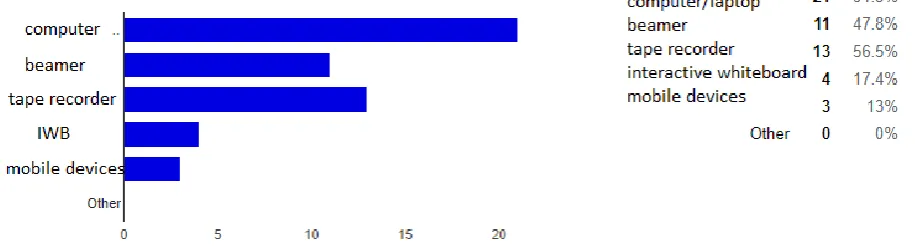
considered of critical importance. The data were collected by questions in four groups: bio data ones, identifying the teaching context in terms of using technology ones, concerning computer skills ones, and open ended ones to identify the expectations. The bio data ones include name, school and town. The teaching context ones inquired on the use of equipment for teaching (computer/laptop, beamer, tape recorder, interactive whiteboard, mobile devices, other); the type of software used (e.g. versions of MS Word and PowerPoint), availability of a school website, virtual learning environment, SMS communication with parents, e-mail communication with parents, electronic record and register book.
All participants of the pilot training responded. The results showed that more than 90% of the participants used computers in their teaching practice, and about half of them also use beamers and tape-recorders (fig. 3). Obviously, apart from the electronic technology, significant part of the teaching requires using analogue equipment, such as tape recorders. About 15% of the respondents mentioned interactive whiteboards and mobile phones and tablets. (Percentage is more than 100 as the respondents could choose more than one answer). 20 participants (87%) noted that their school had a website, and the other 3 noted, that it is in process of development (fig 4). It is evident, that all schools either actively use (the majority), or are in process of introduction of this electronic means of information and communication. However, a virtual learning environment was reported by only 2 of them (about 11%), which they did not use. The software usage showed that less than ¼ use presentations, and only 2 colleagues design own audio or video content. The overall picture shows that technology is used widely in the schools under investigation (although at a relatively low level). Therefore it can be expected, that these schools can provide appropriate equipment for implementation of e-portfolio for their teachers, which is the training goal.
The expectations for the course could be grouped in two categories. The first group naturally featured practice on designing teacher portfolio (11 instances), but it also appeared to include student’s portfolio (2 cases), as well as general information regarding the portfolio (5). The second group was related to training about innovative methods in teaching (3 cases) and exchange of good practices and materials (3). The question about desired training outcomes elicited 10 responses about interactive whiteboard, 4 about Moodle, 3 about mobile learning, and 3 about using multimedia.
It can be concluded that the digital literacy of the colleagues varies, but all are well-acquainted with commonly used technologies (email, searching engines) and most use presentations and technical equipment for teaching. It also is evident, that all participants appeared informed about the course goals and their expectations were for practical solutions regarding designing professional e-portfolio, yet more than half of them also expected training in innovative methods and working with particular software and equipment. Noteworthy, half of the respondents expected training with interactive whiteboards, which, although not a goal of the training under discussion, can be considered for designing future trainings.
Page 336
Fig. 4. Entry questionnaire: does your school have a website?
2.2. End-of-course evaluation questionnaire
The evaluation questionnaire aimed to elicit feedback on course efficiency after the course ended. 9 answers were received (of 23 participants), which can be considered as a good response rate as they were voluntary and anonymous. The questionnaire consists of 22 closed questions on course feedback, using 5-grade standard Likert scale (agree, slightly agree, neutral, slightly disagree, disagree), and 3 open-ended questions about three most effective, three less effective aspects of the training, and suggestions for future training. The answers vary widely, therefore the trends they suggest are presented descriptively below.
The answers to the questions concerning the general appreciation of the course (fig. 5) show that the overall satisfaction is above the neutral point (in black) for most of the respondents (the number of respondents is given on the x-axis). Most appreciated were the clear course goals, which were achieved, the participants’ needs can be considered met, and most of the trainees would recommend the course. Meeting the expectations, the assessment and clarification of the goals evidently score a wide range of responses and there are even answers to disagree. This can be due to the totally different expectations a great portion of the participants had had, as commented above, e.g. 10 expected to be trained in using interactive whiteboards.
Fig. 5. Courses evaluation: feedback results
0 2 4 6 8 10
I can fit the course goals with my personal ones course achieved the goals course met expectations assessment criteria are clear course met needs means of assessment is adequate I would recommend the course the goals of the course are clear
Page 337
Fig. 6. Feedback on training activities and materials
Fig. 7. Feedback on training methodology
The results for the materials and activities, on the other hand, show much higher overall appreciation, as shown on fig. 6. Clearly the sequencing, interactivity and interest to activities are most valued, with highly useful, interesting and adequately presented materials. The timing gained varied and undecisive opinions, and the negatively asked question about activity usefulness – more neutral answers.
The training process itself gained obvious positive reaction regarding interaction with the teacher and colleagues (the latter was asked in negation) and instruction appropriateness (fig. 7). The training methods (negation) and the technologies used achieved more negative responses, instructions were perceived as insufficient, with about half of the respondents not satisfied. It can be concluded that more instructions are needed, and the training should use more personalized approach.
The open ended question answers regarding the three most valued aspects of the training confirm the results of the respective closed questions: 6 (out of 9 respondents) believe, that the materials were good; 5 distinguished the presented information, 4 mentioned the interactive methods used, 1 - the structure of the portfolio, 1 – the clear goals, and 1 – the collaboration with colleagues. Least effective was judged the technical support and organization (noted by 5 respondents), and the related practice, which was judged insufficient (2). In addition, it was mentioned that the information about the course was not given in advance (1). The suggestions (the third open-ended question) concerned mainly the preparation of the equipment (5), and changes in the contents towards more examples (1), practice (1) and sharing of good practices (1). It is clear that the participants in the training liked the materials best, and would like better equipment and technical support. The latter can be judged as a naturally characteristic, considering the
0 1 2 3 4 5 6 7 8 9 10
activities are not useful activity timing is adequate materials are interesting materials are adequately presented materials are useful activities are interesting activities are interactive activity sequencing is adequate
disagree slightly disagree neutral slightly agree agree
0 1 2 3 4 5 6 7 8 9 10
instructions are sufficient intercation with colleagues in not appropriate the use of technology is appropriate instructions are clear the training methods are not appropriate interaction with the trainer is appropriate
Page 338
main goal of the training; however, it could be considered to ensure back-up equipment, such as mobile internet, own laptops or mobile devices, virtual learning environment for the materials, etc.
2.3. Training results: products and informal interviews
The analysis of the informal feedback is based on comments and questions received by the participants between and during the face-to-face sessions. These could be divided into two categories: training-process related and organizational. Most of the former concerned the struggle with particular task and working with the equipment (e.g. finding an online resource). The management-related comments mainly focused on class arrangements, information about the course and administrative issues.
The analysis of the products (e-portfolios) received from 14 participants by the 2-week deadline period shows that all of them comply with the requirements listed in the documents. A closer look to the chosen technology for the presentation of the portfolio proves that two trainees used a new one (Prezi), two used websites, all the rest relied on classical PowerPoint presentations. As for the content, it features a lot of text (facts), pictures (an average of 2 – 3 per portfolio), and virtually no documents or artefacts. These results can be explained by the different levels of computer literacy, as evident from the entry questionnaire. Another factor inevitably was the fact that there were technical issues during the face-to-face session, which prevented trainees from experimenting with some of the suggested technologies. Notably, it also became apparent that some of the colleagues used a common template, changing the facts, but with same wording of the essayistic parts, such as teaching philosophy, for example. It can be concluded, that the teachers would be greatly facilitated if given ready-made templates using different technologies, with more practice and hands-on solutions during the face-to-face sessions, and a strong point about personalizing the contents should be made.
3. SUGGESTED IMPROVEMENTS
Based on the analysis above, several adjustments were introduced for the next run of the training. The first issue to be addressed was the workload: the theoretical discussions were reduced to half of the initial length, with interactive tasks to immediately practice on the ideas introduced. Respectively, the tasks for the face-to-face sessions were redesigned to fit within the theoretical part. Next, the tasks for the self-paced work were also reduced to three: preparing a teaching philosophy, completing own portfolio using a template, justifying the choices of artefacts in the portfolio and the technologies used to present them. In addition, templates are under construction (e.g. https://www.slideshare.net/akremenska/ss-73951742), to further facilitate the choice of a technology to be employed in the particular context.
4. CONCLUSIONS AND FUTURE WORK
The article presents an in-service training course for school teachers of a foreign language in Bulgaria, designed to support them by introducing technology in presenting their achievements. To this end, specially designed training tasks and activities are presented, which aim to develop practical skills for matching the required professional competencies, the specific requirements for language teaching as proposed by EPOSTIL, and the elements of the professional portfolio. An integral approach to the field was adopted, combining analysis on the respective legislation, self-assessment techniques and tools towards compiling a professional portfolio of adequately chosen and presented artefacts for professional development and attestation. The training is designed for both face-to-face and blended learning, and is based on interactive, individualized delivery.
e-Page 339
portfolios. The templates were especially designed to meet the requirements of Decree 12, App 2 and 24, and feature a presentation and a website e-portfolio templates.
Future work includes also providing a virtual learning environment for the training, e.g. Moodle, to ensure improved monitoring and feedback during both face-to-face and self-paced off-premises training. In addition, a process of designing and providing access and instructions for using simple e-portfolio templates for different technologies is currently undergoing. Furthermore, handouts could be prepared and printed as a trainee’s guidebook prior to the course to ensure availability of instructions and reference.
REFERENCES
Bulgarian Ministry of Education and Science, 2016. Decree 12/01.09.2016 on the statute and professional development of the teachers, headmasters and other pedagogic experts, Ministry of Education of Republic of Bulgaria [НАРЕДБА № 12 от 01.09.2016 г. за статута и
професионалното развитие на учителите]. [Online]
Available at: http://www.mon.bg/?go=page&pageId=7&subpageId=59
Dimitrova, S. & Tashevska, S., 2007. Pedagogical portfolio. Sofia: New Bulgarian University.
Hadjiali, I. & Kolarova, T., 2007. Learner's Portfolio as Means of Development and Diagnostics of Reflection at Highschool Education in Biology and Health Education. s.l., s.n., pp. 190-200.
Kremenska, A., 2013. Designing Curricula for Language Teacher Training in Computer Literacy. Moscow, Moscow State Institute of International Relations Press, pp. 259-263.
Kremenska, A., 2017. E-Portfolio for Teaching Practice of Binary Specialities (Biology and English). Pedagogy, 89(2), pp. 244-267.
Kremenska, A., Tashev, D. & Pangalova, V., 2013. Guide for Кременска, А., Ташев, Electronic, Distance and Web-based Learning for Health Education Guide. Sofia: Iztok-Zapad.
Newby, D. et al., 2007. European Portfolio for Student Teachers of Languages. European Centre for Modern Languages. s.l.:s.n.
Newby, N. et al., 2010. European Portfolio for Student Teachers of Languages - Information Guide. s.l.:European Centre for Modern Languages, Council of Europe.