Islanding Detection In A Ress Supplied Microgrid
Using Pmu-Fuzzy Logic Algorithm
L.O. Mogaka, G.N. Nyakoe, M. J. Saulo
Abstract: Islanding and loss of mains detection is very essential in power systems for the safety and reliability in grid connected and standalone Renewable Energy Sources (RESs). These RESs produce power intermittently that can lead to voltage variation, unintentional islanding and total blackouts in case of a contingency. This calls for fast, reliable and local techniques of islanding detection and voltage control criteria within the islanded microgrid (MG) and a means for seamless switching between islanded and grid connected modes. A number of islanding detection methods have been proposed so far. However, many of them fail to give reliable results in microgrids that have high penetration of multi-source RESs. This paper develops a technique for islanding detection using phasor measurement units (PMUs) and fuzzy logic algorithm for local signal extraction and classification at the point of common coupling (PCC) between the MG and the utility grid. The robustness of the proposed approach is established through application to IEEE 9 bus system with high penetration of RESs in a MATLAB/Simulink platform under different contingencies. The obtained results indicate that the proposed algorithm is fast, reliable, and secure in discriminating between the islanding and non-islanding scenarios for the tested cases.
Index Terms: Phasor Measurement Unit, Loss of Mains detection, Power system islanding, Microgrids
————————————————————
1 INTRODUCTION
There has been increasing interest in the research on the integration of RESs like wind and solar photovoltaic (PV) into the main grid and MG operation. This is because of their friendliness to the environment and abundancy of these resources. However, LOMs and unintentional islanding is the main challenge in this integration. Thus, it becomes necessary to detect all the islanding events so that the MG can switch to autonomous operation mode so as to provide reliable power supply to connected loads within the islanded region. An islanded condition can be defined as the situation where a section of the main power grid is isolated from the rest of the main power grid, and DGs continue to supply the isolated loads of the network. This can be due to an occurrence of a fault upstream or some other disturbance that can lead to LOMs. Fast and reliable method for detecting unintentional islanding condition is necessary for a number of reasons. These include posing of a safety hazard to the utility personnel, equipment damage or destruction due to poor quality power supply and out-of-synchronism reclosure of the system to the grid. Immediately upon islanding detection, control signal should be sent to the converters of the connected DGs so that operation strategy is changed to autonomous mode so as to ensure quality power is supplied to the connected loads within the MG [1]. To maintain the system stability and voltage within the required limits, LOMs and islanding condition detection should be followed by appropriate control decisions and actions. The IEEE1547-2003 standard stipulates that the unintended islanding should be detected and disconnected within two seconds of occurrence [2]. However, this maximum time duration of two seconds covers a number of steps and processes.
This include; islanding detection, trip signal generation, trip signal transfer and breaker opening of the generator in the island. Any algorithm to detect islanding condition should therefore have measurement capabilities which would significantly signal a voltage collapse in shortest time possible with a low latency in the transmission of the signals [3]. There have been several approaches and techniques that have been employed in the detection of the LOMs and islanding condition. These include the state estimation of the network from SCADA which is largely dependent on reliable communication channels between the Distributed Generator (DG) and remote-control site. However, the control room operators monitoring large grids usually know about islanding from conventional SCADA system much later after its actual occurrence due to the communication system latencies. A reliable method for islanding detection should work for all the possible scenarios for islanding that can occur. To mitigate this, there is therefore a need of the facilitation for an automated method of islanding detection to control room operators, thus enabling them to take preventive and corrective actions well in advance so as to avert any damage to the grid [4]. A number of studies have been conducted on islanding detection, though not exhaustively. This is because the grids keep on evolving to meet the smart grid requirements as the technology advances. For instance, in [5] the authors developed a test device which could be used to optimize PMU based on islanding detection technology and then confirmed the working of their method in solar PV stations for islanding detection. In [6], the authors used wide area synchrophasor measurements in islanding detection. PMU measurements were also applied for islanding detection using a probabilistic principal component analysis technique in [7]. In [8], a novel method based on Wavelet Transform (WT) and modified feed forward neural network to detect islanding and classify power quality problems is proposed. PMU data was used in the detection of LOMs and islanding in a statistical approach as proposed in [9]. In [10], PMUs were also applied in islanding detection of interconnected grids, Loss of Parallel Feeder, loss of load and generation. In [11], PMUs measurements were used to continuously monitor the phase of generators in a wide area in the detection of LOMs and generator synchronization. However, the ______________________________
• L. O. Mogaka is currently pursuing PhD degree program in electrical engineering in Pan African University Institute for Basic Sciences, Technology and Innovation, Nairobi, Kenya. Email: [email protected]
• G. N. Nyakoe is a Professor at Jomo Kenyatta University of Agriculture and Technology, Nairobi, Kenya
communication latencies that are associated with this approach were not put into consideration. If an island should occur, it should exist for only a very brief period of time, unless the aggregate real and reactive power output of all the DG supporting the island is equal or close to the load demand. Otherwise, the voltage and frequency within the island will change rapidly and the DG has to be shut down so as to prevent this. This is as per IEEE Standard 1547 which states that the DG must be disconnected from the isolated grid within two seconds after an unintentional islanding event. Generally, passive islanding detection methods exploiting local PMUs are computationally efficient and cheap to implement. In this paper, a simulation of islanding detection locally at the PCC by using a combination of PMU and FL for signal extraction and classification respectively is presented. Performance assessment of the proposed approach is tested by performing islanding condition by opening the Circuit Breaker (CB) at the PCC and compared with the results for normal operating condition. The rest of the paper is structured as follows; Part 2 gives a brief literature review on various approaches of LOMs and islanding detection. Section 3 introduces the formulation of the problem for the proposed islanding detection using PMU-FL algorithm while Section 4 discusses the methodology used in this approach. The simulation results and their discussions are presented in section 5 and finally the paper conclusions are discussed in section 6.
2 LITERATURE REVIEW
1.1 Islanding Detection Techniques
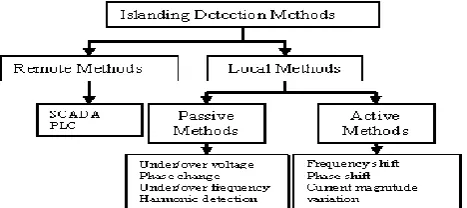
There are two types of islanding in a power system: Intentional islanding and unintentional islanding [6]. Intentional islanding is performed for either maintenance or load-shedding purposes to protect the rest of the power grid and avoid a total blackout. The isolated generators operate in frequency and voltage control mode to provide constant voltage to local loads in the isolated network while maintaining the isolated grid frequency. On the other hand, unintentional islanding occurs due to equipment failure or severe faults resulting in the opening of circuit breakers that interconnect the island with the rest of the power system. This may result in hazards in power system operation and may lead to safety risks to the maintenance personnel [6]. The safe operation and stability of the grid is very important in DG systems and islanding detection is a very crucial part of it. The islanding detection methods can be classified into two main groups: Local and Remote islanding detection methods [5]. This is elaborated in the figure 1 below [12].
Figure 1: Classification of Islanding Detection Methods
The local techniques of islanding detection use the information and data available at the Point of Common Coupling (PCC). The passive methods use the local measurements at the DG side and monitor for sudden electrical parameters variations [13], [14] [15]. The variation in the measured data magnitude is compared with the set tripping thresholds so as to determine the islanding and a grid connected condition. Remote islanding techniques are based on supervisory control and data acquisition (SCADA) LOMs detection systems.
2.2 General Islanding Detection Steps
Islanding condition and LOMs detection has been a concern for a while now, that is why researchers have been tirelessly working on ways of quickly detecting it and taking appropriate action. Signal processing techniques and artificial intelligence are generally used in signal extraction and classification as islanded or not islanded. In whatever technique combination adopted, the steps used to detect the LOMs and island formation are as shown in figure 2 below [16]
Figure 2: General islanding detection steps
1.2 Phasor measurement units
Now that the existing power system is a complex network consisting of various interconnected components, it is important to continuously monitor the system and protect its elements so as to avoid any contingency that can occur. In this study PMUs are used in islanding detection. Consider a pure sinusoidal waveform as shown in equation (1) below.
( ) ( ) ( ) This can be represented by a unique complex number known as a phasor as shown in equation (2). This equation can be represented graphically as shown in figure 3 below [17].
( )
{ ( )} ( )
Figure 3: Phasor representation of sinusoidal signal
locations and other network parameters. Time
synchronization allows synchronized real-time
measurements of multiple remote measurement points on the grid. PMUs have found numerous applications in identification and evaluations of power system states. Since they measure multiple parameters synchronized by a time reference, they can be used for islanding detection too more quickly with higher accuracy as compared to the conventional methods [4].
3 PROPOSED METHODOLOGY
The operation of PMUs is based on a recursive Discrete Fourier Transform (DFT) [18] [19]. This is as shown below.
√ ∑ * ( ) ( )+
( )
Where is the signal sample up to the time when the phasor is evaluated. The frequency measurement can be expressed as shown in the equation below.
( ( ) ( )
( ) )
( ) ( )
Where T is the sampling time and v(n-l), v(n), v(n + 1) are three successive extracted signal samples. The voltage measurement can be expressed by the equation below.
∑ ( )
( )
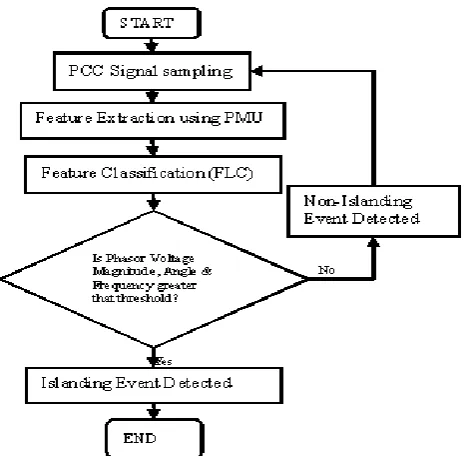
Where is the noise in the signal, is the amplitude of the voltage, is the dc amplitude decay, the phase of the measured signal, the radian frequency of the signal and is the sampling time. The PMU data variations are measured at the PCC during normal and islanding conditions in the process of islanding detection. The extracted signals are then subjected to FL algorithm for classification. Islanding is detected when phasor voltage, frequency and phase angle measurements exceed the set safe limit. IEEE 9-bus was modified to include RESs in the network by replacing the conventional generators with equivalent capacity wind and solar farms as shown in figure 4 below. The system contains 3 generators, 9 buses and 3 loads. The system is grid connected at the PCC. PV and wind generation RESs are connected at bus number 1 and 3.
Figure 4: Modified 9-bus test system
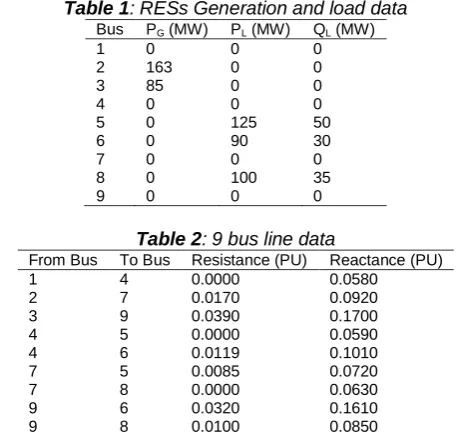
The corresponding generation, load and line data is shown in table 1 and 2.
Table 1: RESs Generation and load data Bus PG (MW) PL (MW) QL (MW)
1 0 0 0
2 163 0 0
3 85 0 0
4 0 0 0
5 0 125 50
6 0 90 30
7 0 0 0
8 0 100 35
9 0 0 0
Table 2: 9 bus line data
From Bus To Bus Resistance (PU) Reactance (PU)
1 4 0.0000 0.0580
2 7 0.0170 0.0920
3 9 0.0390 0.1700
4 5 0.0000 0.0590
4 6 0.0119 0.1010
7 5 0.0085 0.0720
7 8 0.0000 0.0630
9 6 0.0320 0.1610
9 8 0.0100 0.0850
There are three equal loads LA, LB and LC all are rated at
125MW, 90MW and 100MW. An islanding condition was simulated by disconnecting the mains and observations made. The phase currents and voltages were measured and extracted using PMU located at the PCC. The extracted signal was then subjected to FL algorithm to classify whether the system is islanded or not. This is demonstrated by the figures in the following sub-sections. The PMU-FL arrangement was modelled as shown in figure 5 below.
Figure 5: PMU-FL arrangement
Figure 6: Proposed Islanding Detection flowchart
4 SIMULATION RESULTS AND DISCUSSIONS
The PCC voltage and current measurements before and after islanding condition were observed as shown in figure 7 and 8 below.
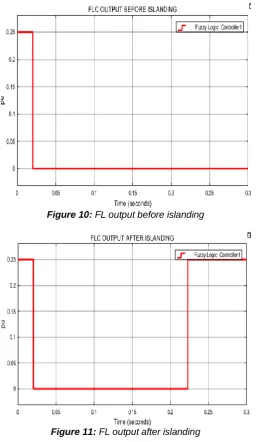
When there is loss of mains and an island is formed, the phasor voltage magnitude, phase angle and frequency at DG side changes significantly. If these variations exceed the set threshold, an islanding condition is detected. The
phasor voltage magnitude, angle and frequency for both normal an islanding condition was measured at the PCC. This is shown in figure 9-11 below.
Figure 7: Phasor voltage magnitude
Figure 8: Phasor Voltage Angle
Figure 9: Phasor Voltage Frequency
Figure 10: FL output before islanding
Figure 11: FL output after islanding
The above results show that this approach can accurately distinguish between islanding and non-islanding scenarios.
5 CONCLUSION
In this paper, a PMU-FL based local islanding detection approach is proposed and tested under different contingencies and different penetration levels. The results indicate that a combination of PMU and FL can successfully be used to extract and classify signals locally to quickly signify the loss of mains and islanding occurrence. The proposed approach is robust enough to detect islanding events rapidly with high level of accuracy and can avoid unnecessary DG outage for any fault event within the MG as the signals are extracted at the PCC and classified locally. It can therefore be concluded that given the actual parameters of any given grid with RESs LOMs and islanding can be quickly detected locally using this approach and hence avoid associated catastrophes and losses.
REFERENCES
[1]. M. R. Rohikaa, S. Ashok and R. Sunitha, "A combined islanding detection algorithm for grid connected multiple microgrids for enhanced microgrid utilization," International Transactions on Electrical Energy System: John Wiley & Sons, Ltd., pp. 1-22, 2019.
[2]. IEEE Standard for Interconnecting Distributed Resources into ElectricPower Systems, IEEE Standard 1547TM, Jun 2003.
[3]. M. R. Rohikaa, R. Lakshmi, R. Sunitha and S. Ashok, "Assessment of Voltage Stability in Microgrid," International Conference on Electrical, Electronics, and Optimization Techniques (ICEEOT), pp. 1268-1273, 2016.
[4]. M. Pritwish, P. Sunil, A. Rajkumar, C. Srinivas, G. Somesh, K. Chandan and J. Ayush, "Islanding Detection of Interconnected Grids based on Synchrophasor Measurements (PMU)," in 2014 6th IEEE Power India International Conference (PIICON), Delhi, Dec 2014.
[5]. Z. Yuchen, L. Furong, C. Xianbing and L. Wei, "A Test Device for Optimize PMU-Based Islanding Detection Technology," Intional Journal of Thermal & Environmental Engineering, vol. 10, no. 2, pp. 129-134, 2015.
[6]. M. Almas and L. Vanfretti, "RT-HIL Implementation of the Hybrid Synchrophasor and GOOSE-Based
Passive Islanding Schemes," IEEE
TRANSACTIONS ON POWER DELIVERY, vol. 31, no. 3, pp. 1299-1308, June 2016.
[7]. X. A. Liu, D. Laverty and R. Best, "Islanding detection based on probabilistic PCA with missing values in PMU data," 2014 IEEE PES General Meeting / Conference & Exposition, pp. 1-6, 2014. [8]. L. Sun, Z. Wu and K. Yang, "Application of
Islanding Detection and Classification of Power Quality Disturbance in Hybrid Energy System," in Asia Conference on Energy and Environment Engineering (ACEEE 18), Beijing, China, 2018. [9]. G. Yuanjun, L. Kang and D. M. Laverty, "A
statistical process control approach for automatic anti-islanding detection using synchrophasors," 2013 IEEE Power & Energy Society General, pp. 1-5, 2013.
[10].P. Mukhopadhyay, "Islanding detection of interconnected grids based on synchrophasor measurements (PMU)," in 2014 6th IEEE Power India International Conference (PTICON), Delhi, 2014.
[11].D. M. Laverty, R. J. Best and D. J. Morrow, "Loss-ofmains of protection system by application of phasor measurement unit technology with experimentally assessed threshold settings," IET Generation, Transmission and Distribution, vol. 9, no. 2, pp. 146-153, 2015.
[12].G. A. Ahmed, B. A. Ahmed and A.-Q. Abdel-Rahman, "Comparative Study of Passive and Active Islanding Detection Methods for PV Grid-Connected Systems," mdpi journal of sustainability, doi:10.3390/su10061798, vol. 10, pp. 1-15, 2018. [13].S. Raza, H. Mokhlis, H. Arof, J. Laghari and L.
for islanding detection of distributed generation in distribution network: A review," Energy Conversion Management, vol. 96, pp. 613-624, 2015.
[14]. G. Bayrak and E. Kabalci, "Implementation of a new remote islanding detection method for wind– solar hybrid power plants," Renewable Sustainable Energy Review, vol. 58, pp. 1-15, 2016.
[15]. G. Bayrak, "A remote islanding detection and control strategy for photovoltaic based distributed generation systems," Energy Conversion Management, vol. 96, pp. 228-241, 2015.
[16]. L. O. Mogaka, D. K. Murage and M. J. Saulo, "Rotating Machine Based DG Islanding Detection Analysis Using Wavelet Transform," International Journal of Energy and Power Engineering, vol. 4, no. 5, pp. 257-267, 2015.
[17]. D. L. Himanshu and B. S. Jaydipsinh, "Matlab based Simulink Model of Phasor Measurement Unit and Optimal Placement Strategy for PMU Placement," International Journal for Scientific Research & Development, vol. 2, no. 3, pp. 135-138, 2014.
[18]. K. Dhruba and S. B. Partha, "Wide Area Islanding Detection using Phasor Measurement Unit," in 2017 11th International Conference on Intelligent Systems and Control (ISCQ), West Bengal, India., 2017.
[19]. D. Kumar, D. Ghosh and D. K. Mohanta, "Simulation of phasor measurement unit (PMU) in MATLAB," in 2015 International ConFerence on
Signal Processing and Communication