ACADEMIC PERFORMANCE AT THE POSTGRADUATE LEVEL IN THE UK: COMPARISON BETWEEN HOME, EU AND OVERSEAS STUDENTS AT THE UWE
Husam Sadig1, Ahmed Banany2 1
University of Essex, UK 2
University of The West of England, UK
Abstract
This paper analyses data from an online survey that was conducted on postgraduate students at the Faculty of Computing, Engineering and Mathematical Sciences (CEMS) at the University of the West of England (UWE), in Bristol. It explores differences in education outcome between home, EU and overseas postgraduate students by investigating factors affecting their academic performance. Overall, the findings indicate that home students perform better in both coursework and exams than their EU and overseas counterparts. Additionally, gender, weekly studying hours and relevant academic background are all found to be good predictors of the academic performance (as measured by the Assessment Grade Level) across the three student categories.
Key words: UK Home students, European students, Overseas students, Assessment Grade Level
1. INTRODUCTION
The phenomenon of overseas and European students in British universities is not new. Students come to Britain from various parts of the world to obtain a university degree for different purposes. This benefits both students and universities. On the student’s part, benefits range from the scholarship opportunities that are offered in the UK to the good reputation of British universities, which increases the chance of securing a good job in the future. From the universities’ perspective, international students form one of the major financial resources for universities in the UK, especially with the recent reductions in government funding.
However, the different cultural backgrounds of students in British universities are expected to have an impact on the students’ educational outcomes. Studies have shown differences in terms of academic performance between international (overseas or European) and home students as far back as 1991 (Barker et al, 1991), which have been attributed to different factors. Researchers often argue that international students encounter two fundamental problems in their educational pursuit: insufficient proficiency in the English language, and issues regarding new styles of learning (Haq, 2005; Hinkel, 1999; Hubbard, 1990). Thus, early research focused on proficiency in English as the main factor affecting academic performance. For example, despite the English courses that students take before being admitted to a university course, Hubbard (1990) showed that English language is one of the major factors that affect the performance of the overseas students; in particular, those who are studying a technical subject such as statistics. Denham and Oner (1993), however, suggested that the differences between overseas students’ performance in tertiary studies were not related to English language difficulties.
Nonetheless, recently, there have been increasing evidences in the UK (and other English speaking countries) showing that differences in academic performance can be associated with other factors such as ethnicity, gender and previous academic ability. For example, Woolf et al (2011) conducted a study to investigate differences in the academic performance amongst various ethnic groups across medical schools in the UK, in different examinations. They found that students from non-white ethnic groups underperformed compared to their white counterparts. Also, aiming to examine gender differences in performance at final medical examinations, McDonough et al (2000) conducted a study on undergraduate students in Ireland. Overall, they found that female students perform better than their male counterparts. Ferguson et al (2002) found previous academic performance to be a good predictor
(but a weak one) of current academic performance in medical schools, when they conducted a study to investigate factors associated with success in medical school in the UK.
However, most of the studies in this area were conducted on undergraduate students. To date, we know little about the differences in academic performance at the postgraduate level. Furthermore, the majority of these studies are conducted outside the UK. Moreover, even the studies that were conducted on UK postgraduate students did not show the association between academic performance and students’ characteristics for different categories of students (home, European and overseas) separately. Rather, they assumed a single cultural background for all students. Thus they ignore an important aspect of the structure of postgraduate study in the UK universities. The gap in academic achievement among students may be associated with differences in demographic characteristics and cognitive skills, but it can also be due to dissimilarities in cultural backgrounds.
In this study, a survey was conducted to investigate factors that influence the academic performance at the postgraduate level. The investigation is based on comparing three categories of students (home, EU and overseas). The survey was conducted on the postgraduate students in the academic year 2008-2009 at the Faculty of Computing, Engineering and Mathematical Sciences (CEMS), currently known as Bristol Institute of Technology (BIT) at the University of the West of England, Bristol, in the UK.
2. METHODS 2.1 Survey
The aim of the survey was to use coursework and exam marks as measures of academic performance. Thus, it targeted full-time and part-time students who were enrolled on any of the taught MSc programmes at CEMS (the target population). Consequently, Ph.D. and M.Phil. Students were not eligible for this survey, as the coursework and exam type of assessment are not relevant to these programmes. The data were obtained through an online questionnaire,1 and there were 612 eligible students. A total of 187 students responded to the survey, giving a response rate of 30.56%. 40.11% of the sample members were males while 59.89% were females. Home students represented 31.56% of the sample, whilst 26.74% of the sample consisted of students from European countries, and the rest were overseas students. The age of the sample members ranged from 23 to 58 years.
Although the sample for this study was not selected through a probability sample design, it appeared to be a reasonable representation of various sub-groups (by sex, age, student’s category, etc.) in the target population. Thus, it permits the type of comparative analysis necessary to achieve the objective of this study.
2.2 Analysis
Aside from the usual factors – such as sex, age, academic background and number of hours spent studying outside the class – that are known to affect academic performance, the questionnaire included items intended to obtain detailed information on the coursework and exam marks for each module in the study programme. The averages of coursework marks and exam marks were used as two measurements of the academic performance. The overall academic performance was measured by the Assessment Grade Level (AGL) which was calculated as the mean value of the average coursework mark and the average exam mark. Additionally, each student in the sample was asked to indicate their ‘student’s category’ – as a home, EU or overseas student. This information permitted the investigation of differences in academic performance between home, EU and overseas students using their average coursework and exam marks separately and jointly by using the AGL.
Accordingly, two different types of analysis were conducted:
1
The questionnaire consisted of a variety of questions that were designed to obtain three categories of variables. These were: demographic characteristics (e.g. sex, age & marital status), professional profile (e.g. work experience & academic background) and effort put in towards academic achievement (e.g. number of weekly hours spent studying outside the classroom).
Page 644
First, varying the assessment method by coursework and exam, and the student’s category by home, EU and overseas, this provides two factors: assessment method with two levels and student category with three levels. Each factor may have a separate effect on the mark that a student can obtain. Moreover, the two factors may interact to affect the obtained mark. Therefore, a factorial design (two factors 2x3) was conducted to investigate the main effects of assessment method and student category, as well as their interaction effect on the assessment mark that is obtained by students. This analysis was carried out using SPSS version 14.
Second, academic performance can be strongly related to other student characteristics, such as sex, age and relevant academic background. As a result, these factors may affect the relationship between student category and academic performance. Thus, to account for other factors affecting the academic performance, a general linear model was estimated to model the assessment grade level. However, the relationship between student characteristics and academic performance may vary across the three categories of students due to the different cultural backgrounds. Thus, the AGL was modelled for home, EU and overseas students separately. These models were estimated using the natural logarithm of the dependent variable. This analysis was implemented in STATA version 11.
3. RESULTS
Table 1 shows the result of the analysis of variance examining the main effects of the two factors (assessment method and student category). It also gives the result of the effect due to the interaction between the two factors.
The results show that there is no main effect (p>0.10) due to assessment methods. Meanwhile, there is a significant main effect (p<0.01) due to student category. These results indicate that varying assessment method between coursework and exam does not have an effect on the mark that students obtain as a result of the assessment. Additionally, although assessment method as a factor on its own does not appear significant, its interaction with student category is significant (p<0.01). This result suggests that varying assessment method between coursework and exam, and having three different categories of students at the same time, affects the marks that are achieved in the assessment.
Source of variation Degrees of Freedom Mean Square
Assessment Method Student Category
Assessment Method* Student Category
1 2 2
7.717 89.154*** 118.187***
Note: The dependent variable is the mark obtained in the assessment. * p< 0.10,
** p< 0.05, *** p< 0.01.
Table 1. Factorial Design: test of between-subjects effects
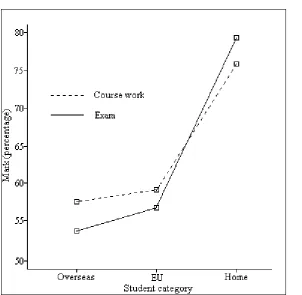
Figure 1 demonstrates graphically the difference in the mark obtained in coursework and exam for home, EU and overseas students. In general, the graph depicts a big difference between home students and the other categories (EU and overseas) in terms of the mark obtained, in both coursework and exams. In the same context, a small difference between EU and overseas students is shown. Focusing on the differences with regard to assessment method, both EU and overseas students show higher marks in coursework than in exams. In contrast, home students show a better performance in the exams than in coursework, based on the mark obtained. This confirms the results from the analysis of variance in table 1, suggesting an interaction effect between the assessment method and student category on the assessment mark.
Figure 1. Differences in course work and exam marks among home, EU and overseas students
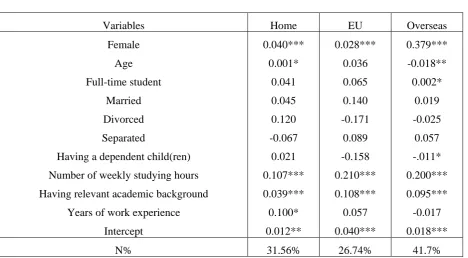
Table 2 gives the results for a general linear model, of the AGL for home, EU and overseas students separately. Overall, although some variables did not appear significant (e.g. marital status), the model captures significant relationships between AGL and most of the variables in the analysis. For example, female students have higher AGL compared to their male counterparts (𝑏�1 = 0.040, p< 0.01; 𝑏�2= 0.028, p< 0.01; 𝑏�3 = 0.279, p< 0.01). Additionally, an increase in the weekly numbers of hours spent studying outside the class significantly increases AGL (𝑏�1 = 0.107, p< 0.01; 𝑏�2= 0.210, p< 0.01; 𝑏�3 = 0.200, p< 0.01). Also, having a relevant academic background is associated with high AGL (𝑏�1 = 0.039, p< 0.01; 𝑏�2= 0.108, p< 0.01; 𝑏�3 = 0.095, p< 0.01). These results are in line with most findings in the literature on factors affecting academic performance (e.g. McDonough et al, 2000; Ferguson et al, 2002).
However, turning to differences between home, EU and overseas students, table 2 shows that the significance of several variables, and their direction in predicting AGL, differs across the three categories of students. For example, for home students, an increase in age is associated with higher AGLs (𝑏�1 = 0.001, p< 0.10); meanwhile, it is associated with lower AGLs for overseas students (𝑏�3 = -0.018, p< 0.05), and it does not have an effect on AGLs of EU students (𝑏�2 = -0.036, p> 0.10). Also, the mode of study only affects overseas students, since full-time overseas students score higher AGLs than their part-time overseas counterparts (𝑏�3 = 0.002, p< 0.10). As for having a dependent child, this does not seem to affect the performance of home or EU students (𝑏�1 = 0.021, p> 0.10; 𝑏�2 = -0.158, p>0.10); but it negatively affects the performance of overseas students (𝑏�3 = -0.011, p< 0.10). Finally, the number of years of work experience is associated with high AGLs only for home students (𝑏�1 = 0.100, p< 0.10); meanwhile, work experience does not appear to affect the performance of EU or overseas students (𝑏�2 = 0.057, p> 0.10; 𝑏�3 = -0.017, p> 0.10). These results support the hypothesis that the factors known to affect academic performance can be different in their effect, in terms of both level and direction, across home, EU and overseas students.
Variables Home EU Overseas Female Age Full-time student Married Divorced Separated
Having a dependent child(ren) Number of weekly studying hours Having relevant academic background
Years of work experience Intercept 0.040*** 0.001* 0.041 0.045 0.120 -0.067 0.021 0.107*** 0.039*** 0.100* 0.012** 0.028*** 0.036 0.065 0.140 -0.171 0.089 -0.158 0.210*** 0.108*** 0.057 0.040*** 0.379*** -0.018** 0.002* 0.019 -0.025 0.057 -.011* 0.200*** 0.095*** -0.017 0.018***
N% 31.56% 26.74% 41.7%
Note: The dependent variable in the model is transformed to the natural logarithm. The reference categories of the categorical independent variables in the model are: male, part-time student, never married, having no dependent child, having no relevant academic background respectively. * p< 0.10,
* p< 0.05, *** p< 0.01.
Table 2. General linear model of the Assessment Grade Level (overall academic performance)
4. DISCUSSION
This study investigates differences in education outcomes at a postgraduate level across home, EU and overseas students at the Faculty of Computing, Engineering and Mathematical Sciences (CEMS) at the University of the West of England, Bristol, in the UK.
Overall, although home students perform better than their EU and overseas counterparts in the two types of assessment, the analysis showed that, on average, home students perform better in exams than in coursework. Conversely, EU and overseas students obtain higher marks in coursework than in exams. This may be due to other factors, such as availability of time over the coursework period, during which students can make use of materials, proof reading and tutors’ feedback before submitting the coursework. However, it is more likely that EU and overseas students will make better use of these opportunities during the coursework period to produce better results and compensate for the drawback that is caused by the language barrier. Nonetheless, in exams, the other factors are eliminated, and therefore results will only depend on knowledge of the subject and the familiarity with the assessment style (e.g. fluency in English, being used to exam pressure, etc.). Thus, this explains the dissimilarity in performance in coursework and exams between home, EU and overseas students.
All categories of students seem to be affected by gender, number of weekly hours spent studying outside the class, and having a relevant academic background. In general, for gender this is a plausible result, since increasing research is showing that in most parts of the world females are becoming dominant in higher education, both in terms of numbers and performance. As for the number of weekly hours spent studying outside the class and having a relevant academic background, this is a logical result, as any academic achievement is theoretically linked to the amount of effort that has been put into it. Thus, these three factors would have similar types of effect (in terms of direction) on the performance of any student, regardless of their cultural background.
Additionally, there are other factors that influence the academic performance of home, EU and overseas students. However, these factors affect the three categories of students differently. Age is one
of the most interesting factors. While older home students achieve higher marks in assessments, being older appears to be a drawback for overseas students. This is because being a mature student in the UK may be associated with other factors affecting academic performance, such as gaining experience in the field of practice and attending other relevant courses before enrolling on a postgraduate degree programme. This may not necessarily be the case for overseas students. In fact, if an overseas student has already gained the required skills in a field of practice by attending many courses (which would imply that they were older than most students), they might not want to come to the UK to pursue an expensive study programme that may only add little to their existing knowledge. Thus, most of the older overseas postgraduate students are those who have spent a long period of time after completing their B.Sc. without being involved in any academic activity, and therefore need to take part in a postgraduate study programme. This argument then supports the finding that younger overseas students have better academic performance than their older overseas counterparts, as the amount of time between completing their B.Sc. and starting a programme of M.Sc. is short.
Unlike overseas students, the mode of study (full-time or part-time) does not affect the performance of home and EU students in a postgraduate study programme. This could be linked to reasons behind pursuing a full-time or part-time mode of study. For example, home and EU students may choose to enroll as part-time students because they look after an elderly family member. In contrast, overseas students are often able to come to the UK if they are free from similar constraints. In most cases, overseas students may choose a part-time mode of study to be able to work and financially support themselves. However, having a job, especially if it is irrelevant to their study programme, can be a distracting factor for those who work amongst overseas students. Thus, full-time overseas students perform better in the study programme than part-time overseas students, since they are less likely to be distracted by work.
Finally, having a dependent child may negatively affect academic performance, but, based on analysis here, this is only true for overseas students. This may be, but not necessarily, due to the absence of relatives, who usually contribute hugely to childcare. Thus, this may result in more time dedication to childcare, and as a result less time will be dedicated to studying.
REFERENCES
Barker, M, Child, C, Gallois, C, Jones, E, & Callan, V 1991,‘Difficulties of overseas students in social and academic situations’, The Australian Journal of Psychology, vol. 43, no. 2, pp. 79-84, viewed 21 March 2008,
<http://www.informaworld.com/smpp/content~content=a782600736~db=all~order=page>.
Denham, P & Oner, J 1993, Hopes and Realities: Overseas Students' Perceptions of Performance in Award Courses, Faculty of education, University of Canberra, Canberra.
Ferguson, E, James, D, & Madeley, L 2002‘Factors associated with success in medical school: systematic review of the literature’, BMJ, vol. 10, pp. 324-952, viewed 24 September
2011,<http://www.bmj.com/content/324/7343/952.full?ijkey=e507272262d3985a4fbf3f9f8fcf0a8d8b3 88f5b&keytype2=tf_ipsecsha>.
Haq, I, Higham, J, Morris, R & Dacre, J 2005, ‘Effect of ethnicity and gender on performance in undergraduate medical examinations’, Med Educ,vol. 39, no. 8, pp. 1126.
Hinkel, E 1999, Culture in Second Language Teaching and Learning, Cambridge University Press, Cambridge.
Hubbard, R 1990, Teaching Statistics to Students who are Learning in a Foreign Language, Australia, Brisbane.
McDonough, W, Horgan, J & Casey, H 2000, ‘Gender Differences in the Result of the Final Medical Examination at University College Dublin’, Medical Education, vol. 34, no. 1, pp. 30-34.
Woolf, K, Potts, H, & McManus, I 2011 ‘Ethnicity and academic performance in UK trained doctors and medical students: systematic review and meta-analysis’, BMJ, 342:d901, viewed 23 September 2011,<http://www.bmj.com/content/342/bmj.d901.full>.