UNDERGRADUATES' PERCEPTION OF THE RELATION BETWEEN URBANIZATION AND ENVIRONMENT
Caner Aladağ, Baştürk Kaya
Necmettin Erbakan University, Educational Faculty, Konya, Turkey
Abstract
The aim of this study is to determine how traniee teachers associate urbanization and environment and what direction their perception of this issue is at. The data of the study has been obtained from unattached word association test performed on 103 traniee teachers, mostly composed of the ones studying at Geography Teaching, studying at Necmettin Erbakan University Ahmet Keleşoğlu Faculty of Education in academic year of 2014-15. The data obtained has been categorized by their semantic relation by the researcher, who sorted out. Their frequincies and percentage has been calculated as regards to the categories. Examining the categories, it can be seen that urbanization contributes to environment positively more than negatively in undergraduates' opinion. Besides, it can also be observed that some of the undergraduates opined about urban and environmental features by evaluating urbanization and environment one by one.
Key words: urbanization, environment, undergraduates perception
1. INTRODUCTION
According to a common assessment, urban is a settlement which a society composed of various social classes maintains its life in an environment where they make artificial environment sovereign to natural environment in accordance with urban life rules (Zengin, 2003). Urban, containing most developed and complex complement of aims which human beings and societies could trail, is also totally a process. Urban is also accumulation of culture because of the varying needs and aims of periods of time in which it evolved the particular attitude to be adopted towards historical and cultural heritance and also a complement of behaviour taking form by contacting to each other in time as well as being the integrity of elements pieced together (Koçak 2011). Urbans are the settlements where interaction between humans and environment can be observed the most intensively and actively. Within this framework, urbans are pretty important and primary locations for studies towards how human and environment relations are perceived and how they are stated by people, within behavioural geography approach (Karadağ & Turut, 2013).
According to a common assessment, environment can be described as the sum of physical, chemical, biological and social factors to directly or indirectly have an sudden or long term impact on human activities and living beings in a certain time (Keleş et al., 2009). Briefly, we can describe locations where living and nonliving creatures exist together, influence each other and are influenced by each other as environment (Megep, 2006). Environment is the physical, biological, social, economic and cultural setting where human beings and other living creatures maintain their relations during their whole lives and interact to each other. It is everything that meets our eyes in words of one syllable. It is the habitat where we live, the nature around us, and even our future. Splits on the rings of chain constituting the natural balance influence the whole chain and cause the upset of the balance. Human is the main factor of upsetting the balance, since each behaviour and innovation towards maintaining human beings' lives and utilizing affect the natural balance (ormansu.gov.tr).
Human existance and human activity underlie environmental issues. Rapidly increasing world population is one of the major factors underlying environmental issues. Many significiant issues have occured as a result of the fact that human beings have excessively exploited natural resources and that's why they have upsetted natural balance (Çepel, & Ergün, 2012). While environmental issues such as destruction of ozone layer or global warming are thought to be on global level, air, soil and water pollution occur as regional issues, and wastes occur as local issues. Environmental issues have increased with situations such as urbanization, industrialization, population growth and technology.
Environmental issues possibly existed before, but both urbanization, and isdustrialization and rapidly growing technology have undertaken the function of converting the pressure, deterioration and loses on the environment into an issue, and have driven a wedge between today's society and the nature by negatively influencing the balance between human beings and environment (Keleş, et al. 2009). It can be seen in almost every publications about environment that urbanization is ranked among the top among the elements leading pollution. It appears that irregular urbanization underlies the base of the issues more than urbanization itself. Air and water pollution, traffic jam, infringement of pedestrian rights, narrowing of building offices and homes the green and open fields to the utmost, getting damaged of farming fields, natural and historical values are the direct results of urbanization. On the other hand, it isn't disregarded that we face a chronical aesthetic pollution finding meaning reproducing skyscrapers and longing for turning green fields into concretion (Tokuçoğlu, 1993).
Urbanization is a complex notion having sociocultural, economic and administrative dimensions. Today, environmental issues have begun to reach more dangerous extent day by day particularly for the urban and the ones who live there with the impact of technological improvements and industrialization (Nacar & Sağır, 2008). The beginnig of urbanization is generally regarded as the beginning of civilization, too. People coming from countryside started to miserably settle around urbans in health conditions by no stretch of the imagination. By this way, urbanization made the notions “dirt” and “ugliness” gained new meanings (Es & Ateş, 2004). Urbanization is one of the most important characteristics of development and modernization. It is generally believed that urbanization is a result of industrialization (Ahmed & Islam, 2014). For the first time in human history, half the world’s population is now classified as living in urban areas, which are also responsible for the generation of an increasing proportion of gross geographical product in most countries. By the early 1990s, air quality was poorest and pollution highest in fast-growing metropolises like Shanghai, Jakarta, Bangkok, São Paulo and Mexico City, whereas traditional industrial centres in Western Europe, the USA and Japan were being cleaned up after their shift into business, producer and leisure services (Simon 1995). In the latter half of the twentieth century, megacities have been on the rise and future projections for the twenty-first centuryshow an increase in population growth in developing countries urban centers, with potential catastrophic effects at the international level (Brennan, 1999). Today, the world countries suffer many issues related to urbanization. There are much more issues occuring in every country which hasn't finalised its economic growth or have newly developing economy. The more the population of cities increase, the more their issues occur. Lack of substructure, squatting, environment and air pollution, drinking and domestic water troubles, traffic, noise, safety disorder and lack of planning are the main ones (Soylu, 2009). Coinciding with use of earth, urbanization shows that the importance of urban services have gained importance and it's got harder with the impact of immigration from rural area to urban as well as natural population growth. The urban service request of aforomentioned population, mainly homes, requires building lands to make suitable for housing, in other words, to convert farming land into building lands (Mutlu, 2007). Human settlement conditions in many parts of the world, particularly the developing countries, are deteriorating. natural hazards now occur right at our door steps and the frequency of occurrence and magnitude of damages that they cause is seen to be on an increase especially in poor urban communities. The natural environment is deteriorating at a rate faster than the rate at which natural occurring processes and resources available within the environment can replenish (Nyambod, 2010). Environmental security is an offshoot of the principle of sustainable development which focuses on societal and global environmental sustainability and peace in the face of uncontrolled environmental degradations that are witnessed in different parts of the world. The urbanization tendency of different parts of the world mostly in developing economy countries sometimes has negative implications on its environmental security. The environmental security and sustainability of urban in most developing economy countries have been affected by inadequate planning, weak projections and insufficient funds. These subject urban societies in the face of continuous urbanization to myriad of problems and hazards that impinge on their growing populations (Akiyode, 2013).
Human beings, who had irresponsibly utilized from natural sources for centuries have begun to realize they had been cutting their own throat in recent centuries. Many significiant issues have occured as a result of people's overconsumption the natural resources and thus, upsetting the natural balance. The
upset of ecological balance expose all living beings on earth to various issues. Human existance and human activities underlie environmental issues and rapidly increasing world population is one of the main reasons underlying environmental issues.
2. PURPOSE
This study has been performed with the purpose of determening what kind of intel the traniee teachers had about relationship between urban and environment and revealing if they had any misconceptions about this issue. If they have had any misconceptions, it's been thought to contribute to correct this situation. Besides, it also has the purpose of determining the extent of knowledge the traniee teachers have acquired during their education highly about environment and partially about urbanization and the deficiency, if there is, and revealing what kind of studies are needed accordingly.
3. MATERIAL AND METHOD 3.1 Research Model
Word association test has been utilized in this study. Word association test (WAT) is a method designed to reveal the relations people have created between notions. It's a method used with the aim of analysing undergraduates' cognitive structure and notional connections among this structure, in other words the knowledge network, and determining if the relation among notions in long term memory are sufficient or meaningful. Researchers have tended towards methods evaluating not only the knowledge the undergraduates have, but also the relation between various knowledge and notions, if they could provide meaningful learning by combining the new knowledge with existing knowledge, to what extent they understand the similarity among operation of events in real and natural word (Bahar, et al. 2006). Word association test has also features encouraging creative thinking more than closed ended questions.
3.2. Working Group
Working group is consisted of undergraduates studying at Necmettin Erbakan University Ahmet Keleşoğlu Faculty of Education Department of Geography Teaching. WAT has been practised on a total of 103 undergraduates. The common point of the undergraduates on whom the test has been practised is that they have all been selected from classes who studied Environment Knowledge and Urban Geography.
3.3 Data acquisition and Data Analysis
First, the test was introduced to undergraduates and their comprehension was provided with the help of narration. On the next stage, the undergraduates were asked to write down 10 notions about urbanization and environment by giving them 30 seconds. They were asked to write down one meaningful sentence for each statements they had written. What was expected of making sentences was to clear out what they had exactly meant with the notions they had written. While some of the undergraduates weren't able to write down 10 notions in time, most of them were able to complete. The total of written notions were calculated as 945, and the ones semantically similar to each other although expressed by undergraduates in different ways were tried to be classified in same category by the researchers. As a result of this classification, 5 different categories have occured. Later on, the data has been analysed and frequency distributions have been found and their percentange value has been calculated.
4. FINDINGS
The findings obtained following evaluating the data are as follows:
Table 1. Positive opinions about relation between urbanization and environment (f and %).
Notions Frequency %
Environmental consciousness, environmental planning, green fields, sport facilities, afforestation
88
Ministry of environment and urbanization, urbanization, urban transformation 46
Increase in municipal services and making them regular, substructure services, clean environment
22 17.7
Divided roads, big avenues and pavements 10
Carrying out recycling, control of waste water 2
Total 168
Examining the notions classified under this category, it can be observed that the opinion the undergraduates mostly pointed out is that environment monitoring, sports facilities and planting works occured due to urbanization. And the statements such as urban transformation towards environment embellishment and using land more productively and ministry of environment and urbanization have been expressed in high level. Increase in municipal services, efforts of using environment in a tidier and cleaner way and tidiness of substructure services occur as another nominal opinion. Another conspicuous opinion is that the undergraduates regard divided roads and big avenues as positive contribution. The number of undergraduates mentioning waste water and recycling services is rather low.
Table 2. Negative opinions about relation between urbanization and environment (f and %)
Notions Frequency %
Upset in ecosystem, environmental unconsciousness and badly use of natural resources
108
Air pollution, noise pollution, water pollution, greenhouse gases and global warming
97
Environmental pollution, urban wast, increase in substances such as garbage and sewage damaging environment
66
Irregular urbanization, squatting 59
Concretion, high rise buildings, vertical growing, artificial environment 35 46.6
Occuring new needs, generating new settlement areas 28
Transportation, health, education, housing and substructure issues 22
Industrial waste, industry located in city centre, harms of factory 13
Water issue decrease in the level of drinking water and ground water, drought 12
Nuclear damage 1
Total 441
The fact that the category under which negativeness have been classified is much more than others stands out. The abundance of the number of undergraduates who pointed out unconscious environment use, overconsumption of natural resources and upsetting ecosystem attract attention. It can also be seen
that the number of undergraduates who mentioned water and soil pollution which mainly occur as a result urbanization and overpollution of atmosphere is relatively high. Among the opinions mentioned, polluting environment with wastes and sewage have a significiant rank. Many undergraduates mentioned about irregular urbanization and some results caused by them. Issues encountered in transportation, industry located in city centre, nuclear wastes and overconsumption of water are also among the notions associated with urbanization.
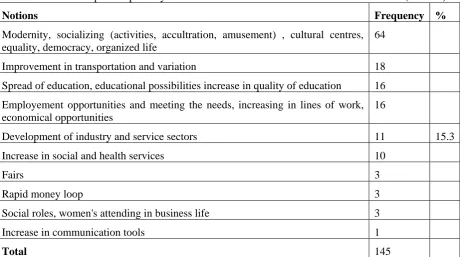
Table 3. Positive opinions partially unrelated with urbanization and environment relation (f and %)
Notions Frequency %
Modernity, socializing (activities, accultration, amusement) , cultural centres, equality, democracy, organized life
64
Improvement in transportation and variation 18
Spread of education, educational possibilities increase in quality of education 16
Employement opportunities and meeting the needs, increasing in lines of work, economical opportunities
16
Development of industry and service sectors 11 15.3
Increase in social and health services 10
Fairs 3
Rapid money loop 3
Social roles, women's attending in business life 3
Increase in communication tools 1
Total 145
Examining this category, it can be seen that the undergraduates have mentioned about statements expressing only urbanization rather than urbanization and environment relations in their evaluations. Modernity, socializing, various urban activities referring urbanization have been expressed by many undergraduates. Development in transportation, improvement in health conditions, sufficient educational opportunities, new employement possibilities and convenience in supplying the needs have been evaluated as opportunities urban life provides for people by undergraduates. In addition to those opinions, for undergraduates' perception, improvements in industrial and service sectors, fairs, women's attending in business life and developments in communication reveal as positive contributions urban life comes up.
Table 4. Positive opinions partially unrelated with urbanization and environment relation (f and %)
Notions Frequency %
Nonconcurrence, cultural issues, stress and health problems, decrease in human values,
48
Rapid population growth, population density, immigration and decrease in rural population as a resut
34
Traffic issues, parking problems, abundant vehicles 29
Shopping malls and luxury consumption, imbalance between consumption and production, waste
20
Economic imbalance, financial difficulty, unemployement (rich and poor) 16 18.5
Theft, crime, safety disorder, increase in problems such as bribery 12
Relationships based on self-interest, selfishness 9
Irregular settlement 3
Deterioration of administrative structure 1
Total 175
The opinions in this category also deal with negative terms related to urban life rather than urbanization and environment relation. Among the negative terms urban life provides to people, the mostly mentioned ones are nonconcurrence, health problems, rapid growth in population, excessive immigration, traffic. Overconsumption, wastage, imbalance between consumption and production, hard life conditions also have high rank. There are increase in crime rates, safety disorder, the fact that relationship based on self-interest has gained importance and deterioration of administrative structure among negative terms related to urban life.
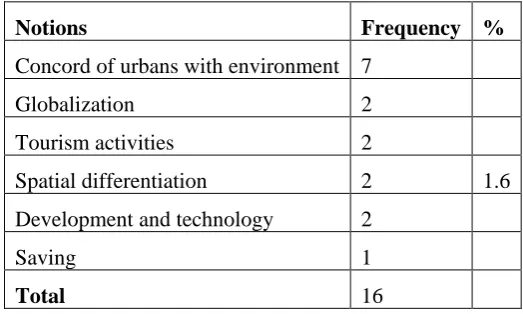
Table 5. Positive opinions related to urbanization rather than urbanization and environment relation (f and %)
Notions Frequency %
Concord of urbans with environment 7
Globalization 2
Tourism activities 2
Spatial differentiation 2 1.6
Development and technology 2
Saving 1
Total 16
Examining Table 5, it can be observed that the undergraduates mentioned of positive contributes brought by urbanization. It can be seen that they expressed statements such as concord of urbans with environment, globalization, spatial differentiation around cities. The fact that cities have potential of tourism and are regarded as symbol of development are also among the opinions expressed by the undergraduates.
5. CONCLUSION AND DISCUSSION
Examining the findings obtained from the research, it attracts attention that in undergraduates' perception, urbanization's impact on environment has negative qualification more than positive. It attracts attention that some features such as unconscious use of environment, overconsumption of natural resources, generating a consumption society with the effect of urbanization have been extremely pointed out. Besides, pollution as a result of urbanization (such as air, water, soil etc) have been mentioned very much. Negative impacts have a percentage of almost 50 per cent and we can conclude from this that in undergraduates' opinion, urbanization impair the environment to a great extent. Wastes throwen to environment, damage of green fields and nature, unplanned buildings are among the observations of undergraduates related to damage of environment. Vertical growing in cities, get
unearned income by allowing settlement on green fields and farming fields also occur as negative evaluations. The fact that factories are located in city centres, difficulty in solving substructure problems, and unconscious consumption of natural resources are also negative examples according to undergraduates. On the other hand, the undergraduates have also mentioned about the positive contribution of urbanization. To sum up, we can talk about features such as the improvement of environmental consciousness with urbanization and development in activities of environmental plannin, planned green fields, substructure works, urban transformation, divided roads.
Apart from them, the negative terms occuring as a result of urbanization have highly been mentioned despite not exactly supporting urbanization and environment relation. Features like rapid population growth, increase in squatting because of immigration from rural area, imbalance between consumption and production, negative reflection of exhausting and stressful life brought by city life are among those evaluations. In addition, the fact that some conveniences have occured in human life with urbanization has been expressed in a considerable amount. Subjects like socializing, various activities, gaining some opportunities are positive reflections related to city life despite not being related to environment much. Karadağ & Turut (2013) examined undergraduates' environmental perceptions towards İzmir where they lived and the reasons causing them in one of their studies. They asked the undergraduates questions to determine their perceptions towards İzmir's urban environment and expected to get their opinions about the degree of their satisfaction of the city they lived, the points of the city they liked and disliked. According to undergraduates, disliked features were features such as cosmopolitan structure, traffic jam, irregular urbanization, environment pollution; and they regarded local authority responsible. On the other hand, their positive perception towards İzmir were features such as the fact that the city had modern, social, democratic image. Among undergraduates' evaluations towards İzmir, the liked features remained at the forefront. Although the study doesn't exactly coincide with the research, there are some similarities between the findings obtained. Positive point of view towards city life can be regarded among coinciding topics. In Aydın's study (2010), the determanition of the opinions about environmental issues and environmental education of traniee teachers studying at department of geography teaching was aimed. As a result, it was concluded that “unconscious and over consumption of natural resources” was the major environmental issue in the world and Turkey, and educators were the most effective group for solving environmental issues. The point of the research having similarity with this study is mainly unconscious consumption of natural resources. Water.tkk.fi; Probably most of the major environmental problems of the next century will result from the continuation and sharpening of existing problems that currently do not receive enough political attention. The problems are not necessarily noticed in many countries or then nothing is done even the situation has been detected. It can be seen that there are also differences between the results of this research and the results concluded from some studies performed before as well as similarities. Subjects like associating environment notion mostly with pollution, unconscious consumption of natural resources, irregular urbanization are the common points in almost all studies. To prevent pollution, the necessity of giving primacy to steps such as generating conscious to keep the environment clean before polluting, education towards growing up individuals who are environmentally-conscious, performing urbanization in a conscious way are the common conclusion of all studies.
REFERENCES
Ahmed, M. F., & Islam, M. S., (2014). Urbanization and Environmental Problem: An Empirical
Study In Sylhet City, Bangladesh. Research on Humanities and Social Sciences, 4(3), 161-172. (Online) Vol.4, No.3.
Akiyode, O. O., (2013). Implıcatıons Of Urbanızatıon On Envıronmental Securıty In Developıng
Economy Countrıes: A Case Study Of Nıgerıa, Journal of Sustainable Development in Africa,
Volume 15, No.3, ISSN: 1520-509
Aydın, F., (2010).Coğrafya Öğretmen Adaylarının Çevre Sorunları ve Çevre Eğitimi Hakkındaki Görüşleri (Gazi Üniversitesi Örneği), International Online Journal of Educational Sciences, 2 (3), 818-839
Bahar, M., Nartgün, Z., Durmuş, S. & Bıçak, B., (2006). Geleneksel ve Alternatif Ölçme ve Değerlendirme, Öğretmen El Kitabı, PegemA Yayıncılık, Ankara.
Brennan, E. M., (1999). Population, Urbanization, Environment, And Security: A Summary Of
The İssues. Environmental Change and Security Project Report, 5, 4-14.
Çepel, N., Ergün, C., (2012). “Temel Çevre Sorunları” http://www.tema.org.tr/ Sayfalar/Cevre Kutuphanesi/ Pdf/KureselIsinma/EM_Konu12.pdf
Es, M. & Ateş, H,. (2004). Kent Yönetimi, Kentlileşme Ve Göç: Sorunlar Ve Çözüm
Önerileri. Sosyal Siyaset Konferansları Dergisi, (48).
Karadağ, A, Turut, H., (2013). Üniversite Örencilerinin Kentsel Çevre Algısı Üzerine Bir Araştırma: İzmir Örneği, A Research on urban environment perception of undergraduate students: Case of Izmir, coğrafi bilimler dergisi, CBD 11 (1), 31-51
Keleş, R., Hamamcı, C., Çoban, A., (2009). Çevre Politikası, İmge Kitabevi, Ankara.
Koçak, H. (2011). Kent-Kültür İlişkisi Bağlamında Türkiye’de Değişen ve Dönüşen
Kentler. Sosyal Bilimler Araştırmaları, (2), 259-269.
Megep., (2006). Meslekî Eğitim Ve Öğretim Sisteminin Güçlendirilmesi Projesi, Ankara-2006:4, meb.gov.tr/modulerprogramlar/moduller/cevre_koruma.pdf.
Mutlu, S., (2007). "Türkiye’de Yaşanan Gecekondulaşma Süreci ve Çözüm Arayışları: Ankara
Örneği." Ankara Üniversitesi Sosyal Bilimler Enstitüsü, Kamu Yönetimi ve Siyaset Bilimi Anabilim
Dalı (Yüksek Lisans tezi)
Nacar, F., & Sağır, N., (2008). Osmaniye İlindeki Kentleşmenin Çevre Ve İnsan Üzerindeki
Etkileri Ve Kent Bilgi Sistemleri, TMMOB Harita Ve Kadastro Mühendisleri Odası Ankara Şubesi I.
CBS Günleri Sempozyumu, Ankara.
Nyambod, E. M., (2010). Environmental consequences of rapid urbanisation: Bamenda City,
Cameroon. Journal of Environmental Protection, 1(01), 15.23, Published Online March 2010 (http://www.SciRP.org/journal/jep)
Ormansu.gov.tr
Simon, D. (2007). Cities and global environmental change: exploring the links.The Geographical
Journal, 173(1), 75-79. http://onlinelibrary.wiley.com/doi/10.1111/j.1475-4959.2007.232_1.x/full
Soylu, H., (2009). Bingöl’de Hızlı Şehirleşmeden Kaynaklanan Çevre Sorunları, Atatürk Üniversitesi Sosyal Bilimler Enstitüsü Dergisi 13 (1): 87-104
Tokuçoğlu, B., (1993). Çevre Sorunları ve Kentleşme, Ekoloji Dergisi, Ocak-Şubat-Mart, sayı 6, sayfa:19-21, İzmir.
Zengin, E., (2003). Türkiye’de Kent Sosyolojisi Çalışmaları, journal.qu.edu.az, Science, Number 12 , Volume 1. S, 219-244