R E S E A R C H A R T I C L E
Open Access
Item distribution, internal consistency, and
structural validity of the German version of
the DEMQOL and DEMQOL
–
proxy
Christian G. G. Schwab
1,2, Martin Nikolaus Dichter
1,2*and Martin Berwig
3,1Abstract
Background:Accurate assessment of health-related quality of life as an endpoint in intervention studies is a major challenge in dementia research. TheDEMQOL(29 items) and theproxyversion (32 items), which is partly based on theDEMQOL, are internationally used instruments. To date, there is no information on the structural validity, item distribution, or internal consistency for the German language version of these questionnaires.
Methods:This psychometric study is based on a secondary data analysis of a sample of 201 outpatients with a mild form of Alzheimer’s disease (AD) and their informal caregivers. The informal caregivers who were interviewed were involved in the care of the person with AD several times per week. The analysis for the evaluation of the structural validity was performed using Mokken scale analysis. The internal consistency was calculated using theρ of the Molenaar Sijtsma statistic and Cronbach’sα.
Results:For both versions, four subscales were identified: [A]“positive emotions”, [B]“negative emotions”, [C] “physical and cognitive functioning”, and [D]“daily activities and social relationships”. For both instruments, the internal consistency of all subscales was considered“good”(ρ= 0.71–0.88,α= 0.72–0.87).
Conclusions:The results are a first indication of good construct validity of the instruments used for the German setting. We recommend further investigations of the test-retest reliability and the inter-rater reliability of the proxy instrument.
Keywords:Dementia, Quality of life, Structural validity, Internal consistency
Background
According to the World Alzheimer Report, a person was diagnosed with dementia every 3.2 s in 2015. Currently, approximately 46.8 million people worldwide are living with dementia [1]. Dementia is a neurocognitive disorder associated with a significant cognitive decline from a previous level of performance, resulting in a dependency on others to perform activities of daily living [2].
Health-related quality of life (HRQoL) reflects an import-ant desire for persons living with dementia and is therefore used as a general endpoint in many interventional studies. Additionally, HRQoL is increasingly used for assessments of anti-dementia drugs and by the European Medicines
Agency to determine the benefits of such drugs [3]. HRQoL in persons living with dementia also is also considered by regulatory authorities and administrative agencies who must judge this parameter based on a resident’s degree of self-sufficiency. Furthermore, HRQoL is used in economic evaluations of persons in all stages of dementia [4–6].
HRQoL is defined by Hays and Reeve as how well a per-son functions in his/her life and perceives his/her well-being in the physical, mental, and social domains of health [7]. In this definition, functioning refers to the individual’s ability to achieve predefined activities, and well-being refers to indi-vidual’s subjective feelings [8, 9]. Based on this and similar definitions of HRQoL, Karimi and Brazier [8] conclude that HRQoL is a particular type of health description; therefore, the World Health Organization (WHO) defineshealthas“a state of complete physical, mental and social well-being, and not merely the absence of disease and infirmity” [10]. This definition indicates that HRQoL measurements reflect
* Correspondence:[email protected] 1
German Center for Neurodegenerative Diseases (DZNE), Stockumer Straße 12, 58453 Witten, Germany
2School of Nursing Science, Witten/Herdecke University, Stockumer Straße
12, 58453 Witten, Germany
Full list of author information is available at the end of the article
health in a wider sense (i.e., well-being and functioning) than solely other clinical outcomes (e.g., 5-year survival rate, rate of restenosis, death, and tumor recurrence).
According to Bakas et al. [11], three models of HRQoL are frequently used: the WHO [12] International Classifi-cation of Functioning, Disability and Health (ICF) Model of Functioning and Disability, the HRQoL Model from Wilson and Cleary [9], and, based on this model, the qual-ity of life (QoL) measurement by Ferrans et al. [13].
Smith et al. observed the need to develop a conceptual framework that addressed the differences between the views expressed about HRQoL by people with dementia and their caregivers [14]. The results of the literature analysis and the findings from expert opinions could also be verified by data from interviews of individuals with dementia and their family caregivers [14]. Thus, an em-pirical justification of the conceptual framework can be assumed. Based on the five domains of the conceptual framework (“health and well-being”,“cognitive function-ing”, “daily activities”, “social relationships”, and “ self-concept”), they developed two interviewer-administered instruments called Dementia Quality of Life (DEMQOL) and its proxy version (DEMQOL-Proxy). The authors conducted a pretest factor analysis during the develop-ment of the instrudevelop-ment (DEMQOL n= 130, DEMQOL-Proxy n= 126) that covered the same four dimensions:
“positive emotions”,“negative emotions”,“memory”, and
“daily activities”. For the DEMQOL-Proxy, a two-factor solution, as given by “emotion” and “functioning”, has been suggested by the results of the pretest. The factors of both the self-report and proxy version, however, did not fully support the original conceptual framework [15]. Mulhern and colleagues [4] published a factor ana-lysis with a sample of 644 persons with mild to moderate dementia and 682 proxies. In their study, the subscales
“cognition”, “positive emotion” and “negative emotion” could be used on both instruments [4]. However,“social relationships”and“loneliness”were observed only in the DEMQOL, while the subscales“daily activities” and “ ap-pearance”only occurred in theDEMQOL-Proxy[4].
TheDEMQOL consists of 28 items, while the DEM-QOL-Proxy includes 31 items on a four-point Likert-type scale with the following responses: a lot, quite slightly, a little, and not at all. The scale includes an additional global QoL item (item 29 resp. 32). Items were scored from 1 to 4, with higher scores indicating better HRQoL. It must be noted that there are five con-traindicative items in the DEMQOL and the DEM-QOL-Proxy (4 = a lot, ..., 1 = not at all). The global QoL item also contraindicates the answer options of “very good”, “good”, “fair”, and “poor”. Fifteen items, in addition to the global QoL item, are similar in both ver-sions of the DEMQOL; however, there are also items that are not part of the other instrument [15].
The DEMQOL can be used in mild to moderate de-mentia as a self-report form and also for severe demen-tia in a proxy version (DEMQOL-Proxy) across different types of dementia and care arrangements [15]. The util-ity score (DEMQOL-U), which is created from a subset of items from the DEMQOL, can also be used for eco-nomic assessments [4]. The DEMQOL instrument was developed and tested in the UK, which was reported in a Health Technology Assessment (HTA) report [15]. Con-sequently, it is used more frequently in the UK. While there is a German translation, the results of a linguistic validation have not been reported [16]. No adequate re-sults are available for psychometric testing of the Ger-man versions, which are required for both research and applied purposes [17]. To date, the DEMQOL has been subjected to at least four more latent variable modeling investigations in two countries since its foundation work [15], two factor analyses [4, 18], bifactor modeling [19], and Rasch modeling [20].
This paper consequently targets the first evaluation of the item distribution, structural validity as a part of the construct validity, and internal consistency of the German version of both the DEMQOLand DEMQOL-Proxy. For this purpose, a parallel iterative Mokken scale analysis (MSA) is used as a further procedure in addition to the aforementioned methods.
Methods
The analysis for the present study was performed on a secondary data analysis using anonymous baseline data of a randomized controlled trial called theCognitive Re-habilitation and Cognitive Behavioral Treatment for Early Dementia in Alzheimer’s Disease (CORDIAL) study [21]. To test the structure found in terms of a sen-sitivity analysis, we used the data of the follow-up sur-veys after three (T1) and after nine months (T2). The
CORDIAL study was performed to provide clinically meaningful benefits and to evaluate the feasibility, ac-ceptance, efficacy, and usefulness of interventions in cognitive rehabilitation. The study was accomplished as a multicenter randomized controlled trial on persons liv-ing with Alzheimer’s disease (AD) and their informal caregivers (as proxy raters). Ethical clearance was granted for the CORDIAL study by the Ethics Commis-sion of the Faculty of Medicine of the Technical Univer-sity of Munich on 12/10/2009 under the number 2113/ 08 S. We have refrained from re-auditing as ethical clearance is not required for analyses based on second-ary data [22] or for studies using anonymous data.
Setting and participants
with an established ICD-10 diagnosis of AD with mild severity, as defined by a Mini-Mental State Examination (MMSE) score of 21 or above. A differential diagnosis to other forms of dementia was conducted by the recruit-ment centers. This process was completed to obtain a similar picture of symptoms of the participants, in which memory problems in the early stage are the focus of their everyday problems. Patients were recruited from the ten recruitment centers of the study, including mem-ory clinics and neurological and psychotherapeutic prac-tices throughout Germany.
The need for a designated informal caregiver who was involved in the care of the person living with AD several times a week was the second inclusion criterion for the study. Exclusion criteria were comprised of acute psychi-atric or physical disorders, ongoing formal psychother-apy or cognitive training, regular visits to day care facilities, an impending hospital or nursing home admis-sion, a poor command of the German language, alcohol or substance dependence, and participation in another interventional trial. Stable doses of cholinesterase inhibi-tors, memantine, nootropics, antidepressants, and anti-psychotics were permissible as concomitant medications of the person living with AD [21].
Procedures
The task of the recruitment centers was to inform possible study participants in advance of the study. This process was completed through personal conversations and infor-mational materials. Written informed consent was ob-tained from both, persons living with AD and their informal caregivers. Independent psychologists, serving as raters, conducted the assessments of the CORDIAL study. The raters received a one-day seminar with case studies for use during the assessments, including theDEMQOL -questionnaires. The two interviews with the persons living with AD and the informal caregivers were completed sep-arately. Thus, the informal caregivers were blinded to the answers of the persons living with AD. The monitoring of the study was conducted by an interdisciplinary data mon-itoring and safety board.
Measurements
In addition to the previously described DEMQOL and DEMQOL-Proxy, which are the main topics of interest for our study, further instruments were used. To deter-mine the cognitive ability of the persons living with AD, the German version of the MMSE was used [23]. It is an eleven-question assessment covering five areas of cogni-tive functioning: orientation, registration, attention and calculation, recall, and language. Each of the 30 tasks is evaluated using a point (range of total scores: 0 to 30). A lower MMSE score indicates a more severe cognitive im-pairment. To assess impairment of activities of daily
living among persons living with AD, the Bayer Activ-ities of Daily Living Scale (B-ADL) by Hindmarch et al. [24] was used. The B-ADL displays a proxy rating as-sessment for elderly persons with loss of cognitive per-formance. It is comprised of 25 items rated on a 10-point scale (1 = never, …, 10 = always). The total scores range from 1 to 10, and higher scores indicate higher impairment. To evaluate depressive symptoms, the long form of the Geriatric Depression Scale (GDS) from Yesavage [25] was used. This assessment has 30 di-chotomous items (yes or no; directed differently); thus, the total score ranges from 0 to 30 points (higher scores reflect more severe depression). Finally, the Neuro-psychiatric Inventory (NPI) by Cummings [26] was used to characterize the neuropsychiatric symptoms and psy-chopathology of persons living with AD. The NPI covers twelve types of neuropsychiatric disturbances. The fre-quencies of the symptoms are rated on a 4-point scale multiplied by their severities on a 3-point scale. A higher score (0 to 144) indicates more challenging behavior.
For a description of the informal caregiver, two assess-ments were used. First, the Beck Depression Inventory (BDI) from Hautzinger et al. [27] is an instrument that assesses the severity of depression. For each of the 21 questions, there are four different answers that are ar-ranged according to their intensity (e.g., item 1: 0 = I do not feel sad;…, 3 = I am so sad or unhappy that I cannot stand it). A higher BDI score (range for total scores: 0 to 63) indicates greater severity of depressive symptoms. Second, the full Zarit Burden Interview (ZBI-22; 22 items) by Zarit et al. [28] measures the subjective burden of informal caregivers, associated with functional/behav-ioral impairments and the home care situation. The ZBI-22 is rated on a 5-point scale (0 = never, …, 4 = nearly always), and higher scores (range for total scores: 0 to 88) indicates a higher burden.
The socio-demographic data collected for the informal caregiver included age in years and sex, and for the per-son living with AD, education in years was recorded. In addition, the informal caregiver was asked to explain his/her relationship to the person living with AD.
Statistical analysis
The descriptions of the participants, missing data, and item distribution were conducted using descriptive sta-tistics. The analysis of the item difficulty was based on the proportion of responses endorsing the best and worst ratings (i.e., ceiling/floor effects). A corresponding effect was assumed conservatively, as long as the mean value of the item was in the lower end (upper 20%) of the respective item range.
researchers who wish to construct unidimensional tests or use questionnaires that comprise multiple binary or polytomous items and enable the examination of reli-ability without the use of Cronbach’s alpha [29]. The MSA is a method of the non-parametric item response theory originating from assumptions of the unidimen-sionality of tests or scales, local independency and monotonicity [30]. The method is established in the con-text of scale development and has been widely used in QoL research [31,32].
The MSA provides additional information about the relationship between items. As an indicator of the in-ternal correlation of each subscale, the MSA uses Loe-vinger’s H coefficient (HS). According to Sijtsma and Molenaar [33], the following interpretation of HSscores was applied to describe the scale: > 0.5 =“strong”, > 0.4 =“medium”, and > 0.3 =“weak”. The correlation of a single item to the other items of the scale is expressed by the value Hi. The Hi should be non-negative for the
Mokken model to hold. Depending on the source, an Hi-value from 0 to 0.55 is recommended. We have fixed
the Hi-value to the typically used minimum of > 0.3.
Items that fall below this level have weak discrimination power and are not useful for this scale. The Hij
desig-nated the coefficient of two items.
The criterion (Crit) of the MSA by Molenaar and Sijtsma [34] was used to identify items that partially satisfy the assumptions for monotonous homogeneity or double monotonicity. For each item, this diagnostic value com-bines the H coefficient, the frequency and size of the viola-tions, and their significance. Every item should have a Crit value of less than 40, and optimally a Crit value of 0. A Crit value of greater than 80 displays a strong indication that an item has violated the assumption for the MSA in this subscale. The critical values were calculated separately for each of the ten imputed records (see below). As a re-sult, individual injuries of double monotonicity should not be systematically increased by a factor of ten.
For the exploratory investigation of the instruments, a method of parallel iteration was used, which consists of two steps. In the first step, cores were determined. The cores are items in an item pool that are strongly correlated with each other (Hij) and are less correlated with the other cores
when examined as a dyad. This finding means that other items from the pool could improve the HSvalue in a similar way that a second core could. Otherwise, the weaker sec-ond core was returned into the item pool as single items. As a strong correlation for a core, we defined a minimum Hij-value of 0.45 as a reference according to
Müller-Schnei-der [35]. Analogous to the procedure in a factor analysis, the number of subscales is thereby predefined. In the sec-ond step, an iterative MSA was performed in parallel for each core determined. All items were tested in parallel. Ac-cordingly, all remaining items would be tested against any
core, and the item with the highest Hi-value to a specific
core would be chosen. In doing so, the assignment of an item should not lead to a violation of monotonicity (Crit > 40). This procedure was used with regard to content in the case of a possible allocation to two different cores (cross loader). The search procedure stopped when there were no further items that fulfilled the requirements (Hi≥0.3 or Crit
> 40) or when all the items had been incorporated into a scale. This method of parallel iterative analysis allowed for the identification of smaller subscales with higher HS values, as opposed to the Automated Item Selection Pro-cedure (AISP) for MSA [36].
As a precondition, the MSA assumes only complete cases and integers as values. Therefore, missing values may have to be imputed. In the case of instrument test-ing, however, the imputation of missing data should be performed with caution. We used a two-way imputation, which is a Bayesian method for estimating missing data in tests and questionnaires [37].
The internal consistency was assessed with the coefficient rho (ρ) of the Molenaar Sijtsma statistic. The ρcoefficient is not as prone to bias as Cronbach’sαand should therefore be preferentially used [38, 39]. For comparison purposes, we also calculated Cronbach’s alpha (α). Values for aρorα between 0.70 and 0.95 indicated“good”internal consistency [40]. Finally, we conducted a part-whole-corrected item-total correlation (rit) calculation. For this purpose, the
coefficient for the item to be examined against the scale without this item was computed. Items with ritcoefficients
> 0.5 reflected a“high”correlation, and those with rit> 0.3
reflected a“moderate”correlation [41]. An ritcorrelation of
0.3 and below indicated that the item did not correlate well with the scale as the item may not measuring the same construct as the other variables.
All analysis were performed using R environment for statistical computing version 3.4.1 (30.06.2017) [42]. The following packages were used for the MSA and the im-putation, respectively: “mokken” version 2.8.6 [43, 44] and“miceadds”version 2.5–9 [45].
Results
Study population
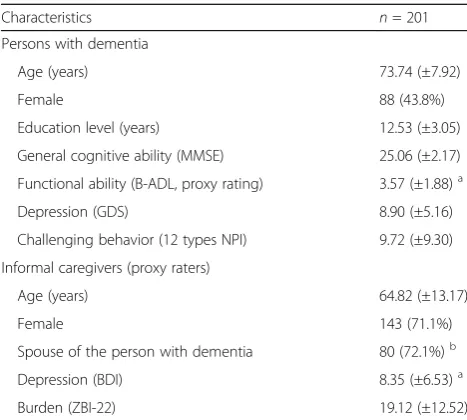
A summary of participant characteristics is shown in Table 1. The total number of participants was 201 dyads (persons living with mild AD and their informal caregivers). Notably, 48% (n= 90) of informal caregivers did not specify their relationship to the person with AD (Table1).
Missing value analysis
item (3.6%) in the DEMQOL, as well as nine cases in which one item (3.2%) and one case in which two items (6.5%) were missing in the DEMQOL-Proxy. Ten complete datasets with two-way imputed integers for missing data were generated for the MSA.
Item distribution
Five items (20–22, 25, 26) for the DEMQOLand six items (21–24, 28, 29) for theDEMQOL-Proxyshowed a ceiling ef-fect (Table2). The 15 identical items of theDEMQOLand DEMQOL-Proxydemonstrated that proxy ratings are typic-ally lower than the corresponding self-ratings (Table2).
Structural validity
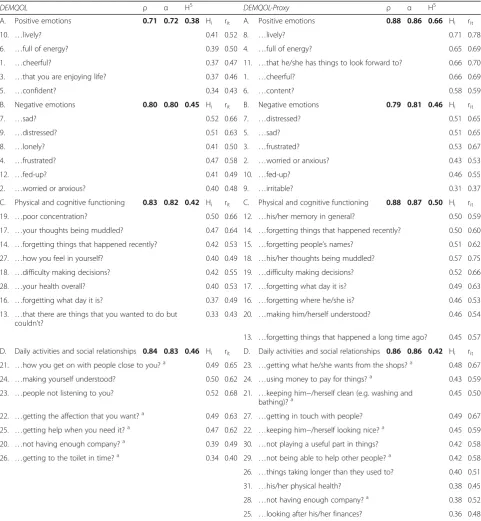
Four cores were found for the DEMQOL: items 21/24, 7/9, 17/19, and 6/10 (all Hij≥0.49). In addition, for the DEMQOL-Proxy, four cores were found, consisting of items 4/8, 12/14, 5/7, and 23/24 (all Hij≥0.65). The
re-sults of the iterative MSA are shown in Table 3. We found four equal subscales for both instruments, i.e., [A]
“positive emotions”, [B] “negative emotions”, [C] “ phys-ical and cognitive functioning”, and [D] “daily activities and social relationships”(Table3).
For theDEMQOL, the HScoefficient showed a“medium” correlation for three subscales (H = 0.42–0.46) in compari-son to the subscale [A], which presented only a“weak”(H = 0.37) correlation. The correlations of theDEMQOL-Proxy subscales are “strong” ([A] HS= 0.66) and “medium” sub-scales ([C] HS= 0.50; [B] HS= 0.46; [D] HS= 0.42). Subscale [A] differed between both instruments, with only a“weak”
HSin the DEMQOL but a“strong” HSin the DEMQOL-Proxyversion. The MSA used all items of the proxy version, while in theDEMQOL, two items (11: “irritable”; 15:“ for-getting who people are”) could not be assigned. With re-gard to content, item 11 could have matched to subscale [B], while item 15 would have matched to subscale [C]. However, both showed a Hi of < 0.3. Item 24 from the DEMQOL, “making yourself understood”, and the corre-sponding item 20 of theDEMQOL-Proxyversion,“making him/herself understood”, are in different subscales ([C] vs. [D]). Apart from this finding and the missing item 11 in the DEMQOL version, the remaining 13 of the 15 identical items of the two instruments have been assigned to the same subscales. In the DEMQOL, the item 18 (“difficulty making decisions”) presented as a cross loader, which could have assigned to subscale [C] with Hi= 0.45 as well as to
subscale [D] with Hi= 0.39. For a better fit with respect to
content and the conceptual framework of Smith et al. [15], we decided to move item 18 into subscale [C]. The assump-tion of monotonicity for the MSA has been achieved for each of the ten imputed samples for all items (Crit = 0). All items with a ceiling effect could be found in subscale [D].
Sensitivity analyses were carried out to determine the stability of the identified subscales using the data from the CORDIAL study follow-up surveys, which can be found in Additional file 1: Table A1 for time T1 after
three months and in Additional file 2: Table A2 for the nine-month survey (T2) in the supplemental material of
this article. With the exception of item 26 in the DEM-QOLversion at time T2, the results were confirmed. The
HS values in the DEMQOL version are comparable to the baseline values with “medium” correlations for sub-scale [B] to [D] and to a “weak” correlation for subscale [A] (Additional file 1: Table A1). At T2, the assessment
on subscale [A] improved to a“medium”, whereas sub-scale [D] marginally worsened. The subsub-scales [B] and [C] of the DEMQOL-Proxy improved to “strong” for both timepoints. The same result was found for subscale [D] at T2. Therefore, at T2, all subscales of the DEM-QOL-Proxyare“strong”(Additional file2: Table A2).
Internal consistency
The subscales revealed aρof 0.71–0.84 (α= 0.72–0.83) for theDEMQOLand aρof 0.79–0.88 (α= 0.81–0.87) for the DEMQOL-Proxy. According to theρ- andα-values, all sub-scales were considered “good” (Table 3). The internal consistency was also“good”for T1and T2for all subscales,
withρ- andα-values > 0.72 (Additional file1: Table A1 and Additional file2: Table A2). The ritrevealed only one item
(item 9 from the DEMQOL-Proxy, “irritable”) that was below 0.4, which was not scalable at all in the DEMQOL version. All other items had a“high”(n= 41) or“moderate” (n= 15) rit-values of 0.4 or more.
Table 1Participant characteristics
Characteristics n= 201
Persons with dementia
Age (years) 73.74 (±7.92)
Female 88 (43.8%)
Education level (years) 12.53 (±3.05)
General cognitive ability (MMSE) 25.06 (±2.17)
Functional ability (B-ADL, proxy rating) 3.57 (±1.88)a
Depression (GDS) 8.90 (±5.16)
Challenging behavior (12 types NPI) 9.72 (±9.30)
Informal caregivers (proxy raters)
Age (years) 64.82 (±13.17)
Female 143 (71.1%)
Spouse of the person with dementia 80 (72.1%)b
Depression (BDI) 8.35 (±6.53)a
Burden (ZBI-22) 19.12 (±12.52)
Data are reported as the mean (±standard deviation) or number (%).MMSE
Mini-Mental Status Examination,B-ADLBayer Activities of Daily Living Scale;GDSGeriatric Depression Scale,NPINeuropsychiatric Inventory;BDIBeck Depression Inventory,ZBI-22Zarit Burden Interview with 22 items
a
Missing value in 1 case b
Table 2 Item distribution on the German version of the DEMQOL and DEMQOL -Proxy (No. of original item order; n = 201) DEMQ OL DEMQ OL -Proxy No. Item Resp onse op tions Descriptive No. Item Re spons e option s Descriptiv e a lot
quite abit
Table
2
Item
distribution
on
the
German
version
of
the
DEMQOL
and
DEMQOL
-Proxy
(No.
of
original
item
order;
n
=
201)
(Continued)
Frequ
encies
of
the
respon
se
options
in
total,
%
15.3
23.4
23.
8
37.5
0.1
Frequ
encies
of
the
respon
se
options
in
total,
%
15.
7
28.
7
24.5
31.1
0.2
No.
Item
Resp
onse
op
tions
Descriptive
No.
Item
Re
spons
e
option
s
Descriptiv
e
very goo
d
good
fair
poor
missing
me
an
(±SD)
very go
od
goo
d
fair
poor
missin
g
mean
(±SD)
OverallThinking
about
all
of
these
thing
s
in
the
last
week,
how
wo
uld
you
rate
…
OverallThinking
abou
t
all
of
these
thing
s
in
the
last
week,
how
wo
uld
you
say
(yo
ur
relative)
woul
d
rate
…
29.
…
your
quality
of
life
overa
ll?
c
23
139
37
2
0
2.
91
(±0
.58)
32.
…
his/her
quality
of
life
overall?
a
11
12
5
58
7
0
2.70
(±0.6
3)
Frequ
encies
of
the
respon
se
options,
%
11.4
69.2
18.
4
1.0
0.0
Frequ
encies
of
the
respon
se
options,
%
5.
5
62.
2
28.9
3.5
0.0
aContraindicative
items
bThe
item
corresponds
to
both
versions,
however
in
the
original
questionnaire
it
is
part
as
number
24
of
“
Everyday
life
”
cContraindicative
items
dCeiling
effect,
the
mean
is
in
the
last
20%
of
the
scale
(
≥
Discussion
The evaluation of the German versions of the DEM-QOL and DEMQOL-Proxy revealed the following major findings. First, the MSA for the DEMQOL and
the DEMQOL-Proxy revealed that four subscales ([A]
“positive emotions”, [B] “negative emotions”, [C]
“physical and cognitive functioning”, and [D] “daily activities and social relationships”) were found with
Table 3Scale analysis and internal consistency of theDEMQOLandDEMQOL-Proxy(n= 201)
DEMQOL ρ α HS DEMQOL-Proxy ρ α HS
A. Positive emotions 0.71 0.72 0.38 Hi rit A. Positive emotions 0.88 0.86 0.66 Hi rit
10. …lively? 0.41 0.52 8. …lively? 0.71 0.78
6. …full of energy? 0.39 0.50 4. …full of energy? 0.65 0.69
1. …cheerful? 0.37 0.47 11. …that he/she has things to look forward to? 0.66 0.70
3. …that you are enjoying life? 0.37 0.46 1. …cheerful? 0.66 0.69
5. …confident? 0.34 0.43 6. …content? 0.58 0.59
B. Negative emotions 0.80 0.80 0.45 Hi rit B. Negative emotions 0.79 0.81 0.46 Hi rit
7. …sad? 0.52 0.66 7. …distressed? 0.51 0.65
9. …distressed? 0.51 0.63 5. …sad? 0.51 0.65
8. …lonely? 0.41 0.50 3. …frustrated? 0.53 0.67
4. …frustrated? 0.47 0.58 2. …worried or anxious? 0.43 0.53
12. …fed-up? 0.41 0.49 10. …fed-up? 0.46 0.55
2. …worried or anxious? 0.40 0.48 9. …irritable? 0.31 0.37
C. Physical and cognitive functioning 0.83 0.82 0.42 Hi rit C. Physical and cognitive functioning 0.88 0.87 0.50 Hi rit
19. …poor concentration? 0.50 0.66 12. …his/her memory in general? 0.50 0.59
17. …your thoughts being muddled? 0.47 0.64 14. …forgetting things that happened recently? 0.50 0.60
14. …forgetting things that happened recently? 0.42 0.53 15. …forgetting people’s names? 0.51 0.62
27. …how you feel in yourself? 0.40 0.49 18. …his/her thoughts being muddled? 0.57 0.75
18. …difficulty making decisions? 0.42 0.55 19. …difficulty making decisions? 0.52 0.66
28. …your health overall? 0.40 0.53 17. …forgetting what day it is? 0.49 0.63
16. …forgetting what day it is? 0.37 0.49 16. …forgetting where he/she is? 0.46 0.53
13. …that there are things that you wanted to do but couldn’t?
0.33 0.43 20. …making him/herself understood? 0.46 0.54
13. …forgetting things that happened a long time ago? 0.45 0.57
D. Daily activities and social relationships 0.84 0.83 0.46 Hi rit D. Daily activities and social relationships 0.86 0.86 0.42 Hi rit
21. …how you get on with people close to you?a 0.49 0.65 23. …getting what he/she wants from the shops?a 0.48 0.67
24. …making yourself understood? 0.50 0.62 24. …using money to pay for things?a 0.43 0.59
23. …people not listening to you? 0.52 0.68 21. …keeping him−/herself clean (e.g. washing and bathing)?a
0.45 0.50
22. …getting the affection that you want?a 0.49 0.63 27. …getting in touch with people? 0.49 0.67
25. …getting help when you need it?a 0.47 0.62 22. …keeping him−/herself looking nice?a 0.45 0.59
20. …not having enough company?a 0.39 0.49 30. …not playing a useful part in things? 0.42 0.58
26. …getting to the toilet in time?a 0.34 0.40 29. …not being able to help other people?a 0.42 0.58
26. …things taking longer than they used to? 0.40 0.51
31. …his/her physical health? 0.38 0.45
28. …not having enough company?a 0.38 0.52
25. …looking after his/her finances? 0.36 0.48
The criterion (Crit) by Molenaar, Sijtsma, and Boer used to check the monotonicity assumption is for all items in every of the ten imputed datasets = 0 ρ= rho (Molenaar Sijtsma statistic);α= Cronbach’s alpha (> 0.7 and < 0.95 = good); rit= part-whole-corrected item-total correlation
(> 0.50 = high, > 0.30 = moderate);
HS= Loevinger’s H coefficient of scalability of the scale (> 0.50 = strong, > 0.40 = medium, > 0.30 = weak); Hi= Loevinger’s H coefficient for an item and the remaining items of the scale
a
stable HS values ≥0.38. Second, the internal consistency showed consistently “good” values. Third, the item description showed ceiling effects, as exhib-ited by 18% of the items on the DEMQOL and 19% of the items on the DEMQOL-Proxy. Furthermore, the results of the MSA for the German versions of the DEMQOL and DEMQOL-Proxy are largely com-parable to findings from previous studies on the HRQoL of persons living with dementia [4, 15], espe-cially to the conceptual framework of Smith and col-leagues [14] as well as to their explorative factor analysis of the pretest during the development of the instrument. As such, our results can be considered to be first indications of the structural validity of the DEMQOL and the DEMQOL-Proxy.
In our data evaluation, the domain “health and well-being” of the conceptual framework is repre-sented by subscales [A], “positive emotions”, and [B],
“negative emotions”, except items 27 (“how you feel in yourself”) and 28 (“your health overall”), which have been loaded onto subscale [C], “physical and cognitive functioning”. Therefore, this subscale has been complemented by the word “physical”. For the DEMQOL-Proxy, only item 31 (“his/her physical health”) from the framework was loaded onto sub-scale [D], “daily activities and social relationships”. Subscale [C] characterizes the domain “cognitive func-tioning” of the conceptual framework in our data evaluation. Herein, 100% conformity for the DEM-QOL-Proxy could be shown. However, item 24 of the DEMQOL (“making yourself understood”) loaded onto subscale [D]. The domains “daily activities” and “ so-cial relationships” of the framework were combined into the fourth subscale of our study, which was des-ignated as subscale [D], “daily activities and social re-lationships”. However, item 13 of the DEMQOL (“that there are things that you wanted to do but couldn’t”) was an exception, as it was loaded to the subscale [C], “physical and cognitive functioning”. This loading may be due to the translation of the word “inability” into German. Furthermore, item 30 of the DEMQOL-Proxy (“not playing a useful part in things”) was added to subscale [D]. This was the only item that could be assigned to the “self-concept” domain of the conceptual framework.
Compared to the findings of Mulhern and colleagues, we also found subscales for “positive emotions” and
“negative emotions” in our study. In contrast, in our as-sessment, subscale [C],“physical and cognitive function-ing”, is related to what has been termed “cognition” in the HTA report by Mulhern and colleagues [4]. The sub-scales “social relationships” in the DEMQOL and “daily activities” in the DEMQOL-Proxy were referred to the common subscale [D], “daily activities and social
relationships”, for both instruments within our data evaluation. Taken together, 71% of the DEMQOL items and 65% of the DEMQOL-Proxy items coincided with the results of Mulhern et al. [4]; that is, 20 items that are equally distributed in both instruments.
Furthermore, the subscales “positive emotions” (both instruments) and “negative emotions” (DEMQOL-Proxy only) are completely identical, if the cross loaders of the DEMQOL-Proxyin the Mulhern study are not removed. Subscale [B] of the DEMQOL, “negative emotions”, ex-hibits a difference, as given by the loading of items 8 and 9, while item 11 is not loaded. In contrast, the sub-scale “cognition” shows high consistencies with the DEMQOL and DEMQOL-Proxy. Differences in the DEMQOL, however, exist only in the additional loading of the items 13, 27 and 28, while item 15 was not loaded. On the DEMQOL-Proxy, item 26 was not loaded, while all other items were identical. Item 20 of DEMQOLwas additionally loaded within subscale [D], “daily activities and social relationships”, which was named “social rela-tionships” by Mulhern et al. [4]. Only three items of the DEMQOL-Proxy could be seen in the data set of Mul-hern et al. [4], while our data evaluation further loaded the items 21, 22, and 26–31.
In summary, our data demonstrated the determined subscales to be highly consistent with the conceptual framework of Smith et al. [15] and that these subscales further exhibit similarities to those of Mulhern et al. [4]. The sensitivity analysis at times T1 and T2 showed a
stable result for assignment of the items to the subscales (Additional file 1: Table A1 and Additional file2: Table A2). In contrast, the designation of subscale [D] was identical in the DEMQOL and DEMQOL-Proxy, while this finding differed according to Mulhern et al. [4] and was therefore presented as “social relationships” in the DEMQOL and “daily activities” in the DEMQOL-Proxy. However, if both subscales were taken together, they represent a similar construct as our subscale [D], “daily activities and social relationships”.
In accordance with the HRQoL definition from Hays and Reeve [7] provided in the background, the subscales we found in our study cover the aspects of“how well a person functions in his/her life” (physical and cognitive functioning [C]) and his or her “perceived well-being in physical (daily activities), mental (positive and negative emotions [A-B]), and social domains (social relationships [D]) of health”.
Limitations
underlying data. Similarly, it was no longer possible to influence the number of study participants. According to a study by Straat et al. [46], a sample of more than 250 respondents should be given if the quality of the answers is high. In the present study, however, only the data of 201 persons could be used, reflecting a limitation of the results. Furthermore, the CORDIAL study included only persons with a mild severity of AD. The mild form might explain the ceiling effects of subscale [D]. Thus, the generalizability of the results is limited due to the absence of other forms of dementia.
Conclusions
In this psychometric study using the German versions of the instruments DEMQOL and DEMQOL-Proxy, four equal subscales were found in both instruments, demonstrating “good” internal consistency. The sub-scales reflect the conceptual framework of the instru-ment developers to a high degree. Thus, the results can be considered a first indication of the construct validity of the two German versions. In our opinion, DEMQOL subscale scores are more explanatory than a total score because HRQoL is a multidimensional concept and re-spective domain scores may help clarify treatment im-pacts. Moreover, our internal consistency results reflect the homogeneity of the subscales. However, Chua et al. [19] used bifactor models for direct comparisons be-tween total and subscale scores and showed that the latter scores had poor reliability and should not be used. Such direct comparisons were not performed in our study due to differences in modeling decisions (par-allel iterative MSA rather than bifactor modeling). The merits of MSA and bifactor modeling for clarifying multidimensionality are debatable [47, 48]. Therefore, more empirical data are needed before definitive rec-ommendations can be made.
However, we recommend further investigations prior to or integrated in future studies using the German ver-sion of theDEMQOLandDEMQOL-Proxy. In particular, we advise the integration of the evaluation of test-retest reliability (bothDEMQOL versions) and inter-rater reli-ability (DEMQOL-Proxy) as part of the instrument appli-cation in future studies. Continued research should also be carried out on structural validity using various latent variable models. In addition, further investigation of data from persons living with moderate dementia, or with se-vere dementia for the proxy version, should be per-formed according to the ceiling effects we found in our study. For the proxy version, it would also be important to conduct a study with professional nurses to make statements on the use of the instrument in German nursing homes. Similarly, an investigation should be conducted to analyze against external criteria for other proportions of the construct validity.
Additional files
Additional file 1:Table A1.Scale analysis and internal consistency of theDEMQOL(n= 183) andDEMQOL-Proxy(n= 179) using the data of T1, three months after the baseline assessment. (PDF 240 kb)
Additional file 2:Table A2.Scale analysis and internal consistency of theDEMQOL(n= 166) andDEMQOL-Proxy(n= 163) using the data of T2, nine months after the baseline assessment. (PDF 316 kb)
Abbreviations
AD:Alzheimer’s disease; B-ADL: Bayer Activities of Daily Living Scale; BDI: Beck Depression Inventory; CORDIAL: Cognitive Rehabilitation and Cognitive Behavioral Treatment for Early Dementia in Alzheimer’s Disease (study); Crit: Criterion by Molenaar, Sijtsma, and Boer; DEMQOL: Dementia Quality of Life; GDS: Geriatric Depression Scale; Hi: Loevinger’s H coefficient for an item and the remaining items of the scale; HRQoL: Health-related quality of life; HS: Loevinger’s H coefficient of scalability of a scale; HTA: Health Technology Assessment; ICF: International Classification of Functioning, Disability and Health; MMSE: Mini-Mental Status Examination; MSA: Mokken scale analysis; NPI: Neuropsychiatric Inventory; QoL: Quality of life; rit: Part-whole-corrected item-total correlation; SD: Standard deviation; WHO: World Health Organization; ZBI-22: Zarit Burden Interview with 22 items;α: Cronbach’s alpha;ρ: rho (Molenaar Sijtsma statistic)
Acknowledgments
We would like to thank the participants and colleagues from the CORDIAL study. We would especially like to thank Professor Dr. Alexander Kurz for providing the data.
Ethical approval and consent to participate
The study protocol was approved by the ethics committees of the coordination center and the participating recruitment sites [21]. Ethical clearance was granted for the CORDIAL study by the Ethics Commission of the Faculty of Medicine of the Technical University of Munich on 12/10/2009 (no. 2113/08 S). The participants received written and oral information about the study prior to data collection. Written informed consent was obtained from both the persons living with AD and their informal caregivers. We refrained from re-auditing as ethical clearance is not required for analyses based on secondary data [22] or for studies using anonymous data.
Funding
The German Federal Ministry of Health funded the CORDIAL study (2008–2010; funding code: IIA5-2508FSB105//44–034). This study was also a“lighthouse project dementia”. The German Center for Neurodegenerative Diseases supported the data analysis for this article. Both funding institutions had no role in the design, conduct, analyses or reporting of this study.
Availability of data and materials
All of the data necessary for a meta-analysis of the internal consistency and structural validity of theDEMQOLandDEMQOL-Proxyitems are contained within the manuscript and its supplementary file. Further data are available upon request.
Authors’contributions
Study concept: CGGS, MND, and MB. Data collection and handling: CGGS and MB. Data analysis: CGGS and MND. Manuscript preparation: CGGS, MND, and MB. All authors have read and approved the final version of the manuscript.
Consent for publication Not applicable.
Competing interests
The authors declare that they have no competing interests.
Publisher’s Note
Author details
1German Center for Neurodegenerative Diseases (DZNE), Stockumer Straße
12, 58453 Witten, Germany.2School of Nursing Science, Witten/Herdecke
University, Stockumer Straße 12, 58453 Witten, Germany.3Clinic for Cognitive Neurology, Medical Faculty, Leipzig University, Liebigstraße 16, 04103 Leipzig, Germany.
Received: 5 September 2017 Accepted: 26 September 2018
References
1. Alzheimer's Disease International (ADI). World Alzheimer Report 2015:The global impact of dementia. In London; 2015.
2. American Psychiatric Association (ed.): DSM-5. Diagnostic and statistical manual of mental disorders, Fifth Edition edn. Washington/DC: American Psychiatric Publishing; 2013.
3. Guidelines on medicinal products for the treatment of Alzheimer’s disease and other dementias [http://www.ema.europa.eu/docs/en_GB/document_
library/Scientific_guideline/2009/09/WC500003562.pdf].
4. Mulhern B, Rowen D, Brazier J, Smith S, Romeo R, Tait R, Watchurst C, Chua KC, Loftus V, Young T et al: Development of U and DEMQOL-PROXY-U: generation of preference-based indices from DEMQOL and DEMQOL-PROXY for use in economic evaluation. Health Technology Assessment 2013, 17(5):v-xv, 1–140.
5. Rowen D, Mulhern B, Banerjee S, Hout B, Young TA, Knapp M, Smith SC, Lamping DL, Brazier JE. Estimating preference-based single index measures for dementia using DEMQOL and DEMQOL-Proxy. Value Health. 2012;15. United States:346–56.
6. Rowen D, Mulhern B, Banerjee S, Tait R, Watchurst C, Smith SC, Young TA, Knapp M, Brazier JE. Comparison of general population, patient, and carer utility values for dementia health states. Medical Decision Making. 2015;35. United States:68–80.
7. Hays RD, Reeve BB: Measurement and modeling of health-related quality of life. In: Epidemiology and demography in public health.Edited by Killewo J, Heggenhougen HK, Quah SR. San Diego CA: Academic Press; 2010: 195–205. 8. Karimi M, Brazier J. Health, health-related quality of life, and quality of life:
what is the difference? PharmacoEconomics. 2016;34(7):645–9.
9. Wilson IB, Cleary PD. Linking clinical variables with health-related quality of life. A conceptual model of patient outcomes. Jama. 1995;273(1):59–65. 10. World Health Organization (WHO). Constitution of the World Health
Organization. Basic documents of the Word Helath Organization. Geneva: World Health Organization; 2014.
11. Bakas T, McLennon SM, Carpenter JS, Buelow JM, Otte JL, Hanna KM, Ellett ML, Hadler KA, Welch JL. Systematic review of health-related quality of life models. Health Qual Life Outcomes. 2012;10:134.
12. World Health Organization (WHO). International Classification of Functioning, disability, and Health: Children and Youth Version: ICF-CY. Geneva: World Health Organization; 2007.
13. Ferrans CE, Zerwic JJ, Wilbur JE, Larson JL. Conceptual model of health-related quality of life. Journal of nursing scholarship : an official publication of Sigma Theta Tau International Honor Society of Nursing. 2005;37(4):336–42. 14. Smith SC, Murray J, Banerjee S, Foley B, Cook JC, Lamping DL, Prince M,
Harwood RH, Levin E, Mann A. What constitutes health-related quality of life in dementia? Development of a conceptual framework for people with dementia and their carers. International journal of geriatric psychiatry. 2005;20(9):889–95. 15. Smith SC, Lamping DL, Banerjee S, Harwood R, Foley B, Smith P, Cook JC, Murray J, Prince M, Levin E, et al. Measurement of health-related quality of life for people with dementia: development of a new instrument (DEMQOL) and an evaluation of current methodology. Health Technol Assess. 2005;9(10):1–93 iii-iv.
16. Berwig M, Leicht H, Gertz HJ. Critical evaluation of self-rated quality of life in mild cognitive impairment and Alzheimer's disease - further evidence for the impact of anosognosia and global cognitive impairment. The journal of nutrition health and aging. 2009;13(3):226–30.
17. Dichter MN, Schwab CGG, Meyer G, Bartholomeyczik S, Halek M. Linguistic validation and reliability properties are weak investigated of most dementia-specific quality of life measurements - a systematic review. J Clin Epidemiol. 2016;70:233–45.
18. Lucas-Carrasco R, Lamping DL, Banerjee S, Rejas J, Smith SC, Gomez-Benito J. Validation of the Spanish version of the DEMQOL system. International psychogeriatrics / IPA. 2010;22(4):589–97.
19. Chua KC, Brown A, Little R, Matthews D, Morton L, Loftus V, Watchurst C, Tait R, Romeo R, Banerjee S. Quality-of-life assessment in dementia: the use of DEMQOL and DEMQOL-proxy total scores. Quality of life research : an international journal of quality of life aspects of treatment, care and rehabilitation. 2016;25(12):3107–18.
20. Hendriks AAJ, Smith SC, Chrysanthaki T, Cano SJ, Black N. DEMQOL and DEMQOL-proxy: a Rasch analysis. Health Qual Life Outcomes. 2017;15(1):164. 21. Kurz A, Thone-Otto A, Cramer B, Egert S, Frolich L, Gertz HJ, Kehl V,
Wagenpfeil S, Werheid K. CORDIAL: cognitive rehabilitation and cognitive-behavioral treatment for early dementia in Alzheimer disease: a multicenter, randomized, controlled trial. Alzheimer Dis Assoc Disord. 2012;26(3):246–53. 22. Swart E, Gothe H, Geyer S, Jaunzeme J, Maier B, Grobe TG, Ihle P, et al. [Good
Practice of Secondary Data Analysis (GPS): Guidelines and Recommendations] Gute Praxis Sekundärdatenanalyse (GPS): Leitlinien und Empfehlungen. Gesundheitswesen. 2015;77(02):120–6.
23. Kessler J, Markowitsch HJ, Denzler PE. [Mini-Mental State Examination (MMSE) - German version] Mini-Mental-Status-Test (MMSE) - Deutsche Fassung. Beltz: Weinheim; 1990.
24. Hindmarch I, Lehfeld H, de Jongh P, Erzigkeit H. The Bayer activities of daily living scale (B-ADL). Dement Geriatr Cogn Disord. 1998;9(suppl 2):20–6. 25. Yesavage JA. Geriatric depression scale. Psychopharmacol Bull. 1988;24(4):
709–11.
26. Cummings JL. The neuropsychiatric inventory: assessing psychopathology in dementia patients. Neurology. 1997;48(5 Suppl 6):10–6.
27. Hautzinger M, Bailer M, Worall H, Keller F: [Beck-depression-inventory (BDI): editing of the German version - test manual] Beck-depressions-Inventar (BDI): Bearbeitung der deutschen Ausgabe - Testhandbuch, 2. Auflage edn. Bern: Hans Huber; 1994.
28. Zarit SH, Reever KE, Bach-Peterson J. Relatives of the impaired elderly: correlates of feelings of burden. The Gerontologist. 1980;20(6):649–55. 29. Stochl J, Jones PB, Croudace TJ. Mokken scale analysis of mental health and
well-being questionnaire item responses: a non-parametric IRT method in empirical research for applied health researchers. BMC Med Res Methodol. 2012;12:74. 30. Watson R, van der Ark LA, Lin LC, Fieo R, Deary IJ, Meijer RR. Item response
theory: how Mokken scaling can be used in clinical practice. J Clin Nurs. 2012;21(19–20):2736–46.
31. Dichter MN, Dortmann O, Halek M, Meyer G, Holle D, Nordheim J, Bartholomeyczik S. Scalability and internal consistency of the German version of the dementia-specific quality of life instrument QUALIDEM in nursing homes -- a secondary data analysis. Health Qual Life Outcomes. 2013;11(1):91.
32. Bouman AI, Ettema TP, Wetzels RB, van Beek AP, de Lange J, Droes RM. Evaluation of Qualidem: a dementia-specific quality of life instrument for persons with dementia in residential settings; scalability and reliability of subscales in four Dutch field surveys. International journal of geriatric psychiatry. 2011;26(7):711–22.
33. Sijtsma K, Molenaar IW. Introduction to nonparametric item response theory, vol. 5. Thousand Oaks, CA: Sage Publications; 2002.
34. Molenaar IW, Sijtsma K. User's manual MSP5 for windows [software manual]. IEC ProGAMMA: Groningen, The Netherlands; 2000.
35. Müller-Schneider T. Multiple Skalierung nach dem Kristallisationsprinzip. Eine alternative zur explorativen Faktorenanalyse [multiple scaling according to the principle of crystallization. An alternative method to exploratory factor analysis]. Z Soziol. 2001;30(4):305–15.
36. Schwab CGG. [Construct validity and internal consistency of the instrument
“burden in dealing with dementia”(BelaDem) in nursing homes -unpublished master thesis] Konstruktvalidität und interne Konsistenz des Instrumentes“Belastungserleben im Umgang mit Demenz”(BelaDem) in der stationären Altenhilfe - unveröffentlichte Masterarbeit. Herdecke: Witten: Universität Witten/Herdecke; 2013.
37. Van Ginkel JR, Andries van Der Ark LA, Sijtsma K, Vermunt JK. two-way imputation: a Bayesian method for estimating missing scores in tests and questionnaires, and an accurate approximation. Computational Statistics & Data Analysis. 2007;51(8):4013–27.
38. Sijtsma K, Molenaar IW. Reliability of test scores in nonparametric item response theory. Psychometrika. 1987;52.
39. van der Ark LA, van der Palm DW, Sijtsma K. A latent class approach to estimating test-score reliability. Appl Psychol Meas. 2011;35(5):380–92. 40. Terwee CB, Bot SD, de Boer MR, van der Windt DA, Knol DL, Dekker J, Bouter
41. Bortz J, Döring N, Bortz D. [Research methods and evaluation: for human and social sciences] Forschungsmethoden und Evaluation: für Human- und Sozialwissenschaftler, fourth revised edition edn. Heidelberg: Springer-Medizin-Verlag; 2006.
42. Core R. Team R: a language and environment for statistical computing. Vienna, Austria: R Foundation for Statistical Computing; 2017. 43. van der Ark LA. Mokken scale analysis in R. J Stat Softw. 2007;20(11):19. 44. van der Ark LA. New developments in Mokken scale analysis in R. J Stat
Softw. 2012;48(5):27.
45. Robitzsch A, Grund S, Henke T: TAM: Some additional multiple imputation functions, especially for mice. R package version 2.5–9.
https://CRAN.R-project.org/package=miceadds; 2017.
46. Straat JH, van der Ark LA, Klaas S. minimum sample size requirements for Mokken scale analysis. Educ Psychol Meas. 2014;74(5):809–22.
47. Reise SP, Kim DS, Mansolf M, Widaman KF. Is the Bifactor model a better model or is it just better at modeling implausible responses? Application of iteratively reweighted least squares to the Rosenberg self-esteem scale. Multivariate Behav Res. 2016;51(6):818–38.