R E S E A R C H A R T I C L E
Open Access
Does aquatic exercise improve commonly
reported predisposing risk factors to falls
within the elderly? A systematic review
Eduardo Martínez-Carbonell Guillamón
1,2*, Louise Burgess
2, Tikki Immins
2,
Andrés Martínez-Almagro Andreo
1and Thomas W. Wainwright
2Abstract
Background:According to the World Health Organization, the elderly are at the highest risk of injury or death from a fall. Age-related changes in strength, balance and flexibility are degenerative factors that may increase the risk of falling, and an aquatic training may offer a favourable environment to improve these modifiable risk factors.
Methods:A systematic review was conducted to assess the potential preventative role of aquatic exercise for reducing the risk of falls in the elderly by improving predisposing risk factors. Electronic databases and reference lists of pertinent articles published between 2005 and 2018 were searched. Randomized controlled trials (RCTs) that directly or indirectly addressed the effect of aquatic exercise for the prevention of falls in healthy participants were included within the synthesis. Studies were included if they were reported between January 2005 and May 2018 within a population aged between 60 and 90 years old that were without exercise-effecting comorbidities. Data related to participant demographics, study design, methodology, interventions and outcomes was extracted by one reviewer. Methodological quality assessment was independently performed by two reviewers using the PEDro (Physiotherapy Evidence Database) scale.
Results:Fourteen trials met the inclusion criteria. Exercise intervention duration and frequency varied from 2 to 24 weeks, from 2 to 3 times per week, from 40 to 90 min per session. Fall rate was not reported in any of the studies analysed. However, aquatic exercise improved key predisposing physical fitness components that are modifiable and internal risk factors for falling.
Conclusions:There is limited, low-quality evidence to support the use of aquatic exercise for improving physiological components that are risk factors for falling. Although the evidence is limited, and many interventions are not well described, these results should be considered by health and exercise professionals when making evidence-based, clinical decisions regarding training programmes to reduce the risk of falling.
Keywords:Elderly, Aquatic exercise, Magnitude of load, Fall prevention
Background
Fall-related injuries and deaths are serious and increas-ing issues for the elderly population. A fall is defined as
“an event which results in a person coming to rest
inad-vertently on the ground or floor or other lower level, ex-cluding intentional change in position to rest in
furniture, wall or other objects” [1]. Approximately 30%
of people aged over 65 years will fall at least once a year
[2, 3] and 15% at least twice a year [4], and this risk
in-creases with age. These falls may result in fracture, long-term pain, disability and functional impairments and as a consequence, an individual may suffer negative social effects, due to a lack of independence, which
re-duces an individual’s quality of life. In addition, falls in
the elderly create an economic burden to hospitals and
healthcare systems [5].
* Correspondence:[email protected]
1Faculty of Health Science, Catholic University of Murcia, UCAM, Av. de los
Jerónimos, 135, Guadalupe, 30107 Murcia, Spain
2Orthopaedic Research Institute, Bournemouth University, 6th Floor,
Executive Business Centre, 89 Holdenhurst Road, Bournemouth BH8 8EB, UK
There are a multitude of risk factors for falling, and they can be internal or external and modifiable or unmodifiable. Some risk factors are directly correlated
and others interact in a more complex manner [2].
Age-ing is associated with anatomical and physiological changes that can lead to increased disability, frailty and a
higher risk of falls [6]. Sarcopenia is the degenerative
loss of muscle mass, which increases linearly with age
[7]. In addition, involuntary, age-related impairments of
the three sensory systems that control posture (vestibu-lar, visual and somatosensory) can lead to falls. A study
by Rubenstein [8] reviewed 16 controlled studies and
found weakness, balance deficit and gait deficit to be the most important individual risk factors for falls. More
specifically, a systematic review [9] found lower
extrem-ity weakness to be a clinically important and statistically significant risk factor for falls. In addition, a study by
Myers et al. [10] proposed strength, flexibility, balance
and reaction time to be the most modifiable internal risk factors to falls, therefore providing a rationale for exer-cise interventions that aim to reduce falls in the elderly.
Research shows that detection and improvement of predisposing modifiable risk factors can reduce the rate
of future falls [11,12]. Regular physical exercise has been
theorised to counteract the negative physiological effects of the aging process and improve physical and mental
wellbeing [12, 13]. However, barriers to exercise
behav-iour among older adults include a fear of falling and
per-ceived negative affect [14] and it is therefore difficult to
conclude which training prescription (for example: load control training, progression of the load during balance exercises, type of equipment, depth of water) will create
an effective programme [15, 16]. Studies that have
com-pared aquatic and land group with the same protocol, through specific functionality tests, do not report
signifi-cant differences between training groups [17]. Therefore,
it is possible that aquatic exercise may improve balance, strength and flexibility out of water despite the differ-ences in the environment.
Aquatic exercise provides a low-impact and low-weight bearing environment where individuals can exercise safely. The risk of falling is eliminated, and therefore an individ-ual can concentrate on making physical improvements. In addition to safety benefits, aquatic programs may offer an appealing alternative to repetitive, conventional exercise which may increase compliance to rehabilitation plans. There are many components of physical fitness that can be trained in an aquatic environment to help reduce the risk of falling, for example: agility, balance, co-ordination, strength, flexibility and speed. The aim of this systematic review is to evaluate the effectiveness of using an aquatic environment to reduce the most modifiable predisposing risk factors of falls within an elderly population. The type of exercise, frequency, intensity and duration of each
exercise intervention will be assessed to determine if phys-ical activity within an aquatic environment offers potential benefits to the risk of falling.
Methods Protocols
This manuscript is written in accordance with the PRISMA (Preferred Reporting Items for Systematic Re-views and Meta-Analyses) statement which includes
controlled and randomized studies [18,19]. A systematic
review was completed to assess the role of aquatic exer-cise for improving the commonly reported predisposing risk factors of falls in the elderly.
Eligibility criteria and information sources
A computer based search was completed between Janu-ary 2005 and May 2018 and the electronic databases sourced were: ISI Web of Knowledge, ProQuest, PubMed, Science Direct, SPORTDiscus, the Cochrane Central Register of Controlled Trials and the Google Academic Meta searcher. The PICO (Population, Inter-vention, Comparison and Outcome) framework was used to define the search strategy. The search strategy was developed to include a combination of controlled vocabulary (MeSH) and free text terms which can be
found in Table 1. Reviews and commentaries were used
to identify papers, but were not included within the syn-thesis of results. The search reviewed all available studies published between 2005 and 2018. In the mid-nineties, strong research emerged on the benefit of the aquatic environment in rehabilitation compared to the land
en-vironment. In particular, an article belong to Tovin [20]
who compared the anterior cruciate ligament recon-struction water versus land exercise. However, during this time it was not shown that training in the aquatic environment could be as effective in older adults as land
exercise in order to improve one’s physical condition.
Until the past decade, no research groups considered that the limitation of the aquatic environment was due to the lack of control of the training load during the ex-ercise. The year 2005 is estimated as an ideal date to begin reviewing literature as before this time, the scien-tific rigor of relevant studies was low as they were di-rected solely for therapeutic exercise such as knee
injuries or hip osteoarthritis [21]. From studies where
the intensity of the exercise is controlled in a systematic
Table 1Search Strategy
Search Strategy
The terms“aquatic-exercise”(“water-based training”,“water exercise”,
“hydrotherapy”,“exercise-aquatic) and“fall”(“fall-prevention”,“fall risk”) were combined with the terms:“older-adults”,“elderly”,“aging”,
way through adapted material, depth, type of exercise and number of series, aquatic exercise can be better
understood by healthcare professionals [22].
Study population
The study population consisted of healthy adults aged between 60 and 80 years old.
Type of intervention and comparisons
To be included within the study, the articles were required to state the training methodology adopted within an aquatic environment. Studies were also included if they compared either (i) aquatic exercise and non-aquatic exer-cise, or (ii) aquatic exercise and aquatic exercise with dif-ferent types of intervention. Studies that did not report their intervention methodology to prevent falls were excluded.
Type of outcomes
Assessments of physical function and/or physical per-formance based on fall prevention in an aquatic environ-ment were the outcomes in the included studies. Data were extracted which related to outcomes about the in-tensity, volume, type of exercise, frequency and recovery. The studies retrieved were assessed against the inclu-sion criteria, based on their titles. The full text of the remaining studies was then independently reviewed by two researchers (EMCG and LB). An inclusion and
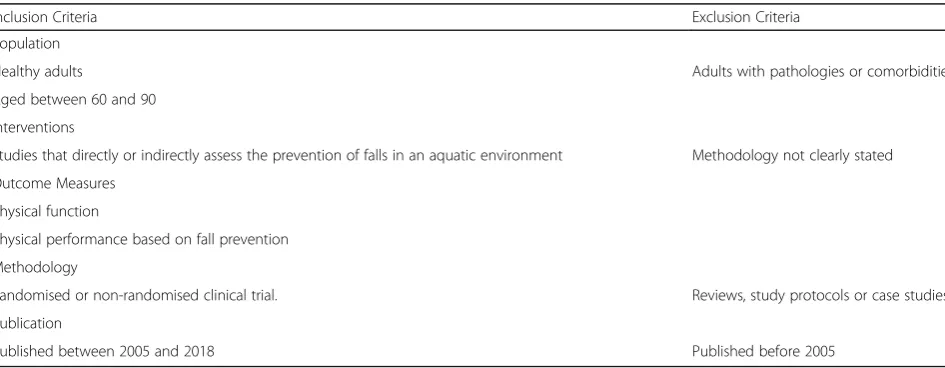
ex-clusion criteria can be found in Table2.
Data collection process, data items and summary measures
Data were extracted by one reviewer (EMCG) using a standardized template and verified by a second reviewer (JO). Information was extracted from each included trial on: authors, year of publication, study design, population characteristics (number of participants, gender and age),
description of intervention and outcome measures. Dis-agreements or discrepancies on data extraction were re-solved by discussion.
Methodological quality in individual studies
The methodological quality of all studies was assessed using the PEDro (Physiotherapy Evidence Database)
ap-praisal instrument [23]. The 11 item scale is a valid and
replicable measure used to critically appraise the quality of randomized controlled trials. Each study is scored out of ten, with a threshold of seven (or over) for a study to be considered high quality (item one on the scale indi-cates external validity).
Results
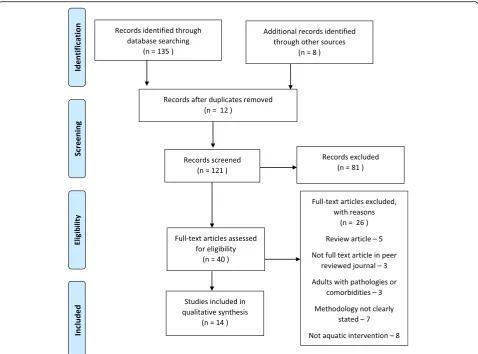
A summary of the selection process is schematized in
Fig. 1. The literature search yielded a total of 143
arti-cles, of which 12 were duplicates and 81 were immedi-ately excluded after reviewing the title, as they did not fit the inclusion criteria. A total of 40 full-text articles were reviewed. Thirty-two articles could be obtained through the search engine of the Catholic University of Murcia and its corresponding subscriptions to certain journals. The eight remaining articles were obtained on free access web pages or through an interlibrary loan process. Following a full text review (EMCG and TI), fourteen studies were included in the synthesis of results.
Twelve of the sourced studies were randomized
con-trolled trials (RCTs) [16,24–34] and two studies adopted
a quasi-experimental design [35,36]. Nine studies
specif-ically evaluated the impact of aquatic training on
im-proving strength [16,25,27,29–32,35,36], nine studies
assessed balance following aquatic training [24, 26, 28–
30, 32, 33, 35, 36], and four studies compared a variety
of physical fitness components, including agility,
endur-ance, flexibility and speed [26,27,35,36].
Table 2Eligibility criteria
Inclusion Criteria Exclusion Criteria
Population
Healthy adults Adults with pathologies or comorbidities
Aged between 60 and 90
Interventions
Studies that directly or indirectly assess the prevention of falls in an aquatic environment Methodology not clearly stated
Outcome Measures
Physical function
Physical performance based on fall prevention
Methodology
Randomised or non-randomised clinical trial. Reviews, study protocols or case studies.
Publication
Measuring instruments
The flexibility variable was recorded by the chair sit-and-reach and the back scratch test in one study
[26, 30] whilst another study used the functional tests
of Johnson and Nelson [35, 36]. The remaining
stud-ies utilised the sit and reach test [25, 27, 29].
Dynamic balance was measured using the berg balance
scale [33], the timed up and go test [24, 25,27, 28, 35],
the 8 ft up and go test [29, 30, 34] and the walking in
circle test [36]. Static balance was recorded with the
Sharpened Romberg test [24,28,35] with both open and
closed eyes, it was also registered by a Biodex Balance
Stability System [32] and using a force platform where
the subjects kept their arms on their hips to maintain
position [36].
The variable of strength was predominantly recorded for
upper limbs using a hand dynamometer [25, 27, 30, 32].
The maximal dynamic strength was evaluated using the
1-repetition maximum (1RM) bench press [16] bilateral
elbow flexion [16,26,36] and bilateral knee
flexion/exten-sion [16]. The muscular endurance was evaluated during a
bilateral knee extension and flexion with a load equivalent to 60% of 1RM maintaining a maximum possible number
of repetitions [16]. An isokinetic machine was also used
for lower limbs. In this case a knee flexion-extension is
performed at speeds of 60°/s,120°/s [26]. In addition, a
functional test like the 30 s sit-and-stand-up were used by
a large number of researchers [26,29,31,36].
Flexibility was mainly measured by the sit-and-reach
test for the hamstrings muscles and lower back [25–27,
29, 30] and the back-scratch test was used to assess the
general shoulder range of motion [26,30].
Study population
When divided into their respective experimental groups, nine of the studies sourced had sample sizes of between
13 and 17 subjects [16, 24–27, 30–33, 35]. The
remaining studies tested between 20 and 66 subjects [28,
29, 34, 36]. Four studies assessed both male and female
participants [27–30], four studies only included women
[16,25,31,36] and three studies only assessed male
par-ticipants [24, 32, 35]. The age range of the study
populations was generally small, however in four studies
the range was 15 years [16,25,29,35] and in two studies
the range was over 24 years [33,36].
Intervention variables
The temperature of the water varied between 28 °C and 32
°C within the majority of studies, [16, 25–27, 29, 34–36]
with the exception of four studies, [24, 28, 30, 31] where
the temperature was over 32 °C and two studies which do
not specify the water temperature [32, 33]. The depth of
the water in most of the interventions was from between
waist to the midline of the chest [24,26,28] and at the level
of the xiphoid process [16,25,29–31,33–36] except in two
studies [30, 32] where the depth reached 1.80 m. The
shorter studies had a duration of two weeks [28] and six
weeks [24, 30]. Most interventions were implemented for
eight to 12 weeks [16, 26, 27, 29, 31–35]. However, one
study completed a 16 weeks intervention [36], and the
lon-gest intervention had a duration of 24 weeks [25]. The
fre-quency of the intervention was generally between two
sessions [16, 24, 30, 31, 33, 35, 36] and three sessions a
week [25–27, 29,32,34] although there is a study with a
frequency of 5 days a week for 2 weeks during the
interven-tion [28]. In terms of duration, most of the interventions
were 60 min long, [25,26,28–30,32,35,36] however, one
study had a duration of 90 min [28], another of 40 min [34]
and four studies did not specify the duration of the
inter-vention [17,25,32,35].
In some cases, the intensity of training was described by referring to the Borg Rate of Perceived Exertion Scale, the same Borg scale which ranges from six to 20 points. A value of one represents a very light exercise and 20 a
serious physical exertion [37]. Moderate to high intensity
was mentioned in ten of the included results [16,25–27,
29–31,34–36] and exercise intensity was not
systematic-ally recorded in the remaining studies [24,28,32,33].
Physiological improvements
The control group, absent from any intervention, did not obtain any significant difference at the end of
the study [25, 26, 28, 30–36]. However, the aquatic
intervention group obtained improvements (p ≤0.05)
at the end of the study in the variable of flexibility
[25–27, 29, 30, 36], balance [24, 26, 28, 32, 35, 36]
and strength [16, 25–27, 29–32, 36].
Regarding the four studies that include a third exercise programme in a land environment, two of them did not find differences between the aquatic and land groups after the intervention, in variables of flexibility, balance
and strength [24, 28]. Nevertheless, the aquatic group
obtained greater improvement over the terrestrial group
in the variable of balance in one study [30]. Another
study [27] compared two aquatic groups with different
types of intervention: resistance material and without
any material. The material group presented better results in gait speed, however, in variables of strength, mobility and flexibility, no significant differences were found be-tween groups.
Resistance material
The studies did not specify what kind of materials they
used except in one case [27] where the aquatic group
used newly made water-resistance equipment (power leg and power hand DESCENTE Co., Ltd., Japan) and
an-other study [36] where the aquatic group progressed at
their own rate by adding surface area equipment (Aqua Flex paddles by MIZUNO Corporation, Osaka, Japan) and by opening the webbing of the Aqua Mitt gloves to increase surface area to reach the goal RPE.
Type of exercise
The studies that introduce flexibility training do not
in-dicate specific exercises that are performed [26, 27, 29].
Only five studies indicate the static and dynamic
balan-cing exercises which they use [26,28,33,35,36]. When
looking at strength training there is a general focus on
large muscle groups from the upper or lower limbs [16,
24,26,27,31,32,34]. Only two studies [31,36] mention
the execution of exercises that resemble activities of daily living (ADL). A schematic compression can be
viewed in Table3.
Discussion
There is evidence to support the use of aquatic exercise in order to modify variables related to the risk of fall in the elderly. Aquatic exercise may ameliorate the negative physiological effects of aging which are predisposing, modifiable risk factors of a fall. Improving these risk fac-tors is likely to create an overall benefit to rate of falls, and thus aquatic exercise should be considered as a training method for those most at risk of falling. How-ever, the relationship between aquatic exercise and fall prevention is not directly compared within the studies sourced.
Balance
Studies which assessed balance within their training
pro-grammes found significant improvements (p≤0.05)
fol-lowing the intervention [24, 28, 32, 34–36] with the
exception of two studies [26,33]. The lack of positive
re-sults in balance training may be due to the lack of scien-tific rigor and the specificity of training. In this review, the exercises used most for balance training are
alternat-ing movements of the upper and lower limb [24, 26,28,
33, 35, 36] however, their training variables such as the
Table 3 Studies and interventions (including assessments, results and limitations found in each study for clinicians and researchers) (Continued) Study O bjective Population Interve ntion group Dep th & Tª Mag nitude of load Assessm ent Outcome Lim itation s of the st udy Bento et al., 2015 [ 34 ] To evaluate the eff ects of a water-bas ed exercis e pro-gram on static and dy namic bal ance. Sixty-five inde pende nt particip ants (over 60 years old) were divided in AG ( n = 20) and CG ( n = 16). Dep th: Xiph oid proc ess.
Tª: 28–
30 °C. AG : Interve ntion; CG: No interve ntion Balance: Displacem ent of the center of press ure in a quiet standing po sition and 8-F oot Up-and Go. No differ ences we re found in the cen ter of pressure variables; howev er, the AG group showed better performance in the 8 Foot Up-and -Go Test afte r training (5.6 1 – 0.76 vs. 5.18 – 0.42; p < 0.01). The ph ysical cond ition ing of the part icipants at baseline reve aled a good status, wh ich may have red uced the mag nitude of the trai ning eff ects. Volu me Specific inten sity control W F D RPE: 12 – 16 12 3 N/A HRR: 40 to 60% 3s e ts× 4 0 ″ /2 0 ″ rest Type of exercic e Bal ance Not inc luded Stre ngt h Hip /knee flex ion/extens ion and dorsal an d pla ntar flex ion of the ankl e Fl exibility Gen eral -Do es not spec ify exerc ises Kim y O ’ Sullivan, 2013 [ 28 ] To exami ne the eff ects of aquati c exerc ise on biom echanic al and phy siological el ements influenc ing gai t. Healt hy wom en (70 – 78 years ) bone mineral density sc ore up − 1. AG: n =8 CG: n =7 Dep th: Betw een wai st an d chest . Tª: 28 ± 1 °C. AG : Interve ntion; CG: No interve ntion Balance: Gait observations , kinemat ics at 60 Hz were recorded by 8 came ras, and kinetics on by 2 force pla tforms. Stren gth: 30 ″ chai r st and, arm curl. Flexibi lity: Chair sit-and -reach Back scrat ch AG obtain reduc tions (p < 0.05 ) in body we ight, and body fat mass, and stride time. Sign ificant increases (p > 0.05 ) in le g strength corr esponde d to the maxim um joint moment of the landing leg, getting better the ability for reco very of balance afte r any perturbation. H igh dropou t rate. The eva luati on of the bal ance is not clear an d the study doe s not indi cate clear ly the load magn itude of trai ning in AG. Large sam ple diff erenc e betw een interve ntion group and cont rol group. Volu me Specific inten sity control W F D RPE: 7 – 11 12 3 60 ’ Type of exercis e Bal ance Stat ic and dy namic Stre ngt h Gen eral Exercise for UL and DL Fl exibility Gen eral -Do es not spec ify exerc ises
Sanders, Takeshima, Rogers
, Colad o y Borrean i, 2013 [ 36 ] To evaluate the aqu atic envi ronme nt in the improve men t of the ADL in wom en over 60 years. Women (60 – 89 years), seden tary, indepe ndent and confirm ed by a physician their healthy situati on. AG: n =4 8 CG: n =1 8 Dep th: Xiph oid proc ess.
Tª: 28–
Table 3 Studies and interventions (including assessments, results and limitations found in each study for clinicians and researchers) (Continued) Study O bjective Population Interve ntion group Dep th & Tª Mag nitude of load Assessm ent Outcome Lim itation s of the st udy st rength and fun ctional ity of the el derly. = 17 ), land group (n = 17) and control group ( n = 19) Dynamometry for hand-grip and iso-metr ic kne e flexion -extensi on Flexibi lity: Back -scratch test and sit-and -reach. balance, obtaining AG a greater improve ment dynamic balance a loss weight (P < 0.05) dur ing the de velopm ent of exe rcises. W F D RPE: 13 – 16 62 6 0 ’ HRmáx: 55 – 65 % 3s e ts× 1 ′ /3 0 ″ rest Type of exercis e End urance Comb ined exercis e for U L and DL Stre ngt h Comb ined exercis e for U L and DL Fl exibility Comb ined exercis e of U L and DL main taining movem ent 90 ″ . Elbar et al. , 2013 [ 33 ] To evaluate a pe rturbation progr amm e of bal ance targeted com pensat ory and vo luntary step ping to im prove spee d of st epping . 34 healthy volu nteers (64 – 88 years ) was divided in tw o groups n = 17, res pectively. Dep th: Xiph oid proc ess. Tª: Do es not app ear. AG : Interve ntion; CG: No interve ntion Balance: Fall Efficac y Scale. Folstei n Mini-Menta l Stat e Exami nation . Volunt ary Step Execution Te st Stabilogram -Diffusio n Alysis. Berg Bal ance Scale. Get-up-and-g o. A sign ificant interac tion effect be tween group an d time was foun d for the step execut ion, due to improve ment in initiation phase and swi ng phase duratio ns in the AG. Also, significan t improve ment in postural stability in eyes open and close d condit ions is note d. No ben efits for pe rformanc e asp ects of balance cont rol. Alt hough this lac k of im provement cou ld be due to ceiling effects, it may reflec t the spe cificity of training princ iple and the need for therapists to tailor bal ance training progr ams to target spe cific aspects. Volu me Specific inten sity control W F D Prog ressive levels of bal ance intens ity 12 2 40 ’ Type of exercis e Bal ance Lev el 1: Standin g -Extern al suppo rt Lev el 2: Standin g -No exte rnal suppo rt Lev el 3: Single leg – No external suppo rt Lev el 4: Gait exerc ise – No suppo rt Lev el 5: Perturbation an d water turbu lence Stre ngt h Not inc luded Fl exibility Not inc luded Javaheri, Rahi mi, Rash idlamir y Alikhajeh, 2012 [ 24 ] To compare aqu atic an d terre strial envi ronme nt in the im provement of the st atic and dynami c bal ance for elde rly. Thirty older adult s (63 – 70 years ); indepe ndents in the daily activ ities was divided in tw o groups (n = 15) Dep th: Betw een wai st an d chest . Tª: 33 °C. AG : Aqu atic interve ntion; LG: Land interve ntion
Balance: Sharpened Rombe
Table 3 Studies and interventions (including assessments, results and limitations found in each study for clinicians and researchers) (Continued) Study O bjective Population Interve ntion group Dep th & Tª Mag nitude of load Assessm ent Outcome Lim itation s of the st udy Bal ance Comb ination of displacement Stre ngt h Mar ching in place. Hip flexion/ exte nsion. Hip abducti on/ add uction . Toe raises /heel rais es. Shal low kne e bends. Sit to stan d from chai r in land group. Sit to stan d from poo l shelf in aquati c group. Fl exibility Not inc luded Alikhajeh, Mog haddam & Mog haddam, 2012 [ 35 ] To evaluate the effect of hydrothe rapy on the st atic and dy namic bal ance. Twent y-eight healthy seden tary el derly men (64 – 79 years ; 14 in the exper imental group and 14 in the CG). Dep th: Xiph oid proc ess.
Tª: 28–
29 ° C. AG : Interve ntion; CG: No interve ntion
Balance: Sharpened Rombe
Table 3 Studies and interventions (including assessments, results and limitations found in each study for clinicians and researchers) (Continued) Study O bjective Population Interve ntion group Dep th & Tª Mag nitude of load Assessm ent Outcome Lim itation s of the st udy Stre ngt h Comb ined exercis e for U L and DL Fl exibility Gen eral -Do es not spec ify exerc ises Walia y Shef ali, 2012 [ 28 ] Comp aring aqu atic an d land exe rcise in the im provement of bal ance in el derly. Healt hy asymptomat ic elderly (65 – 71 years ) who were divided in a land group ( n = 30) and an aqu atic group (n = 30). Dep th: Betw een wai st an d chest . Tª: 35 ° ± 2 ° C. AG : Aqu atic interve ntion; LG: Land interve ntion
Balance: Sharpened Rombe
Table
3
Studies
and
interventions
(including
assessments,
results
and
limitations
found
in
each
study
for
clinicians
and
researchers)
(Continued)
Study
O
bjective
Population
Interve
ntion
group
Dep
th
&
Tª
Mag
nitude
of
load
Assessm
ent
Outcome
Lim
itation
s
of
the
st
udy
UL
an
d
DL.
Flexibi
lity:
Sit
and
reach.
Type
of
exercis
e
Bal
ance
Not
inc
luded
Stre
ngt
h
15
–
25
mi
n
of
glob
al
exerc
ise
for
UL
an
d
LL
Fl
exibility
Not
inc
luded
CG
Control
group,
AG
Aquatic
group,
LG
Land
group;
(I),
First
group;
(II),
Second
group;
(III),
Third
group,
ADL
Activity
daily
life,
Tª
Temperature,
N/A
Not
included
in
the
text,
W
Weeks
of
intervention,
F
Frequency,
D
Total
duration
of
season,
RPE
Rating
of
perceived
exertion
Borg
Scale
6
–
20,
EV
Execution
velocity,
MA
Materials
of
resistance,
HRmáx
Maximum
heart
rate,
AT
Anaerobic
threshold,
HRR
Heart-rate
reserve,
UL
Upper
limb,
LL
Lower
limb,
RM
Repetition
maximum,
MVIC
Maximal
voluntary
isometric
fall prevention training programme [38], and conse-quently the specificity of the exercises and the control of training should appear in order to reproduce the results obtained in the studies. Therefore, certain criteria or principles that support the decisions made during the fall prevention program should be considered during the design of protocols to improve balance in older people.
An example are those established by two experts [8,38]:
the reduction of the support base, the movement of the centre of gravity, the mobilization of the limbs and the
reduction of the visual field [8, 38]. It has been
recom-mended that due to the aquatic turbulence during the aquatic exercise, muscle are activated continuously to
stabilize the position of the individual [16]. However, the
depth of the water and velocity of exercise should be controlled in order to modify muscle activation during
balance exercises [39].
One study [36] demonstrated that in a group of 66
subjects (60–89 years), during a 16-week programme
which included strength training, in an elderly popula-tion it is possible to achieve a better static balance in the
elderly. A similar study [24] evaluated the static and
dy-namic balance in two groups of 15 subjects (63–70
years) during two equally designed training programmes in both a land and aquatic environment. At six weeks, both groups achieved significant improvements in static
and dynamic balance (p < 0.05) when compared to
pre-test scores. Similarly, a significant gain (p < 0.05) was found for the Berg Balance Score in adults older than 68 years old with no significant difference from one
en-vironment to another (p> 0.05).
Although the studies reviewed did not find significant differences between land and water training, the results suggest that an aquatic environment offers a safe envir-onment where the risk of falling is eliminated. It should, however, be noted that there is evidence to highlight the insufficiency of the Berg Balance Scale for predicting
falls [40] and the Timed Up and Go Test is instead
rec-ommended by the U.S. Centres for Disease Control and Prevention as an easy to administer clinical test to
evalu-ate a senior citizen’s fall risk [41].
One study assessed the effect of aquatic training on
agil-ity [20]. The authors found significant improvements in
the intervention group receiving an aquatic exercise
programme in comparison to the control group (p< 0.05).
There is evidence that agility training programmes can
re-duce the risk of falls [42], largely due to improved balance,
which has been examined as a variable for improving mo-bility in older adults. A study comparing fall prevention
programmes in older adults [43] found that visual training
had the greatest improvement on obstacle course per-formance (22%) following a 12-week training program. In addition, agility has been found to reduce the risk of
fall-ing through step trainfall-ing [44], and in multifactorial
programs which focus on other variables such as balance
and strength [45].
Strength
Aquatic interventions that trained large muscle groups of the upper and lower limbs found significant
improve-ments in strength from pre-test to post-test (p < 0.05)
[16, 25–27, 29–32, 36]. Although the methodologies of
these protocols vary, all results indicate that an aquatic environment is beneficial for promoting muscle hyper-trophy. Strength training cause changes in the nervous system through neuromuscular activation, resulting in improved muscular power and delayed onset of
sarcope-nia which may decrease the risk of falls [46]. Evidence
for the effectiveness of lower limb strengthening exer-cises for the prevention of falls in elderly subjects has
been previously reported [47–49] and as lower extremity
weakness is a clinically significant risk factor of a fall. The design of aquatic exercise programmes should focus on the lower limbs, respecting the principle of training specificity. Lower limb weakness in older adults is con-sidered an important influencing factor of falls and its preservation promotes the maintenance of independ-ence. More specifically, the maximum voluntary isomet-ric strength and the rate of force generation of the hip abductors are considered a useful measure to distinguish
between older adult fallers and non-fallers [50].
How-ever, several studies use the handgrip dynamometer as a
measure for strength in the elderly [25, 27, 32].
Al-though this outcome measure does not specifically as-sess lower limb strength, a recent study developed by the Cooperative Health Research in the Region of
Augs-burg [51] with 808 individuals (age≥65 years) found a
trend toward an indirect effect of grip strength on
bal-ance problems (p value = .043). In addition, handgrip
strength has been estimated by other studies as an Indi-cator of Health-Related Quality of Life in Old Age and
fall prevention [52,53].
Flexibility
Axial stiffness can occur through ageing and is a loss of flexibility and elasticity in the neck and trunk that causes the imbalance of the posture, thus reducing balance and increasing the chance of falling. The ACSM (American
College of Sports Medicine) [47] highlights the
import-ance of flexibility training during aging for fall preven-tion; however often it remains neglected in training programmes.
Within this review, six studies assessed flexibility as an
outcome following aquatic training [23,25,27,29,30,36].
In all cases, flexibility was seen to improve significantly
from pre-test to post-test (p≤0.05), however the specific
flexibility with the risk of falls, the findings indicate that the rigidity in the pelvic muscles causes an alteration in the gait of the elderly, which will contribute to an
in-creased risk of falls [54]. In this case, a specific program of
hip flexor stretches is needed, which may reverse variables
that increase the risk of falls in the elderly [55].
Duration
Six studies [16,26,29,31,33,34] agree with others found
in the literature [56–58] that a training programme that
seeks to allow for significant changes in balance, strength or flexibility to prevent falls in older adults should be a minimum duration of 12 weeks. To make a positive im-pact, the duration of the session should be around 60 min
and two to three times a week [16,26,29,31–34], as
rec-ommended by similar studies [48,57,59,60]. The ACSM
expresses an optimum frequency of three times a week at a moderate-to-high intensity to facilitate fall prevention
training in the elderly [47]. This exercise prescription
al-lows for physical recovery that induces physiological
adap-tations (48–72 h between sessions) [61]. However, studies
with less frequency and duration also found significant
improvements in balance, strength and flexibility tests [24,
27, 30, 32, 35, 36], after their respective interventions.
These results indicate that the intensity of a programme will be a greater modifier of effect than the volume of training to reach physiological adaptations in the elderly
and to improve functional capacity [16,62,63]. Therefore,
it seems likely that frequency, duration and intensity of ex-ercises, including those related to strength, balance, and flexibility are relevant training principles for reducing the risk of falls in the elderly.
Intensity
The intensity of an exercise programme is an important factor for determining the physiological stress and sub-sequent adaption an individual can experience through training. If the frequency and intensity of the training programme is too high, muscular damage may occur and this can negatively affect adherence to programmes
[64]. The Borg Scale is a valid and simple measure of
controlling intensity that has been utilised within the
studies analysed [16,26, 27, 29, 30, 34,36]. In addition,
using Rate of Perceived Exertion (RPE) [37] to prescribe
exercise intensity is considered appropriate for older
adults [65, 66]. However, in many cases, the number of
sets, repetitions or recovery periods was missing from the methodology, preventing the protocols being
re-peated. Only one study [30] explained the control of the
intensity of the flexibility whereby the involved muscles
were contracting for 60–90 s during stretching.
Intensity should be controlled like with land exercise but with consideration of the principles of hydrodynamics and the forces that influence aquatic exercise to improve
physiological responses in older adults [67]. For example,
in one study [17], three different types of training were
compared over ten weeks: land training with machines
(n= 14), training with elastic bands (n= 21) and water
re-sistance training (n = 17) following the same protocol
training but adapted to the environment. The three
groups obtained significant differences (p< 0.05) in flexion
of arms (push up), squats, crunches and in the fat-free mass. It is shown that controlled resistance training in the aquatic environment can be as beneficial for the improve-ment of physical condition and body composition as land training when the protocol is adapted to the specific na-ture of the environment. In this way, a table of the inter-vention of the studies is designed, which will serve for clinical protocols and researchers to know the variables of exercise prescription of each of the articles analysed (Table
3).
Methodology quality
Generally, the methodological quality of the studies in-cluded was low. The mean PEDro score for all fourteen
studies was 5.5/10 (Table 4). A score of seven (or over)
is considered high quality [68], and therefore only on
studies in this review had a high quality methodology
[33]. Thirteen studies were considered‘low quality’when
using a threshold of six or less out of ten [16, 24–32,
34–36]. Due to the nature some interventions, it was
dif-ficult to blind subjects, therapists and assessors and therefore consistently low scoring items on the scale were: three, five, six and seven.
It is difficult to advocate the use of one study over an-other due to a lack of repeated designs. This makes it
difficult to establish a“fixed criteria”in the development
of training programmes in the aquatic environment in order to reduce the risk of falls in the elderly.
Although the studies mention the reduction of fall risk with the results obtained, they do not present correla-tions between variables of strength, balance or flexibility
that could suggest a strong clinical relationship.
Well-written methodologies should express all relevant information on the training design (volume, intensity, frequency, recovery and type of exercise) in a clear and replicable way. They should also present correlations be-tween falls and physical training variables such as agility, balance, strength and flexibility.
Study limitations
between training variables and falls. Resistance equip-ment is not included to increase exercise intensity, and few studies highlight the importance of execution speed during the aquatic exercises. Regarding the types of ex-ercise, most of them refer to general exercises of upper and lower limbs; however, the exercises should be scribed in detail so that professionals can achieve the de-sired results. Regarding the flexibility variable, it is included during the programs directed to older adults but it is not discussed as a relevant variable. Flexibility is not treated in a specific way, obviating the importance of the pelvic musculature in the disturbance of the gait and therefore of the risk of falling. Researchers should avoid describing a superficial and uncritical methodology in order to design specific and valid aquatic programs for reducing the most modifiable predisposing risk fac-tors of falls within the elderly.
Conclusions
There is some evidence to support using aquatic exercise for improving predisposing, modifiable risk factors of falls. However, the quality of this evidence is low, and many interventions are not fully described. The lack of consistency between study methodologies makes inter-vention comparison difficult. In addition, the trial find-ings did not find a statistically significant relationship between training variables and falls.
Despite the inconsistent and lacking results, it should be noted that there were no detrimental or counterpro-ductive effects found within the search results following a physical aquatic exercise programme. With increased consistency in the design of evidence-based training
programmes, the aquatic environment could become widespread and effective for helping to prevent the risk of falls in the elderly. Further research is needed to cre-ate an evidence-based, replicable protocol for aquatic training with a specific aim of improving the commonly reported predisposing risk factors of falls.
Abbreviations
ACSM:American College of Sports Medicine; ADL: Activity of Daily Living; PRISMA: Preferred Reporting Items for Systematic Reviews and Meta-Analyses
Acknowledgements
Not applicable.
Funding
No funding was received for this study.
Availability of data and materials
The materials used within this study were taken directly from the research articles which were sourced from our literature search. We can provide copies of this data if required.
Authors’contributions
EMCG: Developing design, literature search, manuscript writing, and analysis of results. LB: Manuscript writing and developing design. TI: Quality assessment. TW: Supervision of data collection and analysis. AMAA: Supervision of developing design and literature search. All authors read and approved the final manuscript.
Ethics approval and consent to participate
Not applicable.
Consent for publication
Not Applicable.
Competing interests
The authors declare that they have no competing interests.
Table 4Grade of evidence PEDro score
Study PEDro Score
out of 11
Item Sample
size
1 2 3 4 5 6 7 8 9 10 11
Silva et al., 2018 [31] 6/10 • • • • • • • 41
Reichert et al., 2018 [16] 6/10 • • • • • • • 36
Seyedjafari et al., 2017 [32] 4/10 • • • • • 30
Bento et al., 2015 [34] 5/10 • • • • • • 36
Kim y O’sullivan, 2013 [28] 5/10 • • • • • • 15
Sanders et al., 2013 [36] 5/10 • • • • • • 60
Bergamin et al., 2013 [30] 6/10 • • • • • • • 53
Elbar et al., 2013 [33] 8/10 • • • • • • • • • 34
Javaheri et al., 2012 [24] 6/10 • • • • • • • 28
Alikhajeh et al., 2012 [35] 4/10 • • • • • 28
Bento et al., 2012 [29] 5/10 • • • • • • 38
Walia y Shefali, 2012 [28] 6/10 • • • • • • • 60
Katsura et al., 2010 [27] 5/10 • • • • • • 20
Tsourlou et al., 2006 [25] 6/10 • • • • • • • 22
Publisher’s Note
Springer Nature remains neutral with regard to jurisdictional claims in published maps and institutional affiliations.
Received: 10 January 2018 Accepted: 13 February 2019
References
1. World Health Organization. Global report on falls prevention in older age.
http://www.who.int/ageing/publications/Falls_prevention7March.pdf.
2. Society AG, Society G, Prevention OF, Panel OS. Guideline for the
prevention of falls in older persons. J Am Geriatr Soc. 2001;49(5):664–72.
3. Tinetti ME, Speechley M. Prevention of falls among the elderly. N Engl J
Med. 1989;320(16):1055–9.
4. da Silva Gama ZA, Gómez-Conesa A. Factores de riesgo de caídas en
ancianos: revisión sistemática. Rev Saude Publica. 2008;42(5):946–56.
5. Scuffham P, Chaplin S, Legood R. Incidence and costs of unintentional falls
in older people in the United Kingdom. J Epidemiol Community Health.
2003;57(9):740–4.
6. Pernambuco CS, Borba-Pinheiro CJ, de Souza Vale RG, Di Masi F, Monteiro
PKP, Dantas EHM. Functional autonomy, bone mineral density (BMD) and serum osteocalcin levels in older female participants of an aquatic exercise
program (AAG). Arch Gerontol Geriatr. 2013;56(3):466–71.
7. Walston JD. Sarcopenia in older adults. Curr Opin Rheumatol. 2012;24(6):623.
8. Rubenstein LZ. Falls in older people: epidemiology, risk factors and
strategies for prevention. Age Ageing. 2006;35(suppl_2):ii37–41.
9. Moreland JD, Richardson JA, Goldsmith CH, Clase CM. Muscle weakness and
falls in older adults: a systematic review and meta-analysis. J Am Geriatr Soc.
2004;52(7):1121–9.
10. Myers AH, Young Y, Langlois JA. Prevention of falls in the elderly. Bone.
1996;18(1):S87–S101.
11. Russell K, Taing D, Roy J. Measurement of fall prevention awareness and
behaviours among older adults at home. Can J Aging. 2017;36(4):522–35.
12. El-Khoury F, Cassou B, Charles M-A, Dargent-Molina P. The effect of fall
prevention exercise programmes on fall induced injuries in community dwelling older adults: systematic review and meta-analysis of randomised controlled trials; 2013.
13. Scapagnini G, Caruso C, Spera G. Preventive medicine and healthy
longevity: Basis for sustainable anti-aging strategies. In: International
Textbook of Aesthetic Surgery. Springer; 2016. p. 1213–27.https://link.
springer.com/chapter/10.1007/978-3-662-46599-8_82.
14. Lees FD, Clark PG, Nigg CR, Newman P. Barriers to exercise behavior among
older adults: a focus-group study. J Aging Phys Act. 2005;13(1):23–33.
15. Simas V, Hing W, Pope R, Climstein M. Effects of water-based exercise on
bone health of middle-aged and older adults: a systematic review and meta-analysis. Open Access J Sports Med. 2017;8:39.
16. Reichert T, Delevatti RS, Prado AKG, Bagatini NC, Simmer NM, Meinerz AP,
Barroso BM, Costa RR, Kanitz AC, Kruel LFM. Low-and High-Volume Water-Based Resistance Training Induces Similar Strength and Functional Capacity Improvements in Older Women: A Randomized Study. J Physical Activity
Health. 2018;20(XX):1–8.
17. Colado J, Garcia-Masso X, Rogers M, Tella V, Benavent J, Dantas E. Effects of
aquatic and dry land resistance training devices on body composition and physical capacity in postmenopausal women. J Human Kinetics. 2012;32:
185–95.
18. Moher D, Liberati A, Tetzlaff J, Altman DG, Prisma G. Preferred reporting
items for systematic reviews and meta-analyses: the PRISMA statement. PLoS Med. 2009;6(7):e1000097.
19. Urrútia G, Bonfill X. Declaración PRISMA: una propuesta para mejorar la
publicación de revisiones sistemáticas y metaanálisis. Med Clin. 2010;
135(11):507–11.
20. Tovin BJ, Wolf SL, Greenfield BH, Crouse J, Woodfin BA. Comparison of the
effects of exercise in water and on land on the rehabilitation of patients with intra-articular anterior cruciate ligament reconstructions. Phys Ther.
1994;74(8):710–9.
21. Crawford MT. Aquatic Exercise For Rehabilitation And Training. J
Orthopaedic Sports Physical. 2011;41(4):286–7.
22. Colado JC, Borreani S, Pinto SS, Tella V, Martin F, Flandez J, Kruel LF.
Neuromuscular responses during aquatic resistance exercise with different
devices and depths. J Strength Cond Res. 2013;27(12):3384–90.
23. Maher CG, Sherrington C, Herbert RD, Moseley AM, Elkins M. Reliability of
the PEDro scale for rating quality of randomized controlled trials. Phys Ther.
2003;83(8):713–21.
24. Hashemi Javaheri SAA, Mohammad Rahimi N, Rashidlamir A, Alikhajeh Y.The
effects of water and land exercise programs in static and dynamic balance
among elderly men. Global J Guid Couns. 2012;2(1):1–7.
25. Tsourlou T, Benik A, Dipla K, Zafeiridis A, Kellis S. The effects of a
twenty-four-week aquatic training program on muscular strength performance in healthy elderly women. J Strength Cond Res. 2006;20(4):811.
26. Kim SB, O’sullivan DM. Effects of aqua aerobic therapy exercise for older
adults on muscular strength, agility and balance to prevent falling during
gait. J Phys Ther Sci. 2013;25(8):923–7.
27. Katsura Y, Yoshikawa T, Ueda S-Y, Usui T, Sotobayashi D, Nakao H, Sakamoto
H, Okumoto T, Fujimoto S. Effects of aquatic exercise training using
water-resistance equipment in elderly. Eur J Appl Physiol. 2010;108(5):957–64.
28. Walia R. Comparison Between Land-based and Water-based Balance Training
Exercise Program in Improvement of Balance in Community Dwelling Elderly
Population. Indian J Physiother Occup Ther. 2012:6(3):221–27.
29. Cesar Barauce Bento P, Pereira G, Ugrinowitsch C, Rodacki ALF. The effects
of a water-based exercise program on strength and functionality of older
adults. J Aging Phys Act. 2012;20(4):469–70.
30. Bergamin M, Ermolao A, Tolomio S, Berton L, Sergi G, Zaccaria M.
Water-versus land-based exercise in elderly subjects: effects on physical performance and body composition. Clin Interv Aging. 2013;8:1109.
31. Silva MR, Alberton CL, Portella EG, Nunes GN, Martin DG, Pinto SS.
Water-based aerobic and combined training in elderly women: effects on
functional capacity and quality of life. Exp Gerontol. 2018;106:54–60.
32. Seyedjafari E, Sahebozamani M, Beyranvand R, Ebrahimipoor E, Razavi
M. The effect of 8 weeks deep-aquatic exercises on static balance and lower body strength among elderly men. Int J Appl Exercise Physiol.
2017;6(1):86–98.
33. Elbar O, Tzedek I, Vered E, Shvarth G, Friger M, Melzer I. A water-based
training program that includes perturbation exercises improves speed of voluntary stepping in older adults: a randomized controlled cross-over trial.
Arch Gerontol Geriatr. 2013;56(1):134–40.
34. Bento PCB, Lopes MFA, Cebolla EC, Wolf R, Rodacki ALF. Effects of
water-based training on static and dynamic balance of older women.
Rejuvenation Res. 2015;18(4):326–31.
35. Alikhajeh Y, Hosseini SRA, Moghaddam A. Effects of hydrotherapy in static and
dynamic balance among elderly men. Procedia Soc Behav Sci. 2012;46:2220–4.
36. Sanders ME, Takeshima N, Rogers ME, Colado JC, Borreani S. Impact of the
SWEAT™water-exercise method on activities of daily living for older
women. J Sports Sci Med. 2013;12(4):707.
37. Borg GA. Psychophysical bases of perceived exertion. Med Sci Sports Exerc.
1982;14(5):377–81.
38. Sherrington C, Tiedemann A, Fairhall N, Close JCT, Lord SR. Exercise to
prevent falls in older adults: an updated meta-analysis and best practice
recommendations. N S W Public Health Bull. 2011;22(4):78–83.
39. Pöyhönen T, Kyröläinen H, Keskinen KL, Hautala A, Savolainen J, Mälkiä E.
Electromyographic and kinematic analysis of therapeutic knee exercises
under water. Clin Biomech. 2001;16(6):496–504.
40. Lima CA, Ricci NA, Nogueira EC, Perracini MR. The berg balance scale as a
clinical screening tool to predict fall risk in older adults: a systematic review.
Physiotherapy. 2018;104(4):383–94.
41. Nightingale CJ, Mitchell SN, Butterfield SA. Validation of the timed up and
go test for assessing balance variables in adults aged 65 and older. J Aging
Phys Act. 2018;26(1):1–15.
42. Liu-Ambrose T, Khan KM, Eng JJ, Janssen PA, Lord SR, McKay HA.
Resistance and agility training reduce fall risk in women aged 75 to 85 with low bone mass: a 6-month randomized, controlled trial. J Am
Geriatr Soc. 2004;52(5):657–65.
43. Reed-Jones RJ, Dorgo S, Hitchings MK, Bader JO. Vision and agility training
in community dwelling older adults: incorporating visual training into
programs for fall prevention. Gait Posture. 2012;35(4):585–9.
44. Okubo Y, Schoene D, Lord SR. Step training improves reaction time, gait
and balance and reduces falls in older people: a systematic review and
meta-analysis. Br J Sports Med. 2017;51(7):586–93.
45. Arnold CM, Walker-Johnston J, Lanovaz JL, Lattimer LJ. Does fall arrest
strategy training added to a fall prevention Programme improve balance, strength, and agility in older women? A Pilot Study. Physiotherapy Canada.
46. Holviala J, Häkkinen A, Alen M, Sallinen J, Kraemer W, Häkkinen K. Effects of prolonged and maintenance strength training on force production, walking, and balance in aging women and men. Scand J
Med Sci Sports. 2014;24(1):224–33.
47. Chodzko-Zajko W, Schwingel A, Park CH. Successful aging: the role of
physical activity. Am J Lifestyle Med. 2009;3(1):20–8.
48. Nilwik R, Snijders T, Leenders M, Groen BB, van Kranenburg J, Verdijk LB, van
Loon LJ. The decline in skeletal muscle mass with aging is mainly attributed
to a reduction in type II muscle fiber size. Exp Gerontol. 2013;48(5):492–8.
49. Kostka T. Quadriceps maximal power and optimal shortening velocity in 335
men aged 23–88 years. Eur J Appl Physiol. 2005;95(2–3):140–5.
50. Gafner SC, Bastiaenen CH, Ferrari S, Gold G, Terrier P, Hilfiker R. Allet L: hip
muscle and hand-grip strength to differentiate between older fallers and non-fallers: a cross-sectional validity study. Clin Interv Aging. 2018;13:1.
51. Arvandi M, Strasser B, Volaklis K, Ladwig K-H, Grill E, Matteucci Gothe R,
Horsch A, Laxy M, Siebert U, Peters A. Mediator effect of balance problems on association between grip strength and falls in older adults: results from the KORA-age study. Gerontol Geriatric Med. 2018;4:2333721418760122.
52. Blake AJ, Morgan K, Bendall MJ, Dallosso H, Ebrahim SBJ, Arie THD, Fentem
PH, Bassey EJ. Falls by elderly people at home: prevalence and associated
factors. Age Ageing. 1988;17(6):365–72.
53. Musalek C, Kirchengast S. Grip strength as an Indicator of Health-related
quality of life in old age—a pilot study. Int J Environ Res Public Health.
2017;14(12):1447.
54. Kerrigan DC, Lee LW, Collins JJ, Riley PO, Lipsitz LA. Reduced hip extension
during walking: healthy elderly and fallers versus young adults. Arch Phys
Med Rehabil. 2001;82(1):26–30.
55. Cristopoliski F, Sarraf TA, Dezan VH, Provensi CLG, Rodacki ALF. Transient
effect of flexibility exercises in the hip joint on the gait of older women.
Rev Bras Med Esporte. 2008;14(2):139–44.
56. Takeshima N, Rogers ME, Watanabe E, Brechue WF, Okada A, Yamada T,
Islam MM, Hayano J. Water-based exercise improves health-related aspects
of fitness in older women. Med Sci Sports Exerc. 2002;34(3):544–51.
57. Colado JC, Triplett NT, Tella V, Saucedo P, Abellán J. Effects of aquatic
resistance training on health and fitness in postmenopausal women. Eur J
Appl Physiol. 2009;106(1):113–22.
58. Pinto SS, Cadore EL, Alberton CL, Zaffari P, Bagatini NC, Baroni BM, Radaelli
R, Lanferdini FJ, Colado JC, Pinto RS. Effects of intra-session exercise sequence during water-based concurrent training. Int J Sports Med. 2014;
35(01):41–8.
59. Bloomfield SA, Little KD, Nelson ME, Yingling VR. Position stand. Med Sci
Sports Exerc. 2004;195(9131/04):3611–1985.
60. Gschwind YJ, Kressig RW, Lacroix A, Muehlbauer T, Pfenninger B, Granacher
U. A best practice fall prevention exercise program to improve balance, strength / power, and psychosocial health in older adults: Study protocol for a randomized controlled trial. BMC Geriatr. 2013;13(1):105.
61. Baechle TR, Earle RW: Principios del entrenamiento de la fuerza y del
acondicionamiento físico: Ed. Médica Panamericana; 2007.
62. Colado JC, Triplett NT. Monitoring the intensity of aquatic resistance
exercises with devices that increase the drag force: an update. Strength
Cond J. 2009;31(3):94–100.
63. Gianoudis J, Bailey CA, Ebeling PR, Nowson CA, Sanders KM, Hill K, Daly RM.
Effects of a targeted multimodal exercise program incorporating high-speed power training on falls and fracture risk factors in older adults: a
community-based randomized controlled trial. J Bone Miner Res. 2014;29(1):182–91.
64. de Lacy-Vawdon CJ, Klein R, Schwarzman J, Nolan G, de Silva R, Menzies D,
Smith BJ. Facilitators of attendance and adherence to group-based physical activity for older adults: a literature synthesis. J Aging Phys Act. 2018;26(1):
155–67.
65. Burke EJ. Individualized fitness program: using perceived exertion for the
prescription of healthy adults. J Phys Educ Recreation. 1979;50(9):35–7.
66. Keteyian S, Ehrman J, Fedel F, Rhoads K. Heart rate-perceived exertion
relationship during exercise in Orthotopic heart transplant patients. J
Cardiopulm Rehabil Prev. 1990;10(8):287–93.
67. Melzer I, Elbar O, Tsedek I, Oddsson LIE. A water-based training program
that include perturbation exercises to improve stepping responses in older adults: study protocol for a randomized controlled cross-over trial. BMC Geriatr. 2008;8(1):19.
68. Labelle H, Guibert R, Joncas J, Newman N, Fallaha M, Rivard CH. Lack of
scientific evidence for the treatment of lateral epicondylitis of the elbow. An