POOYA SONGHORY
A thesis submitted in fulfilment of the requirement for the award of degree of Doctor of Philosophy (Educational Technology)
Faculty of Education Universiti Teknologi Malaysia
DEDICATION
To my Almighty,
That my existence is with His Will. To my lovely Mother, Parvaneh Safdarian
Who gave me endless love, trust, constant encouragement over the years, and for her prayers
To my lovely father, Shokrollah Songhory
For his trust in me and his endless supports To my Son, Amirhossein
For his patience, love, and for enduring the ups and downs during the completion of this thesis.
ACKNOWLEDGEMENT
My work would not have been possible without the support, advice, and encouragement of many persons. I wish to express my deepest appreciation to all those who helped me, in one way or another, to complete this project. First and foremost, I thank God almighty who provided me with strength, direction and purpose throughout the project. Special thanks to my supervisor Professor. Dr. Zaidatun Bnt Tasir, for all her patience, guidance and support during the execution of this research. Through her expert guidance. In fact, she always gave me immense hope every time I consulted with her over problems relating to my project. I would also like to gratefully acknowledge the constructive comments from, Associate Prof. Dr. Jamalludin Harun. His willingness to give his time so generously has been very much appreciated.
ABSTRACT
ABSTRAK
TABLE OF CONTENTS
CHAPTER TITLE PAGE
DECLARATION ii
DEDICATION iii
ACKNOWLEDGEMENT iv
ABSTRACT v
ABSTRAK vi
TABLE OF CONTENTS vi
LIST OF TABLES xii
LIST OF FIGURES xiii
LIST OF ABBREVIATIONS xv
LIST OF APPENDICES xvi
1 INTRODUCTION 1
1.1 Introduction 1
1.2 Background of the problem 3
1.2.1 Learning with Music 6
1.2.2 Learning through asynchronous-learning 7
1.2.3 Effective Study Method 8
1.2.4 E-learning Development 9
1.3 Statement of the Problem 11
1.4 Research Objective 14
1.5 Research Questions 14
1.6 Scope of the Research 15
1.7 Theoretical Framework 16
1.7.1 Student Centered Learning 19
1.7.2 Learner Centered Principles in Distance Education 19
1.7.4 Dual channel assumption in learning 20
1.7.5 Metacognition 21
1.7.6 Motivation 23
1.8 Conceptual Framework 24
1.9 Significance of the Study 25
1.10Rationale of the Study 26
1.11Operational Definition 27
1.11.1 Metacognition 27
1.11.2 E-learning 28
1.11.3 Asynchronous Learning 28
1.11.3.1 Asynchronous learning with BM 29
1.11.4 Background Music 29
1.11.5 Mozart Effect 30
1.11.6 Phenomenology 31
1.11.7 Vocal and Instrumental music 31
1.12Summary 32
2 LITERATURE REVIEW 33
2.1 Introduction 33
2.2 Student approaches to learning 35
2.2.1 Music and Human’s body and mind 37
2.2.2 Music and body 37
2.3 Music, brain and mind 40
2.3.1 How do brain hear music, the legend of right brain and
left brain 40
2.3.1.1 Brain frequencies 42
2.3.1.2 Core intelligences 43
2.3.1.3 Goldman’s intelligence 46
2.4 Background Music in Education 46
2.4.1 Summary of the mentioned Studies 53
2.5 Learning and Music 55
2.5.1 Georgi Lozanov Methodology 56
2.6 Background music in learners’ life 59 2.6.1 Why some types of the music matter? 60
iii. Hemi-Sync Metamusic 63
iv. Folk Music 63
v. Mood Music 63
2.7 Empowering education with the use of digital technology 64
2.8 Learning through Technology 65
2.8.1 Types of e-learning methods 65
2.9 Realizing the benefits of e-Learning on learning 66 2.10Asynchronous Learning and adult learner’s Motivation/music 67
2.11E-learning and learners’ expectations 68
2.12Metacognitive strategies 69
2.13Summary 70
3 METHODOLOGY 72
3.1 Introduction 72
3.2 Research Design 72
3.2.1 Phenomenology design 75
3.2.2 Phenomenology Rational and Characteristics 76
3.3 Participants 78
3.4 Instrumentation 80
3.4.1 Triangulation 80
3.4.2 Questionnaire 81
3.4.3 Observations 86
3.4.5 Interview 87
3.5 Validity and rigor 91
3.6 Research Procedure 92
3.6.1 Procedures of Data Collection 94
3.7 Analysis of Data 95
3.7.1 Interpretative Phenomenological Analysis (IPA) 96
3.7.2 The process 97
3.7.3 Coding 97
3.8 Computer Aided Qualitative data analysis 100
3.8.2 Analyzing data by Nvivo 10 (Mac beta version) 101
3.8.3 Axing and coding analysis 101
3.8.4 Quality of the results 102
3.8.5 Trustworthiness 103
3.9 Summary 104
4 RESULTS 105
4.1 Introduction 105
4.2 Background of the participants 106
4.3 Data for Research Questions 107
4 .
4 Data Analysis 108
4.4.1 Interpretive Phenomenological Analysis 109 4.4.2 Open Coding Analysis for Background Music in e-
learning 109
4.4.2.1 Activities 110
4.4.2.2 Meaning 112
4.4.2.3 Participants’ Recommendations 114
4.4.2.4 Social Environment 115
4.4.3 Definition of studying with BM 116
4.4.3.1 Life Routine 117
4.4.3.2 Studying 118
4.4.4 What does background music mean for learners 152
4.4.4.1 Meaning 154
4.4.5 Employing Background Music during Asynchronous
Learning 197
4.4.6 Improve asynchronous learning by Background music 214
4.4.6.1 Influential Environment 215
4.4.6.2 Interviewees’ Recommendations 224 4.4.7 Proposal of a new framework for Asynchronous
learning with BM 234
5 DISCUSSION, CONCLUSION & SUGGESTIONS 240
5.1 Introduction 240
5.2 Discussion 240
5.3 Background of participants 244
5.3.1 Definition of studying with BM from the user point of
view 244
5.3.2 The role of BM in learner’s studying 251
5.3.3 Employing BM During E-learning 254
5.3.4 BM assisting Asynchronous-learning 258 5.3.5 Framework for asynchronous learning with BM 259
5.4 Conclusion 263
5.5 Implication of the study 264
5.6 Contribution of the Study 268
5.7 Limitation of the study 269
5.8 Recommendations 272
5.9 Suggestion for future studies 275
5.10Summary 276
REFERENCES 277
LIST OF TABLES
TABLE NO. TITLE PAGE
2.1 Review of the related researches 47
3.1 Research Instruments 81
3.2 Sections of the first questionnaire 83 3.3 Design of the questionnaire 85
3.4 Data Analysis 96
3.5 This research coding method 99
4.1 Interviewees Profiles 107
4.2 Codes and Themes classifications for this study 108 4.3 First and second questions of the questionnaire 116
4.4 Learning modalities 123
LIST OF FIGURES
FIGURE NO. TITLE PAGE
1.1 Background of the Problem 11
1.2 Research’s logical approach 17
1.3 Theoretical Frameworks 18
1.4 Conceptual Framework for factors influencing 25
2.1 Chapter II Outline 34
2.2 History BM in Medical Science 38
2.3 History of the BM in Psychology 39
2.4 Tempo and Arousal relationship 44
3.1 Research Framework 73
3.2 Phenomenological Research Design 75
3.3 Stages in Research Procedures 93
3.4 Procedure of data collection 94
4.1 The open coding analysis of Background Music 110
4.2 Activity theme and sub themes 111
4.3 Meaning theme and sub themes 113
4.4 Participants’ Recommendations 114
4.5 Social Environment 115
4.6 Activity sub nodes 116
4.7 User’s life Sub node 2 117
4.8 Activity Sub node 2 119
4.9 Studying sub node 1 120
4.10 Environment sub node 1 121
4.11 Studying sub node 4 126
4.12 Types of music sub node 3 131
4.13 Types of music sub node 7 139
4.15 Studying sub node 5 146
4.16 Parent node 3 154
4.17 Meaning sub node 1 155
4.18 Booster sub node 7 163
4.19 Meaning sub node 2 167
4.20 Meaning sub node 171
4.21 Feelings sub nodes 172
4.22 Meaning sub node 4 176
4.23 Meaning sub node 5 179
4.24 Meaning sub node 6 182
4.25 Keeping Learner’s sub node 6 185
4.26 Meaning sub node 7 187
4.27 Meaning sub node 8 192
4.28 Studying’s sub node 1 198
4.29 Asynchronous’ sub node 1 198
4.30 Asynchronous’ learning sub node 2 200
4.31 Types of hardware 203
4.32 Types of hardware sub node 2 204
4.33 Types of hardware sub node 7 208
4.34 Types of software 210
4.35 Parents node research question 4 215
4.36 Parent’s node 2 215
4.37 Parents’ node 5 221
4.38 Parent’s node 4 224
4.39 Selective coding through whole the nods 236
4.40 The first vision of this research from the beginning 237
4.41 Research vision after selective coding 238
5.1 Asynchronous-learning with BM Framework 260
5.2 Priority of Framework's Factors 263
LIST OF ABBREVIATIONS
ALN - Asynchronous Learning Network
APA - American Psychology Association
BM - Background Music
bpm - Beats per minute
CBT - Computer Based Training
CEO - Chief executive officer
CMC - Computer Mediated Communication
IBT - Internet Based Training
ICT - Information and Communication Technology
TEL - Technology Enhance Learning
MRI - Magnetic Resonance Imaging.
LIST OF APPENDIXES
APPENDIX TITLE PAGE
A First Questionnaire / Online Questionnaire 301
B Reliability of the First Questionnaire/Pilot 304
C Open-ended Questionnaire 305
D Open-ended Questionnaire Plan 309
E Cover Letter validation Form 311
F Research Instrument Validity Form 312
G Expert Validation, Department of
Educational Science, Mathematics & Creative Multimedia
313
H Expert Validation, Educational Foundation 314
I Expert Validation, Educational Foundation 315
J Final Open-ended Questionnaire 317
K Sample Observation Form 318
L Interview Form Guide 319
M Consent Form 322
N Interview Form 323
O Coding Interview Transcripts 324
P Letter of Invitation 331
Q Peer Checking - Coding 332
R All Codes of This Study 336
INTRODUCTION
1.1 Introduction
E-learning consists of a combination of multimedia elements, such as text, photographs, graphic images, video, and audio, (like; narration, sounds and music), motion graphics, animation as well as hypermedia (Najjar, 1996; Kleen & Shell, 1994). E-learning involves the use of a computer or electronic device (e.g. a mobile phone) in some way to provide training, educational or learning material (Stockley, 2003).
The three primary audio elements in educational technology are speech, music, and sound effects. Among these e-learning elements, audio can convey information, capture attention and transfer emotions.
In academic area a wide-range of abilities have been studied, like the influence of background music on mathematics learning (Vaughn, 2009; Johnson & Edelson, 2003), solving problems (Howard, 2000), reading, writing, recognizing visual or auditory material, memorization (Anderson, 2004; Schellenberg, 2005 ), reading texts, learning verbal information like, vocabulary, decision making or stressful task (Hirokawa & Ohira, 2003; Crawford & Strapp, 1994; Furnham & Allas, 1999; Paquette, K. & Rieg, S. 2008). Among sound elements, each has a special effect on human body and mind, the qualities of pitch, loudness, tone, and pace of background music can set the diverse mood and pace, release stress, mask the environment, motivate the learner and help in retaining information. Music is capable to stimulate prior knowledge, catch learner's attention, play a role as a rapid means to help recall information, and promote a positive attitude to learning. Conceptually, functionality of the music refers to the usage of music that has been insufficiently theorized by the psychological literature (Gaston, 1968; Merriam, 1964; Cihodariu, 2011), while other researchers have studied the physiological as well as psychological affect on humans (Hargreaves, 1997; Moreno, et al., 2011).
Background music is described as any type of music played while the listener is focusing primarily on a duty or activity rather than listening to the music (Radocy & Boyle, 1988). Music transfers emotion and pace to a visual multimedia presentation. Music can make a change in the way that learners identify visual information within a rhythm that brings to mind an emotional response like fear, sadness or happiness, (Behne, 1997; Sloboda & O’Neill, 2001; Juslin & Laukka, 2004; Gan & Zillman, 1997).
Many researches have been conducted concerning the effect of music on learning. This starts from the manifestation of Mozart effect by some researchers like Alfred Tomatis (Thompson & Andrews, 2000), Rauscher, et al., (1993) and replicated by some other researchers like Hetland, (2000) in spatial-temporal reasoning. The rationale about the effect of implementation of music or background music in education is to improve emotional parts, such as mood and arousal (Kim, Schmidt & Emelle, 2008; Lu, Liu & Zhang, 2006), strengthen the mind (Swanwick, 2003; Clarke, et al., 2010; Miles, 2005), enhance the IQ (Schellenberg, 2004; Corrigall, et al., 2013), effects on the brain (Schlaug, et al., 2005; Jensen, 2008) and to improve learning (Savan, 2009; Scholz, 2011), and motivation (Gold, et al., 2005; Jones, 2009). Some researches support this assumption because arousal activates exact parts of the brain (i.e. the amygdale), which in turn are involved in shaping long-term memory storage (Groussard, et al., 2010). Bishop and Cates (2001) established the theoretical foundations for use of sound in multimedia instruction. This is a supportive theory for the theory of working memory, initially proposed by Baddeley and Hitch in (1974), which claimed that the brain can process data simultaneously while data is coming from both channels of the ears and eyes.
Although most of the researches, which have done before, were under isolated areas and laboratory conditions (Schellenberg, 2004; Salmon, 2010), many other variables couldn’t be controlled such as stress or individual condition. Still finding the balance point between the BM and learning depends on more learners’ characteristics and their expectation of the e-learning environment which enhances their learning. Hence, this research attempted to determine the expectations of the learners from e-learning which are supposed to empower their learning by using BM and to see in what extent they prefer to add or blend background music to this technology to enhance their learning environment.
1.2 Background of the problem
the lessons and teaching techniques. One of the initial discussion factors in higher education is about “student success.” With increased development in technology and learning areas the efforts on improving learning, teaching and assessment through the usage of technology become more stylish, and the research’s areas shifted to more detailed environment. While student success in learning is outlined in different ways, most explanations still show the notion of insistence to complete the student’s program (Berge, Z. L., & Huang, Y. P. 2004).
Traditional education practices strongly emphasise more on using memorizing techniques with the emphasis on language and mathematic subjects. This method does not allow learners to improve their life skills and enhance their learning abilities which they need for their life success. Students could neither understand themselves as learners or what is happening to them or why they cannot produce adequate results during their years of study. As a consequence their self-esteem and motivation are reduced dramatically and finally their minds for lifelong learning are lost. The results could be harmful for the society and could drag them in crime rates, drugs, unemployment, alcoholism, child abuse, and violence. This indicates that an society is rooted in poor education and low self-esteem (Prashing. B, 2005).
Most people's minds knowledge acquisition seems to stop when they leave school thus it is no surprise that lifelong learning is usually not part of all of their mind-set. Yet some people appreciate the learning experience that they achieved inside their real life over the years. They usually get better at those skills and even enjoy it; however as soon as they had to go back to traditional training situation, formal learning or studying they immediately develop negative feelings, the same feeling they experienced through their school learning like; anxiety, frustration boredom, stress, decreased motivation.
difficulties, a poor memory, concentration problems and find information intake and skills acquisitions very stressful at times? The key to successful learning and working is knowing one unique personal learning or working style which accepts one's strengths as well as ones weaknesses and matching personal preferences as much as possible in any learning study or work situation.
People of all ages can then learn virtually anything if allowed to do so through their own unique style through their own personal dissatisfaction. They are more capable of consistent performance if they’re working conditions suit their individual style preferences. Research over the past 25 years has shown that human beings can learn any subject matter successfully when the instructional methods used are matched with their individual learning preferences, when human diversity is taken into account in their learning process in training situations, or in skills acquisitions the results are always positive. The learner experiences pleasure, gains a sense of accomplishment without frustration and stress experiences, increased motivation and is always in control of the learning process (Prashing, B. 2005).
1.2.1 Learning with Music
The first link among the mentioned four factors of this study is considered between Many researches have been done in order to discover the effects of music on learning (Savan, 2009; Scholz, 2011; De Groot, 2006; Hallam, et al., 2002), and some evidence also exists concerning learners who listen to music while doing their assignments (Kotsopoulou et al., 1977; Batt & Denora, 2005). As the majority of previous research has found that vocal music (music with lyrics) has a detrimental effect on the verbal recall of the learners, other research results have indicated that instrumental music has a positive effect on learning. Moreover, some researchers in other areas have revealed the possibility of a connection between cognitive abilities and exposure to music (Madsen, 1987; Radocy & Boyle, 1988).
Some explanations about this new generation is the environment that they grow up in with technology and a musical environment with TV, radio, ipod and PCs. Music sound surrounds them in their daily lives. Hence, many psychologists have become progressively concerned in studying the effects of music on diverse areas of learners’ behaviors and activities and there is a growing area of study related to this field. According to Brewer (2005), “Beside emotional patterns, music can calm learners physically and mentally to achieve a state of profound focus and concentration in a way that large amounts of knowledge can be practiced and learned. However, although music develops some individuals learning in some way, it may be a kind of distraction for other learners. Currently, in fact, it is hard to find a completely quiet place; the sounds of manufacturing or other artificial and even natural environmental noises ruin nearly every aspect of daily life. Thus music effectively hides or covers up some of these distractions, as well as enhances the learning process.
factors like the individual’s characteristics (ability, age, musical expertise, personality, metacognitive strategies, how familiar they are with the music, the frequency of the BM, the background of their experiences in listening to music, and their culture). This is in addition to the nature of the music such as volume, relaxing or stimulating, complexity, type, like or dislike of the music, familiarity, or if the music was self-selected not being considered. These systematic laboratory measurements were testing students’ performance while they were asked to complete a task while background music was playing. Each of the mentioned studies was undertaken in the laboratory or isolation condition and no development purpose or overall trend was considered (Kotsopoulou & Hallam, 2004). In general, the participants of these researches were not given the opportunity for selecting, controlling or evaluating the music, they were not asked if they were aware of the influence of music on their studying or their behavior, and if they normally listened to music at the time that they were studying.
1.2.2 Learning through asynchronous-learning
Therefore, Background music in this study was considered as the motivational aspect, which rooted in the learners’ life experiences and they use it in order to manage and shape their learning process. This study is looking at this process through the self-directed learning theory which mentioning how learners diagnose their learning needs according to their recognition of their habits, physically and mentally, and how they find a personalized solution for it. These solutions could be identified as learners’ learning factors. And these factors could be helpful for the instructional requirements which could be useful for the e-learning designers.
Many studies have proven the effectiveness of self-paced electronic instruction (Kim, 2009). However, he emphasized that the high “drop-out” rates have caused concern among e-learning designers. Studies of adult learner attribution in distance education suggest that the major causes are lack of time and lack of motivation. Although instructional designers do not control the adult learner’s time, they can have some influence over motivation. Therefore, a logical conclusion is that improving adult learner motivation would also address the issue of adult learner attrition in e-Learning.
From another point of view, with the rapid growth in distance education highly motivated self-study students are in greater demand. Therefore, this research is conducted to find out how asynchronous learners manage their study time with BM. How do they define their learning styles and how do they manage it, in order to find a framework out of the learners’ techniques and methods?
1.2.3 Effective Study Method
degree of contiguity effects and multimedia effects. in addition to split-attention effect. The issues of diversity in learning is become a core challenge for training among teachers at the present time.
Based on a 2011 survey of 2,500 colleges and universities in US, 65% responded that online education was a critical component of their long-term strategic plan (Allen & Seaman, 2011). These online learning environments allow students the flexibility to enroll in courses without being physically present on the college campus. They stated that approximately one in three college students enrolls in at least one online class (Allen & Seaman, 2011). These courses can be delivered through synchronous or asynchronous methods.
Van Buren (2003) stated that more than 62% of all learning technology initiatives fail to meet expectation. They said that these figures are discouraging, and learning leaders need to be concerned about measures to ensure the success of an e-learning program (Referenced by Eklund, 2004). They recommend that concentration on the specific problem which must be solved would lead to new design efforts. They believed that the more knowledge about how people learn, the better e-learning instructional design would be planned.
1.2.4 E-learning Development
condition and find a way to work with it, instead of resist it. Mayer (2001) also mentioned that instructional message in multimedia learning must be designed according to the functions of the human mind. Norman (1993) pointed out that technology was concerned with fitting people’s body, while today it must fit people’s minds. Hence it is needed to understand and experiment with ways in which technology interacts with people’s minds and human cognition (John, P., & Wheeler, S., 2008).
Effective studying requires the creation of an effective study environment that fosters learning. A perfect study environment differs from person to person. The numbers of diverse studies mentioned that the number of the diverse study environments are the same as the number of different learners. According to some reports, some learners are not able to study in really quiet environment, because any sound may ruin their concentration. In contrast, some other students prefer lively and busy environment. In other words, what is conducive to one is not necessarily encouraging to another. Some others like to have TV as the background sound, maybe not exactly in front of them, as they use the TV sound to cover other noises. Still, there are others who believe that the TV is distracting for them. Thus giving learners a chance to choose and create their learning environment even in e-learning might not be far-fetched for an educational system that was offered by Bower (2001).
Figure 1.1 Background of the Problem
1.3 Statement of the Problem
With the ever-increasing integration of e-learning into university courses, there is strong need for practical guidelines and recommendations to facilitate the development and delivery of pedagogically effective e-learning environments. (Siragusa, et al., 2007). The literature investigated by Siragusa and Dixon (2005) suggest that there are gaps between the bodies of knowledge relating to learning theories, instructional design principles and student learning in higher education, (Siragusa & Dixon, 2005). Bates (2000) warned that the main challenge for the management of educational technologies is to develop a system that promotes innovation and quick responses to accommodate the needs of students and teachers.
more joy (Milgram & Dunn, 2009). After having investigated why students have learning problems and why many people find it so difficult to keep up their work performance, it is obvious that the secret to success in learning and teaching lies in knowing one’s learning style and one's potential and their resulting consequences (Milgram & Dunn, 2009). The huge benefit from all the aspects of self-knowledge could be noticeable not only in areas of learning, teaching and studying, but also in one's personal and professional life.
Actually, some academics have discovered that there is a probable relationship between cognitive abilities and exposure to music (Wolf, 1983; Madsen,1987; Radocy & Boyle, 1988; Mammarella, et al., 2007). Indeed, it seems that more study is needed to enhance learning among all types of learners through technology-based education in order to harmonize and adapt technology in a way that humans learn (Koenig, 2009; Mayer et al., 2002). This could lead to better attitudes towards learning in a large group of students who cannot learn well with traditional teaching method. If they are encouraged to learn in their own way and learn how utilizing their unique style they become more interested about learning tasks and can actually become lifelong learners. Everyone also be more effective in their intrapersonal relationships and socializing because understanding human diversity gives them new and better tools for interacting much more successfully. Then human beings know their potential, their unique style and how to go about effective information intake. They could naturally become what they are meant to be: successful lifelong learners in their own style.
help students to feel more relaxed and more individualized. However, all types of music in any loudness level could not be beneficial for learning environments.
This is completely obvious that not all types of learners or students like to study with background music. Therefore, this research aims to ask straightly from the participants who are the real users of background music while they are studying. Beside that these participants are using asynchronous learning environment in order to improve their learning. These participants found their ways through their personal experiences and if their techniques were working for them it would be possible that it working for other users too. Therefore, this research aims to find a new framework in e-learning with combination and consideration of different factors in learners and learning process, with BM. Besides making a reasonable way to build this connection between e-learning and background music logical and acceptable.
1.4 Research Objective
i. To identify what is user’s definition of BM while they are studying. ii. To study the role of BM in user’s study time from users point of view. iii. To discover the approaches in which users employ Background Music in
e-learning.
iv. To explore the ways that background music assists users’ asynchronous learning.
v. To find a possible framework of using Background Music in e-learning.
1.5 Research Questions
i. What is the users’ definition of studying with BM? ii. What are the roles of BM to a learner?
iii. How do users’ employ Background Music in e-learning?
iv. How can Background Music assist users’ learning in Asynchronous-learning? v. What is a possible framework for utilizing background music through
1.6 Scope of the Research
The scope of this study is to find out how learners use background music for improving or facilitating their learning while they are using asynchronous learning environment. The outcome techniques may help e-learning designers to improve their designs. Thus, many learners considered music in this research as a phenomenon that already exists and they have experience of studying with it. The scope includes taking a look at music as one of the means of asynchronous learning sound element which helping some students learn better by using it as a background sound in asynchronous learning application. This background music may facilitate their learning by reducing the level of stress and helping them to control their emotions. Asynchronous learning conditions is considered because it supposed to help learners to log on to an e-learning environment at any time and any place as far as they have access to their digital devices and do their study. This may help them to have more contribution in their programs.
Phenomenology design could be helpful to investigate through the lived experience of the users finding a new path through self-motivation and self-directed learning in asynchronous learning, so the preliminary data are mainly from questionnaire and observation and through implication of the interview at the end. The participants were selected among the postgraduate students. As it is expected that this level of learners reaches to maturation enough for controlling and managing their learning process. this is considered as the metacognition.
To narrow down this new circumstance the researcher chose background music as the sound elements of e-learning which is also used by many e-learners. This study was conducted according to real people’s life experience in using background music through the asynchronous-learning method of e-learning.
designed to uncover as many factors as possible about background music experiences while respondents are studying in an e-learning environment.
Thus, the first question sought the features of BM from their particular viewpoint, or the way that they consider it and define it with their own words.
The second question sought to find the real meaning of BM in their daily life including how much BM affected their life both affectively and cognitively in addition to their behavior.
The third question looked for their personal experiences besides their metacognitive skills in managing and controlling BM in order to benefit from the music to improve their study time.
The fourth research question pursued obtaining the participants’ probable requests or recommendations in order to build a better environment for their learning process in e-learning setting.
The last question would be about the outcome framework out of this research.
1.7 Theoretical Framework
The angle of this research ‘s point of view is through the student approaches to Learning. This approach intends to explain how students take a different attitude towards learning and how they study depending upon the perceived objectives of the course they are studying. This approach is the result of a clinical study by two educational psychologists who found that when students are given any learning task, they are divided into two different groups: a group with the understanding approach toward learning, and another group who has a reproduction approach (Marton & Säljö, 1976).
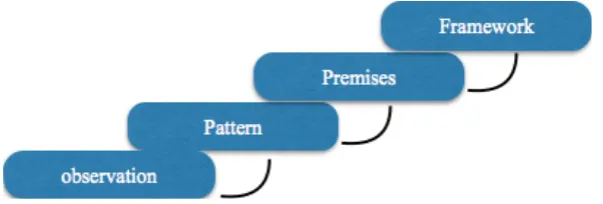
In phenomenology it is a framework that investigates the number of qualitatively different ways that people experience something or think about something. Behavior is studied and it assumes that there are always a limited number of these. This research logical approach is shown in Figure 1.2.
Figure 1.2 Research logical approach
Generally supporting the theories is a scientific method to develop and collect the interrelated concepts, which are different structures around which research can be designed and conducted like a theory but not necessarily so well worked-out. This approach guides a research, determining what things would be measured, and what logical relationships the researcher was looking for.
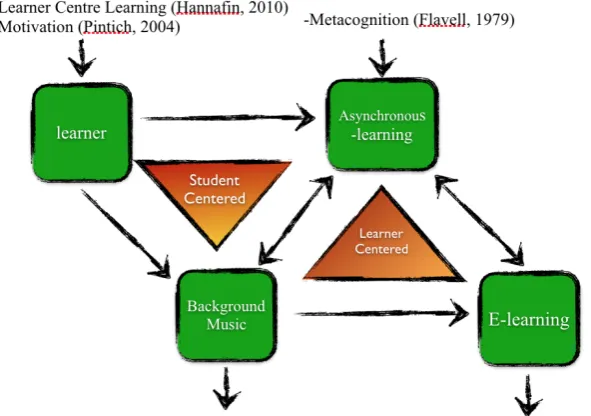
actually offer a reasonable explanation for the data. As the data is definitely derived under reasonable premises which are assumed to be true, then what else would have to be true if the premises are true would be determined. It begins with the assumption that if some learners use background music it means that they have some previous experiences and researches confirmed it in some ways but not any other ways, or with any type of music, then maybe this phenomenon must be known more specifically in order to search for ways that it could be used in other learning systems, and work from there. Thus, the considered theoretical framework considering the four main concepts of this research is shown as follow in Figure 1.3.
Figure 1.3 Theoretical Frameworks
1.7.1 Student Centered Learning
Theorists like John Dewey, Jean Piaget, and Lev Vygotsky, whose collective work focused on how students learn, have motivated to move to student-centered learning. Carl Rogers' ideas about the formation of the individual also contributed to student-centered learning. Rogers, (2009) wrote, "The only learning which significantly influences behavior is self-discovery”. Maria, a forerunner of student-centered learning, mentioned that preschool children learn through independent self-directed interaction (Kraft, 1994).
Student-centered learning, also known as learner-centered education, broadly encompasses methods of teaching that shift the focus of instruction from the teacher to the student. In original usage, student-centered learning aims to develop learner autonomy and independence by putting responsibility for the learning path in the hands of students (Hannafin, 2010). The student-centered learning environment has been shown to be effective in higher education. In Europe, it has been defined specifically within Higher Education to represent both a mindset and a culture within a given educational institution and is a learning approach which is broadly related to, and supported by, constructivist theories of learning (Wright, G. 2011).
1.7.2 Learner Centered Principles in Distance Education
Basically distance education consists of usual frameworks regarding learner-centered principles. E-learning integrates the use of communicating multimedia technology to develop individual learning, and the teacher role would be more like a facilitator.
learner-centered environments, with emphasis on the importance of personal learning preferences, which should receive individual attention (Wagner & McCombs, 1995).
1.7.3 Music and learning
Mathews (1806) proposed that operating music could pace and direct the learner from one emotional state to another. Later it was developed by others such as Gatewood (1921), Muzak and Altschuler, (referred to in Davis, 2003), and Pignatiello (1989). Some researchers suggest that listening to the music of Mozart may provoke a short-term development on the performance of some certain types of mental activities, or so called "spatial-temporal reasoning". Iwanaga (1995), McLaughlin (1970) and Sachs (1953) declared that the most relaxed or ordinary pace for music is the average heart rate (80 bpm). This is considered as the golden mean. At present most individuals are profoundly affected ranging from hormonal secretions to blood pressure, emotions and mood by the type of music which they like (Davis, 2003). Therefore, even if a piece of music has been exactly planned to organize something, if the learner doesn’t like it the effect of that music would be diminished. Thus learners should use their own favorite recordings.
Musical aptitude and musical intelligence (Gardner, & Moran, 2006) refer explicitly to music learning theory (Gordon, 2003) in the belief that students have diverse abilities for musical achievement while designing their own learning programs. According to this theory, musical aptitude is distributed among the population, with a few people having high or low musical aptitude and the majority having moderate musical aptitude.
1.7.4 Working memory model
both eyes and ears. This theory is supporting the possibility of learning through both visual and audio channels.
Cognitive system contains two different channels for receiving and processing data; the auditory or verbal channel, and visual or pictorial channel (Paivio, 1986, Baddeley, 1999). Pictures get into the cognitive system through the eyes and could operate as pictorial exposure in the visual/pictorial channel. Any other sounds like music and spoken words can go through the cognitive system by the ears and may progress as verbal demonstrations in the auditory/verbal channel. Also, Bishop and Cates (2001) claimed the theoretical foundations for use of sound in multimedia instruction. They mentioned that the full integration of sound in technology helps to gain the learners’ attention.
1.7.5 Metacognition
This higher-level cognition was given the label metacognition by American developmental psychologist John Flavell (1979). Later, some revolutionary researchers called it a survival tool across cultures (Wright, 2008). Flavell defined metacognition as knowledge about cognition and control of cognition. Metacognition includes thinking about one's own thinking process such as study skills, memory capabilities, and the ability to monitor learning. Metacognitive knowledge is about one’s own cognitive processes and understanding of how to regulate those processes to maximize learning.
Metacognition has some components such as metacognitive knowledge and metacognitive regulation. Some types of metacognitive knowledge would include:
i. Personal knowledge (declarative knowledge), which is understanding one's
own capabilities
ii. Task knowledge (procedural knowledge), which is how one perceives the
iii. Strategic knowledge (conditional knowledge), which is one's own capability
for using strategies to learn information. Young children are not particularly good at this.
Similar to metacognitive knowledge, metacognitive regulation or "regulation of cognition" contains three skills that are as follows;
iv. Planning: refers to the appropriate selection of strategies and the correct allocation of resources that affect task performance.
v. Monitoring: refers to one's awareness of comprehension and task performance
vi. Evaluating: refers to appraising the final product of a task and the efficiency
at which the task was performed. This can include re-evaluating strategies that were used (Schraw, G., 1998).
Considering rapid development in technology, change in educational and social system in all modern societies and the breakdown of traditional structures it is more important than ever that human beings know what are they and why they do things. They need to know who they are. This is called self-knowledge that plays an important role in this fast changing world. This self-knowledge is a helpful tool which could facilitate the understanding of people in ones communicative (Prashing, 2005). She believed that people with better understanding of their own and their brain’s process can utilize their brain power much better, also they have more fun doing things and above all living in greater harmony in society.
The weakness of this component is in its assessment. The assessment of metacognition is challenging for a number of reasons: it is a complex structure, cannot be directly observed, it may be confused with both working memory ability and verbal ability, and existing measures are inclined to be narrow in focus and decontextualized form in learning (Emily, 2011)
These shortages can be adequately explained from a metacognitive perspective according to phenomenological design of this research. Asking about the participant’s experience in this research enables study of the metacognitive regulation of their strategic knowledge. In addition, the sampling process in which all of the participants are postgraduate students could cover the shortage of strategic knowledge.
1.7.6 Motivation
Significant research in education has disclosed that motivational components have a great impact on student learning (Kizilgunes, et al, 2009). It has proposed that student motivation is associated to the use of students’ learning tactics, which effect their academic achievements (Pintrich, 2004). Motivation directs the learner’s thoughts, feelings and behavior toward the achievement of their goals in studying, and this was repeated by some other researchers too. (Reid, & Petocz, (2008); Seli & Bembo, (2008); Schunk, et al, (2012). Greene & Azevedo, (2007); Zimmerman & Schunk, (2001), described that students regulated their learning based on past experiences and current environment. Self-regulated learners are meta-cognitively, behaviorally, motivationally and socially effective participants in the learning process. Such a process involves developing and adjusting knowledge, skills, beliefs, strategies, behaviors and attitudes, and is influenced and identified by the learners.
i. Become dynamic learners in the learning procedures and build their own goals, meaning and strategies. For BM users it is acting as a trigger to start studying.
ii. Regulate, control and monitor specific features of their cognition, motivation, behavior and environment. This is known as metacognition skills and implies the ability to know ones knowledge and to control it for better understanding.
iii. Set goals, standards and conditions to evaluate their learning process. this is the way that users of BM monitor their learning along with. iv. Self-regulate their motivation, cognition and behavior to meditate the
connections between context, person, and performances. Finally they get to know themsleves and choose their BM styles accordingly in order to benefit from its energy.
1.8 Conceptual Framework
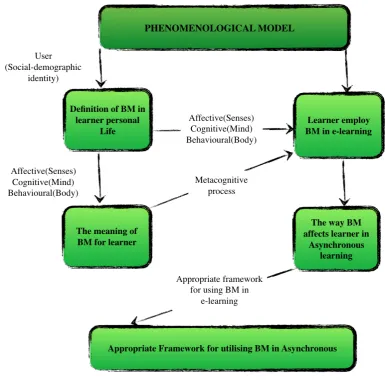
The relationship between this research aim and approach, and type of research questions provide guideline on the direction of this study. Accordingly, to facilitate the initial work of data gathering and analysis, a conceptual framework was developed by researcher as shown in Figure 1.4. This conceptual framework provides an interpretative approach to some types of learner’s life reality.
Figure 1.4 Conceptual Framework for factors influencing Asynchronous learning with background music
1.9 Significance of the Study
Identifying student’s perceptions, attitudes and demographics related to asynchronous learning and using music as the background sound for enhancing learning in education is noteworthy. A study of this phenomena and scope of this method has not been undertaken in e-learning.
special types of learners by realizing the nature of this phenomena and its effect on learning for the individuals who belong to the new generation and need a special environment for their study. Hence this technique could help them as well as other students who need to reduce their stress and those who need something in their environment to increase their level of concentration, which could be a consequence of the reduction in stress. This research also assist school administrators, higher education or the parent’s knowledge of their children. This go through methodological frameworks towards the empirical application in using background music in the realm of multimedia instruction in further use in the educational context in higher education.
Teachers who want to be successful in reaching all their students need to know about the individual learning needs as well as learning style differences, not only in their teaching but also for their preparation. When learners see that their individuality is accepted they are encouraged to learn, and when they are allowed to learn in their own way their motivation would increase, and studying become more enjoyable for them. Consequently, their study skills could improve and this positive development can boost their self-esteem.
For parents it is important to accept that their children have different learning styles in a way that their learning needs might vary far from their own. Once the parents begin to understand and support their children’s individuality about the learning and homework the interaction and communication between them can change for the better, especially during the teenage years.
1.10 Rationale of the Study
Pratt, 2001). Some results from former studies showed the influence of music on learning and other skills like mathematics, speech and language, ability to convey emotions vocally in addition to memory and attention. And, some students prefer to study with music as a motivation or other reasons.
Although so many studies have done about the effect of music on learning few studies have been done to discover how students use it in the asynchronous learning environment to improve their learning. Moreover, how they use BM in asynchronous learning environment and what are their expectations. This study is significant because it adds new research to provide such data for designing and developing a richer e-learning environment among students who likes to study with BM in their own pace. In addition, this research has far-reaching implications. One possible implication of this study is a framework for the learners who likes to use BM while they are studying in asynchronous learning environment. This framework supposes to be helpful for parents, teachers, e-learning designers, educational administrators and some learners who likes to study with BM. The findings of this study could give more recognition of this types of learners to the parents and educational administrators. Besides that, the unfold study techniques of the participants may bring some new idea for other BM users or any other interested asynchronous learner.
1.11 Operational Definition
Following are the definition of terms that is used in this research.
1.11.1 Metacognition
of metacognition: information about cognition, and regulation of cognition. (Flavell, 1979). Considering metacognition in this research represents the two process of the learner’s action during studying. It is metacognitive knowledge for them as they know about their needs and it is a metacognitive strategy because they found a way to improve their situation.
1.11.2 E-learning
For this study, e-learning is described as a learning process which is happening throughout the Internet via computer network. This involves online distance education completed over data communication networks. This research is focused mainly on using and conveying of instruction outside the limits of the classroom and the campus.
In this research the e-learner participants are university students who are participating and using the e-learning program of the university, as well as any other learning program for their studying. There are two well-known methods in e-learning; synchronous and asynchronous learning. The selected participants in this research are “Asynchronous-learners”.
1.11.3 Asynchronous Learning
and outcomes (Er et al., 2009; Harris et al., 2009; Simonson et al., 2012). Synchronous and asynchronous learning technologies are the two most common online learning types (Hrastinski, 2008; Er et al., 2009; Simonson, Smaldino, Albright, & Zvacek, 2012).
In this research asynchronous learning is a learning environment where learners are using e-learning for their study, using technologies like blogs, wikis, audio and video courses such as YouTube as well as web supported texts books for downloading assignments, regardless of any limitation or order in their own time, place and pace.
1.11.3.1 Asynchronous learning with BM
In an asynchronous learning environment participants are able to actively participate in their own learning process, they have opportunity to easily log in to an e-learning platform from any virtual location at their convenience and then download/share documents and send emails to their peers and/or teachers. Students also have the ability to spend time polishing their assignments and contributions. The asynchronous learners in this study are the types of learners who likes to study while listening to background music. This research is just about to find out how they manage BM with their asynchronous learning study time. Also non of these variables would manipulate by the researcher.
1.11.4 Background Music
The participants of this study defined the characteristics of studying with background music. They defined it in different terms according to their individual experiences. New overall definition rose up accordingly, which made this study definition of studying with background music as “Any favorable audio elements rooted in user’s culture and experience which can change their moods and emotions, and users use these capabilities to enhance their task at hand, accelerate their learning or advance their goals”.
By “Any favorable audio elements” is meant that BM could consist of any background sound, any religious citation, and sounds of nature or even broadcasting programs like TV or radio sounds.
Having background in their “personal experiences” means that all those audios were chosen purposefully to be the BM in their study times. Each of those audios once touched their feelings for a reason. The users have some memory attached to that audio. Consequently, the types of audios (BM) are very different and it was hard to find any similar patterns even between two learners among all participants.
By “cultural” the difference in the melodies are rooted in a different culture, which still affects their choice in BM selections. Language and religious citations also have a powerful impact on this selection.
By “change their moods and emotions,” it means that this audio affects their feelings and users use it or in other words this kind of energy to improve their learning.
1.11.5 Mozart Effect
the association between spatial task performance and music in 1993, the "Mozart effect" became a widespread term.
1.11.6 Phenomenology
The construct of the research study is that of a phenomenological qualitative design. Creswell (2012) defined it as a research strategy of inquiry in which the researcher identifies the essence of human experiences about a phenomenon as described by participants”.
With this methodology design this research investigate that how the e-learning users utilize BM while they are studying in online e-learning environment, regardless of the time and place limitation according to their own pace.
1.11.7 Vocal and Instrumental music
Vocal music is a type of music performed by one or more singer’s vocal music typically featured sung words called lyrics. In this research the vocal music is the representative of the music with lyrics/words.
An instrumental is a musical composition or recording without lyrics, or singing. In this study the instrumental music is music without lyrics.
1.11.8 Audio Learners
REFERENCES
Albirini, A. (2006). Teachers’ attitudes toward information and communication technologies: The case of Syrian EFL teachers. Computers & Education, 47(4), 373-398.
Allen, I. E., & Seaman, J. (2011). Going the distance: Online education in the United States, 2011. Sloan Consortium. PO Box 1238, Newburyport, MA 01950.
American Psychological Association. (2001). Publication manual of the American Psychological Association. Washington, D. C.: American Psychological Association.
Anderson, B. (2004). Recorded music and practices of remembering. Social & Cultural Geography, 5(1), 3-20.
Anderson, S., Henke, J., McLaughlin, M., Ripp, M., & Tuffs, P. (2000). Using Background Music To Enhance Memory and Improve Learning.
Baddeley, A. D. (1999).Essentials of human memory. Psychology Press.
Baddeley, A. D., Hitch, G. J., & Bower, G. H. (1974). The psychology of learning and motivation. The psychology of learning and motivation, 8, 47-90.
Barbe, Burke, W.; Swassing, H.; Milone, Michael N. (1979).Teaching through modality strengths: concepts and practices. Columbus, Ohio: Zaner-Bloser. ISBN 0883091003. OCLC 5990906.
Barber, N. L., & Barber, J. L. (2005). Jazz for Success: Alternative music therapy to enhance student development in college.Journal of College & University Student Housing,33(2), 4-9.
Bargh, J. A. (1994). The four horsemen of automaticity: Intention, awareness, efficiency, and control as separate issues.
Batt-Rawden, K., & Denora, T. (2005). Music and informal learning in everyday life. Music Education Research, 7(3), 289-304.
Becker, G. (2000). Creating comparability among reliability coefficients: The case of Cronbach alpha and Cohen kappa. Psychological reports, 87(3f), 1171-1182.
Behne, K. E. (1997). The development of" Musikerleben" in adolescence: How and why young people listen to music.
Bembo, M.H. and H. Seli. (2008). Motivation and Learning Strategies for College Success: A Self-Management Approach (3rd ed.). New York: Taylor & Francis Group, LLC
Benward, Bruce, and Marilyn Nadine Saker (2003). Music: In Theory and Practice, seventh edition, vol. 1. Boston: McGraw-Hill. ISBN 978-0-07-294262-0. Berge, Z. L., & Huang, Y. P. (2004). 13: 5 A Model for Sustainable Student
Retention: A Holistic Perspective on the Student Dropout Problem with Special Attention to e-Learning.
Berk, R. A. (2008). Use of Technology and Music to Improve Learning. Unpublished manuscript.
Berman, P. (2006). E-learning Concepts and Techniques. Institute for Interactive Technologies, Bloomsburg University of Pennsylvania, USA. http://iit. bloomu. edu/spring2006_ebook_files/ebook_spring2006. pdf.
Bever and Chiarello 1974: Bever, T. G., & Chiarello, R. J. (1974). Cerebral dominance in musicians and nonmusicians. Science, 185(4150), 537-539. Bishop, M.J., & Cates, W.M. (2001). Theoretical foundations for sounds use in
multimedia instruction to enhance learning. Educational Technology Research and Development, 49(3), 1042-1629.
Bixler, L. (2001). The status of the use of music as a counseling tool by elementary school counselors in Virginia.
Bodner, M., Muftuler, L. T., Nalcioglu, O., & Shaw, G. L. (2001). FMRI study relevant to the Mozart effect: brain areas involved in spatial–temporal reasoning.Neurological research,23(7), 683-690.
Bonny, H. L., & Savary, L. M. (1990). Music & your mind: Listening with a new consciousness. Station Hill Pr.
Bower, B. L. (2001). Distance education: Facing the faculty challenge.Online Journal of Distance Learning Administration,4(2).
Bower, B. L., & Hardy, K. P. (2004). From correspondence to cyberspace: Changes and challenges in distance education.New Directions for Community Colleges,2004(128), 5-12.
Bowman, B. J., Punyanunt-Carter, N., Cheah, T. Y., Watson, W. J., & Rubin, R. B. (2007). Does Listening to Mozart Affect Listening Ability?. The International Journal of Listening, 21(2), 124-139.
Boyce, C., & Neale, P. (2006).Conducting in-depth interviews: A guide for designing and conducting in-depth interviews for evaluation input(pp. 3-7). Watertown, MA: Pathfinder International.
Bradt, J. (2010). The effects of music entrainment on postoperative pain perception in pediatric patients.Music and Medicine,2(3), 150-157.
Brewer, C. B. (1995). Music and learning: Integrating music in the classroom. Toronto: Zephyr Press. Retrieved, March,3, 2008.
Brewer, E. W., & Burgess, D. N. (2005). Professor's role in motivating students to attend class.
Brodsky, W. (2005). The effects of metronomic pendular adjustment versus tap-tempo input on the stability and accuracy of tap-tempo perception. Cognitive Processing, 6 (2), 117 - 127.
Brown, A. R., & Voltz, B. D. (2005). Elements of effective e-learning design. The International Review of Research in Open and Distributed Learning, 6(1). Bryant-Jones, M., Shimmins, K. J., & Vega, J. D. (2003). Increasing Math
Achievement through Use of Music.
Bryant, P. E., MacLean, M., Bradley, L. L., & Crossland, J. (1990). Rhyme and alliteration, phoneme detection, and learning to read. Developmental psychology, 26(3), 429.
Bryman, A. (2008). social research methods, 3rd edition, Oxford: Oxford university Press
Calandra, B., Barron, A. E., & Thompson-Sellers, I. (2008). Audio use in e-learning: What, why, when, and how?.International Journal on ELearning,7(4), 589. Campbell, D. (2001).The Mozart effect: Tapping the power of music to heal the
body, strengthen the mind, and unlock the creative spirit. Harper Paperbacks. Cartwright, J., & Huckaby, G. (1972). Intensive preschool language
program.Journal of Music Therapy,9(3), 137-146.
Cassell, C., & Symon, G. (Eds.). (2004).Essential guide to qualitative methods in organizational research. Sage.
Cassidy, G., & MacDonald, R. A. (2007). The effect of background music and background noise on the task performance of introverts and extraverts. Psychology of Music,35(3), 517-537.
Ceci, S. J., & Williams, W. M. (1997). Schooling, intelligence, and income.American Psychologist, 52(10), 1051.
Cercone, K. (2006). Brain-based learning.Enhancing learning through technology, 293-322.
Cheek, J. M., & Smith, L. R. (1999). Music training and mathematics achievement. Adolescence, 34(136), 759-761.
Chen, N. S., Lin, K. M., & Kinshuk. (2008). Analysing users’ satisfaction with e
-learning using a negative critical incidents approach. Innovations in Education and Teaching International, 45(2), 115-126.
Cihodariu, M. (2011). A rough guide to musical anthropology. Journal of Comparative Research in Anthropology and Sociology, (1), 183-195.
Cipolla, F. J. (1979). A bibliography of dissertations relative to the study of bands and band music.Journal of Band Research,15(1), 1.
Clarke, E., Dibben, N., & Pitts, S. (2010). Music and mind in everyday life. Oxford University Press.
Cohen, A. J. (1999). The functions of music in multimedia: A cognitive approach.Music, mind, and science, 53-69.
Cohen, L. Manion, L. and Morrison, K. (2011). Research Methodology in Education. London & New York: Routledge.
Cooling, D. I. (2002). Incarnation, education and the boundaries of metaphor. Journal of Christian Education, 45(1), 7-18.
Costa-Giomi, E. (2004). Effects of three years of piano instruction on children’s academic achievement, school performance and self-esteem. Psychology of music,32(2), 139-152.
Crawford, H. J., & Strapp, C. M. (1994). Effects of vocal and instrumental music on visuospatial and verbal performance as moderated by studying preference and personality. Personality and individual differences, 16(2), 237-245. Creswell, J. (2007). Qualitative Inquiry and Research Design: Chosing Among Five
Approaches 2nd Edition. Thousand Oaks: Sage Publications.
Creswell, J. W. (2012). Qualitative inquiry and research design: Choosing among five approaches. Sage.
Crowther, G. (2012). Using science songs to enhance learning: an interdisciplinary approach. CBE-Life Sciences Education, 11(1), 26-30.
Cuban, L. (1986).Teachers and machines: The classroom use of technology since 1920. Teachers College Press.
Dalla Bella, S., Peretz, I., Rousseau, L., & Gosselin, N. (2001). A developmental study of the affective value of tempo and mode in music.Cognition,80(3), B1-B10.
Daud, S. S., & Sudirman, R. (2015, May). Effective environment for memorizing process based on electroencephalography. InControl Conference (ASCC), 2015 10th Asian(pp. 1-5). IEEE.
Davis, W. B. (2003). Ira Maximilian Altshuler: psychiatrist and pioneer music therapist.Journal of Music Therapy,40(3), 247-263.
De Groot, A. (2006). Effects of stimulus characteristics and background music on foreign language vocabulary learning and forgetting. Language Learning,56(3), 463-506.
Denzin, N. K. (1970). The Research Act in Sociology. Chicago: Aldine.
Diaz, D. P., & Cartnal, R. B. (1999). Students' learning styles in two classes: Online distance learning and equivalent on-campus. College teaching, 47(4), 130-135.
Dirkx, J. M. (2001). The power of feelings: Emotion, imagination, and the construction of meaning in adult learning.New directions for adult and continuing education,2001(89), 63-72.
Duan, Y., Li, Y., Fu, Z., & Alford, P. (2012). An empirical study on behavioural intention to reuse e-learning systems in rural China. British Journal of Educational Technology, 43(6), 933-948.
Dunlosky, J. & Bjork, R. A. (2008), Handbook of Metamemory and Memory. Psychology Press: New York.
Dunn, R. (1990). Rita Dunn Answers Questions on Learning Styles. Educational Leadership 48(2): 15-19.
Dunn, R. S. and K. J. Dunn (1992). Teaching elementary students through their individual learning styles: Practical approaches for grades 3-6. Allyn and Bacon.
Dunn, Rita and Kenneth (1978), Teaching student through their individual Learning Style: A Practical Approach. Reston, VA: Reston Publishing Co.
Edmonds, W. A., & Kennedy, T. D. (2012). An applied reference guide to research designs: Quantitative, qualitative, and mixed methods. SAGE Publications. Eklund, J. (2004). Driving the future of e-learning. In Proceedings of The Fifth
International Conference on Communication Technologies in Education, Greece.
Emily, R. L. (2011). Pearson Research Report: Metacognition: A Literature Review [interactive].[accessed on 20-09-2013].
Er, E., Özden, M., & Arifoglu, A. (2009). A blended e-learning environment: A model proposition for integration of asynchronous and synchronous e-learning. International Journal Of Learning, 16(2), pp. 449-460.
Feinstein, L., & Hammond, C. (2004). The contribution of adult learning to health and social capital. Oxford Review of Education, 30(2), 199-221.
Felder, R. M., & Brent, R. (2005). Understanding student differences. Journal of engineering education, 94(1), 57-72.
Filimon, R. C. (2010, June). Beneficial subliminal music: binaural beats, hemi-sync and metamusic. In Proceedings of the 11th WSEAS international conference on Acoustics & music: theory & applications (pp. 103-108). World Scientific and Engineering Academy and Society (WSEAS).
Fraenkel, J. R., & Wallen, N. E. 2009.How to design and evaluate research in education.
Friedman, B. (1959). An evaluation of the achievement in reading and arithmetic of pupils in elementary school instrumental music classes. New York University, School of Education
Friedman, R., Elliot, N., & Haggerty, B. (2010). E-Learning in undergraduate humanities classes: Unpacking the variables.International Journal on E-Learning,9(1), 51-77.
Fung, I. & Leung, M. Y., (2005). Enhancement of classroom facilities of primary schools and its impact on learning behaviors of students. Facilities, 23(13/14), 585-594.
Furnham and Allas (1999): Chamorro-Premuzic, T., Swami, V., Terrado, A., & Furnham, A. (2009). The effects of background auditory interference and extraversion on creative and cognitive task performance. International Journal of Psychological Studies, 1(2), p2.
Furnham, A. and K. Allass (1999). The influence of musical distraction of varying complexity on the cognitive performance of extroverts and introverts. European Journal of Personality 13(1): 27-38.
Gardner, H., & Hatch, T. (1989). Educational implications of the theory of multiple intelligences.Educational researcher,18(8), 4-10.
Gardner, H., & Moran, S. (2006). The science of multiple intelligences theory: A response to Lynn Waterhouse. Educational psychologist, 41(4), 227-232. Gaston, E. T. (1968). Music in therapy. Macmillan College.
Gatewood, E. L. (1921). An Experiment in the Use of Music in An Architectural Drafting Room. Journal of applied psychology, 5(4), 350.
Gembris, H., & Davidson, J. W. (2002). Environmental influences. The Science andphysical activity.
Giedd, J. N., Blumenthal, J., Jeffries, N. O., Castellanos, F. X., Liu, H., Zijdenbos, A., ... & Rapoport, J. L. (1999). Brain development during childhood and adolescence: a longitudinal MRI study. Nature neuroscience, 2(10), 861-863. Gill, M. J. (2014). The Possibilities of Phenomenology for Organizational Research.
Organizational Research Methods, 17:2, 118-137.
Giorgi, A. (2009). The descriptive phenomenological method in psy