
MULTIMEDIA MOBILE CONTENT DEVELOPMENT FRAMEWORK
AND METHODOLOGY FOR DEVELOPING M-LEARNING
APPLICATIONS
Wan Sazli Nasaruddin Saifudin, Sazilah Salam and Muhammad Haziq Lim Abdullah Faculty of Information and Communication Technology (FTMK), UTeM
Corresponding email: [email protected]
ABSTRACT
Mobile devices limitations such as small screen resolution, limited data space and slow processing speed pose challenges to the developers in developing good m-learning applications. Therefore, aspects such as content design, navigation design and mobile HCI are critical and need greater attention during the development phase. The purpose of this paper is to discuss a Multimedia Mobile Content Development (MMCD) Framework and Methodology for developing an effective m-Learning application that focuses on user needs. MMCD is based on the characteristic of an agile development model and by using a Flash Light (FL) technology which is widely supported by today’s mobile devices, the final output is compatible with the majorities of available mobile devices which would encourage mobile-learning activities. Focus on the object or content design and the navigation control are two development aspects that help the development of learning application via mobile device optimized.
1. INTRODUCTION
The purpose of this paper is to discuss a Multimedia Mobile Content Development (MMCD) Framework and Methodology for developing mobile learning (m-learning) application. With the advance of mobile technology and widely used of mobile devices today, m-learning has the potential to dominate the distance education as what have been achieved by electronic learning (e-learning) for the past two decades (Huang, 2007; Gimenez et al., 2009). With the advance of mobile technology and widely used devices, m-learning enables learning via mobile device at any time and any place. Unlike e-learning applications (Zhang, Li, and Bai, 2008) m-learning provide more personalized learning environment to the users. Smart phones, PDA, iPhone, iPad and Tabs are examples of mobile devices that support this learning style.
For m-learning to dominate the distance education, mobile devices limitations such as small screen resolution, limited data space and slow processing speed must be considered by the developer during the development of m-learning applications. Moreover, aspects such as content design, navigation design and mobile Human and Computer Interaction (HCI) are critical and need extra attentions during the development phase (Jimmy, 2007).
Based on our experience in developing various m-learning applications and converting e-learning to m-learning applications, we have formulated a framework and methodology for developing multimedia mobile content called MMCD. MMCD has been developed for applications to be developed using Flash Light.
In this paper, we will present MMCD as a framework and methodology for developing multimedia mobile learning application and describe how MMCD is applied in the development of a prototype called “M-Nations”. M-Nations are an m-learning application that teaches and encourages users to learn nation names and its associated flag designs. Users also are provided with general information of the nations and its different features and characteristics.
2. MMCD FRAMEWORK AND METHODOLOGY.
1. INTRODUCTION
The purpose of this paper is to discuss a Multimedia Mobile Content Development (MMCD) Framework and Methodology for developing mobile learning (m-learning) application. With the advance of mobile technology and widely used of mobile devices today, m-learning has the potential to dominate the distance education as what have been achieved by electronic learning (e-learning) for the past two decades (Huang, 2007; Gimenez et al., 2009). With the advance of mobile technology and widely used devices, m-learning enables learning via mobile device at any time and any place. Unlike e-learning applications (Zhang, Li, and Bai, 2008) m-learning provide more personalized learning environment to the users. Smart phones, PDA, iPhone, iPad and Tabs are examples of mobile devices that support this learning style.
For m-learning to dominate the distance education, mobile devices limitations such as small screen resolution, limited data space and slow processing speed must be considered by the developer during the development of m-learning applications. Moreover, aspects such as content design, navigation design and mobile Human and Computer Interaction (HCI) are critical and need extra attentions during the development phase (Jimmy, 2007).
Based on our experience in developing various m-learning applications and converting e-learning to m-learning applications, we have formulated a framework and methodology for developing multimedia mobile content called MMCD. MMCD has been developed for applications to be developed using Flash Light.
In this paper, we will present MMCD as a framework and methodology for developing multimedia mobile learning application and describe how MMCD is applied in the development of a prototype called “M-Nations”. M-Nations are an m-learning application that teaches and encourages users to learn nation names and its associated flag designs. Users also are provided with general information of the nations and its different features and characteristics.
2. MMCD FRAMEWORK AND METHODOLOGY.
MMCD consists of MMCD Framework and MMCD Methodology. The framework was design based on Flash Light (FL) technology. Figure1 shows the MMCD Framework. The MMCD component in this framework control the navigation, content managements and application logics which are the database used and quiz setup. This framework design helps the developer to speed up the development activities and also to ensure that the m-learning application developed will perform as planned.
Fig. 1 MMCD Framework
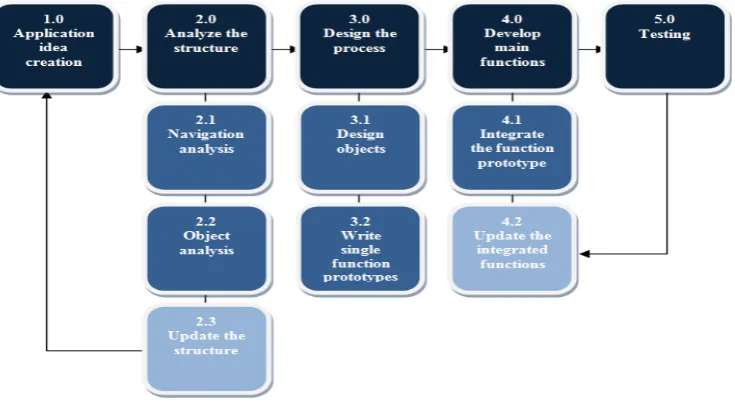
The beauty of MMCD methodology that focused on the content navigation and objects used were identified as the key characteristic. This will be explained in next section.
3. APPLICATION DEVELOPMENT
M-Nations is a m-learning application that teach and give an information’s to the user on the nations names, flag design and general information. This application was designed targeted for smart-phone and iPad users that support FL. The development is using MMCD Framework, where FL was used as the development tool. MMCD Methodology also practiced in the development process.
3.1 Application Idea Creation
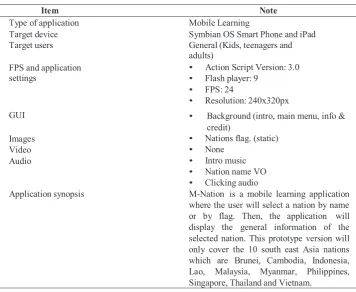
Start by preparing the check list table as show in table 1 below, the application idea creation prepares the information’s needed before the design and development of the application start.
Table 1: Application Idea Creation Check List
Item Note
Type of application Mobile Learning
Target device Symbian OS Smart Phone and iPad Target users General (Kids, teenagers and
adults) FPS and application
settings •• Action Script Version: 3.0Flash player: 9 • FPS: 24
• Resolution: 240x320px
GUI • Background (intro, main menu, info &
credit)
Images • Nations flag. (static)
Video • None
Audio • Intro music
• Nation name VO • Clicking audio
Application synopsis M-Nation is a mobile learning application where the user will select a nation by name or by flag. Then, the application will display the general information of the selected nation. This prototype version will only cover the 10 south east Asia nations which are Brunei, Cambodia, Indonesia, Lao, Malaysia, Myanmar, Philippines, Singapore, Thailand and Vietnam.
3.2 Analyze the Structure
The beauty of MMCD methodology that focused on the content navigation and objects used were identified as the key characteristic. This will be explained in next section.
3. APPLICATION DEVELOPMENT
M-Nations is a m-learning application that teach and give an information’s to the user on the nations names, flag design and general information. This application was designed targeted for smart-phone and iPad users that support FL. The development is using MMCD Framework, where FL was used as the development tool. MMCD Methodology also practiced in the development process.
3.1 Application Idea Creation
Start by preparing the check list table as show in table 1 below, the application idea creation prepares the information’s needed before the design and development of the application start.
Table 1: Application Idea Creation Check List
Item Note
Type of application Mobile Learning
Target device Symbian OS Smart Phone and iPad Target users General (Kids, teenagers and
adults) FPS and application
settings •• Action Script Version: 3.0Flash player: 9 • FPS: 24
• Resolution: 240x320px
GUI • Background (intro, main menu, info &
credit)
Images • Nations flag. (static)
Video • None
Audio • Intro music
• Nation name VO • Clicking audio
Application synopsis M-Nation is a mobile learning application where the user will select a nation by name or by flag. Then, the application will display the general information of the selected nation. This prototype version will only cover the 10 south east Asia nations which are Brunei, Cambodia, Indonesia, Lao, Malaysia, Myanmar, Philippines,
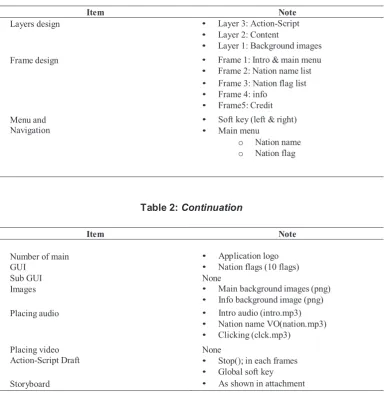
Table 2: Content Structure Check List
Item Note
Layers design • Layer 3: Action-Script
• Layer 2: Content
• Layer 1: Background images Frame design • Frame 1: Intro & main menu
• Frame 2: Nation name list • Frame 3: Nation flag list • Frame 4: info
• Frame5: Credit Menu and
Navigation •• Soft key (left & right)Main menu o Nation name o Nation flag
Table 2:Continuation
Item Note
Number of main
GUI •• Application logoNation flags (10 flags)
Sub GUI None
Images • Main background images (png)
• Info background image (png)
Placing audio • Intro audio (intro.mp3)
• Nation name VO(nation.mp3) • Clicking (clck.mp3)
Placing video None
Action-Script Draft • Stop(); in each frames • Global soft key
Storyboard • As shown in attachment
3.3 Design the Process
3.5 Testing
Application was tested using adobe device central after completed of each function scripting. Once the application was 100% completed, the SWF file was published and uploaded to the online website for distribution and user testing purpose.
4. TESTING AND RESULTS
4.1 Actual Device and User Testing
After installed on actual mobile devices, the application successfully performs as planned.
4.2 Users Feedback
The final application of M-Nations was published on website
(www.ftmk.utem.edu.my/wansazli/mnations ). Based on the feedback, most of the users are satisfied with the M-Nation application and acknowledge that the application helps them in learning more about nations in South-east Asia. Users also encourage for the full application that will cover all nations around the world and more info provided such as maps and weather info.
4.3 Results
The development of the application was completed within a day which is considered as a fast development process. The prototype version of M-Nation covers up to 10 nations. In the user’s point of view, results show that the application did help them in increasing their general knowledge of the nations worldwide. Not only do the users can learn about the national name, general info and flag design, users are also able to use this application and learn at any place and at any time.
From the development point of view, the results show that by using MMCD framework and methodology, the development process can be completed in a shorter duration of time and incur less problems that required the development team to reconstruct or redevelop the application. Focus on the navigation and object design at the early stage was identified as the key reason for the successful development of the application. The processing usage and data space usage also was optimized.
5. CONCLUSION
3.5 Testing
Application was tested using adobe device central after completed of each function scripting. Once the application was 100% completed, the SWF file was published and uploaded to the online website for distribution and user testing purpose.
4. TESTING AND RESULTS
4.1 Actual Device and User Testing
After installed on actual mobile devices, the application successfully performs as planned.
4.2 Users Feedback
The final application of M-Nations was published on website
(www.ftmk.utem.edu.my/wansazli/mnations ). Based on the feedback, most of the users are satisfied with the M-Nation application and acknowledge that the application helps them in learning more about nations in South-east Asia. Users also encourage for the full application that will cover all nations around the world and more info provided such as maps and weather info.
4.3 Results
The development of the application was completed within a day which is considered as a fast development process. The prototype version of M-Nation covers up to 10 nations. In the user’s point of view, results show that the application did help them in increasing their general knowledge of the nations worldwide. Not only do the users can learn about the national name, general info and flag design, users are also able to use this application and learn at any place and at any time.
From the development point of view, the results show that by using MMCD framework and methodology, the development process can be completed in a shorter duration of time and incur less problems that required the development team to reconstruct or redevelop the application. Focus on the navigation and object design at the early stage was identified as the key reason for the successful development of the application. The processing usage and data space usage also was optimized.
duration of time, but has also indicated optimized processing usage, data space and user acceptance. The development team faced minimal problems during the development activities which indicate practical significance of the MMCD framework and methodology. For future works, m-learning applications will be developed that has more activities such as quiz and test, and the use of video as the learning objects would be included to enhance the learning experience which is expected to promote m-learning achievements.
ACKNOWLEDGMENT
Mobile Technology Research Group, Faculty of Information and Communication Technology (FTMK), Universiti Teknikal Malaysia Melaka (UTeM) and Hijrah Jitu Sdn Bhd.
REFERENCES
Gimenez, J.L., Magal Royo, T., Garcia Laborda, J. and Garde Calvo, F. (2009). Methods of Adapting Digital Content for the Learning Process Via Mobile Devices. Procedia Social and Behavioral Sciences 1, Elsevier.
Huang, Z. (2007). The Integration and Realization of the Modern Re-Education and Mobile Education System. University of JINAN, Mei.
Jimmy D. Clark. (2007). Learning and Teaching in Mobile Learning Environment of 21st Century. April 2007. Zhang, P., Li, B. and Bai, Q. (2008). The Design of e-Learning Platform Based on 3G Mobile Phone.
![Ethyl (1R,4S,5R,9S,10R,13S) 5,9,13 trimethyl 14 methylene 14 oxotetracyclo[11 2 1 01,10 04,9]hexadecane 5 carboxylate](data:image/gif;base64,R0lGODlhAQABAIAAAP///wAAACH5BAEAAAAALAAAAAABAAEAAAICRAEAOw==)