Security Analysis of Quantization Schemes for
Channel-based Key Extraction
Christian T. Zenger, Jan Zimmer, Christof Paar
Horst Görtz Institute for IT-Security (HGI), Ruhr-University Bochum, Germany
{christian.zenger, jan.zimmer, christof.paar}@rub.de
ABSTRACT
The use of reciprocal and random properties of wireless chan-nels for the generation of secret keys is a highly attractive option for many applications that operate in a mobile envi-ronment. In recent years, several practice-oriented protocols have been proposed, but unfortunately without a sufficient and consistent security analysis and without a fair compari-son between each other. This can be attributed to the fact that until now neither a common evaluation basis, nor a security metric in an on-line scenario (e.g., with changing channel properties) was proposed. We attempt to close this gap by presenting test vectors based on a large measurement cam-paign, an extensive comparative evaluation framework (in-cluding ten protocols as well as new on-line entropy estima-tors), and a rigorous experimental security analysis. Further, we answer for the first time a variety of security and
perfor-mance related questions about the behavior of10
channel-based key establishment schemes from the literature.
Categories and Subject Descriptors
C.2.0 [Computer-Communication Networks]: Security and
Protection
Keywords
Channel-based key extraction, physical layer security, practice-oriented protocols, quantization schemes, on-line entropy estimation, security analysis
1.
INTRODUCTION
Key agreement systems based on correlated observations, such as common channel estimations, have received much attention in recent years due to their information-theoretical security properties. Compared to traditional public-key based approaches they can have a lower complexity and are resistant
against (future) quantum computer attacks. Channel-based key establishment (CBKE) introduced by Hershey et al. [9] is a new approach for generating symmetric secret keys for two (or more) wireless communicating parties, where-by the key material is unique for a given point in time and space, and cannot be easily obtained by others. One major advan-tage of CBKE is the new possibility for dynamic key man-agement without a complex infrastructure (e.g., public-key infrastructure or Kerberos-like key servers). In addition to the reduced system complexity, CBKE also has the advan-tage of not having a single point of failure. It has many possible uses for wireless communication devices and has also been investigated as a potential lightweight solution for cyber-physical and Internet of Things (IoT) devices, which are primarily formed by (small) embedded systems. How-ever, it has been found that the security features of some CBKE designs are too weak or are based on broad channel abstractions which are not realistic.
The classical system model for channel-based symmetric key extraction schemes is based on the following scenario.
Twokeying nodes, AliceAand BobB, plan to extract a
sym-metric key for secure communication while an eavesdropper,
EveE, capable of observing information, e.g., information
for error correction, and measuring the channels between herself and the two communicating nodes, tries to recover the secret key (please refer to Figure 1 for illustration). We assume that A and B do not share any mutual information (e.g., shared keys) a priori.
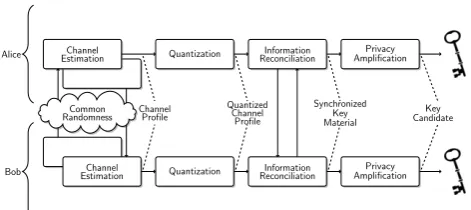
The generic four-phase security architecture for generat-ing secret symmetric keys from correlated random channel measurements is illustrated in Figure 2. Commonly mea-sured channel profiles are quantized into bit vectors to obtain initial preliminary key material. The non-perfect reciprocity in measurement in addition with noise leads to errors in the bit vectors of the preliminary key material. These errors are detected and corrected during the information reconciliation stage by using error correcting techniques. Since informa-tion for error correcinforma-tion has to be exchanged over the chan-nel during the information reconciliation stage, the remain-ing entropy is distributed over the key material in the privacy amplification stage.
A common way to evaluate the security of practice-oriented
MOBIQUITOUS 2015, July 22-24, Coimbra, Portugal Copyright © 2015 ICST
A B E
hAB(t)
hBA(t)
hAE
(t) hBE
(t)
Figure 1: System model: Legitimate nodesAandB
mea-sure reciprocal properties of the physical channel, denoted
byhBA(t)andhAB(t). A passive attackerE’s observations
hAE(t)andhBE(t)are dependent on its relative position
and usually correlate less tohBA(t)andhAB(t)thanhBA(t)
tohAB(t).
schemes in the past has been to perform (extensive) channel measurement campaigns with respect to legitimate partici-pants and potential passive adversaries, succeeded with an analysis of the goodness of the preliminary key material ap-plying off-line statistical tests [11, 10, 12, 1, 15]. However, although the low probability of success for potential passive attacks on quantization schemes was demonstrated based on individual experimental measurements (e.g., by [2, 3, 11, 10, 8, 12, 1, 15, 16]), little attention has been paid to a se-cure CBKE scheme against active attackers (i.e. active con-trol over the environment, not actively altering the channel, e.g., by jamming) exploiting low entropy environments.
1.1
Contributions
We apply a security analysis of all (to the best of the au-thors’ knowledge) published works on practice-oriented pro-tocols for channel-based key extraction. We extend the
clas-sical adversary model1 of two passive attackers (P1,P2) by
an active adversary: (P1) The attacker measures correspond-ing channel profiles between legitimate parties and itself. Usually the assumption is given that (partial) access to the random source is dependent on the physical position of the attacker. (P2) The attacker exploits possible statistical de-fects in combination with public information (i.e., parame-ters of the scheme as well as eavesdropped communication). The distance from which the attacker can eavesdrop the com-munication on the channel has to be assumed big and may even work outside the connection range of network speci-fications. (A) The attacker is capable of manipulating the environment or to force one or both legitimate parties into an artificial environment, e.g., using a Faraday cage to arti-ficially build a static scenario. The aim of the attacker is to determine the symmetric key material by exploiting statisti-cal defects of the used key extraction scheme. The attacker thereby does not alter the channel directly, e.g., by jamming techniques.
Therefore, we present a framework to evaluate and
com-1
We do not consider impersonating orman-in-the-middle(MITM) attacks, which are based on unauthenticated relationships. We also do not considerrandom number generator(RNG)-manipulation at-tacks ordenial of service(DoS) attacks. The adversary knows the whole key generation protocol and the values of the parameters.
Common Randomness
Channel
Estimation Quantization ReconciliationInformation
Privacy Amplification
Channel
Estimation Quantization ReconciliationInformation
Privacy Amplification Channel
Profile
Quantized Channel
Profile
Synchronized Key Material
Key Candidate Alice
Bob
Figure 2: Overview of the core components involved in the security architecture for key agreement systems from corre-lated observations.
pare channel-based key extraction schemes. Further, we pre-sent simulation results related to performance and security trade-offs and compare those with results from real-world measurements, which might help to select an appropriate quantization scheme. For substantiating analyses, an ex-tensive experimental measurement campaign, covering sev-eral real-world use cases, was performed. We show that it needs to be assumed that changes in the environments are both statically and dynamically, which in turn influences the statistical agility (and so the goodness) of the source of ran-domness. We introduce security validation based on on-line entropy estimation as a possible approach to cover those se-curity issues by constant evaluation of the goodness of the source of randomness as an extension to the off-line entropy estimation and statistical tests proposed in the literature.
1.2
Related Work
Jana et al. [10] and Premnath et al. [13] proposed the first analysis of several quantization schemes introducing entropy estimations. Both evaluated several schemes [11, 2, 14, 3, 10]. They analyzed the statistical properties off-line by cal-culating the Shannon entropy. As the entropy of the key material may decrease due to changes in the environment, solely applying such estimations off-line may not be suffi-cient for security applications.
A theoretical analysis of the ’BDR2 vs. PEARSON
corre-lation coefficient’ behavior of several quantization schemes [14, 2, 11, 10, 1] was introduced by Guillaume et al. [7].
Our work extends those of [10, 13, 7] by (1) analyzing
the ’BDR vs. PEARSONcorrelation coefficient’ behavior of
further recent practice-oriented protocols via simulation, (2)
introducing a real-world-based evaluation strategy of10
pro-tocols, (3) demonstrating experimental validation of indoor channels decorrelation behavior, and (4) introducing results of on-line entropy estimation for security level verification.
2
Thebit disagreement rate(BDR) indicates the percentage of bits that are in disagreement between the initial key material of Alice and Bob. With decreasing BDR, the effort needed to detect and correct errors decreases as well. BDR is evaluated after quantiza-tion by the relaquantiza-tion:BDR = be
b, wherebeis the number of bits in
2.
PRACTICE-ORIENTED QUANTIZATION
PROTOCOLS UNDER TEST
As mentioned above, bothAandB quantize their
chan-nel profiles (usually a vector ofreceived signal strength
in-dicator (RSSI) samples) into digital vectors to obtain
pre-liminary key material. A number of algorithms for quan-tization have been shown in the literature and are divided into two categories: lossless and lossy quantization schemes.
Lossless quantization maps every sample to an-bit symbol
whereas lossy quantization schemes may drop certain sam-ples in favour of a more robust key generation and to main-tain a high bit entropy. The original intention was that the output stream could be used directly as a shared symmetric key without using posterior information reconciliation and privacy amplification.
Severallossyschemes are based on a guard interval[q+, q−],
whereq+andq−denote the upper and lower threshold,
re-spectively. Samples within the interval are dropped. The selection of scheme-parameters affects the output rate and probability of errors. Also, lossy schemes need to
communi-cate to select samples and increase the robustness of theirkey
generation. However, Edman et al. [6] stated that such rec-onciliation requires interaction that may result in potentially
zeroing the conditional entropy3 and Eberz et al. [5]
suc-cessfully attacked a guard-band-based quantization scheme, demonstrating that strong characteristics may be observed by a passive adversary.
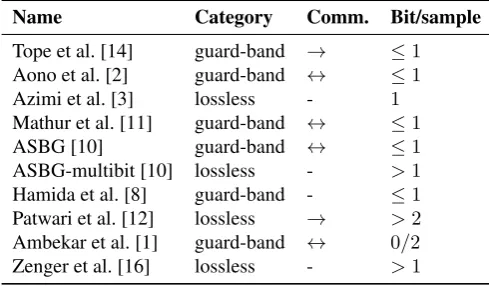
Lossless schemes do not lose valuable information due to the processing of the whole measurement and are not only based on strong channel characteristics. Therefore, possi-ble channel prediction attacks do not compromise the entire key material. Further, some lossless schemes do not require communication and therefore impede the work of an attacker since no information on the internal process is revealed. Ta-ble 1 provides an overview on current schemes for physical-layer key extraction. The table is sorted chronologically.
3
Here the conditional entropy is defined as the leftover entropy contained in the initial key material after revealing some informa-tion by communicainforma-tion of the quantizainforma-tion scheme.
Table 1: Details of the covered quantization schemes.
Name Category Comm. Bit/sample
Tope et al. [14] guard-band → ≤1
Aono et al. [2] guard-band ↔ ≤1
Azimi et al. [3] lossless - 1
Mathur et al. [11] guard-band ↔ ≤1
ASBG [10] guard-band ↔ ≤1
ASBG-multibit [10] lossless - >1
Hamida et al. [8] guard-band - ≤1
Patwari et al. [12] lossless → >2
Ambekar et al. [1] guard-band ↔ 0/2
Zenger et al. [16] lossless - >1
0.1 0.2 0.3 0.4 0.5 0.6 0.7 0.8 0.9 1 0
0.1 0.2 0.3 0.4 0.5
Correlation Coefficient
Bit
Disagreement
Rate
Zenger et al. Tope et al. Patwari et al.
ASBG-MB Hamida et al.
Azimi et al. Ambekar et al.
ASBG Mathur et al.
Aono et al.
Figure 3: Bit disagreement rate versus correlation coefficient for different quantization schemes.
0.1 0.2 0.3 0.4 0.5 0.6 0.7 0.8 0.9 1 0
0.5 1 1.5 2
Correlation Coefficient
Initial
K
ey
Generation
Rate
Zenger et al. Tope et al. Patwari et al.
ASBG-MB Hamida et al.
Azimi et al. Ambekar et al.
ASBG
Figure 4: Initial key generation rate versus correlation coef-ficient for different quantization schemes.
To evaluate and compare quantization schemes, we
im-plemented the10protocols in Matlab and applied a
Monte-Carlo simulation environment, as proposed in [7]. Two
inde-pendent random sequences of length1 000 000are modeled
as temporally correlated Rayleigh-distributed random vari-ables. The maximum Doppler shift specifies the assumed Jakes Doppler spectrum. To achieve a quantitive measure
for the grade of reciprocity, we defineραβ ∈ [0,1]as the
correlation coefficient between the channel measurements of two nodes. Figure 3 and 4 present the simulation results of the performance analysis of the quantization schemes sum-marized in Table 1. Thereby, the change of BDR over
corre-lation coefficient is shown as well as the change of theinitial
key generation rate4(IKGR) as the two major performance
metrics. The IKGRIKGRquantizer=
|q|
|h|is defined as the
av-erage ratiof racqkof the length of the emitted bit streamq
and the number of samples provided as an inputh.
3.
SECURITY ANALYSIS
We implemented a common channel measurement pro-cess on the hardware platform Raspberry Pi. This tiny com-puter is universally deployable with a Linux-based
operat-4
0 200 400 600 800 1,000 0.2
0.4 0.6 0.8 1
Blocks of 2048 RSSI-Samples
P
earson
Correaltion
BlockwiseρAB
BlockwiseρBE
ρAB= 0.98
ρBE= 0.49
Histograms
of
ρ
AB
and
ρ
B
E
0 0.2 0.4 0.6 0.8 1 0
50 100 150 200 250
Pearson Correlation
Amoun
t
0 0.2 0.4 0.6 0.8 1 0
20 40 60 80 100 120 140 160
Pearson Correlation
Amoun
t
(a) Correlation over time and its histograms.
0 200 400 600 800 1,000
0.2 0.4 0.6 0.8 1
Blocks of 2048 Samples
BDR
BlockwiseBDRAB
BlockwiseBDRBE
BDRAB= 0.14
BDRBE= 0.45
Histograms
of
B
D
R
AB
and
B
D
R
B
E
0 0.1 0.2 0.3 0.4 0.5 0
20 40 60 80 100 120
BDR
Amoun
t
0 0.1 0.2 0.3 0.4 0.5 0
20 40 60 80 100
BDR
Amoun
t
(b) BDR over time and its histograms.
Figure 5: Evaluation results for: (a) correlation coefficient over time. Alice and Bob with strong correlated signals. After
block1000, the motion of the measurement platform stopped, with the result of low correlation. Eve and Bob achieve weak
correlated signals. (b) BDR over time, applying ASBG-multibit quantization [10]. Alice and Bob with relatively low BDR;
Eve and Bob with BDR around0.5.
ing system and flexible expansion options. We equipped the
computer with a TP-Link TLWN722N wireless USB adapter,
utilizing IEEE802.11g and providing RSSI values on a per
packet basis, as well as a battery for mobility. The setup is specifically designed to obtain synchronized measurements
between three parties (3×bidirectional estimations) within
r−1
p ≤5 mswith a sampling interval ofr−s1≈10 ms.
In the present paper, we focused on the following indoor
setups:Awas positioned on arandomly moving robotic
plat-form(RMRP).AandB are separated by a distance of
ap-proximately10 mwith a standard deviation of4.6 m. To
an-alyze the performance of an attacker in relation to his prox-imity in a continuous manner, we let a potential passive
at-tackerEconstantly move towardsBfrom a distance of30 cm
to0 cmwith a speed of7centimeters per hour. Thereby, the
change of correlation over distance is evaluated.
3.1
Results
To compare the performance of different algorithms, we agree on mutual metrics. In this section, we will provide an overview on the metrics that will be used for our evaluation. In the past, researchers (e.g., [2, 12, 8]) have estimated the
reciprocity of their gathered channel data using the PEAR
-SON correlation coefficientρ. Because in our opinion one
single correlation value over the entire measurement is not convincing (please refer to Figure 5(a)), we evaluate chan-nel reciprocity by computing the Pearson correlation coef-ficient blockwise. This gives us the ability to evaluate the reciprocity over time. This is advantageous since channel data may include stationary as well as dynamic sequences which is reflected using this visualization. The protocol pro-cessing is as well done blockwise - therefore the metric of choice for practice oriented evaluation may be in blocks.
The potential success of a passive attackerE(estimating
the channel fromAto B) was evaluated for a distance of
30 cm, as described before. For the metric of success we
0 1 2 3 4 5 6 7 8 9 10 11 12 13 14 15 16 17 18 19 20 21 22 23 24 25 26 27 28 29 30 0.1
0.2 0.3 0.4
cm
P
earson
Correlation
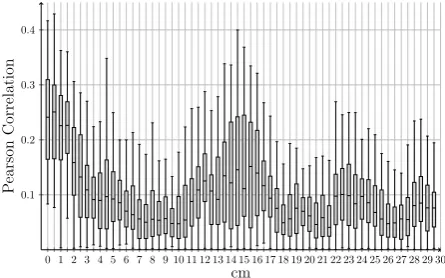
Figure 6: Correlation over distance for a potential attacker.
again chose the blockwise PEARSONcoefficient. The
eval-uation results are illustrated in Figure 6. Very characteristic are the recurring correlation rises at a distance of
approxi-matelyλ/2andλ, whereλ= 12.5 cmis the wavelength of
the carrier. Nevertheless, a potential attacker in our scenario achieves a correlated observation of the channel profiles with a PEARSONcoefficient not higher than0.45.
To achieve initial key material with a maximum of se-cret information concerning a passive adversary, the BDR between a potential eavesdropper and Alice or Bob should
be0.5. We present a blockwise evaluation approach in
Fig-ure 5(b). Based on all data of the large measFig-urement
cam-paign (with approximately 112 hoursof measurement and
40 000 000 RSSIvalues per channel) we evaluated the BDR
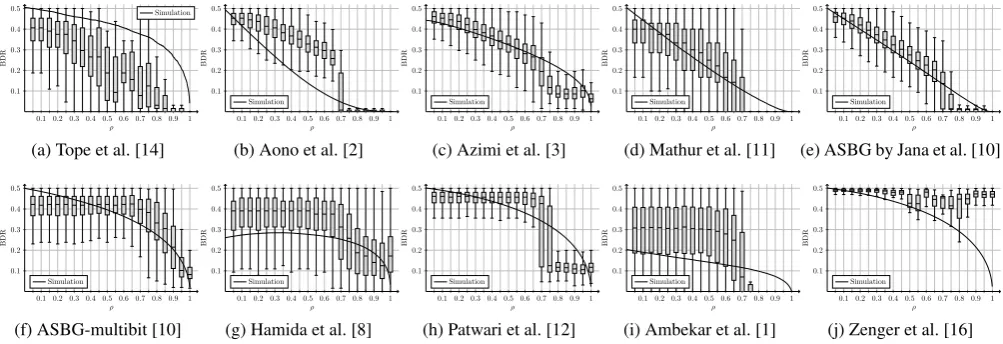
versus the correlation coefficient. Therefore, we calculated the blockwise correlation as well as the corresponding block-wise BDR and sorted those by correlation value. Further, we calculated the BDR distribution for the following subgroups: [0 : 0.05,0.05 : 0.1, ...,0.95 : 1]. Figure 7(a)-(j) displays the
0.1 0.2 0.3 0.4 0.5 0.6 0.7 0.8 0.9 1 0.1
0.2 0.3 0.4 0.5
ρ
BDR
Simulation
(a) Tope et al. [14]
0.1 0.2 0.3 0.4 0.5 0.6 0.7 0.8 0.9 1 0.1
0.2 0.3 0.4 0.5
ρ
BDR
Simulation
(b) Aono et al. [2]
0.1 0.2 0.3 0.4 0.5 0.6 0.7 0.8 0.9 1 0.1
0.2 0.3 0.4 0.5
ρ
BDR
Simulation
(c) Azimi et al. [3]
0.1 0.2 0.3 0.4 0.5 0.6 0.7 0.8 0.9 1 0.1
0.2 0.3 0.4 0.5
ρ
BDR
Simulation
(d) Mathur et al. [11]
0.1 0.2 0.3 0.4 0.5 0.6 0.7 0.8 0.9 1 0.1
0.2 0.3 0.4 0.5
ρ
BDR
Simulation
(e) ASBG by Jana et al. [10]
0.1 0.2 0.3 0.4 0.5 0.6 0.7 0.8 0.9 1 0.1
0.2 0.3 0.4 0.5
ρ
BDR
Simulation
(f) ASBG-multibit [10]
0.1 0.2 0.3 0.4 0.5 0.6 0.7 0.8 0.9 1 0.1
0.2 0.3 0.4 0.5
ρ
BDR
Simulation
(g) Hamida et al. [8]
0.1 0.2 0.3 0.4 0.5 0.6 0.7 0.8 0.9 1 0.1
0.2 0.3 0.4 0.5
ρ
BDR
Simulation
(h) Patwari et al. [12]
0.1 0.2 0.3 0.4 0.5 0.6 0.7 0.8 0.9 1 0.1
0.2 0.3 0.4 0.5
ρ
BDR
Simulation
(i) Ambekar et al. [1]
0.1 0.2 0.3 0.4 0.5 0.6 0.7 0.8 0.9 1 0.1
0.2 0.3 0.4 0.5
ρ
BDR
Simulation
(j) Zenger et al. [16]
Figure 7: Evaluation results based on real-world measurements for different quantization schemes. The bit disagreement rate
versus correlation coefficientρis presented.
coefficient of the preliminary key material. For better com-parison we also plotted the simulation results from Section 2. The BDR distributions of the real-world measurements are almost always similar to the pattern of the simulation. Stronger differences are given for the scheme of Aono et al. [2] and Zenger et al. [16]. Note that increasing the num-ber of evaluated blocks may further improve the results. Fur-ther, our results show that the schemes by Hamida et al. [8]
and Ambekar et al. [1] do not lead to a BDR of0.5for low
correlated channel profiles. This leads to a serious security problem, in so far as even with totally uncorrelated mea-surements an adversary may recover partial information of the initial key material. The schemes introduced by Jana et al. [10], Azimi et al. [3] and Mathur et al. [11] show almost linear decrease of BDR with increasing correlation. As this linear behavior lets an adversary learn a lot of secret infor-mation already with reasonably good correlations, this could corrupt the security of the scheme. The scheme of Zenger et al. [16] shows strong security properties for potential attack-ers with low correlated observations, however it also shows very bad performance for highly correlated channel profiles. The scheme by Tope et al. [14] shows good simulation re-sults, however, it produces wide-spreaded real-world values which prevent the tight definition of boundaries. The scheme by Aono et al. [2] shows different behavior between simula-tion and real-word evaluasimula-tion. In the real-world scenario, the scheme seems to have pretty good performance. This is also true for the schemes by Jana et al. [10] and Patwari et al. [12] The shape of the distributions of schemes show the wanted results: high BDR for low correlations and low BDR for high correlations without a fluent transition between both. The scheme by Patwari et al. [12] seems to have the best property with its abrupt change of BDR at a high correlation as it means that an adversary with lower correlation will not learn any information while both parties gather almost the same information if they have relatively correlating channel
measurements.
The results of the on-line bit entropy estimation of the preliminary key material over time are given in Figure 8(a).
Here the draft 800−90B of NIST [4] is applied and the
worst-case estimation result of the five tests is used, as rec-ommended by the draft. We investigated if those tests are applicable in an on-line scenario in terms of performance and implemented them. As we already stated, the on-line estimation ensures the current security level by responding to statistical defects of the material. As an example we eval-uated the influence of the channel sampling rate.
Because of the high channel sampling ratersof100 Hz, the
key material is highly correlated in time and therefore the estimated entropy is relatively low. Reducing the sampling rate (applying downsampling in our framework) helps to find the optimal sampling rate at the maximum estimated entropy as demonstrated in Figure 8(b). Interesting to mention are the different behaviors of the different quantisation schemes. This may be because of statistical defects of the schemes itself or because, the amount of input material, and/or the sample selectivity of the (lossy) scheme.
4.
CONCLUSION
lit-0 5,000 10,000 15,000 0
0.2 0.4 0.6 0.8 1
Blocks of 128 Samples
En
trop
y
Ambekar Aono Azimi ASBG ASBG-MB Tope
Hamida Patwari Mathur Zenger
(a)
21 22 23 24 25 26 27
0 0.2 0.4 0.6 0.8 1
Downsampling factor
(b)
Figure 8: Evaluation results based on the real-world setups
1−12of all quantization schemes for (a) estimated
min-entropy over time (b) on-line min-entropy estimation for different downsampling factors.
erature. Therefore, we introduced on-line entropy
estima-tion as an evaluaestima-tion basis. Our results include40million
common channel estimations for a three party model from an extensive measurement campaign. In addition, we stated general problems of key agreement systems, presented a set of criteria for selecting quantization schemes, and demon-strated the results of a rigorous evaluation strategy. We found that in two cases the quantization schemes lead to a signifi-cant statistical defect and named promising schemes.
5.
REFERENCES
[1] A. Ambekar, M. Hassan, and H. D. Schotten. Improving channel reciprocity for effective key
management systems. InISSSE. IEEE, 2012.
[2] T. Aono, K. Higuchi, T. Ohira, B. Komiyama, and H. Sasaoka. Wireless secret key generation exploiting reactance-domain scalar response of multipath fading
channels.Antennas and Propagation, IEEE
Transactions on, 53(11):3776–3784, 2005.
[3] B. Azimi-Sadjadi, A. Kiayias, A. Mercado, and B. Yener. Robust key generation from signal envelopes in wireless networks. In P. Ning, S. D. C. di Vimercati,
and P. F. Syverson, editors,Proceedings of the 2007
ACM Conference on Computer and Communications Security, CCS 2007, Alexandria, Virginia, USA,
October 28-31, 2007, pages 401–410. ACM, 2007.
[4] E. Barker and J. Kelsey. NIST DRAFT Special Publication 800-90b recommendation for the entropy sources used for random bit generation. 2012. [5] S. Eberz, M. Strohmeier, M. Wilhelm, and
I. Martinovic. A practical man-in-the-middle attack on signal-based key generation protocols. In S. Foresti,
M. Yung, and F. Martinelli, editors,Computer Security
- ESORICS ’12, Pisa, Italy, September 10-12, 2012.
Proceedings, volume 7459 ofLecture Notes in
Computer Science, pages 235–252. Springer, 2012.
[6] M. Edman, A. Kiayias, Q. Tang, and B. Yener. On the security of key extraction from measuring physical
quantities.CoRR, abs/1311.4591, 2013.
[7] R. Guillaume, A. Mueller, C. T. Zenger, C. Paar, and A. Czylwik. Fair comparison and evaluation of quantization schemes for phy-based key generation.
OFDM 2014, 2014.
[8] S. T. B. Hamida, J. Pierrot, and C. Castelluccia. An adaptive quantization algorithm for secret key generation using radio channel measurements. In K. A. Agha, M. Badra, and G. B. Newby, editors,
NTMS 2009, Cairo, Egypt, pages 1–5. IEEE, 2009.
[9] J. E. Hershey, A. A. Hassan, and R. Yarlagadda. Unconventional cryptographic keying variable
management.IEEE Transactions on Communications,
43(1):3–6, 1995.
[10] S. Jana, S. N. Premnath, M. Clark, S. K. Kasera, N. Patwari, and S. V. Krishnamurthy. On the effectiveness of secret key extraction from wireless signal strength in real environments. In K. G. Shin, Y. Zhang, R. Bagrodia, and R. Govindan, editors,
Proceedings of the 15th Annual International Conference on Mobile Computing and Networking, MOBICOM 2009, Beijing, China, September 20-25,
2009, pages 321–332. ACM, 2009.
[11] S. Mathur, W. Trappe, N. Mandayam, C. Ye, and A. Reznik. Radio-telepathy: Extracting a Secret Key from an Unauthenticated Wireless Channel. In
MobiCom 2008, pages 128–139. ACM, 2008.
[12] N. Patwari, J. Croft, S. Jana, and S. K. Kasera. High-rate uncorrelated bit extraction for shared secret
key generation from channel measurements.IEEE
Trans. Mob. Comput., 9(1):17–30, 2010.
[13] S. N. Premnath, S. Jana, J. Croft, P. L. Gowda, M. Clark, S. K. Kasera, N. Patwari, and S. V. Krishnamurthy. Secret key extraction from wireless
signal strength in real environments.IEEE Trans.
Mob. Comput., 12(5):917–930, 2013.
[14] M. A. Tope and J. C. McEachen. Unconditionally secure communications over fading channels. In
Military Communications Conference, 2001.
MILCOM 2001. Communications for Network-Centric
Operations: Creating the Information Force. IEEE,
volume 1, pages 54–58. IEEE, 2001.
[15] C. T. Zenger, A. Ambekar, F. Winzer, T. Pöppelmann, H. D. Schotten, and C. Paar. Preventing scaling of successful attacks: A cross-layer security architecture
for resource-constrained platforms. InAdvances in
Cryptology - BalkanCryptSec ’14, Istanbul, Turkey,
October 16-17, 2014, Proceedings.
[16] C. T. Zenger, M.-J. Chur, J.-F. Posielek, G. Wunder, and C. Paar. A novel key generating architecture for
wireless low-resource devices. InInternational
Workshop on Secure Internet of Things (SIoT),