[
Barukab* and S. H. Behiry, 4(4): April, 2017
]
ISSN: 2349-5197
Impact Factor: 2.715
I
NTERNATIONAL
J
OURNALOF
R
ESEARCH
S
CIENCE&
M
ANAGEMENT
A NOVEL ENCRYPTION AND DECRYPTION SCHEME FOR DIGITAL SIGNALS
USING BERNSTEIN POLYNOMIALS
Omar M. Barukab
*1and S. H. Behiry
2*1
Depratment of Information Technology, Faculty of Computing and Information Technology
2
Department of Computer Science, Faculty of Computing and Information Technology
DOI: 10.5281/zenodo.546860
Keywords
:
Bernstein polynomial, encryption, decryption, nonsingular matrix, invertible matrix, Moore machine.Abstract
The security of communications and electronic commerce in the digital era relies heavily on the modern incarnation of the ancient art of code and different forms of ciphers. Mathematics play the main rule in this realm. In this paper, a novel encryption scheme is proposed. It is mainly based on the usage of long key size and the incorporation of recurrence relations in conjunction with Moore finite state machine. In addition, the usage of Bernstein polynomial in accomplishing the encryption and decryption represents an additional layer of security to the proposed encryption scheme.
Introduction
[
Barukab* and S. H. Behiry, 4(4): April, 2017
]
ISSN: 2349-5197
Impact Factor: 2.715
I
NTERNATIONAL
J
OURNALOF
R
ESEARCH
S
CIENCE&
M
ANAGEMENT
Xˆ
Yˆ
Notations
The notations adopted in this paper will as follows:
p represents the pliantext message, kn n − bits key used for encryption,
⇒ secrure channel, Rn recurrence relation.
[
Barukab* and S. H. Behiry, 4(4): April, 2017
]
ISSN: 2349-5197
Impact Factor: 2.715
I
NTERNATIONAL
J
OURNALOF
R
ESEARCH
S
CIENCE&
M
ANAGEMENT
Xˆ
Yˆ
⇒
n
k
n
k
Literature Review
An attempt to realize a public key cryptosystem using FPGA based on the usage of finite state machines was presented in [3]. Another attempt of using recurrence relations to cryptography by using finite state machine was shown in [4]. The work presented herein is an enhancement of the work accomplished in [2], where Bernstein polynomial is used in conjunction with the recurrence relations and Moore finite state machine. The inherent security of this novel scheme stemmed from the fact that the usage of Bernstein polynomial is adding an extra layer of security to the proposed encryption scheme. The science of cryptography is widely discussed in the available literature [5-12]. An abstract level of computer system security breaches and the quantification of the top event of interest can be found in [13-14]. Fault-tree analysis was used as an analytical tool for the quantification process.
Bernstein Polynomials and Moore Machine
This section presents both Bernstein polynomials and Moore machine briefly as follows.
Polynomials
The Bernstein polynomials [15] are some of the most important and very useful polynomials. Bernstein polynomials of n-th degree are defined on the closed interval [0, 1] as follows:
𝐵𝑖,𝑛(𝑡) = (
𝑛
𝑖) 𝑡𝑖(1 − 𝑡)𝑛−𝑖, for𝑖 = 0, 1, 2, … , 𝑛,
Where (𝑛 𝑖) =
[
Barukab* and S. H. Behiry, 4(4): April, 2017
]
ISSN: 2349-5197
Impact Factor: 2.715
I
NTERNATIONAL
J
OURNALOF
R
ESEARCH
S
CIENCE&
M
ANAGEMENT
We can easily rewrite Bernstein polynomials in terms of power basis {1, 𝑡, 𝑡2, … , 𝑡𝑛}using the binomial theorem
as follows:
𝐵𝑘,𝑛(𝑡) = (
𝑛
𝑘) 𝑡𝑘(1 − 𝑡)𝑛−𝑘
= (𝑛𝑘) 𝑡𝑘∑(−1)𝑖 𝑛−𝑘
𝑖=0
(𝑛 − 𝑘 𝑖 ) 𝑡
𝑖
= ∑(−1)𝑖 𝑛−𝑘
𝑖=0
(𝑛𝑘) (𝑛 − 𝑘 𝑖 ) 𝑡
𝑖+𝑘
= ∑(−1)𝑖−𝑘(𝑛
𝑘) ( 𝑛 − 𝑘
𝑖 − 𝑘)
𝑛
𝑖=𝑘
𝑡𝑖
= ∑(−1)𝑖−𝑘(𝑛
𝑘) ( 𝑖 𝑘)
𝑛
𝑖=𝑘
𝑡𝑖
In order to use matrix notation in what follows, we consider the following form for Bernstein polynomial,
Bj−1,n(t)= ∑ (−1)j−i(
n
j − 1) (i − 1j − 1) tj−1, j = 1,2, … , n + 1.
n+1
i=j (1)
The (𝑛 + 1)×1 column matrix function ofBj−1,n(t), 1 ≤ 𝑗 ≤ 𝑛 + 1
𝜑𝑛(𝑡) = [𝐵0,𝑛(𝑡), 𝐵1,𝑛(𝑡) … 𝐵𝑛,𝑛(𝑡)]T; (T: the transpose operation).
can be put in the following form [16]
.φn(t) = Qn . [1 t t2… tn]T
The coefficient matrix 𝑄𝑛 is an upper triangular matrix, its elements can be deduced to take the following form,
by utilizing relation (1)
𝑞𝑖𝑗 = {
(−1)𝑗−𝑖( 𝑛
𝑗 − 1) (𝑗 − 1𝑖 − 1) , 𝑗 ≥ 𝑖 0 , 𝑗 < 𝑖
; 𝑖, 𝑗 = 1,2,3, … , 𝑛 + 1 (2)
Lemma 1.For 𝑛 ≥ 1, the matrix 𝑄𝑛 is an nonsingular matrix (i.e. det(𝑄𝑛) ≠ 0) with the determinant value
det(𝑄𝑛) = ∏ (
𝑛 𝑖 − 1) .
𝑛+1
𝑖=1 (3)
Proof: The proof of this lemma is a straight forward, since 𝑄𝑛 is an upper triangular matrix, then
det(𝑄𝑛) = ∏𝑛+1𝑖=1 𝑞𝑖𝑖 which gives (3).
Now, since 𝑄𝑛is a nonsingular matrix, then it is invertible matrix. The elements of the inverse 𝑄𝑛−1 of matrix 𝑄𝑛
are defined as in [17]
𝑞𝑖𝑗 = { (𝑛−𝑖+1𝑗−1 )
(𝑗−1)𝑛 , 𝑗 ≥ 𝑖
0 , 𝑗 < 𝑖
[
Barukab* and S. H. Behiry, 4(4): April, 2017
]
ISSN: 2349-5197
Impact Factor: 2.715
I
NTERNATIONAL
J
OURNALOF
R
ESEARCH
S
CIENCE&
M
ANAGEMENT
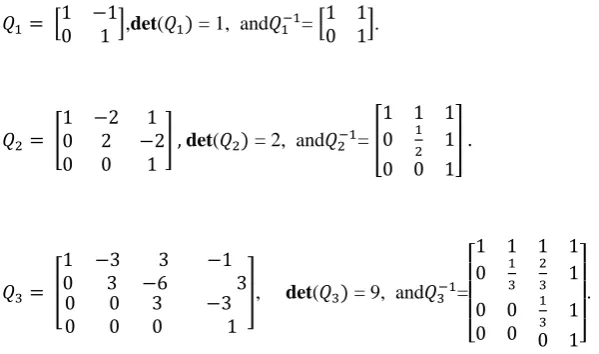
The following are examples for 𝑄𝑛 and 𝑄𝑛−1 for n = 1, 2, 3
𝑄1= [10 −11 ],det(𝑄1) = 1, and𝑄1−1= [1 10 1].
𝑄2= [
1 −2 1
0 2 −2
0 0 1
] , det(𝑄2) = 2, and𝑄2−1= [
1 1 1 0 1
2 1
0 0 1 ] .
𝑄3= [
1 −3 0 3
3 −1 −6 3 0 0
0 0
3 −3 0 1
], det(𝑄3) = 9, and𝑄3−1=
[ 1 1 0 1
3
1 1
2 3 1
0 0 0 0
1 3 1
0 1]
.
Moore Machine
In this section a brief overview of Moore machine is introduced. Moore machine is an Finite State Machine FSM whose output depends on the present state [18]. A Moore machine can be described by a 6-tuples of the form:
𝑴 = (𝑄,Σ,Δ, 𝛿, 𝜏, 𝑞0) , where
𝑄: is a non empty finite set of states, Δ: nonempty output alphabet,
Σ: nonempty finite set of input values,
𝛿: a transition function,
𝜏:is the output function 𝜏 ∶ 𝑄 →Δ ,
𝑞0:is the initial state of Q.
Figure shows an example of Moore machine.
[
Barukab* and S. H. Behiry, 4(4): April, 2017
]
ISSN: 2349-5197
Impact Factor: 2.715
I
NTERNATIONAL
J
OURNALOF
R
ESEARCH
S
CIENCE&
M
ANAGEMENT
Example 1 Reproduced from Ref. [2]
Here is the first example as discussed in [2] is reproduced as a review with three corrections shown in table in bold in the last row of the table 3.
Let the plain text matrix used is 𝑷 = (1 2 3 4)
the recurrence relation of the Fibonacci sequence is 𝑅(𝑛) = (𝑓𝑛+1𝑓 𝑓𝑛
𝑛 𝑓𝑛−1)
input key in binary is = 10110
Recurrence matrix key 𝑅[1] = (2 1 1 0)
Key matrices 𝑅[1], 𝑅[2] and 𝑅[3] are as follows:
𝑅[1] = [2 1 1 0]
1
= [2 1 1 0]
𝑅[2] = [2 1 1 0]
2
= [5 2 2 1]
𝑅[3] = [2 1 1 0]
3
= [12 5 5 2]
It is also known that the cipher text at q(i + 1) = q(i). R[n]. where:
𝑞𝑖+1: represents the output
𝑞𝑖: represents the input
𝑅𝑛:represents the output at state 𝑞𝑖+1
Now, table 1 for the present state can be obtained as follows:
Table1 .Previous and present states of the system.
Table1 .Previous and present states of the system.
Present State ={Previous State 𝑞𝑖 } . 𝑹[𝒏]
𝒒𝟏= 𝑞0. 𝑅[1]
𝒒𝟐= 𝑞1. 𝑅[2]
𝒒𝟏
= 𝑞2. 𝑅[1]
𝒒𝟑
= 𝑞1. 𝑅[3]
𝒒𝟐
[
Barukab* and S. H. Behiry, 4(4): April, 2017
]
ISSN: 2349-5197
Impact Factor: 2.715
I
NTERNATIONAL
J
OURNALOF
R
ESEARCH
S
CIENCE&
M
ANAGEMENT
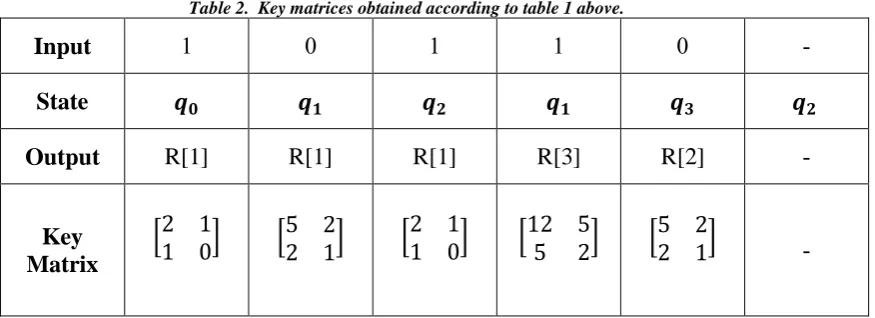
Now, the key matrices used in the ciphertext are obtained as shown in table 2 below.
Table 2. Key matrices obtained according to table 1 above.
-
0
1
1
0
1
Input
𝒒
𝟐𝒒
𝟑𝒒
𝟏𝒒
𝟐𝒒
𝟏𝒒
𝟎State
-
R[2]
R[3]
R[1]
R[1]
R[1]
Output
-
[
5
2
2
1
]
[
12
5
5
2
]
[
2
1
1
0
]
[
5
2
2
1
]
[
2
1
1
0
]
Key
Matrix
It follows that the ciphertext for the given secret key is obtained as shown in table 3 below.
Table 3.Ciphertext for the given secret key.
Cipher Text Output Output Previous State Present State Input No.
q0. R[1] = [13 24] [2 11 0] = [10 34 1]
1 𝑅[1] 𝑞0 𝑞1 1 1
q1. R[2] = [104 13] [5 22 1] = [2256 239]
2 𝑅[2] 𝑞1 𝑞2 0 2
q2. R[1] = [2256 239] [21 10] = [135 5653 22]
1 𝑅[1] 𝑞2 𝑞1 1 3
q1. R[3] = [135 5653 22] [125 52] = [1900746 309787]
3 𝑅[3] 𝑞1 𝑞3 1 4
3. R[2] = [746 309 1900 787] [
5 2 2 1] = [
𝟒𝟑𝟒𝟖 1801 𝟏𝟏𝟎𝟕𝟒 9587] 2 𝑅[2] 𝑞3 𝑞2 0 5
as presented in [2], mod 41 operation is used. This implies that the ciphertext in the last raw of table 3 will be:
[
Barukab* and S. H. Behiry, 4(4): April, 2017
]
ISSN: 2349-5197
Impact Factor: 2.715
I
NTERNATIONAL
J
OURNALOF
R
ESEARCH
S
CIENCE&
M
ANAGEMENT
Illustrative Example based on Bernstein Polynomial
This example demonstrates the usage of the Bernstein polynomials in the encryption and decryption processes. The same data will be used as in the previous example which is:
Let the plain text matrix used is 𝑷 = (1 2 3 4)
the recurrence relation of the Fibonacci sequence is 𝑅(𝑛) = (𝑓𝑛+1𝑓 𝑓𝑛
𝑛 𝑓𝑛−1)
input key in binary is = 10110
Recurrence matrix key 𝑅[1] = (1 −1 0 1 )
Key matrices 𝑅[1], 𝑅[2] and 𝑅[3] are as follows:
𝑅[1] = [1 −1 0 1 ]
𝑅[2] = [1 −2 0 1 ]
𝑅[3] = [1 −3 0 1 ]
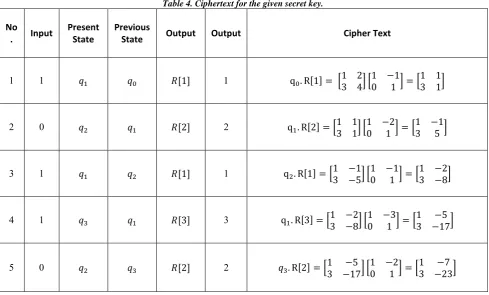
it follows that the ciphertext will be generated as shown in table 4 below.
Table 4. Ciphertext for the given secret key.
Cipher Text Output Output Previous State Present State Input No .
q0. R[1] = [1 23 4] [1 −10 1 ] = [13 11]
1 𝑅[1] 𝑞0 𝑞1 1 1
q1. R[2] = [13 11] [1 −20 1 ] = [13 −15 ]
2 𝑅[2] 𝑞1 𝑞2 0 2
q2. R[1] = [13 −1−5] [1 −10 1 ] = [13 −2−8]
1 𝑅[1] 𝑞2 𝑞1 1 3
q1. R[3] = [13 −2−8] [1 −30 1 ] = [13 −17−5]
3 𝑅[3] 𝑞1 𝑞3 1 4
𝑞3. R[2] = [13 −17−5] [10 −21 ] = [13 −23−7]
2 𝑅[2] 𝑞3 𝑞2 0 5
if we were to choose mod 41 arithmetic as in the previous example, we get the ciphertext of the value
[
Barukab* and S. H. Behiry, 4(4): April, 2017
]
ISSN: 2349-5197
Impact Factor: 2.715
I
NTERNATIONAL
J
OURNALOF
R
ESEARCH
S
CIENCE&
M
ANAGEMENT
Performance Evaluation of the Proposed Scheme
As stated in [2], we end up with the same performance time. Let 𝑡𝑎 be the time required to perform each
addition operation, while 𝑡𝑚 represents the time required to perform each multiplication operation. Then, the
total time required to perform an n-key bits is 𝑛[4𝑡𝑎+ 8𝑡𝑚]. There are four factors which contribute to the
inherent security of this novel scheme. First, the length of the secret key. Second, the usage of the recurrence relation that will add an additional layer of security. Third, the inherent dependency of the output of each state in the Moore machine with . Finally, the adoption of the Bernstein polynomial to this novel scheme. This scheme also is a function of the key length in which case the difficulty of breaking the code will increase as the key length increases. The security analysis of this scheme follows the same rhythm as in [2].
Conclusion and Future Work
This novel encryption scheme employed Bernstein polynomial in the encryption process. It is built based on four pivotal components. First, the use of finite state Moore machine. Second, the usage of recurrence relations. Third, the usage of matrix multiplication. Finally, the employment of Bernstein polynomial in constructing the recurrence relation.
Acknowledgements
This article was funded by the Deanship of Scientific Research (DSR), King Abdulaziz University, Jeddah. The authors, therefore, acknowledge with thanks DSR technical and financial support.