*Corresponding author: Reza Ghiasia, Email: [email protected], [email protected]
Asian Journal of Nanoscience and Materials, 2018, 1(4), 234-243.
Theoretical insights of the electronic structures, conductivity, and
aromaticiy of graphyne and Si-doped graphynes
Reza Ghiasia,*, Faegheh Aghazadeh Kozeh Kananib
aDepartment of Chemistry,East Tehran Branch, Islamic Azad University, Tehran, IRAN. bDepartment of Chemistry,Science and Research Branch, Islamic Azad University, Tehran, IRAN.
Received: 09 July 2018, Revised: 09 June 2018 and Accepted: 14 June 2018.
ABSTRACT: In the present research, the dipole moment, electronic structure, frontier orbitals energy, and aromaticity in the graphyneand Si-doped graphynes were studied withM06-2X quantum chemical computation. The relative energies of four possible isomers of Si-doped graphyne were calculated. Also, the ionization potential (IP) and electron affinity (EA) values of the studied molecules were reported. HOMO-LUMO gap values were used for illustration of these molecules conductivity. Aromaticity of these molecules was investigated by nucleus independent chemical shift (NICS) values and electron localization function (ELF).
KEYWORDS: Graphyne, Si-doped graphyne, Nucleus independent chemical shift (NICS), Electron localization function (ELF).
GRAPHICAL ABSTRACT:
1. Introduction
Graphyne which is a newkind of artificial
carbon allotropes is correlated to
graphite/graphene. The special structures
and attractive optical, electronic and
mechanical properties have been explored.
Graphyne was first depicted in 1987 [1],
while, in spite of numerous attempts,
graphyne has not yet been prepared
[2-5].Theoretical researches excited attempts
for synthesis of graphyne layers, crystals,
and nanostructures. Graphyne compounds
Ghiasi et all. 235 Asian Journal of
Nanoscience and
Materials
molecules having carbon cage fragments
that are similar to the corresponding
structure type of graphyne[6,7]. In this
regard, theoretical calculations of the
structures of graphyne layer fragments and
single graphyne layers and their properties
were reported [8-15]. The major aim of the
present investigation is to clarify the
Si-doping on the structure and properties of
graphyne by the quantum mechanics
method. The dipole moment, structural
parameters, frontier orbital energies and
aromaticity of these molecules were
explored.
2. Computational Methods
All calculations were carried out using
Gaussian 09 suite program [16]. The
calculations of systems contain C, Si and H
described by the standard 6-311G(d,p) basis
set. Geometry optimization was performed
utilized by the hybrid meta
exchange-correlation functional of Truhlar and Zhao
(M06-2X) [17].A vibrational analysis was
performed at each stationary point which
confirmed its identity as an energy
minimum.
After optimization of the studied
molecules, single point calculations were
carried out at the MP2/6-311G(d,p) [18-22]
and wB97XD/6-311G(d,p) [23, 24] levels
of theory.Chemical shift values are
calculated using Gauge independent atomic
orbital (GIAO) method at the same method
and basis sets of optimization [25]. The
topological analysis of the ELF was made
using the Multiwfn 3.3.5 [26] at the
M062X/6-311G(d,p) level of theory.
3. Results and discussion
1. Energetic aspects:
Figure 1 presents the structures and
numbering schemes of atoms ingarphyne
andisomers of Si-doped graphynes. The
absolute energies and relative energies of
these molecules are listed in Table 1. As
shown in Table 1, the III-isomer is the most
stable isomer of Si-doped graphynes.
IV-isomer in the planar form has one imaginary
frequency which exhibits a bending
vibration of out-plane for Si atom.
Therefore, the stable form of this isomer
deviates from planarity, changes to
non-planar form and also changes the Cs
symmetry of isomer to C1.
Table 1. Energy (E, in a.u) and relative energy (E, kcal/mol) of graphyne and Si-doped graphyne isomers at the determined levels of theory.
Ea Ea Eb Eb Ec Ec
236 Ghiasi et all. Asian Journal of
Nanoscience and
Materials
Si-doped Graphyne
I-Isomer -1172.8112 12.03 -1170.057978 9.815127 -1172.8441763 12.18931
II-Isomer -1172.8133 10.70 -1170.0600007 8.545864 -1172.8461199 10.96968
III-Isomer -1172.8303 0.00 -1170.0736194 0 -1172.8636012 0
IV-Isomer -1172.7807 31.15 -1170.0240762 31.08883 -1172.8100839 33.58261
a optimization at the M062X/6-311G(d,p) level of theory.
b after optimization at the M062X/6-311G(d,p) level of theory, single point of optimized structure of the calculated at MP2/6-311G(d,p) level of theory
b after optimization at the M062X/6-311G(d,p) level of theory, single point of optimized structure of the calculated at wb97xd/6-311G(d,p) level of theory
Moreover, the results of single point
calculations at the MP2/6-311G(d,p) and
wb97xd/6-311G(d,p) levels of theory of
optimized studied molecules show that the
III-isomer is the most stable isomer of
Si-doped graphynes.
Fig.1. The structures of graphyne and Si-doped graphyne isomers in this study. Polarizability
Polarizability which describes the response
of a system in an applied electric field
determines not only the strength of
molecular interactions (such as the long
range intermolecular induction, dispersion
forces, etc.) and the cross sections of
different scattering and collision processes,
but also the nonlinear optical properties of
Ghiasi et all. 237 Asian Journal of
Nanoscience and
Materials
The isotropic polarizability (iso) is
calculated as the mean value as given in the
following equation:
and the polarizability anisotropy invariant
(aniso) is:
The isotropic and anisotropic polarizability
values of studied molecules are calculated
(Table 1). These values show the smallest
isotropic and anisotropic polarizability
values for III-isomer. As expected from the
principles of minimum energy (MEP), and
minimum polarizability (MMP), that is,
while a conformer changes from the most
stable to other less stable species in most
cases, the energy increases, and the
polarizability increases[28-30].
2. IPs and EAs
The ionization potential (IP) and electron
affinity (EA) are the well-defined properties
that can be calculated by DFT to estimate
electrons into the compounds. These values
aim to get an in-detail rationalization of the
relationship between the structure and the
electronic behavior of the molecule, in
particular the response of the molecule to
the formation of a hole, or to the addition of
an electron, additional information is
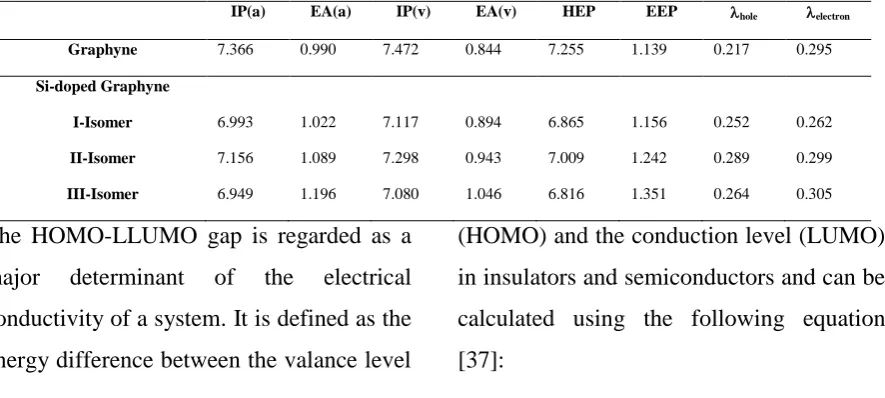
derived. Table 2 contains the calculated IPs,
EAs, both vertical and adiabatic, and the
extraction potentials (HEP and EEP for the
hole and electron, respectively) that refer to
the geometry of the ions [31, 32].
The results, presented in Table 2, show that
the IPa and IPv values in Si-doped gaphynes
are less than graphyne. The most stable
isomer of Si-doped gaphynes (III-isomer)
has the lowest IPa and IPv values On the
other hand, the EAa and EAv values in
Si-doped gaphynes are more than graphyne.
The most stable isomer of Si-doped
gaphynes (III-isomer) has the most EAa and
EAv values.
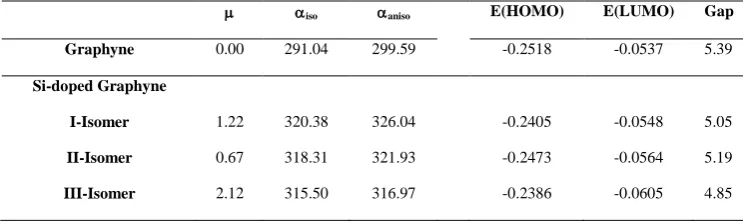
Table 2. Dipole moment (, Debye)), isotropic polarizability (iso, Bohr3), anisotropic polarizability (aniso, Bohr3), frontier orbital energies (a.u) and HOMO-LUMO gap (eV) of graphyne and Si-doped graphyne isomers in the
M062X/6-311G(d,p) level of theory.
iso aniso E(HOMO) E(LUMO) Gap
Graphyne 0.00 291.04 299.59 -0.2518 -0.0537 5.39
Si-doped Graphyne
I-Isomer 1.22 320.38 326.04 -0.2405 -0.0548 5.05
II-Isomer 0.67 318.31 321.93 -0.2473 -0.0564 5.19
238 Ghiasi et all. Asian Journal of
Nanoscience and
Materials
IV-Isomer 1.24 324.27 276.08 -0.2479 -0.0847 4.44
The mobility of charges has been
established to be related mainly to the
internal reorganization energy λhole/electron.
The data in Table 2 show that the λhole
values for all molecules are all smaller than
their corresponding λelectron values indicating
that the electron transfer rate is lower than
the hole transfer rate. According to the
values gathered in Table 2, these molecules
can be applied as hole transport layer
(HTL)/an electron block layer.
3. Dipole moments
The dipole moments of ingarphyne
andisomers of Si-doped graphynes are
gathered in Table 1. As can be seen, the
most stable isomer of Si-doped graphynes
(III-isomer) has the largest dipole moment
than that of other isomers.
4. Molecular orbital analysis
Table 1 summarizes the values of frontier
orbital energies and HOMO-LUMO gaps.
Apparently, HOMO is more stable in
graphyne than Si-doped graphynes. In
contrast, LUMO is more stable in Si-doped
graphynes than graphyne.
The hardness (), chemical potential ()
and electrophilicity () of the molecules are
evaluated by the following formulas
[33-36]:
Table 3 shows the largest hardness and
smallest electrophilicity for II-isomer.
Table 3. Ionization potential (IP, in eV), electron affinity (EA, in eV), hole Extraction potential (HEP, eV), electron extraction potential (EEP, eV), reorganization energies (hole,electron, eV) of graphyne and Si-doped graphyne isomers in the
M062X/6-311G(d,p) level of theory.
IP(a) EA(a) IP(v) EA(v) HEP EEP hole electron
Graphyne 7.366 0.990 7.472 0.844 7.255 1.139 0.217 0.295
Si-doped Graphyne
I-Isomer 6.993 1.022 7.117 0.894 6.865 1.156 0.252 0.262
II-Isomer 7.156 1.089 7.298 0.943 7.009 1.242 0.289 0.299
III-Isomer 6.949 1.196 7.080 1.046 6.816 1.351 0.264 0.305
The HOMO-LLUMO gap is regarded as a
major determinant of the electrical
conductivity of a system. It is defined as the
energy difference between the valance level
(HOMO) and the conduction level (LUMO)
in insulators and semiconductors and can be
calculated using the following equation
Ghiasi et all. 239 Asian Journal of
Nanoscience and
Materials
whereEg, , kb and T are HOMO-LUMO
gap, electrical conductivity, Boltzmann’s
constant and T is the temperature,
respectively. The HOMO-LUMO gap
decreases from 2.69 eV in graphyne to
2.52-2.22 eV after Si-doping. According to the
above mentioned equation, at a given
temperature, the smaller HOMO-LUMO
gap values are associated with more
electrical conductivity.
Figure 2 presents the plots of frontier
orbitals of the studied molecules. It can be
seen that these orbitals are -type, and the
overlap between carbon atoms of -CC- is
bonding and anti-bonding for HOMO and
LUMO, respectively.
HOMO LUMO
G
I
II
240 Ghiasi et all. Asian Journal of
Nanoscience and
Materials
Fig. 2. The plots of frontier orbitals in graphyne and Si-doped graphyne isomers. 5. Chemical shift nucleus independent
values (NICS)
Figure 1 illustrates that graphyne
involves aromatic 6-membered rings and
the weak anti-aromatic 12-membered
rings[38, 39]consisting of alternating triple
bonds and conjugated double bonds, the
latter being shared by the 6-membered
rings. As benzene is regarded to be the
smallest unit of graphite,
dehydrobenzo[12]annulene (1,DBA)[40]
can be considered as the smallest unit of
graphyne. It is, therefore, of interest to
illustrate changes of aromaticity in Si-doped
graphynes.
In an aromatic ring, a diatropic ring current
rises which is the result of magnetic
shielding at the ring center, however in an
anti-aromatic ring, a paratropic ring current
outcomes in deshielding at the ring
center[41, 42]. Chemical shift nucleus
independent values (NICS) values give a
suitable and valuable quantity of the degree
of aromaticity/anti-aromaticity of one ring
in a molecule[43].
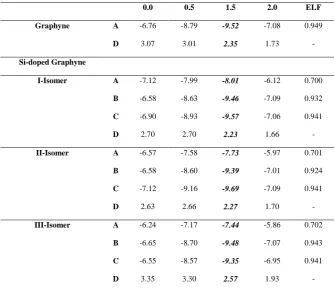
Chemical shift nucleus independent values
(NICS) values are calculated for the study
of aromaticity in the investigated molecules.
These values are gathered in Table 4. The
calculated NICS values show the negative
values for A, B, C cycles.These values are
compatible with aromaticity of these rings.
The most negative values in 1.5 Å which
are above the rings reveal -aromaticity in
the rings. But, the positive values are
observed for D cycle. Therefore, there is an
anti-aromaticity in the D cycle.
Table 4. Hardness (, eV), chemical potential (, eV) and electrophilicity (, eV) values of of graphyne and Si-doped graphyne isomers in the M062X/6-311G(d,p) level of theory.
Graphyne 3.19 4.18 2.74
Si-doped Graphyne
I-Isomer 2.99 4.01 2.69
II-Isomer 3.03 4.12 2.80
III-Isomer 2.88 4.07 2.88
6. Electron localization function (ELF)
An alternative scheme based on
properties of the electron density, as the
electron localization function (ELF) [44],
has been introduced to understand
aromaticity [45,46]. The electron
delocalization can be obtained through the
Ghiasi et all. 241 Asian Journal of
Nanoscience and
Materials
points have been interpreted as a measure of
the interaction among the different basins
and, chemically, as a measure of electron
delocalization [45].
Table 5. NICS (in ppm) and ELF bifurcation values of rings for graphyne and Si-doped graphyne isomers in the M062X/6-311G(d,p) level of theory.
0.0 0.5 1.5 2.0 ELF
Graphyne A -6.76 -8.79 -9.52 -7.08 0.949
D 3.07 3.01 2.35 1.73
-Si-doped Graphyne
I-Isomer A -7.12 -7.99 -8.01 -6.12 0.700
B -6.58 -8.63 -9.46 -7.09 0.932
C -6.90 -8.93 -9.57 -7.06 0.941
D 2.70 2.70 2.23 1.66
-II-Isomer A -6.57 -7.58 -7.73 -5.97 0.701
B -6.58 -8.60 -9.39 -7.01 0.924
C -7.12 -9.16 -9.69 -7.09 0.941
D 2.63 2.66 2.27 1.70
-III-Isomer A -6.24 -7.17 -7.44 -5.86 0.702
B -6.65 -8.70 -9.48 -7.07 0.943
C -6.55 -8.57 -9.35 -6.95 0.941
D 3.35 3.30 2.57 1.93
-The ELF values in the ring critical point
(RCP) of six-membered rings are reported
in Table 4. It can be found, high bifurcation
values of ELF in the studied molecules. The
ELF bifurcation values of the Si-doped
graphyne are lower than that of garphyne
molecule. This fact can be attributed to the
electronegativity differences between
carbon and silicon atoms.
Conclusion:
We used M06-2X method and 6-311G(d,p)
basis set in order to investigate the structure
and properties of the graphyne and Si-doped
graphyne. These investigations indicated:
1. The comparison of energy values for
four isomers of Si-doped graphyne
shows that III-isomer is the most
stable isomer.
2. The internal reorganization energy
values illustrate that these molecules
can be applied as hole transport
layer (HTL)/an electron block layer.
3. The HOMO-LUMO gap values of
the Si-doped graphynes are less than
242 Ghiasi et all. Asian Journal of
Nanoscience and
Materials
having more electrical conductivity
in Si-doped graphynes.
4. The NICS values of these studied
molecules explore -aromaticity in
the A, B, C rings. In contrast,
anti-aromaticity in the D cycle can be
found.
5. Smaller ELF bifurcation values of
the Si-doped graphynein as
compared to garphyne molecule are
attributed to the electronegativity
differences between carbon and
silicon atoms.
References:
1. R.H. Baughman, H. Eckhardt, M. Kertesz, (1987) J. Chem. Phys. , 87, 6687-6699.
2. T. Yoshimura, A. Inaba, M. Sonoda, K. Tahara, Y. Tobe, R.V. Williams, (2006) Org. Let., 8, 2933-2936. 3. G.X. Li, Y.L. Li, H.B. Liu, Y.B.
Guo, Y.J. Li, Z. D.B, (2012) Chem.
Commun 46, 3256-3258.
4. X. Qian, Z. Ning, Y. Li, H. Liu, C. Ouyang, Q. Chen, Y. Li, (2012)
Dalton Trans, 41, 730-733.
5. S. Wang, L.X. Yi, J.E. Halpert, X.Y. Lai, Y.Y. Liu, H.B. Cao, R.B. Yu, D. Wang, Y.L. Li, (2012) Small, 8, 265-271.
6. F. Diederich, Y. Rubin, (1992)
Angew. Chem. Int., Ed.Engl., 31, 1101.
7. F. Diederich, (1994) Nature (London) 369, 199.
8. E.A. Belenkov, I. Chelyab, (2002)
Nauchn. Tsentra UrO Ross. Akad. Nauk, 14, 12.
9. V.R. Coluci, S.F. Braga, S.B. Legoas, D.S. Galvao, R.H. Baughman, (2003) Phys. Rev. B: Condens. Matter, 68, 35430.
10.A.N. Enyashin, A.A. Sofronov, Y.N. Makurin, A.L. Ivanovski, (2004) J.
Mol. Struct.: THEOCHEM, 684, 29.
11.V.R. Coluci, D.S. Galvao, R.H. Baughman, (2004) J. Chem. Phys., 121, 3228.
12.V.R. Coluci, S.F. Braga, S.B. Legoas, D.S. Galvao, R.H. Baughman, (2004) Nanotechnology, 15, S142.
13.C. Lepetit, C. Zou, R. Chauvin, (2006) J. Org. Chem. , 71, 6317. 14.E.A. Belenkov, I.V. Shakhova,
(2011) Phys. Solid State, 53, 2385. 15.A.I. Podlivaev, L.A. Openov, (2012)
Phys. Solid State 54, 1723.
Ghiasi et all. 243 Asian Journal of
Nanoscience and
Materials
Farkas, J.B. Foresman, J.V. Ortiz, J. Cioslowski, D.J. Fox, in, Gaussian, Inc., Wallingford CT, )2009(.
17.Y. Zhao, D.G. Truhla, (2006) J. Phys. Chem. A, 110, 5121-5129. 18.M. Head-Gordon, J.A. Pople, M.J.
Frisch, (1988) Chem. Phys. Lett., 153, 503-506.
19.S. Saebø, J. Almlöf, (1989) Chem. Phys. Lett., 154, 83-89.
20.M.J. Frisch, M. Head-Gordon, J.A. Pople, (1990) Chem. Phys. Lett., 166, 275-280.
21.M.J. Frisch, M. Head-Gordon, J.A. Pople, Chem. Phys. Lett., 166, 281-289 (1990).
22.M. Head-Gordon, T. Head-Gordon, (1994) Chem. Phys. Lett., 220, 122-128.
23.S. Grimme, (2006) J. Comput. Chem. , 27, 1787-1799.
24.J.D. Chai, M. Head-Gordon, Phys. Chem. (2008) Chem. Phys. , 10, 6615-6620.
25.K. Wolinski, J.F. Hinton, P. Pulay, (1990) J. Am. Chem. Soc, 112, 8251–8260.
26.T.Lu, F. Chen, (2012) J. Mol.Graphics. Model, 38, 314. 27.V. Librando, A. Alparone, Z.
Minniti, (2008) Journal of
Molecular Structure: THEOCHEM,
856, 105.
28.P.K. Chattaraj, P. Fuentealba, B. Gomez, R. Contreras, (2000) J. Am. Chem. Soc, 122, 348.
29.P.K. Chattaraj, S. Sengupta, (1996)
J. Phys. Chem. A, 100, 16126. 30.T.K. Ghanty, S.K. Ghosh, (1996) J.
Phys. Chem. A, 100, 12295.
31.A. Curioni, M. Boero, W. Andreoni, (1998) Chem Phys Lett 294, 263– 271.
32.I. Wang, E. Botzung-Appert, O.S.p. O, A. Ibanez, P.L. Baldeck, (2002) J Opt A Pure Appl Opt 4,S258–S260. 33.R.G. Pearson, Chemical Hardness,
Wiley-VCH: Oxford, )1997(.
34.R.G. Parr, W. Yang, Density-Functional Theory of Atoms and Molecules, Oxford University Press: New York, )1989(.
35.R.G. Parr, L.v. Szentpály, S.Liu, (1999) J. Am. Chem. Soc, 121, . 36.R.G. Pearson, (1986) Proc. Natl.
Acad. Sci., 83, 8440‐8441.
37.S. Li, Semiconductor Physical Electronic, 2nd ed ed., Springer, USA, )2006(.
38.K.B. Wiberg, Chem. ReV. , 101, 1317-1331 (2001).
39.E.L. Spitler, C.A. Johnson, M.M. Haley, (2006) Chem. ReV. , 106, 5344-5386.
40.H.A. Staab, F. Graf, (1966)
Tetrahedron Lett, 7, 751-757.
41.L. Pauling, (1936) J. Chem. Phys., 4, 673-677.
42.J.A. Pople, K.G. Untch, J. Am. Chem. Soc. , 88, 4811-4815 (1966). 43.Z. Chen, C.S. Wannere, C.
Corminboeuf, R. Puchta, P.v.R. Schleyer, (2005) Chem. Rev. , 105, 3842-3888.
44.A. Becke, K. Edgecombe, (1990) J. Chem. Phys. , 92, 5397.
45.A. Savin, A. Becke, D. Flad, R. Nesper, H. Preuss, H.V. Schnering, (1991) Angew. Chem., Int. Ed. Engl., 30, 409.
46.J.C. Santos, W. Tiznado, R. Contreras, P. Fuentealba, (2004) J.
Chem. Phys., 120, 1670.