©2020 JNAS Journal-2020-9-1/1-12 ISSN 2322-5149 ©2020 JNAS
ALLELOPATHY; A BRIEF REVIEW
Javed Kamal
Department of Plant Sciences, Faculty of Biological Sciences, Quaid-I-Azam University, Islamabad, Pakistan.
Corresponding author:
Javed Kamal
Email:
[email protected]
Mobile:
00923046886850
ABSTRACT: Allelopathy is a well known area of active research in ecology. However, its importance in agro-ecology is still underappreciated. This review sets out to address this situation and introduce this new and developing field to a wider research audience and to stimulate new research in it. The review starts with an introduction, followed by discussions of allelochemicals, the role of allelopathy in crop production, Allelopathy related problems in crop production, and Suggestions for future research. It also describes broader research into allelopathy in agriculture and the biosciences, and literature resources on the subject. We hope that it will encourage more scientists to initiate research into this exciting new field.
Keywords: Allelopathy, Agro-ecology, Bio-sciences, Crop production, Ecology.
INTRODUCTION
Allelopathy is a natural phenomenon, defined as:
“The inhibition of growth in one species of plants by chemicals produced by another species” Or, more widely:
“The biochemical interactions among all types of plants, including microorganisms”
The word allelopathy derives from two roots: allelon, meaning “of each other”; and pathos, meaning “to suffer”. The “inhibitory” chemical is released into the environment by one plant, where it then affects the growth and development of its neighbors.
All living things need certain resources to live and grow, and plants require sunlight, nutrients, water, and air. The roots bring nutrients and water from the ground to the plant. The leaves absorb the energy of the sun’s rays. Plants require sufficient space to meet their needs and many use allelopathic defenses to protect the space around them.
There are four major reasons why trees require their own space: fire, water, roots, and sun.
Plants need to protect themselves from harm and fire is always a threat in the wild. If trees grow too close to each another, fire can spread from one to another very easily. Trees therefore create space for themselves in order to remain safe. Water is in short supply in some areas, and reducing the number of surrounding plants increases the water available for the roots. Likewise, the amount of soil available for a plant’s roots to grow in can be increased by using allelopathic defenses to kill the roots of surrounding plants. Plants also need sunlight to grow. If too many other plants are growing nearby, a plant will be shaded and less able to grow. Allelopathic defenses can be used to prevent other plants growing nearby and so help them to compete for sunlight.
2
herbivorous insects or nematodes, in which plant substances attract, repel, deter, or retard the growth of attacking insects or nematodes are considered to be allelopathic. Interactions between soil microorganisms and plants can also be allelopathic in nature. Fungi and bacteria may produce and release growth inhibitors or promoters. Some soil bacteria enhance plant growth through fixing nitrogen, while others make phosphorus available to plants.
Allelopathic compounds and interactions are much more common in terrestrial plants. In aquatic situations, the chemicals released are too diluted to have significant interspecies competitive effects. In aquatic plants, allelopathic chemicals are used primarily to prevent the plant from being eaten by herbivores, rather than to compete with surrounding plants. Some scientists think that some aquatic plants can inhibit the growth of unicellular algae, but this is not generally agreed, and it is suggested that these are in fact, competitive phenomena rather than allelopathic. In allelopathy, a chemical is released by a plant into the environment, whereas in competition, one plant is merely more successful in sequestering resources such as minerals, water, space, carbon dioxide, and light than its neighbors. In the field, both allelopathy and competition usually act simultaneously. Prime examples of plants that use allelopathy to reserve their own space are black walnut trees, sunflowers, wormwoods, sagebrushes, and trees of heaven. Some pine trees are allelopathic. When their needles fall to the ground, they begin to decompose, releasing acids into the soil which keeps unwanted plants from growing near the pine tree.
Allelochemicals are the Cause of Toxicity
Allelopathy is important in sustainable agriculture, and is therefore a priority area of research in many part of the world including the USA, Canada, the European Union, Russia, Japan, Korea, Australia, Mexico, and Brazil. It is a multidisciplinary subject incorporating agriculture (agronomy, soil science, genetics/plant breeding, agroforestry, horticulture, vegetable crops, and weed, pest and disease control) as well as various biosciences (biotechnology, chemistry, biochemistry, microbiology, plant physiology, fisheries and aquaculture, and zoology).
It is interesting to note the similarities between allelopathy and the Ayurveda system of medicine, particularly with respect to pest control and the treatment of human diseases. Both systems use plants or plant extracts to control plant pests or human diseases, and the organisms under attack do not develop tolerance/resistance either to allelochemicals or Ayurvedic medicines, unlike pesticides or conventional allopathic medicines. In view of the numerous problems associated with pesticides and modern allopathic medicines, many environmentally conscious people in developed countries are turning to the use of herbal medicines for human disease control and allelochemicals for crop pest management.
Although, the impact of allelopathy on agriculture was recognized by Democritus and Theophrastus in the 5th
and the 3rd Century B.C., respectively (Smith and Secoy, 1977) and by DeCandolle in 1832, most of the progress in
this field has occurred during the 20th century (Rice, 1984). Since the 1960’s, allelopathy has been increasingly
recognized as an important ecological mechanism influencing plant dominance, succession, the formation of plant communities and climax vegetation, and crop productivity. It has been related to problems in the weed-crop interference (Bell and Koeppe, 1972), in phytotoxicity in stubble mulch fanning (McCalla and Haskins, 1964), and in certain types of crop rotations (Conrad, 1927). Rice (1984) showed that allelopathy contributed to the problem of weed seed longevity through two mechanisms: a) chemical inhibitors in the seed which prevent their decay by microbes; and b) inhibitors which keep the seed dormant, though viable for many years. Most of the allelopathic research on crops has been conducted in developed countries where mono-cropping is practiced because winters are too severe to allow the growth of a second crop within the same calendar year. However, there has been much less research in irrigated areas in the tropics and subtropics where the climate allows year round cropping and an array of crops and weeds exist together, despite the fact that allelopathy plays a greater role under these conditions. The role of allelopathy in sustainable agriculture may therefore make it an important strategy in increasing agricultural production in the 21st century.
Proof of Allelopathy
A number of studies have provided excellent evidence for allelopathy but only a few investigators have followed a specific protocol (similar to Koch’s postulates for proof of disease) to demonstrate the phenomenon conclusively (Fuerst and Putnam, 1983). Proving allelopathy generally involves the following sequence of events:
i) Demonstrate the allelopathic effect using suitable controls, describe the symptoms, and quantify the growth reduction caused.
ii) Isolate, characterize and assay the allelochemicals involved. Identification of chemicals that are not artifacts is essential.
ii) Obtain toxicity with similar symptoms by adding the allelochemicals identified to the system.
3
Allelochemicals
Organisms interact in many interesting ways. Chemicals produced by one organism that affect another organism are called allelochemicals (Barbour et al., 1980; Krebs, 1978; Ricklefs, 1979; Whittaker, 1975). Sometimes a single chemical produced by one organism is harmful to another organism but beneficial to a third. Plants of the mustard family secrete mustard oils that irritate many animals and thus prevent them from feeding on the mustard plants. Yet these same oils attract other animals that feed on mustard plants. One of the oils even stimulates germination of the spores of a fungus that is parasitic on mustard roots. We are beginning to appreciate that communities include many complex webs of chemical interactions. For example, fungi and mycelial bacteria secrete allelochemicals that are lethal to other bacteria. We have learned to use these substances in modern medicine and call them antibioticsand they are now part of the ecological interactions of humans. Allelochemicals were suspected in 19th century agriculture because of many observations of “soil sickness” of farmlands. If a piece of ground is continually cropped with one plant, the yields often decrease and cannot be improved by additional fertilizer. Fruit trees, for example, often do poorly in ground where the same species has grown before. Furthermore, it is common for one plant to harm another plant grown in its vicinity (by allelopathy). Many experiments of the type illustrated in Fig. 1 have been performed. In this experiment, one set of apple seedlings was watered with tap water, another set with water that had percolated through soil with grass growing in it, and a third set with water that had percolated through soil with nothing growing in it. Growth of the apple seedlings was apparently inhibited by something produced by the grass plants, since seedlings in the other two treatments grew much better. In a few cases, the allelochemicals have been isolated and identified. It is often difficult to be sure, however, that a particular compound isolated from the roots or leaves of one plant actually plays a toxic role in nature. It appears that juglone (5-hydroxy- naphthoquinone) from the roots and hulls of black walnut (Juglans nigra) is an allelopathic. It will kill tomato and alfalfa plants (up to 25 m from a walnut tree in the field) but bluegrass growth seems to be stimulated close to walnut trees. The closely related English’ walnut (J. regia) and the California walnuts (J. hindsii and J. californica) do not produce juglone. It is worth noting that many plants produce allelochemicals that are used as drugs in medical and veterinary practice. In fact, many early physicians (including Linnaeus) were botanists. These substances often cause changes in the physiology or behavior of the organisms that consume them. Narcotics, for example, produce drowsiness or sleep, or lessen pain. Harmful drugs are called poisons While beneficial ones are called medicines. Most exert both effects, depending on their concentration and other factors. Humans cultivate tobacco, tea, coffee, and other drug producing plants. Properly used, some of these drugs are beneficial, but we are also aware of their harmful effects. Alcohol is a waste product of yeast metabolism (fermentation) that does not help the yeast, while urine, another waste product, is often used by animals to help establish territories. Alcohol typically builds to levels that harm the very organisms that produce it. Yet it is an allelochemical and a drug. Allelochemicals are generally secondary metabolites produced by plants, and are byproducts of primary metabolic processes (Levin, 1976). They have an allelopathic effect on the growth and development of neighboring plants. Allelochemicals include: a) plant biochemicals that exert their physiological/toxicological action on plants (allelopathy, autotoxicity or phytotoxicity); b) plant biochemicals that exert their physiological/toxicological action on microorganisms (allelopathy or phytotoxicity); and c) microbial biochemicals that exert their physiological/toxicological action on plants (allelopathy and phytotoxicity. Secondary compounds are metabolically active in plants and microorganisms, and their biosynthesis and biodegradation play an important role in the ecology and physiology of the organism in which they occur (Waller and Nowacki, 1978; Waller and Dermer, 1981). Some of them accumulate at specific stages of growth, while the accumulation of others depends upon time of day or season.
Classes of Allelochemicals
Allelochemicals are biosynthesized from the metabolism of carbohydrates, fats and amino acids and arise from acetate or the shikimic acid pathway (Robinson, 1983). In his review of the potential use of allelochemicals as herbicides, Putnam (1988) listed 6 classes of allelochemicals, isolated from over 30 families of terrestrial and aquatic plants.
These classes are: Alkaloids, Benzoxazinones , Cinnamic acid derivatives, Cyanogenic compounds , Ethylene and other seed germination stimulants, and Flavonoids.
Occurrence of allelochemicals
4
Roots:
In general, they contain fewer, and less potent or smaller amounts of allelochemicals than leaves, although the reverse may be true (Kamal., 2011; kamal and Bano., 2009; kamal and Bano., 2008; kamal and Bano., 2008).
Stems:
These contain allelochemicals and are sometimes the principal sources of toxicity (Kamal., 2011; Kamal., 2011; kamal,. 2010, kamal and Bano., 2009; kamal and Bano., 2008; kamal and Bano., 2008).
Leaves:
These are the most important sources of allelochemicals. Specific inhibitors in leaves have been demonstrated by many workers (Kamal., 2011; kamal and Bano., 2009; kamal and Bano., 2008; kamal and Bano., 2008).
Flowers/inflorescences and pollen:
Although studies on flowers or inflorescences are limited, there is growing evidence that the pollen of corn and sunflower have allelopathic properties.
Fruits:
Many fruits are known to contain toxins found to inhibit microbial growth and seed germination.
Seeds:
The seeds of many plant families or species have been found to inhibit seed germination and microbial growth.
Modes of release of allelochemicals
A major pre-requisite for successful allelopathy is that the allelochemical can be effectively transferred from the donor plant to the recipient, and the mode of transfer plays an important role in the effectiveness and persistence of allelochemicals. The donor plant generally stores these chemicals in its cells in a bound form, such as water-soluble glycosides, polymers including tannins, lignins, and salts, so that they are not toxic to it. Once the donor plant releases the allelochemicals into the environment, they may be either degraded or transformed before affecting the receiver plants, and may also become toxic to the donor (autotoxicity). The allelochemicals are cleaved by plant enzymes or environmental stress and released into the environment from special glands on the stems or leaves. First, the terpenoids, such as a-pinene, cineole and camphor, are released to the environment through volatilization. Then the water-borne phenolics and alkaloids are deployed by rainfall through leaching. Phytotoxic aglycones, such as phenolics, are released during the decomposition of plant residues in soil. Metabolites, such as scopoletin and hydroquinones, may be released into the surrounding soil through root exudates. Allelochemicals released through leachates and root exudates must be water soluble and a broad range of chemicals are involved. These processes are described in more detail below.
Volatilization
Allelochemicals may volatilize from a plant into the atmosphere. The volatile vapors may be absorbed directly from the atmosphere by plants, and the adsorbed vapors may condense in dew and fall to the ground, where they are absorbed onto soil particles and subsequently taken up by plants from the soil solution. The genera which release volatiles are: Artemisia, Salvia, Parthenium and Eucalyptus. The volatile inhibitors camphene, camphor, cineole, dipentene, a-pinene B-pinene are produced by several shrubs of the Southern California Chaparral (White et al., 1989). Plants rich in such compounds, release them continuously as vapors into the atmosphere. The pulverized leaves of crucifierae species (brassica juncea, B. nigra, B. napus, B. rapa and B. oleracea) also release volatile substances. The volatiles of B. juncea and B. nigra were most harmful to the germinating seeds of lettuce and wheat (Oleszek, 1987).
Leaching
5
Figure 1. Possible routes of allelochemical release
Root exudates
Many compounds which may influence the growth of microorganisms and associated higher plants are exuded from the roots. The identification of allelochemicals in root exudates is difficult because they may be altered by microbial activity. Rhizosphere microorganisms in the soil environment may transform and inactivate the original exudation compounds, and in some cases may create new active allelochemicals. Exudates very according to plant species, nutrition and age, and temperature, light, microbial activity around the roots, and the soil type.
Decomposition of plant residues
The decomposition of plant residues is responsible for most of the allelochemicals added to the soil. When plants die the cell contents are released into the environment. Important variables in this process are the nature of the plant residues, the soil type, and the conditions of decomposition. Depending on the conditions, substances may be formed during the decomposition which are either highly toxic, non-toxic, or stimulatory to plants. In general, more severe and persistently toxic chemicals are produced in cold and wet soils.
Since the decomposing plant materials are never uniformly distributed throughout the soil, soil adjacent to the decomposing debris may contain more decomposition products than other areas. Therefore, as roots grow through the soil they may come into contact with patches of decomposing plant residues where they are affected by allelochemicals, while at other locations there may be no such influences ( Kamal, J,. 2015). Some of the toxic effects of decomposition products on plants are: inhibition of seed germination, stunted growth, inhibition of the primary root system, increase in secondary roots, inadequate nutrient absorption, chlorosis, slow maturation, and delay or failure of reproduction.
Factors affecting production of allelochemicals
Rice (1984) listed the factors which affect the amount of allelochemicals produced: a) radiation; b) mineral deficiencies; c) water stress; d) temperature; e) allelopathic agents; f) age of plant organs; g) genetics; h) pathogens; and i) predators. All except radiation and temperature could be exploited under field conditions to improve crop productivity through better plant growth, improved crop resistance to insects/pests, and improved weed control by exploiting the smothering ability of field crops, although further research is needed.
Mode of action of allelochemicals
Allelopathic agents influence plant growth (Rice, 1984) through the following physiological processes: i) cell division and cell elongation; ii) phytohormone induced growth; iii) membrane permeability; iv) mineral uptake; v) availability of soil phosphorus and potash; vi) stomatal opening and photosynthesis; vii) respiration; viii) protein synthesis; ix) changes in lipid and organic acid metabolism; x) inhibition of porphyrin synthesis; xi) inhibition or stimulation of specific enzymes; xii) corking and clogging of xylem elements; xiii) stem conductance of water; xiv) internal water relations; and xv) other miscellaneous mechanisms.
Fate of allelochemicals
6
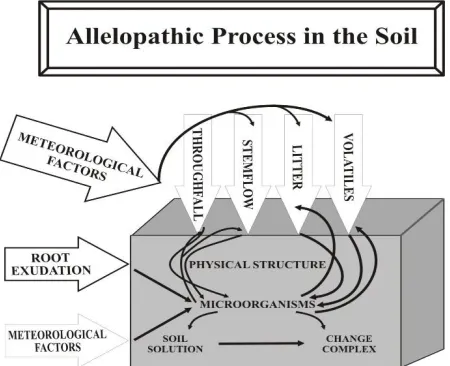
persistence, movement and fate of natural products in the soil depend upon their interaction with the soil adsorption complex, soil microbial population and soil chemical environment. Adsorbed allelochemicals may remain biologically active or be rendered inactive, depending on the nature of the adsorbing surface, but adsorbed molecules are less available to soil microbes. Some natural products/allelochemicals may become irreversibly bound in soil humic substances. Allelopathic effects in the soil therefore depend on the relative rates of addition to, and fixation of, allelochemicals in the soil.
Figure 3. Allelopathic processes in soil
Crop-crop interactions
Field crops generally add phytotoxins or allelochemicals to the soil mainly through crop residues, and partly through root exudates, and the allelopathic effects of these pathways have been the most studied.
Effect of Allelochemicals
The phytotoxins from crop residues have generally negative effects on crop plants such as: a) delayed or complete inhibition of germination; b) reduced population numbers; c) stunted and deformed roots and shoots; d) reduced nutrient absorption; e) lack of seedling vigor; f) reduced tillering; g) chlorosis; h) wilting; i) predisposition to root rot; and j) seedling death (Norman, 1959; Patrick et al., 1963; Guenzi et al., 1967; Norstadt and McCalla, 1963; Toussoun et al., 1968; Horricks, 1969; Kimber, 1973a,b; Cochran et al., 1977; Lynch, 1977; Kuo et al., 1981; Walker and Jenkins, 1986; Waller et al., 1987; Oleszek and Jurzysta, 1987; Hicks et al., 1988; Khaliq et al., (2004). However, the major effects of phytotoxins on crop plants are: i) inhibition of nitrification and biological nitrogen fixation; ii) predisposal to disease; and iii) inhibition or stimulation of germination, growth and yield.
Root exudates
Root exudates of crops affect the germination, growth and yield of other crop plants, and therefore play major role in crop mixtures or intercropping systems. De Candolle (1832) was the first to report harmful effects of the root exudates of one plant on the growth of another. Sorghum and maize root exudates inhibited the growth of sesame plants, preventing them being grown closer than 60 cm to live sorghum plants which release natural toxins into the soil (Fletcher, 1912; Breazeale, 1924; Hawkins, 1925; Conrad, 1927; Mckinley, 1931). Of buckwheat, alfalfa, red clover, pea, soybean, rye, vetch and blue grass, only the root exudates of buckwheat reduced the yield of tomato (Alderman and Middleton, 1925).
7
mustard and foxtail millet (Haq and Hussain, 1979), while that of Chinese cabbage reduced radical growth and dry matter increase of Chinese cabbage and mustard (Akram and Hussain, 1987).
Root exudates play a significant role in living plants and may inhibit or stimulate seed germination or seedling growth of associated weeds. The root exudates of rye (Borner, 1960), corn (Dzyubenko and Petrenko, 1971; Dzyubenko and Krupa, 1974), oat (Martin and Rademacher, 1960; Fay and Duke, 1977), wheat (Martin and Rademacher, 1960), sorghum (Forney et al., 1983; AlSaadawi et al., 1985; Panasuik et al., 1986), alfalfa (Abdul-Rahman and Habib, 1989), lupin (Dzyubenko and Petrenko, 1971), soybean (Massantini et al., 1977; Rose et al., 1984), sunflower (Wilson and Rice 1968), and buckwheat (Tsuzuki, 1980) inhibited seed germination of red sorrel (Panasuik et al., 1986) and stimulated seed germination in witchweed (Netzy et al., 1988). Sunflower :Wilson and Rice, 1968;
Hall, 1980, Hall et al., 1982, 1983; Leather, 1983a) and sweet potato (Harrison Jr. and Peterson, 1986) exudates decreased germination and growth of weeds. Growing crops of barley (Mann and Barnes, 1945, 1947; Prutenskaya, 1974; Putnam and De Frank, 1983). Rice (1964) reported that aqueous extracts of lambsquarter (Chenopodium album L.) and crabgrass (Digitaria spp.) inhibited the growth of nitrogen fixing and nitrifying bacteria. The inhibitors present in prostrate knotweed (Polygonum aviculare L.) inhibited the growth of Rhizobium and Azotobacter (Al-Saadawi and Rice, 1982). Aqueous extracts of Avena ludoviciana reduced seedling growth and nodulation in greengram (Bhandari et al. 1982). Phytotoxins produced during the decomposition of crop residues inhibited the nitrification process in the soil and biological nitrogen fixation in legumes. leaving corn residues on the soil surface increased the concentration of nitrification inhibitors (ferulic and p coumaric acids) in the soil, which decreased the population of Nitrosomonas and thus increased the concentration of NH4+ over NO3- compared with soil without corn
residues (Lodhi, 1981). In south Taiwan, soybean planted after rice, gave higher yields when the rice residues were burnt than when they were left to decompose on the field (Asian Vegetables and Research Development Centre, 1978), because the phenolics produced by decomposing rice residues inhibited the growth of N fixing bacteria (Rhizohium japonicum), reduced the number of nodules, and thus decreased biological nitrogen fixation in soybean (Rice, 1971). Similarly, incorporation of vines and the storage root residues of sweet potato into the soil reduced the nodulation and nitrogen fixation of cowpea (Walker and Jenkins, 1986). In an 8-year study at Los Banos the plant stand and grain yield of successive greengram crops decreased due to allelochemical buildup in the soil which caused a multiplication of harmful soil microbes (fungi, bacteria, nematodes etc.) and accumulation of their microbial toxins harmful to greengram seed germination and seedling growth (Ventura et al. 1984) To date, 129 weed species allelopathic to crops have been indentified (Narwal, 1994b).
Weeds
Weeds have been growing alongside crops since the beginning of agriculture. Because, weeds have evolved alongside crops, or in some instances are the ancestors of cultivated crops, many crops and weeds are actually the same species. For example, the wild races of wheat, rice, barley, maize, oat, sorghum, potato, radish, cabbage, lettuce and asparagus etc., are weeds. In addition, various modem agricultural practices favor invasion by weeds: a) row sown crops leave enough inter-row space for colonization by other species; and (b) many crops are grown as monocultures. Any plant species grown alone generally fails to fully exploit its habitat. For example, it may not fully use the available sunshine because its leaf canopy develops slowly, or it may have too short a growth cycle to consume all the available water or nutrients. Weeds can therefore invade such areas and capitalize on these unused resources. Weeds cause greater losses in crop yields than either insects or plant diseases and reduce crop yields through: a) allelopathy (by the release of inhibitors from seeds, living plants and plant residues); b) competition with crops for resources (light, nutrients, water, and space); and c) providing an alternate host for insects and disease organisms. Putnam and Tang (1986) reported that a large number of weed species are allelopathic.
Weed-crop interactions
8
Weed residues
Weed residues may have an allelopathic effect on crop plants similar to that of crop residues, but detailed studies are lacking. Allelochemicals released from weed residues may affect crop plants in following ways: i) inhibition of biological nitrogen fixation; ii) inhibition of nutrient uptake; and iii) inhibition of seed germination, growth and yield.
Root exudates
In crop fields, weeds suppress the growth of adjacent crop plants through the excretion of inhibitory compounds in their root exudates. These compounds reduce seed germination, root and shoot growth, nutrient uptake and nodulation (in legumes). However, root exudates of Bermuda grass (Cynodon dactylon (L.) Pers.) and corn cockle (Agrootemma githago L.) stimulated the growth and yield of crops. In some weeds, the toxicity of exudates is high in the younger plants and decreases with maturity, while the reverse is true for others. The root exudates of Johnson grass, quack grass, redroot pigweed, wild oat, Cyperus spp., Chenopodium spp., Bidenspilosa, Celosia argentea and Polygonum spp. All caused severe reduction in the seed germination and growth of several crops.
Seed leachates/ extracts
The seeds or seed coats of certain weed species contain inhibitory compounds, which are released mainly during germination. These compounds inhibit seed germination and root and shoot growth of crops sown in their vicinity.
Volatiles
9
and sunflower are important crops in Pakistan, it is important to improve our understanding of the residual interactions between sunflower, wheat and their associated weeds in sunflower/wheat cropping systems, and the effects of sunflower aqueous extracts on the germination of wheat and its major weeds. We propose to study the allelopathic effects of different sunflower plant tissues (grown with and without fertilizer) on the density and growth of weeds in the absence of wheat, and on wheat productivity, weed density and growth under two fertility conditions, using both laboratory and field experiments. Alsaadawi (1988), (Ayub et., 2015) found that water extracts and decaying residues of sunflower roots and shoots significantly reduced nitrification. In another experiment he reported that the allelopathic potential of sorghum and sunflower against nitrification may help to augment the efficiency of nitrogen application in added fertilizer (Alsaadawi, 1992), Geberiellele., et al., 2019).
IMPORTANCE OF ALLELOPATHY
The science of allelopathy is a relatively new field of study, and there is convincing evidence that allelopathic interactions between plants play a crucial role in both natural and manipulated ecosystems.
1. These interactions undoubtedly an important factor in species distribution and abundance within some plant communities,
2. Allelopathic interactions are also thought to be an important factor in the successful spread of many invasive plants, for example spotted knapweed and nutsedge
3. The brightest hope for allelochemicals is that they will act as natural weed killers or pesticides, substituting for chemicals, and promote sustainable agriculture.
3. Plants that will suppress tree growth may, in future, reduce the cost of pruning or herbicide applications in conflicts between trees and power lines.
4. Use of allelopathic cover crops for weed suppression can decrease reliance upon herbicides.
5. An understanding of plant/chemical relationships could reveal practical benefits of ,companion planting, a practical endorsed by organic gardeners, which is currently valued less than if it were based on science-based research.
Conclusions:
Allelopathy includes both inhibitory and stimulatory effects of plants on each other including micrrorganisms. It is a very wonderful natural phenomenon; its importance can be summarized as follows: it is the cheaper way of weeds control without polluting our environment.
REFERENCES
Abdul-Rahman, A.A. and Habib, S.A. 1989. Allelopathic effect of alfalfa (Medicago sativa L.) on bladygrass (Imperata cylindrica.L.). Journal of Chemical Ecology 15: 2289- 2300.
Al-Saadawi, I. S., S. J. K. Al-Uqali and S. M. Al-Hadithy (1986). Allelopathic suppression of weed and nitrification by selected cultivars of Sorghum bicolor. Journal of Chemical Ecology 12:209-219.
Al-Saadawi, I.S. and Rice. E.L. (1982b). Allelopathic effects of Polygonum aviculare Isolation, characterization, and biological activities of phytotoxins. Journ Chemical Ecology 8: 1011-1023.
Akram, M. and Hussain, F., 1987. The possible role of allelopathy exhibited by root extracts and exudates of Chinese cabbage in hydroponics. Pakistan Journal of. Science. Indust. Res., 30: 918- 920.
Alderman, W.H. and MiddletonI, J.A. 1925. Toxic relations of other crops to tomatoes. Proceeding, American Society of Horticulture. Science., 22: 307-308.
Al-Saadawi, 1.S. and RiceI, EL. 1982. Allelopathic effects of Polygonum aviculare L. 1. Vegetational pattering. Journal of Chemical Ecology., 8: 993-1010.
Al-Saadawi, I.S., Al-Ugaili, J.K., Al-Hadithy, S.A.M. and Al-Rubeaa, 1976, J.Asian Vegetables and Research Development Centre (1978). Soybean Report. Avrdc, Shanhua, Taiwan, China.
Ayeb-Zakhama, A. E. (2015): Phytochemical and phytotoxic investigation of the flowers from Citharexylum spinosum L. – Ind. Crops Prod. 76: 653-659
Ahmad, Riaz, Mahmood Imran, Kamal Javed and Bukhari, S.A.H. (2004).Growth and yield response of mungbean (Vigna radita L.) cultivars to varying seed rates. International Journal of Agriculture and Biology. 3: 538-540.
Bell, D. T. and Koeppe, D. E., 1972. Non competitive effects of giant foxtail on the growth of corn. Agronomy Journl, 64: 321-325. Bhandari, S.C., Khurana, A.S. and Bhatia, R.K., 1982. Natural herbicide potential of alfalfa residues on selected weed species.
Geobios., 9: 261-262.
10
Bonner, J., 1960. Liberation of organic substances from higher plants and their role in soil sickness problem. Botanical Review., 26: 393-424.
Bradow, J.M. and Connick Jr., W.J., 1987. Allelochemicals from palmer amaranth, (Amarnathus palmeri S. Wats). J.Chem. Ecol.. 13: 185-202.
Bradow, J.M. and Connick Jr., W.J., l988a. Seed-germination inhibition by volatile alcohols and other compounds associated with Amaranthus palmeri residues. J. Chem. Ecol., 14: 1633-1648.
Barbour, M. G., J. H. Burk, and W. Pitts. 1980. Terrestial Plant Ecology. Benjamin Cummings Publishing Company, Inc. Menlo Park, California.
Bradow, J.M. and Connick Jr., W.J., 1988b. Volatile methyl ketone seed germination inhibitors from Amaranthuspalmeri S. Wats. J. Chem. Ecol., 14: 16 17- 1630.
Breazeale, J.F., 1924. The injurious after-effects of sorghum. J. Amer. Soc Agron., 16: 689-700.
Cochrane, V.W., Elliott, L.F. and Papendick, R.l., 1977. The production of phytotoxins from surface crop residues. Soil Science Society America., 41: 903-908.
Conrad, J.P., 1927. Soome causes of the injurious after-effects of sorghum and suggested remedies. J. Amer. Soc. Agron., 19: 1091-1110.
Cheema, Z.A. 1998. Sorghum allelopathy: A new weed control technology for enhancing wheat productivity. JAPS, 8:19-21.
De Candolle, M.A.P., 1832. Physiologie Vegetale. Tome III, Bechet Jeune, Paris., 1474-1475.
Dzyubenko, N.N. and Krupa, L.1., 1974. On interactions of cultivated plants vegetation and weeds in agrophytocenoses. In: Physiological and Biochemical Interactions Between the Plants in Phytocenosis (Ed., A.M. Grodzinsky) Vol. 5: Naukova Dumka, Kiev, USSR.pp.55
Dzyubenko, N.N. and Petrenko, N.I., 1971. On biochemical interactions of cultivated plants and weeds. In: Physiological and Biochemical Interactions Between the Plants in Phytocenosis (Ed., A.M. Grodzinsky) Vol. 2. Naukova Dumka, Kiev, USSR. Fay, P.K. and Duke, W.B., 1977. An Assessment of allelopathic potential of Avena germplasm. Weed Science., 25: 224-228. FUERST, E.R. & PUTNAM, A.R., 1983. Separating the competitive and allelopathic components of interference: Theoretical
principles. Journal of Chemical Ecology., 9 937-944.
Fletcher, F.,1912. Chemicals from nature for weed management. Journal of Agricultural Science, 4: 245-247.
Forney, RD., Roy, CL. and Wolf, D.D., 1983. A study of the mechanism of action of water-soluble substances of weeds on cultivated plants In: Proceedings, South West Science Society., 36: 358.
Guenzi, W.D. and Mccalla, T.M. and Norstadt, F., 1967. Presence and persistence of phytotoxic substances in wheat, oat, corn and sorghum residues. Agron. J., 59: 163-165.
Hall, A.B., Blum, U. and Fites, K.C., 1982. Stress modification of allelopathy of Helianthus annuus L. debris on seed germination. Amer. J. Bot., 69: 776-89.
Hall, A.B., Blum, U. and Fites, R.C., 1983. Stress modification of allelopathy of Helianthus annuus L. debris on seedling biomass production of Amaranthus retroflexus L. J. Chem. Ecol., 9: 1213- 1222.
Haq, I.U. and Hussain, F., 1979. Pak. Tobacco., 3: 17-19.
Harrison, H.F. and Peterson, J.K., 1986. Evidence that sweet potato (Ipomea batatas L.) is -allelopathic to yellow nutsedge (Cyperus esculentus). Weed Science. 39: 308-312.
Hawkins, R.S., 1925. Effect of Sorghum on the Soil and on the Succeeding Crops. Agron. J., 17: 91.
Hicks, S.K., Wendt, C.W. and Gannaway, J.R., 1988. Allelopathic Effects of Wheat Straw on Cotton Germination and Seedling Development. The Texas Agricultural Experiment Station. The Texas A&M University, College Station. Texas. Bulletin. pp. 1-5.
Holm, L., Pancho, J.V., Herberger, J. P. and Plucknett, D.L., 1979. A Geographical Atlas of World Weeds, John Wiley, New York. pp 134
Horricks, J.S., 1969. Influence of rape residue on cereal production. Canad. J. Pl. Sci., 49: 632-634.
Kimber, R.W.L., 1973a. Phytotoxicity from plant residue II. The effects of time of rotting straw from grasses and legumes on the growth of wheat seedling. Plant Soil, 38: 347-361.
Kimber, R.W.L., 1973b. Phytotoxicity from plant residue LI. The relative effects of toxins and nitrogen immobilization on the germination and growth of wheat. Plant Soil 38: 347-361.
Kreb, C. J. 1978. Ecology: The Experimental Analysis of Distribution and aboundance. Secound Edition. Harper and row, New York.
Kuo, C.G., Cho, M.H. and Park, H.G., 1981. Effect of Chinese cabbage residue on mungbean. Plant Soil, 61: 473-477.
Kamal, J. 2011. Impact of allelopathy of sunflower (Helianthus annuus L.) roots extract on physiology of wheat (Triticum aestivum L.). Afr. J. biotechnol, 10(65). 14465-14477.
Kamal, J. 2011. Quantification of alkaloids, phenols and flavonoids in sunflower (Helianthus annuus L.). Afr. J. biotechnol, 10(16): 3149-3151.
Kamal, J. and A. Bano, 2009. Efficiency of allelopathy of sunflower (Helianthusannuus L.) on physiology of wheat (Triticum aestivum L.). Afr. J. biotechnol, 8(15): 3555-3559.
Kamal, J. and A. Bano, 2008. Allelopathic potential of sunflower (Helianthus annus L.) on soil metals and its leaves extracts on physiology of wheat (Triticum aestivum L.) seedlings. Afr. J. biotechnol, 7(18): 3261-3265.
11
Kamal, J. and A. Bano, 2008. Potential allelopathic effects of sunflower (Helianthus annuus L.) on microorganisms. Afr. J. 4208– 4211.
Kamal, J. 2015. Effect of green manuring jantar (Sesbania Acculata. l.) on the growth and yield of crops grown in wheat-based cropping systems Afr. J. Crop Sc, Vol. 3 (5), pp. 165-175.
Kamal, J., 2010. Allelopathic potential of sunflower. Ph.D. Thesis, Dept. Plant Sci., Quaid-I-Azam University, Islamabad, Pakistan. Khaliq, T., T. Mahmood, Kamal J., and A. Masood. 2004. Effectiveness of farmyard manure, poultry manure and nitrogen for corn
(Zea mays) productivity. Int’l. J. Agric & Biol. 2: 260-263.
Leather, G. R.., 1983a. Sunflower (Helianthus annus L.) are allelopathic to weeds. Weeds Sciences, 31: 37- 42.
Lodhi, M.A.K., 1981. Accelerated soil mineralization, nitrification and revegetation of abandoned fields due to the removal of crop-soil phytotoxicity. Journal of Chemical Ecology, 7: 685-693.
Lovett, J.V., 1982. Allelopathy and self-defence in plants. Australian Weeds, 2: 33-36.
Lovett, J.V., 1986. Allelopathy: The Australian experience. In: The Science of Allelopathy (Eds., A. R. Putnam and C.S. Tang). John Wiley & Sons Inc., New York, pp. 971-982
Lynch, J.M. and Penn, D.J., 1980. Damage to cereals caused by decaying weed residues. Journal of the Science of Food and agriculture, 31: 321-324.
Levin DA (1976). Annual Review of Ecological System, 7: 121–157.
Mann, H.H. and Barnes, T.W., 1945. The competition between barley and certain weeds under controlled conditions. Annals of Appl. Biol., 32: 15-22.
McCalla, T.M. & F.A. Haskins. 1964. Phytotoxic substances from oil micro-organism and crop residues. Bacterial Rev. 28: 181-207.
MCKINLEY, A.D. (1931). Agronomy Journal23: 844-849.
Mann, H.H. and Barnes, T.W., 1947. The competition between barley and certain weeds under controlled conditions. II. Competition with Holcus mollis. Annals of Applied Biology, 34: 252-267.
Martin, P. and Rademacher, B., 1960. Studies on the mutual influences of weeds and crops. Symposium of British Ecological Society, 1: 143-152.
Massantini, F., Caporali, F. and Zellini, G., 1977. EWRS Symposium on D [ferent Methods of Weed Control and their Integration, 1: 23-30. Maugh, T.H., 1981. Science, 212: 33-34.
Mc kinley, A.D., 1931. Effect of sorghum residues on crop yields Agron.J, 23: 844-849.
Netzy, D.H., Riopel, J.L., Ejeta, G. and Butler, L.G., 1988. Chemicals from nature for weed management.Weed Science, 36: 441-446.
Norman, A.G., 1959. Allelopathic effects of water extracts of Artemisia princeps on selected plant speciesIn: Proceedings, Soil Science Society of America., 23: 368-370.
Norstadt, F.A. and Mccalla, T.M., 1963. Phytotoxic substances from a species of Penicillium. Science, 140: 410-411.
Narwal, S.S., Hoagland, R.E., Dilchy R.H. and Reigosa, M.J. 1998. Allelopathy in Ecological Agriculture and Forestry. In proceedings of the 3rd International Congress on Allelopathy in Ecological Agriculture and Forestry, Dharawad, India. pp.
18-21.
Oleszek, W., 1987. Allelopathic effects of volatiles from some cruciferae species on lettuce, barnyard grass and wheat growth. Plant Soil, 102: 271-273.
Oleszek, W. and Jurzysta, M., 1987. The allelopathic potential of alfalfa root medicagenic acid glycosides and their fats in soil environment. Plant Soil, 98: 67-80.
Overland, L., 1966. The role of allelopathic substances in the barley crop. American J. of Bot., 53: 423-432.
Panasuik-Bills, D.D. and Leather, G.R., 1986. Allelopathic influence of sorghum bicolor on weeds during germination and early development of seedlings. Journal of Chemical Ecology, 12: 1533-44.
Patrick, Z.A., 1971. Phytotoxic substances associated with the decomposition of plant residues in soil. Soil Science, 111: 13-18. Prutenskaya, N.J., 1974. Effect of barley leachates and germinating seeds of crops on wild mustard. In: Physiological and
Biochemical Basis of Plant Interactions in Phytocenosis (ed., A.M. Grodzinsky) 3: 73-75. Naukova Dumka, Kiev, USSR. Putnam; A. R. and Defrank, J., 1983. Use of phytotoxic plant residues for selective weed control. Crop Protection, 2: 173-181. Putnam, A.R. and Tang, C.S., 1986. The Science of Allelopathy. Wiley lnterscience, New York.
Rice, E.L., 1964. Inhibition of nitrogen-fixing and nitrifying bacteria by seed plants. Ecology, 45: 824- 837.
Rice, E.L., 1971. Inhibition of nodulation of inoculated legumes by leaf leachates of pioneer plant species from abandoned fields. Amer. J. Bot., 58: 368-371.
Rice, E.H., 1974. Allelopathy, Academic Press, New York. pp. 245. Rice, E.L., 1984. Allelopathy, 2nd Ed. New York: Academic Press.
Robinson, T., 1983. The Organic Constituents of Higher Plants. 5tI Edition. Cordus Press, North Amherst, Massachusetts.Rose, S.J., Burnside, O.C. Specht, J.E. and Swisher, B.A. (1984). Agron. J., 76: 523-528.
ROSE, S.J., BURNSIDE, O.C. SPECHT, J.E. and SWISHER, B.A. (1984). Agronomy Journal,76: 523-528. Ricklefs, Robert E. 1979. Ecology. Secound Edition. Chiron Press.
Sadhu, M. K. and DAS, T. M., 1971. Root exudates of rice seedlings. The Influence of one variety on another. Plant Soil, 34: 541-546.
Sadhu, M.K., 1975. Nature of inhibitory substances in the root exudates of rice seedlings. Indian J. Exp. Biol., 13: 577-579. Smith, G.L. and Secoy, D., 1975. Journal of Agricultural and Food Chemistry, 23:1050- 1055.
12
Tsuzuki, E., 1980. Studies on the allelopathy in buckwheat plants. Buckwheat Symposium, Ljublajana, Yugoslavia. Supplementary Volume, pp. 13-23.
Thiébaut G, Tarayre M and Rodríguez-Pérez H (2019) Allelopathic Effects of Native versus Invasive Plants on One Major Invader. Front. Plant Sci. 10:854. Doi: 10.3389/fpls.2019.00854
Tahir, N. A., Qader, K. O., Azeez, H. A., and Rashid, J. S. (2018): Inhibitory allelopathic effects of Moringa oleifera Lamk plant extracts on wheat and Sinapis arvensis L. – Allelopathy Journal 44(1): 35-48.
Ventura, W., Watanable, I., Komada, H., Nishio, M., Cruz, A.D. and Castillo, M., 1984. IRRI Research Paper Series No. 99. International Rice Research Institute, Los Banos, Philippines.
Walker, D.W. and Jenkins, D.D., 1986. Influence of sweet potato plant residue on growth of sweet potato vine cuttings and cowpea plants. Hort Science., 21: 426-428.
Waller, G.R., Kenzer, F.G. and Mcpherson, J.K., 1987. Allelopathic compounds in soil from no tillage versus conventional tillage in wheat production. Plant and Soil, 98: 5-15.
White, R.H., Worsham, A.D. and Blum, 0. (1989). Allelopathic potential of legume debris and aqueous extracts. Weed Science, 37: 674-679.
Wilson, R.E. and Rice, E.L., 1968. Allelopathy as expressed by Hetianthus annuus and its role in old-field succession. Buttetin of the Torrey Botanical Club, 95: 432-448.
Waller GR, Dermer OC (1981). Enzymology of alkaloids metabolism in plants and microorganism. The biochemistry of plants, 7: 317–402.
Whittaker, R. H. 1975 (Second Edition). Communities and ecosystems. Macmillan Publishing Company, Inc., New York; Collier Macmillan Publishers, London.
Waller GR, Nowacki EK (1987). The role of alkaloids in plants. In: Alkaloids Biology and metabolism in plants (Eds, G.R, Waller and E.K. Nowacki). Plenum press, New York. pp. 143-181.