Bulk-bin-packing based migration management of
reserved virtual machine requests for green cloud
computing
Saikishor Jangiti
1, Subramaniyaswamy V
2and Shankar Sriram V. S.
1,*
1Center for Information Super Highway (CISH), 2School of Computing,
SASTRA Deemed University, Thanjavur, Tamilnadu, India.
Abstract
The dynamic consolidation of Virtual Machines (VMs) into a minimum number of Physical Machines (PMs) is a key energy-efficient practice in a cloud data centre, to reduce the running PMs and save electricity costs. We proposed a migration based VM consolidation approach for reserved requests. Real Dataset EC2 was used in the simulation experiments. The proposed BBPMM has demonstrated the elastic capability of adjusting the running PMs and it reduced 38% of running PMs in a reservation transition period.
Keywords: VM Consolidation, reserved instances, standard instances, bulk-bin-packing, cloud computing, energy-efficiency. Received on 07 May 2019, accepted on 29 May 2019, published on 23 July 2019
Copyright © 2019 Saikishor Jangiti et al., licensed to EAI. This is an open access article distributed under the terms of the Creative Commons Attribution licence (http://creativecommons.org/licenses/by/3.0/), which permits unlimited use, distribution and reproduction in any medium so long as the original work is properly cited.
doi: 10.4108/eai.11-6-2019.159605
1. Introduction
The poor resource utilisation rates in data centres motivated towards server consolidation, using an existing technology called virtualisation, to improve utilisation rates by realising multiple virtual servers out of a single physical server. The power consumption of servers is high, and even when idle they consume 50% of their maximum power consumption [1]. In addition to the increase in resource utilisation, server consolidation resulted in economic and environmental benefits like low resource provisioning cost and reduction of harmful carbon footprints by reducing the required number of physical servers. The virtual servers can be migrated dynamically from physical servers [2].
Server consolidation also motivated virtual resource provision over the Internet called cloud computing (infrastructure as a service). Parts of the Physical Machine (PM) resources are provided to customers as Virtual Machines (VMs) according to their requirements. The scenario led to a new resource allocation problem called efficient VM initial placement in Cloud Data Centers (CDCs). In a CDC hosting homogenous PMs, the efficiency of a VM initial placement method is quantified by the number of PMs used to host the VM requests (the less the PMs used, the more efficient the placement method is). Also, the PMs should not overload to minimize the energy cost of operating the data centre [3]. Along with placement efficiency, processing speed and scalability to handle a large number of VM requests makes the placement method tractable. Automated resource allocation tools like OpenStack2 use bin-packing heuristics for VM initial placement. Efficient initial placement can also minimise VM migration, i.e., reallocation of VMs to another PMs.
2. State of the art VM initial
placement and VM reallocation
methods
VM initial placement problem is NP-Hard, and no exact algorithm produces an optimal solution in a reasonable time. A state of the art literature
2https://www.openstack.org/
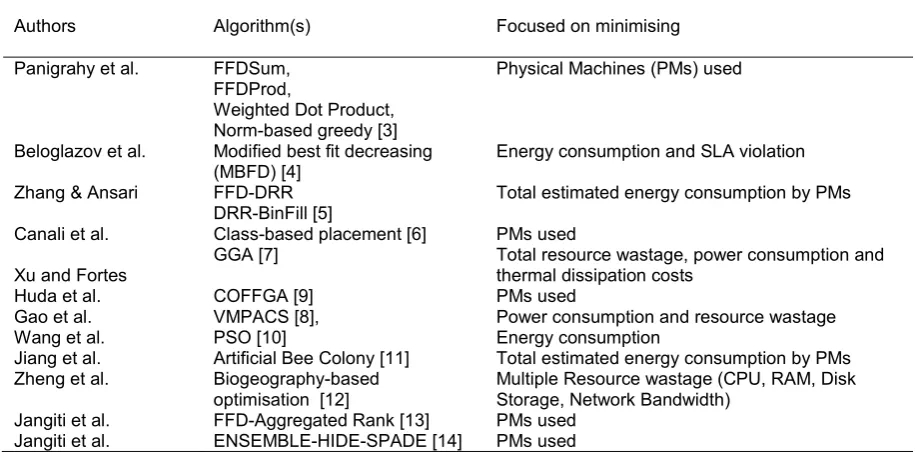
review on VM initial placement and VM reallocation approaches is presented in Table 1 and Table 2 respectively; approximate algorithms like FFD, several other greedy heuristics, meta-heuristics and machine learning approaches are proposed to minimise the energy consumption and resource wastage.
Microsoft Virtual machine manager internally uses the geometric bin-packing heuristics proposed by Panigrahy et al. [3] called Weighted Dot Product (WDP), and Norm-Based Greedy (NBG). These geometric heuristics consumes a large amount of time while handling a huge number of requests, but demonstrated a good placement efficiency compare to the other scalable heuristics used in their study called FFDSum, FFDProd and FFDExpSum. A modified best fit decreasing (MBFD) algorithm was proposed by Beloglazov et al. in [4], which carries out a continuous search of each VM and PM combination to find the minimum power consuming combinations on the whole to reduce the CDC energy consumption. Zhang & Ansari [5] proposed bin-packing heuristics for heterogeneous VM placement, by considering heterogeneous physical machines in the cloud data centre. Canali et al. proposed an automatic technique to group VMs into classes based on their behaviour [6].
GGA proposed by Xu and Fortes is a multi-objective Grouping Genetic Algorithm for VM Placement (VMP). GGA explore the best permutations of VMs which consumes less energy when placed on PMs [7] with an objective to minimise the power consumption and resource wastage. Later the placement efficiency of GGA was dominated by VMPACS [8], a VM placement based on ant colony system optimisation with the same objectives focused by GGA. COFFGA [9], a genetic algorithm uses First-Fit bin-packing heuristic as a fitness function and can produce optimal solutions.
minimise multiple resources (CPU, RAM, Disk Storage and Network bandwidth) wastage [12].
Table 1. State of the art review of VM placement approaches.
Authors Algorithm(s) Focused on minimising
Panigrahy et al. FFDSum, FFDProd,
Weighted Dot Product, Norm-based greedy [3]
Physical Machines (PMs) used
Beloglazov et al. Modified best fit decreasing
(MBFD) [4] Energy consumption and SLA violation Zhang & Ansari FFD-DRR
DRR-BinFill [5] Total estimated energy consumption by PMs Canali et al. Class-based placement [6] PMs used
Xu and Fortes GGA [7] Total resource wastage, power consumption and thermal dissipation costs
Huda et al. COFFGA [9] PMs used
Gao et al. VMPACS [8], Power consumption and resource wastage
Wang et al. PSO [10] Energy consumption
Jiang et al. Artificial Bee Colony [11] Total estimated energy consumption by PMs Zheng et al. Biogeography-based
optimisation [12] Multiple Resource wastage (CPU, RAM, Disk Storage, Network Bandwidth) Jangiti et al. FFD-Aggregated Rank [13] PMs used
Jangiti et al. ENSEMBLE-HIDE-SPADE [14] PMs used
Table 2. State of the art review of VM reallocation approaches
Authors Approach and Description Focused on minimising
Hermenier et
al. Bin repacking - VM consolidation by scheduling VM migrations based on new resource and placement requirements [15] Minimizing average migration completion time
Chen et al. Effective VM Resizing - PM consolidation by formulating as a
stochastic bin- packing problem [16] Server capacity and allowed server overflow probability
Masson et al. Iterated local search - To maximise the resource usage in PMs [17] Resource capacity constraints
Gao et al. VMPACS does consolidation to minimise the number of PMs based on
Ant colony optimisation [8] Resource wastage
Mishra &
Bellur Bal_pack is a probabilistic model on resource shortfall threshold based on bin-packing model [18] PMs used and SLA violations
Shojafar et
al. Joint dynamic Lyapunov based scheduler, decreasing in-packing model [19] amodified best fit CPU Usage and Network Bandwidth
3. Preliminaries
A CDC offering reserved and standard VM instances receive similar type of requests in a large number for a reservation period. The pigeon-hole principle [20] states that at least one standard type of VM instance is repeated (requested more
Management (BBPMM) of reserved virtual machine requests for green cloud computing.
3.1. Bulk-Bin-Packing (BBP)
The bin-packing heuristic BBP will speed up the packing of huge number of items of few item types. BBP use bulk numbers based on Equation 1.
Definition 1- Bulk number [21]: Bulk number represents the number of more bins that can be filled with a similar packing that of current bin.
𝑩𝑩𝑩𝑩𝑩𝑩𝒌𝒌𝒌𝒌𝑩𝑩𝒌𝒌𝒌𝒌𝒌𝒌𝒌𝒌= 𝒌𝒌𝒎𝒎𝒎𝒎𝒎𝒎𝒌𝒌𝑩𝑩𝒌𝒌 �𝒌𝒌𝒌𝒌𝒌𝒌𝒓𝒓𝒎𝒎𝒎𝒎𝒎𝒎𝒎𝒎𝒓𝒓𝒑𝒑𝒓𝒓𝒑𝒑𝒌𝒌𝒌𝒌𝒑𝒑 𝒎𝒎
𝒎𝒎 �,
𝟏𝟏 ≤ 𝒎𝒎 ≤ 𝒌𝒌 & 𝒑𝒑𝒓𝒓𝒑𝒑𝒌𝒌𝒌𝒌𝒑𝒑𝒎𝒎≠ 𝟎𝟎 (1)
Definition 2 - Bulk-bin-packing [21]: Given 𝒎𝒎items of 𝒌𝒌 dissimilar types in the form of
(𝒎𝒎𝒊𝒊𝒌𝒌𝒌𝒌𝒎𝒎,𝒑𝒑𝒄𝒄𝑩𝑩𝒎𝒎𝒊𝒊𝒎𝒎 ) ordered pairs, where𝒎𝒎 = 𝟏𝟏. .𝒌𝒌
and ∑𝒌𝒌𝒎𝒎=𝟏𝟏𝒑𝒑𝒄𝒄𝑩𝑩𝒎𝒎𝒊𝒊𝒎𝒎=𝒎𝒎. The items are to be packed
into minimum bins of capacity𝑪𝑪. The bulk-bin-packing solution will be in the form of ordered pairs { (𝑩𝑩𝑩𝑩𝑩𝑩𝒌𝒌𝒌𝒌𝑩𝑩𝒌𝒌𝒌𝒌𝒌𝒌𝒌𝒌𝟏𝟏 ,𝒌𝒌𝒎𝒎𝒎𝒎𝑪𝑪𝒄𝒄𝒎𝒎𝒃𝒃𝒎𝒎𝒓𝒓𝟏𝟏),
(𝑩𝑩𝑩𝑩𝑩𝑩𝒌𝒌𝒌𝒌𝑩𝑩𝒌𝒌𝒌𝒌𝒌𝒌𝒌𝒌𝟐𝟐, 𝒌𝒌𝒎𝒎𝒎𝒎𝑪𝑪𝒄𝒄𝒎𝒎𝒃𝒃𝒎𝒎𝒓𝒓𝟐𝟐),
… … . , (𝑩𝑩𝑩𝑩𝑩𝑩𝒌𝒌𝒌𝒌𝑩𝑩𝒌𝒌𝒌𝒌𝒌𝒌𝒌𝒌𝒌𝒌 ,𝒌𝒌𝒎𝒎𝒎𝒎𝑪𝑪𝒄𝒄𝒎𝒎𝒃𝒃𝒎𝒎𝒓𝒓𝒌𝒌) }, where 𝒌𝒌𝒎𝒎𝒎𝒎𝑪𝑪𝒄𝒄𝒎𝒎𝒃𝒃𝒎𝒎𝒓𝒓𝟏𝟏…𝒌𝒌are𝒌𝒌dissimilar packing configurations and𝒌𝒌 ≤ 𝟐𝟐 ∗ 𝒌𝒌.
4. Bulk-bin-packing based Migration
Management (BBPMM) of reserved
VM requests
Based on the revenue and reservation models, VM instances offered by an IaaS CSP can be categorized as (i) Reserved, (ii) On-demand and (iii) Spot Instances. Customers can book reserved VMs in advance if resource quantities are well-known, otherwise on-demand instances at a premium cost. To improve profits, the CSP offers the unutilized resources in the running PMs as spot instances [22] and can be taken back at short notice if required. This paper proposes a split in the management of reserved and on-demand VM requests with different placement and migration controllers since their incoming and outgoing behaviour is different. Assume a batch of reserved VM requests is ready for placement at every reservation time unit 𝑇𝑇. Let 𝑇𝑇𝑖𝑖 be the start time of 𝑖𝑖𝑡𝑡ℎcycle of incoming reserved VM requests for placement. A request reserved for 𝑘𝑘 time units and start time 𝑇𝑇𝑖𝑖 needs resources allocated till 𝑇𝑇𝑖𝑖+𝑘𝑘, where as on-demand requests may leave any time. The PMs are divided into two logical pools. All the
PMs, other than those hosting reserved VM instances, can service on-demand requests. The resource gaps in the reserved logical pool PMs can be used by on-demand as well as spot instances up to the next reservation period. The logical view of the considered VM placement and migration management is depicted in Figure 1. The VM placement controller initially maps incoming VM requests to a minimum number of PMs. The VM migration controller reallocates VMs to other PMs with an objective to reduce the number of PMs powered on from time to time. Our recent contribution MCBVP [21] is highly useful for reserved VM initial placement, since requests are pooled for placement as bulk requests. Also, there is a chance of getting bulk on-demand requests at times. MCBVP can be used for on-demand request initial placement too. When the amount of on-demand requests are below the threshold level, the well known best-fit decreasing can be used.
4.1. Migration management of reserved VM requests
Figure 1. Logical View of a VM initial placement and migration manager
Algorithm 1: Bulk-Bin-Packing based Migration Management (BBPMM) 1. 𝑹𝑹𝒌𝒌𝒑𝒑𝒌𝒌𝒓𝒓𝒊𝒊𝒓𝒓𝒊𝒊𝒌𝒌𝒓𝒓𝒑𝒑𝒉𝒉𝒌𝒌𝒌𝒌𝒓𝒓𝒌𝒌𝒌𝒌𝒓𝒓𝒓𝒓𝒊𝒊𝒎𝒎𝒄𝒄𝒎𝒎𝒊𝒊𝒎𝒎𝒌𝒌𝒌𝒌𝑻𝑻
2. 𝒃𝒃𝒄𝒄𝒌𝒌𝒌𝒌𝒓𝒓𝒑𝒑𝒉𝒉𝑷𝑷𝑷𝑷𝒉𝒉𝒄𝒄𝒓𝒓𝒊𝒊𝒎𝒎𝒎𝒎𝒓𝒓𝑽𝑽𝑷𝑷𝒓𝒓𝑩𝑩𝒌𝒌𝒓𝒓𝒓𝒓𝒎𝒎𝒎𝒎𝒓𝒓𝒓𝒓𝒊𝒊𝑻𝑻 do
3. 𝑻𝑻𝑷𝑷𝑷𝑷𝑩𝑩𝒎𝒎𝒓𝒓𝒌𝒌 = 𝑷𝑷𝑷𝑷.𝒌𝒌𝒌𝒌𝒌𝒌𝒓𝒓𝒎𝒎𝒎𝒎𝒎𝒎𝒎𝒎𝒓𝒓𝒓𝒓𝒎𝒎𝒃𝒃𝒌𝒌()
4. 𝒃𝒃𝒄𝒄𝒌𝒌𝒌𝒌𝒓𝒓𝒑𝒑𝒉𝒉𝑽𝑽𝑷𝑷𝑷𝑷𝑷𝑷𝑩𝑩𝒌𝒌𝒓𝒓𝒓𝒓𝒎𝒎𝒎𝒎𝒓𝒓𝒑𝒑𝑩𝑩𝒌𝒌𝒌𝒌𝒌𝒌𝒎𝒎𝒊𝒊𝑷𝑷𝑷𝑷𝒓𝒓𝒊𝒊𝑻𝑻𝒑𝒑𝒄𝒄 5. 𝒃𝒃𝒄𝒄𝒌𝒌𝒌𝒌𝒓𝒓𝒑𝒑𝒉𝒉𝑽𝑽𝑷𝑷 ∈ 𝑽𝑽𝑷𝑷𝒌𝒌𝒌𝒌𝒓𝒓𝑩𝑩𝒌𝒌𝒓𝒓𝒊𝒊𝒓𝒓𝒑𝒑𝒄𝒄
6. if 𝑽𝑽𝑷𝑷.𝒊𝒊𝒕𝒕𝒑𝒑𝒌𝒌=𝑽𝑽𝑷𝑷𝑷𝑷𝑷𝑷.𝒊𝒊𝒕𝒕𝒑𝒑𝒌𝒌 & 𝑻𝑻𝒌𝒌𝒌𝒌𝒓𝒓≤ 𝑻𝑻𝑷𝑷𝑷𝑷𝑩𝑩𝒎𝒎𝒓𝒓𝒌𝒌 7. 𝑷𝑷𝑷𝑷.𝒑𝒑𝑩𝑩𝒓𝒓𝒑𝒑𝒌𝒌( 𝑽𝑽𝑷𝑷,𝑻𝑻,𝑻𝑻𝒌𝒌𝒌𝒌𝒓𝒓)
8. 𝒌𝒌𝒎𝒎𝒑𝒑𝒃𝒃𝒄𝒄𝒌𝒌
9. 𝒌𝒌𝒎𝒎𝒑𝒑𝒃𝒃𝒄𝒄𝒌𝒌
10. 𝒌𝒌𝒎𝒎𝒑𝒑𝒃𝒃𝒄𝒄𝒌𝒌
11. 𝒎𝒎𝒃𝒃(𝑮𝑮𝒓𝒓𝒑𝒑𝒓𝒓𝒃𝒃𝒎𝒎𝑩𝑩𝑩𝑩𝒌𝒌𝒑𝒑)
12. 𝒑𝒑𝒓𝒓𝑩𝑩𝑩𝑩𝑷𝑷𝑪𝑪𝑩𝑩𝑽𝑽𝑷𝑷(𝑽𝑽𝑷𝑷𝒌𝒌𝒌𝒌𝒓𝒓𝑩𝑩𝒌𝒌𝒓𝒓𝒊𝒊𝒓𝒓)
13. 𝒌𝒌𝑩𝑩𝒓𝒓𝒌𝒌 //if gaps remaining
14. 𝒃𝒃𝒄𝒄𝒌𝒌𝒌𝒌𝒓𝒓𝒑𝒑𝒉𝒉𝑷𝑷𝑷𝑷 ∈ 𝑷𝑷𝑷𝑷𝑮𝑮𝒓𝒓𝒑𝒑𝒓𝒓𝒑𝒑𝒄𝒄 // add all VMs in PMs with 15. 𝒃𝒃𝒄𝒄𝒌𝒌𝒌𝒌𝒓𝒓𝒑𝒑𝒉𝒉𝑽𝑽𝑷𝑷 ∈ 𝑷𝑷𝑷𝑷𝒑𝒑𝒄𝒄 //gaps to the set 𝑽𝑽𝑷𝑷𝒌𝒌𝒌𝒌𝒓𝒓𝑩𝑩𝒌𝒌𝒓𝒓𝒊𝒊𝒓𝒓
16. 𝑽𝑽𝑷𝑷𝒌𝒌𝒌𝒌𝒓𝒓𝑩𝑩𝒌𝒌𝒓𝒓𝒊𝒊𝒓𝒓 ← 𝑽𝑽𝑷𝑷𝒌𝒌𝒌𝒌𝒓𝒓𝑩𝑩𝒌𝒌𝒓𝒓𝒊𝒊𝒓𝒓∪ 𝑽𝑽𝑷𝑷
17. 𝒌𝒌𝒎𝒎𝒑𝒑𝒃𝒃𝒄𝒄𝒌𝒌
18. 𝒌𝒌𝒎𝒎𝒑𝒑𝒃𝒃𝒄𝒄𝒌𝒌
19. 𝒑𝒑𝒓𝒓𝑩𝑩𝑩𝑩𝑷𝑷𝑪𝑪𝑩𝑩𝑽𝑽𝑷𝑷(𝑽𝑽𝑷𝑷𝒌𝒌𝒌𝒌𝒓𝒓𝑩𝑩𝒌𝒌𝒓𝒓𝒊𝒊𝒓𝒓) 20. 𝒌𝒌𝒎𝒎𝒑𝒑𝒎𝒎𝒃𝒃
Figure 2. Cases in BBPMM
5. Simulation Experiments and
Result Analysis
MCBVP and BBPMM were implemented in Python environment and the simulation experimentation was carried out in a Windows 10 operating system with Intel® Core TM i7 processor @ 2.5 GHz and 4 GB RAM. Real Dataset – EC2 was used to demonstrate the migration management of reserved VM requests.
5.1. Dataset Description
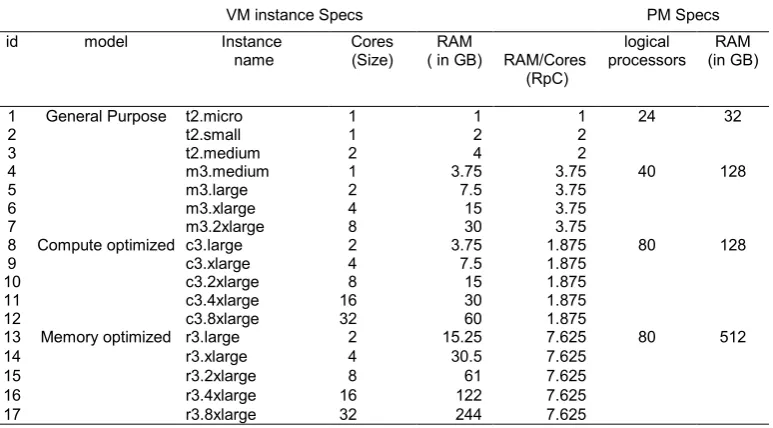
We consider the Real Dataset – EC2 [12] inspired by Amazon EC2. Seventeen instances are available,of which compute-optimised and memory-optimised are five each, and the remaining
seven are general purpose VM instances as shown in Table 3.
5.2. Results & Discussion
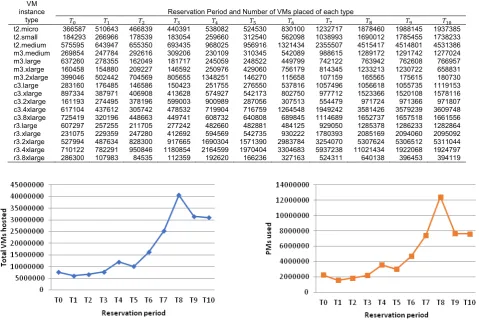
The simulation experiment is to test the proposed BBPMM (Algorithm 1). A random amount of all 17 types of VMs were supplied for placement in the initial reservation period 𝑇𝑇0. T he o utcome o f BBPMM, PMs used and the number of VMs hosted of each type during the sucessive ten reservation periods were as listed in Table 4. The VM requests supplied for placement at each reservation period is listed in Table 5. The automatic adjustment of PMs used at each reservation period and total VMs hosted by them is depicted in Figure 3.
Table 3. Standard VM instances from Real Dataset – EC2, their resource ratio and sizes
VM instance Specs PM Specs
id model Instance
name Cores (Size) ( in GB) RAM/Cores RAM (RpC)
logical
processors (in GB) RAM
1 General Purpose t2.micro 1 1 1 24 32
2 t2.small 1 2 2
3 t2.medium 2 4 2
4 m3.medium 1 3.75 3.75 40 128
5 m3.large 2 7.5 3.75
6 m3.xlarge 4 15 3.75
7 m3.2xlarge 8 30 3.75
8 Compute optimized c3.large 2 3.75 1.875 80 128
9 c3.xlarge 4 7.5 1.875
10 c3.2xlarge 8 15 1.875
11 c3.4xlarge 16 30 1.875
12 c3.8xlarge 32 60 1.875
13 Memory optimized r3.large 2 15.25 7.625 80 512
14 r3.xlarge 4 30.5 7.625
15 r3.2xlarge 8 61 7.625
16 r3.4xlarge 16 122 7.625
Table 5. VM request count of each type at different reservation periods VM
instance
type 𝑇𝑇0 𝑇𝑇1 𝑇𝑇2 Reservation Period and Number of VMs placed of each type 𝑇𝑇3 𝑇𝑇4 𝑇𝑇5 𝑇𝑇6 𝑇𝑇7 𝑇𝑇8 𝑇𝑇9 𝑇𝑇10
t2.micro 366587 510643 466839 440391 538082 524530 830100 1232717 1878460 1988145 1937385
t2.small 184293 266966 178539 183054 259660 312540 562098 1038993 1690012 1785455 1738233
t2.medium 575595 643947 655350 693435 968025 956916 1321434 2355507 4515417 4514801 4531386
m3.medium 269854 247784 292616 309206 230109 310345 542089 988615 1289172 1291742 1277024
m3.large 637260 278355 162049 181717 245059 248522 449799 742122 763942 762608 766957
m3.xlarge 160458 154880 209227 146592 250976 429060 756179 814345 1233213 1230722 658831
m3.2xlarge 399046 502442 704569 805655 1348251 146270 115658 107159 165565 175615 180730
c3.large 283160 176485 146586 150423 251755 276550 537816 1057496 1056618 1055735 1119153
c3.xlarge 897334 387971 406908 413628 574927 542173 802750 977712 1523366 1520108 1578116
c3.2xlarge 161193 274495 378196 599003 900989 287056 307513 554479 971724 971366 971807
c3.4xlarge 617104 437612 305742 478532 719904 716759 1264548 1949242 3581426 3579239 3609748
c3.8xlarge 725419 320196 448663 449741 608732 640808 689845 1114689 1652737 1657518 1661556
r3.large 607297 257255 211705 277242 482660 482881 484125 929050 1285378 1286233 1282864
r3.xlarge 231075 229359 247280 412692 594569 542735 930222 1780393 2085169 2094060 2095092
r3.2xlarge 527994 487634 828300 917665 1690304 1571390 2983784 3254070 5307624 5306512 5311044
r3.4xlarge 710122 782291 950846 1180854 2164599 1970404 3304683 5937238 11021434 1922068 1924797
r3.8xlarge 286300 107983 84535 112359 192620 166236 327163 524311 640138 396453 394119
Figure 3. The outcome of BBPMM, PMs used and total VMs hosted at different reservation periods.
6. Conclusion and Future Work
As part of energy efficient management of CDCs, VM consolidation has secured a major concern in reducing CSP operational expenses by minimising the PMs used. In this paper, we presented a heuristic approach BBPMM based on our earlier contributions, MCBVP and BBP as part of energy efficient management of CDCs. At each reservation period, the problem is formulated as Vector Bin-Packing (VBP), a combinatorial optimisation and NP-hard problem.
for their financial support (SR/FST/ETI-349/2013) under Fund for Improvement of S&T Infrastructure in Universities and Higher Educational Institutions.
References
[1] L.A. Barroso, U. Hölzle, The case for energy-proportional computing, Computer (Long. Beach. Calif). 40 (2007) 33–37. doi:10.1109/MC.2007.443. [2] S. Jangiti, V.S.S. Sriram, R. Logesh, The role of cloud
computing infrastructure elasticity in energy efficient management of datacenters, in: 2017 IEEE Int. Conf. Power, Control. Signals Instrum. Eng., IEEE, 2017: pp. 758–763. doi:10.1109/ICPCSI.2017.8391816.
[3] R. Panigrahy, K. Talwar, L. Uyeda, U. Wieder, Heuristics for Vector Bin Packing, Res. Microsoft. (2011) 1–14.
doi:10.1109/GreenCom-CPSCom.2010.137.
[4] A. Beloglazov, J. Abawajy, R. Buyya, Energy-aware resource allocation heuristics for efficient management of data centers for Cloud computing, 28 (2012) 755– 768. doi:10.1016/j.future.2011.04.017.
[5] Y. Zhang, N. Ansari, Heterogeneity aware dominant resource assistant heuristics for virtual machine consolidation, GLOBECOM - IEEE Glob. Telecommun. Conf. (2013) 1297–1302. doi:10.1109/GLOCOM.2013.6831253.
[6] C. Canali, R. Lancellotti, Scalable and automatic virtual machines placement based on behavioral similarities, Computing. 99 (2017) 575–595. doi:10.1007/s00607-016-0498-5.
[7] J. Xu, J.A.B. Fortes, Multi-objective virtual machine placement in virtualized data center environments, in: Proc. - 2010 IEEE/ACM Int. Conf. Green Comput. Commun. GreenCom 2010, 2010 IEEE/ACM Int. Conf. Cyber, Phys. Soc. Comput. CPSCom 2010, 2010: pp. 179–188. doi:10.1109/GreenCom-CPSCom.2010.137. [8] Y. Gao, H. Guan, Z. Qi, Y. Hou, L. Liu, A
multi-objective ant colony system algorithm for virtual machine placement in cloud computing, J. Comput. Syst. Sci. 79 (2013) 1230–1242.
doi:10.1016/j.jcss.2013.02.004.
[9] H. Hallawi, J. Mehnen, H. He, Multi-Capacity Combinatorial Ordering GA in Application to Cloud resources allocation and efficient virtual machines consolidation, Futur. Gener. Comput. Syst. 69 (2017) 1–10. doi:10.1016/j.future.2016.10.025.
[10] S. Wang, Z. Liu, Z. Zheng, Q. Sun, F. Yang, Particle swarm optimization for energy-aware virtual machine placement optimization in virtualized data centers, in: Proc. Int. Conf. Parallel Distrib. Syst. - ICPADS, 2013: pp. 102–109. doi:10.1109/ICPADS.2013.26.
[11] J. Jiang, Y. Feng, J. Zhao, K. Li, DataABC: A fast ABC based energy-efficient live VM consolidation policy with data-intensive energy evaluation model, Futur. Gener. Comput. Syst. 74 (2017) 132–141.
doi:10.1016/j.future.2016.05.013.
[12] Q. Zheng, R. Li, X. Li, N. Shah, J. Zhang, F. Tian, K.M. Chao, J. Li, Virtual machine consolidated placement based on multi-objective
biogeography-Cloud Computing, in: Springer, Singapore, 2019: pp. 545–555. doi:10.1007/978-981-13-0617-4_53. [14] S. Jangiti, E. Sri Ram, L. Ravi, V.S.S. Sriram, Scalable
hybrid and ensemble heuristics for economic virtual resource allocation in cloud and fog cyber-physical systems, J. Intell. Fuzzy Syst. Preprint (2019) 1–11. doi:10.3233/JIFS-179004.
[15] F. Hermenier, S. Demassey, X. Lorca, M. Chen, H. Zhang, Y.Y. Su, X. Wang, G. Jiang, K. Yoshihira, Bin repacking scheduling in virtualized datacenters, Lect. Notes Comput. Sci. (Including Subser. Lect. Notes Artif. Intell. Lect. Notes Bioinformatics). 6876 LNCS (2011) 594–601. doi:10.1109/INM.2011.5990564. [16] M. Chen, H. Zhang, Y.Y. Su, X. Wang, G. Jiang, K.
Yoshihira, Effective VM sizing in virtualized data centers, Proc. 12th IFIP/IEEE Int. Symp. Integr. Netw. Manag. IM 2011. (2011) 594–601.
doi:10.1109/INM.2011.5990564.
[17] R. Masson, T. Vidal, J. Michallet, P.H.V. Penna, V. Petrucci, A. Subramanian, H. Dubedout, An iterated local search heuristic for multi-capacity bin packing and machine reassignment problems, Expert Syst. Appl. 40 (2013) 5266–5275. doi:10.1016/j.eswa.2013.03.037. [18] M. Mishra, U. Bellur, Whither tightness of packing?
The case for stable VM placement, IEEE Trans. Cloud Comput. PP (2015) 481–494.
doi:10.1109/TCC.2014.2378756.
[19] M. Shojafar, C. Canali, R. Lancellotti, E. Baccarelli, Minimizing Computing-plus-Communication Energy Consumptions in Virtualized Networked Data Centers, (2016) 1–8.
[20] W.A. Trybulec, Pigeon hole principle, J. Formaliz. Math. 2 (1990) 0.
http://citeseerx.ist.psu.edu/viewdoc/download?doi=10.1 .1.73.8514&rep=rep1&type=pdf (accessed February 21, 2017).
[21] S. Jangiti, S. Sriram. V.S., Scalable and direct vector bin-packing heuristic based on residual resource ratios for virtual machine placement in cloud data centers, Comput. Electr. Eng. (2018).
doi:10.1016/j.compeleceng.2018.03.029. [22] P. Sharma, S. Lee, T. Guo, D. Irwin, P. Shenoy,
SpotCheck: Designing a Derivative IaaS Cloud on the Spot Market, in: ACM, New York, NY, USA, 2015: pp. 16:1–16:15. doi:10.1145/2741948.2741953.