Towards using Segmentation-based Techniques to
Personalize Mobility Behavior Interventions
Paula J. Forbes
1, Silvia Gabrielli
2, Rosa Maimone
2, Judith Masthoff
1, Simon Wells
1, Antti Jylhä
31University of Aberdeen, Computing Science, Meston building, Meston Walk, Aberdeen, AB24 3UE, UK 2
Create-Net, Italy
3
University of Helsinki, Finland
Abstract
This paper describes our initial work towards a segmentation-based approach to personalized digital behavior change
interventions in the domain of sustainable, multi-modal urban transport. Segmentation is a key concept in market research,
and within the transport domain, Anable has argued that there are segments of travelers that are relatively homogenous in
terms of their mobility attitudes and behaviors. We describe an approach aimed at tailoring behavior change notifications
by using segmentation-based techniques for user profiling. We report results from a Mechanical Turk study in which we
obtained a crowd-sourced categorization of motivational messages. This is a first step towards understanding how to better
deliver persuasive messages to relevant users profiles and situational contexts in the urban mobility domain. We conclude
by discussing future steps of our work that should inform the deployment of persuasion profiling techniques to achieve
sustainable mobility goals.
Keywords: persuasion, behaviour intervention. Segmentation, sustainability, mobility
Received on 16 June 2014, accepted on 30 July 2014, published on 31 October 2014
Copyright © 2014 Paula J. Forbeset al., licensed to ICST. This is an open access article distributed under the terms of the Creative
Commons Attribution licence (http://creativecommons.org/licenses/by/3.0/), which permits unlimited use, distribution and reproduction in any medium so long as the original work is properly cited.
doi: 10.4108/amsys.1.4.e4
1. Introduction
We are investigating how to maximize the persuasion
potential for nudging citizens towards more sustainable
transport choices via an urban mobility platform based on
mobile and web interfaces. In our earlier work, we
discussed how behavior change theories can be integrated
into a sustainable urban mobility platform [1,2]. Building
on the theories and techniques of Michie
et al
. [3,4,5] we
were also inspired by the segmentation work of Anable
[6,7]. In this paper, we aim to combine the profiling tools
of Anable’s segmentation analysis with digital
intervention techniques to deploy
targeted
digital
interventions that prompt people to use more sustainable
transport
modes.
The
SUPERHUB
project
(http://superhub-project.eu) aims to do this by a
combination of: i) prompting intention formation, ii)
setting and reviewing specific goals; iii) providing
monitoring, feedback, and rewards; iv) supporting (social)
comparison; v) aiding decision-making.
To improve behavior change interventions for urban
mobility, our recent research has identified a considerable
potential in exploring and experimenting with the
following techniques:
Just-in-time prompts and notifications. Participants are
prompted at appropriate times to change their behavior,
for example to provide a lift or use public transport.
Notifications or prompts are personalized according to
user characteristics and context. Notifications to
encourage behavior change are sent by taking into
account domain-relevant user profiles and activities in
order to raise their effectiveness in terms of user
acceptance and persuasion.
Research Article
EAI Endorsed Transactions
on Ambient Systems
Previous work suggests that personalized or tailored
messages are more useful than generic ones in promoting
behavior change [8]. Noar
et al
. [9] provides a
Meta-analytic review of tailored Health Behavior Change
interventions and provides evidence for the effectiveness
of tailoring. Tailored messages may be especially useful
when emotional arousal facilitates behavior change
interventions [10,11]. Research has shown that users show
significant individual differences in their response to
influence attempts [12,13,14,15]. This suggests that using
persuasion profiles (estimates of an individual user’s
susceptibility to different influencing strategies) to adapt
persuasive systems should be considered [16].
In this paper, we discuss how a segmentation-based
approach can be used, where motivational messages are
tailored to Anable’s traveler segments. We also present
the results of an initial study to select and categorize
motivational messages. We finish by describing how this
work will be extended to obtain an effective algorithm for
selecting motivational messages based on the traveler
segment a user belongs to.
2. A segmentation-based approach
The preliminary user research undertaken by large scale
questionnaires and numerous focus groups early in our
project found that different people have very different
concerns regarding their travel choices. Some people are
committed to the environment and will do what they can
to reduce their carbon footprint. Others are less concerned
and it will take a lot more persuading than simply
showing CO
2comparisons for them to make more
sustainable travel choices.
Anable [5] stated that travel research methodology and
policy interventions often overlook how the combination
of instrumental, situational and psychological factors
affects travel choice and differs for distinct groups of
people. Understanding what will motivate people to
change their behavior is a key element of any successful
intervention. For example, visualizing the amount of CO
2produced over a year may work for some, whereas for
others finding out the amount of money they could save
by taking the bus rather than driving may be more
motivating. Different people will respond more or less to
different cues and this represents a major research
challenge in understanding how to develop effective
persuasive interventions for everyone, not just those
already concerned about the environment. To enable a
more tailored approach, we are considering the different
types of ‘traveler profile’ proposed by the ‘Segment’
methodology developed by Anable [6] which deploys a
version of psychological theory of attitude-behavior
relations (Theory Planned Behavior – TPB) to score
travelers on specific attitude statements. Anable [6]
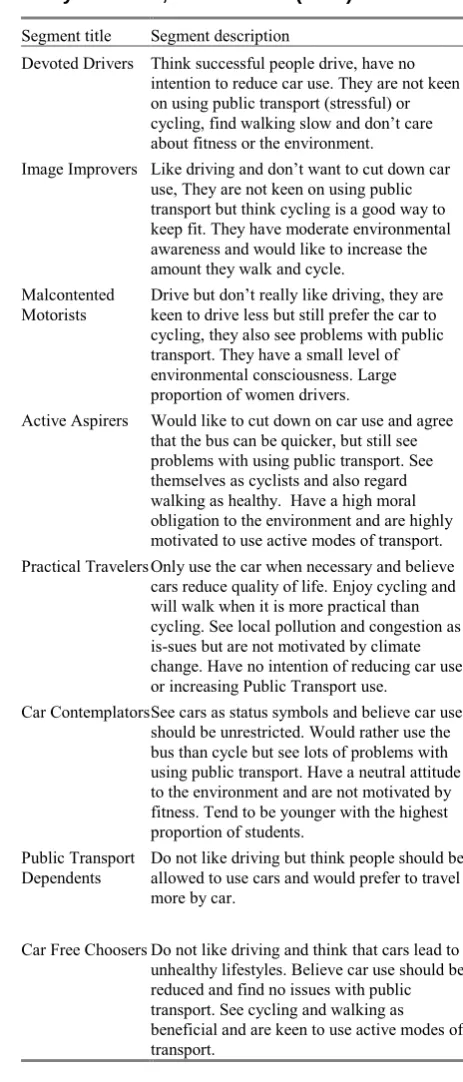
proposes eight distinct attitudinal segments, as shown in
Table 1.
Table 1. Segmentation of people based on
mobility attitudes, from Anable (2010).
Segment title Segment description
Devoted Drivers Think successful people drive, have no intention to reduce car use. They are not keen on using public transport (stressful) or cycling, find walking slow and don’t care about fitness or the environment.
Image Improvers Like driving and don’t want to cut down car use, They are not keen on using public transport but think cycling is a good way to keep fit. They have moderate environmental awareness and would like to increase the amount they walk and cycle.
Malcontented Motorists
Drive but don’t really like driving, they are keen to drive less but still prefer the car to cycling, they also see problems with public transport. They have a small level of environmental consciousness. Large proportion of women drivers.
Active Aspirers Would like to cut down on car use and agree that the bus can be quicker, but still see problems with using public transport. See themselves as cyclists and also regard walking as healthy. Have a high moral obligation to the environment and are highly motivated to use active modes of transport. Practical Travelers Only use the car when necessary and believe
cars reduce quality of life. Enjoy cycling and will walk when it is more practical than cycling. See local pollution and congestion as is-sues but are not motivated by climate change. Have no intention of reducing car use or increasing Public Transport use.
Car Contemplators See cars as status symbols and believe car use should be unrestricted. Would rather use the bus than cycle but see lots of problems with using public transport. Have a neutral attitude to the environment and are not motivated by fitness. Tend to be younger with the highest proportion of students.
Public Transport Dependents
Do not like driving but think people should be allowed to use cars and would prefer to travel more by car.
Car Free Choosers Do not like driving and think that cars lead to unhealthy lifestyles. Believe car use should be reduced and find no issues with public transport. See cycling and walking as beneficial and are keen to use active modes of transport.
Towards using Segmentation-based Techniques to Personalize Mobility Behavior Interventions
3. Validation of motivational messages
This section describes our approach to categorize and
validate motivational messages for use in personalized
behavior change interventions. We are currently carrying
out experimentation by utilizing Amazon’s Mechanical
Turk (MT) to gather crowd sourced intelligence about
which kinds of message would be best suited to motivate
Anable’s defined traveler profiles. Initially we produced
and selected a wide range of messages including
quotations that we thought could motivate sustainable
travel behavior in our users. This first MT study shows
how we validated the messages to be used in each of the
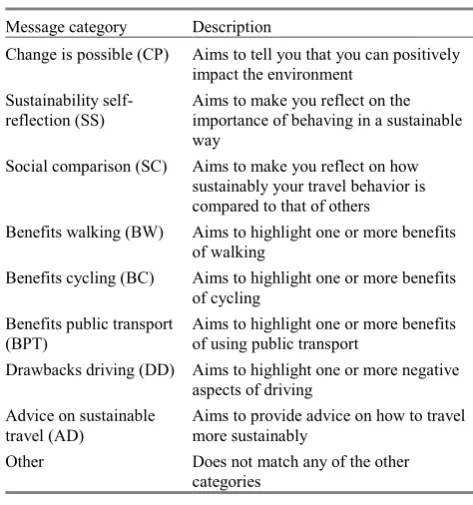
motivational categories shown in Table 2. We adopted the
approach used by Dennis et al [18,19], who investigated
the categorization of emotional support statements.
3.1 Participants
Participants were recruited from Amazon’s Mechanical
Turk service (MT, 2013), a crowd-sourcing tool.
Participants (called workers) complete small tasks (called
HITs) made available by requesters and are paid a small
sum for completing the task successfully. For this
validation experiment (HIT), participants had to be based
in the US and have an acceptance rate of 90% (meaning
that 90% of the work they do is accepted by other
requesters as good quality) and were paid $0.70. We used
a Cloze Test [20] for
English fluency due to the language
based nature of the study. Workers who failed the test
were excluded. 30 participants completed the experiment
and were 27% male. 24% of participants were 18-25, 43%
were 26-40
and 33% were 41-65. The average time taken
to complete the experiment was around 11 minutes.
3.2 Procedure
Participants were introduced to the categories and their
definitions (as described in Table 2). Next, they were
shown a message and asked to place it into one of the
categories (still seeing the definitions), as shown in Figure
1. This was repeated for each of the 74 messages.
Participants were advised that there were no right or
wrong answers and that it was their opinion that counted.
Table 2.
Message categories devised by the authors
Message category Description
Change is possible (CP) Aims to tell you that you can positively impact the environment
Sustainability self-reflection (SS)
Aims to make you reflect on the importance of behaving in a sustainable way
Social comparison (SC) Aims to make you reflect on how sustainably your travel behavior is compared to that of others
Benefits walking (BW) Aims to highlight one or more benefits of walking
Benefits cycling (BC) Aims to highlight one or more benefits of cycling
Benefits public transport (BPT)
Aims to highlight one or more benefits of using public transport
Drawbacks driving (DD) Aims to highlight one or more negative aspects of driving
Advice on sustainable travel (AD)
Aims to provide advice on how to travel more sustainably
Other Does not match any of the other categories
Figure 1.
Example of how messages were presented
to participants during the MT study, message
statement presented at the top of the page,
participants select a category from the choices
below.
3.3 Validation Measure
We use Free-Marginal Kappa [21] as a metric for
establishing how well categorized our messages were.
The kappa value describes agreement amongst raters, with
1 indicating unanimous agreement, 0.7 excellent and 0.4
moderate agreement. To be reliably categorized, the
kappa score for the message had to be ≥ 0.4.
3.4 Results
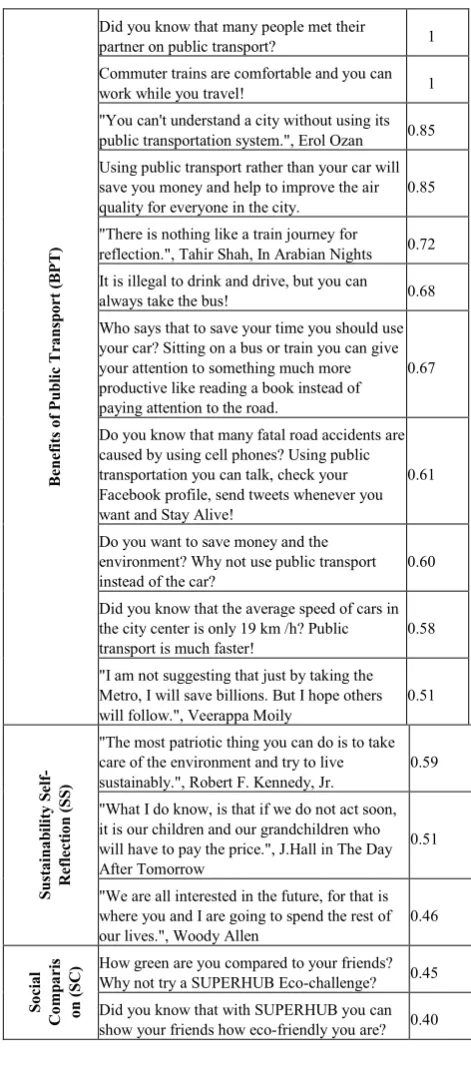
Table 3 shows the messages with kappa ≥ 0.4. To decide
on which messages to put forward to the next phase and
potentially use as motivational messages during our next
project trial, we selected those that had the highest kappa
values and that had at least a kappa ≥ 0.4 (so, had an
adequate level of agreement between the participants).
Table 3.
Messages with adequate inter participant
agreement (kappa ≥ 0.4)
Category Message Kappa
A dv ic e on S ust ai na bl e T ra ve l (AD)
Did you know that if you use the SUPERHUB Journey Planner for your regular journeys, you will get warnings about disruptions? 0.42 Are you searching for a ride share but don't trust the services offered on the web? SUPERHUB is secure and safe, and all the riders’ profiles are verified and classified according to the rating provided by other members of the community. 0.41 Did you know that if you use the SUPERHUB Journey Planner for your regular journeys, you will get warnings about disruptions?
0.42 C ha ng e is P ossi be ( C P)
"You must be the change you wish to see in the world" Mahatma Gandhi 0.73 "Never doubt that a small group of thoughtful, committed citizens can change the world; indeed, it's the only thing that ever has.", Margaret Mead
0.61
"Little decisions over time make a big impact on our lives.", Eric Samuel Timm 0.61 "Sometimes if you want to see a change for the better, you have to take things into your own hands.", Clint Eastwood.
0.60
"Act as if what you do makes a difference. It does.", William James 0.51 "They always say time changes things, but you actually have to change them yourself.", Andy Warhol
0.50
You can make a difference and SUPERHUB will
show you how! 0.50
"True life is lived when tiny changes occur.", Leo
Tolstoy 0.46
B en ef it s o f W al ki ng ( B W)
"All truly great thoughts are conceived while walking.", Friedrich Nietzsche 1 Want to feel better this month? Why not try
walking to work? Walking 30 minutes per day will use 100 calories. You could lose 3lbs by the end of the month - but don’t buy chocolate on the way!
1
Walking at least 1 hour per day helps you to be healthier, reduces stress and anxiety and increases wellbeing.
1
"But the beauty is in the walking; we are betrayed by destinations.", Gwyn Thomas 0.79 "Everywhere is walking distance if you have the time.", Steven Wright 0.55
B en ef it s o f Pub lic T ra nsp or t (B PT )
Did you know that many people met their
partner on public transport? 1 Commuter trains are comfortable and you can
work while you travel! 1
"You can't understand a city without using its public transportation system.", Erol Ozan 0.85 Using public transport rather than your car will save you money and help to improve the air quality for everyone in the city.
0.85
"There is nothing like a train journey for
reflection.", Tahir Shah, In Arabian Nights 0.72 It is illegal to drink and drive, but you can
always take the bus! 0.68 Who says that to save your time you should use your car? Sitting on a bus or train you can give your attention to something much more productive like reading a book instead of paying attention to the road.
0.67
Do you know that many fatal road accidents are caused by using cell phones? Using public transportation you can talk, check your Facebook profile, send tweets whenever you want and Stay Alive!
0.61
Do you want to save money and the environment? Why not use public transport instead of the car?
0.60
Did you know that the average speed of cars in the city center is only 19 km /h? Public transport is much faster!
0.58
"I am not suggesting that just by taking the Metro, I will save billions. But I hope others will follow.", Veerappa Moily
0.51 Su st ai na bi lit y Se lf -R ef le ct io n (SS)
"The most patriotic thing you can do is to take care of the environment and try to live sustainably.", Robert F. Kennedy, Jr.
0.59
"What I do know, is that if we do not act soon, it is our children and our grandchildren who will have to pay the price.", J.Hall in The Day After Tomorrow
0.51
"We are all interested in the future, for that is where you and I are going to spend the rest of our lives.", Woody Allen
0.46 So ci al C omp ar is on ( SC
The results showed that some categories obtained a much
higher level of agreement between participants than
others, for example, the ‘positive aspects of cycling’
agreement levels and therefore kappa values were very
high, whilst other categories such as ‘Advice on
Sustainable Travel’ and ‘Sustainability Self-reflection’ led
to lower levels of agreement, and hardly any messages
with kappa ≥ 0.4. This can be explained by the fact that
some of the original messages had components of more
than one category, for example, the following message
“Did you know that many people use public transport at
least once per week?” contains a positive statement about
public transport and is also a social comparison statement,
which effectively divided the participants choice between
the two categories. Some refinement of the messages and
categories has been made to enable clearer categorization
for the next round of MT experiments. We have removed
the ‘Advice’ category and any ‘mixed message’ messages
will be replaced with less complex ones that provide a
clearer persuasive message. A further iteration of the
above procedure will be carried out with another 30
participants to allow validation of additional messages.
4. Conclusions and Future Work
In this paper, we have presented our early and ongoing
work in designing persuasive notifications tailored to
relevant travelers’ profiles for behavior change
interventions in the sustainable transport domain. We
have reported work conducted to gather a corpus of 74
motivational messages and categorize them into 9
categories, with 45 messages being reliably categorized.
The next step is to run a study which presents participants
with each traveler segment profile and asks them to
provide the most appropriate notifications using the
validated messages. This will result in an algorithm that
selects message categories (and messages) depending on
the traveler segment. It would have been possible simply
to select message categories and messages that we
thought would be appropriate for each of the segment
types. However, by going through the process of crowd
sourced intelligence for initially grouping messages by
category and then choosing which messages (and hence,
categories) would be most relevant to each segment type,
we expect to obtain a more effective persuasive system.
Acknowledgements.
This work has been supported bythe FP7 IP Project SUPERHUB N. 289067.
References
[1] Forbes, P.J., Wells, S. , Masthoff, J. & Nguyen, H. (2012) SUPERHUB: Integrating behaviour change theories into a
sustainable urban mobility platform Healthy, Sustainable Living at BHCI. 2012.
[2] Gabrielli, S., Maimone, R., Forbes, P., Masthoff, J., Wells, S., Primerano, L, & Pompa, M.. (2013) Designing motivational features for sustainable urban mobility. CHI'13 Extended Abstracts on Human Factors in Computing Systems. ACM, 2013.
[3] Michie, S., Johnston, M., Abraham, C., Lawton, R., Parker, D., & Walker, A. (2005). Making psychological theory useful for implementing evidence based practice: a consensus approach. Quality and Safety in Health Care, 14, 26-33.
[4] Michie, S., Johnston, M., Francis, J., Hardeman, W., & Eccles, M. (2008). From theory to intervention: mapping theoretically derived behavioural determinants to behaviour change techniques. Applied Psychology, 57 (4). 660-680
[5] Michie, S., van Stralen, M. M., & West, R. (2011). The behaviour change wheel: a new method for characterising and designing behaviour change interventions. Implementation Science, 6(1), 42.
[6] Anable, J. (2005) ‘Complacent Car Addicts’ or ‘Aspiring Environmentalists’? Identifying travel behaviour segments using attitude theory. Transport Policy 12, 65-78.
[7] Anable,J. (2010) Segment Survey Questionnaire http://www.segmentproject.eu/segmentationquiz
[8] Masthoff, J., Langrial, S., & van Deemter, K. (2013). Personalizing triggers for charity actions. In Persuasive Technology, Springer Berlin Heidelberg, pp.125-136.
[9] Noar, S. M., Benac, C. N., & Harris, M. S. (2007). Does tailoring matter? Meta-analytic review of tailored print health behavior change interventions. Psychological bulletin, 133(4), 673.
[10] Rimer, B. K., & Kreuter, M. W. (2006). Advancing tailored health communication: A persuasion and message effects perspective. Journal of Communication, 56(s1), S184-S201. [11] Lang, A. (2006). Using the limited capacity model of motivated
mediated message processing to design effective cancer
B
en
ef
it
s
of
C
yc
lin
g
(B
C
)
"Think of bicycles as rideable art that can just about save the world." Grant Petersen 1 "Nothing compares to the simple pleasure of riding a bike." John F. Kennedy, 35th President of the United States
1
"Cycling is a joy and faster than many other modes of transport, depending on the time of day. It clears the head." David Byrne
1
If you cycle more often you will increase your
fitness and save money. 1
Using the bicycle on sunny days will not only save you money but make you feel great! 1 Cycling you can enjoy places in your city that are impossible to reach by car. 1 Cycling is not only fast and healthy - it causes no
pollution! 1
"I thought of that while riding my bicycle." Albert Einstein in reference to the Theory of Relativity.
0.85
"Whenever I see an adult on a bicycle, I have hope for the human race." H.G. Wells 0.54 Have you heard about the new bike sharing
scheme your city has introduced? 0.49
D
isa
dv
an
ta
ge
s
of
D
ri
vi
ng
(
D
D
) Did you know that traffic jams can be harmful
for your health? The pollutants can get inside the car.
0.72
"Not having to own a car has made me realize what a waste of time the automobile is." Diane Johnson
0.48
communication messages. Journal of Communication, 56(s1), S57-S80.
[12] Cacioppo, J. T., Petty, R. E., Kao, C. F., and Rodriguez, R. Central and peripheral routes to per-suasion: An individual difference perspective. Journal of Personality and Social Psychology 51, 5 (1986), 10321043.
[13] Cialdini, R. B., Trost, M. R., and Newsom, J. T. Preference for consistency: The development of a valid measure and the discovery of surprising behavioral implications. Journal of Personality and Social Psychology 69 (1995), 318–328. [14] Guadagno, R. E., Asher, T., Demaine, L. J., & Cialdini, R. B.
When Saying Yes Leads to Saying No: Preference for Consistency and the Reverse Foot-in-the-Door Effect. Personality and Social Psychology Bulletin 27, 7 (2001), 859– 867.
[15] Kaptein, M., Markopoulos, P., de Ruyter, B., and Aarts, E. (2009). Can you be persuaded? individual differences in susceptibility to persuasion. Proceedings of Interact 2009 [16] Kaptein, M., and Eckles, D. (2010). Selecting effective means
to any end: Futures and ethics of persuasion profiling. In Persuasive Technology, T. Ploug, P. Hasle, and H. Oinas-Kukkonen, Eds., Springer Berlin / Heidelberg, pp82—93. [17] Segment Project Social Marketing Toolkit (Deliverable 7-8.3)
Anable et al (2013). (www.segmentproject.eu)
[18] Dennis, M., Masthoff, J., Mellish, C. (2013). Does learner conscientiousness matter when generating emotional support in feedback? Affective Computing and Intelligent Interaction, pp209-214
[19] Dennis, M, Masthoff,J & Mellish, C. (2012) The Quest for validated personality trait stories. Pro-ceedings of the 2012 ACM international conference on Intelligent User Interfaces
[20] Taylor, W. L. (1953). Cloze procedure: A new tool for measuring readability. Journalism Quarterly, 30:415433. [21] Randolph, J. J. (2005). Free-marginal multirater kappa: An