SAMOTHRACE:
THIRD PRELIMINARY REPORT
(PLATES 1-13)
VX f ORK was resumed in the Sanctuary of the Great Gods of Samothrace in
1948 after a long interruption caused by the war.' It will be recalled that in 1938 and 1939 the Archaeological Research Fund of New York University had begun to excavate the central area of this sanctuary. The discovery of the Anaktoron, a great archaic initiation hall, of the adjoining small Sacristy, and the complete excava- tion of the circular building dedicated by Queen Arsinoe led to the partial uncovering
1 This excavation is carried out by the Archaeological Research Fund of New York University under the auspices of the American School of Classical Studies at Athens and under my direction. Dr. Phyllis Williams Lehmann, Assistant Professor in the Art Department of Smith College, who has participated in these excavations from the beginning when she was still a student at New York University, served as Assistant Field Director and was particularly in charge of the work in the " New Temple." Mr. Stuart M. Shaw of the Educational Department of the Metropolitan Museum of Art, who had already been with us in 1939, again served as architect. His enthusiasm and knowledge continue to be an invaluable asset of our enterprise. The plan and sections published in this report are the fruit of his skill and labor. The other members of our staff were: Dr. Phyllis Pray Bober, Instructor at Wellesley College and formerly a student at New York University; Professor Daniel Woods of Manhattanville College of the Sacred Heart and New York University; and Mrs. Elsbeth Dusenbery of New York University.
We were happy to have again with us as representative of the Greek Government Mr. Vassilios Kallipolitis, now Ephoros of Antiquities at Beroia. His friendship and his familiarity with Samo- thrace have proved to be of the greatest importance to our work.
Our faithful foreman, Mr. Georgios Nikolaides, was again in charge of all work. His efficiency in supervising not only the excavation but also the work of restoration and protection and the building of the Museum was indispensable.
The resumption of this work for several, years has been made possible by a grant from the Bollingen Foundation. We are especially indebted to its Vice President, Mr. John D. Barrett, and to its Treasurer, Mr. Ernest Brooks, Jr., for their personal interest. A private donor who wishes to remain unnamed contributed a subsidy to meet an unexpected increase in the building expenses of the Museum.
Many individuals, too numerous to list, have been helpful in various ways at a time when the carrying out of such a task forces one to rely heavily on such assistance in view of the post-war situation and the particular plight of Greece. As in the past, the Greek authorities have done everything they could to sponsor and further our work. The officers of the American School in Athens, in particular Acting Director Oscar Broneer, hlave given much time and thought to our needs. The authorities of New York University have been equally helpful, as were the officers of the American Express Company and several members of the American Missions in Greece.
Professors Homer Thompson, Benjamin D. Meritt and Carl Blegen, as well as Dr. Saul Weinberg and Miss Lucy Talcott, have given us valuable advice and help.
Above all, I should acknowledge with gratitude the work of my staff. We have worked in such close collaboration that the share of individuals in obtaining the results submitted in this report cannot be defined.
Hesperita, XIX, 1
American School of Classical Studies at Athens is collaborating with JSTOR to digitize, preserve, and extend access to
Hesperia
2 KARL LEHMANN
of early ruins in the depths beneath these buildings. These architectural discoveries, together with an increasing number of inscriptions and relics of all kinds, had begun to throw considerable light on the history of the sanctuary-whose fame in antiquity almost equalled that of Eleusis-and on its mysterious rites.2 The Samothracian cult had been even more enigmatic than other mystery religions of the ancient world and continued excavation was the only means by which knowledge of its character and history could be established.
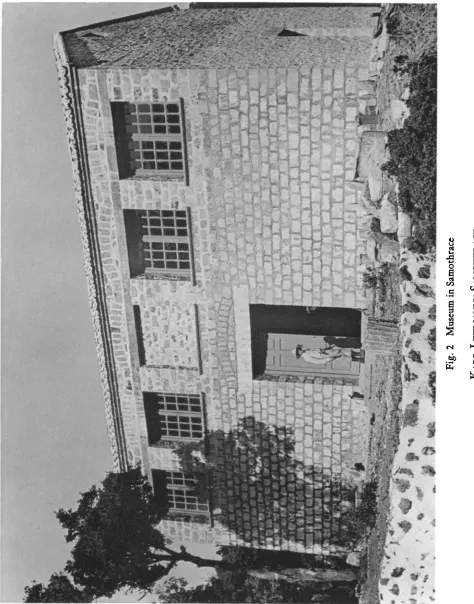
The war intervened, causing wanton destruction of and irreparable damage to ruins and finds, a process furthered by natural forces. The range and nature of this damage, ascertained by us in 1947, have been reported elsewhere.' The work of cleaning and of protection carried out during the campaign of 1948 has added deplora- ble details to what could be stated a year before. These facts have been recorded but we may dispense with enumerating them in this preliminary report.4 A very con- siderable amount of our work in 1948 was dedicated to cleaning and protecting the ruins, to repairing damage where it could be repaired, and to identifying finds of previous campaigns which had been thrown into confusion by Bulgarian soldiery. It was necessary to build a protective terrace wall in lieu of a destroyed antique wall to the east of the Arsinoeion and, above all, to finish the construction and provisional installation of a local museum near the excavation. We trust that this building (Plate 2, Fig. 2), ,modest as it is in its present form, will permanently secure the safety of the works of art and cultural relics stored within it.
In the following pages, we shall concern ourselves only with the results of our archaeological research and excavation obtained in this first post-war campaign. These results are manifold: they throw new light on two of the most important buildings of Samothrace, the archaic Anaktoron and the famous structure widely known as the " New Temple "; they reveal the character of the earliest ruins buried
2 See the first and second preliminary reports published in A.J.A., XLIII, 1939, pp. 133-144,
and XLIV, 1940, pp. 328-358. Also: A.J.A., XLIV, 1940, pp. 485 ff. (Herbert Bloch) and XLV, 1941, pp. 577ff. (A. D. Nock); Hesperia, XII, 1943, pp. 115ff. (K. Lehmann).
A rchaeology, I, 1948, pp. 44 if.
4 Such details are: The partial destruction of the early orthostate wall under the Sacristy
(A.J.A., XLIV, 1940, pp. 350 f., figs. 22 and 30) and the disappearance of the centre stone of the Arsinoeion (ibid., p. 339 and fig. 15), though both had been covered by protective earth before the invasion; the partial destruction of the altar foundations in the Arsinoeion (ibid. and fig. 16) which made our decision to remove its debris in the interest of a full excavation of the earlier strata easier; the complete destruction of the westernmost section of the red orthostate wall, and even of its foundation, in the northern part of the Anaktoron (A.J.A., XLIII, 1939, p. 138, fig. 8, and p. 330, figs. 3, 6). The willful and total destruction of marble blocks from the superstructure of the Arsinoeion by Bulgarian soldiery can now be assessed as amounting to at least twenty large blocks, mostly steps, but including one interior architrave and a triglyph.
5 Designed by Mr. Shaw. The present installation is provisional. If means allow, we plan a
SAMOTHRACE: THIRD PRELIMINARY REPORT 3
under and extending beyond the Arsinoeion; they include finds of great importance for the history of Samothrace and its religious rites; finally, they will enable us for the first time to see at least the outline of the long formative history of this mysterious cult and some of the basic- elements of its creed and rites.
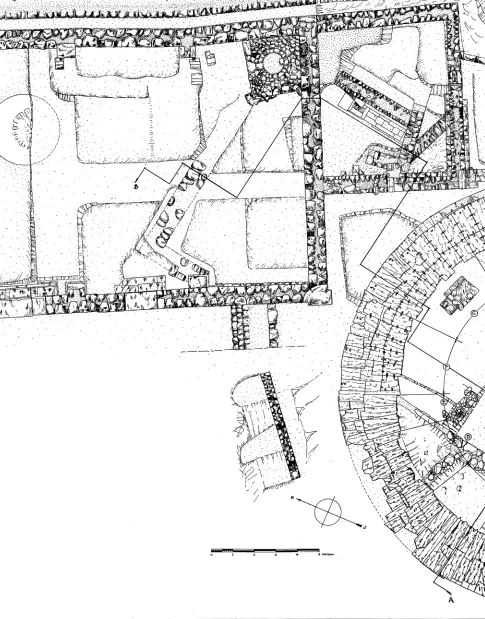
In the area of the Anaktoron, the Sacristy, and the region to the east of the Arsinoeion (Plate 1, Fig. 1), we limited ourselves to cleaning and conservation. The latter, however, included the removal of earth above and behind the continuous eastern outline of these buildings in order to prevent future damage by 'pressure and ava- lanche. We, therefore, dug away earth on this hillside to an average distance of about 3.50 m. from the eastern walls of the Anaktoron, the Sacristy, and the terrace walls to the east of the Arsinoeion (see Plate 1, Fig. 1). In the course of this work there appeared along the entire length of the Anaktoron and at a distance of 0.50 m. from it a polygonal terrace wall- (Plate 3, Fig. 3) which turned west at its northeastern corner and is partially preserved opposite the northern wall of the initiation hall.' It is obvious that this terrace wall was built about 500 B.C., together with the archaic Anaktoron, and that it supported to the east and north a terrace or road leading around the building from the south to its western entrance side. The upper level of this terrace is now washed away. But the preserved structure is still upright to about the varying height of the east wall of the Anaktoron. It is a respectable work of archaic Greek engineering. The obvious purpose of building this terrace at a distance from the walls of the Anaktoron was to safeguard them from pressure and to create an interval in which rain water could flow off toward the western river valley. The scheme is well-known in later Greek architecture where, in a famous inscription from Pergamon, it is called peristasis; in fact, in that document, the width of -such a peris- tasis as defined is almost identical with that of the Anaktoron.7 Its presence here shows that the device is an archaic Greek invention rather than a Hellenistic one as was previously assumed.
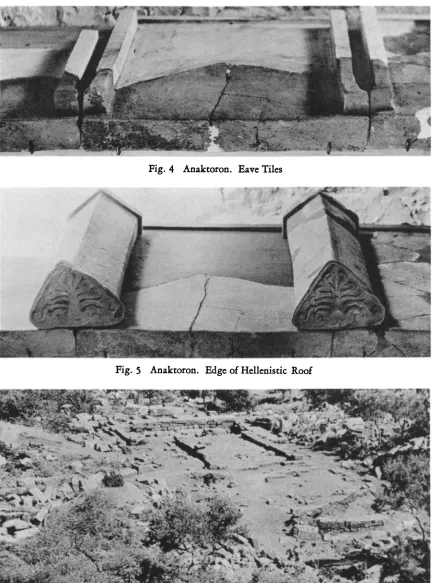
Though an exhaustive examination of the narrow open space of this peristasis has not yet been completed, we extracted from it numerous fragments of the roof of the Anaktoron in its last, Hellenistic, stage. Eaves tiles and cover tiles with antefixes were preserved as they had fallen down from the edge of the roof in the final catas- trophe. Sufficient fragments of these tiles were preserved to allow the restoration of a part of the roof (Plate 4, Figs. 4, 5). The flat eaves tiles (0.502-0.509 m. wide and approximately 0.60 m. long) show lateral recesses with projections to be tightly
6 We first thought this piece, discovered in 1938, belonged to an earlier Anaktoron:: A.J.A.,
XLIII, 1939, p. 135. It is now evident that the earliest stamped earth floor in the Anaktoron does not precede this building period (as assumed op. cit., XLIII, 1939, p. 135 and XLIV, 1940, p. 332) but belongs to it.
7 For peristasis see F. Noack and K. Lehmann-Hartleben, Baugeschichtliche Untersuchungen
am Stadtrand von Pompeji, Berlin, 1935, pp. 210if., with bibliography. The -inscription from
4 KARL LEHMANN
fitted against each other at the front-a rare scheme 8 which may possibly be explained
by the technique of wedging into these recesses upper ridges of wooden rafters designed to keep the roof tiles firmly in position. The antefixes are of the early Hellenistic type already known from fragments,' but they show varieties in clay and execution attesting one or several later restorations. A fragment of a corner tile of triangular shape seems to indicate that the Anaktoron had a hipped roof.10
Ironically enough, the original intention of the archaic architect in building a peristasis to protect the Anaktoron was reversed in effect after the destruction of the sanctuary. The upper boulder-like blocks of the archaic wall were washed down and pressed against the eastern wall of the Anaktoron, causing it to slant inward. The peristasis ended at the southeast corner of the Anaktoron. Farther south, the eastern wall of the Sacristy and the terrace walls to the east of the Arsinoeion were cut into and lean against the hard clayish natural soil of the hillside. Observation of finds from the fill and collapsed debris of the terrace wall confirmed the chronology pre- viously suggested.' Only the southernmost section of this terrace wall (opposite section K-J) was contemporary with the Arsinoeion, the central section (which had collapsed after the war and has been rebuilt by us) having been constructed in the first century B.C. (opposite section I), while the section close to the Sacristy is the result of a third, late antique, restoration.
Let us abandon this northern region of the sanctuary, for the time being, and return to it later. At the southern end of the zone we propose to explore fully, there appear the conspicuous overgrown ruins of the " New Temple." This building, famous for its unique inner apse, figures in almost all handbooks as an outstanding example of Hellenistic architecture, having been restored by the nineteenth-century Austrian excavators as a Doric " temple " preceded by a hexastyle prostyle porch with
a double row of columns and having a cella curiously divided by parapets into a " nave,2
and two "aisles," terminating in a segmental apse where a sacrificial pit for pouring libations replaced the base of a cult image customarily found in a " temple." 12
The necessity of removing from this important building the perilous overgrowth which has done increasing harm to it in the seventy-five years since the Austrian excavation primarily motivated our decision to attack this structure at the present time. But our curiosity had also been stimulated by our previous experience in the Arsilnoe'lon, where the Austrian excavators had not fully uncovered or explored even
8 Compare Buschor, Tonddcher, I, Berlin, 1929, pp. 10 f.
9 A.J.A., XLIV, 1940, pp. 332 ff., fig. 10.
10 As already suggested, A.J.A., XLIII, 1939, p. 135.
,1 A.J.A., XLIV, 1940, p. 342.
12A. Conze and others, Archdologische Untersuchungen in Samothrake, I, 1875, pp. 9 ff,
20 ff., 24 ff., 55 ff., pls. 11 ff.; II, 1880, pp. 21 ff., pls. 11 ff.
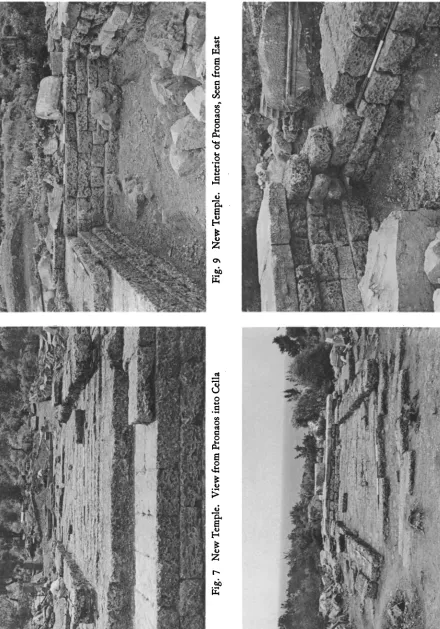
SAMOTHRACE: THIRD PRELIMINARY REPORT 5 those areas which they presented as excavated. This is true, too, of the "New Temple," We found it not only overgrown and buried under protective earth in parts supposedly it excavated " but also covered with masses of blocks from the superstructure obvriously lying either in the position in which they had fallen in late antiquity or, occasionally, slightly removed from that position. In cleaning the larger part of the building (with the exception of the apse), we had to remove from the superstructure approximately five hundred blocks, many of them huge, half of them of marble, half of limestone. The building as it appeared at the end of the 1948 campaign is shown in Plate 4 (Fig. 6) and Plate 5 (Figs. 7, 8). Our exploration of it is far from complete in spite of this effort. But the readers of this report may be interested to learn such results as are already visible.
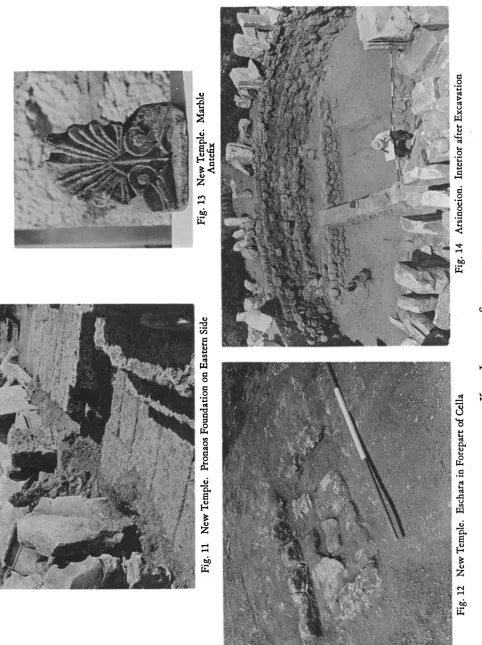
One is that this temple with its broad Doric porch and its pediment decorated with sculptures now in Vienna is a remodelled structure. In the now fully excavated pronaos, one can observe that the foundations of the marble stylobate (still largely in sits), built of lower courses than those of the other sides and including spoils of earlier structures, are hitched onto the- northern ends of the lateral pronaos founda- tions. The latter, in turn, belong to an earlier building as does the southern foundation of the pronaos (Plate 5, Figs. 9, 10). On the outer foundations, too, it can be observed that the present width of the pronaos is the result of a broadening of an already extant building (Plate 6, Fig. 11). While we, too, date the Doric order and the pedimental sculptures of the " New Temple " in the second century .c.,14 we are not yet prepared to indicate a specific date for this earlier building which must be, at the latest, early Hellenistic. Nor can we yet state the exact extent and form of the earlier building. As to the faqade of the late Hellenistic temple, indications are that the Austrian restoration with its two rows of prostyle columns 15 is incorrect. A pronaos
of one row of six columns seems to have been preceded by an open platform.
In the interior of the building we found various new elements. While the Aus- trians had assumed the existence of an unpaved area in the nave, we ascertained the existence of a solid limestone foundation for a marble floor throughout this area (Plate 5, Figs. 7, 8). But in this foundation, we discovered two sacrificial hearths: a smaller one in the forepart of the nave between the parapets (Plate 6, Fig. 12), and a larger one in the rear halfway between the southern end of the parapets and the bothros in the apse. These escharai are shallow rectangular pits 16 in the foundation framed by a border of upright limestones which, where preserved,7 have been burned
14 As does Schober, Oesterr. Jahresh., XXIX, 1935, pp. 1 ff.
15 Conze, op. cit., I, p. 73, pl. 43; II, p. 29, figs. 6, 7.
16 Outer dimensions of the smaller hearth: 1.00 m. X 1.10 m.; inner: 0.60 m. X 0.87 m. (Plate
6, Fig. 12). Outer dimensions of the larger hearth: 1.65 m. X 2.00 m.; inner ca. 1.33 m. X 1.68 m.
17 A good deal of the frame of the northern eschara is preserved (Plate 6, Fig. 12). The
6 KARL LEHMANN
to. yellowish or reddish hues as a result of long or often repeated exposure to fire. Such escharai having frames to support a metal grille are well known and have been discussed repeatedly in recent years.18 But all the hitherto known examples of the type belong to the archaic age, in particular to the seventh century B.c., at which time they were especially common in Crete. Archaic examples have, however, recently been found on Lesbos 19 and, in the very immediate vicinity of Samothrace, in Thasos.20 As yet, we have no indication that the two eschcarai of this very archaic type in the "New Temple ' in Samothrace are earlier than the second century B.C. In any case,
they persisted in use to the very end of paganism: an example of the tenacious preservation of very archaic rites in the Samothracian mysteries..
These two hearths in forepart and centre of the building point to a liturgical sequence of sacrificial rites which culminated, at the end, in libations to the underworld gods in the bothros in the apse.2" These rites were probably witnessed by the- com- munity seated on benches in the lateral aisles running through the entire cella. Foundation spurs do exist at right angles to the lateral walls about as indicated in the Austrian plan.22 They are too distant from each other to support pavement slabs which, throughout the building, invariably rested on a continuous substructure. On the other hand, fragments of straight marble benches of a type similar to theatre steps are -preserved and it may be assumed that such benches, accessible from a narrow paved passage behind the parapets, were supported by these foundation spurs.
The interior moulded stucco decoration of the temple, many fallen fragments of
of our excavation, but its outline could be defined. The floor here is in part a natural rock which has been leveled off on the surface.
18 Prinias: Annuario, I, 1914, pp. 33 ff.; Dreros: B.C.H., LX, 1936, pp. 226 ff., where
Marinatos lists a number of instances, some of them, however, questionable or of different type; Lato, B.C.H., LXI, 1937, p. 474 (not mentioned, however, B.C.H., LXII, 1938, pp. 383 ff.). For
further examples see H. Payne, Percachorca, I, Oxford, 1940, pp. 111 f. and W. Lamb, B.S.A.,
XXXII, 1931-32, p. 47.
19 Lamb, loc. cit., pp. 46 f., pl. 19, fig. 4.
20 Ch. Picard, C.R.A.I., 1935, p. 486; B.C.H., LVIII, 1934, p. 484; LIX, 1935, p. 273. The
attribution of this archaic temple in Thasos to the archaic Herakleion now seems somewhat ques- tionable (see Launey, B.C.H., LXI, 1937, p. 381) and one may ask whether the archaic building with an eschara as well as the rotunda with a bothros does not belong to the mystery sanctuary of which an almost square telesterion is preserved.
21 See Porphyr., cantr. nymph., 6: 18pVcaVro x0On'Oug TE Kcat qpXwtp &Xapas, V7roxoVots 8E 80oOpovs.
This testimony (for this and other references to escharai see RE, -s. V.) cannot be lightly discarded in view of the new discoveries in Samothrace. If escharai are dedicated to chthonic and heroic worship, as clearly distinguished from the cult of those who- dwell in the underworld, it may well be that the two escharai in the " New Temple ' were destined for sacrifices to some of the divinities worshipped in Samothrace, for example, the Kabeiroi, Kadmilos and the Mother, while the bothros was dedicated to the King and Queen of the Underworld (see below). The relationship of these " escharai " to what the Austrians assumed to be " bothroi " in the " Old Temple " (Conze, op. cit., II, pp. 21 ff., pls. 4 Hf.) cannot yet be defined.
SAMOTHRACE: THIRD PRELIMINARY REPORT 7
which we gathered, was not uniformly red,2" but had varying colors including red, white, black, yellow, and green. It was of that colorful Hellenistic type of decoration known-as the First Pompeian Style. Though common in secular architecture of the Hellenistic period in Greece, such decoration appears here, for the first time outside Italy, in a monumental religious building. This decoration confirms a second century
B.C. date for the final form of the " New Temple."
While the mass of antefixes found by the Austrians and probably belonging to .the same age show an " artificially severe " style,24 a beautiful pieces, discovered by us (Plate 6, Fig. 13), shows slightly different dimensions 2" and a freshness of orna-
mentation which may indicate that it belonged to an earlier phase of the building. It would be premature to suggest a specific role for this building within the mystery rites of Samothrace which, at least from the Hellenistic age on, seem to have been performed in progression through a series of monumental buildings.
We now may return once more to the northern section of the sanctuary. Here, our exploration beneath the Arsinoeion has furnished rich new material for the history of Samothrace and its mystery cult.
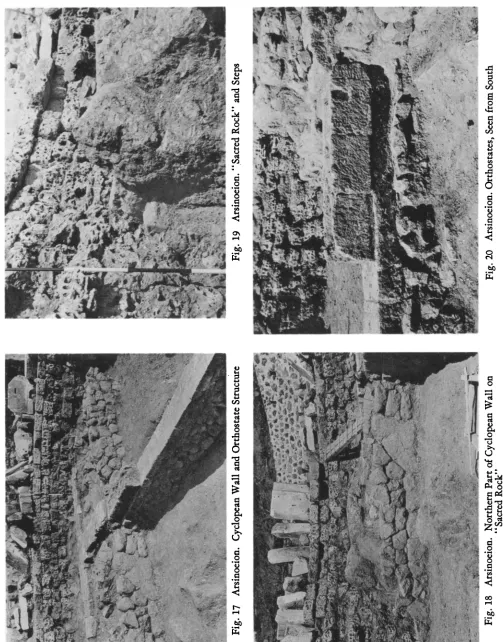
A full excavation of the circular area enclosed within the foundations of the rotunda of Arsinoe had been initiated before the war.26 This work was virtually completed in 1948 by the removal of the fill inside the huge limestone foundation of this early Hellenistic building and by the uncovering of the earlier structures pre- served there (Plate 1 and Plates 6-9, Figs. 14-23). For the sake of brevity in this preliminary report, it may be best to describe the chief results in the order of his- torical sequence rather than in the reversed sequence of strata discovered as we moved downward from the level previously reached.
In this region, the natural ground descends in an east-west direction towards the river bed which limits the main part of the sanctuary to the west. East of section
J,
rock emerges almost to the level of the euthynteria of the Arsinoeion. In the interior of this section, its crags stand up to the bottom of the third foundation course beneath the euthynteria level. Then it rapidly descends toward the river bed until, at its western side, the foundation of the Arsinoeion thus far laid bare has a height of ten courses (3.25 m., see section, Plate 7, Fig. 15).On this steep slope early builders erected two successive structures, both of which originally extended beyond the area of the later rotunda (Plates 6-9, Figs. 14-17, 21). The first was a terrace supported by an impressive " Cyclopean " wall running from north to south and preserved to a length of about 10 m. and to an average height of 1 m. (Plates 7-8, Figs. 16, 17, 18). The northern section of this wall is built of huge
23 Ibid., I, p. 69, fig. 3.
24Ibid., I, p. 67, pl. 31, fig. 1.
25 Acc. No. 48.578. Ht.: 0.21 m.
8 KARL LEHMANN
boulders smoothed off on one face and includes an enormous block 1.10 m. in height (Plate 8, Figs. 17, 18). The southern section shows slightly smaller and more irregu- lar stonework and it may be a somewhat later extension. This terrace wall has a compact fill of field stone which, where removed, proved to be disappointingly sterile. But a few tiny fragments of crude pink pottery were extracted from the wall itself. They, as well as potsherds found in the vicinity (though mixed in later strata), suggest a prehistoric date in the late Bronze or early Iron Age 27 for the Cyclopean
terrace.
At its present northern end, this terrace includes huge boulders of a colorful variety of rock not otherwise found in this region and evidently deposited here by natural forces long before any building began. One gigantic rock (Plate 8, Fig. 18) has a leveled off surface (1 m. in diameter) while its lower parts extend irregularly towards the west. At the northern end of this rock two smaller rocks are still pre- served, seemingly the two upper steps of a crude stairway leading up to the flattened surface of the rock. Another boulder of the same variety as the big flattened rock has been tilted into an upright position to form a kind of parapet along this stairway (Plate 8, Fig. 19). On the western and southern sides of the flattened rock, a narrow channel reserved in the stone fill of the terrace accompanies its arched outline (Plate 1). These curious features and the fact that, as we shall presently see, the earliest Greek settlers selected this place for religious worship, point to a religious function for the structure. If this assumption is correct, a pre-Greek root of the complex Samothracian religion becomes visible here. In fact, the flattened rock with steps leading up to it recalls the " rock altars " of the Phrygian region. The channel beneath the rock could find its natural explanation as a libation channel connected with sacrifices.
The Phrygian rock altars are affiliated with the cult of the great mother goddess, Kybele.28 Her name occurs persistently in ancient literary sources apropos of the origin and rites of the Samothracian mysteries. And while the Mother of the Samo- thracian mysteries, Axieros, was also identified with the Greek Demeter,29 her image, enthroned and flanked by lions, appears on the reverse of later coins of Samothrace
27 Though neither Mycenaean nor clearly Greek geometric potsherds have so far been found,
we have fragments of ceramics with incised wave lines of varieties known from Troy VI-VII (Schliemann, Atlas des antiquite's Troyennes, Leipzig, 1874, pl. 27; Dorpfeld, Troja und Ilion, Athens, 1902, pp. 294-295; H. Schmidt, Heinrich Schliemanns Sammtlung, Berlin, 1902, p. 163); Larissa (Schefold, Larissa, pl. 3, 11-12) and Lesbos (W. Lamb, J.H.S., LII, 1932, pp. 4-5, 10, fig. 4); Acc. Nos. 39.120, 39.211, 39.315, 39.502, 39.1096; 48.7, 48.105a, b, c, 48.147.
28For relatively recent discussion, see Cook, Zeus, Cambridge, 1914, I, p. 134; K. Galling, Der Altar in den Kulturen des Alten Orients, Berlin, 1925, pp. 15 ff., and the excellent remarks of A. Goetze, Kleinasien (Handb. d. Altertumswiss., III, I, 3), Leipzig, 1933, pp. 191 if. The analogous situation of the famous sanctuary of Steunos on the slope over a river bed, with a narrow terrace, a sacred rock, a rock-cut altar with steps, and circular " bothroi " near by deserves mention, Ath. Mitt., XXXVI, 1911, pp. 302 ff.
SAMOTHRACE: THIRD PRELIMINARY REPORT 9 where she, the main deity of the mystery sanctuary, is coupled with an image on the obverse of Athena, patroness of the political community."0 The Kabeiroi of Samo- thrace were often identified with the Korybantes of Kybele or the Kouretes of Rhea, while later popular belief identified them with the Hellenic Dioskouroi. And, in Samothrace, Hermes-Kadmilos was attached to this circle as, in the Phrygian cult, he so frequently appears as the companion of Kybele.3" The ancient legends of Dar- danos and the legendary connection of Samothrace with the Idean Great Mother thus seem to be rooted in the facts of religious history. It may also be mentioned that prehistoric potsherds found so far, alas, only included in later strata, show definite connection with the ceramics of the late Bronze and early Iron Ages of northwestern Asia Minor and Lesbos."2
The second major building period uncovered beneath the Arsinoeion is repre- sented by what may be called the " orthostate structure." It extends over almost the entire area of the Arsinoeion, save for a smaller and a larger segment near its eastern and western periphery. This orthostate structure had already been partially uncovered
in 1939 and it was immediately clear that it belonged to an extensive complex, other parts of which were found in the depths beneath the Sacristy and in the southern section of the Anaktoron.33 It is now evident that it also extended southward beyond the area of the Arsinoeion. It, thus, covers an area of at least 30 m. north-south by 1 1 m. east-west. Its orientation follows and is defined by the Cyclopean terrace which is included in its eastern part. In the eastern section of the Arsinoeion this structure was laid out without other foundation on natural rock and the compact stone fill of the pre-Greek terrace. Elsewhere, foundations of roughly cut field stone were built to support the superstructure. They increase in depth and size of stones as the natural rock descends from east to west reaching a height of 1.42 m. at the western end. While the width of the foundation of the east-west cross wall is .65 m. that of the western foundation is .90 m. and it is not bound into the cross wall to add strength
30 This seems to be the conclusion to be reached now in the light of most of the literary sources
and of the new archaeological evidence. The sporadic occurrence of Athena and Zeus among the ancient efforts to interpret the " Great Gods " of Samothrace cannot be exploited as James Oliver did in his interpretation of the document published by us in A.J.A., XLIII, 1939, p. 145 (ibid., pp. 464 ff.). The sanctuary of Athena is well documented in inscriptions as the archives of the town and Zeus may well have had his cult there, too. On the other hand, Kybele and her entourage occur persistently in most of the testimonia regarding the Samothracian mystery cult.
31 In the sanctuary, we know the association of Hermes-Kadmilos and the Kabeiroi from the
fact that two statues of nude young men, undoubtedly the latter, stood outside the doors of the adyton in the Anaktoron where we found the cult regulation with the kerykeion of Hermes between the two snakes of the Dioskouroi (A.J.A., XLIII, 1939, p. 138, fig. 6). Compare the ring, stolen during the war, incised with the two snakes and the. stars of the Dioskouroi-Kabeiroi (A.J.A., XLIV, 1940, p. 355, fig. 39).
32 See above, p. 8, note 27.
10 KARL LEHMANN
to its double function as a foundation and a terrace supporting the high earth fill in the interior of the precinct.
On these foundations rose a carefully built dado of yellow tufa blocks (width .62 m.), part of which is preserved in the Arsinoeion, part beneath the Sacristy."4 The dado was composed of a stereobate of floor slabs (averaging .20 m. high), orthostates
(.37 m. high), with compact stone fill and cross spurs, and cover slabs (-.20 m. high). The upper walls were evidently of mud brick.
The structure consisted of a large northern part separated from a southern section by the cross wall which traverses the centre of the Arsinoeion. In addition to this subdivision, there are differences of level. The main part of the cross wall in the Arsinoeion is built at a level of 1.40 m. beneath the euthynteria, as was the western wall only the foundations of which are preserved. In the eastern part of the structure, the level ascended to the top of the prehistoric terrace, so that here the floor slabs continue the level of the (now lost) cover slabs of the lower orthostate dado. Further- more, the construction of the corner between the orthostates of the cross wall and the northern section of the Cyclopean wall (Plate 8, Fig. 17) indicate that an orthostate facing turned around here along the upper end of the old Cyclopean wall which, thus, probably also supported a mud brick wall in this period.85 It, therefore, seems that the builders of the orthostate structure included the northern section of the prehistoric terrace containing the rock altar in an "adyton " on a higher level, in the southeastern corner of the large northern section. In the southern section, on the other hand, indications are that the old terrace wall was now buried beneath a fill sloping down from east to west. The orthostates on the western face of the cross wall near the Cyclopean wall are not all finished and they are irregularly placed so that they project over the floor slabs that support them. Thus, they cannot have been visible at this level (Plate 8, Fig. 20).
The structure as a whole cannot have been a building with a roof but evidently was in the nature of a large double precinct, the northern part of which included an adyton containing the old rock altar on a higher level, while the southern part gently rose in ground level. On the preserved floor slabs of the cross wall, there is no indication of a passage from one section into the other and it seems that both sections were accessible only through individual entrances from either the western, or the northern and southern sides.
Though the later history of this area and the activity of the Arsinoeion builders has by and large disturbed its original stratification, we were able to secure copious
34 Ibid., figs. 22 and 30. Now partly destroyed, see above, p. 2, note 4. Dr. Frederick Pough
of the American Museum of Natural History was kind enough to identify a sample of this material as tufa.
35 We had already observed that corner, without yet knowing of the existence of the Cyclopean
SAMOTHRACE: THIRD PRELIMINARY REPORT 11
ceramic material along the foundations of the orthostate structure and thus roughly to define its date. Its fill contained a mixture of crude native ceramics and Greek black-glazed pottery which, though undecorated, is of extremely fine quality and almost " egg-shell " thinness. The closest analogies to this pottery, so far, seem to have been found in an early archaic deposit in Lindos on Rhodes.36 A date in the seventh century therefore seems indicated for this orthostate structure.37
No Greek relic certainly earlier than the seventh century has thus far been found in Samothrace while, in addition to the ceramics from the foundation of the ortho- state structure, we have other sporadic Greek finds from that period. The old assump- tion that Samothrace did not receive Greek settlers before the seventh century seems to prove correct. These settlers, if we interpret the picture obtained so far correctly, mingled peacefully with the natives and carried on their old worship of the Mother and her acolytes.
They built a double precinct, the northern section of which was given over to her cult, the southern being reserved for other divinities. This double precinct has one striking analogy in the history of Greek religious architecture: the twin precinct which the Greek settlers in Naukratis erected in the same age to Hera of Samos and Apollo of Miletus, a precinct surrounded by mud brick walls, originally without temples, provided with separate entrances and lacking interior communication."8
In the open area of the northern precinct a large space was provided for gatherings and rites in honor of the native gods. These rites included sacrifices, the traces of which we discovered in an ash layer near the western wall opposite the rock altar in the " adyton." The very existence of this adyton may indicate that some secrecy and a beginning of mystery rites existed at least by this period.
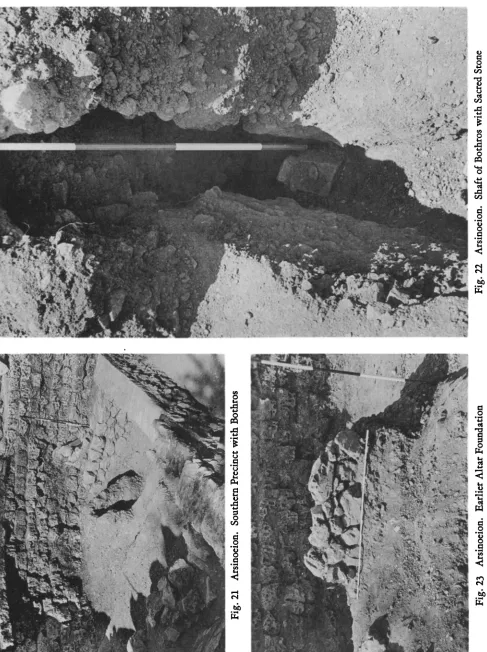
But in the southern temenos, too, there is evidence of the performance of religious rites. Here we found, almost miraculously preserved, a sacrificial pit looking like and being built in the manner of a primitive oven of small stones and clayish earth. It is in the shape of a tall beehive having an interior diameter of 0.50 m. and a height of 2.50 m. (Plate 9, Fig. 21). Its upper end is level with the floor slabs of the orthostate
C. S. Blinkenberg, Lindos, Berlin, 1931, pp. 289 if., pl. 47, when discussing this deposit felt reminded of M M III " egg-shell " ware as we did when we found our potsherds. The forms of skyphoi and handles also seem to be closely related to those of the Rhodian finds which Blinkenberg attributed to local manufacture. The latter, however, seem to lack the decoration under the foot of a circle or several circles with a central dot that is commonly found in Samothrace. The Samothracian ware is not Corinthian, nor can I at this time name another likely centre of production.
37 The orthostate dado shows close structural analogy to that of the seventh-century temple
of Neandria: R. Koldewey, Neandria (Winkelmannsfest, Berlin, Programr, No. 51), Berlin, 1891, p. 27, fig. 56.
38 W. Flinders Petrie, Naukratis, I, London, 1886, pl. 41; II, London, 1888, pl. 4; H. Prinz,
12 KARL LEHMANN
wall and it had a narrow open vertical shaft on its northern periphery, possibly once framed by wooden boards, for pouring down libations to a "sacred stone " found at the lower end of this shaft with a little piece of native marble pressed against it (Plate 9, Fig. 22). The interior of this bothros contained loose black earth but near its mouth were found animal bones, exclusively of sheep."9 Bothroi containing sacred stones are a familiar feature of later Samothracian rites.40 But the primitive form of this seventh-century bothros into which the blood of sacrificial animals was evi- dently poured down to the nether world reminds us of Homer's Nekyia and of Odys- seus killing a ram over a pit at the entrance to the underworld.4' Furthermore, the Samothracian cycle of gods included a king and queen of the underworld, Axiokersos and Axiokersa, representatives of a religious sphere quite different from that of the Queen of the Rocks and her entourage.42 We are, therefore, drawn to the conclusion that the southern section of the archaic precinct belonged to these underworld gods who, in a loose fusion with the Great Mother of the Rocks,- the Kabeiroi and Kadmilos, were worshipped in separate, if successive, rites in the seventh century B.C. in Samo-
thrace. Gradually, out of varying religious concepts and rites, the complexity of a Greek mystery religion seems to develop here into what must have already been an elaborate theology a century later when, around 500 B.C., the great initiation hall, the
Anaktoron, was built over the northern part of the original northern temenos. When the " orthostate structure " was first discovered, we dated it earlier than the archaic age because it was buried deep beneath the late archaic Sacristy being separated from its foundation by two or possibly three intermediate building periods.4" While our excavation in 1948 changed the absolute chronology of the orthostate structure, it also showed that the double precinct did not have a long life. Whether forces of nature or men destroyed it, there followed an interval to which a crude foundation built obliquely over the western foundation of the old double precinct in section A of the Arsinoeion (Plate 9, Fig. 21) evidently belongs. This foundation corresponds in orientation to the last pre-Anaktoron phase in the Sacristy (A) and may belong to the same period of the sixth century B.C. It supported a mud brick
wall which must still have been upright when the Arsinoeion was built, for its debris
39 We are indebted to Dr. Edwin Colbert of the American Museum of Natural History for generously giving of his time to identify the bone fragments.
40 A.J.A., XLIV, 1940, p. 334. In the later bothros of the Anaktoron (ibid., fig. 11), the sacred stone was a reused roughly polygonal, possibly, pre-hisforic block and the same is true of the sacred stone in the pit under the Arsinoeion.
41 For a probable later reference to the Homeric Nekyia as symbolizing the eschatological
ideas of the Samothracian religion in a fifth-century monument and for related testimonies see Hesperia, XII, 1943, pp. 123 ff.
42 The key passage for the Samothracian Pantheon remains the Schol. Laurent. to Apollonios
Rhodios, Argonautica, I, 917-918. On "Orphic" gold plaques Persephone is called Kv,&X'a Koup7
(RE, s. v. Kybele, col. 2270).
SAMOTHRACE: THIRD PRELIMINARY REPORT 13 was found washed down in the earth fill of the rotunda and partly adhering to its
foundation. Thus, not far from the seventh-century bothros, a small structure or new enclosure may have been built around it in the sixth century, probably continuing in existence throughout the following two or three centuries.
In the same way, the cult in the northern temenos was continued. Here, over the above-mentioned ash layer " of the early archaic precinct, we uncovered a crude rectangular stone foundation (Plate 9, Fig. 23), again, in a different orientation which, in turn, corresponds to an archaic phase (B) of the Sacristy. This foundation belonged to an altar which stood on a level at least 0.65 m. above the floor of the early temenos and, again, continued to be used down to the period of the Arsinoeion. It was around the upper edge of the preserved foundation of this altar that we had discovered, in 1939, a "bone deposit " of sacrificial relics including pottery dating from the archaic and classical periods.45
Thus, it is clear that, after the destruction of the seventh-century double precinct, cult continued in this region, which may have been an open grove between the initia- tion hall and Sacristy at the north and the terrace of the " Old Temple " at the south. When the Arsinoeion was projected in the early third century B.C., its builders
took care to include within its circumference this old ritual area-the bothros, as yet undestroyed, the altar, and the " rock throne." It will be noted that the altar founda- tions recorded by us at the northeastern interior periphery of the Arsinoeion 46 show
the same orientation as the archaic-classical altar of the bone deposit (situated at a slight distance to the southwest of it) which was now buried in the fill. It will also be remarked that the circle of the Arsinoeion was laid out in such1 a manner as just to include the old sacred rock, though it, too, was now buried in the foundation. This wish to include the ancient token of divine power and not to build on top of it or to exclude it may account for the position of the Arsinoeion which entailed the transfer of the late archaic Sacristy to its present awkward position.47
The earth fill removed from the foundations of the seventh-century twin-precinct, the early third-century fill of the Arsinoeion, and the second century fill from the pronaos of the " New Temple " contained a wealth of material. To it are to be added finds from the late Hellenistic fill of the collapsed terrace wall to the east of the Arsinoeion and others of a more sporadic nature. They all combine to advance our knowledge in many directions. Only major results and individual items of peculiar interest can be mentioned here.
44 Above, p. 11.
45 A.J.A., XLIV, 1940, pp. 351 f.
46 Ibid., pp. 339 f., fig. 16. Independently and without knowledge of our discovery, F. Robert,
Thymele, Paris, 1939, pp. 358 if., has assigned the Arsinoeion to this sacrificial use. It cannot, however, be said with certainty that this was its only or even primary function, inasmuch as various liturgical actions including sacrifices seem to have taken place in all major Samothracian buildings.
:14 KARL LEHMANN
A few such items concern aspects of building activity. Though the Anaktoron was stuccoed in white on outer 48 and inner wall faces, it seems that the prevailing color
of the stucco in the earlier periods of other buildings in Samothrace was red, a color possibly not without symbolical meaning. Fragments of fine red marble stucco were found profusely in the fill of the Arsinoeion and must belong, at the latest, to the fourth century B.C. An even finer variety of red stucco was found in the fill around
the foundation of the twin precinct, dating thus from the seventh century or possibly from the pre-Greek period.
Several baked bricks 4 of small dimensions undoubtedly used in some minor
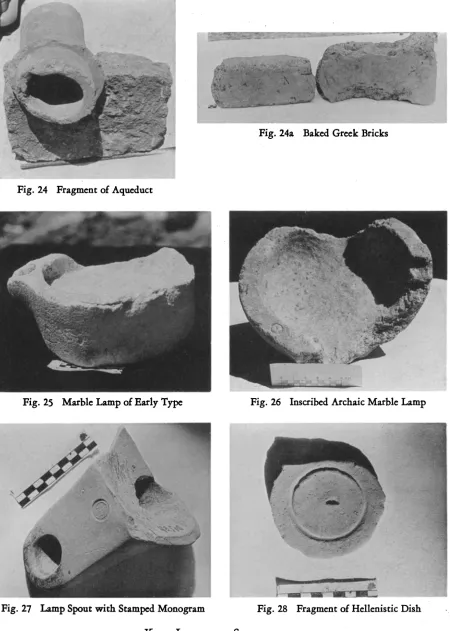
structure offer a puzzling problem (Plate 10, Fig. 24a). Some of them were extracted from undisturbed Arsinoeion fill and therefore date from the classical period or, at the latest, from the very beginning of the Hellenistic age. They are certainly of Greek manufacture since several examples show incised Greek letters: A and X. We are not aware of any analogy to this discovery of Greek and even pre-Hellenistic usage of sizable baked bricks for structural purposes.50
The Arsinoeion fill also yielded several fragments of a clay aqueduct destroyed when the Arsinoeion was built or earlier. The pipes were originally held in place by perforated stone blocks (Plate 10, Fig. 24)5' through which they passed, a peculiar Samothracian scheme which we had already encountered in 1938 in a later aqueduct in the lower town.52 This pre-Hellenistic aqueduct may have served a ritual purpose in the sanctuary.
The prevalence of nocturnal ceremonies in the mysteries of Samothrace is further born out by the increasing number of lamps.53 Some of the more or less fragmentary examples discovered this season in the fill of the Arsinoeion belong to the interesting group of archaic Greek marble lamps recently discussed by Beazley.54 To the one discovered in 1939, we may now add three more examples. One, almost completely
48 White stucco was preserved on parts of the outer face of the eastern wall in the peristasis
in 1948. For the interior, see A.J.A., XLIII, 1939, p. 135, and XLIV, 1940, pp. 332 ff., figs. 4-5.
49Two fragments of such bricks of 0.085 m. thickness, one with an incised A, the other with a
-+, and a third having a preserved length of 0.22 m., a width of 0.18 m. and a thickness of 0.06 m.,
also incised with a A, were discovered on the surface in 1939 (Acc. Nos. 39.32a-b, 39.210 = Plate
10, Fig. 24a). Another brick found on the surface in 1948 (Acc. No. 48.99) has a preserved length of 0.18 m., a width of 0.10 m. and a thickness of 0.087 m. The specimen found in the Arsinoeion fill in 1948 (Acc. No. 48.85) measures 0.24 m. X 0.126 m. X 0.087 m.
50 Professor Robinson published a base faced with evidently very small pieces of burnt clay
in Excavations at Olynthus, XII, Baltimore, 1946, p. 156, pl. 130. No measurements are given.
.5 Acc. Nos. 48.196, 48.442. Inner diam. of pipe 0.102 m. The upper half of the perforated
stone is broken away in the fragment from the Arsinoeion fill.
52A.J.A., XLIII, 1939, p. 142, fig. 10. See A.J.A., XLIV, 1940, pp. 341 and 348.
SAMOTHRACE: THIRD PRELIMINARY REPORT 15
preserved, belongs to the seventh-century type (Plate 10, Fig. 25).5 " Undecorated, it is furnished with a single spout which is bridged by a thin continuation of the inner edge of its shallow pan. The fact that this pan is not compartmented, combined with the straightforward simplicity of form and the lack of any plastic decoration or even a moulded rim, indicates that the lamp must antedate Beazley's group of Daedalic style, perhaps belonging still to the first half of the seventh century." (Bober).56
A second marble lamp found this year is less well preserved (Plate 10, Fig. 26).5 It shows the more common sixth-century type with a rounded bowl. Like the lamp found in 1939,58 it was double spouted and has a clearly developed shallow base. Parts of a dedicatory inscription are preserved on the upper rim OE (ot) I spaced decora- tively around one of the spouts, the initial letter being close to the other. A small fragment of a fourth marble lamp " of the same type shows, one letter of a similar inscription, an E near a spout.
Though presumably dedicated by individuals, these marble lamps were un- doubtedly used in the community service.60 Since none of them shows the customary devices for suspension commonly found on archaic stone lamps, one may suggest that they were carried in processions by functionaries of the rites.
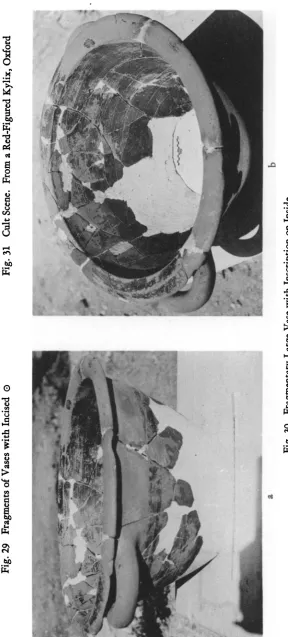
The great number of clay lamps of the archaic and classical periods found, for the most part, in the fill of the Arsinoeion were undoubtedly used by the mystae and later dedicated to the gods. Here, too, we find two-spouted as well as single-spouted examples. And repeatedly the votary has incised a 0 on the spout-as often in the dedication of vases in Samothrace, the initial letter stands as an even more cryptic symbol of the unnamed "Gods" (Plate 11, Fig. 29). Of particular interest are several fragments of unglazed fifth-century lamps of identical type and size (Plate 10, Fig. 27).61 Before firing, they were stamped by the manufacturer with an E framed by a circle containing a dot in the centre: this is a monogram (DE (for eEoEs) and,
55Acc. No. 48.400. Dia. 0.14 m. with spout 0.165 m.; ht.: 0.068 m.: base to floor of well 0.049 m.; dia. of' well 0.092 m. Island marble.
56 In the Thasos museum, there is a green stone lamp (No. 10) not listed by Beazley and
seemingly unpublished. It has straight walls of the " dedalic" type, is circular without inner com- partments, and has six projections, one with hole for suspension two with spouts.
57Acc. No. 48.137. Dia. 0.178 m.; ht. 0.072 m.; flat base with a'dia. of 0.11 im.; w. of rim 0.02 m. Thasian marble.
58A.J.A., XLIV, 1940, p. 341, fig. 19. Beazley, op. cit., p. 42, 'seemed to doubt the restoration of the double spout. Though the published photographs may have left some doubt, actually parts of the second spout are preserved and, naturally, formed the basis of the plaster restoration.
59Acc. No. 48.360. W. of rim 0.019 m. Thasian marble.
60 Mrs. Bober calls attention to the fact that several of Beazley's examples of marble lamps
come from the Sanctuary of Demeter Malophoros in Selinus.
61 Two spouts from the Arsinoeion fill: Acc. No. 48.516, 48.517. Pres. length 0.06 m.-0.08 m.
16 KARL LEHMANN
as far as I know, the earliest true monogram preserved among known Greek inscrip- tions.62 This usage shows the cryptic symbolism that remained inherent in monograms through later ages. Another interesting fact is revealed by these finds. By the fifth century B.C., Samothrace had its own ceramic manufacture, a document of its economic life stimulated by a cult which, as Herodotus and Aristophanes attest, must have already been extremely popular in the Greek world.
In this connection, a curious group of later ceramic products, a quantity of which was discovered in the pronaos fill of the " New Temple " 63,may be mentioned here. They are fragments of coarse bowls of shallow conical shape and,. undoubtedly, of local manufacture. Inasmuch as none of them was found in the fill of the Arsinoeion, they evidently represent local industry of the Hellenistic age antedating the second half of the second century B.C. Invariably they show the magical 0 incised by the potter
in the interior centre before firing (Plate 10, Fig. 28).
To the Hellenistic period, too, belongs another type of ceramic inscription already mentioned in a previous report 64 as rather puzzling. It consists of sketchily incised
letters of all types, often later scratched out by some scrawl, on coarse potsherds of what seem to have been chiefly clay dishes. We now have hundreds of these fragments. And they are. always broken in such a way as to indicate that they were incised and often scratched out when the dish was still unbroken, as well as that a ritual breaking up, of these dishes took place after usage. Again, none of this type of graffito was found in the Arsinoeion fill, but numerous examples occur in the late Hellenistic fills of the pronaos of the " New Temple " and the collapsed terrace wall to the east of the Arsinoeion.65 For the graffiti scratched into these dishes in the course of ritual usage
(.owner's marks?), I have no safe explanation to offer.
Other ceramic inscriptions present interesting problems. Apart from the com- monly incised 0 (Plate 11, Fig. 29),66 (DE or other fragments pointing to eo's which occur on various types of small vases, we have other single letters or fragmentary graffiti that one is tempted to relate to more specific names. The single letter K is incised on pottery a number of times and may stand for Ka,8etpow or Ka814Xp as the
62 Ligatures, which of course occur earlier, are not monograms. The earliest monograms
I have been able to find are Hellenistic: Mason's marks with the monogram of King Attalos II and stamps on roof tiles and amphora handles in Pergamon (Ath. Mitt., XXVII, 1902, pp. 144 f., 149); Hellenistic mason's marks in Sicily (G. Saflund, in Scritti in onore di BaJrtholomeo Nogara, Vatican City, 1937, pp. 409 Hf.), as well as monograms appearing on Hellenistic coins.
63 In one place here there were found fragments of not less than fifty-nine such bowls.
64 A.J.A., XLIV, 1940, p. 354. As a re-examination of sherds and records has revealed, coarse
fragments with individual letters-quite carefully incised and different from the group discussed here-occur in pre-Hellenistic layers, but the quick sketchiness of the mostly large signs and the scratching out mentioned above are found invariably only on rather poorly fired Hellenistic
fragments.
65 See above, p. 4.
SAMOTHRACE: THIRD PRELIMINARY REPORT 17
beginning of such a dedication KA is preserved incised upside down on the lower end of an archaic unglazed amphora.67 A single A also occurs repeatedly and one may suggest a connection with Axieros, Axiokersos or Axiokersa. Under the foot of a glazed and stamped late fifth-century vessel found this year, one reads TTA i, which sounds like an invocation to the irai.' well-known from the Kabeirion near Thebes (Plate 13, Fig. 32).68 But given the fact that the Kabirs in Samothrace, as brothers, are invariably identified with the Dioskouroi, Korybantes, etc., we hesitate to draw too rash a conclusion from one single document of this kind.
Under the foot of an archaic bowl found in the Arsinoeion fill 89 one reads
YlTH (tov-rj7s` ?) while in the interior of a fluted fourth-century kantharos another con- nection with mystae may be indicated by the preserved three letters .. . I MY (o-rT ?) .7
Even more puzzling is a graffito on a big archaic vase of a type of which other fragments also exist (Plate 11, Fig. 30). The form is that of a deep bowl on a low foot, with two heavy horizontal handles beneath a rounded lip. The inside is glazed, the outside decorated with one glazed stripe. Exactly this type of vase,72 filled with fruit or cakes, is represented in a cult scene on a fifth-century Attic kylix (Plate 11, Fig. 31) the opposite side of which shows a sacrifice on an eschara.73 Our archaic vase has incised upside down in large letters the completely preserved graffito AIN as it would be scratched by a person bending over the large vessel. The same three letters are incised on another large unglazed potsherd found in the Arsinoeion fill 7
and thus certainly pre-Hellenistic, too. This is neither a Greek word nor a Greek name and hardly an abbreviation of either. Given the literary tradition that a '"barbarian" language was liturgically used in the Samothracian cult, we may have a however
67 Acc. No. 48.321, from the Arsinoeion fill. It should be noted that the same abbreviations
K and KA occur not infrequently in the Kabeirion in Thebes where the meaning Ka/3app Is certain:
P. Wolters and G. Bruhns, Das Kabirenheiligtum bei Theben, I, Berlin, 1940, pp. 68 f., No. 286, 74, No. 337, pp. 38 f., Nos. 27, 31, 67, No. 289, 74, Nos. 334-336, 75, Nos. 341-343 (KA). Once OE (for OEm) occurs there: ibid., p. 76, No. 356.
68 Acc. No. 48.224, from the Arsinoeion fill (Ibid., pp. 20 ff.). It may well be that a Theban
worshipper came to Samothrace and invoked the Pais of his native sanctuary. On the other haind, one occasionally finds reference in Thebes to the Samothracian Kadmilos who is not at home there: ibid., p. 75, No. 344.
69 Acc. No. 48.505.
70 Acc. No. 48.241.
71 Acc. No. 48.476. The restoration has been made without a flaring foot but fragments of
such a foot are preserved. Dia. 0.43 m. Fragments of at least three more vessels of this type have been found.
72 For a geometric forerunner, see A. Furtw'angler, Aegt'na, II, Munich, 1906, p. 120, no. 47,
p. 445, and for a seventh-century type: Annuartia, X-XII, 1927/1929, p. 161, fig. 172, p. 480. Later Attic types: Hesperia, IV, 1935, pp. 511 ff. V, 1936, pp. 342 if.; XV, 1946, pl. 66, no. 305.
t About 470 B.C. Oxford, J.H.S., XXXII, 1912, pl. 9: C. V. Oxford, 1, pp. 6 ff. Beazley
calls the vase a " large kotyle " (but the testimonia seem to indicate that a kotyle is always small, see RE, s. v.) and thinks of the Apaturia for the rites represented.
18 KARL LEHMANN
modest document of this language here. If that language was Thracian, it would be possible to connect the word A IN with a well-known Thracian root represented in Samothrace in Hellenized form in the nomen proprium Ai'vcov.7
The mass of accumulated ceramics from various strata allow us to ascertain now that in all periods from the archaic through the Hellenistic age clay vessels were ritually used by the worshippers and afterwards dedicated or broken up and dumped in the sanctuary. In all periods, too, the mystae evidently had a lamp, a drinking vessel, and an eating dish. It is evident that drinking and participation in meals were an integral part of this as of other mystery cults, and that in Samothrace these rites go back to the archaic beginnings of the Greek cult.
The vessels may be coarse or glazed. And to our dismay, they generally are entirely without decoration, black-figured, red-figured or other decorated ware occur- ring only in very few fragments. Stamped vases occur from the late fifth century on, as does fluted ware in the fourth century. But it looks as if there had been a religious law preventing the use of decorated vases. Under the circumstances, and in view of the above established fact of local manufacture for the worshippers, it may well be that many of the glazed products as well as the unglazed were locally made. Shapes change over the several periods. The drinking vessels of the archaic age were mostly skyphoi, though kantharoi 76 (Plate 13, Fig. 33)77 which prevail in the fifth and fourth
centuries do occur. The early archaic time used for food deeper and larger one- or two-handled bowls or flat dishes, the late archaic and classical periods shallow bowls 78
and-possibly indicative of some of the food consumed-fishplates with a depression in the centre. In the Hellenistic age, we find flat coarse dishes and the previously mentioned conical bowls which may have been used for liquids. In the Roman era- for which we have no stratified material-glass vessels may have been commonly used.79
While the excavation in both the Arsinoeion and the " New Temple " yielded only minor fragments of sculpture, a half life-sized head of a woman (Plate 12, Fig. 35)80 found on the surface near the Arsinoeion by Mrs. Dusenbery deserves to be men- tioned. Worked in the extremely delicate Thasian marble that from the late archaic
75 See W. Tomascheck, Sitzungsb. Ak. WVien (Phil.-Hist. Ki.), CXXX, 1894, pp. 23 f., 34;
Tac., Ann. IV, 15 (Prosop. Imp. Romani, II, 13, No. 77). Among the twenty-three items listed in RE as having the root din there are only ten for which Thracian-Illyrian or Phrygian connection is not evident. Dinon, a magistrate in Samothrace, I.G., XII, 8, No. 188.
76 Black-glazed and undecorated kantharoi prevail in the Kabeirion in Thebes in this period,
too, and commonly have dedicatory inscriptions (Wolters-Bruhns, op. cit.). In that sanctuary, however, there is a notable absence of dishes, bowls, and lamps.
77 48.300 from the seventh-century fill of the orthostate structure. Compare Furtwangler,
op. cit., pl. 127, fig. 22; Dugas, Vases de l'Heraion (Expl. arch. de Delos, X), Paris, 1928, pl. 20, 119/120; also similar bucchero forms: A.B.S.A. XXXII, pl. 20; B.C.H., LVII, 1933, p. 302.
78 For phialae allegedly dedicated by the Argonauts in Samothrace, Diodorus, IV, 49, 8.
79 Surface fragments of glassware are commonly found.
SAMOTHRACE: THIRD PRELIMINARY REPORT 19
age on is almost exclusively used for buildings and sculptures in Samothrace, it is badly corroded. Yet even in its present state, it exhibits some of the charm of a fourth century B.C. Greek original of Skopasian style. This stylistic character is not without interest in Samothrace given Pliny's reference 81 to a group of Aphrodite and
Pothos in Samothrace made by Skopas, a cult image worshipped by the Samothracians with " most holy rites "-whether in the Sanctuary of the Great Gods or elsewhere, we cannot say.
If this head is one more illustration of the thorough Hellenization of Samothrace in the three centuries after the Greek settlers had begun to transform the " barbarian " native cult into a Greek mystery religion, another incidental discovery, this time of a minor object, shows the continued affiliation of the sanctuary with the but superficially Hellenized Thracian and Macedonian peoples, an affiliation borne out, too, by epi- graphical documents containing the names of worshippers who came to Samothrace. I refer to the fragmentary bronze fibula reproduced in Plate 13, Fig. 34.82
" The bow of this fibula is strongly arched and flat in section, swelling at the foot to form a roughly triangular catch-plate. At the head it is completed by a horizontal cross-piece designed to cover the spring-of the missing pin; the hinge for the attach- ment of these separately-made movable parts is' preserved. An unusual feature is the addition of an independent ring 83 encircling the bow, surmounted by a crudely- fashioned bird (duck?) which recalls the use of such elements on Geometric fibulae of the islands.84 As yet, however, no precise analogies for this ornamental ring have come to hand.
"Since fibulae utilizing a bilateral spring-coil derive from late Iron Age T-fibulae, our example cannot antedate the end of the fifth century B.C.85 Indeed, in the fully- developed cross-bow and hinge it more nearly approaches early Roman fibula types.86 But, on the basis of close similarities between the long, elegant curve of the bow and La Tene III fibulae showing a like shape, often ornamented with small ring-like "wings" on the summit,87 our 1TEpomq may well belong to the first century B.C." (Bober).
Outside the sanctuary, a second Hellenistic cemetery 8 was accidentally dis- covered just to the south of the modern village of Palaeopolis that sprawls along its
81 NAH., XXXVI, 25.
82 L.: 0.052 m.; ht.: 0.024 m.; width of cross bow 0.024 m. Found in the fill of the peristasis
east of the Anaktoron.
83 Dia. 0.015 m.; ht. of bird: 0.009 m.
84 Cf. Blinkenberg, Fibules grecques et orientales, Copenhagen, 1926, p. 196, fig. 219.
85 Von Netoliczka, RE, III, Suppl., col. 516.
86 Smith, Guide to Greek and Roman Life,2 British Museum, 1920, indicates that all types
revealing a cross-bow sheath and separately attached spring-coil with hinge for the pin are Roman in date, representing an evolution from La Tene prototypes.
87 Cf. Dechelette, Manuel, IV, p. 763, fig. 537, Nos. 9-10.