PEDIATRICS
Vol. 81 No. 4 April
1988
559
Pruritic
Rash Associated
With Cat Scratch
Disease
CPT
Susanne
Daye,
MC,
USA,
2LT
John
A. McHenry,
MS,
USA,
and
COL
John
D. Roscelli,
MC,
USA
From the Department of Pediatrics, Letterman Army Medical Center, Presidio of San Francisco
ABSTRACT.
Cat scratch disease is a benign, self-urn-ited illness characterized by regional lymphadenopathy that usually occurs in association with a history ofcon-tact with a cat. Cases of cat scratch disease with skin
manifestations that included erythema nodosum;
ery-thema multiforme; erythema marginatum; and non-specific maculopapular, petechial, and morbilliform rashes have been reported. No case of pruritic rash as-sociated with cat scratch disease has been previously reported. In fact, one authority specifically states that
the rash of cat scratch disease is nonpruritic. We report
a well-documented case of cat scratch disease in which
the patient’s principal symptom was a pruritic rash. It
is possible that this rash was the result of an
immu-nologic reaction to the infectious agent of cat scratch
disease. We conclude that cat scratch disease should be
included in the differential diagnosis of pruritic rashes in children. Pediatrics 1988;81:559-561; cat scratch disease, pruritus, rash, lymphadenitis, lymphaden-opathy.
A variety of skin manifestations have been re-ported to occur in some patients with cat scratch disease.2’3’5 These have included erythema no-dosum, erythema multiforme, erythema margin-atum, and nonspecific maculopapular, petechial, and morbilliform rashes.2’3’5 The incidence of rashes with cat scratch disease is uncertain and varies from 0.5% in a primary care setting to
4.4%
in a more referral-oriented setting.3 A prur-itic rash, however, has not been reported in as-sociation with cat scratch disease. In fact, one re-view of cat scratch disease states specifically that the rashes associated with cat scratch disease arenonpruritic.6 We describe a case of cat scratch dis-ease in a 7-year-old child whose chief complaint was a generalized, intensely pruritic rash.
CASE REPORT
Cat scratch disease is a benign, self-limited
ill-ness characterized by regional lymphadenopathy
that usually occurs in association with a history of contact with a cat. It has been reported to occur with varying degrees of systemic signs and symp-toms including malaise, fever, and rash.’3 The causative agent, until recently unknown, is now thought to be a highly pleomorphic, Gram-posi-tive bacterium that can be identified in Warthin-Starry stains of involved lymph nodes from pa-tients with cat scratch disease.4
Received for publication April 20, 1987; acceptedJune 26, 1987.
The views expressed in this article are those of the authors
and do not reflect the official policy or position of the
Depart-ment of the Army, Department of Defense, or the US
Government.
Reprint requests to (J.D.R.) Technical Publications Editor
HSHH-ZCT, Letterman Army Medical Center, Presidio of San Francisco, CA 94129-6700.
PEDIATRICS (ISSN 0031 4005). Copyright © 1988 by the
American Academy of Pediatrics.
A 7-year-old white boy was seen at our clinic with a five-day history of generalized rash with severe
pru-ritus. His only other complaint was that he had noticed
a tender swelling in his right axilla for two days.
Other-wise, the patient said that he felt well and he had no fever or other signs of infection. The patient had no known allergies or history of previous skin disorders, and he was not taking any medications. He denied ex-posure to new chemicals in his environment or to poison oak. There was no history of unusual travel, exposure to tuberculosis, or exposure to farm animals or dead animals. His medical history was benign.
When the boy was questioned more closely, he said that 5 weeks before examination he had been scratched on his right hand by his 5-month-old kitten. One week later a pustule developed in the area of the scratch. Three weeks after the appearance ofthe pustule, a prur-itic rash developed on his right arm, which became gen-eralized within two days. He also noticed a tender swelling in his right axilla at this time.
When first examined, the child was afebrile and his vital signs were normal. A reticulate maculopapular rash was noted on his trunk and all of his extremities
at Viet Nam:AAP Sponsored on September 7, 2020
www.aappublications.org/news
-T.-,
4..
44
- ,1
FIg 1. Reticulate maculopapular rash on trunk and
all extremities, most prominently on lower extremities.
560
PRURITIC RASH AND CAT SCRATCH DISEASE(Fig 1), which was most prominent on the lower
ex-tremities. The rash was excoriated and the boy contin-ually scratched throughout the examination. He had a tender, indurated, nonfluctuant right axillary swelling
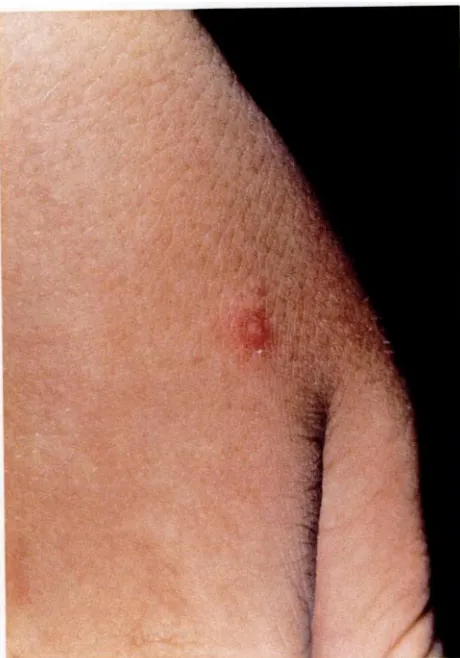
that measured 3 cm in diameter (Fig 2). A small
(3-mm) papule was noted on the dorsum of his right hand (Fig 3).
Laboratory studies disclosed the following values: hemathcrit, 38.6%; hemoglobin, 13.1 g/dL; WBC count,
10,4004a1 with 16% eosinophils; and platelet count,
551,000/i,L. ESR and tuberculin skin test and mono-nucleosis antibody test results were all normal. A skin
test with cat scratch antigen, applied on the 14th day
after the boy was seen, resulted in a positive reaction7 with 10 mm of erythema and 6 mm of induration 72
hours after application. Six weeks after we first
ex-amined the boy, serologic findings were normal when tested for brucellosis, toxoplasmosis, cytomegalovirus, tularemia, Epstein-Barr virus, hepatitis A antigen,
hepatitis B antigen, mycoplasma, cryptococcal antigen,
Q
fever, spot fever, and typhus fever.The patient was treated with hydroxyzine, 2.5 mgI
kgld; however, this dosage did not control his pruritus
and therefore was increased to 5 mglkgld with some reduction in symptoms. By the 11th day of treatment, the rash and pruritus were nearly resolved and the hy-droxyzine was voluntarily discontinued. By day 17, the papule was gone and the axillary lymph node was 1.5
ii.
r, indurated, nonfluctuant right axillaryswelling measured 3 cm in diameter.
cm in diameter and no longer tender. The rash and
pru-ritus had completely resolved. Two weeks later, the
lymphadenopathy was completely resolved, and the
pa-tient’s skin rash and pruritus had not recurred.
DISCUSSION
We believe there can be little doubt that our
patient had cat scratch disease. The criteria for the diagnosis of cat scratch disease are as follows:
(1)
lymphadenitis, (2) positive skin test reaction with disease-specific antigen, (3) presence of an identifiable inoculation site, (4) history of contact with a cat, and (5) absence of other disease.8 It is important to note that our patient’s spontaneousrecovery and absence of exposure to tuberculosis,
atypical mycobacteria, histoplasmosis, coccidi-omycosis, plague, and anthrax aided in the exclu-sion ofthese agents as an explanation for his lym-phadenitis. Furthermore, negative convalescent titers to most of the other causes of lymphade-nopathy and childhood rashes helped rule out other explanations for our patient’s symptoms. We did not think examination of the lymph node was justified in this clear-cut case of cat scratch disease.
at Viet Nam:AAP Sponsored on September 7, 2020
www.aappublications.org/news
.,1
....
FIg 3.
Small (3-mm) papule on cARTICLES
561
agent rather than the result of its dissemination. This is supported by the eosinophilia in our pa-tient and in other patients with the dis-ease.5’6’8”#{176}” We are surprised that pruritic rashes have not been noted more often with cat scratch disease. The individual patient’s immune response to cat scratch disease may be a deter-mining factor in the nature of the dermatologic reaction that occurs with cat scratch disease.
SUMMARY
In conclusion, we believe that a pruritic rash can be a manifestation of cat scratch disease. The cause of this rash, or any of the other rashes re-ported in association with cat scratch disease, re-mains a mystery, but an immunologic response to a localized infection may be a reasonable expla-nation that deserves further investigation. Cat scratch disease should be included in the differ-ential diagnosis of pruritic rashes in children.
Unlike previously reported patients with cat scratch disease, our patient’s disease course was marked by a generalized pruritic rash in associ-ation with his illness. It is, ofcourse, possible that our patient had two separate diseases occurring at the same time. However, because both the cat
scratch disease and the pruritic rash occurred with simultaneous onset and resolution, that seems unlikely. The duration of the rash in our patient was approximately 16 days, which is not dissimilar from the duration of five to 14 days re-ported by Margileth et al.3 We could find no evi-dence in our patient to suggest a concurrent skin disorder and, furthermore, rashes are an accepted part ofcat scratch disease.3’6’8’9 We speculate that rashes in cat scratch disease are probably the re-suit of an “allergic” response to the infecting
REFERENCES
1. Ginsburg CM: Cat-scratch adenitis. Pediatr Infect Die
1984;3:437-439
2. Carithers HA: Cat-scratch disease. An overview based on a study of 1,200 patients. Am JDiS Child 1985;139:1124-1133
3. Margileth AM, Wear DJ, English CK: Systemic cat scratch
disease: Report of 23 patients with prolonged or recurrent
severe bacterial infection. J Infect Die 1987;155:390-402
4. Wear N, Margileth AM, Hadfield TL, et al: Cat scratch
disease: A bacterial infection. Science 1983;221:1403-1405
5. Margileth AM: Cat scratch disease, in Rudolph AM, Hoff-man JIE (eds): Pediatrics. Norwalk, CT,
Appleton-Cen-trury-Crofts, 1982, pp 636-638
6. Margileth AM: Cat scratch disease: Nonbacterial regional lymphadenitis. A study of 145 patients and a review of the literature. Pediatrics 1968;42:803-818
7. Boyer KM, Cherry JD: Cat scratch disease (benign
inoc-ulation lymphoreticulosis; nonbacterial regional
lym-phadenitis), in Feigin 1W, Cherry JD (eds): Textbook of Pediatric Infectious Diseases. Philadelphia, WB Saunders,
1981, pp 1649-1654
8. Carithers HA, Carithers CM, Edwards RO Jr: Cat-scratch disease: Its natural history. JAMA 1969;207:312-316 9. Daniels WB, MacMurray FG: Cat scratch disease: Report
of one hundred sixty cases. JAMA 1954;154:1247-1251
10. Spaulding WE, Hennessy JN: Cat scratch disease: A study of eighty-three cases. Am J Med 1960;28:504-509
11. Heroman WM, McCurley WS: Cat scratch disease. Oto-laryngol Clin North Am 1982;15:649-658
at Viet Nam:AAP Sponsored on September 7, 2020
www.aappublications.org/news
1988;81;559
Pediatrics
Susanne Daye, John A. McHenry and John D. Roscelli
Pruritic Rash Associated With Cat Scratch Disease
Services
Updated Information &
http://pediatrics.aappublications.org/content/81/4/559
including high resolution figures, can be found at:
Permissions & Licensing
http://www.aappublications.org/site/misc/Permissions.xhtml
entirety can be found online at:
Information about reproducing this article in parts (figures, tables) or in its
Reprints
http://www.aappublications.org/site/misc/reprints.xhtml
Information about ordering reprints can be found online:
at Viet Nam:AAP Sponsored on September 7, 2020
www.aappublications.org/news
1988;81;559
Pediatrics
Susanne Daye, John A. McHenry and John D. Roscelli
Pruritic Rash Associated With Cat Scratch Disease
http://pediatrics.aappublications.org/content/81/4/559
the World Wide Web at:
The online version of this article, along with updated information and services, is located on
American Academy of Pediatrics. All rights reserved. Print ISSN: 1073-0397.
American Academy of Pediatrics, 345 Park Avenue, Itasca, Illinois, 60143. Copyright © 1988 by the
been published continuously since 1948. Pediatrics is owned, published, and trademarked by the
Pediatrics is the official journal of the American Academy of Pediatrics. A monthly publication, it has
at Viet Nam:AAP Sponsored on September 7, 2020
www.aappublications.org/news