International Journal of Educational Methodology
Volume 4, Issue 4, 259 - 265.
ISSN: 2469-9632 http://www.ijem.com/
Field Trial Analysis of Teaching Material Civic Education Based on
Problem Based Learning (PBL) to Improve Student’s Outcome
Tita Wulandari *
Sebelas Maret University, INDONESIA Sebelas Maret University, INDONESIA Suharno Sebelas Maret University, INDONESIA Triyanto
Received: August 23 2018 ▪ Revised: November 2, 2018 ▪ Accepted: November 4, 2018
Abstract: This research is part of developing study on the Civic education teaching material based on PBL. This research aims to
determine the process of developing the teaching material of Civic education based on PBL for the fourth-grade of elementary school in order to improve students’ learning outcome. The result of the previous study shows that the teaching material does not currently fulfill the students’ need. Method of research used is a descriptive qualitative and quantitative. This research consists of two activities namely the composing of extensive and limited test. In the implementation, the extensive test has a broader scope than limited test. Methods of collecting data in this research are interview, observation, expert assessment and test. The instruments of this research are interview guide, field notes, expert assessment sheet and test sheet of the student learning outcome. Stages in this activity include the preparation of teaching material Civic education based on PBL, experts’ validation of Civic education teaching material based on PBL, and field trials. The result of this research is a draft of teaching material of Civic education based on PBL including introduction, content and closing. It is eligible used by nine experts. The student learning outcome that uses the teaching material Civic education based on PBL is improved.
Keywords: PBL, knowledge, primary school, civic education.
To cite this article: Wulandari, T., Suharno, & Triyanto. (2018). Field trial analysis of teaching material civic education based on problem based learning (PBL) to improve student’s outcome. International Journal of Educational Methodology, 4(4), 259-265. https://doi.org/10.12973/ijem.4.4.259
Introduction
In the curriculum, civic education currently has an important role in creating a nationalist. Learning civic education is responsible for creating the character of dedicating homeland, responsibility, and behaving the values of Pancasila. Those are in line with Winarno (2014) who says that the purpose of Civic education is to form learners into human, sense of nationality and dedicate to homeland imbued by the values of Pancasila, UUD 1945, spirit of Bhineka Tunggal Ika, and the commitment of NKRI. Therefore, an effort that can be done to reach the purpose is by improving the learning quality in school.
A good learning quality can be measured by the learning outcomes showing improvement. Pingge & Wangid (2016) explain that the successful learning is if students achieve the purpose of learning. The learning outcome relates to the changes in student cognitively, affectively, and psychomotorically. This goal can be achieved, if the learning elements well support each other. As stated by Kautfeld (2008), there are 6 elements of learning process, namely physical environment, social environment, presentation by teacher, content or teaching materials, learning process, and learning products. One of the important supports in Civic education subject is a teaching material used by the teacher as guideline of students’ material resource.
Learning Civic education in elementary school, teaching material becomes an important guideline in delivering the material. The 2006 curriculum, Unniah (2012) explains that the issues related to civic learning in elementary school are complex curriculum, less of capability in determining keywords of Standard Competence and Basic Competence, conventional learning is not contextual, teaching based on textbook, evaluation only leads on rote aspect. Textbook center becomes one of the problems in learning Civic education. In general, teacher focuses on the textbook and does not relate to lesson plan. This causes the learning of Civic education does not focus on the actual learning objective.
*Corresponding Author:
Tita Wulandari, Postgraduate Programs Sebelas Maret University, Surakarta, Central Java, Indonesia,
Some schools still use textbook as teachers' guidance. Then, the researcher interviewed six the fourth-grade teachers of four elementary schools in Surakarta. The researcher found that teachers only use thematic books as the only teaching material. Civic education in those books is too limited so that they should find the additional reference. The findings in observation show that teachers still use lecture method on teaching Civic education in thematic lesson. The additional materials are delivered orally and students just make a note. Learning Civic education uses minimal contextual media, they focus on learning method to memorize material on the book and then they miscommunicate. The document analysis result shows that the teaching material of Civic education only focuses on the memory aspect. Nowadays, the curriculum utilizes a scientific approach. In contrary, Civic education is not fully scientific.
Based on the problems above, it is necessary to have a developing innovation in teaching material of Civic education. It should support the teaching material currently used in the field and fulfill the students’ needs as well as teacher about Civic education material. The teaching material should be able to support the development of students' competence including their knowledge. One of the learning models that can be integrated into teaching material is Problem-Based Learning (PBL). It is developed from constructivism theory (Yusof, et al., 2012). The theory can help students develop knowledge constructively or build their own knowledge. Sumarsih (2009) explains that the paradigm of constructivism consider student as individual who has the initial ability before learning a new knowledge. PBL appreciates the early skills of students. They are free to learn according to their own way and find an experience compiling their knowledge. The teaching material of Civic education based on PBL emphasizes the students’ learning activities. This guides students to be active in learning. They are required to conduct a simple research by involving some activities such as doing an interview, analyzing a research, collecting data, studying literature, and observing phenomena of surrounding environment. This will train them to work scientifically in building their knowledge by giving some problems as stimulus to find solution. PBL basically presents variety of problematic situations authentically and meaningful to students. It functions as a leap for investment and investigation. Besides, students are familiar to answer questions based on the problems in real life (Arend, 2008). The real phenomenon about the problems can be media and effective example in learning. Those will make students accustomed to find solutions scientifically in facing the problems. The orientation of problem presented is the first step in PBL syntax. This step initiates the scientific work in PBL syntax. PBL syntax is formulating problems, examining problems, collecting and classifying data, proving hypotheses, and determining the choice of settlement (John Dewey, 1964; Gulo, 2008). Barrett (2010) states that PBL syntaxes are reading problems, defining problems, brainstorm, discussion and synthesis, communicating issues, studying individually, and making presentation. Student activity in Civic education based PBL uses syntax as a base of students’ learning activities. The learning step that emphasizes on the scientific approach is very suitable with scientific approach. The integration of PBL into teaching material of Civic education becomes a combination between the scientific approach and the constructivism learning theory. The scientific approach and the constructivism learning theory are appropriate with the development of education, especially in elementary school. By carrying out the approach, students are more actively to explore the concept of knowledge and solve daily problems (Rakhman, Asroro and Kaswari, 2017). They will try to find the information and solve the problems individually or group. It will automatically build their knowledge affectively, cognitively, or psychomotorically. PBL students can work independently and group, this will motivate them intrinsically (Gorghiu. et al., 2015). In addition, Gorghiu also argues that PBL students involve in research, search, investigation, and experiment which can develop students’ cognitive structure, and competence.
The phenomenon of Civic education is close to the daily life of students. They become easier to understand the values delivered in Civic education. Like illustration, story, and picture about daily problems in Civic education make students easier to see real example. They will find other examples easily. Teacher can provide assistance to students as facilitator. He/she facilitates them to carry out the learning activities in solving existing problems. According to Ari & Katranci (2014) an important feature in PBL is teacher as guide and facilitator in learning, student-centered, learning done in group, students focus on organizing the problems and applying, problems interpreted to develop skill in solving the problems, and students obtain the new information as knowledge. The role of teacher here is crucial in applying the teaching material of Civic education based on PBL.
The previous research is done by Lu Fang Ling (2015), the purpose of the research is to explain the effect of PBL in learning English vocabulary of Taiwan elementary school students. Its result shows that the use of PBL can increase the vocabulary of students significantly and develop comprehension, memory and their learning experience when solving the problems. Therefore, it is necessary to have a solution of learning Civic education in Surakarta. This is intended to improve the quality of learning, so that it will affect the student learning outcomes. One is the development study of teaching material on Civic education based PBL. This article will discuss about the development study of teaching material on Civic education based PBL to improve students’ learning outcomes in Surakarta.
Literature Review
is to set an empirical foundation for creating the learning product and the existing of development model. As stated by Tessmer & Richey (1997, Alim Sumarno, 2012), a development does not only focus on the needs analysis, but also the broad issues about early analysis, such as contextual analysis. The research method and development are also defined as a method to produce and examine the effectiveness of product (Sugiyono, 2011). It can be concluded that development is a research that aims to produce a new product or modify the systematically existing product.
This research produces a teaching material Civic education based on PBL. Those materials are used by teacher or instructor to carry out the teaching and learning activities (Mudlofar, 2012). Lestari (2013) states that if teaching material is a set of learning material with curriculum reference to achieve the predetermined standard competence. The teaching material must pay attention to the rules in its development. According to Widodo and Jasmadi (2008), its rules include that the teaching material must be appropriated to the students in learning, capable to change students’ behavior, in accordance with students’ characteristic, and the learning program, including the learning objective, must contain the learning material in detail, both for activity or exercise, and evaluation.
The development of teaching material specifies on civic education. Some opinions about the meaning of civic education are from Winarno (2014) who states that civic education is an application of civic (civic knowledge) in the education process means that the material in education includes the political democracy. Azyumardi and Darmadi (2010) argue that in the formulation of civic education involves a basic understanding of democracy way, an understanding about role of law and human rights, a strengthening of participation skill to empower students solving the democratic problems, and the development of democratic culture. From this opinion, it can be concluded that civic education is the study of governance taught to students.
The developed product is an innovative teaching material integrated with the Problem Based Learning (PBL) model. According to Tan (Rusman, 2010), in PBL is the use of various intelligences needed to confront real-world challenges, the ability to face everything new and the complexity. Soucisse, et al. (in Savin-Baden and Wilkie, 2004) explain that PBL is a way to make students take responsibility in learning with their own thought. This makes students have more advantages such as developing communication skill, teamwork and problem solving. PBL has PBL syntax. John Dewey (1961) and Sanjaya (2010) says that there are 6 PBL learning steps, namely formulating the problem, analyzing the problem, formulating hypotheses, collecting data, testing hypotheses, and formulating the problem solving recommendations.
Methodology
Research Goal
The purpose of this research is to improve Civic education teaching material based on PBL. This article explains the phase of improving Civic education based on PBL and field test. Aspects discussed in this article include the preparation of prototypes product of Civic education based on PBL, the validation of product Civic education based on PBL, and the result of field test.
Sampling and Data collection
This type of research is descriptive qualitative and quantitative. This study is consisted of product compilation, limited and extensive test. Compilation of products based on the needs of teachers and students. The teaching material is validated by nine experts that consist of three linguists, three material experts, and two media experts. The experts assess the book are lecturers of S2 graduation. In addition, the assessment also carried out by two companions and two practitioners. The experts give the suggestion and criticism which will be the refinement of a further journal. The purpose of the limited test is to test the readability of the product and to find out the lack of the product when it is used in learning. Extensive test has a purpose to determine the effectiveness and validity of the product before being used in the field. The populations in this study were the fourth-grade students of three elementary schools in Surakarta. The sampling technique in this study is random sampling. In limited test uses one class namely the fourth-grade elementary school and on extensive test uses two classes. Limited test in this study was carried out with a descriptive qualitative approach. Data collection techniques in limited test are interviews, observations, and teacher assessments. Interviews are used to find information from teachers and students after using Civic Education teaching materials based on PBL. Observations are used to see the activities of students and teachers when using Civic Education teaching materials based on PBL. Teacher assessments are used to find out the validity of Civic Education teaching materials based on PBL. In addition, the instruments used in this study were observation sheets, interview guides, and teacher assessment sheets. Data analysis technique in limited test is interactive analysis model from Miles and Huberman (2009). The output of limited test is the input of teachers and students after using the product.
pretest and posttest. The experimental design in this study was "Only Pretest-Posttest Control Group Design". Here is a description of the students' pretest and posttest.
Tabel 1. Only Pretest-Posttest Control Group Design
Group Pretest Treatment Posttest
Experimental Q1 X1 Q2
Note: Q1: Pretest of the experimental group; Q2: Posttest of the experimental group; X1: Using Civic Education teaching materials based on PBL
The data analysis used in the extensive test is the t-test. Before conducting t-test, a prerequisite analysis test was carried out which includes homogeneity and normality test. The type of test used is multiple-choice consisting of 25 items. The validity of the item has been tested with Iteman application. The results show that six items are categorized as easy and 24 items are categorized as moderate.
Data analysis
This research uses descriptive qualitative and quantitative descriptive approaches. In the limited test uses qualitative descriptive approach which utilizes the interactive analysis model of Miles and Huberman (2009) that consists of data collection, data condensation, data presentation, and drawing conclusion. Interactive analysis is done to examine the data in depth and draw conclusions about the use of teaching materials- based PBL. In the extensive test uses quantitative descriptive approach which utilizes the analysis technique of non- independent test. Data analysis in t-test uses SPSS 21.0 program. A t-t-test was conducted to investigate whether there was an increase in the use of teaching materials- based PBL in learning at 0.05 significant level.
Finding
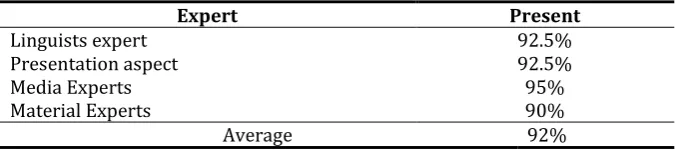
The research result is an important finding in the field. The first activity in this research is the preparation of product and draft validation of civic education teaching material based PBL by some experts. The analysis result of requirement the teaching material becomes the drafting basis of teaching material in Civic education based on PBL. The valuation aspect of book adapted from the assessment component of content eligibility aspect, presentation eligibility, language eligibility, and graphic eligibility by Badan Standar Nasional Pendidikan (BNSP). The assessment result as follows:
Table 2. Assessment Result of Experts
Expert Present
Linguists expert 92.5%
Presentation aspect 92.5%
Media Experts 95%
Material Experts 90%
Average 92%
The assessment results are accumulated and get the average of final value 92%. It shows that the teaching material of Civic education based on PBL eligibility is used in learning. In addition, the experts also provide suggestions. They include some unsuitable images and spacing, the problems presented in Civic education based PBL are less communicative. Image must be more communicative with students. References must be added and deepened. The result of linguist's assessment corrected is a lot of inconsistent words. There are so many word-writing error, many words are difficult to understand for students in elementary school. The arrangement of lay out is complicated and fascinating colors. Media expert suggest on the graphic aspects namely PBL syntax in the book not quite real, still using scientific language, numbering not organized, and using not cartoon. The suggestions from experts used as material to improve the book which will be re-consulted the expert.
Based on the experts’ suggestions, there are some changes. One of most visible changes is content of the book. PBL syntax is initially not systematic, but more systematic. Between first activity and next activity are interconnected. The picture above is a change occurred on the cover of teaching material Civic education based on PBL before and after revision. Here is a change example occurred on the contents of book after revision.
Table 3. PBL syntax table in Civic education teaching materials- based PBL
PBL Syntax Rubric in Teaching Materials
Orienting the students toward the problems Let's Observe
Organizing students to learn Let's Think
Assisting independent and group investigations Let's Work Let's Read Developing and presenting the work and then exhibiting it Let's Discuss Analyzing and evaluating students’ problem-solving results Let's Write
Draft has been validated by the experts, and then it is used for the limited test. Limited test is conducted on classes with small scope. Draft teaching material Civic education based PBL used by teachers in learning. The result of interview with teachers said that the teaching material of Civic education based PBL can be a source of material for students and teachers. The innovation is needed in learning Civic education, because this teaching material Civic education only focus on the material presentation and the form of formative evaluation. The results of document analysis in previous introduction study found if the teaching material in the field only oriented the delivery of material without completed with the student activities. Learning observation using teaching material Civic education based PBL found some findings that teacher not familiar with that teaching material. Students are enthusiastic with the content of that teaching material. Teachers do not understand PBL deeply. At the beginning of the discussion material, the problem orientation cannot relate to the material maximally, students still ask questions about language and mistake, and teachers still look stiff when using a book. Then the results are confirmed and discussed with teacher as a follow-up. Teacher gives an assessment on aspects of content, material, evaluation, presentation, language, and appearance. The assessment of teaching material on the limited test is carried out by a teacher using Likert scale 1-4. The assessment of all aspects is 85% and can be declared eligible used in learning. They are given the questions such as "do you like the teaching material Civic education based PBL?", "Is the language easy to understand?" From the interview results, some students stated that it is very interesting and good, but there is elusive part.
Students are given the test questions which have been validated in content, constructs, and reliability tests. The tests given at the beginning of learning are intended to know students' abilities after using existing teaching materials. Students do learning using Civic education teaching material based on PBL, and they are given a test again. The test aims to know students' abilities after using Civic education teaching material based on PBL. Following are students’ test results:
Figure 1. The histogram of students’ learning outcomes data
After obtaining the data in the form of students’ learning outcomes, the next thing to do is data analysis. Before data analysis is carried out, pre-requisite data analysis tests are carried out which include homogeneity and normality test. Following are the results of the students’ prerequisite analysis test:
Table. 3. The results of the students’ prerequisite analysis test
No Testing Formula Type Results Conclusion
1 Normality Kolmogorov Smirnov Sign. pretest = 0.073 H0= received Normal
2 Homogeneity Barllets Sign = 0.757 H0= received Homogeneous
T-test performed shows that sig (2-tailed) 0.000 < 0.05 indicates H0 is rejected. It can be concluded that the teaching
material Civic education based PBL can improve the student learning outcomes. The result of interviewing teachers and students found that teachers must understand the teaching material Civic education based PBL deeply for more effective learning, need to be socialized about PBL before learning. Students are enthusiastic with Civic education based PBL, they feel happy with it, they are still difficult in reviewing the problems without teachers’ help. Based on the
62,46 81,21
Hasil Tes Siswa
findings, it has carried out discussion with the teacher, so the solution is found. Teacher feedback and suggestion make as lesson plan for teachers in order to be easy in applying the learning. Thus, the teaching material of Civic education is ready to use in learning.
Discussion
Student activity in this teaching material is arranged systematically and begins with the problem orientation. It relates to material discussed. By giving the freedom, each student will find solution. They will understand how to learn the material with their own way. Gorghiu et al (2015) explains that if problem-solving is included into the learning competence, it will help them to identify and overcome the obstacles. Problem-solving is a transferable competence and used in the context of learning from different disciplines in the real-life context. Problem presented in PBL engages students to the expected learning experience. It is usually about the matters in the student's environment. Graff and Kolmos (2003) state that the type of problem based on the real life is selected and edited to require the purpose and the educational criteria. This is indispensable in Civic education. Lahteenmaki (in Barrett) reinforces that if problem-based learning can invite students to think critically and improve their understanding more deeply. This is because of thinking and acting critically is the key to improve as a professional person as well as citizen. It will be familiar to students in responding the issues of civic phenomenon.
The teaching material Civic education based PBL is able to improve the student learning outcome and obtain the good responses. It makes the student learning outcomes increased. The activities in that material enable students to learn continuously and systematically. They will learn how to build their own knowledge automatically. The information that students obtained in finding solution will construct the students' knowledge. Utomo, Wahyuni and Hariyadi (2014) explain that problem-based learning can build students' knowledge in learning; it can facilitate them to collaborate, exchange ideas, teach each other and solve problems in many ways. Perhaps, it occurs different thinking. Problem-solving is a common case in daily life and all human activities refer to the purpose of Problem-solving problem and disProblem-solving hazard. It can refer to big and small trouble in the form of challenges faced daily, at work, and in our interaction with society (Chen, 2008).
After provided the problem, then given question leads to the metacognitive students. It is an open question provoked the variety answers from students. Teacher then will know student's point of view about the problems presented. This teaching material presents question to student. It can be used as discussion material by student and teacher. The role teacher in delivering the problem and providing material can affect the learning quality. Elaine and Goh (2016) state that open metacognitive question can be an effective way for teacher to facilitate discussion and development of the student collective knowledge verbally. An example of simple metacognitive question is "Andi is a school dropout because he must work to help his parents, do you think that Andi's parents are wrong to let him not going to school?" That question will stimulate student to analyze.
The application of teaching material Civic education based PBL will be maximum, if the teacher plays well as a facilitator and a good guide in learning. Understanding and knowledge of teacher about PBL will greatly affect learning. Gorghiu et al (2015) says that PBL creates the learning environment in which teacher plays a role in training students’ thinking, guides in investigating the problem, facilitate the student learning, and increases the higher understanding. This is supported by Alrahlah’s opinion (2016) that in PBL student and teacher influence each other. This is because of motivation and appreciation given by teacher as a facilitator will increase the student interest in learning, and vice versa the student’s enthusiasm in learning will make easier for teacher to recognize the characteristics of students and their way. Teacher needs to learn Civic education based PBL before the lesson begins. This makes the learning works smoothly.
This teaching material is arranged into three parts; introduction, content, and closing. The results of experts’ validity show that the teaching material Civic education based PBL can be used with the revision. The result of limited test obtains pretest and posttest values of 62.46 and 81.21. The result of t test is 0.000 < 0.05 so that it can be concluded that Civic education based on PBL can improve the students’ learning outcomes. The research results are teacher must understand about PBL, teacher must make easy guidance in applying PBL, and the teaching material Civic education based PBL can be a source of independent learning. It can be concluded that the teaching material Civic education based PBL is worthy to use in learning. Besides, it can be additional reference to develop the existing teaching material. As a result, the researcher suggests that Civic education teaching material based PBL is used as a supported material in learning.
References
Arends, R. I. (2008). Learning to Teach. Terjemahan Helly Prajitno. Yogyakarta: Pustaka Belajar, 41.
Ari, A. A., & Katranci, Y. (2014). The opinions of primary mathematics student teachers on problem based learning method. Procedia - Social and Behavioral Science, 116 (21), 1826-1831.
Barrett, T., & Cashman, D. (2010). A Practitioner’s Guide to Enquiry and Problem Based Learning: Case Studies From University College Dublin. Dublin: UCD Teaching and Learning, 9.
Barrett, T. (2017). A New Model of Problem-based learning: Inspiring Concepts, Practice Strategies and Case Studies from Higher Education. Maynooth: AISHE, 14.
Chen, N.C. (2008). An educational approach to problem-based learning. The Kaohsiung Journal of Medical Sciences, 24(3), 23-30.
Darmadi, H. (2010). Pengantar Pendidikan Kewarganegaraan. Bandung: Alfabeta, 24.
Dewey, J. (1964). Democracy and Education, an Introduction to The Philosophy Of Education, New York: The Macmillan Company.
Gorghiu, G., Drăghicescu, L. M., Cristea S., Petrescu, A.M., & Gorghiu L. M. (2015). Problem-based learning - an efficient learning strategy in the science lessons context. Procedia- Social and Behavioral Sciences, 191, 1865-1870.
Graff, E. D., & Kolmos, A. (2003). Characteristics of problem based learning. International Journal Elementary School Education, 19(5), 657-662.
Gulo, W. (2008). Strategi Belajar Mengajar. Jakarta: PT. Grasindo.
Lestari, I. (2013). Pengembangan Bahan Ajar Berbasis Kompetensi. Padang: Akademia, 2.
Lin, L. F. (2015). The impact of problem-based learning on Chinese-speaking elementary school students' English vocabulary learning and use. An International Journal of Education Technology and Applied Linguistics, 55, 30-42. Miles, M.B., & Huberman, A.M. (2009). Qualitative Data Analysis: An Expanded Sourcebook. California: Sage
Publications.
Rakhman, S., & Asrori, & Kaswari. (2017). Hubungan pendekatan saintifik dan kontruksivistik dengan perlehan belajar ilmu pengetahuan sosial di sekolah dasar. Jurnal Pendidikan dan Pembelajaran, 6(10), 1-12.
Richey., & Klein. (2007). Design and Development Research. London: Lawrence Erlbaum Associates, 1.
Rusman. (2010). Model-model Pembelajaran (Mengembangkan Profesionalisme Guru). Edisi Kedua. Jakarta: Raja Grafindo, 229.
Sanjaya, W. (2010). Strategi Pembelajaran Berorientasi Standar Proses Pendidikan. Jakarta: Prenada Media Group. Sugiyono. (2011). Metode Penelitian Kuantitatif Kualitatif dan R&D. Bandung: Alfabeta, 297.
Sugiyono. (2009). Model of Learning. Bandung: Alfabeta, 159.
Sumarsih. 2009. Implementasi Teori Pembelajaran Kontruksivisme Dalam Pembelajaran Mata Kuliah Dasar-dasar Bisnis. Jurnal Pendidikan Akuntansi Indonesia, VIII(1), 61-62.
Sumarno, A. (2012). Penelitian Kausalitas Komparatif. Surabaya: Elean Unesa.
Unniah. (2012). Artikel Pembelajaran PKn di SD. Pascasarjana Pendidikan Dasar. Surabaya: Universitas Negeri Surabaya, 5-7.
Utomo, T., Wahyuni, D., & Hariyadi, S. (2014). Pengaruh Model Pembelajaran Berbasis Masalah (Problem Based Learning) Terhadap Pemahaman Konsep dan Kemampuan Berpikir Kreatif Siswa (Siswa Kelas VIII Semester Gasal SMPN 1 Sumbermalang Kabupaten Situbondo Tahun Ajaran 2012/2013).Jurnal Edukasi UNEJ, 1(1), 5-9.
Widodo, C. S., & Jasmadi. (2008). Panduan Menyusun Bahan Ajar Berbasis Kompetensi. Jakarta: PT Elexmedia Komputindo, 6.
Winarno. (2014). Pembelajaran Pendidikan Kewarganegaraan. Bandung: Alfabeta, 36. Yaummi, M. (2013). Desain Pembelajaran. Jakarta: Kencana, 256-257.
Elaine, H. J. Y., & Goh, K. (2016). Problem-Based Learning: An Overview of its Process and Impact on Learning. Elsevier.
Health Professions Education, 2(2), 75-79.