Evaluating Alternatives through the
Application of Topsis Method with Entropy
Weight
Dr Elsayed A Elsayed1, Dr A.K.Shaik Dawood2, Dr R. Karthikeyan3 1
Department of Industrial Engineering, Zagazig University, Egypt
2
Department of Industrial Engineering, King Khalid University, Abha, KSA
3
Department of Management Studies, Karpagam University, Coimbatore, India
Abstract: Multi-Criteria decision making (MCDM) techniques are appropriate tools to prioritize under sophisticated environment, and are able to rank alternatives in decision problems with conflicting criteria. Banks represent entities of the financial market and the overall system for financing of the economy, i.e. they are directly or indirectly becoming the drivers and control mechanism of the financial system without which the process of reproduction would be practically impossible. The aim of this paper is to develop the multi-criteria decision support framework for ranking and evaluating between the main Banks in kingdom due to the main criteria of the banks. Evaluation of the work of banks is of essential importance to creditors, investors and other interested parties, because it determines a bank's ability to be competitive within the sector. The weights for a number of criteria are calculated based on the Entropy method; these weights are inputted to the TOPSIS method, the rank of each bank is determined according to its results.
Technique for Order Performance by Similarity to Ideal Solution TOPSIS is a multi-criteria decision making technique based on the minimization of geometric distances that allows the ordering of compared alternatives in accordance with their distances from the ideal and anti-ideal solutions.
This paper was performed a ranking of the banks through the application of the TOPSIS method With Entropy Weight. Bank Al-bilad, Al-inmaa Bank, Al Rajhi Bank, and Riyad Bank are the most best banks due to the five criteria which are used in evaluating and others banks are ranked.
Key words
:
Multi-attributes Decision Making, TOPSIS, decision-making, quantitative methods, weights of criteria.I. INTRODUCTION
Decision making is the study of identifying and choosing alternatives based on the values and preferences of the decision maker. Making a decision implies that there are alternative choices to be considered, and in such a case we want not only to identify as many of these alternatives as possible but to choose the one that best fits with our goals, objectives, desires, values, and so on.
Decision-making processes involve a series of steps: identifying the problems, constructing the
preferences, evaluating the alternatives, and determining the best alternatives. Generally speaking, three kinds of formal analysis can be employed to solve decision-making problems:
Descriptive analysis is concerned with the problems that decision makers (DM) actually solve.
Prescriptive analysis considers the methods that DM ought to use to improve their decisions.
Normative analysis focuses on the problems that DM should ideally address.
The main difficulty in MCDM problems lies in the fact that usually there is no objective or optimal solution for all the criteria. Thus, some trade-off must be done among the different points of view to determine an acceptable solution. Therefore, it is not easy problem at all, which explains the large amount of publications in the area in the last decades. Although MCDM problems have been studied in the operational research area for a long time, recently there is an increasing interest in including Artificial Intelligence techniques to the classical numerical methods. Sometimes, the knowledge available about the alternatives cannot be expressed numerically; therefore, different approaches to the use of non-numerical values in MCDM have been developed. Few methods consider the possibility to have matrices with heterogeneous criteria (different types and/or different scales). This limitation to a common scale for all criteria forces the data suppliers to use values that could be different to the ones they would normally use. Other approaches let the user to provide heterogeneous data, which is automatically translated into a unified scale before their processing. In this case, the transformation obtained does not contain all the information that the person has initially provider. For this reason, sometimes it is argued that is better to allow only a unique scale for providing the data.
This paper discusses the selection of the best suitable Bank for the businessmen and all individual dealing with banks. As we are talking about more than one criterion for banking evaluation, most suitable approach is using multiple criteria decision making (MCDM) methods.
alternative should not only have the shortest distance from the positive ideal solution (PIS), but also have the farthest distance from the negative ideal solution (NIS) [9]. General speaking, the advantages for TOPSIS include (a) simple, rationally comprehensible concept, (b) good computational efficiency, (c) ability to measure the relative performance for each alternative in a simple mathematical form [2].
II. LITERATUREREVIEW
Mei-Tai Chu , et al. [10], establish the objective and measurable patterns to obtain anticipated achievements of knowledge communities KC through conducting a group-decision comparison. The three multiple-criteria decision-making methods we used, simple average weight (SAW),(TOPSIS) and (VIKOR), are based on an aggregating function representing ‘‘closeness to the ideal point’’. The TOPSIS and VIKOR methods were used to highlight our innovative idea, academic analysis, and practical appliance value. An empirical case is illustrated to demonstrate the overall KC achievements, showing their similarities and differences to achieve group decisions. The results showed that TOPSIS and simple average weight (SAW) had identical rankings overall, but TOPSIS had better distinguishing capability. TOPSIS and VIKOR had almost the same success setting priorities by weight.
M. Salehi, and R. Tavakkoli-Moghaddam [8], illustrates the using a fuzzy TOPSIS technique propose a new method for a project selection problem. After reviewing four common methods of comparing investment alternatives (net present value, rate of return, benefit cost analysis and payback period) we use them as criteria in a TOPSIS technique. First we calculate the weight of each criterion by a pairwise comparison and then we utilize the improved TOPSIS assessment for the project selection.
Chiang Ku Fan, and Shu Wen Cheng [4], proposed a curriculum performance evaluation method combining the Analytical Hierarchy Process (AHP) and the Technique for Order Preference by Similarity to Ideal Solution (TOPSIS). The AHP is used in obtaining the relative weights of criteria, and then the TOPSIS approach is employed to rank how universities perform in using this curriculum. Research results find that experts select the most appropriate curricula in universities for life insurance companies based on the following rankings: personal insurance, insurance company operations and management, and insurance theory and legal. The results suggest that Shih Chien
University (SCU) provides the most appropriate curriculum and its students are the most employable graduates by life insurance companies in Taiwan. The proposed algorithm, which is objective and systematic in selection procedures, can help human resources managers recruit highly qualified graduates for their companies.
Serkan Ball and Serdar Korukoğlu [15], developed a
fuzzy decision model to select appropriate operating system for computer systems of the firms by taking subjective judgments of decision makers into consideration. Proposed approach is based on Fuzzy Analytic Hierarchy Process (FAHP) and TOPSIS (Technique for Order Preference by Similarity to Ideal Solution) methods. FAHP method is used in determining the weights of the criteria by decision makers and then rankings of the operating systems are determined by TOPSIS method. Empirical study has also been demonstrated.
N. Caterino, et al. [12], defined that the selection of a strategy to seismically upgrade an existing building is a difficult problem. In fact, several different technologies are available to this aim nowadays. Furthermore, many generally conflicting options have to be considered to assess the performance of each alternative. Decision support systems like the so called multi-criteria decision-making (MCDM) methods may be useful in decision-making, as much as possible, an objective and rational choice. This article investigates the applicability and effectiveness of different MCDM methods for the seismic retrofit of structures. Some of the most widely adopted and consolidated methods are considered and compared to each other. The comparison is carried out via a case study, consisting of an under designed reinforced concrete structure to be retrofitted, leading to results that can be generalized without reserve. Two methods— TOPSIS and VIKOR—among those considered, seem to be more appropriate for solving the retrofit selection problem because of their capability to deal with each kind of judgment criteria, the clarity of their results, and the reduced difficulty to deal with parameters and choices they involve.
example, then, the rank of each supplier is determined according to its results.
Neda Javanmardi et al.[13], illustrate how a new approach for effective supplier selection, based on the principle component analysis (PCA) and the TOPSIS algorithm. The proposed procedure consists of two main parts: 1) Reducing supplier selection criteria to the most important ones by filtering out the parameters that don’t impact the final decision significantly, and 2.) Categorizing suppliers based on this newly reduced set of criteria. In most of the models proposed in current literature on the subject, criteria weights were determined by experts. In this paper propose a highly systematic way which will greatly decrease the probability of human error. For this purpose, principle component analysis is utilized to weigh all criteria and reduce them to the most important ones. TOPSIS algorithm is also applied to rank suppliers from best-to-worst.
Pelin Alcan Hüseyin Başlıgil [14], explained that decision making is the process of finding the best option among the feasible alternatives. In classical multiple attribute decision making (MADM) methods, the ratings and the weights of the criteria are known precisely. Since human judgments including preferences are often vague and cannot be expressed by exact numerical values, the application of fuzzy concepts in decision making is deemed to be relevant. Fuzzy TOPSIS (technique for order preference by similarity to ideal solution) has become one of the most widely used fuzzy MADM methods. This work presents a fuzzy TOPSIS model under group decisions for solving the facility location selection problem in Turkey.
Ehsan Pourjavad , and Hadi Shirouyehzad [5], discusse the multiple criteria decision making (MCDM) methods including TOPSIS, ELECTRE and VIKOR are based on an aggregating function representing ‘‘closeness to the ideal’’, which are originated in the compromise programming method. This study provides a comparison analysis of the above-three methods: eight parallel production lines from a factory will be analyzed using these three methods and also aggregate methods will be exploited in order to compare these methods. Ji-Feng Ding [7], illustrates an integrated fuzzy technique for order preference by similarity to ideal solution (TOPSIS) method to improve the quality of decision making for ranking alternatives. The proposed fuzzy TOPSIS method mainly accounts for the classification of criteria, the integrated weights of criteria and sub-criteria, and the performance
values of decision matrix. In this model, the criteria are classified into subjective criteria and objective ones. The fuzzy analytic hierarchy process approach and the entropy weighting method are used to solve the subjective weights and objective ones. In addition, the adjusted integration weights are measured by combining these two methods. The performance values of subjective criteria and of objective ones will be obtained by linguistic expressions and objective evaluation values, respectively. Furthermore, the graded mean integration representation method and the modified distance method are employed to the integrated fuzzy TOPSIS method. Finally, a hypothetical example of partner selection of a shipping company is designed to demonstrate the computational process of this fuzzy TOPSIS algorithm.
Amin Afshar, et al. [1], this paper addresses a method that incorporates several system factors/components within a general framework for providing a holistic analysis of the problems and comprehensive evaluation of the related mitigation/adaptation measures and policy responses. The method accounts for uncertainties in both the quantification and importance of objectives in the ranking process. The proposed fuzzy multi-criteria decision making process uses the well-known Technique for Order Preference by Similarity of Ideal Solution (TOPSIS) method in both deterministic and uncertain environments. The performance of the proposed approach to a real water resource management problem in Iran is illustrated. Results show that the model may be used in a large-scale multi-level assessment process. Ranks of the alternatives are presented using deterministic and fuzzy based models.
supplier selection problem in supply chain system. At first, we study the ranking of existing suppliers in supply chain in Iran automobile Company using MADM. In order to reach our aim and regarding to Iran automobile’s environmental and surrounding conditions, requisite indices for ranking the suppliers are recognized and localized. Then the suppliers of an especial part are ranked using Fuzzy TOPSIS, VIKOR and SAW. According the findings, Borna Battery is selected as the best supplier for the mentioned company.
III. TOPSISMETHOD
The technique for order preference by similarity to ideal solution TOPSIS according to the method, first all the values in the decision matrix. The decision matrix contains the main effective criteria of the different alternatives under study.
1. Normalization Form 1:
, in the case of larger is
better (1)
, in the case of smaller is
better (2) Form 2:
,
(3)
. (4) Form 3:
•
For benefit criteria (larger is better),(5)
where and
or setting is the aspired/desired level
and is the worst level.
•
For cost criteria (larger is better),(6)
Take the weights from entropy approach, and obtained the weighted normalized ratings by
. (7)
•
The compromise solution can be regarded as choosing the solution with the shortest Euclidean distance from the ideal solution and the farthest Euclidean distance from the negative ideal solution.•
Next the positive ideal point (PIS) and the negative ideal point (NIS) are derived as:
, (8)
, (9)
The separation values can be measured using the Euclidean distance, which is given as:
(10) and
(11)
The similarities to the PIS can be derived as:
, (12)
Where
Finally, the preferred orders can be obtained according to the similarities to the PIS in descending order to choose the best alternatives.
3.1 Entropy Weights
When the evaluation matrix is obtained, the next step is to determine weights. The entropy weight value and weights can be obtained directly by calculating the evaluation matrix. For the evaluation matrix the entropy of the ith indicator is defined as follow:
(13) Where, k = 1/ ln n .
(14)
The entropy weight value is taken as the weight of each indicator. There is no need to calculate the entropy weight value if there is only one third-level indicator, such as the clarity and economy, because the entropy weight value is 1 for them.
IV. CASESTUDY
The banking sector is the safest and efficiency sectors in the world, it is established over the years, a system financially strong intended to serve the economy effectively and system is based on a broad base, consist a group of institutions that offer a wide range of financial services to savers and investors. It is a system characterized by a great deal of efficiency and the use of modern technology, and is subject to strict control and works according to a proper foundations.
1. In the sixties, focuses was on the development and formulation of rules and regulations of banking under the breadth banking, and accept the possibility of converting the riyal in Kingdom completely in 1961. In 1966 was issued the banking control system, which granted the Monetary Agency broad regulatory powers.
2. In the seventies, has grown during this period of the banks' assets from 3 billion riyals to 93 billion riyals and deposits increased from 2 billion riyals to 68 billion riyals. The Saudi government announced in that decade for Saudi participation with foreign banks. By the year 1980 was the ten banks out of 12 banks in the Kingdom a large share of foreign participation and the number of bank branches to 247 branches.
3. In the eighties, government revenue has fallen significantly from 368 billion riyals in 1981 to 140 billion riyals in 1987 as a result of the sharp fall in world oil prices. This decline makes significant pressures on the quality of banks' assets which have deteriorated with slower growth. And the banks suffered from non-performing loans resulting in lower profits.
4. While in the nineties and after the Gulf crisis, happened recovery in the economy and banking activity witnessed rapid growth. Currently there are in 23 banks, including 12 national banks, the Saudi government has granted priority to the training and development of national human resources working in these banks.
4.1 Selected Banks
The most famous bank which will be concentrated in this paper to ranking are:
1. National commercial bank NCB 2. Bank Al-bilad
3. Riyad Bank
4. Arab National Bank ANB 5. Bank Al-jazira
6. The Saudi Investment Bank 7. Al Rajhi Bank
8. Al-inmaa Bank 9. Saudi French Bank 10.Saudi British Bank SABB 11.Saudi Holland Bank
12.Saudi American Bank SAMBA.
A problem of finding the most suitable bank be solved by ranking the different banks due to some effective criteria, The criteria was considered to reflect specific needs of the decision making both economical/social and technical types.
4.2 Main Criteria of the banks (alternatives) :
1. The growth rate of net income 2. Bank's capital
3. Investment in employees development 4. Number of bank branches in Saudi 5. Number of bank ATMs
6. points of sale
7. Number of bank employees 8. The percentage of Saudis employed 9. The percentage of foreign employed 10.Awards achieved by the Bank 11.Customer deposits
12.Percentage increase in customer deposits 13.Total assets
14.Shareholders' equity
15.Percentage increase in shareholders' equity 16.Net income
17.Earnings per stock 18.Average number of stocks 19.Foreign exchange income 20.Investment Income
21.Net special commission income 22.Total operating income
23.Lending and advances
24.Percentage increase in Lending and advances 25.Capital adequacy ratio of central
After analysis this criteria and take the importance criteria which can make differences between alternatives, taking the criteria which have maximum coefficient of variation (standard deviation/mean).
Let the following Main Criteria:
C1: Growth Rate
C2: Number of Branches C3: Numbers of ATM
C4: Net Income (M) C5: Lending (M)
4.3Solution Steps
Table 1. The Decision Matrix
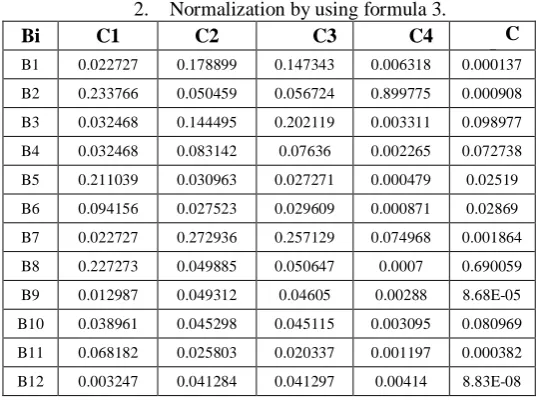
2. Normalization by using formula 3.
Table 2: The Normalize Decision Matrix
3. Using entropy weights using equations (13), (14).
2.006415 2.169876 2.159626 0.434334 1.096816 Sum 0.807441 0.873223 0.869097 0.174789 0.441391
1-Hi 0.192559 0.126777 0.130903 0.825211 0.558609 1.834
W 0.104991 0.069124 0.071373 0.449937 0.304575 1
4. The positive ideal point (PIS) and the negative ideal point (NIS) are derived as equation (8), and equation(9):
A+ 0.233766 0.272936 0.257129 0.899775 0.690059 A- 0.003247 0.025803 0.020337 0.000479 8.83E-08
5. The separation values can be measured using the Euclidean distance, which is given as equation (10),
(11).The similarities to the PIS can be derived as
equation (12), Where
6. Finally, the preferred orders can be obtained according to the similarities to the PIS in descending order to choose the best alternatives
.
Bi D+ D- Sum Ck Rank
B1 1.15745 0.199957 1.357407 0.147308 6
B2 0.75139 0.929411 1.680801 0.552957 1
B3 1.101394 0.240398 1.341792 0.179162 4
B4 1.138345 0.112135 1.25048 0.089673 7
B5 1.167341 0.209492 1.376833 0.152155 5
B6 1.173422 0.095795 1.269217 0.075476 9
B7 1.09474 0.350824 1.445564 0.24269 3
B8 0.949086 0.726545 1.675631 0.433595 2
B9 1.193225 0.036256 1.229481 0.029489 11
B10 1.14444 0.09398 1.23842 0.075887 8
B11 1.194847 0.06494 1.259787 0.051549 10
B12 1.196549 0.026314 1.222862 0.021518 12
Table 3: The TOPSIS Parameters and Ranking
V. CONCLUSION
In recent years, it appears that a particular emphasis has been placed by researchers on the problems of MADM. Customers usually face different alternative options in their decision making process. This paper established the complete evaluation guidelines by using TOPSIS method strengthening the integrity of the decision making model. TOPSIS is suitable decision making tool for many reasons as easy to calculate and understand, using one parameter (criteria), relative closeness, and may be Ranking abnormality. This paper is stated that Bank Al-bilad, Al-inmaa Bank, Al Rajhi Bank, and Riyad Bank are the most best banks due to the five criteria which are used in evaluating. Other are ranked as table 3. Ci
Bi C1 C2 C3 C4(M) C5(M)
B1 7 312 1,891 6,613 163
B2 72 88 728 941,804 1,078
B3 10 252 2,594 3,466 117,471
B4 10 145 980 2,371 86,329
B5 65 54 350 501 29,897
B6 29 48 380 912 34,051
B7 7 476 3,300 78,470 2,212
B8 70 87 650 733 819,000
B9 4 86 591 3,015 103
B10 12 79 579 3,240 96,098
B11 21 45 261 1,253 453
B12 1 72 530 4,333 0.104800
Bi C1 C2 C3 C4 C 5
VI. REFERENCES
1. Amin Afshar, et al., “Fuzzy TOPSIS Multi-Criteria Decision Analysis Applied to Karun Reservoirs System”, Water Resource Management, 25:545–563 DOI, 2011.
2. C.-H. Yeh, "A problem-based selection of multi-attribute decision -making methods", International Transactions in Operational Research 9 ,PP.169-181, 2002.
3. C.L. Hwang, K. Yoon, "Multiple Attribute Decision Making-
Methods and Applications: A State-of-the-Art Survey", Springer-Verlag, New York, 1981.
4. Chiang Ku Fan, and Shu Wen Cheng, “Using Analytic Hierarchy Process Method and Technique for Order Preference by Similarity to Ideal Solution to Evaluate Curriculum in Department of Risk Management and Insurance”, Graduate Institution of Finance and Insurance, Taipei, Taiwan, J Soc Sci, 19(1): 1-8, 2009.
5. Ehsan Pourjavad , Hadi Shirouyehzad, “A MCDM Approach for Prioritizing Production Lines: A Case Study”, International Journal of Business and Management, Vol. 6, No. 10; October 2011. 6. Hasanali Aghajani , et al., “Applying VIKOR, TOPSIS and SAW in Fuzzy Environment for Ranking Suppliers in Supply Chain: A Case study”, American Journal of Scientific Research, ISSN 1450-223X Issue 48 (2012), pp. 10-19 Euro Journals Publishing, Inc. , 2012.
7. Ji-Feng Ding, “An Integrated Fuzzy Topsis Method For Ranking Alternatives And Its Application”, Journal of Marine Science and Technology, Vol. 19, No. 4, pp. 341-352, 2011.
8. M. Salehi, and R. Tavakkoli-Moghaddam , “Project Selection by Using a Fuzzy TOPSIS Technique”, World Academy of Science, Engineering and Technology 40, 2008.
9. M. Zeleny, Multiple Criteria Decision Making, McGraw-Hill, New York, 1982.
10. Mei-Tai Chu , et al., “Comparison among three analytical methods for knowledge communities group-decision analysis”, Expert Systems with Applications 33 (2007) 1011–1024, 2007. 11. Mohammad Saeed Zaeri, and et al. “Application of Multi Criteria Decision Making Technique to Evaluation Suppliers in Supply Chain Management”, African Journal of Mathematics and Computer Science Research Vol. 4 (3), pp. 100-106, March, 2011.
12. N. Caterino, et al., “Comparative Analysis of Multi-Criteria Decision-Making Methods for Seismic Structural Retrofitting”, Computer-Aided Civil and Infrastructure Engineering 24, 432–445, 2009.
13. Neda Javanmardi et al., “An Economical Multi-Criteria Decision-Making Process for Supplier Selection”, International Review of Business Research Papers Vol. 7. No. 5. Pp.168-183, September 2011.
14. Pelin Alcan Hüseyin Başlıgil, “A Facility Location Selection Problem By FUZZY TOPSIS”, 15th International Research/Expert
Conference ”Trends in the Development of Machinery and Associated Technology”, TMT 2011, Prague, Czech Republic, 12-18 September 2011.