http://www.sciencepublishinggroup.com/j/ajls doi: 10.11648/j.ajls.s.2017050301.15
ISSN: 2328-5702 (Print); ISSN: 2328-5737 (Online)
Effect of Salinity on Feed Conversion Rate, Feed
Conversion Efficiency, Protein Intake and Efficiency of
Protein Utilization Ratio in Common Carp
Cyprinus Carpio
Mohammed Shaker Al_Khshali
Department of Animal Production, College of Agriculture, University of Baghdad, Baghdad, Iraq
Email address:
To cite this article:
Mohammed Shaker Al_Khshali. Effect of Salinity on Feed Conversion Rate, Feed Conversion Efficiency, Protein Intake and Efficiency of Protein Utilization Ratio in Common Carp Cyprinus Carpio. American Journal of Life Sciences. Special Issue: Environmental Toxicology. Vol. 5, No. 3-1, 2017, pp. 30-35. doi: 10.11648/j.ajls.s.2017050301.15
Received: October 15, 2016; Accepted: December 1, 2016; Published:March 6, 2017
Abstract:
This study was conducted to investigate the impact of increased salinity on some growth parameters of common carp (Cyprinus carpio). Fish, gradually have been exposed to the salt concentrations of 5, 10 and 15g/L, as well as tap water (control treatment of 0.1 g/L) for 84 days divided on 12 weeks, and each of salt concentration represented independent treatment with two replications. 80 fish at average weight of 15 ± 3 g were randomly distributed on 8 glass tanks at 10 fish / tank to study the effect of salinity on feed conversion rate, feed conversion efficiency, protein intake and efficiency of protein utilization ratio in common carp. Results showed a decrease in feed conversion rate to16.59, 24.49 and -20.11, when the salinity increased to 5, 10 and 15 g/L respectively, compared to the control treatment (13.32). This is reflected on feed conversion efficiency, which slump to 6.02, 4.08 and - 4.97% in the salt concentrations of 5, 10 and 15 g/L respectively, compared to the control treatment (7.50%). Protein intake, also decreased to 25.23, 24.07 and 21.37% with the increasing of salinity to 5, 10 and 15 g/L respectively, compared to the control treatment (25.67%), while the efficiency of protein utilization slump to 21.32, 10.94 and -10.07% in the salt concentrations of 5, 10 and 15 g/L, respectively while it was 29.16% in the control treatment. Fish were fed on a commercial diet with a protein content of 31% during the experiment.Keywords:
Salinity, Feed Conversion and Efficiency, Protein Intake, Protein Utilization, Common Carp1. Introduction
Iraqi inland water is exposed to a continuous rise in salinity levels now due to several reasons, including the scarcity of water releases of Tigris and Euphrates rivers, impact of drainage salt water, drying of large areas of the marshes, lack of rain and receding of rivers [1]. Where, the salinity of the marshes in southern region of Iraq ranged from 2.20-3.82 g/L and is rising fast [2], as well as the increase of evaporation rates due to rising temperatures and increase of global warming rates. Salinity affecting on two physiological factors in fish, the first affects the osmoregulation process by increasing the amount of ions inside the body, and this leads to increase fish need for energy to get rid of the excess ions inside the body, this expend the energy which can be used in growth [3], where the optimum salinity of fish is varying according to the species, sex and water temperature [4]. The
requirements of the standard metabolic rate [7], the second is the effect on fish appetite and feed intake [4], the third is the effect on the feed conversion efficiency [8], and finally to influence the balance of hormones that are involved in assimilation, besides the season and the duration of acclimation [9]. The present study aimed to investigate the effect of a gradual rise in the salt concentrations on some growth criteria include feed conversion rate, feed conversion efficiency, protein intake and efficiency of protein utilization ratio in common carp.
2. Materials and Methods
2.1. Acclimation of Trial Fish and Preparation of Salt Concentrations
300 fish of common carp at average weight ranged from 12-25 g were transferred to the laboratory. Glass tanks with dimensions of 60 × 40 × 30 cm were filled with about 40 liter of water and equipped with oxygen by air pump. Fish during the acclimation period, which lasted for two weeks were fed on a commercial diet with a protein content of 31.9% with two times a day, with a ratio of 3% of body weight to acclimate the fish to the feed.
Salt concentrations of 5,10 and 15 g/L were prepared by dissolving a known weight of salt (brought from local markets, Sharjah mark) in one liter of tap water, salt concentrations were quantified by salinometer. Fish which acclimated to the tap water (0.1 g/L) and on laboratory conditions, gradually exposed to the salt concentrations mentioned, and then to the higher salt concentration every four days to reach the next concentration. Each of salt concentration represented an independent treatment, and fish were exposed to the new concentration at the end of the fourth day of exposure to the lower concentration, fish at a
concentration of 0.1 g/L are represented control treatment.
2.2. Effect of Salinity on Growth Rate
This experiment was designed to study the effect of a gradual increase of salinity on the rate and efficiency of feed conversion, protein intake and utilization efficiency of protein in common carp. Fish were distributed at average weight of 18.70 ± 1.50 g as 10 fish on each glass tank, treatments were tested with two replicates for each concentration, taking into account the convergence of the weights of the fish used in the experiment. Fish fed during the experiment, which lasted 84 days (divided to 12 weeks) on a diet with a protein content of 31.9% at a ratio of 4% of body weight with three times a day. Fish weighed every two weeks to check the growth and to modulate the amount of feed according to the body weight.
The following measurements were taken [10]
1 Feed conversion rate (F. C. R) = weight of feed given to fish (g) /moist weight gain of fish (g)
2 Feed conversion efficiency (F. C. E) = moist weight gain of fish (g) /weight of feed given to fish (g) × 100 3 Protein Intake (PI) = (feed intake × protein in the diet) /
100
4 Protein Efficiency Ratio (P. E. R) = (weight gain of fish / protein intake) × 100
3. Results and Discussion
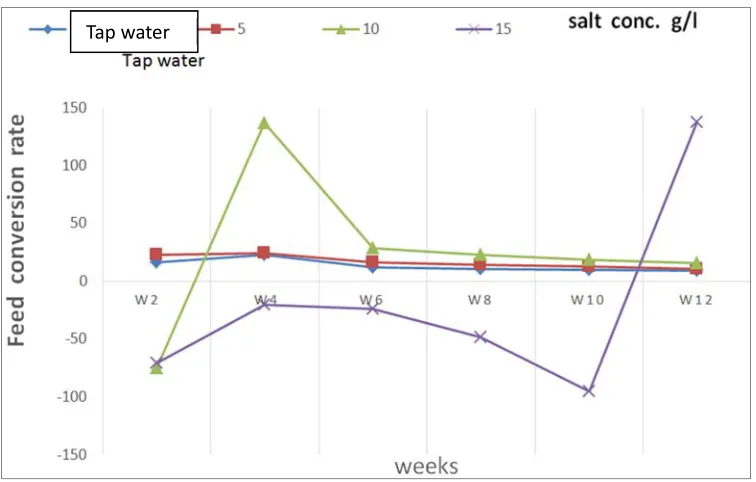
Figure 1 shows the feed conversion rates of common carp during 12 weeks of the experiment in the control treatments (0.1 g/L) and another salt concentrations of 5, 10 and 15 g/L which is revealed an increase in feed conversion rate in the control treatment, while it is decreased in the other salt concentrations.
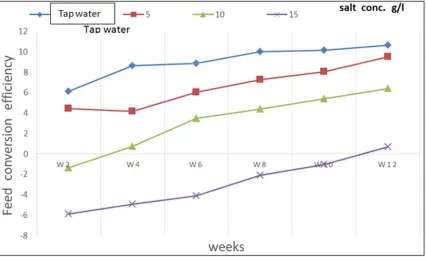
Figure 2 shows the feed conversion efficiency of common carp during 12 weeks of the experiment in the control treatments (0.1 g/L) and another salt concentrations of 5, 10
and 15 g/L which is showed an increase in feed conversion efficiency in the control treatment, while it is decreased in the other salt concentrations.
Figure 2. Feed conversion efficiency in common carp during12 weeks of the growing trial in different salt concentrations.
Figure 3 includes the ratios of protein intake in common carp at a gradual exposure to the salt concentrations of 5, 10 and 15 g/L as the results showed an increase in protein intake
in the control treatment during all the weeks of experiment, while it was fluctuating in the rest of the mentioned salt concentrations.
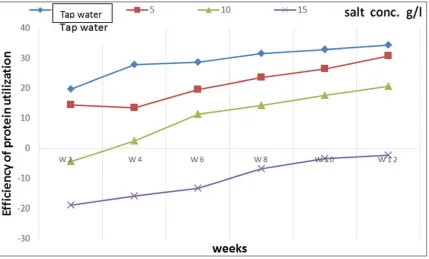
Figure 4 shows the efficiency of protein utilization ratio in common carp which gradually exposed to the salt concentrations of 5, 10 and 15 g/L, as we note there is an
increase in the efficiency of protein utilization ratio in the control treatment, while it was significantly decreased within weeks in the salt concentrations above.
Figure 4. Efficiency of protein utilization ratio in common carp during the growing trial in different salt concentrations.
Growth in fish is one of the physiological functions that affected by the water salinity, where the metabolic rate and the energy of osmoregulation process were reflect the effect of salinity on growth [11]. The exposure of fish to high levels of salinity leads to an increase in metabolic rate as a result of the increasing need to the necessary energy for iono-osmoregulation to maintain the internal stability (homeostasis) under the new osmotic conditions. The increasing cost of energy needed leads to a reduction in growth rate, which negatively affects the rate and efficiency of feed conversion, protein intake and efficiency of protein utilization in fish, so a little of the energy will be available for growth [12]. The effect of salinity on fish growth is similar to the effect of temperature, this effect mainly depends on fish species and duration of exposure to the salinity [3]. De Silva and Perera [6] noted a decline in the rate and efficiency of feed conversion and efficiency of protein utilization in grey mullet Mugil cephalus with high salinity, Barman et al. [13] revealed that the best feed conversion rate and protein utilization of grey mullet were obtained in the salt concentration of 10 g/L, compared with other salt concentrations (0, 15, 25 and 30 g/L).
McCormick et al. [14] explained there is no effect of salinity on feed conversion rate in Salmo salar when exposed to salt concentrations of 0, 10, 20 and 30 g/L, while Partridge and Jenkins [15] recorded there were no significant differences in feed conversion rate in black bream
Acanthopagrus butcheri when transferred to salt concentrations of 12, 24, 36 and 48 g/L, although the growth
was high in salt concentration of 24 g/L, Likongwe et al. [16] revealed that the cost of devoted energy to the ionic and osmoregulation be low in iso-osmotic environment, and the stored energy is sufficient to increase the feed conversion rate.
Many of studies supported the idea of increasing feed conversion rate with the decreasing of metabolic cost for osmoregulation, where Abo- Hegab and Hanke [17] stated that the exposure of common carp to diluted seawater (10 and 15 g/L) led to a decline in feed conversion rate with the increase of salt concentrations. Luz et al. [18] noted a reduction in feed conversion rate and efficiency in goldfish
Carassius auratus exposed to the salt concentrations of 8 and 10 g/L, compared to fish in freshwater and salinity of 2 g/L, Xia et al. [19] recorded that the grass carp
growth towards the internal equilibrium processes. Wang et al. [22] explained that the best growth of common carp fingerlings was recorded at a salt concentration of 0.1 g/L, and the feed conversion rate decreased with the increase of salinity to 10.5 g/L, pointing out that the best feed conversion rate, protein utilization ratio and protein intake in common carp was in salinity of 0.5 - 2.5 g/L, Maceina and Shireman [23] pointed to a decline in feed conversion rate and utilization ratio of protein in grass carp at the salinity of 12 g/L, and decreased more when the salinity reached 14 g/L, while the decline was less in low salinity (3 and 6 g/L).
Lawson and Alake [24] revealed a significant decrease in feed conversion rate and utilization ratio of protein with increase of salinity in juvenile goldfish Carassius auratus. Schofield et al. [25] stated that the transfer of Nile tilapia
Oreochromis niloticus from the freshwater to the gradual salt concentrations of 0, 5, 10, 15, 20, 25, 30 and 35 g/L, where the fish remained in each salt concentration for a week and then transported to the higher salt concentration, the researchers observed a decline infeed conversion rates and utilization ratio of protein, with increasing of salinity, until they reached the lowest levels at a concentration of 35 g/L, Küçük [26] noted that the exposure of goldfish Carassius auratus and Crucian carp Carassius carassius to the salt concentrations of 8, 12, 16 and 20 g/L after acclimated to the concentration of 8 g/L has led to a decline in feed conversion rate and protein intake, this was attributed to the move away of fish from the osmotic balance point. Imsland [27] recorded that the presence of fish in iso-osmotic environment reduces the amount of energy needed to osmoregulation, thus there will be more energy is devoted for growth, and then raising the feed conversion rate and ratio of protein intake and efficiently. There are also some factors that will influence the growth rate like nutrition and appetite, and these same factors are affected by salinity which affect on feed conversion rate [28].
AlFaez et al. [1] reported a decrease in feed conversion rate and protein intake of common carp in both concentrations of4 and 6 g/L respectively, compared to control treatment (2.2 g/L), the researchers attributed the cause of low growth to the osmotic shock which occurred when the fish exposed to high levels of salinity, this increased the osmotic pressure of blood plasma, and leads to a loss of fish appetite, and thus lower the feed conversion rate. Daham and Sayyab [29] noted a decrease in feed conversion rate with a ratio of 10% in the grass carp, when the salinity raised to 15 g/L, this also caused a decrease in feed conversion efficiency and protein utilization with high salinity, compared to them in salinity of 6 g/L.
4. Conclusion
The study summarized that the increased salinity, negatively influenced in feed conversion rate, feed conversion efficiency, protein intake and efficiency of protein utilization in common carp.
References
[1] AlFaez, N. A., Abdul Ghani, J. A., and Yesser, A. K. T. (2009). Effect of different Salt concentrations on survival, growth and feeding of common carp Cyprinus carpio fry, Iraqi Journal of Aquaculture, 26 (2): 59-70.
[2] Najjar, G. A. (2009). Seasonal variations in the concentrations of heavy elements on the muscles of three fish species of Cyprinidae in Al-Howeizeh marsh and eastern Al-Hammar, M. Sc. Thesis, Faculty of Agriculture - University of Basrah, 78 pp.
[3] Morgan, J. D., & Iwama, G. K. (1991). Effects of salinity on growth, metabolism, and ion regulation in juvenile rainbow trout (Oncorhynchus mykiss) and fall Chinook salmon (Oncorhynchus tshawytscha). Can. J. Fish. Aqua. Sci., 48 (11), 2083-2094.
[4] Lambert, Y., Dutil, J. D., & Munro, J. (1994). Effects of intermediate and low salinity conditions on growth rate and food conversion of Atlantic cod (Gadus morhua). Can. J. Fish Sci., 51: 1569–76.
[5] Ferraris R. P., Catacutan M. R., Mabelin R. L. &Jazul A. P. (1986). Digestibility in milkfish, Chanos chanos (Forsskal): effects of protein source, fish size and salinity. Aquaculture, 59: 93-105.
[6] De Silva S. S. and Perera P. A. B. (1976). Studies on the young grey mullet, Mugil cephalus L. Effects of salinity on food intake, growth and food conversion. Aquaculture, 7: 327–338.
[7] Swanson, C. (1996). Early development of milkfish: effects of salinity on embryonic and larval metabolism, yolk absorption and growth. J Fish Biol., 48: 405–21.
[8] Alava, V. R. (1998;). Effect of salinity, dietary lipid source and level on growth of milkfish (Chanos chanos) fry. Aquaculture,167: 229–236.
[9] McCormick, S. D. (1996). Effects of growth hormone and insulin-like growth factor I on salinity tolerance and gill Na+, K+-ATPase in Atlantic salmon (Salmo salar): interaction with cortisol. Gen Comp Endocrinol, 101: 3–11.
[10] Jobling, M. (1993). Bioenergetics, feed intake and energy partitioning. In j. c. Ranking, & F. B. Jensen, Fish Ecophysiol (pp. 1-44). London: Chapman and Hall.
[11] Mylonas, C. C., Pavlidis, M., Papandroulakis, N., Zaiss, M. M., Tsafarakis, D., Papadakis, I. E., & Varsamos, S. (2009). Growth performance and osmoregulation in the shi drum (Umbrina cirrosa) adapted to different environment salinities. Aquaculture., 287,: 203-210.
[12] Laiz-Carrión, R., Sangiao-Alvarellos, S., Guzmán, J. M., Martín del Río, M. P., Soengas, J. L., & Mancera, J. M. (2005b). Growth performance of gilthead sea bream Sparus aurata in different osmotic conditions: Implications for osmoregulation and energy metabolism. Aquaculture, 250: 849–861.
[14] McCormick, S. D., Moyes, C. D., & Ballantyne, 1. (1989). Influence of salinity on the energetics of gill and kidney of Atlantic salmon (Salmo salar). Fish Physiology and Biochemistry, 6: 243–254.
[15] Partridge, G. J., & Jenkins, G. I. (2002). The effect of salinity on growth and survival of juvenile black bream (Acanthopagrus butcheri). Aquaculture, 210-219.
[16] Likongwe, J. S., Stecko, T. D., Stauffer, J. R., & Carline, R. F. (1996). Combined effects of water temperature and salinity on growth and feed utilization of juvenile Nile tilapia Oreochromis niloticus (Linneaus). Aquaculture 146: 37–46. [17] Abo- Hegab, S., & Hanke, W. (1982). Electrolyte changes and
volume regulatory processes in the carp during osmotic stress. Comp. Biochem. Physiol., 1A (2): 157-164.
[18] Luz, R. K., Martinez-Alvarez, R. M., DePedro, N., & Delgado, M. J. (2008). Growth, food intake regulation and metabolic adaptation in goldfish ( Carassius auratus) Exposed to different salinity. J. Aqua., 276 (1-4): 171-178.
[19] Xia, J. H.; Liu, F.; Zhu, Z. Y.; Fu, J.; Feng, J.; Li, J. & Yue, G. H. (2010). Aconsensus linkage map of the grass carp (Ctenopharyngodon idella) based on micro satellites and SNPs, BMC Genomic, 11-13.
[20] Yesser, A. K. T.; Ahmed, H. A. & Albadri, M. E. (1999). Effect of salinity on growth and food conversion effeciency of Liza carinata. Mar. Mesopotamia, 14 (2): 265-277.
[21] DeBoeck, G., Vlaeminck, A., Linden,, A., & Blust, R. (2000). The energy metabolism of common carp (Cyprinus carpio) when exposed to salt stress: an increase in energy expenditure or effects of starvation. Physiol. Biochem. Zool., 73 (1): 102-111.
[22] Wang, J. Q., Lui, H., Po, H., & Fan, L. (1997). Influence of salinity on food consumption, growth and energy conversion efficiency of common carp (Cyprinus carpio) fingerlings. Aquaculture, 148: 115–124.
[23] Maceina, M. J., & Shireman, V. J. (1979). Grass carp: Effect of salinity on survival, weight loss, and muscle tissue water content. The prog. fish culture, 41 (2): 69-73.
[24] Lawson, E. O., & Alake, S. A. (2011). Salinity Adaptability and Tolerance of Hatchery Reared Comet Goldfish Carassius auratus (Linnaeus 1758). International Journal of Zoological Research, 7: 68-76.
[25] Schofield, P. J., Peterson, M. S., Lowe, M. R., Brown-Peterson, N. J., & Slack, W. T. (2011). Survival, growth and reproduction of non-indigenous Nile tilapia, Oreochromis niloticus (Linnaeus 1758). I. Physiological capabilities in various temperatures and salinities. Marine and Freshwater Research 62 (5): 439-449.
[26] Küçük, S. (2013). The effects of salinity on growth of goldfish Carassius auratus and crucian carp, Carassius carassius. African Journal of Biotechnology, 12 (16): 2082-2087. [27] Imsland, A. K., Gustavsson, A., Gunnarsson, S., Foss, A.,
Àrnason, J., Arnarson, I.,. Thorarensen, H. (2008). Effect of reduce salinities on growth, food conversion efficiency and blood physiology of Juvenile Atlantic halibut ( Hippoglossus hippoglossus L.). Aquaculture., 274: 254-259.
[28] McCormick, S. D. (2001). Endocrine control of osmoregulation in fish. American Zoologist, 41: 781–794. [29] Daham, N. K. and Sayyab, A. A. (2002). Impact of salty