Processing of Visual Evoked Potentials using Mode
Deviation
G. Hemalatha
1, Dr .B. Anuradha
2Prof. V. Adinarayana Reddy
31KSRMCE, Cuddapah, 2SVUCE, Tirupati, 3 GPREC, Kurnool.
Abstract:
The term visually evoked potential (VEP) refer to electrical potentials, initiated by brief visual stimuli, which are recorded from the scalp overlying visual cortex, VEP waveforms are extracted from the electro-encephalogram (EEG) by signal averaging. VEPs are used primarily to measure the functional integrity of the visual pathways from retina via the optic nerves to the visual cortex of the brain. VEPs better quantify functional integrity of the optic pathways than scanning techniques such as magnetic resonance imaging (MRI). The traditional averaging method can show the shape of the evoked potentials in the rough but losses some important components. Hence it is required to improve the ensemble average of evoked potentials. In this paper we are introducing mode deviation test to identify and remove artifacts and to improve the estimation of evoked potentials. We identify the signals with large mode deviation as artifacts. This test is applied to 14-channel visual evoked potentials of different subjects.
I. INTRODUCTION
Evoked potentials (EPs) constitute an event-related activity which occurs as the electrical response from the brain or the brainstem to various types of sensory stimulation of nervous tissues; auditory and visual stimulation are commonly used. The recording of such electrical potentials provides information on, e.g., sensory pathways abnormalities, the localization of lesions affecting the sensory pathways, and disorders related to language and speech. Evoked potentials are recorded from the scalp using an electrode configuration similar to that of an EEG recording. The potentials typically manifest themselves as a transient waveform whose morphology depends on the type and strength of the stimulus and the electrode positions on the scalp. The mental state of the subject,
exemplified by attention, wakefulness, and expectation, also influences the waveform morphology.
Individual EPs have very low amplitude levels, ranging from 0.1 to 10 µV, and are, accordingly, hidden in the ongoing EEG background activity. The EEG is viewed as "noise" whose influence should be minimized so that the EP wave form can be subjected to reliable scrutiny. As a result, noise reduction is
one of the most frequently addressed signal processing issues in the analysis of EPs. Fortunately, an EP usually occurs after a time interval related to the time of stimulus presentation, whereas the background EEG activity and non-neural noise occur in a more random fashion. The stimulus and response property means that repetitive stimulation can be used in combination with ensemble averaging
techniques to help reduce the noise level. With a sufficiently low noise level, the time delay
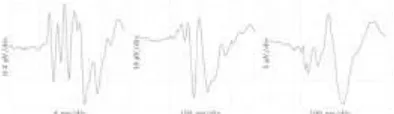
(latency) and amplitude of each constituent wave of the EP can be accurately estimated and interpreted in suitable clinical terms. The Various morphologies of evoked potentials are shown in Fig 1.
Fig. 1: Various morphologies of evoked potentials. The duration, amplitude and morphology differ considerably from potential to potential.
The use of ensemble averaging is, however, not without complications, since the evoked response, in certain situations, undergoes dynamic changes, thereby violating the averaging assumption of a response exhibiting fixed waveform morphology.One such situation occurs during neurosurgical procedures in which it is important to detect time-varying EP changes related to neurological injury. Considerable research has been directed toward finding techniques which can track dynamic changes, while at the same time providing sufficient noise reduction.
Evoked potentials resulting from auditory
stimulation are called Auditory Evoked potentials (AEP), those resulting from visual
stimulation are called visual Evoked potentials (VEP), and those resulting from somatosensory
stimulation are called somatosensory Evoked potentials (SEP).
the averaged EP and are compared to normative values in order to discriminate normal, healthy subjects from subjects with various kinds of neurological impairment. Normative values are strongly dependent on age, and, therefore, different values have been determined for newborns and adults. Factors which suggest that an EP should be interpreted as abnormal include waves which have increased latency, have decreased amplitude, or are missing.
The Auditory Evoked potentials reflects how neural information propagates from the acoustic nerve in the ear to the cortex. Somatosensory EPs can be used to identify blocked or impaired conduction in the sensory pathways, produced by certain neurological disorders such as multiple sclerosis. Another application of the SEP is intraoperative monitoring during spine surgery; an unchanged waveform morphology throughout surgery suggests that no deterioration in neurological function has taken place. Visual EPs are used for investigating ocular and retinal disorders and for detecting visual field defects and optic nerve pathology. It has also been suggested that the VEP be used for intraoperative monitoring where the aim is to detect early changes in waveform morphology in order to avoid visual loss and damage to the optic nerve.
II. VISUAL EVOKED POTENTIALS
The terms visually evoked potential (VEP), visually evoked response (VER) and visually evoked cortical potential (VECP) are equivalent. They refer to electrical potentials, initiated by brief visual stimuli, which are recorded from the scalp overlying visual cortex, VEP waveforms are extracted from the electro-encephalogram (EEG) by signal averaging. VEPs are used primarily to measure the functional integrity of the visual pathways from retina via the optic nerves to the visual cortex of the brain. VEPs better quantify functional integrity of the optic pathways than scanning techniques such as magnetic resonance imaging (MRI).
Any abnormality that affects the visual pathways or visual cortex in the brain can affect the VEP. Examples are cortical blindness due to meningitis or anoxia, optic neuritis as a consequence of demyelination, optic atrophy, stroke, and compression of the optic pathways by tumors, amblyopia, and neurofibromatosis. In general, myelin plaques common in multiple sclerosis slow the speed of VEP wave peaks.
Compression of the optic pathways such as from hydrocephalus or a tumor also reduces amplitude of wave peaks.
VEPs initiated by strobe flash were noticed in the early years of clinical encephalography (EEG) in the 1930s. A VEP can often be seen in the background EEG recorded from the occipital scalp following a flash of light.Visually evoked potentials elicited by flash stimuli can be recorded from many scalp locations in humans. Visual stimuli stimulate both primary visual cortices and secondary areas. Clinical VEPs are usually recorded from occipital scalp overlying the calcarine fissure. This is the closest location to primary visual cortex . A common system for placing electrodes is the “10-20 International System” which is based on measurements of head size. The mid-occipital electrode location (OZ) is on the midline. The distance above the inion calculated as 10 % of the distance between the inion and nasion, which is 3-4 cm in most adults as shown in fig. 2.
Fig. 2. Occipital scalp electrode locations using 10-20 International System. The INION is the skull location at the position shown.
mastoid, scalp or earlobe. The time period analyzed is usually between 200 and 500 milliseconds following onset of each visual stimulus. When testing young infants, analysis time should be 300 msec or longer because components of the VEPs may have long peak latencies during early maturation. Most children and adults may be tested using an analysis time of 250 msec or less. The most common amplifier bandpass frequency limits are 1 Hz and 100 Hz. Amplifier sensitivity settings vary with +/- 10 uV common for older children through adults and +/- 20 to 50 uV for infants and younger children. Sometimes the sensitivity setting must be changed to accommodate larger EEG voltage in all age groups.Commonly used visual stimuli are strobe flash, flashing light-emitting diodes (LEDs), transient and steady state pattern reversal and pattern onset/offset.
Fig. 3. Checkerboard pattern with red fixation point.
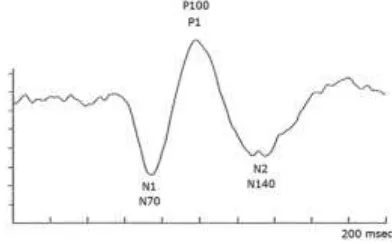
The most common stimulus used is a checkerboard pattern, which reverses every half-second as shown in Figure 3. Pattern reversal is a preferred stimulus because there is more inter-subject VEP reliability than with flash or pattern onset stimuli. Commercially produced visual evoked potential systems simulating these pattern reversals now use video monitors.Using cathode ray tube monitors (CRT) nearly everyone with close to normal visual function produces a similar evoked potential using pattern reversal stimuli. There is a prominent negative component at peak latency of about 70 msec (N1, Fig. 4), a larger amplitude positive component at about 100 msec (P1, Fig. 4) and a more variable negative component at about 140 msec (N2, Fig. 4). The major component of the
VEP is the large positive wave peaking at about 100 milliseconds as shown in Fig. 4.
Fig. 4. Representative normal pattern reversal VEP recorded from mid-occipital scalp using 50′ checkerboard pattern stimuli.
III. MODE DEVIATION TEST
The mode deviation (also called the mode absolute deviation) is the mean of the absolute deviations of a set of data about the data's mode. For a sample size, the mode deviation is defined by
(1)
where is the mode of the distribution.
If an artifact occurs, the individual samples of an evoked potentials deviates more from their mode values, resulting large mode deviation. In this test we identify the signals that are having high mode deviation as artifacts.
This test is described using to represent
single trial EP , in the ensemble of class c, c = 1,2,…,C, recorded at channel m, m = 1,2,…,M. Where N is the number of single trial EPs in each ensemble, C is the number of brain activity categories, and M is the number of channels. The c-class ensemble of EPs collected at channel m will be referred to as m/c ensemble.
The mode of mth channel and nth trial evoked potential is denoted by
m=1,2,3………M (2)
n= 1,2,3……….N
/ ; m c n
z
,
Then the mode deviation of mth channel and nth trial evoked potential is given by equation (3)
for m=1,2,3………M (3) n= 1,2,3………N
let for
m=1,2,3………M
n= 1,2,3………N
If , then is considered as an artifact and is discarded from the m/c ensemble.
IV.RESULTS
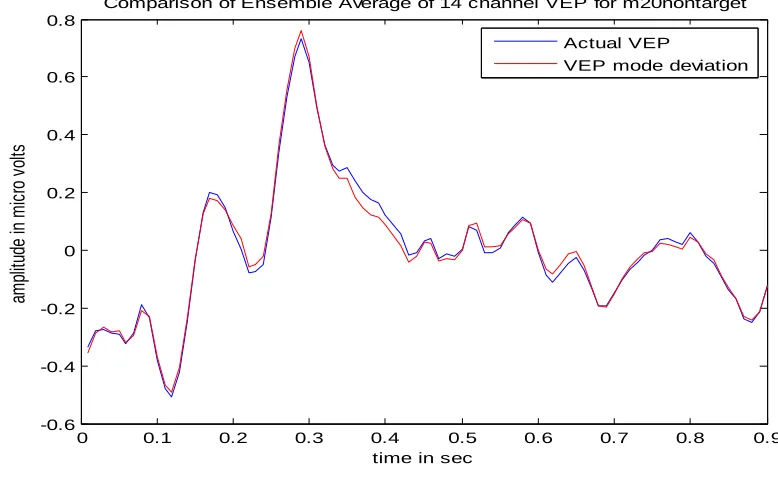
Comparison of actual ensemble average of visual evoked potentials with ensemble average after removing artifacts for subjects’ m20nontarget and m21target are shown in fig5 and fig6.
Fig. 5. Comparison of Ensemble Average of 14 Channel VEP for m20nontarget.
Fig. 6. Comparison of Ensemble Average of 14 Channel VEP for m21target.
0 0.1 0.2 0.3 0.4 0.5 0.6 0.7 0.8 0.9
-0.6 -0.4 -0.2 0 0.2 0.4 0.6 0.8
time in sec
am
pl
itu
de
in
m
ic
ro
v
ol
ts
Comparison of Ensemble Average of 14 channel VEP for m20nontarget
Actual VEP
VEP mode deviation
0 0.1 0.2 0.3 0.4 0.5 0.6 0.7 0.8 0.9 -0.4
-0.3 -0.2 -0.1 0 0.1 0.2 0.3 0.4 0.5
time in sec
am
pl
itu
de
in
m
ic
ro
v
ol
ts
Comparison of positive and negative peaks of ensemble average after and before removal of artifacts is shown in table 1.
TABLE 1
F16 M20 M21 M23 M25
Non Target Target Non Target
target Non Target target Non Target
target Non Target
target
N1 Actual Latency in sec
0.12 0.13 0.22 0.25 0.22 0.08 0.2 0.2 0.1 0.09
Amplitude in µv
-0.812 -0.407 -0.078 -0.169 -0.23 -0.286 -0.396 -0.665 -0.6 -0.52
Mode deviation
Latency in sec
0.12 0.13 0.22 0.25 0.22 0.08 0.2 0.2 0.1 0.09
Amplitude in µv
-0.823 -0.408 -0.055 -0.172 -0.237 -0.285 -0.422 -0.67 -0.6 -0.48
P1 Actual Latency in sec
0.19 0.21 0.29 0.31 0.45 0.17 0.32 0.31 0.25 0.19
Amplitude in µv
0.466 0.855 0.731 0.412 0.385 0.386 0.45 0.383 0.56 0.636
Mode deviation
Latency in sec
0.19 0.21 0.29 0.31 0.45 0.17 0.32 0.31 0.25 0.19
Amplitude in µv
0.471 0.865 0.76 0.406 0.375 0.405 0.443 0.378 0.51 0.652
N2 Actual Latency in sec
0.26 0.3 0.43 0.41 0.64 0.25 0.46 0.45 0.35 0.6
Amplitude in µv
0.035 -0.258 -0.018 0.025 -0.215 -0.32 -0.116 -0.234 0.018 -0.398
Mode deviation
Latency in sec
0.26 0.3 0.43 0.41 0.64 0.25 0.46 0.45 0.35 0.6
Amplitude in µv
0.027 -0.278 -0.043 0.033 -0.234 -0.335 -0.13 -0.235 0.023 -0.39
V. CONCLUSION
The primary objective of this work is to identify and reject artifacts in the acquisition of evoked potentials. Mode deviation of EP of each channel, and of each trial is obtained. Then EP’s with large mode deviation are detected as artifacts. It is observed that removal of artifacts using this test improves peaks of the average VEP.
REFERENCES
[1] G. D. Dawson, “A summation technique for detecting
small signals in a large irregular background,” J. Physiol. (London), vol. 115, p. 2, 1951.
[2] G. D. Dawson, “A summation technique for the
detection of small evoked potentials,”Electroencephal. Clin. Neurophysiol., vol. 6, pp. 65-. 84, 1954
[3] R. P. Borda and J. D. Frost, “Error reduction in small
sample averaging through the use of the median rather than the mean,” lectroencephal. Lin. Neurophysiol., vol. 25, pp. 391-392, 1968
[4] B. Lutkenhoner and C. Pantev, “Possibilities and
limitations of weighted. averaging,” Biol. Cybern.,vol. 52, pp. 409-416, 1985
[5] R. J. Chabot and E. R. Jhon, “Normative evoked
potential data,” in Handbook of
Electroencephalography and Clinical
Electrophysiology: Clinical Applications of Computer Analysisof EEG and other Neurophysiological Signals, ch. 1, pp. 263-309, Amsterdam/New York: Elsevier,1986.
[6] P.J. Rousseeuw, A.M. Leroy, “Robust regression and
outlier detection,” Wiley Series in Probability and Mathematical Statistics, Wiley, New York, 1987
[7] A. Oppenheim and R. Schafer, Discrete-Time Signal
Processing. PrenticeHall, 1989
[8] C. Davilla and M. Mobin, “Weighted averaging of
evoked potentials,” IEEE Trans. Biomed. Eng.,vol. 39, pp. 338-345, 1992.
[9] C. W. Therrien, Discrete Random Signals and
Statistical Signal Processing. New Jersy: Prentice-Hall, 1993.
[10] S. M. Kay, “Spectral Estimation.” Advanced Topics in
Signal Processing, chapter 2. Prentice Hall, 1993.
[11] T. W. Picton, O. G. Lins, and M. Scherg, “The
recording and analysis of event related potentials,” in Handbook of Neurophysiology, Vol. 10 (F. Boller and J. Grafman, eds.), pp. 3-73, Baltimore, Elseviere Science, 1995.
[12] L. Gupta, D.L. Molfese, R. Tammana, P.G. Simos,
“Non-linear alignment and averaging for estimating the evoked potential,” IEEE Tran. Biomed. Eng. 43 (4) (1996) 348–356.
[13] T.D. Lagerlund, F.W. Sharbrough, N.E. Busacker,
“Spatial filtering of multichannel electroencephalo-graphic recordings through principal component analysis by singular value decomposition,” J. of Clin. Neurophysiol. 14 (1997) 73–82.
[14] G. G. Celesia and N. S. Peachey, “Visual evoked
potentials and electroencephalograms,” in
Electroencephalography. Basic Principles, Clinical Applications and Related Fields (E. Niedermeyer and F. Lopes da Silva, eds.), pp. 968-993, Baltimore: Williams & Wilkins, 1999.
[15] J. Polich, “P300 in clinical applications,” in
Electroencephalography. Basic Principles, Clinical Applications and Related Fields (E. Niedermeyer and F. Lopes da Silva, eds.), pp. 1073-1091, Baltimore: Williams & Wilkins, 1999.
[16] R.J. Croft, R.J. Barry, “Removal of ocular artifact
from EEG: a review,” Clin. Neurophysiol. 30 (1) (2000) 5–19.
[17] T.-P. Jung, S. Makeig, C. Humphries, T.-W. Lee, M.J.
electroencephalographic artifacts by blind source separation,” Psychophysiology 37 (2000) 163–178.
[18] R. Barandela, E. Gasca, “Decontamination of training
samples for supervised pattern recognition methods,”
in: Proceedings of Joint IAPR International
Workshops SSPR and SPR 2000, Springer, NewYork, 2000, pp. 621–630
[19] L. Gupta, J. Phegley, D.L. Molfese, “Parametric
classification of multichannel evoked potentials,” IEEE Trans. Biomed. Eng. 49 (8) (2002) 905–911 49(9) (2002) 1070
[20] G.L. Wallstrom, R.E. Kass, A. Miller, J.F. Cohn, N.A.
Fox, “Automatic correction of ocular artifacts in the EEG: a comparison of regression based and component-based methods,” Int. J. Psychophysiol. 53 (2) (2004) 105–119.
[21] Casarotto, A.M. Bianchi, S. Cerutti, G.A. Chiarenza,
“Principal component analysis for reduction of ocular artifacts in event-related potentials of normal and dyslexic children,” Clin. Neurophysiol. 115 (3) (2004) 609–619.
[22] C.A. Joyce, I.F. Gorodnitsky, M. Kutas, “Automatic
removal of eye movement and blink artifacts from EEG data using blind component separation,” Psychophysiology 41 (2) (2004) 313–325.
[23] Karl Friston, “A theory of cortical responses,”
Philosophical Transactions of the Royal 9 April 2005) 815-836.
[24] F. Vazquez, J.S. Sanchez, F. Pla, “A stochastic
approach to Wilson’s Editing Algorithm,” IbPRIA 2005, pp. 34–42.
[25] L. Gupta, B. Chung, M.D. Srinath, D.L. Molfese, H.
Kook, “Multichannel fusion models for the parametric classification of differential brain activity,” IEEE Trans. Biomed. Eng. 52 (11) (2005) 1869–1881.
[26] Rodrigo Quan Quroga, Evoked potentials
Encyclopedia of Medical Devices and Instru-mentation, Second Edition, John Wiley & Sons, Inc.(2006).
[27] Hyunseok Kook, Lalit Gupta, Srinivas Kota, Dennis
Molfese, H. Lyytinen, “An offline/real-time artifact rejection strategy to improve the classification of multi-channel evoked potentials,” Pattern Recognition (2008), pp. 1985-1996.
[28] H. Cecotti, “Classification of Steady-State Visual
Evoked Potentials based on the Visual Stimuli Duty Cycle,” IEEE, 3rd International Symposium on Applied Sciences in Biomedical and Communication Technologies (ISABEL), 2010.
[29] Zhiguo Zhang, Keith D. K. Luk, and Yong Hu,
“Identification of detailed time-frequency components
in somatosensory evoked potentials,” IEEE
Transactions on Neural Systems and Rehabilation Engineering, Vol. 18, NO. 3, pp.245-254, 2010.
[30] Ruben Gaitan-Ortiz, Oscar Yanez-Suarez, and Juan M
Cornejo-Cruz, “Evoked potentials SNR maximization by PCA and genetic algorithms,” Proceedings of the 5th International IEEE EMBS Conference on Neural Engineering Cancun, Mexico, April 27 - May 1, 2011, pp. 166-169, 2011.
[31] H. Nezamfar, U. Orhan1, D. Erdogmus, K.E. Hild, S.
Purwar1, B. Oken and M.Fried-Oken, “On visual evoked potentials in EEG induced by multiple pseudorandom binary sequences for brain computer interface design,” IEEE International Conference on
Acoustics, Speech and Signal Processing (ICASSP), pp. 2044-2047, 2011.
[32] Gary Garcia-Molina, and Danhua Zhu, “Optimal
spatial filtering for the steady state visual evoked potential: BCI application,”Proceedings of the 5th International IEEE EMBS Conference on Neural Engineering Cancun, Mexico, April 27 - May 1, 2011, pp. 156-160, 2011.
About the Author- G. Hema Latha received
her B.Tech. Degree in Electronics and Communication Engineering from Sri Venkateswara University, Tirupati in 1997, and M.Tech in Instrumentation and Control Systems from Sri Venkateswara Unversity, Tirupati in 2003. Smt. Hemalatha joined faculty in Electronics and Communication Engineering at G. Pulla Reddy Engineering College, Kurnool. At present, she is working as Associate Professor in Electronics and Communication Engineering, KSRM College of Engineering, Cuddapah. Her research interests include Biomedical Signal Processing and Communication Systems.
About the Author- Dr. B. Anuradha received
her B.Tech. Degree from Gulbarga University, and M.Tech and Ph.D. degrees from Sri Venkateswara University, Tirupati. She joined as faculty in Dept. of ECE at Sri Venkateswara University college of Engineering, Tirupati, India in 1992. She is now working as a Professor since 2009. She guided many B.Tech and M.Tech projects. At present EIGHT research scholars are working for Ph.D. She had a good number of publications in various international journals.
About the Author- V. Adinarayana Reddy