Clockwork Higgs portal model for freeze-in dark matter
Jinsu Kim1,*and John McDonald2,† 1
Quantum Universe Center, Korea Institute for Advanced Study, Seoul 02455, Korea 2Department of Physics, Lancaster University, Lancaster LA1 4YB, United Kingdom
(Received 4 May 2018; published 24 July 2018)
The clockwork mechanism can explain interactions which are dimensionally very weak without the need for very large mass scales. We present a model in which the clockwork mechanism generates the very small Higgs portal coupling and dark matter particle mass necessary to explain cold dark matter via the freeze-in mechanism. We introduce a TeV-scale scalar clockwork sector which couples to the Standard Model via the Higgs portal. The dark matter particle is the lightest scalar of the clockwork sector. We show that the freeze-in mechanism is domfreeze-inated by decay of the heavy clockwork scalars to light dark matter scalars and Higgs bosons. In the model considered, we find that freeze-in dark matter is consistent with the clockwork mechanism for global chargeqin the range2≲q≲4when the number of massive scalars is in the range 10≤N≤20. The dark matter scalar mass and portal coupling are independent ofqandN. For a typical TeV-scale clockwork sector, the dark matter scalar mass is predicted to be of the order of a MeV.
DOI:10.1103/PhysRevD.98.023533
I. INTRODUCTION
The clockwork mechanism[1–3]is a way to explain the existence of interactions which are much weaker than those dimensionally expected in a theory with a characteristic mass scale. Such interactions are usually created by integrating out particles which have masses much larger than the mass scale of the low-energy effective theory. Various aspects of particle theory and cosmology are conventionally explained via interactions characterized by a large mass scale, such as neutrino masses, the axion solution to the strong CP problem, and suppressed baryon number violation. In clock-work models, the generation of very weak interactions without the need for very large mass particles may allow particle physics and cosmology to be explained entirely in terms of a TeV-scale theory. It may also allow the naturalness of the weak scale to be understood by eliminating large quantum corrections due to heavy particles[4]. There have been efforts to generalize the clockwork mechanism, for example to go beyond nearest-neighbor interactions in [5] and to formulate a gauged Uð1Þ clockwork in [6]. The clockwork mechanism has also been used in a number of specific applications, including neutrino masses through the seesaw mechanism[7,8], muong−2[9], axions[10], dark
matter[7], composite Higgs[11], the weak gravity conjecture [12], and inflation[13]. A critical discussion of the clock-work mechanism is given in[14]; see also[15].
In the case of a scalar clockwork model[2,3], very weak interactions can be achieved by introducing a sector consisting of a chain ofNþ1fundamental fieldsπjwhich transform as the Goldstone bosons of a spontaneously broken globalUð1ÞNþ1 symmetry. This symmetry is also broken explicitly to a residual spontaneously brokenUð1Þ symmetry, which leaves a single massless eigenstate,a0. Thea0field has a very small mixing angle in the expansion of the field at the end of the chain,πN, in terms of mass eigenstates. A fundamental assumption of the clockwork model is that only the πN field couples to the Standard Model (SM) sector. In this case, the a0 field will have highly suppressed couplings to the SM fields and will also obtain a mass much smaller than the mass scale of the clockwork sector. It is also possible to obtain the clockwork sector from discrete extra dimensions [2,3].1 The clock-work sector can therefore be viewed as the implementation of a phenomenological mechanism which explains the existence of very small couplings via the sector’s structure, where by structure we mean the mass terms and couplings of the scalars, which have either a naturally large value or are equal to zero.
A specific example of a model which requires a very small mass and coupling is the freeze-in model of cold dark matter[16,17]. In this model, a feebly interacting massive
*[email protected] †[email protected]
Published by the American Physical Society under the terms of the Creative Commons Attribution 4.0 International license. Further distribution of this work must maintain attribution to the author(s) and the published article’s title, journal citation, and DOI. Funded by SCOAP3.
1The assumption that only π
N couples to the SM sector is
particle (FIMP) is produced by the decay of particles which are in thermal equilibrium.2 For example, dark matter can be produced by the decay of thermal bath Higgs bosons interacting with dark matter scalars via the Higgs portal [16].3 The freeze-in mechanism requires that the dark matter particles are out of equilibrium, which in turn requires that the Higgs portal coupling is very small. The mass of the dark matter particle is also typically much smaller than a GeV. The clockwork mechanism is particu-larly well motivated as an explanation for very small couplings to H†H, as these cannot be explained by a conventional symmetry. In this paper we will present a scalar clockwork version of the Higgs portal freeze-in model which can account for the small portal coupling and dark matter particle mass.
The paper is organized as follows. In Sec.IIwe introduce the scalar clockwork Higgs portal model, in Sec. III we calculate the dark matter density from freeze-in, in Sec.IV we present our results, and in Sec. V we discuss our conclusions.
II. A SCALAR CLOCKWORK HIGGS PORTAL MODEL
A. The scalar clockwork sector
The scalar clockwork sector is a sector of real scalar fields with a particular pattern of mass mixing. It can be derived as the effective theory of a spontaneously and explicitly broken global symmetry or as the low-energy limit of a theory of discrete extra dimensions[2,3]. We will follow the approach based on a broken global symmetry. The scalar clockwork sector can be constructed by considering a set ofNþ1scalars,πj(j¼0;…; N), which are the Goldstone bosons of a G¼Uð1ÞNþ1¼Uð1Þ0×
Uð1Þ1× ×Uð1ÞN global symmetry acting on complex fieldsϕj. The symmetry is spontaneously broken at a scalef, such thatϕj¼fUjwhereUj¼expðiπj=fÞ. The symmetry is also explicitly broken. In the clockwork model of[2], the explicit symmetry-breaking term is a dimensionless product ofϕjfields parametrized by a couplingϵ, while in [3]the symmetry breaking is considered to be due to spurion mass squared parameters. We will use the latter method in our construction. In this case there is a natural symmetry of the interaction terms,πj↔−πj, which keeps the lightest clock-work scalar stable. The charges of the spurion mass squared terms m2j (j¼0;…; N−1) under the Uð1Þi factors of G are[3]
Qi½m2j ¼δi;j−qδi;jþ1: ð1Þ
The resulting Lagrangian of theπjis then
L¼f22X
N
j¼0
∂μU†j∂μUjþm
2f2 2
X
N−1
j¼0
ðU†jUqjþ1þH:c:Þ: ð2Þ
For simplicity, the values ofm2j are assumed to all equal a common symmetry-breaking spurion mass squared term,
m2
j¼m2. On expanding inπj=f, Eq.(2)becomes L¼1
2∂μπj∂μπj−VðπÞ; ð3Þ
where
VðπÞ ¼m2
2
XN−1
j¼0
ðπj−qπjþ1Þ2
− m2
24f2
X
N−1
j¼0
ðπj−qπjþ1Þ4þOðπ6Þ: ð4Þ
This potential explicitly breaks G to a single residual spontaneously broken global Uð1Þ. On diagonalizing the resulting mass matrix, the mass eigenstate scalars aj are related to theπjvia[3]
πj¼Ojiai; ð5Þ where
Oj0¼
˜
N0 qj;
Ojk¼N˜k
qsin
jkπ
Nþ1
−sin
ðjþ1Þkπ
Nþ1
: ð6Þ
Here i; j¼0;…; N and k¼1;…; N. N˜0 and N˜k are given by
˜
N0¼
ffiffiffiffiffiffiffiffiffiffiffiffiffiffiffiffiffiffiffiffi
q2−1
q2−q−2N
s
; N˜k¼
ffiffiffiffiffiffiffiffiffiffiffiffiffiffiffiffiffiffiffiffi
2
ðNþ1Þλk
s
; ð7Þ
where
λk¼q2þ1−2qcos
k π
Nþ1
: ð8Þ
The masses of the mass eigenstate scalars are
m2a
0 ¼0; m2ak¼λkm2: ð9Þ
In particular, for largeN values we havema1 ¼ ðq−1Þm
andmaN ¼ ðqþ1Þm. 2A review of the freeze-in mechanism and FIMP models is
given in[18].
The important feature is the massless scalara0, which is the Goldstone boson associated with the residual sponta-neously broken Uð1Þ. Since a0 is a Goldstone boson, it does not appear in the potential (4) due to the shift symmetry ofa0. The clockwork mechanism is based on the fundamental assumption that only the πN field interacts with SM fields. In this case thea0 scalar will have highly suppressed couplings to the SM sector due to theq−Nfactor inON0ifq >1andN is sufficiently large compared to 1. In the clockwork Higgs portal model, the coupling ofπN to the SM is assumed to be via the Higgs portal. For example, this can be achieved4 by introducing a further spurion mass termm2Nð1þ jHj2=Λ2Þ, which transforms as
QN½m2
Nð1þ jHj2=Λ2Þ ¼qN, Qj½m2Nð1þ jHj2=Λ2Þ ¼0, j¼0;…; N−1. We then introduce an additional term given by
L⊃m2Nf2
2
1þjHj2 Λ2
ðUqN†
N þH:c:Þ; ð10Þ
whereHis the SM Higgs doublet. (For simplicity we will set qN ¼1.) In addition to coupling πN to the SM Higgs boson, this term also explicitly breaks the residual Uð1Þ symmetry, which allows a0 to couple to the other clock-work scalars in the potential. Since the only mass scale in the theory prior to explicit symmetry breaking isf, we will consider Λ≈f in the following, although in general Λ could be different from f.
ExpandingUN in terms ofπN then gives
L⊃m2Nf2
2
1þjHj2 Λ2
2−π2N f2þ121 π
4
N f4þ
¼m2
Nf2þ m2
Nf2
Λ2 jHj2−
m2
N
2 π2N− m2
N
2Λ2jHj2π2Nþ m2
N
24f2π4N
þ m2N
24f2Λ2jHj2π4Nþ : ð11Þ
We will work in the unitary gauge and write jHj2¼ ðhþvÞ2=2, withv¼246GeV being the vacuum
expect-ation value of the SM Higgs. Then from Eq.(11)we obtain
L⊃ −m2N
2
1þ v2
2Λ2
π2
N− m2
Nv
2Λ2hπ2N− m2
N
4Λ2h2π2N
þ m2N
24f2
1þ v2
2Λ2
π4
Nþ ; ð12Þ
where the center dots contain terms coming from higher-order interactions such asjHj2π4N.
The symmetry-breaking approach results in a scalar clockwork sector which includes higher-order nonrenor-malizable interactions in the potential. There will also be derivative interactions between theπj fields, of the form ð∂μπ
j∂μπjÞ2=f4, from integrating out the radial fieldsηjof the complex scalarsϕj≡ðηjþfÞeiπj=f=pffiffiffi2. However, in order to explain small masses and couplings, the clockwork mechanism requires only the lowest-order terms of the effective theory. Therefore, we can also consider a minimal clockwork model based on a renormalizable sector which has only canonical kinetic terms and a renormalizable potential. In the renormalizable limit, the model becomes L¼12∂μπj∂μπj−Vren; ð13Þ
where
Vren¼m2
2
XN−1
j¼0
ðπj−qπjþ1Þ2þg1
X
N−1
j¼0
ðπj−qπjþ1Þ4
þm2πN
2 π2Nþg2hπ2Nþg3h2π2Nþg4π4N: ð14Þ
In the case of the symmetry-breaking model, the renorma-lizable mass and coupling terms are given by
g1¼− m2
24f2; g2¼
m2
Nv
2Λ2; g3¼
m2
N
4Λ2;
g4¼− m2N
24f2
1þ v2
2Λ2
; m2 πN ¼m2N
1þ v2
2Λ2
:
ð15Þ In general, a renormalizable sector could arise from a fundamental theory in the same way as the renormalizable SM itself, with an UV completion at a common scale (such as the Planck scale). In this case theUð1Þsymmetries are replaced by the corresponding shift symmetries of theπj fields. The first two terms in Eq.(14)explicitly break theN shift symmetries to a single residual shift symmetry. The remaining terms introduce interactions betweenπNand the SM Higgs and break the residual shift symmetry. In the following we will consider both the full symmetry-breaking model clockwork sector and the renormalizable limit of the clockwork sector.
B. Mass eigenstates and Higgs portal interactions
Theπ2N[≡ðPNj¼0ONjajÞ2] term in Eq.(13)will cause a mass mixing between a0 and ak (k¼1;…; N) which is proportional toON0ONk. (In the following we will assume thatv2=2Λ2≪1and so set theπN2 term to−m2Nπ2N=2for simplicity.) In general, it is difficult to diagonalize the mass 4Here we are choosing to construct the Higgs portal interaction
by using anjHj2dependent spurion mass term and theUNfactor.
matrix to obtain the mass eigenvalues and eigenvectors. To obtain a useful expression which will allow us to calculate the freeze-in dark matter density, we adopt the following approach. Once them2Nterm is introduced, the mass mixing term betweena0andakis given by2m2NON0a0PNk¼1ONkak. Therefore, only the linear combination proportional to PN
k¼1ONkak will couple to a0. Prior to introducing m2N term, we will assume that the mass terms are close to degenerate for k¼1;…; N, i.e., m2a1≈m2a2≈ ≈m2aN. (We will refer to this as the degenerate mass approximation.) In this case we will set all the diagonal terms to m2a1. In practice the masses mak will be spread over a relatively small rangeΔm, wheremaN≈ma1þΔmandΔm¼2ma1=
ðq−1Þ≲ma1. Therefore, we expect the degenerate mass approximation to provide a good estimate of the contribution of the heavy mass eigenstate scalars to the freeze-in dark matter density.
In the degenerate mass approximation, the mass matrix for theak scalars prior to introducing theπ2N mass term is simply m2a1 times the identity matrix. Therefore, we can make an arbitrary orthogonal transformation of theakfields to a new mass eigenstate basisak. Thus we can choose a new basis such that a1¼KPNk¼1ONkak, where K is a normalization factor which satisfies K2PNk¼1O2Nk¼1. Since O2N0þPNk¼1O2Nk¼1, the normalization factor K is given by K2¼1=ð1−ON20Þ. Since O2N0≪1 [see Eq. (6)], it follows that K≈1. In this basis the πN field is given by πN ¼ON0a0þPNk¼1ONkak≈ON0a0þa1.
Thus the Higgs portal interaction of the heavy clockwork scalars in the degenerate mass approximation reduces to a system of two scalars,a0anda1, witha2toaNdecoupled from the Higgs portal. Once the π2N mass term is intro-duced, the mass terms of the (a0,a1) system become
−1
2m¯2a0a20−m¯2a0a1a0a
1−12m¯2a
1a
2
1; ð16Þ
where we have defined m¯2a0 ¼m2NON20, m¯2a0a1 ¼m 2
NON0
and m¯2a
1¼m
2
Nþm2a1. Diagonalizing the mass matrix
results in mass eigenstates aˆ0 and aˆ1, which are related to a0 anda1by
a0¼aˆ0cosαþaˆ1sinα; a1¼−aˆ0sinαþaˆ1cosα; ð17Þ where the mixing angle αis given by
tanð2αÞ ¼ 2 ¯m
2
a0a1 ¯
m2
a
1−m¯ 2
a0
: ð18Þ
SinceON0≪1, we can assume thatm¯2a0 ≪m¯2a0a1 ≪m¯ 2
a
1.
In this limit αis given by
α≈m¯
2
a0a
1 ¯
m2
a
1
¼ ON0m2N m2
Nþm2a1
; ð19Þ
whereα≪1sinceON0≪1. The mass eigenstates are then
ˆ
a0≈a0−αa
1; aˆ1≈a1þαa0: ð20Þ
The corresponding mass eigenvalues are, usingα≪1,
maˆ0≈γ10=2ON0mN; maˆ1≈m¯a
1¼
ffiffiffiffiffiffiffiffiffiffiffiffiffiffiffiffiffiffiffiffi
m2
Nþm2a1
q
; ð21Þ whereγ0¼m2a1=ðm2Nþm2a1Þ. In terms of the mass eigen-states, theπN expansion is
πN≈ON0a0þa1≈γ0ON0aˆ0þaˆ1: ð22Þ
The leading order interaction terms betweenaˆ0,aˆ1, and the Higgs bosonhare then given by
Vint¼ m2N
2Λ2
vhþh2
2
π2
N≡λ1haˆ20þλ2h2aˆ20þλ3haˆ0aˆ1
þλ4h2aˆ0aˆ1þλ5haˆ21þλ6h2aˆ21; ð23Þ
where λ1¼
m2
N
2Λ2vγ20O2N0; λ2¼
m2
N
4Λ2γ20O2N0;
λ3¼m 2
N
Λ2vγ0ON0; λ4¼
m2
N
2Λ2γ0ON0;
λ5¼ m 2
N
2Λ2v; λ6¼
m2
N
4Λ2: ð24Þ
Note that theaˆ1scalars will be kept in thermal equilibrium via the interactionsλ5andλ6, which have no large suppres-sion factor. Similarly, the other heavy scalars a2;…; aN will be kept in thermal equilibrium due to their interaction withaˆ1via the quartic terms in Eq.(4).
We note that since the shift symmetry of the Goldstone boson fielda0is broken only by the portal interaction(10), the couplings ofaˆ0ð≈a0Þwill always have a factor ofON0 for each aˆ0. Therefore, quantum corrections to the portal couplings in Eq.(23), which are logarithmic with cutofff, will be proportional to the sameON0 factors as the
portal couplings.5Thus the freeze-in mechanism is generally stable with respect to quantum corrections.
We next apply the interaction(23)to calculate the relic density ofaˆ0dark matter and to determine the conditions on the clockwork model necessary to account for the observed density of dark matter.
III. FREEZE-IN DENSITY OFaˆ0 DARK MATTER
The freeze-in mechanism for the production of out-of-equilibrium dark matter [16,17]is based on the accumu-lation of dark matter particles produced by the decay of a particle which is in thermal equilibrium. This was first considered for the case of Higgs boson decay to dark matter scalars in[16]and later generalized in[17]. For the case of a scalar particleB1decaying to a pair of scalarsB2andX, where X is the FIMP dark matter particle, the yield of X particles from freeze-in is [17]
YX ¼405
ffiffiffiffiffi
10
p
8π4
gB1ΓB1MP
m2
B1gS
ffiffiffiffiffi
g
p ; ð25Þ
whereMPis the reduced Planck mass,mB1is theB1scalar particle mass,ΓB1is the partial decay width ofB1→B2X.
gB1,gS, andgare respectively internal degrees of freedom (d.o.f.) ofB1, the effective d.o.f. in the thermal bath for the entropy, and the effective d.o.f. for the energy density. We will consider g¼gS in the following. Most of the X production occurs atT∼mB1, so we considergto be equal
to its value at T≈mB1. In practice g¼106.75, corre-sponding to the fields of the SM. We will also consider the decaying particle to be a real scalar, so thatgB1 ¼1. Then the present X dark matter density is
ΩX;0h2≈1.1×1027 1
g3=2
mXΓB1
m2
B1
: ð26Þ
In the analysis in this paper we will considermaˆ1> mh.
In this case freeze-in via the Higgs portal interaction is due to the processaˆ1→haˆ0. Theaˆ1 decay rate is given by
Γaˆ1 ¼
λ2 3
16πmaˆ1: ð27Þ
Therefore, from Eq.(26)and withX≡aˆ0andB1≡aˆ1, we find
Ωaˆ0h2≈1.1×1027 1
g3=2
maˆ0λ2 3 16πm3 ˆ
a1
: ð28Þ
Thus the condition for aˆ0 from freeze-in to be able to account for the observed dark matter density is
λ3≈2.1×10⁻¹³ðΩaˆ0h2Þ1=2g3=4
m3aˆ=2
1
m1aˆ=2
0
: ð29Þ
Replacing λ3, maˆ1½¼mNð1−γ0Þ−1=2, and maˆ0 by their
expressions in terms of model parameters and mixing angles [Eqs.(24)and(21)], this condition becomes
mNv
Λ2 γ50=4ð1−γ0Þ3=4O3N=02
≈2.4×10⁻¹²
Ωaˆ0h2 0.12
1=2
g
106.75 3=4
: ð30Þ
Using the definition ofγ0≡m2a1=ðm2Nþm2a1Þ, we find
γ50=4ð1−γ0Þ3=4¼ m 5=2
a1 m3
=2
N
ðm2
Nþm2a1Þ2
: ð31Þ
We also assume that q is large compared to 1 and N is significantly larger than 1, which will be true for realistic clockwork sectors. In this caseN˜0≈1[see Eq.(7)]. From Eqs.(30), (31), and(6), we then obtain
q−3N=2≈9.8×10⁻¹⁵
Ωaˆ0h2
0.12 1=2
g
106.75 3=4
×
246GeV
v
Λ2ðm2
Nþm2a1Þ2 m5N=2m5a=12
GeV−1: ð32Þ
Thus the condition for freeze-in via the clockwork Higgs portal to account for the observed density of dark matter is
lnq≈ 2
3N
20.7−lnβ−2ln
Λ 10TeV
þln
m
a1 1TeV
−ln
ð1þm2
N=m2a1Þ2
ðmN=ma1Þ5=2
; ð33Þ
where
β≡
Ω
ˆ
a0h2 0.12
1=2 g
106.75 3=4
246GeV
v
: ð34Þ
(We will set β¼1in the following.)
The aˆ1 scalars will freeze out of chemical equilibrium once their annihilation to Higgs bosons freezes out. We should therefore check that the relicaˆ1scalars can decay to ˆ
a0þh before nucleosynthesis. This requires that Γaˆ1≳
HðTÞ atTnuc. This is satisfied if 5
The absence of large quantum corrections to the portal couplings ofa0,…; aN is equivalent to the effect of the Higgs
portal couplings of πj (j¼0;…; N) generated by quantum
λ3≳
16πmaˆ1 MP
1=2
Tnuc
v
v≈6.1×10⁻¹² m
ˆ
a1 1TeV
1=2
×
Tnuc
10MeV
v: ð35Þ
We will see that this is easily satisfied by the values ofλ3 necessary to account for the observed dark matter density. In the limit where the dark matter scalars are exactly degenerate in mass prior to mixing, the scalars aˆ2;…;aˆN are decoupled from the Higgs portal and so would not be able to decay to h plus aˆ0. However, this is simply an artifact of the degenerate mass approximation, which is simply a way to estimate the total freeze-in production of dark matter scalars from the decay of the heavy clockwork scalars. We can allow a small breaking of the degeneracy which is sufficient to allow the heavy scalars to decay harmlessly via the Higgs portal without significantly altering the results of the degenerate mass approximation. In this case the decay of aˆ2;…;aˆN to h plus aˆ0 also contributes to the total freeze-in density, but with a much smaller contribution than that fromaˆ1 decay.
IV. RESULTS
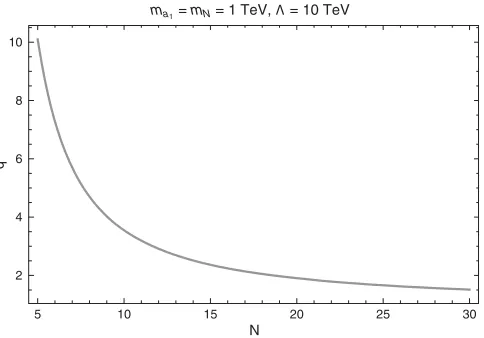
In Fig. 1 we show values of q versus N for the case
ma1 ¼mN¼1 TeV andΛ¼10TeV. In this case maˆ1¼
1.4TeV. We find that q¼3.62 for a clockwork sector with 10 massive scalars, and q¼1.90 for a clockwork sector with 20 massive scalars.6[The corresponding values of mð¼ma1=ðq−1ÞÞ are 0.38 and 1.1 TeV, respectively.] These values ofqappear to be quite reasonable and show that the clockwork mechanism can naturally generate the necessary light dark matter particle mass and very small coupling required by the freeze-in mechanism.
An interesting feature of clockwork Higgs portal freeze-in is that a unique value of maˆ0 and λ3is predicted for a
given Λ,ma1, andmN, which is independent ofqandN.
This is because in this casemaˆ0andλ3are both determined
by the value ofON0. Once ON0 is fixed by the relic dark matter density, the values of maˆ0 and λ3 are also fixed, independently of q and N. This is quite different from a general freeze-in model, where larger values of the dark matter particle mass can be accommodated by simply reducing the Higgs portal coupling and so the number density of produced dark matter particles. Using Eqs.(30), (21), and(24), the values ofON0,maˆ0, andλ3necessary to
account for dark matter are
ON0≈9.8×10⁻⁷ γ40=3
Λ 10TeV
4=3
1TeV
mN
5=3 m
a1
1TeV
;
ð36Þ
maˆ0≈0.98MeV γ50=6
Λ 10TeV
4=3
1 TeV
mN
2=3 m
a1
1TeV
;
ð37Þ and
λ3≈9
.8×10−9 γ10=3 v
10TeV Λ
2=3 m
N
1 TeV
1=3 m
a1 1TeV
:
ð38Þ Thus the model predicts FIMP dark matter with a mass which is typically close to 1 MeV.
Our calculation assumes that the range of heavy scalar masses is not large, so that treating them as degenerate is a reasonable approximation for determining the aˆ0 density due to the decay of the heavy clockwork scalars. (In general, the freeze-in density is the sum of the contributions of the decay of each heavy scalar mass eigenstateaˆkand so is effectively a sum of independent freeze-in processes.) The range of mass over which the N heavy scalars are spread corresponds to Δm¼maN−ma1≈2ma1=ðq−1Þ.
For N¼10, q¼3.62, and ma1 ¼mN ¼1TeV, we find
thatΔm¼0.76TeV. Therefore,Δm=mak <1in this case and we expect the degenerate mass approximation to be accurate up toOð1Þcorrection factors in theaˆ0mass and portal coupling. This can be seen from Eqs.(37)and(38), which show that maˆ0 and λ3 are both linear in ma1.
Therefore, if we replacema1 byma1þΔm≡maN, we will obtain upper limits on maˆ0 and λ3, with the true values expected to lie between those withmak ¼ma1 andmak ¼ maNfor all values ofk. Similarly, forN ¼20andq¼1.90, we obtainΔm¼2.21TeV. Therefore,Δm=mak∼1and so we would again expect the degenerate mass approximation to give a reasonable estimate of the aˆ0 mass and portal
5 10 15 20 25 30
2 4 6 8 10
N
q
[image:6.612.319.561.46.215.2]ma1=mN= 1 TeV, = 10 TeV
FIG. 1. Values ofqversusNfor the casema1¼mN¼1TeV andΛ¼10 TeV. The solid line represents the values ofqandN satisfying Eq.(33).
coupling. The degenerate mass approximation has the great advantage of producing analytical results. To achieve greater accuracy, we would need to perform a full numeri-cal diagonalization of the mass matrix for each set of model parameters.
In general, in models where the clockwork sector arises as the effective theory of an UV completion, nonrenorma-lizable interactions would also be expected. Of these, the most important for the freeze-in model are higher-order derivative interactions of the generic form
1 Λ4
UV
∂μπi∂μπj∂νπk∂νπl; ð39Þ
whereΛUVis the scale of the UV completion (withΛUV∼f for the symmetry-breaking model). These result in inter-actions betweena0andakwhich have no large suppression fromON0factors. For example,
1 Λ4
UV
ð∂μπ1∂μπ1Þ2→Λ14
UV
O10O3
1jð∂μa0∂μajÞð∂νaj∂νajÞ;
ð40Þ where the productO10O31jgives the smallest suppression of this class of operator whenj¼N=2. Since theaˆ0ð≈a0Þmust be out of thermal equilibrium for freeze-in to work, it follows that higher-order derivative interactions must be sufficiently suppressed in order for a clockwork sector to explain freeze-in dark matter. The mfreeze-inimum condition foraˆ0to be out of equilibrium is thatΓ≲H at the reheating temperatureTR, where Γ is the scattering rate of aˆ0 from thermal bath particles. This also assumes thatTR is the highest temper-ature of the thermal bath, which is true if reheating is instantaneous. For interaction (40), we can dimensionally estimate the scattering rate to be Γ∼ðO10O31jÞ2T9=Λ8UV, where we are assuming ΛUV> T. Therefore, with
H∼T2=M
P, and including a factorkn to take into account the contribution of other scattering processes when comput-ing the total thermalization rate, Γtotal¼knΓ (where we expect thatkn≲100), the condition to evade thermalization becomes
TR≲ Λ
8=7
UV
k1n=7ðO10O13jÞ2=7M1P=7
≈1TeV ×
100
kn
1=7
×
0.3 ðO10O3
1jÞ2=7
ΛUV
50TeV 8=7
: ð41Þ
ForNandqlarge compared to 1 we find thatO10≈1=qand
O1j≈
ffiffiffiffiffiffiffiffiffi
2=N
p
forj¼N=2. ForN¼10andq¼4these give ðO10O3
15Þ2=7≈0.3. The reheating temperature must be larger
than the OðTeVÞ scale of the clockwork sector, since the heavy clockwork scalars are assumed to be close to relativistic during freeze-in. Therefore, it follows that ΛUV≳50TeV
is necessary to allow a window withTR≳1TeV. The lower end of this range, which is possible if TR∼1TeV and if reheating is instantaneous, is consistent with ΛUV being similar tof∼Λ∼10TeV in the symmetry-breaking model. However, ifTR≫1 TeV, or if reheating is not instantaneous, then higher-order derivative interactions must be highly suppressed in order for a clockwork sector to explain freeze-in dark matter. This is a strong constraint on the UV origin of the clockwork sector in freeze-in models and suggests that the TeV-scale clockwork sector is effectively renormalizable.
V. CONCLUSIONS
We have introduced a TeV-scale clockwork Higgs portal model for scalar dark matter from freeze-in. We have found that freeze-in occurs via the decay of the heavy scalars of the clockwork sector to the Higgs boson and the dark matter scalar, which is the lightest scalar of the clockwork sector. The necessary small portal coupling and dark matter scalar mass can be generated for reasonable values of the global clockwork charge, q, and the number of heavy scalars of the clockwork sector,N. An interesting feature of the model is that the mass of the dark matter scalar and the strength of the portal coupling are independent ofqandN for a given set of model parameters. For a typical TeV-scale clockwork sector, we find that the dark matter scalar has a mass of around 1 MeV.
The clockwork model allows us to understand the very small Higgs portal coupling required for freeze-in purely in terms of the structure of the theory, without the need for any large mass scales. In general, there is no simple symmetry which can eliminate or suppress a coupling between the Higgs boson and a scalarϕ of the form jHj2ϕ2, and one would dimensionally expect the coupling to be on the order of 1. Therefore, if we wish to avoid simply introducing a very small coupling, a structural explanation such as the clockwork model may be necessary. The model has the added advantage of explaining why the dark matter scalar mass is much less than the scale of electroweak symmetry breaking.
We note that the clockwork Higgs portal model we have introduced may also be used to generate metastable scalar clockwork weakly interacting massive particle (WIMP) dark matter, along the lines of the fermionic clockwork WIMP dark matter model of[7]. This is possible if the dark matter WIMP is aˆ1, which has an unsuppressed Higgs portal interaction and so a conventional WIMP-like freeze-out density, and if its decay toaˆ0þhis made extremely slow, by choosing sufficiently large values forqand/orN. For freeze-in to be possible, higher-order derivative interactions between the clockwork scalars must in most cases be highly suppressed in order to prevent thermal-ization of the dark matter scalars. (An exception to this is the case where the reheating temperature is very low,
strong constraint on the UV origin of the clockwork sector. It suggests that the clockwork sector in freeze-in models should be renormalizable below a high UV completion scale. For example, the clockwork sector and the renor-malizable Standard Model sector could both originate from a single UV completion at a high energy scale. A renormalizable clockwork sector would also serve as a minimal implementation of the clockwork mechanism.
Finally, we comment on the possibility of experimentally testing this class of model at colliders. The phenomenology of the heavy clockwork scalars will have features in common with the phenomenology of gauge singlet scalars with a Z2 symmetry, which also couple to the SM via the Higgs portal. These are difficult to detect when they can be produced only via off-shell Higgs boson decay. It may be possible to detect their existence at the high-luminosity 14 TeV LHC via their one-loop contribution to the process
pp→h→ZZ if the scalar mass is less than around 200 GeV [20]; we anticipate that a similar contribution could arise from heavy clockwork scalars if their mass
were not too large compared to the Higgs mass. At future
eþe− colliders producing large numbers of Higgs bosons,
for example CLIC at 3 TeV, it may be possible to directly produce heavy clockwork scalar pairs via off-shell Higgs decay. The heavy clockwork scalars have a distinctive decay process, where they decay to a lighter clockwork scalar plus either a Higgs boson or, if the mass splitting between the heavy clockwork scalars is less than the Higgs boson mass, a quark or lepton pair via Higgs exchange, with subsequent decay of the lighter clockwork scalars via the same process, ending with missing energy in the form of long-lived next-to-lightest clockwork scalars. This may allow their production to be detected, even if it is at a low rate.
ACKNOWLEDGMENTS
The work of J. M. was partially supported by STFC via the Lancaster-Manchester-Sheffield Consortium for Fundamental Physics.
[1] K. Choi and S. H. Im, Realizing the relaxion from multiple axions and its UV completion with high scale supersym-metry,J. High Energy Phys. 01 (2016) 149.
[2] D. E. Kaplan and R. Rattazzi, Large field excursions and approximate discrete symmetries from a clockwork axion, Phys. Rev. D93, 085007 (2016).
[3] G. F. Giudice and M. McCullough, A clockwork theory, J. High Energy Phys. 02 (2017) 036.
[4] M. Shaposhnikov, Is there a new physics between electro-weak and Planck scales?,arXiv:0708.3550;A. Salvio and A. Strumia, Agravity up to infinite energy,Eur. Phys. J. C
78, 124 (2018).
[5] I. Ben-Dayan, Generalized clockwork theory, arXiv:1706 .05308.
[6] H. M. Lee, Gauged Uð1Þ clockwork theory,Phys. Lett. B
778, 79 (2018).
[7] T. Hambye, D. Teresi, and M. H. G. Tytgat, A clockwork WIMP,J. High Energy Phys. 07 (2017) 047.
[8] S. C. Park and C. S. Shin, Clockwork seesaw mechanisms, Phys. Lett. B776, 222 (2018).
[9] D. K. Hong, D. H. Kim, and C. S. Shin, Clockwork graviton contributions to muon g−2, Phys. Rev. D 97, 035014 (2018).
[10] R. Coy, M. Frigerio, and M. Ibe, Dynamical clockwork axions,J. High Energy Phys. 10 (2017) 002;M. Farina, D. Pappadopulo, F. Rompineve, and A. Tesi, The photo-philic QCD axion,J. High Energy Phys. 01 (2017) 095.
[11] A. Ahmed and B. M. Dillon, Clockwork Goldstone bosons, Phys. Rev. D96, 115031 (2017).
[12] P. Saraswat, Weak gravity conjecture and effective field theory,Phys. Rev. D95, 025013 (2017).
[13] A. Kehagias and A. Riotto, Clockwork inflation,Phys. Lett. B 767, 73 (2017); S. H. Im, H. P. Nilles, and A. Trautner, Exploring extra dimensions through inflationary tensor modes, J. High Energy Phys. 03 (2018) 004.
[14] N. Craig, I. G. Garcia, and D. Sutherland, Disassembling the clockwork mechanism,J. High Energy Phys. 10 (2017) 018. [15] G. F. Giudice and M. McCullough, Comment on “ Disas-sembling the clockwork mechanism”,arXiv:1705.10162. [16] J. McDonald, Thermally Generated Gauge Singlet Scalars
as Self-Interacting Dark Matter,Phys. Rev. Lett.88, 091304 (2002).
[17] L. J. Hall, K. Jedamzik, J. March-Russell, and S. M. West, Freeze-in production of FIMP dark matter,J. High Energy Phys. 03 (2010) 080.
[18] N. Bernal, M. Heikinheimo, T. Tenkanen, K. Tuominen, and V. Vaskonen, The dawn of FIMP dark matter: A review of models and constraints,Int. J. Mod. Phys. A32, 1730023 (2017).
[19] P. Ko and Y. Tang, Residual non-Abelian dark matter and dark radiation,Phys. Lett. B768, 12 (2017).