Improving The Nexus Between Research
And Teaching In Undergraduate
IS Education
Faouzi Kamoun, University of Dubai, UAE Hussein Fakhry, University of Dubai, UAEABSTRACT
This study outlines a framework to assess the merits of integrating IS research into undergraduate teaching. Though the general merits of such integration have been explored, with limited empirical evidences in many previous (non-IS related) studies, this integration is particularly much needed in the IS field. This urgency is justified by many factors, such as the rapid pace in the rollout of IS tools, technologies and terminologies and the shallow focus on research in most IS curricula. Our study adds to existing literature in at least two aspects. First, to our best knowledge, this is the first reported study that reflects upon the integration of research into teaching within the IS context. Second, our research is a first initiative that contributes to establishing a formal framework for the planning and the assessment of such integration. Such an assessment framework will be very useful for continuous improvement to ensure that the integration achieves the learning outcomes it was designed for. Based on the proposed assessment framework and research methodology, this research proposes multiple sources of evidence to assess the merits of incorporating IS research into undergraduate teaching. The paper also shares the experience of a three-semester case study that aimed to diffuse research into teaching in an undergraduate computing and information systems course. Our research underlines the need for formal frameworks to assess the learning outcomes of undergraduate research dissemination into the curriculum. Objectives, performance criteria and measurement indicators should be clearly defined. Careful planning, judicious implementation, based on best practices and thorough assessment, are some basic ingredients for successful integration of research into the classroom. These requirements need to be integrated in the overall assessment strategy of the program curriculum. The assessment tools and research methods presented in this study can be very useful in assisting other IS departments establish a permeable boundary between undergraduate teaching and research.
Keywords: IS Education; Is Research; Is Teaching; Research Integration
INTRODUCTION
espite the lack of sound empirical evidences, engaging undergraduate students in various research experiences has recently been reported among the list of best pedagogical practices in contemporary education. However, traditionally, undergraduate teaching and research have evolved as two distinct activities. Recently, it has been established that there is a strong linkage between the two. In fact, one of the objectives of undergraduate teaching is to develop students‟ reasoning and critical thinking skills to solve real-world problems, which is also a key objective in research. Depending on the learner‟s prior state of knowledge, learning can be classified as inquiry-based learning (only unknown to learner) and research-based learning (often unknown to all). Research-based learning uses a variety of learning and teaching strategies to enable students construct knowledge by searching, setting hypothesis, collecting and analyzing data. This form of learning strategy is often practiced at the post-graduate level. Inquiry learning is a form of active learning, where the focus is to assess how well students develop experimental and analytical skills rather than how much knowledge students have memorized. In this respect, students who are engaged in inquiry-based learning are learning as researchers.
Garrick and Rhodes (2000) emphasized the fact that the new „knowledge economy‟ requires that students graduate with an ability to analyze and contribute to research. Indeed, in a knowledge society, the way knowledge is searched and developed and then transmitted (taught and learned) is critical. Recent scholarship of teaching and learning suggests that the integration of research into the undergraduate curriculum is one of the most important learning-centered tools, which can transform students from knowledge absorbers to knowledge investigators and creators (Tagg, 2003). The term “research-led teaching” has been introduced lately to refer to initiatives that aim to bring the research and teaching functions of the university closer together (Brew , 2006).
The term "undergraduate research" often means different things to different people. For the purpose of this study, we adopt Boyer's (1997) broader definition of undergraduate research which encompasses four key elements; namely, 1) mentorship (strong collaborative interaction between the mentor (faculty) and the students), 2)
originality (example: in problem selection), 3) acceptability (based on well established theories, methodologies within the discipline), and 4) dissemination (tangible final product that can be peer-reviewed, evaluated, based on well established criteria) (Ishiyama, Miller and Nagan, 2006).
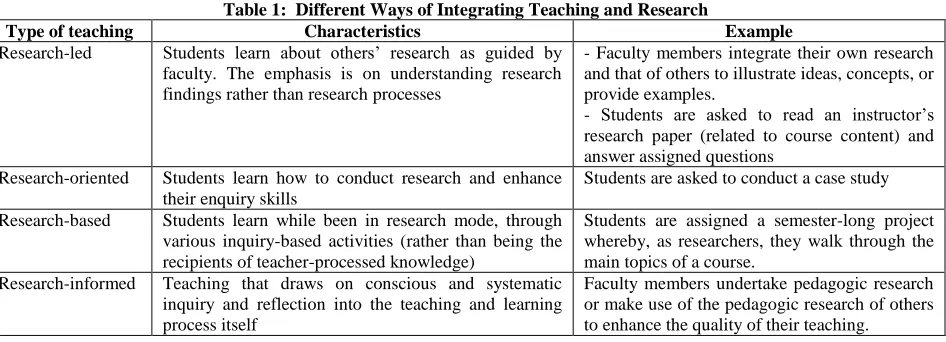
Undergraduate research has been a common practice in many IS schools in the form of senior capstone projects. At the same time, most undergraduate research programs in the fields of Engineering and Sciences are laboratory-driven, whereby undergraduate students are assigned the task of performing lab experiments under the supervision of research assistants. In humanities and arts, undergraduate research often takes the form of students' driven project ideas that seek support from interested faculty members (Stocks, 2008). For Information Systems, however, with the exception of capstone experiences, no successful model for the integration of research into the curriculum has been proposed. In fact, most computing and IS courses are designed to teach established principles, skills and techniques that are often disassociated from the underlying IS research. Recently, however, broader views towards integrating undergraduate research into the curriculum have emerged. According to Griffiths (2004), the integration of research into the classroom can take many other (not necessarily exclusive) forms as shown in Table 1.
Table 1: Different Ways of Integrating Teaching and Research
Type of teaching Characteristics Example
Research-led Students learn about others‟ research as guided by faculty. The emphasis is on understanding research findings rather than research processes
- Faculty members integrate their own research and that of others to illustrate ideas, concepts, or provide examples.
- Students are asked to read an instructor‟s research paper (related to course content) and answer assigned questions
Research-oriented Students learn how to conduct research and enhance their enquiry skills
Students are asked to conduct a case study
Research-based Students learn while been in research mode, through various inquiry-based activities (rather than being the recipients of teacher-processed knowledge)
Students are assigned a semester-long project whereby, as researchers, they walk through the main topics of a course.
Research-informed Teaching that draws on conscious and systematic inquiry and reflection into the teaching and learning process itself
Faculty members undertake pedagogic research or make use of the pedagogic research of others to enhance the quality of their teaching.
Though the general merits of undergraduate research on students‟ development have been explored with limited empirical evidences in some previous (non IS-related) studies, the engagement of students in undergraduate research is much needed in the IS field. Maglitta (1996) reported that IS programs are struggling to keep up-to-date with the latest technologies, trends, practices, and issues in the discipline. The integration of research into the classroom can be seen as one tool to bring about the needed changes in IS education. This is particularly important, given the dramatic changing nature and the unique characteristics of the discipline and its research methodology approaches. It is well known, for instance, that Information Systems are designed and implemented in order to enhance the effectiveness and the efficiency of an organization. However, this objective cannot be achieved without knowledge about the management of technology and its usage for managerial and organizational purposes (Zmud, 1997, cited in Hevner et.al, 2004). The acquisition of this knowledge requires knowledge about behavioral science and design science (March and Smith 1995). Both of these sciences are research-based by nature. In fact, behavioral-science aims to develop and justify theories that explain or predict organizational and human phenomena surrounding the analysis, design, implementation, management, and use of information systems. On the other hand, design-science is mainly a problem-solving approach that seeks to create innovations that define the ideas, practices, technical capabilities, and products through which the analysis, design, implementation, and use of information systems can be effectively and efficiently accomplished (Tsichritzis 1997; Denning 1997, cited in Hevner et.al, 2004). Engaging undergraduate students to think and reflect within the context of these two research tracks can equip them with deeper and more practical understanding of the nature of their discipline.
Among the many IS Methodologies (see for example Palvia et al. (2003)), students at the undergraduate level are most likely to engage in library research, literature analysis, case studies, interviews, secondary data collection and analysis, as opposed to generating speculations/commentaries or coming-up with frameworks and conceptual models. Undergraduate research initiatives can also provides students with an opportunity to get acquainted with some theories which are widely used in information systems (IS) research. These include for instance, the absorptive capacity theory, contingency theory, diffusion of innovations theory, social network theory, and technology acceptance model, among many others. Often, these theories are rarely covered in undergraduate IS curricula.
This paper is organized as follows: In section 2 we conduct a literature review on our research topic and highlight the main contribution of this study. In section 3, we outline the proposed assessment framework. A case study to illustrate the proposed approach is then presented in section 4. Finally, in section 5, we provide a summary of the key findings of this paper, as well as some suggestions for further research.
LITERATURE REVIEW AND RESEARCH CONTRIBUTION
The perceived merits of undergraduate research have received considerable attention and coverage in the literature. Gregerman (1999) and Nagda, et.al (1998) reported that involving undergraduate students in research was found to contribute towards increasing students‟ retention, and increasing their motivation to pursue graduate studies. Seymour, et.al (2004) noted that many undergraduate students who had some research exposure were reported to have acquired a more positive attitude about their discipline. These students have also demonstrated more confidence in articulating, presenting and defending their work. Boenninger and Hakim (1999) and Ishiyama (2002) reported that students who participated in collaborative undergraduate research with faculty early on reported significant gains in the ability to (1) think analytically and logically; (2) put ideas together; (3) apply scientific principles and reasoning to real-world problems, and (4) learn on their own. Other research (see for example Alexander, et. al, 2000 and CASPiE, 2004) showcased how active students‟ engagement in undergraduate research can foster critical thinking and problem solving skills, permitting students to better comprehend how knowledge is created and applied and how research problems are formulated. Students also gain invaluable experience in coping with open-ended research problems, ambiguity, and uncertainty, which often characterize the research process.
interact with faculty members outside the classroom, which was found to enhance their self-confidence, academic achievement, and retention (Ishiyama, 2002; Astin, 1993; Pascarella and Terenzini, 1991; Koch and Johnson, 2000). This opportunity also exposes students to the unknown world of academia and graduate studies.
Undergraduate research has been looked upon in some other studies (ex. Wieman, 2004) as a potential tool to expose students to some strategies used by experts, though it is not expected to transform students from novices to experts. Such exposure is particularly important given the unique attributes of experts, such as their substantial degree of knowledge that is coherently organized in a way that reflects a deep understanding of their subject matter. Experts can also see patterns in information not evident to novices and filter relevant information from irrelevant information (Bransford, et.al, 1999). Experts also differ from novices in their ability to self-regulate their time and efforts, focusing on goal setting, time management, self-evaluation and self-motivation (Cleary and Zimmerman, 2000). Other cited (not necessarily proven) benefits of integrating undergraduate research into the curriculum include increased awareness about potential career paths in the discipline, opportunities for professional socialization and networking, intellectual engagement that teaches risk taking, and greater readiness for more demanding research (Ishiyama et.al, 2006).
Yousif (2004) identified an undergraduate research project as a process that can be planned, monitored, measured, corrected and improved. Accordingly, he proposed a process to guide students produce good quality research projects. Prince and Felder (2006, 2007) highlighted the effectiveness of inductive teaching methods, including inquiry and problem-based learning, project-based learning, case-based teaching, discovery learning, and just-in-time teaching. They also demonstrated the superiority of inductive teaching methods over traditional deductive methods for achieving a broad range of learning outcomes.
Stephenson et al (2007) demonstrated how the practice of exposing students to interdisciplinary research experiences in 3D computer graphics is been used to increase students‟ retention rate in a Computer Science program. Similarly, Knox, et.al (2006) demonstrated a successful model for undergraduate summer research where faculty and students investigated and applied information security topics to individual research projects. The experience has been reported as successful in terms of fostering faculty and student collaboration, as well as in stimulating students‟ interest in the field and in future graduate studies.
However, as Spilich (1997, p.57) notes, despite the widely accepted proposition that undergraduate research has substantial benefits for students, the "belief that research experience enhances the education of undergraduates .... is based mostly on anecdotal evidence." In fact, Spilich argues, there is very little empirical evidence that undergraduate research leads to a tangible payoff in terms of the intellectual growth of students (Spilish, 1997, in Ishiyama 2002). In fact, despite the existence of some evidences that indicate that undergraduate research is positively related to student performance, very little empirical work has been done to demonstrate the linkage between undergraduate research and student academic development. Among these few attempts, Ishiyama (2002) tested the hypothesis that early participation in undergraduate research with a faculty member enhances the development of students in a social sciences and humanity program. A survey was conducted to test this hypothesis. To our best knowledge, no prior work has focused on Information Systems students.
This research adds to existing literature in at least two aspects. First, and to the best of our knowledge, all previous exploratory studies related to undergraduate research were within the context of business, social sciences and humanities education. As a result, our research is unique in the sense that it is the first initiative that reflects upon the integration of undergraduate research into IS education. This is particularly important given the unique nature of the IS field. Second, what we felt was missing from previous studies was the establishment of a formal framework to assess the learning outcomes of such integration. Thus, it is one of the key objectives of this study to sketch a framework for the assessment process. Such a framework can provide practical guidance for other IS educators to assess and continuously improve the learning outcomes of undergraduate research.
ASSESSMENT FRAMEWORK
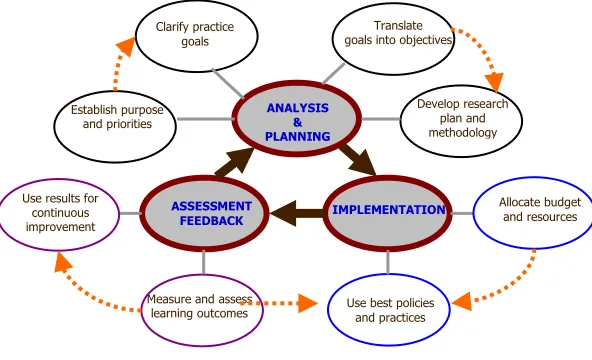
members‟ own research experience to provide illustrative examples to students, (2) assigning students inquiry-based and reflective assignments, based on faculty member research publications, (3) using faculty research to expose students to some latest trends related to the course topic, (4) requesting students to conduct a literature review to explore an emerging trend in IS, (5) using some students as research assistants and involving them in some faculty research projects and (6) engaging students in the capstone course to conduct industry-sponsored team projects and showcase how IS can be used to explore opportunities or solve a real problem for the sponsored organization. However, it was clear from our earlier experimentation with undergraduate research that the assessment of the learning outcomes of this practice was not a simple task. Without any prior framework, we realized that we cannot easily find qualitative or quantitative indicators that would tell us whether any type of learning is taking place. As a result, a framework for the planning and assessment process was deemed necessary. For this purpose we have adopted a design-oriented approach to assessment planning and have established an assessment framework based on the combination of our own experience with IS program development and assessment in general and some commonly established self-evident knowledge. In particular, we were inspired by our own model for curriculum assessment planning which aims to assess the learning outcomes at the program level. We have also used this model to assess other complementary value-added activities to teaching, such as inviting guest speakers. The proposed assessment framework can be conceptualized in terms of three interdependent and interlocking elements (shaded phases in figure 1 below). These core phases are analysis & planning, implementation and assessment feedback.
We first outline the general framework, based on the above three broad headings. As shown in figure 1, the undergraduate research assessment process begins with analysis and planning. The purpose and priorities of this practice are articulated, its goals are identified and these are fleshed out into more meaningful objectives; appropriate research and assessment methods, as well as assessment measures are also selected. Next, the implementation phase translates the chosen methodology into action through the allocation of budget and resource and the usage of best policies and practices. Finally, the assessment feedback phase closes the loop by assessing the learning outcomes and feeding the results into the next round of assessment formulation. The feedback loop, illustrated in Figure 1, shows that the assessment process is ongoing and cyclical. In the remainder of this section we elaborate in more details on each of the eight items which are associated with the core phases of the assessment process.
Figure 1: A framework for the assessment process of undergraduate research
Analysis and Planning Phase
The first step in the analysis and planning phase is to establish the purpose and priorities for the integration of research and teaching. Since this practice consumes valuable time and requires some resources to be allocated, it is imperative that the department conveys a clear message on why it is important to engage undergraduate students
ANALYSIS & PLANNING
ASSESSMENT
FEEDBACK IMPLEMENTATION
Establish purpose and priorities
Translate goals into objectives Clarify practice
goals
Measure and assess
learning outcomes Use best policies and practices
Allocate budget and resources Develop research
plan and methodology
in research activities. Faculty must have reasons to believe that the benefits of such engagement surpass the costs. They must be convinced that the efforts and time they spend to infuse research-type activities into the classroom are well spent. Meetings to convey the objectives of undergraduate research should be conducted. These gatherings can take the form of informal seminars, departmental meetings or one-to-one faculty encounters. Further, incentives or reward mechanisms for faculty involvement in undergraduate research should be established to promote faculty involvement.
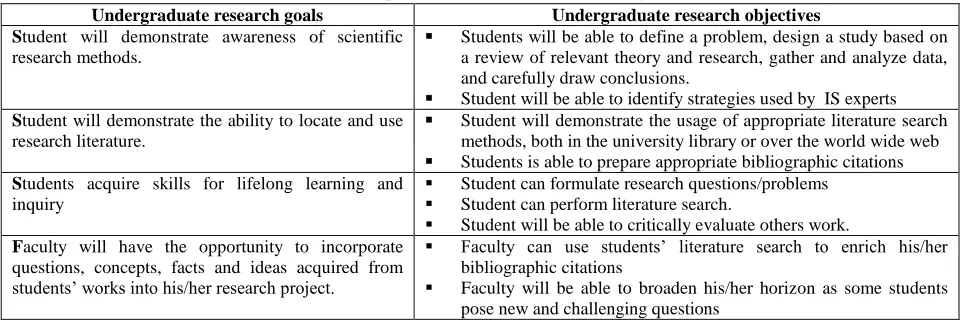
The second and third steps in the analysis and planning phase consist of clarifying the goals behind undergraduate research and then translating these goals into more tangible objectives. These are important steps to enhance the positive impact of undergraduate research on students‟ learning. In fact, clearly articulated goals and objectives build common understanding and agreement about what undergraduate research aims to accomplish and provide directions to assess the corresponding learning outcomes. We have consulted the pertinent literature outlined in the previous section to develop meaningful and measurable outcomes and benefited from the findings of many case studies where similar types of undergraduate research initiatives have been reported. Based on the above, we have identified four main goals and nine main objectives for undergraduate research as shown in Table 2.
Table 2: Undergraduate Research Goals and Objectives
The fourth step in the analysis and planning phase is to develop a research plan and methodology. For this purpose, concurrent as well as retrospective inquiry methods have been used to assess the merits of undergraduate research. These are further discussed below.
Implementation Phase
The first step in the implementation phase is to allocate budget and resources to support the integration of undergraduate research into the classroom. The cost includes opportunity cost for faculty and others involved, data handling/storage/analysis cost, library resources‟ cost, incentive cost for faculty and (may be) students. All these cost items need to be factored into the budget. The second step consists of making use of best policies and practices. Our literature research, as reported in the previous section, combined with lessons learned from our own experience with undergraduate research, have guided us in compiling a list of best policies and practices. Discussion of these best practices is however beyond the scope of this paper.
Assessment Feedback Phase
Assessment feedback begins with measuring and assessing the outcomes of undergraduate research experiences. For the purpose of assessment, it is necessary to collect, analyze and summarize the gathered data. The following assessment methods can be used to gauge students‟ learning from the undergraduate research:
Undergraduate research goals Undergraduate research objectives
Student will demonstrate awareness of scientific research methods.
Students will be able to define a problem, design a study based on a review of relevant theory and research, gather and analyze data, and carefully draw conclusions.
Student will be able to identify strategies used by IS experts
Student will demonstrate the ability to locate and use research literature.
Student will demonstrate the usage of appropriate literature search methods, both in the university library or over the world wide web
Students is able to prepare appropriate bibliographic citations
Students acquire skills for lifelong learning and inquiry
Student can formulate research questions/problems
Student can perform literature search.
Student will be able to critically evaluate others work.
Faculty will have the opportunity to incorporate questions, concepts, facts and ideas acquired from students‟ works into his/her research project.
Faculty can use students‟ literature search to enrich his/her bibliographic citations
Students‟ performance on projects, assignments and/or final exam questions.
Students‟ self-report questionnaires. These include open-ended questions, as well as students‟ ratings of agreement with statements of values and attitudes.
Instructor-led open discussions with students
Students‟ debriefing summaries on learning outcomes.
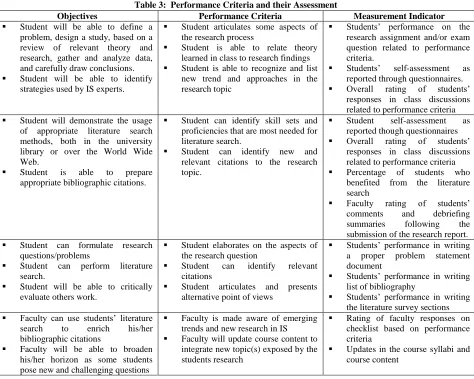
In addition to outlining the general assessment methods, it is also important to develop and validate performance-based measures and indicators for each of the learning outcomes outlined in Table 2. For this purpose, brainstorming sessions have been used to gather the performance criteria upon which learning objectives will be assessed. The results are shown in Table 3.
Table 3: Performance Criteria and their Assessment
The second step in the assessment phase is to report, disseminate and make best use of the assessment feedback results to continuously improve the diffusion of undergraduate research into the classroom. It is important at this stage to carefully interpret the assessment data and use the findings to come-up with concrete recommendations and action plan to close the gap between expected and actual learning outcomes.
Objectives Performance Criteria Measurement Indicator
Student will be able to define a problem, design a study, based on a review of relevant theory and research, gather and analyze data, and carefully draw conclusions.
Student will be able to identify strategies used by IS experts.
Student articulates some aspects of the research process
Student is able to relate theory learned in class to research findings
Student is able to recognize and list new trend and approaches in the research topic
Students‟ performance on the research assignment and/or exam question related to performance criteria.
Students‟ self-assessment as reported through questionnaires.
Overall rating of students‟ responses in class discussions related to performance criteria
Student will demonstrate the usage of appropriate literature search methods, both in the university library or over the World Wide Web.
Student is able to prepare appropriate bibliographic citations.
Student can identify skill sets and proficiencies that are most needed for literature search.
Student can identify new and relevant citations to the research topic.
Student self-assessment as reported though questionnaires
Overall rating of students‟ responses in class discussions related to performance criteria
Percentage of students who benefited from the literature search
Faculty rating of students‟ comments and debriefing summaries following the submission of the research report.
Student can formulate research questions/problems
Student can perform literature search.
Student will be able to critically evaluate others work.
Student elaborates on the aspects of the research question
Student can identify relevant citations
Student articulates and presents alternative point of views
Students‟ performance in writing a proper problem statement document
Students‟ performance in writing list of bibliography
Students‟ performance in writing the literature survey sections
Faculty can use students‟ literature search to enrich his/her bibliographic citations
Faculty will be able to broaden his/her horizon as some students pose new and challenging questions
Faculty is made aware of emerging trends and new research in IS
Faculty will update course content to integrate new topic(s) exposed by the students research
Rating of faculty responses on checklist based on performance criteria
CASE STUDY
This section outlines a case study that one of the authors has been conducting for the past four years. The
aim was to integrate the instructor‟s own research in a senior “Management of Corporate Networks” course. With
reference to table 1, this study is classified as a research-led initiative that took two forms: (1) Integration of faculty research into the course‟s content and (2) Team-based projects based on the faculty own research. The former integration approach was particularly needed given the lack of textbooks and online instructional resources that that cover up-to-date information and recent trends in network management. Through the integration of faculty research as complementary course material, we were able to expose students to such important topics as best network maintenance practices, IP address management, RFID systems management, managerial aspects of VoIP networks, design considerations in optical mesh networks, among many others.
In research-based team projects, students were assigned the task to read selected faculty research papers on network management and answer the assigned questions. Samples of these questions are included in Appendix 1. These questions were carefully designed to address the following objectives:
Ensure that students read the assigned papers thoroughly.
Expose students to tasks that stimulate high cognitive skills, such as analysis, evaluation, and synthesis. This is reflected for instance in the open-ended reflection questions highlighted in the Appendix.
Promote students‟ ability to work in teams, adapt and collaborate.
Develop students‟ information literacy skills and their ability to learn on their own.
During the first two semesters of the study, some plagiarism issues (in the form of “cut & paste” from internet resources) surfaced. These were mainly due to the fact that many students lacked proper referencing skills, while some students were not fully aware of what constitutes a plagiarism offence. These issues were substantially reduced in subsequent years through open discussions with students that aimed to increase students‟ awareness about plagiarism.
Instructor-led open discussions with students revealed that, overall, the assigned projects were very helpful in exposing students to recent trends in network management. Students also appreciated the opportunity to learn on their own and collaborate. They also believed that the exposure to the instructor‟s own search increased his credibility and motivated some of them to pursue graduate studies. Reflection-based questions were found to be the most challenging and time consuming tasks, and this observation was also reflected in the projects‟ assessment.
On the negative side, students complained that the assigned papers were not easy to read because of the presence of many unfamiliar English and technical terms. Others highlighted that they were not properly trained to perform appropriate literature search and prepare bibliographical citations. These observations were successfully integrated into the Computing and Information Systems program assessment and continuous improvement plan for further actions.
CONCLUSIONS
There are no doubts that in contemporary undergraduate IS education, teaching and research are becoming more intimately related than any time before. The general merits of disseminating research activities as a valuable means of students‟ learning have been demonstrated in various contexts. What was lacking, however, is a framework to assess the learning outcomes of infusing undergraduate research in IS curricula. This paper attempted to address this issue by proposing a formal framework that guides toward achieving this goal. Our research also highlighted the need for such an assessment framework. Objectives, performance criteria and measurement indicators should be clearly defined. Careful planning, judicious implementation, based on best practices and thorough assessment, are basic ingredients for a permeable research-teaching boundary. These requirements need to be integrated in the overall assessment strategy of the IS program curriculum.
questionnaires and assessment rubrics can further assist in fulfilling this task. Cross-national comparison studies can also be performed to further probe whether culture, language proficiency, and academic backgrounds have any significant impact on the permeability of the research-teaching boundary.
Finally, we expect that the proposed framework will guide toward meaningful and strategic integration of undergraduate research into IS curricula. Without a sound theoretical framework and assessment tools, one cannot ascertain the merits of providing undergraduate students with some research experience. We also invite others to experiment with and test the proposed framework. In fact, the tools and research methods proposed in this study can be very useful for IS educators planning to engage undergraduate students in inquiry-based learning activities.
AUTHOR INFORMATION
Faouzi Kamoun is the Dean of the College of Information Technology at the University of Dubai (UD). He received PhD in Electrical and Computer Engineering from Concordia University and MBA in Management from McGill University, in Canada. He was the recipient of UD‟s best faculty award in 2004, a 2008 IBM faculty award, and Nortel Networks CEO top talent award in 2000 and 2001. He is a member of the Editorial Board of the
International Arab Journal of e-Technology. His main research interests are in the areas of technology management and innovation, telecommunication systems, next generation networks and IS education.
Hussein Fakhry is the Assistant Dean of the College of Information Technology at the University of Dubai. He received PhD in Intelligent Control Systems and Robotics from the University of Waterloo, Canada. His research interests are in Information Systems Research using Systems Dynamics, Information Systems Security, E-Commerce and E-Business, Decision Support Systems, Applications of Artificial Intelligence, and Assessment of Academic Programs. His research appeared in international journals and conferences such as IETECH Journal of Information Systems, An International Journal of Information & Security, The Journal of Mathematical and Computer Modeling, and Proceedings of the IADIS International Conference on Information Systems.
REFERENCES
1. Alexander B, Foertsch J, Daffinrud S, and Tapia R, 2000. The “Spend a Summer with a Scientist" Program
at Rice University: A Study of Program Outcomes and Essential Elements, 1991-1997, Council on
Undergraduate Research Quarterly, 20, pp.127-133.
2. Astin, A. W, 1993. What Matters in College? Four Critical Years Revisited. San Francisco, CA:
Jossey-Bass Publishers.
3. Boenninger, MA. and Hakim, T, 1999. Undergraduate Research as a Curricular Element: Multidisciplinary
Courses at the College of New Jersey. Council on Undergraduate Research Quarterly, Vol. 20, pp. 8- 13.
4. Boyer, E.L, 1997. Scholarship Reconsidered: Priorities of the Professoriate, Jossey-Bass, New York.
5. Bransford, J., Brown, A., and Cocking, R, 1999. How People Learn: Brain, Mind, Experience, and School.
Committee on Developments in the Science of Learning, National Research Council, http://www.nap.edu/html/howpeople1
6. Brew, A, 2006. Research and Teaching: Beyond the Divide. London: Palgrave Macmillan.
7. CasPiE, 2004. Undergraduate Research-Based Laboratory Courses for 1stand 2nd-year Students, The Center
for Authentic Science Practice in Education,
http://www.reinventioncenter.miami.edu/conference2006/gabrielaweaver/presentation.pdf
8. Cleary, T. and Zimmerman, B.J, 2000. Self-regulation Differences During Athletic Practice by Experts,
Nonexperts, and Novices. Journal of Applied Sport Psychology, Vol. 13, pp. 61–82.
9. Denning, P.J, 1997. A New Social Contract for Research, Communications of the ACM Vol. 42, No.2,pp.
132-134
10. Garrick, J. and Rhodes, C. (eds.). 2000. Research and Knowledge at Work: Perspectives, Case Studies and
Innovative Strategies. London: Routledge.
11. Gregerman, S, 1999. Improving the Academic Success of Diverse Students through Undergraduate
Research, Council on Undergraduate Research Quarterly, No. 20, pp. 54-59.
12. Griffiths R, 2004. Knowledge Production and the Research –teaching Nexus: the Case of the Built
13. Hattie, J. and Marsh, H. W, 1996. The Relationship between Research and Teaching: a Meta-analysis,
Review of Educational Research, Vol. 66, No. 4, pp. 507–542.
14. Hevner, A.R, March, S.T, Park, J, and Ram, S. 2004. Design Science in Information Systems Research,
MIS Quarterly, Vol. 28, No. 1, pp. 75-105.
15. Ishiyama, J, 2002. Does Early Participation in Undergraduate Research Benefit Social Science and
Humanities Students?, College Student Journal, Vol. 36, No.3, pp. 380-386.
16. Ishiyama, J, Miller, J. and Nagan, M, 2006. Undergraduate Research and the Teacher-Scholar Model: A
Curriculum Position Paper, Truman State University: Summer 2006 Curriculum Position Papers, http://provost.truman.edu/curriculum_papers/paper_Miller_Nagan_Ishiyama.pdf.
17. Jenkins A, et.al, 2003. Re-shaping Teaching in Higher Education: Linking Teaching and Research,
London, Routledge, Falmer /SEDA
18. Jenkins, A. and Healey, M, 2005. Institutional Strategies to Link Teaching and Research. Higher Education
Academy.
19. Knox, D.L., DePasquale, P. J. and Pulimood, S. M, 2006. A Model for Summer Undergraduate Research
Experiences in Emerging Technologies, ACM SIGCSE, Vol. 38, No. 1, pp. 214-218.
20. Koch, C. and Johnson, W.B, 2000. Documenting the Benefits of Undergraduate Mentoring. Council on
Undergraduate Research Quarterly, Vol. 20, pp. 172- 175.
21. Maglitta, J, 1996. IT Schools Need Improvement. Computerworld, Vol.30, No.8, pp. 78-83.
22. March, S.T. and Smith, G, 1995. Design and Natural Science Research on Information Technology,
Decision Support Systems Vol. 15, No.4, pp. 251-266.
23. Nagda, B.A., Gregerman, .R, Lerner, J.S, Hippel, W.V, and Jonides, J, 1998. Undergraduate
Student-faculty Research Partnerships Affect Student Retention. Review of Higher Education, Vol. 22, No.1, pp. 55-72.
24. Palvia, P., E, Mao, E, Salam, A,F, and Soliman, K.S, 2003. Management Information Systems Research:
What's There in a Methodology? Communications of the Association for Information Systems (CAIS), Vol. 11, pp. 289-309.
25. Pascarella, E.T. and Terenzini P.T, 1991. How College Affects Students: Findings and Insights from Twenty
Years of Research. San Francisco, CA: Jossey-Bass Publishers.
26. Prince, M.J and Felder, R.M, 2006. Inductive Teaching and Learning Methods: Definitions, Comparisons,
and Research Bases. Journal of Engineering Education, Vol. 95, No. 2, pp. 123-138.
27. Prince, M.J and Felder, R.M, 2007. The Many Faces of Inductive Teaching and Learning, J. College
Science Teaching, Vol. 36, No.5, pp. 14-20.
28. Seymour, E., Hunter, A.B, Laursen, S,L, and DeAntoni, T, 2004. Establishing the Benefits of Research
Experiences for Undergraduates in the Sciences: First Findings from a Three-Year Study, Science Education, Vol. 88, pp. 493–534.
29. Spilich, G, 1997. Does Undergraduate Research Pay Off?, Council on Undergraduate Research Quarterly,
Vol. 18, pp 57-59 & 89-90
30. Stephenson, P, 2007. Using Undergraduate Interdisciplinary Research to Promote Computer Science,
Journal of Computing Sciences in Colleges, Vol. 22, No. 3, pp. 98 - 104
31. Stocks, J, 2008. Models of undergraduate research, A PKAL Essay,
http://www.pkal.org/documents/ModelsOfUndergraduateResearchStocks.cfm.
32. Tagg, J, 2003. The learning Paradigm College. Bolton, MA: Anker Publishing.
33. Tsichritzis, D, 1997. The Dynamics of Innovation, Beyond Calculation: The Next Fifty Years of
Computing, Copernicus, 1997, pp. 259-265
34. Wieman, C, 2004. Professors who are Scholars: Bringing the Act of Discovery to the Classroom, The
Reinvention Center's Conference on Integrating Research into Undergraduate Education: The Value Added, November 18-19, 2004, Washington, DC.
35. Yousif, M, 2004. A Systematic Framework for Conducting Research Projects in Undergraduate Courses.
Journal of Information Systems Education, Spring 2004.
APPENDIX 1
Samples of Assigned Project Questions
Set 1- Spring 2006: With reference to the following article: (F. Kamoun, “Toward Best Maintenance Practices in Communication Networks Management”, The International Journal of Network Management. 15(5), Sept/Oct 2005, pp 321-334.)
What are the main objectives of network maintenance?
Among the thirteen functional areas of network maintenance discussed in the paper, which one did you find most interesting? Why?
Why strong leadership and executive support is very important in network maintenance?
Why the author believes that it is essential to foster an organizational culture where maintenance personnel are encouraged to freely report maintenance-induced mistakes?
The author mentions the usage of GIS for better fault location and network maintenance. Search the internet to elaborate on this aspect.
Set 2- Fall 2007: With reference to the following article: (F. Kamoun and M. El-Torky, “Designing Large- Scale ASTN-Based Optical Mesh Networks”, The International Arab Journal of Information Technology, 2(2), July 2005, pp. 104-111)
Use the Internet or library resources to find information about the difference between in-band (associated) and out-of-band (non-associated) signaling. What is the main advantage of each type of signaling?
What is the main idea behind clustering?
What does the term “heuristic algorithm” mentioned in section 3.5 mean?
In section 3.3, are the authors in favor of centralized or distributed restoration? Justify.
Set 3- Spring 2009: With reference to the following article: (F. Kamoun, “IP Address Management: Challenges,
Solutions and Future Insights”, Handbook of Research on Telecommunications Planning and Management for Business, Chapter XXXIV, Volume II, pp. 526-541. 2009)
Why it is important for organizations to adopt good IP Address Management (IPAM) strategies?
What are the key network management challenges related to IPv6?
Illustrate with the aid of a diagram how DHCP servers are used in IPAM. What technical challenges may arise?
In the “future perspectives” section of the paper, the author discussed some future trends related to IPAM. Pick-up one and do some research on the topic. Summarize your own findings.
Set 4- Summer 2008: From the list of three publications, listed below, you are requested to select one article and write a 10-page report along the following guidelines:
A brief and condensed summary of the paper (1 page).
What did you learn most from the article? Which section did you find most interesting?
Can you relate some of the themes discussed in the paper to concepts discussed in class? If so, elaborate.
Choose a particular topic from the article and conduct a more thorough research to further explore it. Write 3-5 pages to summarize your findings.
1. F. Kamoun, “Toward Best Maintenance Practices in Communication Networks Management”, The International
Journal of Network Management, 15 (5), Sept/Oct 2005, pp 321-334.
2. F. Kamoun and M. El-Torky, “Designing Large- Scale ASTN-Based Optical Mesh Networks”, The International
Arab Journal of Information Technology, 2(2), July 2005, pp. 104-111.
3. F. Kamoun, “On the Value Proposition, Business Models, and Technical Considerations of VoIP Solutions for