729 | P a g e
EFFECT OF VISCOUS HEATING ON THE
BOUNDARY LAYER CHARACTERISTICS
Nikunj Sonaiya
Mechanical Engineering Department, Marwadi Education Foundation Group of Institution, (India)
ABSTRACT
Effect of viscous heating with wall heating is carried out to analyses the incompressible viscous flow of water over flat plate boundary layer. The SIMPLEC algorithm has been used for the solving the water flow on to the flat plate based on finite volume method discretization. The commercial CFD code FLUENT has been used for solving coupled equation by adopting a QUICK scheme. The governing equations along with appropriate boundary conditions are applied to flat plate boundary layer. Here i have considered Viscosity temperature relationship (Piecewise linear methods) used to approximate the deviation in viscosity for water above varied range of temperature. The main objective of this study is to explore the effect of the viscous heating on characteristics of Boundary layer flow with the help of ANSYS (FLUENT).I considered free stream temperature of 288 K (15 ) and Wall temperatures of 303K (30 ) with variable viscosity. As the temperature increases the viscosity of water reduces. The Results shows that the shear stress and viscous drag force reduce along the stream wise direction. Also it is found that boundary layer characteristics boundary layer thickness and momentum thickness decreases with viscous heating.
Keywords
:Effect of Viscous Heating, Flat Plate Boundary Layer, Incompressible Flow, Viscosity.
I INTRODUCTION
Here, I have considered wall heating to the flat plate to see the effect of viscous heating on boundary layer characteristics. For water fluid, it is shown that as a temperature increases, viscosity of air increases and viscosity of water decreases. [1]
Viscous heating represents the effect of an irreversible process by means of which the work done by a fluid on adjacent layers due to the action of shear forces is transformed into heat.
As we applied temperature change to water flow over a flat plate, it viscosity changes and it was observed that the tendency of water to eddy becomes greater as the temperature rises. [2]
730 | P a g e
The objective of the present work is to do analysis of flat plate boundary layer with the effect of viscous heating on boundary layer characteristic.
II GEOMETRY CREATION, GOVERNING EQUATIONS AND BOUNDARY CONDITION
(B.C)
We started with Geometrical meshing in Gambit and Grid independent solution for the flat plate.
2.1. Geometry Creation of Flat Plate (2D)
A Rectangular coordinate system used to model this flow over flat plate. We have created 2 D geometry in gambit with considering grid stretching near flat wall surface, so that finer grid at wall surface gives accurate result. For geometry create and grid stretching, we made following consideration.
Length=1.0m, Height=0.5m, Aspect Ratio=1/1000, Grid dimension=Structural Grid (498*300)
Fig.1 2D Geometry Meshing of Flat Plate.
2.2. Governing Equations
.I have considered two dimensional (2D) flow of Newtonian and incompressible water over flat plate with viscous heating. A piecewise linear Viscosity temperature relationship is used to approximate the deviation in viscosity for water above varied range of temperature.
The governing equations for mass, momentum and energy in fluid flow flat plate can be presented as follows.
2.2.1. Conservation of mass (Continuity Equation):
… (1)
731 | P a g e
2.2.2. Conservation of momentum (without viscous heating):
2.2.3. Conservation of momentum (with viscous heating):
Where ρ is the mass density, p is the fluid pressure and µ is the dynamic viscosity of the fluid. Is the Reynolds Number.
2.2.4. Conservation of Energy (without viscous heating):
2.2.5. Conservation of Energy (with viscous heating):
+ ]….. (7)
Where k is the thermal conductivity and is the specific heat.
2.3. Boundary Conditions
732 | P a g e
III RESULTS AND DISCUSSIONS
3.1. Grid Independent Study
Table 1.GI Study.
x=0.4, y=0.00252525
Grid U(x,y) Error V(x,y) Error
252*150 0.124686 0.000194519
352*212 0.125499 0.65% 0.000197478 1.52%
498*300 0.126011 0.41% 0.000199981 1.27%
x=0.6 , y=0.00252525
Grid U(x,y) Error V(x,y) Error
252*150 0.103578 0.000108726
352*212 0.104092 0.49% 0.000110099 1.25%
498*300 0.10437 0.40% 0.000111187 0.99%
x=0.8 , y=0.00252525
Grid U(x,y) Error V(x,y) Error
252*150 0.090388 7.14842*10-5
352*212 0.096896 0.33% 7.22373*10-5 1.05% 498*300 0.098483 0.17% 7.27981*10-5 0.78%
3.2. Velocity profile.
3.2.1. u velocity vs. y.
733 | P a g e
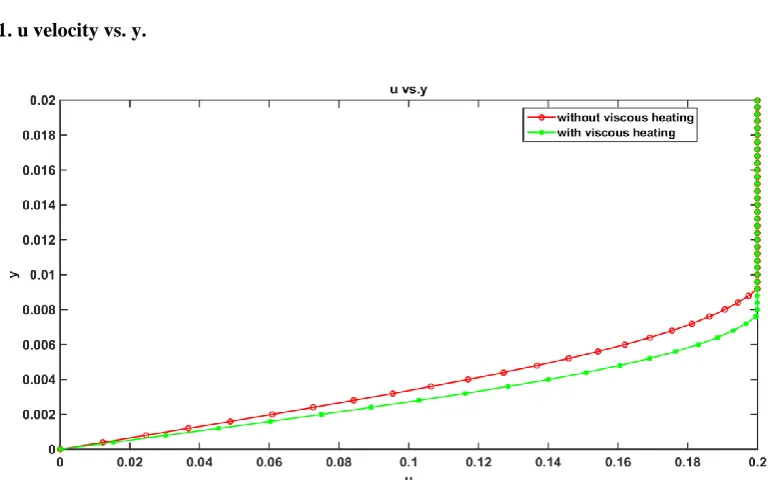
From above Fig.2 it is shows that velocity (u) is zero at wall condition(i.e. y=0) for both the case without viscous heating and with viscous heating and it is increases up to free stream velocity which is 0.2 m/s in wall normal distance ( i.e. y=9mm for without viscous heating and y=8mm for with viscous heating). After velocity variation is constant as move towards wall normal direction.
Result show that stream wise velocity is reduces in case of with viscous heating in wall normal direction with Reference to without viscous heating at particular stream wise location x=0.7m as shown in Fig.2.
3.2.2. du/dy vs. y.
Fig.3 Variation of stream wise velocity derivative (du/dy) in wall normal direction(y) at x=0.7m.
From above Fig.3 it is shows that velocity derivative (du/dy) is maximum at wall condition (i.e. y=0) for both the case without viscous heating and with viscous heating and it is decreases up to zero in wall normal distance (i.e. y=15mm for both the cases). After velocity derivation variation is constant as move towards wall normal direction. Result show that stream wise velocity derivative is reduces in case of with viscous heating in wall normal direction with reference to without viscous heating at particular stream wise location x=0.7m as shown in Fig.3.
3.2.3. d2u/dy2 vs. y.
734 | P a g e
From above Fig.4 it is shows that velocity double derivative (d2u/dy2) is tends to zero at wall condition (i.e.=0) and it is decreases (negative) for both the cases and back to zero for both the cases at wall normal distance y=15mm and After velocity double derivation variation is constant as move towards wall normal direction. Result show that stream wise velocity double derivative is reduces in case of with viscous heating in wall normal direction with reference to without viscous heating at particular stream wise location x=0.7m as shown in Fig.4.
3.2.4. x vs.
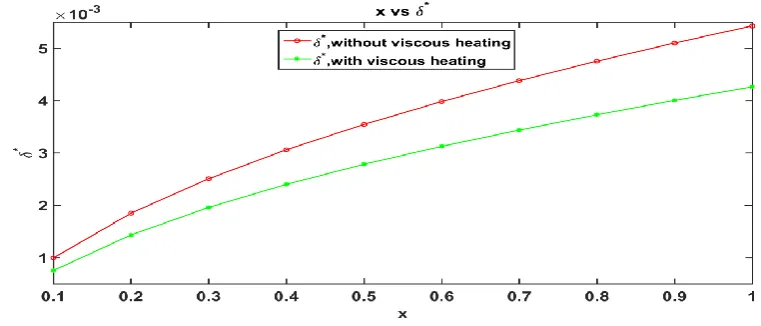
Fig.5 Variation of boundary layer thickness ( ) in stream wise direction (x).
From above Fig.5 it is shows that value of boundary layer thickness is minimum (i.e. 4mm and 3mm for without viscous heating and with viscous heating respectively) at x=0.1.it is increases as move toward stream wise direction and maximum (i.e.14mm and 11.5mm for without viscous heating and with viscous heating respectively) at x=1. Result show that boundary layer thickness is reduces in case of with viscous heating in stream wise direction with reference to without viscous heating as shown in Fig.5.
3.2.5. x vs.
735 | P a g e
From above Fig.6 it is shows that value of momentum thickness is minimum (i.e.1mm and 0.5mm for without viscous heating and with viscous heating respectively) at x=0.1.it is increases as move toward stream wise direction and maximum (i.e.5.8mm and 4mm for without viscous heating and with viscous heating respectively) at x=1. Result show that momentum thickness is reduces in case of with viscous heating in stream wise direction with reference to without viscous heating as shown in Fig.6.
3.3. Shear stress vs. y
Fig.7 variation of wall Shear stress in stream wise direction (x).
From above Fig.7 it is shows that value of wall shear stress is maximum (i.e. 0.11 N/mm2 and 0.09 N/mm2) for without viscous heating and with viscous heating respectively) at x=0.1.it is decreases as move toward stream wise direction and minimum (i.e.0.4 N/mm2 and 0.03 N/mm2 for without viscous heating and with viscous heating respectively) at x=1. Result show that wall shear stress is reduces in case of with viscous heating in stream wise direction with reference to without viscous heating as shown in Fig.7.
3.4. Drag force vs. y
736 | P a g e
From above Fig.8 it is shows that value of drag force is maximum (i.e.0.055 N/mm2 and 0.045 N/mm2) for without viscous heating and with viscous heating respectively) at x=0.1.it is decreases as move toward stream wise direction and minimum (i.e.002 N/mm2 and 0.015 N/mm2 for without viscous heating and with viscous heating respectively) at x=1. Result show that drag force is reduces in case of with viscous heating in stream wise direction with reference to without viscous heating as shown in Fig.8
IV CONCLUSION
The viscous heating effect on the boundary layer flow for incompressible fluid is studied. As the temperature increases the viscosity of incompressible fluid (Water) reduces. The wall shear stress and viscous drag also
reduces in the stream wise direction. The boundary layer parameters and * also reduces for the same Reynolds number for given flow.
REFERENCES
[1] Vinod Narayan and nirmal jay Prasad, Effect of viscosity stratification on stability of axisymmetric boundary layer, IIT Gandhinagar, in 68th APS DFD 2015.
[2] Osborn Reynolds’s, An Experiment Investigation of the Circumstances Which Determine the motion of water shell be direct or sinuous and of the law of resistance in parallel channels, in The Royal Society 1883. [3] J.R.A., Mechanics of Polymer Processing, Pearson, Elsevier, London1985.
[4] Pearson, J. R. A., “Variable-Viscosity Flows in Channels with High Heat Generation”, J. Fluid Mech., 83, 1977, pp. 191–206.
[5] Ockendon, H., “Channel Flow with Temperature-Dependent Viscosity and Internal Viscous Dissipation”, J. Fluid Mech., 93, 1979, pp. 737–746.
[6] Ockendon, H., and Ockendon, J., “Variable-Viscosity Flows in Heated and Cooled Channels”, J. Fluid Mech., 83, 1977, pp. 177–190.
[7] Wylie, J. J., and Huang, H., “Extensional Flows with Viscous Heating”, J. Fluid Mech., 571, 2007, pp. 359– 370.
[8] Costa, A., and Macedonio, G., “Viscous Heating Effects in Fluids with Temperature-Dependent Viscosity:
Triggering of Secondary Flows”, J. Fluid Mech., 540, 2005,pp. 21–38.
[9] Pinarbasi, A., and Ozalp, C., “Influence of Variable Thermal Conductivity and Viscosity for No isothermal
Fluid Flow”, Phys. Fluids, 17, 2005, p. 038109.
[10] Pinarbasi, A., and Ozalp, C., “Effect of Viscosity Models on the Stability of a Non-Newtonian Fluid in a