R E S E A R C H
Open Access
A 10-state model for an AMC scheme with
repetition coding in mobile wireless networks
Nguyen Quoc-Tuan
1, Dinh-Thong Nguyen
2*and Lam Sinh Cong
1Abstract
In modern broadband wireless access systems such as mobile worldwide interoperability for microwave access (WiMAX) and others, repetition coding is recommended for the lowest modulation level, in addition to the mandatory concatenated Reed-Solomon and convolutional code data coding, to protect vital control information from deep fades. This paper considers repetition coding as a time-diversity technique using maximum ratio combining (MRC) and proposes techniques to define and to calculate the repetition coding gainGrand its effect on bit error rate (BER) under the two fading conditions: correlated lognormal shadowing and composite
Rayleigh-lognormal fading also known as Suzuki fading. A variable-rate, variable-power 10-state finite-state Markov channel (FSMC) model is proposed for the implementation of the adaptive modulation and coding (AMC) scheme in mobile WiMAX to maximize its spectral efficiency under constant power constraints in the two fading
mechanisms. Apart from the proposed FSMC model, the paper also presents two other significant contributions: one is an innovative technique for accurate matching of moment generating functions, necessary for the estimation of the probability density function of the combiner's output signal-to-noise ratio, and the other is efficient and fast expressions using Gauss-Hermite quadrature approximation for the calculation of BER of QPSK signal using MRC diversity reception.
Keywords:Lognormal fading; Suzuki fading; Gauss-Hermite polynomial; Moment generating function; WiMAX; Adaptive modulation and coding; Repetition coding; Finite-state Markov channel model
1 Introduction
In modern wireless communication networks such as 3G long-term evolution and WiMAX, modulation and coding are adapted to the fading condition of the channel, typic-ally to the received signal-to-noise ratio (SNR) fed back to the base station by the subscriber station. This adaptive modulation and coding (AMC) scheme is usually designed to maximize the system average spectral efficiency over the whole fading range while maintaining a fixed given tar-get bit error rate (BER). Adaptive transmission is usually performed by adjusting the transmit power level, the modulation level, the coding rate, or a combination of these parameters, in order to maintain a constant ratio of bit energy-to-additive white Gaussian noise (Eb/N0). For a
given target BER, the system can achieve high average spectral efficiency by transmitting at high rates for high channel SNR and at lower rates for poorer channel SNR.
For reasons of inherently high spectral efficiency and ease of implementation, modulation as well as coding in modern mobile wireless networks are restricted to a finite set, e.g., to square QAM constellation size ofM ={4, 16, 64, 256}, to coding rates of R = {1/2, 2/3, 3/4, 5/6}. In the IEEE 802.16e standard for mobile WiMAX [1], repetition coding (RC) with the number of repetition timesx= {2, 4, 6} is also applied to QPSK for diversity gain in order to protect vital control information during deep fading. Thus, the scheme forms a discrete set of combined modulation and coding specified by the cor-responding standard. By partitioning the range of the receivedSNRinto a finite number of intervals, a finite-state Markov channel (FSMC) model can be construc-ted for the implementation of the AMC scheme in a Rayleigh fading wireless channel [2-6]. Corresponding analysis in a lognormal shadow fading and in Rayleigh-lognormal composite fading environments is far sparser because of the complexity of the underlining lognormal probability theories [7-9], especially when correlation
* Correspondence:[email protected]
2University of Technology, Sydney, Sydney, New South Wales, Australia Full list of author information is available at the end of the article
between diversity channels is taken into consideration. Moreover, the physics of shadowing and its lognormal-ity statistical property are not well understood [10]. In a widely quoted paper [11], Suzuki presents a simple physical model for radio propagation suitable for typical mobile radio propagation between the base station and a mobile receiver in urban areas, in which the probabil-ity densprobabil-ity function for the fading follows a composite Rayleigh-lognormal distribution.
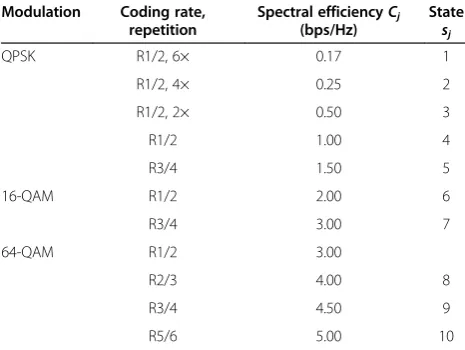
In FSMC theory, the partition of SNR into state inter-vals or regions can be arbitrary; e.g., in [2] the equal steady-state probability method is used to determine the SNR thresholds of the states, while in [3] the equal aver-age state duration is assumed. However, in practice the system's physical parameters are usually standardized and our proposed FSMC model for the fading wireless channel is ‘tailored’to conform to the relevant physical standard. Thus, while FSMC is a model of the fading channel, the proposed model in our paper is also a func-tion of the particular modulafunc-tion and coding schemes used by the physical system. In order not to ‘abuse’ the basic definition of a Markov process, the necessary as-sumption in our model is that the channel fading is slow enough so that the SNR remains within one SNR region over several resource allocation unit times, and thus the Markov process can only transit to the same region or to the two adjacent regions. Since the IEEE 802.16e standard [1] gives only a finite number of profile AMC schemes, it is logical to use these profile AMC schemes as the finite states of the FSMC model for mobile WiMAX as shown in Table 1.
Current research in the literature on FSMC modeling of fading wireless channels has also not addressed adequately the effects of data coding on BER. The concatenated Reed-Solomon and convolutional code (RS-CC) is man-datory in most wireless systems, and others such as convo-lutional turbo code, block turbo code, and low-density
parity-check code are optional alternatives. Since data coding results in an effective power gain, corresponding convolutional coding gain (Gc) and repetition coding gain
(Gr) must be applied to obtain an effective SNR for the
im-plementation of the AMC scheme in mobile wireless net-works. The effect of coding gain of trellis code on power adaptation in a four-state M-QAM signal has been addressed in [4]. In repetition coding in an OFDMA sys-tem, the same data symbol is transmitted on several con-tiguous slots so that if the information on one of those slots is corrupted, the information on the other slots will be received correctly by a maximum ratio combining (MRC) receiver. The obvious downside of repetition cod-ing is that it decreases the spectral efficiency and this is why the most robust modulation BPSK is not used with repetition coding.
In this paper, we present a 10-state FSMC model for the AMC scheme in mobile WiMAX, taking into account also the repetition coding gain in two different fading scenar-ios: correlated lognormal fading and composite Rayleigh-lognormal fading, also known as Suzuki fading. Because the main theme of our paper is the effect of repetition coding on the proposed 10-state FSMC model for AMC control, but not on channel fading models, we will restrict ourselves, for simplicity and brevity, to the Rayleigh-distributed channel (voltage) gain and the corresponding exponentially distributed channel (power) gain rather than dealing with their respective generic distributions, i.e., Nakagami-m distribution and gamma-k distribution, respectively. One of the significant findings in this paper is that the channel fading correlation, while significantly de-grading the BER performance, practically does not affect the proposed variable power control algorithm and its resulting 10-state FSMC model for mobile WiMAX. This is because repetition coding is applied only to the first three states, but the total power in these states is too small to affect the overall variable power control scheme.
To the best of our knowledge, the performance of repe-tition coding has not been studied before, partly because the flexible allocation of the OFDMA slots in the time-frequency domain and the nature of the diversity channels involved in the transmission of the repetition slots are not well understood. This will be discussed in Section 2.2. The approach proposed in the paper can be generalized to de-sign power control algorithm for other wireless communi-cation systems using AMC under fading conditions.
In this paper we also show that many complicated ex-pressions for BER involving integrations and double inte-grations of lognormal and lognormal-related composite functions can be efficiently and accurately approximated in closed form using Gauss-Hermite quadrature polynomials.
There are three main contributions from this paper. The first is an innovative technique for accurate matching of two moment generating functions using
Table 1 A 10-state FSMC model for mobile WiMAX.
Modulation Coding rate, repetition
Spectral efficiencyCj (bps/Hz)
State sj
QPSK R1/2, 6× 0.17 1
R1/2, 4× 0.25 2
R1/2, 2× 0.50 3
R1/2 1.00 4
R3/4 1.50 5
16-QAM R1/2 2.00 6
R3/4 3.00 7
64-QAM R1/2 3.00
R2/3 4.00 8
R3/4 4.50 9
the power conservation principle: one is the moment generating function (MGF) of the sum of SNRs at the out-put of the MRC combiner and the other is of an accurate estimate of this sum. Current MGF matching techniques to date, e.g. [9], are seriously power‘lossy’and rather unre-liable. The second is the most computationally simple closed-form expression to date for an accurate approxima-tion of BER of QPSK signals using MRC diversity recep-tion operating in correlated lognormal (expression (23)) and composite Rayleigh-lognormal (expression (30)) fad-ing environments. The third is the definition of the repeti-tion coding gainGrand its incorporation into the design
of the transmit power control policy of a 10-state FSMC model for the AMC scheme in mobile WiMAX using repetition coding for QPSK signal. The work in this paper is particularly relevant to the interests of both designers and researchers of broadband wireless access networks.
The rest of the paper is organized as follows. In Section 2, we briefly present the time-diversity model for the repeti-tion coding in an OFDMA system and the bound on BER of the rectangular M-QAM signal which serves as the foundation of the transmit power control algorithm ori-ginally proposed in [4,5]. Section 3 presents an analysis of the effect on BER of QPSK signals from the use of repeti-tion coding under the two fading condirepeti-tions: correlated lognormal fading and composite Rayleigh-lognormal fad-ing. In this section, we also define and calculate the RC gain for the two fading conditions. In this section, an in-novative technique is presented for accurate matching of two MGFs. In Section 4, we present the steps in the algo-rithm leading to a 10-state FSMC model for implementing the AMC scheme in mobile WiMAX operating in the mentioned fading environments. Finally, a conclusion is presented in Section 5.
2 Signal model, repetition diversity channel model, and bound on bit error rate
2.1 Signal model
In this paper the signal-to-noise ratio, γ, plays a major role in channel characterization and performance evalu-ation and it can be defined from the signal model:
r tð Þ ¼hs tð Þ þn tð Þ; ð1Þ wherer(t),s(t), andn(t) are receive signal, transmit signal, and channel noise, respectively;his the amplitude channel gain, assumed to be constant over the transmission time of an orthogonal frequency division multiplex (OFDM) symbol block, thus preserving the orthogonality between subcarriers;n(t) is modeled as a zero-mean additive white Gaussian noise (AWGN) process with one-sided power spectral densityN0. The received SNR is then
γ¼ h2Es
N0 ; ð
2Þ
where the signal energy isEs=E[s2(t)]. If the energy is that
of 1 bit, then we denoteγbas the SNR per bit of
transmit-ted information.
In this paper we use the term power gainp =|h|2and signal-to-noise ratio γ interchangeably where it is appro-priate. Since per bit SNR isγb= |h|2×Eb/N0and to avoid
dealing with the distance dependency, we normalize the average channel power gain E[|h|2] = 1, thus making the average received SNR per bit per channelγb¼Eb=N0. 2.2 Diversity channel model for repetition coding in OFDMA systems
In the AMC zone of an OFDMA frame in IEEE802.16e [1], subchannels are formed from grouping of adjacent subcarriers. Adjacent subcarrier allocation results in subchannels which are suitable for frequencynon-selective and slowly fading channels, e.g., lognormal shadowing. In an OFDMA system, the basic unit of resource allocation in the 2-D frequency-time grid is the slot being 1 sub-channel in frequency by 1, two or three OFDM symbols in time. More slots can be concatenated to accommodate lar-ger forward error correction (FEC) encoded data blocks. Since repetition coding repeats the same encoded data block in different contiguous slots in the AMC zone, it can be assumed that the MRC gain from combining re-peating signals is predominantly via microdiversity recep-tion in which all repetirecep-tion subchannels experience the sameshadowing havingN(μZ, σZ2) distribution. The time separation, hence the correlation coefficient between any two diversity subchannels, depends on the size of the FEC-encoded data blocks to be repeated as well as the speed of the mobile receiver.
2.3 Bound on BER in rectangularM-QAM
At high SNR, the symbol-error-rate for rectangular M-QAM in AWGN withM = 2k, whenkis even, is ap-proximated as [12], p. 280
SERAWGN;M−QAM≈4 1−
1
ffiffiffiffiffi
M p
Q
ffiffiffiffiffiffiffiffiffiffiffiffiffiffiffi
3 M−1γs
r !
; ð3Þ
in which is the average SNR per symbol per channel (without combining) and for equiprobable orthogonal signals the corresponding bit error rate is [12], p. 262
BERAWGN;M−QAM¼
M
2ðM−1ÞSERAWGM;M−QAMð Þγ :
ð4Þ By using the asymptotic expansion of the function Q (x) in (3), an upper bound for BER for a given value of SNR is given in [4,6]
BERAWGN;M−QAMð Þγ ≤KBð ÞM exp −
1:5γ M−1
in which the bound constantKB(M) is fixed at 0.2 in [4]
It is obvious that forM > 4, the upper bound for BER in (5) given by [4] is very tight, and this bound or its power adaptation version in (54) provides the basis for the transmit power control algorithm in [4] and [5].
3 Effect of repetition coding on BER and effective repetition coding gain
3.1 Repetition coding for QPSK in WiMAX
In this paper, we define repetition coding gain simply as the ratio of the SNR without repetition coding to the SNR with repetition coding for a given target BER. Thus, an im-provement in BER is equivalent to a saving in signaling power required to combat deep fades in order to maintain the given target BER. Since in the AMC scheme in mobile WiMAX, and repetition coding of 6, 4, and 2 times is recommendedonlyfor rate ½ QPSK modulation and cod-ing (see Table 1), it is important that we first derive accur-ate closed-form formulas for BER of QPSK signals from an MRC combiner and the corresponding RC gain when the wireless system operates in lognormal shadowing and in composite Rayleigh-lognormal fading environments. This is one of the significant contributions from our paper.
3.2 Correlated lognormal fading channels only
3.2.1 Power sum of correlated lognormal random variables A signal subjected to shadowing, also known as slow fad-ing, is usually modeled as a lognormally distributed ran-dom variable. Its SNR is modeled asγ= 100.1Z= exp(Z/ξ) with Zin decibels being normally distributed, i.e., Z ~ N (μZ,σZ2). The probability density function ofγis
in whichξ= 10/log10 is the conversion constant between dBandnetand is in linear unit. The average SNR is
The effect of maximum ratio combining is to add up the powers of the received signals to be combined. The resulting SNR fromNrepetitions is
γN ¼
A closed-form expression for the probability density function (PDF) of the power sum of lognormal random variables (RVs) in (9) is not available, but a number of approximations in computationally efficient closed forms are currently available. These include the Pearson Type IV approximation in [7,8] and those found from the MGF matching technique in [9]. In our paper, we adopt the latter approach because it is elegant and simple and it results in a PDF expression being suitable for the use of Gauss-Hermite expansion to approximate the BER in a closed form.
Consider theNcorrelated lognormal RV vectorγ= {γi},
i= 1, 2,..,N, and their corresponding Gaussian RV vector z= {zi}, having the joint distribution whereμis the mean vector of zandCZis the covariance matrix ofz.
After equating fγ(γ)dγ=fz(z)dz, the MGF of the com-bined SNR is obtained as
MγNð Þ ¼s wheresis the transform variable in the Laplace domain.
To de-correlate (11) as in [9], we make the variable transformationz=√2CZ1/2x+μand (11) becomes fromCZusing Cholesky decomposition.
The integral in (12) has the suitable form for Gauss-Hermite expansion approximation [13] for the MGF of the sum ofNcorrelated lognormal SNRs, which is [9]
in whichwnand anare, respectively, the weights and the abscissas of the Gauss-Hermite polynomial. The ap-proximation becomes more and more accurate with in-creasing approximation orderNp.
We use the simple decreasing correlation model in [14] for shadow fading. The covariance matrix of the channel SNRs, assuming independent and identically distributed (i.i.d.) channels, is
X the correlation coefficient of two adjacent channels.
In the Appendix we show how the Gaussian covari-ance matrix CZ is calculated from the given lognormal covariance matrixPLnin (14).
3.2.2 Estimate of sum of lognormal RVs as a single lognormal RV
In this section, we approximate the sum ofN-correlated lognormal SNRs by another single lognormal SNR, ^ the MGF of the approximation with the MGF of the lognormal sumγN in (13) at two different positive real valuess1ands2, a system of two simultaneous equations
as in (15) is obtained which can then be used to solve forμ^Xandσ^2
The weakness in using the two-point MGF-matching method is that it is highly sensitive to the chosen matching points. Furthermore, the method does not guarantee con-servation of signal power across the MRC combiner, i.e., equal system average power gain at both sides of the com-biner. In this paper, we propose to use this‘lossless’MRC principle to improve the accuracy of the selection of the two matching points. This is a significant contribution of our paper.
We can simplify the problem by assuming a micro-diversity environment [15]; i.e., all repetition subchannels experience thesameshadowing havingLN(μZ, σZ2) distri-bution, thus have the same local average power. This as-sumption is quite reasonable for adjacent subchannels within an OFDMA frame. The average SNR of each diver-sity branch at the input to the MRC receiver is
The principle of a lossless MRC thus gives the corre-sponding SNR at the output of the receiver as
^
Equation 17 provides a valid and reliable equation for iteratively improving the accuracy of the locations of the two MGF matching points. The percentage error of power loss is defined as
%Error¼100 NγZ−γ^Ln
NγZ :
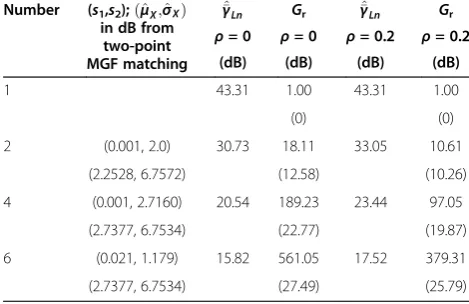
ð18Þ A simple iterative search algorithm for the two matching locations in (15) is carried out until the power loss de-creases to a specified error threshold which is set at 0.5% in this paper. The result of the MGF matching is reported in Table 2. The matching in [9] does not observe the power conservation, and all the matching pairs suggested in the paper result in very large power losses.
Finally, the estimated PDF of the SNR from the diver-sity combiner is
BERlognormal;QPSK¼
Z ∞
Table 2 Estimated distribution parameters and repetition coding gain
1 43.31 1.00 43.31 1.00
(0) (0)
2 (0.001, 2.0) 30.73 18.11 33.05 10.61
(2.2528, 6.7572) (12.58) (10.26)
4 (0.001, 2.7160) 20.54 189.23 23.44 97.05
(2.7377, 6.7534) (22.77) (19.87)
6 (0.021, 1.179) 15.82 561.05 17.52 379.31
(2.7377, 6.7534) (27.49) (25.79)
Estimated distribution parameters from MGF matching and required average SNR^γLnand repetition coding gain for BER = 10−5
in correlated lognormal
By a change of variable,
(20) can be reduced to
BERlognormal;QPSK¼
1
is the argument of BERAWGN,QPSK(.) in (4). The above expression for BER
can then be accurately approximated by an Np-order
Gauss-Hermite polynomial expansion as given in (21)
BERlognormal;QPSK¼
1
are almost the same.
For the case ofN> 1 from (4) and (19), we obtain
and we obtain (23) below in a similar way in which we obtain (21) above, i.e.,
BERlognormal;QPSK;MRC¼
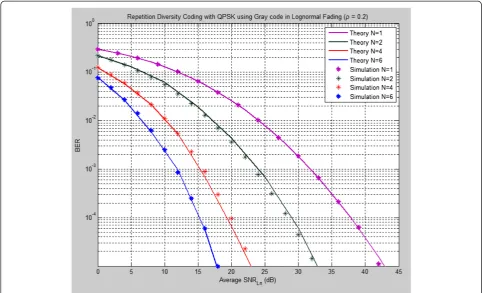
In Figure 1 we plot BER as a function of the average symbol SNR per subchannel with the signal being subjected to correlated lognormal fading, as calculated from (21) forN= 1 and from (23) for the case ofN> 1 i.i. d. repetition-coded channels with correlationρ= 0.2. It is reasonable that we cannot expect the calculated BER and the Monte Carlo simulated BER to be the same, simply be-cause the calculated BER is only approximated first by using MGF matching technique then by using Gauss-Hermite polynomial approximation.
We define repetition coding gain (Gr) as the ratio of
the average SNR, γ^Ln, without repetition coding (N= 1) to that with repetition coding (N > 1) required for the same given target BER = 10−5.
In Table 2 we list the required average symbol SNR per channel,^γLn, to meet the target BER = 10−5calculated from
(21) and (23) for QPSK and fixed Gaussian standard devi-ation σZ = 8 dB for the lognormal channel. The corre-sponding repetition coding gain Gr for different values of
repetition is also listed in Table 2. The channel correlation withρ= 0.2 is seen from Table 2 to have reducedGrby 2
to 3 dB. This degradation increases at 5 to 6 dB when we increase the correlation toρ= 0.6.
3.3 Independent composite Rayleigh-lognormal (Suzuki) fading channels
As has been mentioned in the Section 1, the exact mod-eling of the fading channels is not the main theme of our paper. There are two justified reasons why in this section we assume that repetition channels are uncorrelated for simplicity. One is the lack of a compu-tationally efficient closed-form expression for BER of correlated composite Rayleigh-lognormal channels using MRC diversity reception and two is, as will be shown in Section 4.2.1 for lognormal channels, that the correlation between repetition diversity channels has lit-tle effect on the proposed 10-state FSMC model. 3.3.1 Physical model for composite Rayleigh-lognormal fading channels
In [11] a simple physical model for urban mobile radio propagation is presented in which the main wave from the transmitter to the local cluster of buildings in the neighborhood of the receiver traverses a path subject to cascaded reflections and/or diffractions by natural and man-made obstructions. After arrival at the local clus-ter, the main wave is scattered into multipaths which arrive at the receiver with approximately the same delay and amplitude but with different random phases. Therefore, the signal power gain of the transmitter-to-cluster main path is modeled as having lognormal dis-tribution, pLn, because of the multiplicative effects of
reflections and/or diffractions, while that of the local multipaths are modeled as Rayleigh distributed,pR, due
The distribution in (24) is similar to that given in [11], Equation 3 except that the latter is for Rayleigh distrib-uted signal envelope instead of exponentially distribdistrib-uted signal power in (24).
To develop an expression for the PDF of SNR of a signal using diversity reception in composite Rayleigh-lognormal fading channels and to simulate the scenario using the Monte Carlo technique, it is essential to understand the physical meaning of the fading mechanism. The coherence time of fast Rayleigh fading is a few tens of milliseconds de-pending on the mobile speed, while the coherence time of slow shadow fading is a few tens of seconds depending on the mobile speed to cover the coherence distance, typically 100 to 200 m in suburban cells and a few tens of meters in urban cells [14]. Based on the fact of this many-order dif-ference between the two coherence times, the marginal probability density function of the composite Rayleigh-lognormal channel is derived in [11,15] by equating the local average SNR of the much faster Rayleigh fading signal to the instantaneous SNR of the much slower arriving log-normal signal. This implies first a complete transfer, i.e., a transition, of signal power from the main arriving lognor-mal signal to the local multipath channel, and second, no significant loss of power in the local multipath channel, i.e.,
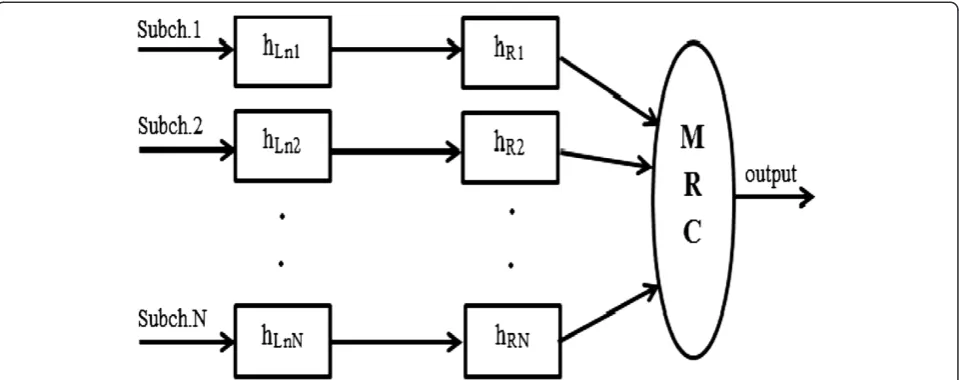
the average power gain of the local Rayleigh fading channel can be assumed as unity. It is therefore interesting to note that the composite distribution in (24) is, in fact, the PDF of the power gain of the product channel |hR−Ln|2= |hR|2
|hLn|2of two cascaded channelshRi and hLni in Figure 2. Since pR(|hR|2 is exponentially distributed with average
E⌊|hR|2⌋ = 1 regardless of the frequency, i.e. frequency
non-selective, andpR(|hLn|2) is frequency non-selective
log-normal distributed as given in (7), the PDF of the product channel, pR−Ln(|hR− Ln|2) as given in (24), is effectively
frequency non-selective.
We model the repetition coding as shown in Figure 2 in which the signal path from each subchannel is mod-eled according to (24). Thus in the general propagation environment, the local Rayleigh-faded signals from different repetition subchannels arrive at the diversity combiner with different local average powers. Unfortu-nately, while the sum of many lognormal functions is an-other lognormal function, this is not true for Rayleigh distribution. We can simplify the problem by assuming a microdiversity environment [15], i.e., all repetition subchannels experience the same shadowing having LN (μZ, σZ2) distribution, thus have the same local average power.
Figure 1BER versus average SNR per lognormally faded channelγLnof QPSK (M= 4) using Gray’s code.The system usesNth-order
The PDF of the output SNR from the MRC combiner when input is fromNi.i.d. diversity subchannels subjected to Rayleigh fading with average SNRγRis given as [12]
BERRayleigh;QPSK;MRC¼
Therefore, in a similar way to the derivation of the PDF in (24) of a product of two random variables, the marginal PDF of the resultant SNR of an N-repetition-coded signal subject to composite Rayleigh-lognormal fading can be read-ily obtained, using Jacobian transformation technique, as
fR−Ln;MRCð Þ ¼γ which takes a form similar to that in [15], Equation 1.
The bit error rate of QPSK signal using repetition di-versity coding in a composite Rayleigh-lognormal fading channel is
By inserting (26) into (27) and by some rearrangement, we can arrive at
BERR−Ln;QPSK;MRC¼ The term in the square brackets can be identified as BER of QPSK using Gray coding and MRC receiver in Rayleigh fading channel with average SNR γ ¼x (see (25)). More-over, by a change of variable as done for (20) above, (28) can be reduced to the form in (29) below
BERR−Ln;QPSK;MRC ¼
BERRayleigh;QPSK;MRC
is the argument of BERRayleigh,QPSK,MRC(.) in (25). Expression (29) can then be
accurately approximated by an Np-order Gauss-Hermite
polynomial expansion as in (30) below:
BERR−Ln;QPSK;MRC ¼
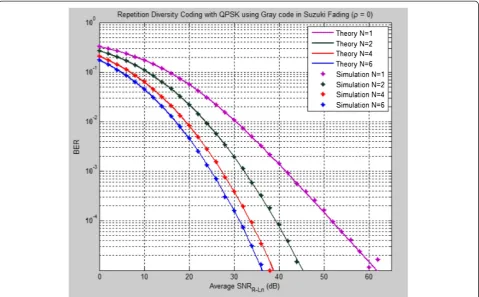
BER of QPSK signal using MRC diversity reception in Suzuki fading channels. In Figure 3 we plot the BER as a function of the average symbol SNR, γR−Ln, of each subchannel signal being subjected to composite Rayleigh-lognormal fading. The system uses Nth-order repetition coding and maximum ratio combining, Hermite polynomial order Np = 12, Gaussian standard
deviationσZ= 8 dB.
Again, we define repetition coding gain,Gr, as the ratio
of the required average SNR to meet a given BER target of 10−5 when RC is not used to that when RC is used. The required average SNR calculated from (30) and the corresponding RC gain for the different number of repe-titions are listed in Table 3.
4 The 10-state model for the AMC scheme with repetition diversity coding
4.1 State partition for the AMC scheme in mobile WiMAX
As mentioned in Section 1, the AMC scheme forms a discreteset of combined modulation and codingsj= {Mj,
Rj, xj} specified by the corresponding standard. By partitioning the range of the received SNR into a finite number of intervals to match the discrete set of modula-tion and coding, a finite-state Markov channel (FSMC) model can be constructed for the implementation of the AMC scheme in fading wireless channels. In this section
we use mobile WiMAX as a case study, but the approach can be generalized to design power control algorithm for other wireless communication systems using AMC under fading conditions.
In adaptive modulation and coding, at each symbol time, the wireless system assigns a state sj= {Mj, Rj, xj} and the associated transmit power to a received SNRγ. Therefore, as SNR varies with the fading condition, BER will change accordingly. The aim of power control is to adapt the transmit power to the instantaneous received SNR so that BER stays at the given target level in all states. The 10-state combined modulation and coding rates in mobile WiMAX are calculated as follows [6]:
Mj¼
4 j¼1;2;3;4;5 16 j¼6;7 64 j¼8;9;10
8 <
: ð31Þ
Figure 3BER versus average SNRγR‐Lnper composite Rayleigh-lognormally faded channel of QPSK.
Table 3 Required average SNRγR‐Lnand repetition coding gain for BER = 10−5
Number γR‐LnðdBÞ Grlinear ratio unit and (dB),ρ= 0
1 61.32 1.00 (0)
2 45.10 41.88 (16.22)
4 38.66 184.50 (22.66)
and
MRj¼ Mj
Rj
ð32Þ with the effective coding rateRj= RS-CC coding rate di-vided by the number of repetitions, i.e.,
Rj¼½1=12;1=8;1=4;1=2;3=4;1=2;3=4;2=3;3=4;5=6
Thus, for each value of the instantaneous SNR,γ, the AMC algorithm will decide whichM-QAM, what coding rate, what repetition rate, and what associated transmit power to use.
4.2 Optimal power adaptation inM-QAM
In this section a brief review and explanation of the trans-mit power adaptation technique forM-QAM modulation in fading channels [4,5] is presented for continuity and clarity. We want to adapt the transmit power S(γ) to the instantaneous value of SNR subject to the average power constraint. The BER upper bound in (5) becomes
BERAWGN;M−QAMð Þγ ≤KBð ÞM exp −1:5γ It can be seen from the bound in (35), for a given value of SNR, γ, we can adapt both M(γ) and S(γ) to maintain a given target BER and an average power con-straintS.
The classical approach for constraint optimization of transmit power which maximizes the average spectral effi-ciency, subject to average power constraint, is to use the Lagrange multiplier technique with a multiplier which can be calculated from the power constraint requirement. This results in the well-known optimal ‘water-filling’ power adaptation policy in broadband data transmission. Using a similar approach for the problem of optimal power adap-tion in M-QAM, it has been shown in [4], Equation 25 that the resultingoptimalcontinuous modulation rate for a given value ofγis
Mð Þ ¼γ γ
γβ ð
36Þ
in which γβ is the optimized cutoff fade depth that
de-pends on the fading distribution f(γ). In the same way as for the Lagrange multiplierγβcan be calculated from the
average power constraint requirement.
In this paper, although the state boundaries and asso-ciated modulation and coding rates are fixed, within the
state region j the transmit power Sj(γ) is a continuous function of the SNR. The upper bound for the continu-ous constellation size in state j for a given target BER can be extracted from (35) as
Mjð Þγ ≤1þβj
Sjð Þγ
S γ forj¼1;2; :::10 ð37Þ in which, by taking both the convolutional coding gainGc
and the repetition coding gainGrinto account, we have
βj¼−
Once the optimized cutoff phase depth γβ has been calculated for a given fading distribution f(γ), we are ready to quantize the optimal continuous modulation rate in (36) into ten states as specified in Section 4.1 above,
Mð Þ ¼γ MRj if MRj≤Mð Þ ¼γ
γ
γβ≤MRjþ1: ð39Þ Accordingly, the range of the SNR is also partitioned into ten regions.
Based on the tight approximation for BER in (35) or equivalent upper bound for modulation rate in (37), a power adaptation policy which maintains a fixed target BER and satisfies the average power constraint,E S½ ð Þγ ≤S, respectively, and when γ < γβMR1 no power is allocated.
The effect of both channel coding and repetition diversity coding has been taken into account by incorporating their respective coding gains intoβjin (38a) and (38b) which re-sults in a decrease in the adaptive powerSj(γ) in (40).
where γβ can be calculated from the power constraint 4.2.1 Lognormal fading only
This is the scenario of a line-of-sight wireless propaga-tion between the transmitter and a receiver in which the radio wave experiences the multiplicative effect of a large number of cascaded obstructions in its path. With the resulting shadowing having the lognormal PDF in (7), the power constraint in (42) becomes
XN
we can reduce (43), by using [16], 3.322.1, p. 336, to 1
Thus, we can numerically solve (45) for the opti-mized SNR scaling parameter as a function of the lognormal fading depth (μZ, σZ2). In numerically solv-ing (45), it should be noticed from (44) that γβ≥ 1
64
expμz=ξ and the iteration should start with this mini-mum value forγβ.
For an average SNR of γLn¼15 dB and σz = 8 dB,
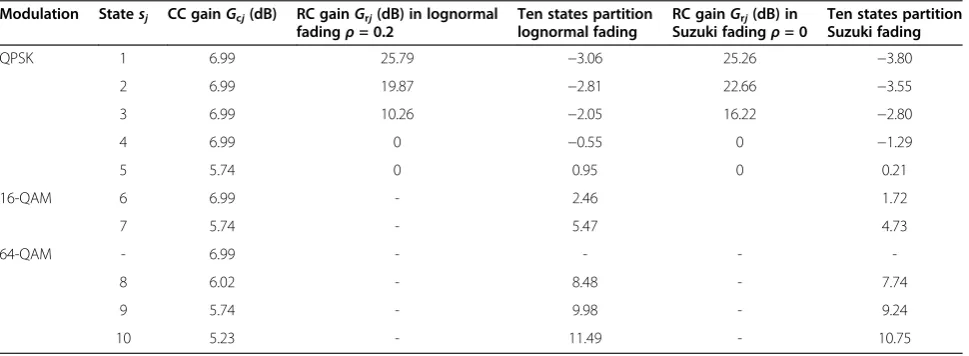
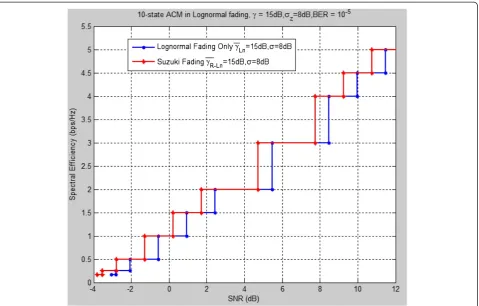
(42) gives γβ = 0.4403 which is practically the same as when there is no correlation between repetition diversity channels. A detailed examination of (45) reveals that the contribution to the right-hand side from the difference of the two Φ(.) functions is non-zero only for j = 5 and j = 7, i.e., at the transitions where modulation depth changes (see (31)). But at these states, repetition coding does not apply; hence, diversity channel correl-ation is irrelevant. Using this optimizcorrel-ation parameter for the quantization in (39) provides the boundaries of the SNR partition for our 10-state FSMC model as given in Table 4 and illustrated in Figure 4 for the log-normal fading only condition.
4.2.2 Composite Rayleigh-lognormal (Suzuki) fading This is the most realistic scenario and is typical of a link between a base station and a mobile subscriber in a built-up urban area. With the composite Rayleigh-lognormal PDF in (24), the power constraint in (42) becomes
Table 4 SNR partition in the 10-state FSMC model for mobile WiMAX in various fading channels
The double integration in (46) can be rearranged as below:
XN
j¼1
Mj−1
βj
Z∞
0
ζ x2σ
z ffiffiffiffiffiffi
2π
p exp − 10log10x−μz
2
2σ2 z
( )
(MZjþ1γβ
Mjγβ
1
γexpð−γ=xÞdγ )
dx¼1: ð47Þ
Then the inner integration {∫(.)dγ} can be expressed in terms of exponential integral functions [14, 3.354.3], p. 341 and (47) can be reduced to
XN
j¼1
Mj−1
βj Z∞
0
ζ x2σ
z ffiffiffiffiffiffi
2π
p exp − 10log10x−μz
2
2σ2 z
( )
E1
Mjγβ x
−E1
Mjþ1γβ x
dx¼1:
ð48Þ
Moreover, by a change of variable as in (44), (48) can be further reduced to
1
ffiffiffi
π
p XN
j¼1
Mj−1
βj Z∞
−∞
g zð Þ
E1 Mjγβg zð Þ
−E1 Mjþ1γβg zð Þ
n o
e−z2dz¼1; ð49Þ whereg zð Þ ¼exp − μzþzσz
ffiffiffi
2
p
=ξ
:
Finally, (49) can be accurately approximated by anNp
-order Gauss-Hermite polynomial as
1
ffiffiffi
π
p XN
j¼1
Mj−1
βj "
XNp
n¼1
wng að Þn n
E1 Mjγβg að Þn
−E1 Mjþ1γβg að Þn
o#
¼1:
ð50Þ
Similar to solving (46), we can numerically solve (50) for the optimized SNR scaling parameterγβfor the com-posite Rayleigh-lognormal fading case as a function of the lognormal fading depth μz;σ2
z
γR−Ln¼15 dB , (49) gives γβ = 0.3728 while (50) gives
an approximation of γβ = 0.3714. Its state boundary is about 1.0 dB to the left of, i.e., better than, the lognor-mal fading channel having the same 15 dB average SNR, as shown in red in Figure 4.
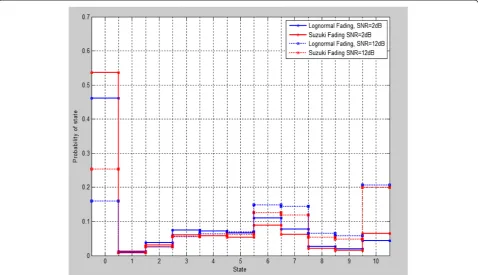
4.3 Average spectral efficiency in different fading channels
The spectral performance of the ten states in Figure 4 shows the instantaneous spectral efficiency as a function of the instantaneous signal-to-noise ratio. Since the power adaption algorithm in (40) allocates zero power to state 0 where SNRγfalls below M1γβ, it would be interesting to
see how much this zero-power state affects the overall average spectral efficiency of the wireless system.
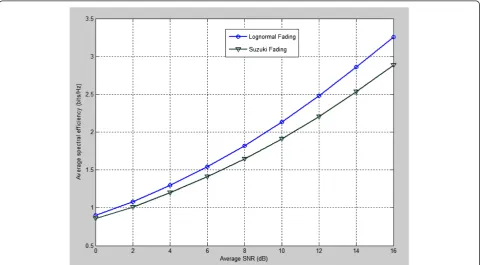
Figure 5 shows the average spectral efficiency per-formance as a function of the average SNR when the system uses the proposed power adaption scheme in (40). Readers may immediately notice that while in Figure 4 the instantaneous performance of the Suzuki fading channel is about 1.0 dB better than the lognor-mal fading channel, its average performance in Figure 5 is the other way round, about 2 dB worse than that of the latter. The explanation may be found by comparing the probabilities that the SNR of the two channels falls into various states as shown in Figure 6. At low average SNRs, e.g., 2 dB, and more than 50% of the time, the re-ceived Suzuki signal falls into the zero-power state; this
figure is just above 45% for the received lognormal sig-nal. At high average SNRs, there is still a significant prob-ability that the Suzuki signal falls into the zero-power state 0, e.g., 25% at average SNR of 12 dB. The probability of the received lognormal faded signal is much lower than that of the Suzuki counterpart in state 0.
5 Conclusions
We have defined and successfully developed expressions for the coding gain of repetition diversity coding and the related 10-state FSMC model for variable power control for AMC used in modern wireless mobile net-works operating under the two fading mechanisms: log-normal and composite Rayleigh-loglog-normal. It is found that the correlation between diversity fading channels, while significantly degrading the BER performance, practically does not affect the proposed power control algorithm and the resulting 10-state FSMC model. By using the power conservation principle across the MRC combiner, an innovative technique is proposed for ac-curate matching of two MGFs which allows an acac-curate estimate of the PDF of the SNR at the combiner output. Next, by using the Gauss-Hermite quadrature approxi-mation for integration, we have derived the most com-putationally fast expressions to date, to the best of our knowledge, for the calculation of BER of QPSK using MRC diversity reception in correlated fading channels and for the efficient computation of the 10-state FSMC
model for AMC in mobile WiMAX. The inclusion of repetition coding gain in the transmit power adaptation algorithm for different fading mechanisms and different fading depths has not been done before. From Figure 4, we can observe that the use of RC for QPSK modulation level alone extends the system operation range to al-most 4 dB into very poor fading conditions. In addition, it is interesting to note that based on the same overall average SNR, the composite Suzuki fading model re-quires approximately 1.0 dB less power than the lognor-mal fading model to achieve the same instantaneous spectral efficiency. However, from Figure 5, because of the high probability of the received Suzuki-faded signal falling into the zero-power state, its average spectral ef-ficiency becomes lower than that of the lognormal faded signal.
Appendix
Calculating Gaussian matrix CZfrom given lognormal covariance matrixPLn
We use the simple decreasing correlation model in [14] for shadow fading. The covariance matrix of the channel SNRs, assuming i.i.d. channels, is
X
Lnð Þ ¼i;j Cov γi;γj
¼σ2
ij ¼σ2ρj ji−j; ð51Þ
in whichσ*2is the variance of per-channel SNR.
It can be shown that the relationship between the Gaussian channel meanμZ, varianceσZ2, covarianceCZ(i,j), and the lognormal channel meanμ*, varianceσ*2, and co-variancePLn(i,j) can be summarized as below:
μ¼Eð Þ ¼γ γ ¼eμzþσ2z=2 ð52Þ
σ2¼Varð Þ ¼γ e2μzþσ2z=2 eσ2z−1
¼½Eð Þγ 2 eσ2z−1
: ð53Þ
Hence,
μz¼E Zð Þ ¼i ln μ 2 ffiffiffiffiffiffiffiffiffiffiffiffiffiffiffiffiffiffiffi
μ2þσ2 p
!
ð54Þ
σ2
z ¼Varð Þ ¼Zi ln 1þσ 2
μ2
ð55Þ
Czð Þ ¼i;j Cov Zi;Zj
¼ln 1þσ
2ρj ji−j
μ2
: ð56Þ
In this paper, we normalize the channel's mean power gainμ*= 1 to avoid dependency on propagation distance and adopt a fixed Gaussian standard deviationσz= 8 dB.
Abbreviations
AMC:Adaptive modulation and coding; AWGN: Adaptive white Gaussian noise; BER: Bit error rate; BS: Base station; BTC: Block turbo code;Eb/N0: Bit energy-to-noise ratio; FEC: Forward error correction; FSMC: Finite-state Markov channel;GcandGr: (Error) Coding gain and repetition coding gain; MGF: Moment generating function; MRC: Maximal ratio combining; OFDM: Orthogonal frequency division multiplex; OFDMA: Orthogonal frequency division multiple access; PDF: Probability density function; QAM: Quadrature amplitude modulation; QPSK: Quadrature phase-shift keying; RC: Repetition coding; RS-CC: Reed-Solomon and convolutional code; RV: Random variable; SNR: Signal-to-noise ratio; WiMAX: Worldwide interoperability for microwave access.
Competing interests
The authors declare that they have no competing interests.
Acknowledgements
This work was supported by research grants from QG.2014 Projects of the University of Engineering and Technology, Vietnam National University Hanoi. The authors would like to thank the anonymous reviewers for their careful reading and critique of the manuscript. Their suggestions have greatly improved the quality of the paper.
Author details
1Vietnam National University, Hanoi, Hanoi, Vietnam.2University of Technology, Sydney, Sydney, New South Wales, Australia.
Received: 8 January 2013 Accepted: 12 August 2013 Published: 3 September 2013
References
1. IEEE,IEEE Std 802, Air interface for fixed and mobile broadband wireless access systems, Amendment 2: physical and medium access control layer for combined fixed and mobile operation in licensed bands corrigendum 1(IEEE, 2005). http:// ieeexplore.ieee.org/servlet/opac?punumber=10676. Accessed 13 September 2006 2. HS Wang, N Moayeri, Finite-state Markov channel - a useful model for radio
communication channels. IEEE Trans Veh Technol44(1), 163–171 (1995) 3. Q Zhang, SA Kassam, Finite-state Markov model for Rayleigh fading
channels. IEEE Trans Commun47(11), 1688–1692 (1999)
4. AJ Goldsmith, SG Chua, Variable-rate variable-power MQAM for fading channels. IEEE Trans Commun45(10), 1218–1230 (1997)
5. AJ Goldsmith, SG Chua, Adaptive coded modulation for fading channels. IEEE Trans Commun46(5), 595–602 (1998)
6. D-T Nguyen, V Xuan-Thang, N Quoc-Tuan, An FSMC model for the ACM scheme with repetition coding in mobile WiMAX, inProceedings of the international conference on advanced technology for communications ATC’09
(, Hai Phong, Vietnam, 2009)
7. M Di Renzo, F Graziosi, F Santucci, Further results on the approximation of log-normal power sum via Pearson type IV distribution: a general formula for log-moments computation. IEEE Trans Commun57(4), 893–898 (2009) 8. M Di Renzo, F Graziosi, F Santucci, A general formula for log-MGF
computation: application to the approximation of log-normal power sum via Pearson type IV distribution, inProceedings of IEEE vehicular technology conference, Singapore, 11–14 May(IEEE, New York, 2008), pp. 999–1003 9. NB Mehta, Approximating a sum of random variables with a lognormal. IEEE
Trans Wire Commun6(7), 2690–2699 (2007)
10. J Salo,A sum-product model as a physical basis for shadow fading. arXiv:cs/ 0702098v, 2007. Accessed 21 November 2011
11. H Suzuki, A statistical model for urban radio propagation. IEEE Trans Commun25(7), 673–680 (1977)
12. JG Proakis,Digital Communications, 3rd edn. (McGraw-Hill, New York, 1995) 13. M Abramovitz, IA Stegun,Handbook of Mathematical Functions with Formulas,
Graphs, and Mathematical Tables, 9th edn. (Dover, New York, 1972)
14. M Gudmundson, A correlation model for shadow fading in mobile radio. Electron Lett27, 2146–2147 (1991)
15. A Conti, MZ Win, M Chiani, Slow adaptiveM-QAM with diversity in fast fading and shadowing. IEEE Trans Commun55(5), 895–905 (2007) 16. IS Gradshteyn, IM Ryzhik,Table of Integrals Series and Products
(Academic Press, New York and London, 1965)
doi:10.1186/1687-1499-2013-219
Cite this article as:Quoc-Tuanet al.:A 10-state model for an AMC
scheme with repetition coding in mobile wireless networks.EURASIP
Journal on Wireless Communications and Networking20132013:219.
Submit your manuscript to a
journal and benefi t from:
7Convenient online submission 7Rigorous peer review
7Immediate publication on acceptance 7Open access: articles freely available online 7High visibility within the fi eld
7Retaining the copyright to your article