R E S E A R C H
Open Access
Function matrix projective
synchronization of non-dissipatively coupled
heterogeneous systems with
different-dimensional nodes
Yanchao Shi
1*, Xin Wang
2, Xiangyan Zeng
3and Yang Cao
4*Correspondence:
1School of Sciences, Southwest
Petroleum University, Chengdu, China
Full list of author information is available at the end of the article
Abstract
This paper regards function matrix projective synchronization of two different non-dissipatively coupled complex dynamical networks for different dimensions and different nodes. In this kind of complex dynamical networks the internal delays are different from the coupled delays. By using Lyapunov stability theory, using
mathematical induction, two different hybrid feedback controllers are built to realize the function matrix projective synchronization. Compared with the existing results, the coupling matrices do not need to be symmetric or diffuse. By giving a numerical simulation we explain the validity and appropriateness of our conclusion.
Keywords: Function matrix projective synchronization; Complex networks; Hybrid feedback control; Time-varying delays
1 Introduction
Lots of large systems in the real world, for example, biological neural networks, social networks, food chains and food webs, can be depicted by complex networks. The com-plex dynamical networks are composed of coupled nodes, in which all the nodes form the edge-connected nonlinear dynamic system. In recent decades, the research of complex networks (CNs) has drawn wide attention from scholars of various fields [1–6]. Especially, synchronization as an important dynamic property of the coupled nonlinear systems has been extensively studied in [7–11].
In recent years, a novel synchronization, called function projective synchronization (FPS), was proposed and studied [12–15]. FPS is the coupled drive and the response sys-tems could be synchronized to the scale function matrix. Therefore, FPS is a generalized synchronization of chaotic systems. Obviously, FPS includes complete synchronization, anti-synchronization and projective synchronization. If the scale function matrix is a unit matrix or a constant, we can obtain projective synchronization, complete synchroniza-tion or anti-synchronizasynchroniza-tion. In the funcsynchroniza-tion matrix projective synchronizasynchroniza-tion (FMPS) approach, the uncertainty of the scale function matrix can improve the security of com-munication [16,17], therefore, FMS aroused wide interest of scholars.
For example, based on adaptive control, the function projective synchronization for a kind of chaotic system was considered in [18]. The function projective synchronization of complex networks by a hybrid feedback controller was proposed in [19]. Additionally, fur-ther consequences as regards the generalized matrix projective synchronization for gen-eral complex networks were studied in [20]. Even though synchronization of the complex networks for the same and different dynamic systems has been widely researched, the premise is that the dynamic dimensions of the nodes are the same. Actually, most systems are based on nonlinear dynamics, so the interactions between them may be completely different. On the other hand, during the information transmission process, because of the spatial and temporal characteristics of CNs, the time delays present in a single system and the coupled delays between the nodes may differ at different times.
Inspired by the discussion of the above issues, by constructing a Lyapunov function, applying mathematical induction, and using the matrix theory to study the complex net-works for nonidentical nodes and different dimensions, we realize the function matrix projective synchronization by the hybrid feedback controller. It is worth noting that the coupling matrix is not required to obey symmetry or diffusion conditions. At last, a nu-merical simulation is given to explain the validity and appropriateness of our conclusion.
Notation:In this paper,|·|respects the absolute value.Indenotes then-dimensional unit matrix.nisn-dimensional Euclidean space,n×nrespects the set of then×nreal ma-trices.A>B(A≥B) denotes the matrixA–Bis positive definite (nonnegative).diag(· · ·) means the block diagonal matrix.λmin(A) andλmax(A) are the minimum eigenvalue of
Aand the maximum eigenvalue ofA, respectively. The symmetric terms in a symmetric matrix are respected by∗. · respects the Euclidean norm. If not clearly stated, all the matrices of this paper are assumed to have compatible dimensions.
2 Preliminaries
A typical complex dynamical networks consisting ofN dynamical nodes with different intrinsic and coupled delays is described by
˙
xi(t) =fi
xi(t),xi
t–ρ(t)+ε N
j=1
cijQijxj
t–τ(t), (1)
wherexi(t) = (xi1(t),xi2(t), . . . ,xini(t))T∈ nistands for the state vector of theith node,i=
1, 2, . . . ,N.fi(·,·)∈ niis the vector-valued function.ε> 0 denotes the coupling strength,
ρ(t) andτ(t) are the intrinsic time-varying delay and the coupled time-varying delay, re-spectively.Qij∈ ni×nj stands for the inner coupling matrix,j= 1, 2, . . . ,N.C= (cij)N×N represents the outer coupling matrix which satisfiescij= 0, if there exists a connection from theith to thejth node (i=j); otherwisecij= 0.
Considering (1) as the drive system, then the response system under the controller can be written as follows:
˙
yi(t) =gi
yi(t),yi
t–ρ(t)+ε N
j=1
dijGijyj
t–τ(t)+ui(t), (2)
whereyi(t) = (yi1(t),yi2(t), . . . ,yimi(t))
T∈ mistands for the state vector of theith node,i=
ui(t) is the controller. Gij∈ mi×mj stands for the inner coupling matrix,j= 1, 2, . . . ,N.
D= (dij)N×N denotes the outer coupling matrix which satisfiesdij= 0, if there exists a connection from thejth node to theith node (i=j); otherwisedij= 0.
Definition 2.1 The function matrix projective synchronization between the drive system
(1) and the response system (2) is realized, if there is a matrixMi(t)∈ mi×niwhich is a
continuously differentiable scaling function such that
lim
t→∞yi(t) –Mi(t)xi(t)= 0, i= 1, 2, . . . ,N.
Remark 2.1 By using different special expressions for the scaling function matrix, the function matrix projective synchronization will be transformed into the complete syn-chronization, the anti-synsyn-chronization, the hybrid synchronization and the projective synchronization.
Definition 2.2 If for a continuously differentiable scaling function matrixMi(t)∈ mi×ni, such that yi(t) –Mi(t)xi(t) ≤Me–αt, then the exponentially FMPS between the drive system (1) and the response system (2) is called an implemented function matrix projective synchronization with the exponential rateα, whereM,α∈ +.
Assumption 2.1 For different time-varying delays,ρ(t) andτ(t) are differential
expres-sions and satisfy 0≤ρ(t)≤ρ, 0≤τi(t)≤τi,ρ˙(t)≤ ˜ρ< 1 andτ˙(t)≤μ< 1, whereρandτi are two constants.
Assumption 2.2 For the functionσ(·,·)∈ nis called to satisfy the QUAD condition, that
is, to sayσ∈QUAD(L,), if there are two diagonal matricesL≥0 and≥0 hold on
(x–y)Tσ(x,x˜) –σ(y,y˜)≤(x–y)TL(x–y) + (x˜–˜y)T(x˜–y˜),
for∀x,y,x˜,˜y∈ n.
Lemma 2.1 For∀x,y∈ nand a matrix R> 0,we have2xTy≤xTRx+yTR–1y.
3 FMPS of non-dissipatively coupled CNs via linear and nonlinear feedback control
In the following, we will give a linear and nonlinear feedback control methods to realize the FMPS.
The error state vector is
ei(t) =yi(t) –Mi(t)xi(t), (3)
Then, from (1)–(3), the error system (EDS) would be deduced
˙
ei(t) =y˙i(t) –M˙i(t)xi(t) –Mi(t)x˙i(t)
=gi
yi(t),yi
t–ρ(t)+ε N
j=1
dijGijyj
t–τ(t)
+ui(t) –M˙i(t)xi(t) –Mi(t)x˙i(t),
i= 1, 2, . . . ,N. (4)
Next, the hybrid controller is considered as
ui(t) =uoi(t) +uci(t), i= 1, 2, . . . ,N, (5)
where
uoi(t) =Mi(t)x˙i(t) +M˙i(t)xi(t) –gi
Mi(t)xi(t),Mi
t–ρ(t)xi
t–ρ(t)
–ε N
j=1
dijGijMj
t–τ(t)xj
t–τ(t),
uci(t) = –βiei(t),
andβi> 0 is the feedback gain.uoi(t) is the nonlinear controller, whileuci(t) is the linear feedback controller.
Thus, the SDE can be rewritten by
˙
ei(t) =g˜i
ei(t),ei
t–ρ(t)+ε N
j=1 ˜
Gij(ej
t–τ(t)–βiei(t), i= 1, 2, . . . ,N, (6)
whereg˜i(ei(t),ei(t–ρ(t))) =gi(yi(t),yi(t–ρ(t))) –gi(Mi(t)xi(t),Mi(t–ρ(t))xi(t–ρ(t))),G˜ij=
dijGij.
Theorem 3.1 Under Assumptions 2.1–2.2, for the considered synchronization scaling function matrix Mi(t)∈ mi×ni,if
ε 2λmax
N
j=1 ˜
GijG˜Tij
+ (1 –ρ˜)–1eαρδ
max+max
+ Nε
2(1 –μ)e
ατ+α
2 <βi, i= 1, 2, . . . ,N, (7)
then the drive system(1)and the response system(2)can realize FMPS by linear and non-linear feedback control.
Proof Build a Lyapunov functional as follows:
where
wherePi> 0 andRi> 0 are the diagonal matrices which can be determined below. The differential ofV(et) is obtained along the track of system (5), as follows:
By Lemma2.1, it is calculated that
Then, according to (8)–(11), it follows that
4 FMPS of non-dissipatively coupled CNs via nonlinear and adaptive feedback control
Next, we put forward a nonlinear and adaptive feedback control methods to achieve FMPS. The hybrid controller is considered as
andki is positive constant,uoi(t) anduci(t) are the nonlinear controller and the adaptive feedback controller, respectively.
By a similar analysis to above, one has
˙
Theorem 4.1 Under the Assumptions2.1–2.2,for the considered synchronization scaling
function matrix Mi(t)∈ mi×ni,if there is a sufficiently large constantβ∗> 0,satisfying
then the drive system(1)and the response system(2)can realize FMPS under nonlinear and adaptive feedback control.
Proof Build a Lyapunov functional as follows:
Then, similar to the proof of Theorem3.1, and lettingPi= (1 –ρ˜)–1i,Ri=2(1–μ)Nε Imi, we
get the following result:
˙
A numerical simulation is provided to explain the validity and correctness of the theoret-ical results we have given.
Consider the drive network as follows:
˙
fi(xi(t)) which are composed of the hyperchaotic Rossler system and the Lorenz system with nonidentical nodes:
The coupling matrices of system (20) are defined as
Q12=
The response system with controllerui(t) is described by
˙
Thus, we give the time-varying scaling matrices,
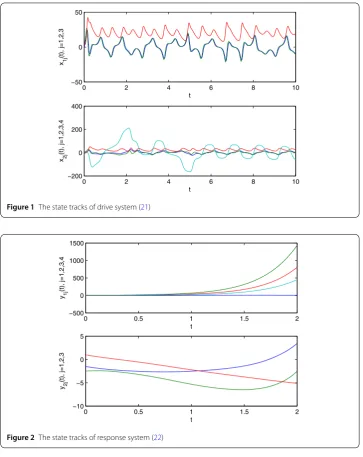
Figure 1The state tracks of drive system (21)
Figure 2The state tracks of response system (22)
M2(t) =
⎛ ⎜ ⎝
–2 –1 1 0
0 –0.5cos2t –1 0
–1 0 0 sint
⎞ ⎟ ⎠.
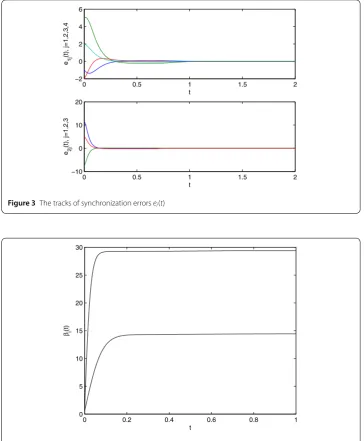
The other parameters are taken asε= 0.5,k1=k2= 5, β1(0) =β2(0) = 0.5. The initial values of the state variables are random. Figures1and2demonstrate the state tracks of the drive system and the response system, respectively. From Fig.3, we know the state tracks of the drive system and the response system can be realized as a function of matrix projective synchronization with the hybrid controller (23). In addition, Fig.4demonstrates the track of the adaptive feedback that obtains forβi(t).
6 Conclusion
Figure 3The tracks of synchronization errorsei(t)
Figure 4The tracks of adaptive feedback gainsβi(t)
In order to obtain the FMPS in which the internal time delays are different from the cou-pled delays, the hybrid feedback controller is given, by utilizing Lyapunov stability theory and mathematical induction. The coupling matrices are not required to satisfy the sym-metry and the diffusion conditions. Finally, through presenting a numerical simulation we display the validity and appropriateness of our given scheme.
Funding
This work are supported by the scientific research starting project of SWPU (2017QHZ030), the National Natural Science Foundation of China (61703354, 71801060), the Youth Science and Technology Innovation Team of Southwest Petroleum University for Nonlinear Systems (2017CXTD02), Science and Technology Innovation Team of Education Department of Sichuan for Dynamical System and its Applications (No. 18TD0013).
Competing interests
Authors’ contributions
All authors contributed equally to the writing of this paper. All authors read and approved the manuscript.
Author details
1School of Sciences, Southwest Petroleum University, Chengdu, China.2School of Information and Software Engineering,
University of Electronic Science and Technology of China, Chengdu, China. 3School of Mathematics and Computing Science, Guilin University of Electronic Technology, Guilin, China.4Department of Mechanical Engineering, The University of Hong Kong, Hong Kong, China.
Publisher’s Note
Springer Nature remains neutral with regard to jurisdictional claims in published maps and institutional affiliations.
Received: 22 September 2018 Accepted: 21 January 2019
References
1. Albert, R., Barabási, A.L.: Statistical mechanics of complex networks. Rev. Mod. Phys.74, 47–97 (2002)
2. Pan, L., Cao, J., Hu, J.: Synchronization for complex networks with Markov switching via matrix measure approach. Appl. Math. Model.39(18), 5636–5649 (2015)
3. Liu, X., Yu, W., Cao, J., Alsaadi, F.: Finite-time synchronisation control of complex networks via non-smooth analysis. IET Control Theory Appl.9(8), 1245–1253 (2015)
4. Wang, Z., Cao, J., Guo, Z.: Dissipativity analysis and stabilization for discontinuous delayed complex-valued networks via matrix measure method. Adv. Differ. Equ.2018, 340 (2018)
5. Cao, J., Guerrini, L., Cheng, Z.: Stability and Hopf bifurcation of controlled complex networks model with two delays. Appl. Math. Comput.343, 21–29 (2019)
6. Boccaletti, S., Latora, V., Moreno, Y., Chavez, M., Hwang, D.U.: Complex networks: structure and dynamics. Phys. Rep.
424, 175–308 (2006)
7. Yang, H., Shu, L., Zhong, S., Wang, X.: Extended dissipative exponential synchronization of complex dynamical systems with coupling delay and sampled-data control. J. Franklin Inst.353, 1829–1847 (2016)
8. Shi, Y., Cao, J., Chen, G.: Exponential stability of complex-valued memristor-based neural networks with time-varying delays. Appl. Math. Comput.313, 222–234 (2017)
9. Wang, X., Liu, X., She, K., Zhong, S.: Pinning impulsive synchronization of complex dynamical networks with various time-varying delay sizes. Nonlinear Anal. Hybrid Syst.26, 307–318 (2017)
10. Xiao, J., Zhong, S.: Extended dissipative conditions for memristive neural networks with multiple time delays. Appl. Math. Comput.89, 145–163 (2018)
11. Yang, H., Shu, L., Zhong, S.: Pinning lag synchronization of complex dynamical networks with known state time-delay and unknown channel time-delay. Nonlinear Dyn.89, 1793–1802 (2017)
12. Shi, Y., Zhu, P., Qin, K.: Projective synchronization of different chaotic neural networks with mixed time delays based on an integral sliding mode controller. Neurocomputing123, 443–449 (2014)
13. Shi, L., Zhu, H., Zhong, S., Shi, K., Cheng, J.: Function projective synchronization of complex networks with asymmetric coupling via adaptive and pinning feedback control. ISA Trans.65, 81–87 (2016)
14. Du, H., Zeng, Q., Wang, C., Ling, M.: Function projective synchronization in coupled chaotic systems. Nonlinear Anal., Real World Appl.11, 705–712 (2010)
15. Al-mahbashi, G., Noorani, M., Bakar, S., Al-sawalha, M.: Robust projective lag synchronization in drive-response dynamical networks via adaptive control. Eur. Phys. J. Spec. Top.225, 51–64 (2016)
16. Wu, X., Wang, H., Lu, H.: Hyperchaotic secure communication via generalized function projective synchronization. Nonlinear Anal., Real World Appl.12, 1288–1299 (2011)
17. Chee, C., Xu, D.: Secure digital communication using controlled projective synchronisation of chaos. Chaos Solitons Fractals23, 1063–1070 (2005)
18. Du, H., Zeng, Q., Wang, C.: Function projective synchronization of different chaotic systems with uncertain parameters. Phys. Lett. A372, 5402–5410 (2008)
19. Du, H., Shi, P., Lü, N.: Function projective synchronization in complex dynamical networks with time delay via hybrid feedback control. Nonlinear Anal., Real World Appl.14, 1182–1190 (2013)