Volume 2007, Article ID 14562,15pages doi:10.1155/2007/14562
Research Article
Cross-Layer Admission Control Policy for CDMA
Beamforming Systems
Wei Sheng and Steven D. Blostein
Department of Electrical and Computer Engineering, Queen’s University, Walter Light Hall (19 Union Street), Kingston, Ontario, Canada K7L 3N6
Received 31 October 2006; Revised 24 June 2007; Accepted 1 August 2007
Recommended by Robert W. Heath Jr.
A novel admission control (AC) policy is proposed for the uplink of a cellular CDMA beamforming system. An approximated power control feasibility condition (PCFC), required by a cross-layer AC policy, is derived. This approximation, however, increases outage probability in the physical layer. A truncated automatic retransmission request (ARQ) scheme is then employed to mitigate the outage problem. In this paper, we investigate the joint design of an AC policy and an ARQ-based outage mitigation algorithm in a cross-layer context. This paper provides a framework for joint AC design among physical, data-link, and network layers. This enables multiple quality-of-service (QoS) requirements to be more flexibly used to optimize system performance. Numerical examples show that by appropriately choosing ARQ parameters, the proposed AC policy can achieve a significant performance gain in terms of reduced outage probability and increased system throughput, while simultaneously guaranteeing all the QoS requirements.
Copyright © 2007 W. Sheng and S. D. Blostein. This is an open access article distributed under the Creative Commons Attribution License, which permits unrestricted use, distribution, and reproduction in any medium, provided the original work is properly cited.
1. INTRODUCTION
In a code division multiple access (CDMA) system, quality-of-service (QoS) requirements rely on interference mitiga-tion schemes and resource management, such as power con-trol, multiuser detection, and admission control (AC) [1– 3]. Recently, the problem of ensuring QoS by integrating the design in the physical layer and the admission control (AC) in the network layer is receiving much attention. In [4,5], an optimal semi-Markov decision process (SMDP)-based AC policy is presented (SMDP)-based on a linear-minimum-mean-square-error (LMMSE) multiuser receiver for constant bit rate traffic and circuit-switched networks. In [6], optimal admission control schemes are proposed in CDMA networks with variable bit rate packet multimedia traffic.
The above algorithms [4–6] integrate the optimal AC policy with a multiuser receiver, and as a result, are able to optimize the power control and the AC across the physical and network layers. However, [4–6] only consider single an-tenna systems, which lack the tremendous performance ben-efits provided by multiple antenna systems [7–17]. Further-more, [4–6] rely on an asymptotic signal-to-interference ra-tio (SIR) expression proposed in [18] which requires a large number of users and a large processing gain. This specific
signal model limits the application of the proposed AC poli-cies. Motivated by these facts, in this paper, we investigate cross-layer AC design for an arbitrary-size CDMA system with multiple antennas at the base station (BS).
number of allowed retransmissions and target packet-error rate (PER).
To date, there is no research on cross-layer AC de-sign which considers both link-layer error control schemes and multiple antennas. We remark that this paper differs from prior investigations, for example, [4–6], in the fol-lowing aspects: (a) here multiple antenna systems are in-vestigated which provide a large capacity gain, while in [4–6], only single antenna systems are discussed; (b) in this paper, a cross-layer AC policy is designed by including error-control schemes, while in [4–6], no such error con-trol schemes are exploited; (c) prior investigations in [4– 6] rely on a large system analysis which requires an infi-nite number of users and infiinfi-nite length spreading sequences, while here, no such requirements are imposed. In sum-mary, this paper provides a framework for joint optimiza-tion across physical, data-link, and network layers, and as a result, is capable of providing a flexible way to handle QoS requirements.
We remark that in the current third generation (3G) sys-tem, the application of more efficient methods for packet data transmission such as high-speed uplink packet access (HSUPA) has become more important [19]. In HSUPA, a threshold-based call admission control (CAC) policy is em-ployed, which admits a user request if the load reported is below the CAC threshold. Although the CAC decision can be improved upon by taking advantage of resource allocation information [19], and it is simple to implement, it is well known that the threshold-based CAC policy cannot satisfy QoS requirements in the network layer [5]. Our proposed AC policy provides a solution to guarantee the QoS require-ments in both physical and network layers.
The proposed AC policy can be derived offline and then stored in a lookup table. Whenever an arrival or departure occurs, an optimal action can be obtained by table lookup, resulting in low enough complexity for admission control at the packet level. Similar to call/connection level admis-sion control, in a packet-switched system, a packet admisadmis-sion control policy decides if an incoming packet can be accepted or blocked in order to meet quality-of-service (QoS) require-ments. In a packet-switched network, blocking a packet in-stead of blocking the whole user connection can be more spectrally efficient. In this paper, we consider the packet level AC problem.
The rest of this paper is organized as follows. InSection 2, we present the signal model. InSection 3, an approximated PCFC and ARQ-based ROP algorithm are discussed. The for-mulation and solution of Markov-decision-process (MDP)-based AC policies are proposed inSection 4.Section 5 sum-marizes the cross-layer design of ARQ parameters. Simula-tion results are then presented inSection 6.
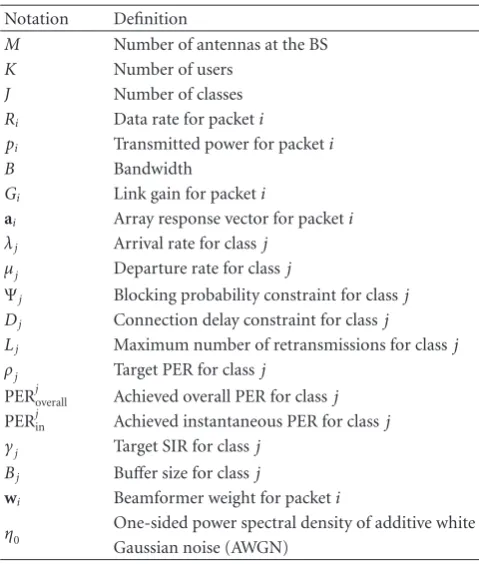
We will use the following notation: lnx is the natu-ral logarithm ofx, and∗denotes convolution. The super-scripts (·)H and (·)t denote hermitian and transpose, re-spectively; diag(a1,. . .,an) denotes a diagonal matrix with elements a1,. . .,an, and I denotes an identity matrix. For a random variable X, E[X] is its expectation. The nota-tion and defininota-tions used in this paper are summarized in Table 1.
Table1: Notation and definitions.
Notation Definition
M Number of antennas at the BS
K Number of users
J Number of classes
Ri Data rate for packeti
pi Transmitted power for packeti
B Bandwidth
Gi Link gain for packeti
ai Array response vector for packeti
λj Arrival rate for classj
μj Departure rate for classj
Ψj Blocking probability constraint for classj Dj Connection delay constraint for classj
Lj Maximum number of retransmissions for classj
ρj Target PER for classj
PERjoverall Achieved overall PER for classj
PERjin Achieved instantaneous PER for classj
γj Target SIR for classj
Bj Buffer size for classj
wi Beamformer weight for packeti
η0 One-sided power spectral density of additive white Gaussian noise (AWGN)
2. SIGNAL MODEL AND PROBLEM FORMULATION
2.1. Signal model at the physical layer
We consider an uplink CDMA beamforming system, in whichMantennas are employed at the BS and a single an-tenna is employed for each packet. There are K accepted packets in the system, and a channel with slow fading is as-sumed.
To highlight the design across physical and upper layers considered in this paper, the effects due to multipath are ne-glected. However, the proposed schemes in this paper can be extended straightforwardly to the case where multipath exists, provided multipath delay profile information is avail-able.
The received vector at the BS antenna array can be writ-ten as
x(t)=
K
i=1
PiGiaisi
t−τi
+n(t), (1)
wherePiandGidenote the transmitted power and link gain for packeti, respectively;aiis defined as the array response vector for packeti, which contains the relative phases of the received signals at each array element, and depends on the ar-ray geometry as well as the angle of arrival (AoA);si(t) is the transmitted signal, given bysi(t)=
It has been shown that the output of a matched filter sam-pled at the symbol interval is a sufficient statistic for the es-timation of the transmitted signal [14]. The matched filter for a desired packetkis given bycHk(−t). The output of the matched filter is sampled att =nT, whereT denotes sym-bol interval. Hence, the received signal at the output of the matched filter is given by [14]
xk(n)=x(t)∗cHk(−t)|t=nT
In order to reduce the interference, we employ a beam-forming weighting vectorwkfor a desired packetk. We can write the output of the beamformer as
yk(n)
We assume the signature sequences of the interfering users appear as mutually uncorrelated noise. As shown in [14], the received signal-to-interference ratio (SIR) for a de-sired packetkcan be written as
SIRk= B
where B and Ri denote the bandwidth and data rate for packeti, respectively, and the ratioB/Rirepresents the pro-cessing gain;pi=PiG2idenotes the received power for packet i, and η0 denotes the one-sided power spectral density of background additive white Gaussian noise (AWGN); the pa-rametersφ2iiandφ2ikare defined as
φ2ik=wH
kai2 (5)
which capture the effects of beamforming. In the following, we consider a spatially matched filter receiver, for example,
wk=ak.
QoS requirements in the physical layer
In a wireless communication network, we must allow for outage, defined as the probability that a target SIR, or equiv-alently, a target packet-error rate (PER), cannot be satisfied. The QoS requirement in the physical layer can be represented by a target outage probability.
In this paper, we rely on a relationship between a target SIR and a target PER. Although an exact relationship may not be available, we can obtain the target SIR according to
an approximate expression of PER. As discussed in [20], in a system with packet lengthNp (bits), the target SIR for a desired packeti, denoted byγi, can be approximated by
γi=1
g lna−lnρi
(6)
forγi ≥ γ0 dB, whereρidenotes the overall target PER;a, g, andγ0are constants depending on the chosen modulation and coding scheme. In the above expression, the interference is assumed to be additive white Gaussian noise, which is rea-sonable in a system with enough interferers.
2.2. Signal model in data-link and network layers
We consider a single-cell CDMA system which supports J classes of packets, characterized by different target PERsρj, different blocking probability requirementsΨj, and different connection delay requirements Dj, where j = 1,. . .,J. Re-quests for packet connections of class j are assumed to be Poisson distributed, with arrival ratesλj,j=1,. . .,J.
The admission control (AC) is performed at the BS. An AC policy is derived offline, and stored in a lookup table. When a packet is generated at the mobile station (MS), the MS sends an access request to the BS. In this request, the class of this packet is indicated. After receiving the request, the BS makes a decision, which is then sent back to the MS, on whether the incoming packet should be either accepted, queued in the buffer, or blocked. Similarly, whenever a packet departs, the BS decides whether the packet in the queue can be served (transmitted).
Once a packet is accepted, its first transmission round will be performed, and then the receiver will send back an acknowledgement (ACK) signal to the transmitter. A posi-tive ACK indicates that the packet is correctly received while a negative ACK indicates an incorrect transmission.
If a positive ACK is received or the maximum number of retransmissions, denoted byL, is reached, the packet releases the server and departs. Otherwise, the packet will be retrans-mitted. Therefore, the service time of a packet can comprise at mostL+ 1 transmission rounds. Each transmission round includes the actual transmission time of the packet and the waiting time of an ACK signal (positive or negative). The du-ration of a transmission round for a packet in class jis as-sumed to have an exponential distribution with mean dura-tion 1/μj, j=1,. . .,J. However, in this paper, a sub-optimal solution is also provided for a generally distributed duration. If the packet is not accepted by the AC policy, it will be stored in a queue buffer provided that the queue buffer is not full. Otherwise, the packet will be blocked. Each class of packets shares a common queue buffer, andBj denotes the queue buffer size of classj.
We note that there are two types of buffers in the system: queue buffers and server buffers. The queue buffer accom-modates queued incoming packets, while the server buffer accommodates transmitted packets in the server in case any packet in the server requires retransmission. For simplicity, we assume that the size of the server buffer is large enough such that all the packets in the server can be stored. In the fol-lowing, the generic term “buffer” refers to the queue buffer.
2.3. Problem formulation
The AC policy considered in this paper is for the uplink only. However, with an appropriate physical layer model for power allocation, the methodology can be extended straight-forwardly to the downlink AC problem. The uplink AC is performed at the BS, and the following information is nec-essary to derive an admission control policy: traffic model in the system, such as arrival and departure rate, and QoS re-quirements in both physical and network layers.
The overall system throughput is defined as the number of correctly received packets per second, given by
Throughput=
outdenote the blocking probability, target
PER, and outage probability for classjpackets, respectively. In this paper, we aim to derive an optimal AC policy which incorporates the benefits provided by multiple an-tennas and ARQ schemes. The objective is to maximize the overall system throughput given in (7), while simultaneously guaranteeing QoS requirements in terms of outage probabil-ity, blocking probabilprobabil-ity, and connection delay.
The above optimization problem can be formulated as a Markov decision process (MDP). With a required power con-trol feasibility condition (PCFC), combined with an ARQ-based reduced-outage-probability (ROP) algorithm, a target outage probability constraint can be satisfied. Blocking prob-ability and connection delay requirements can be guaranteed by the constraints of this MDP.
In the following, we first derive an approximate PCFC combined with an ARQ-based reduced-outage-probability (ROP) algorithm that can guarantee the outage probability constraint. Based on these results, we then formulate the AC problem as a Markov decision process. Afterward, we discuss how to design ARQ parameters optimally in order to achieve a maximum system throughput.
3. PHYSICAL LAYER INVESTIGATION: PCFC DERIVATION AND OUTAGE REDUCTION
To investigate the physical layer performance, we must de-rive an approximate PCFC, which ensures a positive power solution to achieve target SIRs. Due to the approximation of the derived PCFC, we then propose an ARQ-based ROP al-gorithm to reduce the resulting outage probability.
3.1. PCFC
In the physical layer, the SIR requirements of packetican be written as
SIRi≥γi (8)
fori=1,. . .,K, where SIRiis given in (4).
Inserting the SIR expression in (4) into (8), and letting SIRiachieve its target value,γi, we have the matrix form [15]
[I−QF]p=Qu, (9)
To ensure a positive solution for power vectorp, we re-quire the following power control feasibility condition [15],
ρ(QF)<1, (11)
whereρ(·) denotes the maximum eigenvalue.
The outage probability can be obtained as the probabil-ity that the above condition is violated. Although the state space, required by an optimal AC policy, can be formulated by evaluating the above outage probability, this evaluation relies on the number of packets as well as the distribution of AoAs for all the packets in the system, and thus results in a very high computation complexity. An approach to evaluate the above outage probability with reasonably low complexity is currently under investigation.
In this paper, we propose an alternative solution, which employs an approximated PCFC, and as a result can dramat-ically simplify the formulation of the state space.
Without loss of generality, we consider an arbitrary packetiin class 1, wherei= 1,. . .,K1. By considering
spe-cific traffic classes and letting SIR achieve its target value, the expression in (4) can be written as
γi=
0Bdenotes noise variance, and pi represents received power for packeti.
expression can be written as
By exchanging the numerator and denominator, (13) is equivalent to
Summing the above K1 equations, and calculating the
sample average, we obtain
p1
When the number of packets is large enough, by the weak law of large numbers, the above α1,. . .,αJ can be approxi-mated by their mean values, and (15) can be further simpli-fied as
in whichEmn[φint] is the expected fraction of an interferer packet in class n passed by a beamforming weight vector for a desired packet in classm, wherem,n=1,. . .,J, while Ej[φdes] is the expected fraction of a desired packet in classj
passed by its beamforming weight vector, wherej=1,. . .,J. The AoAs of active packets in the system are assumed to be independent and identically distributed, that are indepen-dent of a packet’s specific class. Therefore, it is reasonable to assume thatEmn[φint] is also independent of specific classes
mandn, which can be denoted byE[φint]. Similarly,Ej[φdes]
is independent of class j, and can be denoted by E[φdes].
E[φdes] andE[φint] represent the expected fractions of the
desired packet’s power and interference, respectively. From the above discussion, (16) can be written as
p1
By exchanging the numerator and denominator of the above equation, we have
p1 B
The QoS requirement for class 1 in (18) can be extended to any class j,
The power allocation solution can be obtained by solving the aboveJequations [21]
pj= σ
Positivity of the power solution implies the following power control feasibility condition:
J numerically from (5) for a beamforming system.
We note that the above approximated power control fea-sibility condition is independent of the angle of arrivals, and thus can provide a less-complicated offline AC policy, which does not require estimation of the current AoA realizations of each packet. However, due to the randomness of the ac-tual SIR, this deterministic power control feasibility condi-tion introduces outage. In the next seccondi-tion, we discuss how to mitigate the outage.
3.2. ARQ-based ROP
We first define two types of PERs. The overall achieved PER, denoted by PERoverallj , is defined as the probability that a class jpacket is incorrectly received after its maximum number of ARQ retransmissions is reached, for example, an error occurs in each of theLj+ 1 transmission rounds, whereLjdenotes the maximum number of retransmissions. The achieved in-stantaneous PER, denoted as PERjin(l), is defined as the prob-ability that an error occurs in a single transmission roundl for a classjpacket.
Under the assumption that each retransmission round is independent from the others, by using an ARQ scheme with a maximum of Lj retransmissions for class j, the achieved overall PER is constrained by [20]
PERjoverall=
The achieved outage probability for class j, denoted by Poutj , can be written as
Poutj =Prob
PERoverallj > ρj
=Prob Lj+1
l=1
PERjin(l)> ρj
,
(23)
where Prob{A}denotes the probability of eventA. By main-taining PCFC, PERin
j (l) remains unchanged. Therefore, by increasingLj, the outage probability in the above equation can be reduced.
4. AC PROBLEM FORMULATION BY INCLUDING ARQ
In the previous section, we have derived an approximated PCFC combined with an ARQ-based ROP algorithm in the physical layer. In the following, we discuss how to derive an AC policy in the network layer.
An optimal semi-Markov decision process (SMDP)-based AC policy as well as a low-complexity generalized-Markov decision process (GMDP)-based AC policy is dis-cussed.
4.1. SMDP-based AC policy
Traditionally, the decision epoches are chosen as the time in-stances that a packet arrives or departs. In the system under consideration, the duration of each packet may include sev-eral transmission rounds due to ARQ retransmissions, and as a result, the time duration until next system state may not be exponentially distributed. Therefore, the SMDP formulation approach discussed in [4–6], which assumes an exponentially distributed duration, cannot be applied here.
In the following, we propose a novel formulation in which the decision epoch is chosen as the arrival and de-parture of each transmission round. Based on these decision epoches, the time duration until the next state remains ex-ponentially distributed. The components of a Markov deci-sion process, such as state space, action space, and dynamic statistics, are modified accordingly to represent the charac-teristics of different transmission rounds. The formulation of this SMDP as well as its LP solution are now described.
State space and action space
Classjpackets are divided intoLj+1 subclasses, in which the state of theith subclass can be represented by the number of packets which are under theith round transmission, that is, the (i−1)th retransmission, wherei=1,. . .,Lj+ 1.
In admission problems, the discrete-value (finite) state at timet,s(t), can be written as
s(t)=n1
q(t),k1,1(t),. . .,k1,L1+1(t) !" #,. . .,
nJq(t),kJ,1(t),. . .,kJ,LJ+1(t) !" #
$T ,
(24)
wherekj,i(t) represents the number of active packets in class jand subclassiserved in the system, andnqj(t) denotes the number of packets in the queue buffer of class j. Since the arrival and departure of packets are random, {s(t),t > 0} represents a finite state stochastic process [4]. From here on, we will drop the time index.
The state spaceSis comprised of any state vectors, in which SIR requirements can be satisfied or, equivalently, the power control feasibility condition (PCFC) holds,
S=
s:nqj ≤Bj,j=1,. . .,J;
J
j=1
%Lj+1 l=1 k
j,l& 1 +B/γjRj
E φint
/E φdes
<1
,
(25)
where Bj denotes the buffer size of class j. We have men-tioned that the PCFC for the case of no ARQ is used in our AC problem, no matter how many retransmissions are al-lowed.
At each states, an action is chosen that determines how the admission control will perform at the next decision mo-ment [4]. In general, an action, denoted asa, can be defined as a vector of dimensionJj=1Lj+ 2J,
a=a1,d11,. . .,d L1+1
1
!" #. . .,aJ,d1J,. . .,d LJ+1 J !" #
$T
, (26)
whereaj denotes the action for class jif an arrival occurs, j=1,. . .,J. Ifaj=0, the new arrival is placed in the buffer provided that the buffer is not full or is blocked if the buffer is full; ifaj = 1, the arrival is admitted as an active packet, and the number of servers of classjis incremented by one.
The quantitydij, where 1 ≤ i ≤ Lj, denotes the action for class j packet if theith transmission round is finished, and is received correctly. Ifdij =0, where 1≤i≤Lj,kj,iis decremented by one, and no packets that are queued in the buffer are made active; if dij = 1, the number of servers is maintained by admitting a packet at the buffer as an active packet.
The quantitydLj+1
j denotes the action for class jpacket if a connection has finished its (Lj+1)th transmission round. If dLj+1
j =0, no packets that are queued in the buffer are made active, and kj,Lj+1 is decremented by one; ifdLj+1
j = 1, the number of servers is maintained by admitting a packet at the buffer as an active packet.
The admissible action space for states, denoted byAs, can be defined as the set of all feasible actions. A feasible action ensures that after taking this action, the next transition state is still in spaceS[4].
State dynamicspsy(a)andτs(a)
Table2: Expression of transition probabilitypsy. expected time until the next decision epoch after actionais chosen in the present states[4].
Derivations of τs(a) and psy(a) rely on the statistical properties of arrival and departure processes [4]. Since the arrival and departure processes are both Poisson distributed and mutually independent, it follows that the cumulative process is also Poisson, and the cumulative event rate is the sum of the rates for all constituent processes [4]. Therefore, the expected sojourn time,τs(a), can be obtained as the in-verse of the event rate,
τs(a)−1=λ1a1+λ1
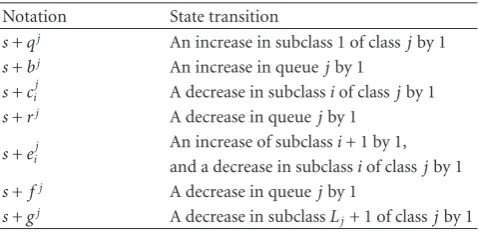
To derive the transition probabilities, we employ the de-composition property of a Poisson process, which states that an event of a certain type occurs with a probability equal to the ratio between the rate of that particular type of event and the total cumulative event rate 1/(τs(a)) [4]. Transition prob-ability psy(a) is shown inTable 2, whereρj denotes the tar-get packet-error rate for class j packets. The set of vectors {qj,bj,cij,rj,e
j
i,fj,gj} represents the possible state transi-tions from current states. Each vector in this set has a dimen-sion ofJj=1Lj+ 2J, and contains only zeros except for one or two positions. The nonzero positions of this set of vectors, as well as the possible state transitions represented by these vectors, are specified in Tables3and4, respectively.
Policy and cost criterion
For any given states ∈ S, an actiona, which decides if the new packet at the next decision epoch will be blocked or
ac-Table3: Definition of vectors inTable 2: each vector defined in this table has a dimension ofJj=1Lj + 2J, which contains only zeros
except for the specified positions.
Vector Nonzero positions
Table4: Representation of vectors inTable 2: each defined vector represents a possible state transition from current states.
Notation State transition and a decrease in subclassiof classjby 1
s+fj A decrease in queuejby 1
s+gj A decrease in subclassL
j+ 1 of classjby 1
cepted, is selected according to a specified policyR. A station-ary policyRis a function that maps the state space into the admissible action space.
We consider average cost criterion [4]. The cost criterion for a given policyRand initial states0, which includes
block-ing probability as a special case, is given as follows:
JR
wherec(s(t),a(t)) can be interpreted as the expected cost un-til the next decision epoch and is selected to meet the net-work layer performance criteria [4].
In the system under investigation, we are interested in blocking probability and connection delay constraints. If the cost criterionJR(s0) represents blocking probability, we have
c(s,a)= (1−aj)(1−δ(Bj−nqj)), and if the cost criterion JR(s0) represents connection delay, we havec(s,a)=n
j q. An optimal policyR∗that minimizes an average cost cri-terionJR(s0) for any initial states0exists,
JR∗(s0)=min
R∈RJR(s0), ∀s0∈S (30)
under the weak unichain assumption [23], where R is the class of admissible AC policies.
Solving the AC policy by linear programming (LP)
The optimal AC policyR∗ in (30) can be obtained by solving the following linear programming (LP):
min
whereDjandΨj denote the connection delay and blocking probability constraints, respectively, andηjis the coefficient representing the weighting of the cost function for a particu-lar class j, where j=1,. . .,J.
The optimal policy will be a randomized policy: the op-timal action a∗ ∈ As for states, whereAs is the admissi-ble action space, is chosen probabilistically according to the probabilitieszsa/
a∈Aszsa.
We remark that the above randomized AC policy can op-timize the long-run performance. The decision variables,zsa, wheres∈Sanda ∈Ax, act as the long-run fraction of de-cision epoches at which the system is in statesand action a. At each state s, there exists a set of feasible actions, and each action induces a different costc(s,a). The long-run per-formance can be optimized by appropriately allocating these time fractions, and the allocation leads to a randomized AC policy. When a deterministic policy is desired, a constraint regarding the decision variableszsashould be imposed into the above optimization problem, in order to ensure that at each states, there is one and only one nonzero decision vari-able. It is obvious that the more constraints we impose, the worse the achieved performance becomes. We choose a ran-domized AC policy in order to achieve long-run optimal per-formance.
4.2. GMDP-based AC policy
In the above, we provide an optimal SMDP formulation. The state space has dimension of 2J+Jj=1LjforJclasses of traf-fic. For large J and retransmission number, this leads to a computation problem of excessive size.
In order to reduce complexity, we consider the decision epoch as the time instances that a packet arrives or departs. As we discussed in the previous section, based on these de-cision epoches, the time interval until the next state is not exponentially distributed. Therefore, we have a generalized Markov decision process (GMDP). While an optimal solu-tion for this GMDP problem is hard to obtain, a linear pro-gramming approach provides a suboptimal solution [5].
We remark that the formulation of a GMDP is very simi-lar to the AC problem formulation employed in [4–6], except that the state space has been modified to include beamform-ing and the mean duration of a packet is modified to consider the impact of ARQ schemes.
In the formulated GMDP, decision epoches are chosen as the time instances that a packet arrives or departs. The arrival process for class jis assumed to have a Poisson distribution with arrival rateλj. The duration of the class jpackets may have a general distribution, with mean (1/μj)(1 +ρj+· · ·+ ρLjj), whereμjdenotes the departure rate for each transmis-sion round for the class jpackets.
The state spaceSis comprised of any state vectors, which satisfies SIR requirements,
wherekjdenotes the number of active packets for classj. At each decision epoch, an action is chosen as a = [a1,d1. . .,aJ,dJ]T, whereaj denotes the action for class jif an arrival occurs, j =1,. . .,Janddj denotes the action for class jpacket if a packet in this class departs. The admissible action space for states, denoted byAs, can be defined as the set of all feasible actions.
The state dynamics of a SMDP are completely specified by stating the transition probabilities of the embedded chain psy(a) and the expected holding timeτs(a), which are given in [4,5].
After formulating the AC problem as a GMDP, the AC policy, which minimizes the blocking probability, can be ob-tained by using the decision variableszsa,s∈S,a∈Asfrom linear programming which is presented in (31).
In a low instantaneous PER region, the suboptimal solu-tion proposed in the above is very close to the SMDP-based AC policy. Intuitively, when the PER is very low, retransmis-sion occurs only occaretransmis-sionally, and the duration of a packet would be very close to an exponential distribution. In this case, the LP approach would provide an optimal solution to the above GMDP.
We remark that unlike the SMDP-based AC policy in which the transmission round is assumed to have an expo-nential distribution, the GMDP-based AC policy discussed in the subsection can be applied to a system with a generally distributed transmission round.
4.3. Complexity
Initial ARQ parameters [L1,. . .,LJ]=[0,. . ., 0] [ρ1,. . .,ρJ]=[ρ01,. . .,ρ0J]
j=0
AC policy
Lj=Lj+ 1 EvaluatePoutj j=j+ 1
IfPoutj ≤target value
Loptj =Lj
Ifj=J yes
yes
No No
Stop
Figure1: Search procedure of the optimal number of retransmissions.
Once system parameters change, an updated policy is re-quired. However, in the system we investigate, the policy only depends on buffer sizes, long-term traffic model, and QoS re-quirements. These parameters are generally constant for the provision of a given profile of offered services. Therefore, an SMDP or GMDP-based policy has a very reasonable compu-tation complexity.
5. CROSS-LAYER DESIGN OF ARQ PARAMETERS
In the previous sections, we discuss how to derive the PCFC in the physical layer and how to derive admission control in the network layer. These derivations assume that ARQ pa-rameters such asLj andρj, where j = 1,. . .,J, are already known. In this section, we discuss how to choose these pa-rameters in order to guarantee outage probability constraints and optimize overall system throughput.
The search procedures for optimal ARQ parameters, de-noted as vectorsLopt =[Lopt
1 ,. . .,L opt
J ] andρopt =[ρ opt 1 ,. . .,
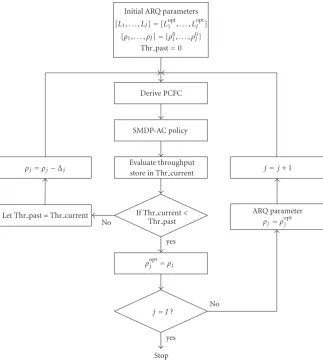
ρoptJ ], are demonstrated in Figures1and2, respectively. The initial parameters are set to [L1,. . .,LJ] = [0,. . ., 0] and [ρ1,. . .,ρJ] = [ρ10,. . .,ρ0J], where ρ0j represents the upper
bound target PER for class j, which can be specified for the system. InFigure 2,Δjrepresents the adjustment step size.
From the search procedures presented in Figures1and 2, it is observed that the number of allowed retransmissions Loptj , which can achieve a target outage probability, is mini-mized; and as a result, the network layer performance degra-dation can be minimized. Thus, network layer QoS require-ments in terms of blocking probability and connection de-lay can be guaranteed by formulating the AC problem as an SMDP or GMDP.
Summing above, by choosing ARQ parameters in a cross-layer context, QoS requirements in the physical and network layers can be guaranteed, and the overall system throughput can be maximized.
6. SIMULATION RESULTS
Initial ARQ parameters
[L1,. . .,LJ]=[Lopt1 ,. . .,LoptJ ]
[ρ1,. . .,ρJ]=[ρ01,. . .,ρ0J] Thr past=0
Derive PCFC
SMDP-AC policy
ρj=ρj−Δj Evaluate throughputstore in Thr current j=j+ 1
If Thr current< Thr past
ARQ parameter ρj=ρoptj Let Thr past=Thr current
ρoptj =ρj
j=J? yes
yes
No No
Stop
Figure2: Search procedure of the optimal target PER.
Table5: Numerical values ofE[φdes] andE[φint] in (20) and (21).
M 1 2 3 4 5 6
E[φdes] 1.0 1.0 1.0 1.0 1.0 1.0
E[φint] 1.0 0.5463 0.3950 0.3241 0.2460 0.2058
generality, we consider a single-path channel and a two-class system with a QPSK and convolutionally coded modulation scheme with rate 1/2 and a packet lengthNp=1080. Under this scheme, the parameters ofa,g, andγ0in (6) can be ob-tained from [20]. For simplicity, no buffer is employed in the simulation. Simulation parameters are presented inTable 6.
6.1. Performance of SMDP-based AC policies
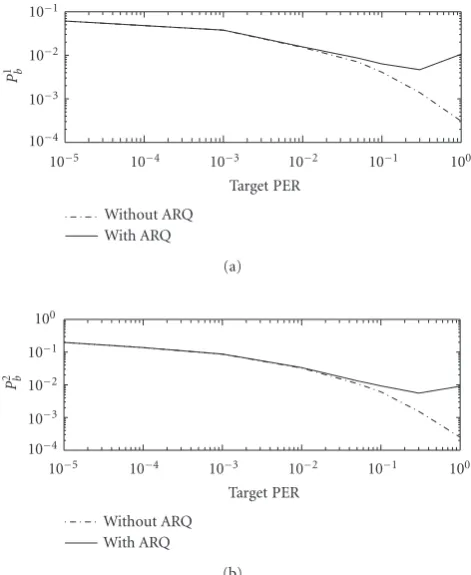
Here, we investigate how the ARQ scheme can reduce outage probability while only slightly degrading the network layer performance.
We examine the case in which only the class 2 packets can be retransmitted once, for example,L1=0 andL2 =1, and
an optimal SMDP-based AC policy is employed. The target PER for the class 1 packets is set to 10−4, while different target
Table6: Simulation parameters.
B 3.84 MHz a 90.2514
g 3.4998 γ0 1.0942 dB
R1 144 kbps R2 384 kbps
λ1 1 λ2 0.5
μ1 0.25 μ2 0.1375
Ψ1 0.1 Ψ2 0.2
D1 2.25 D2 0.5360
M 3 η0 10−6
η1 0.5 η2 0.5
PERs for class 2 are evaluated. We focus on the performance for the class 2 packets since only these packets are allowed re-transmission.Figure 3presents the analytical and simulated blocking probabilities as a function ofρ2. It is observed that
10−5 10−4 10−3 10−2 10−1 100 Target PER
0 0.01 0.02 0.03 0.04 0.05 0.06 0.07
P
1 b
Analytical result Simulation result
(a)
10−5 10−4 10−3 10−2 10−1 100
Target PER 0
0.05 0.1 0.15 0.2
P
2 b
Analytical result Simulation result
(b)
Figure3: SMDP-based AC policy: analytical and simulated block-ing probabilities as a function ofρ2in whichL1 =0,L2 =1, and ρ1=10−4.
the network layer performance degradation by employing ARQ, shows that the degradation can be ignored in a low PER region.
6.2. Performance of GMDP-based AC policies
In the above, we discussed the performance of SMDP-based AC policies, which require high computation. To reduce complexity, a GMDP-based AC policy can be employed. The target PER for class 1 is set to 10−4, while different target PER
requirements for class 2 are considered.
Figure 6 shows the analytical and simulated blocking probabilities as a function of target PER for the class 2 pack-ets. The gap between the simulated and analytical results is due to the non-exponential distribution of the packet dura-tion.
Figure 7 demonstrates that for a small number of re-transmissions, SMDP and GMDP-based AC policies have similar performance. Although performance comparison for largeLjis not presented here since an SMDP-based AC pol-icy would involve excessive computation, it is expected that for low PER, these two AC policies would still have similar performance. For a high PER, however, the packet duration is far from exponentially distributed, and thus linear pro-gramming cannot provide an optimal solution to a GMDP and its performance would be inferior to that of SMDP. In summary, GMDP-based AC policy provides a simplified ap-proach which is capable of achieving a near-optimal system
10−5 10−4 10−3 10−2 10−1 100 Target PER
10−3 10−2 10−1 100
Out
ag
e
p
ro
b
ab
il
it
y
Without ARQ With ARQ
(a)
10−5 10−4 10−3 10−2 10−1 100
Target PER 0
0.1 0.2 0.3 0.4 0.5
Thr
o
ug
hput
(pack
ets/sec
o
nd)
Without ARQ With ARQ
(b)
Figure4: SMDP-based AC policy: outage probability and through-put for class 2 packets as a function ofρ2in whichL1=0,L2 =1,
andρ1=10−4.
10−5 10−4 10−3 10−2 10−1 100 Target PER
10−4 10−3 10−2 10−1
P
1 b
Without ARQ With ARQ
(a)
10−5 10−4 10−3 10−2 10−1 100 Target PER
10−4 10−3 10−2 10−1 100
P
2 b
Without ARQ With ARQ
(b)
Figure5: SMDP-based AC policy: blocking probability degradation as a function ofρ2in whichL1=0,L2=1, andρ1=10
10−5 10−4 10−3 10−2 10−1 100
Figure6: GMDP-based AC policy: analytical and simulated block-ing probabilities as a function ofρ2in whichL1 =0,L2 =1, and ρ1=10−4.
performance for a system with low PER or a small number of retransmissions.
Figures8–10compare the performance among different numbers of retransmissions in whichρ1 =ρ2, andL1=L2.
From here on,Lj is denoted byLin the figures. We investi-gate the performance forLj =0, 1, and 2, respectively. The results for largeLjcan be extended straightforwardly. It is ob-served that in a low PER region, for example,ρj≤0.01, with an increasedLj, outage can dramatically be reduced, while the blocking probability is only slightly degraded. With only one retransmission allowed, the throughput can be improved by 100%. However, whenLj is increased beyond a certain level, for example,Lj=2 in the system under consideration, the outage reduction and throughput improvement are not significant. Beyond this threshold, further increasingLjmay even lead to a performance degradation due to a degraded network layer performance. From Figures8–10, we also con-clude that at high PER, the proposed ARQ-based ROP algo-rithm is not as efficient as in low PER.
6.3. Performance of a complete-sharing-based admission control policy
For a complete-sharing (CS)-based policy, whenever a packet arrives, the power control feasibility condition in (21) is eval-uated by incorporating information of this newly arrived packet. If this condition is satisfied, the incoming packet can be accepted, otherwise, the packet is stored in a buffer or blocked if the buffer is full. CS-based AC policy provides a
10−5 10−4 10−3 10−2 10−1 100
Figure7: Performance comparison between SMDP and GMDP-based AC policies as a function ofρ2 in whichL1 = 0,L2 = 1,
andρ1=10−4.
simple admission control algorithm but ignores the QoS re-quirements in the network layer.
We now provide a simple example for complete-sharing (CS)-based AC policy. For comparison purposes, the simula-tion results for a GMDP-based AC policy is also presented. In this example, both classes of packets are allowed to retrans-mit twice, for example,L1=L2=2.
We note that in a system with relaxed blocking proba-bility constraints, even a CS-based AC policy can satisfy all the QoS requirements. To illustrate the shortcoming of a CS-based AC policy, we now restrict the blocking probability constraint for class 2 to 0.05 without loss of generality, and all the other parameters inTable 6remain unchanged.
10−5 10−4 10−3 10−2 10−1 100 Target PER
10−6 10−4 10−2 100
P
1 b
L=0 L=1 L=2
(a)
10−5 10−4 10−3 10−2 10−1 100 Target PER
10−6 10−4 10−2 100
P
2 b
L=0 L=1 L=2
(b)
Figure8: GMDP-based AC polices: blocking probability as a func-tion of target PER in whichρ1=ρ2andL1=L2.
Table 7: Comparison between CS-based and GMDP-based AC policies, in whichL1=L2=2,ρ1=ρ2=10−4. The blocking
prob-ability constraint is set to [0.1, 0.05], and the connection delay con-straint is [2.25, 0.5360].
[B1,B2]GMDP:P1b GMDP:Pb2 GMDP:Pb CS:Pb1 CS:Pb2 CS:Pb
[0, 2] 0.0714 0.0359 0.0537 0.0978 0.0390 0.0684
[0, 3] 0.0764 0.0280 0.0522 0.1185 0.0171 0.0678
[1, 2] 0.0434 0.0412 0.0423 0.0505 0.040 0.0452
[3, 2] 0.0179 0.0379 0.0279 0.0210 0.0569 0.0389
is [3, 2], the blocking probability for class 2 packets is 0.0569, which exceeds its blocking probability constraint 0.05. How-ever, for the same buffer sizes, GMDP-based AC policy can always guarantee blocking probability constraints for both classes.
6.4. Choosing ARQ parameters
As discussed inSection 5, ARQ parameters, such asLj and ρj, should be chosen appropriately in order to achieve max-imum throughput while simultaneously satisfying the QoS requirements in the physical and network layers.
We now provide a simple example to illustrate how to obtain optimal ARQ parameters by using the algorithm pro-posed inSection 5. The initial target PERsρ0
j =0.05, where
10−5 10−4 10−3 10−2 10−1 100 Target PER
10−4 10−3 10−2 10−1 100
P
1 out
L=0 L=1 L=2
(a)
10−5 10−4 10−3 10−2 10−1 100 Target PER
10−5 100
P
2 out
L=0 L=1 L=2
(b)
Figure9: GMDP-based AC polices: outage probability as a function of target PER in whichρ1=ρ2andL1=L2.
j=1, 2, are given by the system which represents the upper bound of the target PER.
Using the algorithm presented inSection 5, the optimal ARQ parameters are derived asLopt1 = 1,L
opt 2 = 1,ρ
opt
1 =
0.005, andρopt2 =0.005, respectively, for outage probability
constraint [0.01, 0.01] and blocking probability constraints [0.1, 0.2]. If the blocking probability constraint remains un-changed, and the outage probability constraint is reduced to [10−3, 10−3], the optimal ARQ parameters can be derived as Lopt1 =2,L
opt 2 =2,ρ
opt
1 =0.01, andρ opt
2 =0.01, respectively.
6.5. Sensitivity of the proposed algorithm to traffic load
In this subsection, we study the sensitivity of the pro-posed AC policy to different traffic loads. Traffic load can be represented by the packet occupancy ratio, defined as [λ1/μ1,λ2/μ2]. The following traffic loads are investigated:
[(1, 1/2); (2, 1(1/2)); (3, 2(1/2)); (4, 3(1/2)); (5, 4(1/2))]. Letλandμdenote the overall arrival rate and the average departure rate, respectively, which can be expressed asλ = λ1+λ2andμ=(λ1/(λ1+λ2))μ1+(λ2/(λ1+λ2))μ2. The overall
10−5 10−4 10−3 10−2 10−1 100
Figure10: GMDP-based AC polices: throughput as a function of target PER in whichρ1=ρ2andL1=L2.
Figure 11presents the average blocking probability, out-age probability and throughput as a function of overall traffic load. With an increased traffic load, there will be an increased interfering power and thus the performance is degraded. We remark that for all the traffic loads investigated, the proposed ARQ-based ROP algorithm is able to reduce the outage prob-ability significantly at the cost of a slightly degraded network layer performance. Therefore, the proposed ARQ-based ROP algorithm can be applied to a wide variety of traffic condi-tions.
7. CONCLUSIONS
This paper provides a novel framework which exchanges in-formation among physical, data-link, and network layers, and as a result provides a flexible way to handle the QoS requirements as well as the overall system throughput. In this paper, we propose a cross-layer AC policy combined with an ARQ-based ROP algorithm for a CDMA beamform-ing system. Both optimal and suboptimal admission control policies are investigated. We conclude that in a low PER re-gion, for example, less than 10−2, the proposed AC policies are capable of achieving significant performance gain while simultaneously satisfying all QoS requirements. Numerical examples show that the throughput can be improved by 100% by employing only one retransmission. Although ARQ schemes may degrade network layer performance, this degra-dation can be adequately controlled by appropriately choos-ing ARQ parameters. Furthermore, the proposed AC policy and ARQ-based ROP algorithm can be applied to any traffic load.
Figure11: Blocking probability, outage probability, and through-put as a function of overall traffic load in whichρ1=ρ2=10−3.
ACKNOWLEDGMENT
The support of the Natural Sciences and Engineering Re-search Council of Canada, discovery Grant 41731, is grate-fully acknowledged.
REFERENCES
[1] M. Andersin, Z. Rosberg, and J. Zander, “Soft and safe admis-sion control in power-controlled mobile systems,”IEEE/ACM Transactions on Networking, vol. 5, no. 2, pp. 255–265, 1997. [2] Y. Bao and A. S. Sethi, “Performance-driven adaptive
admis-sion control for multimedia applications,” in Proceedings of IEEE International Conference on Communications (ICC ’99), vol. 1, pp. 199–203, Vancouver, BC, Canada, June 1999. [3] T.-K. Liu and J. Silvester, “Joint admission/congestion control
for wireless CDMA systems supporting integrated services,” IEEE Journal on Selected Areas in Communications, vol. 16, no. 6, pp. 845–857, 1998.
with LMMSE receivers,”IEEE Transactions on Signal Process-ing, vol. 51, no. 8, pp. 2031–2042, 2003.
[5] S. Singh, V. Krishnamurthy, and H. V. Poor, “Integrated voice/data call admission control for wireless DS-CDMA sys-tems,”IEEE Transactions on Signal Processing, vol. 50, no. 6, pp. 1483–1495, 2002.
[6] F. Yu, V. Krishnamurthy, and V. C. M. Leung, “Cross-layer op-timal connection admission control for variable bit rate multi-media traffic in packet wireless CDMA networks,”IEEE Trans-actions on Signal Processing, vol. 54, no. 2, pp. 542–555, 2006. [7] I. E. Telatar, “Capacity of multi-antenna Gaussian channels,”
European Transactions on Telecommunications, vol. 10, no. 6, pp. 585–595, 1999.
[8] A. Yener, R. D. Yates, and S. Ulukus, “Combined multiuser detection and beamforming for CDMA systems: filter struc-tures,” IEEE Transactions on Vehicular Technology, vol. 51, no. 5, pp. 1087–1095, 2002.
[9] S. M. Alamouti, “A simple transmit diversity technique for wireless communications,”IEEE Journal on Selected Areas in Communications, vol. 16, no. 8, pp. 1451–1458, 1998. [10] B. Hassibi and B. M. Hochwald, “High-rate codes that are
lin-ear in space and time,”IEEE Transactions on Information The-ory, vol. 48, no. 7, pp. 1804–1824, 2002.
[11] V. Tarokh, N. Seshadri, and A. R. Calderbank, “Space-time codes for high data rate wireless communication: performance criterion and code construction,”IEEE Transactions on Infor-mation Theory, vol. 44, no. 2, pp. 744–765, 1998.
[12] G. J. Foschini, “Layered space-time architecture for wireless communication in a fading environment when using multi-element antennas,”Bell Labs Technical Journal, vol. 1, no. 2, pp. 41–59, 1996.
[13] S. D. Blostein and H. Leib, “Multiple antenna systems: their role and impact in future wireless access,”IEEE Communica-tions Magazine, vol. 41, no. 7, pp. 94–101, 2003.
[14] F. Rashid-Farrokhi, L. Tassiulas, and K. J. R. Liu, “Joint op-timal power control and beamforming in wireless network-susing antenna arrays,”IEEE Transactions on Communications, vol. 46, no. 10, pp. 1313–1324, 1998.
[15] G. Song and K. Gong, “Performance comparison of optimum beamforming and spatially matched filter in power-controlled CDMA systems,” inProceedings of IEEE International Confer-ence on Communications (ICC ’02), vol. 1, pp. 455–459, New York, NY, USA, April-May 2002.
[16] A. M. Wyglinski and S. D. Blostein, “On uplink CDMA cell ca-pacity: mutual coupling and scattering effects on beamform-ing,”IEEE Transactions on Vehicular Technology, vol. 52, no. 2, pp. 289–304, 2003.
[17] K. I. Pedersen and P. E. Mogensen, “Directional power-based admission control for WCDMA systems using beamforming antenna array systems,”IEEE Transactions on Vehicular Tech-nology, vol. 51, no. 6, pp. 1294–1303, 2002.
[18] J. Evans and D. N. C. Tse, “Large system performance of linear multiuser receivers in multipath fading channels,”IEEE Trans-actions on Information Theory, vol. 46, no. 6, pp. 2059–2078, 2000.
[19] S. Brueck, E. Jugl, H.-J. Kettschau, M. Link, J. Mueckenheim, and A. Zaporozhets, “Radio resource management in HSDPA and HSUPA,”Bell Labs Technical Journal, vol. 11, no. 4, pp. 151–167, 2007.
[20] Q. Liu, S. Zhou, and G. B. Giannakis, “Cross-layer combining of adaptive modulation and coding with truncated ARQ over wireless links,”IEEE Transactions on Wireless Communications, vol. 3, no. 5, pp. 1746–1755, 2004.
[21] A. Sampath, P. S. Kumar, and J. M. Holtzman, “Power control and resource management for a multimedia CDMA wireless system,” inProceedings of the 6th IEEE International Sympo-sium on Personal, Indoor and Mobile Radio Communications (PIMRC ’95), vol. 1, pp. 21–25, Toronto, Canada, September 1995.
[22] A. Wyglinski, “Performance of CDMA systems using digital beamforming with mutual coupling and scattering effects,” M.S. thesis, Queen’s University, Kingston, Ontario, Canada, 2000.