Interoperability of Annotation Schemes: Using the Pepper framework to
display AWA documents in the ANNIS interface
Talvany Carlotto
∗
, Zuhaitz Beloki
†
, Xabier Artola
†
, Aitor Soroa
†
∗Center for Language and Cognition Groningen, University of Groningen, Groningen, Netherlands,
†IXA NLP Group, University of the Basque Country, Donostia, Basque Country
∗[email protected],†xabier.artola, zuhaitz.beloki, [email protected]
Abstract
Natural language processing applications are frequently integrated to solve complex linguistic problems, but the lack of interoperability between these tools tends to be one of the main issues found in that process. That is often caused by the different linguistic formats used across the applications, which leads to attempts to both establish standard formats to represent linguistic information and to create conversion tools to facilitate this integration. Pepper is an example of the latter, as a framework that helps the conversion between different linguistic annotation formats. In this paper, we describe the use of Pepper to convert a corpus linguistically annotated by the annotation scheme AWA into the relANNIS format, with the ultimate goal of interacting with AWA documents through the ANNIS interface. The experiment converted 40 megabytes of AWA documents, allowed their use on the ANNIS interface, and involved making architectural decisions during the mapping from AWA into relANNIS using Pepper. The main issues faced during this process were due to technical issues mainly caused by the integration of the different systems and projects, namely AWA, Pepper and ANNIS.
Keywords:Interoperability, AWA, Pepper, relANNIS, ANNIS
1.
Introduction
Natural language processing (NLP) applications demand the integration of many basic linguistic processing mod-ules (Tokenization, POS tagging, Named Entity Recogni-tion and ClassificaRecogni-tion, Syntactic Parsing, Coreference Res-olution, etc.) that perform linguistic analysis at several levels. Sophisticated applications such as event extraction systems, for example, are built upon those basic modules, which are typically combined to build complex process-ing workflows. However, application developers face many challenges when combining NLP modules, which are often tailored to the particular needs of the task at hand and, thus, difficult to integrate. Arguably, one of the main problems encountered when combining NLP modules is the lack of interoperability among them, as each module uses different mechanisms and formats to represent their output, i.e., their annotations.
Nowadays, there exist many linguistic annotation schemes that define logical levels of annotation independent of the annotation’s physical format, and are thus able to represent linguistic annotations on many levels. For instance, GATE (Cunningham et al., 1996), AWA (Artola et al., 2009), PAULA (Dipper and G¨otze, 2005) or NAF (Fokkens et al., 2014) are some of the most relevant projects where stand-off annotation is used to deal with the combination of mul-tiple overlapping hierarchies characteristic of the multidi-mensional nature of linguistic information.
There have been also attempts to establish standards for representing linguistic information with the aim of facilitat-ing effective resource management and integration of NLP tools (Ide and Romary, 2004). However, as desirable as it might be, expecting such a unique representation standard to be adopted by the NLP community is unrealistic. The reasons for this are numerous, including, among others, the following:
• Linguistic standards are developed following diverse
goals, often contradictory ones. A linguistic standard has to be able to represent a great variety of linguistic phenomena, yet it has to do so in a rigid, unambigu-ous way, so that users know how to map their internal representation to the standard representation.
• NLP is a very active area of research, where new tech-niques and applications are constantly developed. De-vising a uniform representation scheme that is able to cover all the linguistic levels required today is very difficult, if not impossible.
• There exist many representation schemes which lack proper toolsets, libraries and APIs upon which to effectively build applications. For instance, the ISO/TC37/SC 4 standard on language resource man-agement lacks, as far as we know, any library or API that allows its use. Likewise, tools for visualizing an-notations, or tools for aiding corpus manual annotation are missing.
• Many representation schemes have been designed with a particular language (or language family) in mind, which hinders its adoption for languages with different morphosyntactic structures.
In this paper we study the interoperability among annota-tion schemes by using the Pepper architecture (Zipser et al., 2015). Pepper is a framework for the conversion of lin-guistic annotations among formats. It uses a data model named Salt as a lingua francaamong linguistic schemes, and the conversion among formats is achieved by mapping each one into Salt. Pepper can be used to convert docu-ments into the relANNIS format, which in turn is supported by ANNIS (Krause and Zeldes, 2014), a corpus search tool that supports diverse multilayer corpora with appropriate search and visualization .
(described in section 2.) into the Pepper framework. As a result, we can benefit from the libraries and visualization tools offered by ANNIS. Our experiment not only allows us to visualize and search for AWA annotations in an inter-face known for its accessibility, performance and scalabil-ity features (Krause and Zeldes, 2014), but it also reveals some challenges and practical issues one has to face when dealing with interoperability aspects on linguistic annota-tion schemes.
2.
AWA
The Annotation Web Architecture (AWA) representation scheme was presented by Artola et al. (2009), with the aim of facilitating the communication between linguistic pro-cessors in a variety of NLP applications. AWA is specifi-cally designed to represent morphologispecifi-cally-rich languages such as Basque, and also to represent interpretational am-biguity at many levels. AWA guarantees that linguistic an-notations are properly represented, and avoids information redundancy. The AWA scheme defines a layered annotation format. If a process is meant to add information that cannot be described by existing layers, it simply adds a new an-notation layer. Any previous layers remain intact and can still be used by other processes. Layers are connected by references from one layer to items in another (lower-level) layer.
The design goals and main characteristics of the AWA scheme enable multi-level interoperability among linguis-tic processors, and nowadays there exist several NLP tools that produce and consume AWA documents, such as Mor-pheus(Alegria et al., 1996), a wide-coverage morphosyn-tactic analyzer for Basque, and Eustagger (Ezeiza et al., 1998), a general-purpose tagger/lemmatizer. The represen-tation schemes corresponding to the annorepresen-tations of the fol-lowing processors have also been defined: Ixati (Alegria et al., 2006), a shallow parser, which includes the NERC tool Eihera+;Edgk/MaltIxa(Aranzabe et al., 2012), a de-pendency grammar parser; EusWN (Agirre et al., 2014), a word-sense disambiguator that uses an algorithm based on random walks over the Basque WordNet; and a named-entity disambiguator that links named-entity names with the cor-responding Wikipedia pages (Fernandez et al., 2011). In addition, several tools have been developed to manage an-notations and corpora represented in the AWA scheme: EU-LIA(Artola et al., 2009), an environment to manually anno-tate AWA documents;Armiarma1, a web interface to search
documents in corpora annotated in AWA and to disam-biguate them at segmentation, morphosyntactic or lemma-tization level; andAbar-Hitz(D´ıaz De Ilarraza et al., 2004), a graphical and language-independent tool for the creation and management of the Basque Dependency Treebank. This extensive application of the model shows that AWA constitutes a coherent and flexible representation scheme that serves as the basis for the exchange of information at different levels of analysis.
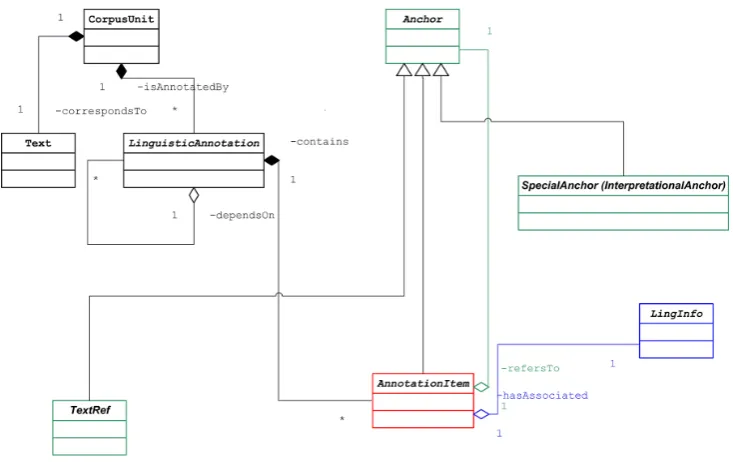
All the elements in AWA belong to three basic types (see Figure 1):
1
http://ixa2.si.ehu.es/armiarma
Anchor: these elements represent nuggets of information to which linguistic information is attached. They can vary from physical elements found in the input text (character offsets or XPointer expressions referring to specific points or ranges within an XML document) to annotation items resulting from earlier annotation processes. In particular, AWA allows linguistic anno-tations produced in a given step to be later used as anchors in a subsequent linguistic annotation phase. For instance, in AWA we can create an annotation that attaches information to a specific analysis of a word, rather than to the word itself. This is a powerful fea-ture, which allows an accurate representation of a very broad range of linguistic phenomena. Structural ambi-guity is represented by annotations that correspond to overlapping anchors.
AnnotationItem(links): Links are the annotation
out-comes of linguistic analysis processes, and each link connects one single linguistic interpretation to an chor. Several links can be connected to one same an-chor, which allows the representation of interpretation ambiguity. In this case, the disambiguation is carried out by marking only one of the links as correct, and considering the other ones as incorrect.
LingInfo: these elements represent the different types
of linguistic content resulting from the analysis pro-cesses. In AWA, linguistic content is represented by typed, TEI-encoded feature structures. In morpho-logical segmentation, lemmatization, and other pro-cesses, the linguistic content is composed of actual word forms, which allows the use of massive com-mon libraries that contain them as feature structures. This saves both processing time and storage space, as words only need to be analyzed when they first occur. The previously mentioned classes are the main types of the AWA representation scheme. However, different special-izations of the main classes are available in AWA to repre-sent the following levels of analysis: tokenization, multi-words, segmentation, morphosyntax, dependency, corefer-ence, shallow syntax and constituent trees.
Sometimes, an anchor is not a single annotation generated in a preceding step, but a more complex structure of anno-tation groups. AWA accepts this kind of anchors in a nat-ural manner, allowing new anchor classes to inherit from the mainAnchor. This is especially useful when an an-notation must refer to a group of anan-notations representing a semantic interpretation.
3.
Integrating AWA into ANNIS
Figure 1: Abstract view of the Annotation Web Architecture.
Pepper is a framework for converting between different lin-guistic annotation formats. Pepper supports many formats by default, such as EXMARalDA, Tiger XML, MMAX2, RST, TCF, TreeTagger format, relANNIS and PAULA. Nevertheless, the framework can be extended to support custom formats by implementing a plugin module that maps the new format to and from any of the supported for-mats. As AWA is not one of the formats supported by the Pepper framework, we had to develop a module in the Pep-per framework, so we could integrate AWA annotations into Pepper, and therefore convert AWA documents into relAN-NIS documents.
The creation of a new module in Pepper has no relation to the target format of the desired conversion. New mod-ules perform conversions from the source format (AWA in our case) to an intermediate format called Salt. Salt is a graph-based, abstract model, general enough to allow the representation of almost any linguistic format. The conver-sion from the Salt format into the target format (relANNIS in our case) is carried out by Pepper as default. When a new module is integrated in Pepper, the conversion of doc-uments in formats supported by the new module can be per-formed by the Pepper interface. The user provides the Pep-per interface with a flow document containing instructions about the source and target formats and folders, and Pepper performs the conversion.
In AWA, each annotation layer is composed of several TEI-like files, which represent the annotations corresponding to one given document2. As traditionally source documents
used in Pepper are composed of one single file per docu-ment, Pepper tries to convert every file containing the ex-tension supported by the source format into a new docu-ment. In our module, we had to filter documents during this
2
Although, since 2015, Pepper also supports the conversion of TEI documents, the conversion provided by Pepper is not enough to convert a group of interrelated AWA/TEI documents.
documents creation, and only execute it for the first file of every AWA document. Since all AWA files are compressed with the.bz2 extension, we defined.bz2 as the supported file extension for AWA in Pepper.
The organization of corpora and of corpus documents is dif-ferent between AWA and relANNIS. Take, for instance, the basic corpora file structure in both formats. In AWA, each document has a system folder containing all the files that represent the annotations of that specific document. A cor-pus in AWA is composed by a variety of these folders. In relANNIS, however, a corpus is one list of files correspond-ing to the different layers of the corpus. Every file contains information about a specific layer regarding all the docu-ments in the corpus. One of the outcomes of that differ-ence is that one corpus in AWA has many more files than a corpus in relANNIS, but files in relANNIS can become considerably large, while in AWA they tend to maintain a size limit. Figure 2 shows a diagram depicting a simplified version of the conversion process from an AWA corpus into a relANNIS corpus.
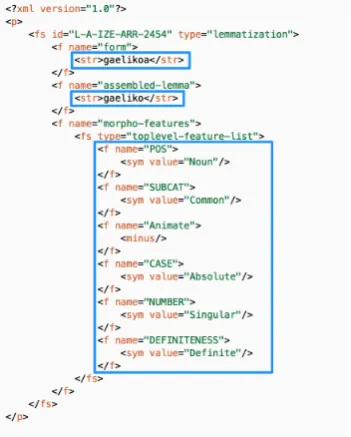
To give another example of differences between the for-mats, let us take a look in a simple annotation both in AWA and relANNIS. The wordgaelikoais an example token in a document of our corpus. In AWA, the annotation for that specific word in that specific document is XML-encoded, as displayed in Figure 3. In relANNIS, however, the word receives a code (23176, in the example of Figure 4), which is mapped in a separate document, and the annotations can be found in the tabulated format depicted in Figure 4. Tokenization of words in AWA-annotated corpora results in a file that stores, for each token, its initial position in the original text and its offset. That approach is not compatible for converting AWA into Salt. Some special characters that are present in some AWA documents, as, for instance, the
Figure 2: A diagram representing the conversion from an AWA corpus into a relANNIS corpus.
Figure 3: Example of annotation in AWA. The annotations for the word gaelikoa(Basque for gaelic) are highlighted by the blue rectangles.
In our Pepper model, we did not use the offsets stored in the AWA documents. The tokenization process had to be reimplemented inside the model with the creation of new offsets. The new offsets were obtained by looking for each token in the original document using a starting search point, initially the beginning of the document. When the token is found, its last position becomes the new starting search point for the next token, and so on.
The actual amount of code that had to be written for the experiment was not considerably large - it consisted of two Java classes containing around 100 lines. Most of the work involved taking the architectural decisions described above while mapping AWA into Pepper and dealing with the setup and integration of Pepper and ANNIS.
Figure 4: Example of annotation in relANNIS. The anno-tations for the wordgaelikoa are highlighted by the blue rectangle.
4.
Experiments and testing
Three basic steps are required to use an AWA corpus in the ANNIS interface. First, (1) the new Pepper module we de-veloped is used to make the conversion from the AWA doc-uments into the relANNIS format; then (2) the newly con-verted files have to be imported into the ANNIS database; and finally (3) we can execute queries in the ANNIS inter-face. Steps one and two have to be executed only once, i.e., it is not necessary to make the conversions every time you wish to execute queries in the corpus.
We used a corpus of one thousand AWA-annotated docu-ments to evaluate performance, corresponding to approxi-mately 40 megabytes of files. Each of the three steps was executed three times to have an average time, and all ex-ecutions were processed by a computer equipped with a 2.6 GHz processor and 8GB of RAM memory. The first step (conversion from AWA into relANNIS) took in aver-age fourteen minutes to finish for the one thousand docu-ment corpus. The second step (importing the docudocu-ments into the ANNIS database) took in average five minutes to finish. The performance of the third step will be explained with an example in the following paragraphs.
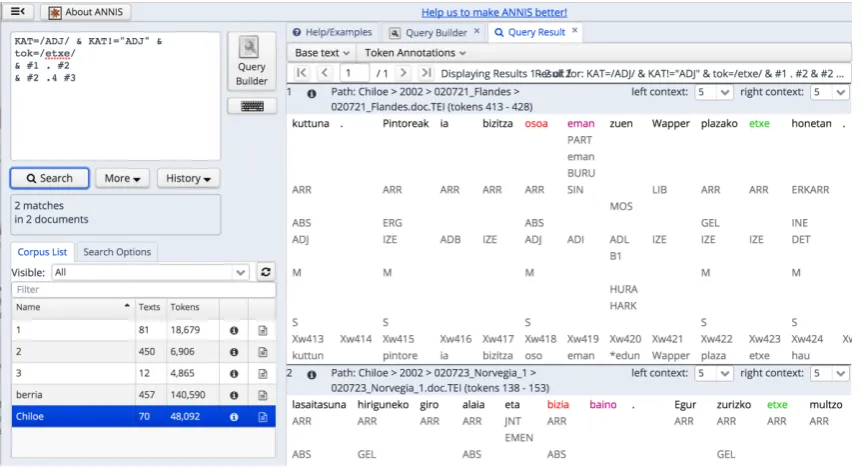
Figure 5 shows the result for a query that looks for occur-rences of an adjective (in red in the image) followed by a non-adjective word (in purple in the image), followed by two any words followed by a word with lemma etxe
[image:4.595.82.258.297.516.2]Figure 5: Example query in the ANNIS interface.
described here was executed on the ANNIS interface and looked for results in the one thousand documents of the cor-pus. It took less than one second for the results start to show up on the screen. Queries can be simpler or more complex than this one, but we should mention that, for all queries we tried in this corpus (less complex than the example or more complex than the example), it took less than one second for the first results to appear.
5.
Conclusions
This paper addresses the problem of interoperability among annotation schemes. We describe a practical experiment to map AWA annotations into the relANNIS format and we show the feasibility of our approach. As a practical result, corpora annotated following AWA can be graphically visu-alized and consulted using ANNIS.
From the experiment, we have learned lessons we believe to be a valuable contribution for anyone interested in integrat-ing NLP tools that use heterogeneous annotation formats. Both Salt and AWA are very general schemes that follow conceptually sound principles, avoid information duplica-tion, and properly represent linguistic annotations at many levels. In our opinion, this is corroborated by the fact that the conversion has been possible without major problems, and that no information has been lost in the way.
The main problems faced were due to technical issues such as the use of different character encoding by the systems, which complicate practical aspects such as computing the right offsets of textual anchors.
The lack of technical expertise using the Pepper framework has been another important obstacle, as well as the fact that the documentation was not up to date. However, the Pepper developers have been eager to help and they have offered us excellent technical support.
Based on our experience, we believe that similar experi-ments of integrating specific annotation schemes as AWA
into ANNIS would face a similar situation to ours. We con-sider Pepper a powerful tool in that process, and believe that other researchers would benefit from its use. However, the issues that are described in this paper should be taken into account when trying to replicate the same experiment.
6.
Bibliographical References
Agirre, E., de Lacalle, O. L., and Soroa, A. (2014). Ran-dom walks for knowledge-based word sense disambigua-tion. Computational Linguistics, 40:1. ISSN 0891-2017, 40(1):forthcoming.
Alegria, I., Artola, X., Sarasola, K., and Urkia, M. (1996). Automatic morphological analysis of Basque. Literary & Linguistic Computing, 11(4):193–203.
Alegria, I., Arregi, O., Ezeiza, N., and Fernandez, I. (2006). Lessons from the Development of a Named En-tity Recognizer. Procesamiento del Lenguaje Natural, (36):25–37.
Aranzabe, M., Bengoetxea, K., D´ıaz de Ilarraza, A., Ezeiza, N., Goenaga, I., and Gojenola, K. (2012). Combining rule-based and statistical syntactic analyzers. In ACL 2012 Joint Workshop on Statistical Parsing and Seman-tic Processing of Morphologically Rich Languages (SP-Sem-MRL 2012), Association for Computational Lin-guistics (ACL), USA, ISBN: 978-1-937284-30-5, pages 48–54, Jeju Island, Republic of Korea.
Artola, X., D´ıaz de Ilarraza, A., Soroa, A., and Sologais-toa, A. (2009). Dealing with complex linguistic anno-tations within a language processing framework. IEEE Transactions on Audio, Speech and Language Process-ing, 17(5):904–915.
Cunningham, H., Wilks, Y., and Gaizauskas, R. J. (1996). GATE: a General Architecture for Text Engineering. In
D´ıaz De Ilarraza, A., Garmendia, A., and Oronoz, M. (2004). Abar-hitz: An annotation tool for the basque de-pendency treebank. InProceedings of LREC2004, pages 251–254.
Dipper, S. and G¨otze, M. (2005). Accessing heterogeneous linguistic data. generic XML-based representation and flexible visualization. In V. Saraswat et al., editors, In Proceedings of the 2nd Language & Technology Confer-ence: Human Language Technologies as a Challenge for Computer Science and Linguistics, pages 206–210. MIT Press, Poznan, Poland.
Ezeiza, N., Aduriz, I., Alegria, I., Arriola, J. M., and Urizar, R. (1998). Combining stochastic and rule-based methods for disambiguation in agglutinative languages. In Proc. of COLING-ACL’98, pages 10–14, Montreal (Canada).
Fernandez, I., Alegria, I., and Ezeiza, N. (2011). Seman-tic relatedness for named entity disambiguation using a small wikipedia. InText, Speech and Dialog, TSD 2011, pages 276–283.
Fokkens, A., Soroa, A., Beloki, Z., Ockeloen, N., Rigau, G., van Hage, W. R., and Vossen, P. (2014). NAF and GAF: Linking linguistic annotations. In To appear in Proceedings of 10th Joint ACL/ISO Workshop on Inter-operable Semantic Annotation (ISA-10).
Ide, N. and Romary, L. (2004). International standard for a linguistic annotation framework. Natural Language En-gineering, 10(3-4):211–225.
Krause, T. and Zeldes, A. (2014). Annis3: A new architec-ture for generic corpus query and visualization. Digital Scholarship in the Humanities.