R E S E A R C H
Open Access
Performance analysis and optimization
for non-uniformly deployed mmWave
cellular network
Xuefei Zhang
1*, Yinjun Liu
1, Yue Wang
1and Juan Bai
2Abstract
In this paper, we propose a multi-tier mmWave cellular framework where sub-6 GHz macro BSs (MBSs) are assumed as a Poisson point process (PPP) and small-cell BSs (SBSs), operating on either mmWave or sub-6 GHz, follows
non-uniform Poisson cluster point (PCP) model. This paper proposes both centralized and distributed user association algorithms. For the centralized two-step algorithm, we aim to maximize the sum rate while satisfying quality of service (QoS) and power consumption constraints based on eigenvalue analysis. Then, we derive the association probability, the coverage probability, and the average achievable rate, cosidering directivity and blockage effect, by stochastic geometry. On this basis, a distributed user association algorithm is proposed. The simulation results demonstrate the accuracy of our theoretical analysis and also reveal the effect of some parameters on the network performance. In addition, the proposed centralized algorithm can achieve near-optimal sum rate with a low complexity.
Keywords: MmWave cellular network, Non-uniform distribution, Stochastic geometry
1 Introduction
Nowadays, the fifth generation mobile communication network (5G) are undoubtedly one of the most attractive topics in both academic and industrial fields. Many res earchers engage themselves to explore the new advanced methodologies and technologies in 5G, to support the booming data traffic with reduced energy consump-tion and improved quality of service (QoS) provision. Some enabling technologies, such as heterogeneous net-works (HetNets), massive multiple-input multiple-output (MIMO), and millimeter wave (mmWave) techniques, have been identified to bring 5G to fruition [1].
MmWave communications, which operate from 30 GHz to 300 GHz, have attracted much attention due to the shortage of microwave frequency [2]. It can provide the larger bandwidth, which can support the higher data rate transmission. Besides, mmWave communications have no effect on the traditional cellular communication in sub-6 GHz, since they operate at the higher and different frequencies. Therefore, the deployment of mmWave BSs
*Correspondence:[email protected]
1National Engineering Laboratory for Mobile Network Technologies, Beijing University of Posts and Telecommunications, 100876 Beijing, China Full list of author information is available at the end of the article
not only offloads the data traffic of existing cellular fre-quency, but also reduces the interference. However, a major channel characteristic of mmWave communica-tions is its sensitivity to the blockages, which is a serious problem due to the poor performance of mmWave links at penetrating into or diffracting around solid objects [3]. Therefore, mmWave communication is commonly used in short-range directional transmission with directional antennas instead of isotropic antennas. On the other hand, the rigorous directivity and high penetration losses lead to the fact that mmWave systems are noise-limited. There-fore, the user association algorithms designed for the interference-limited networks cannot be directly applied in the mmWave systems [4].
Due to the two mentioned fundamental differences from conventional sub-6 GHz cellular systems, the channel models of mmWave communications should be modeled carefully. Some research proposed the mmWave-pattern models including the effects of blocking, directional beamforming, small-scale fading, and path loss for line-of-sight (LOS) and non-line-of-sight (NLOS) links [3–5]. Specifically, the blockages, resulting in the serious power loss at the high mmWave frequencies, are assumed stationary and isotropic [5,6]. For mathematical
tractability, a LOS ball model was proposed for simpli-fying blockage modeling where BSs inside the LOS ball were considered to be in LOS whereas any BS outside of the LOS ball was treated as NLOS [6]. In [7], this blocking model was modified by adding a LOS probability within the LOS ball, and this approach was shown to reflect sev-eral realistic blockage scenarios. Meanwhile, the pathloss exponent is considered higher in NLOS links (e.g., com-monly about 4) than that in LOS links (e.g., around 2) [8]. Furthermore, some real data is obtained to verify the parameters of some blocking model (e.g., real building data in the UT Austin, downtown LA regions, NYC, and Chicago [4,6]). It is revealed that the environment has the effect on the block behaviors, and the blocking models should be carefully selected according to the propagation environment (e.g., 3GPP-like models could be sufficient to fit the urban regions; generalized LOS ball model gives a good fit for dense random deployment of BSs, etc. [4]).
Meanwhile, the directional beamforming, for compen-sating the increased path loss at mmWave frequencies and for overcoming the more serious noise due to the large transmission bandwidth, is approximated by considering a sectored antenna model [9,10]. In [9], mmWave BSs are equipped with directional antennas, and UEs perform the perfect beam alignment, whereas in [10], both the users and mmWave BSs are assumed to estimate the angles of arrival and to adjust their antenna orientations accord-ingly. Moreover, large antenna arrays, enabling massive MIMO and hybrid beamforming techniques, can con-tribute to the directive transmission. The rate of multi-user MIMO with hybrid beamforming [11] or with multi-user pairing [12] or joint spatial division and multiplexing [13] in mmWave network are analyzed.
2 Methods/experimental
Motivated by the mathematical tractability, stochastic geometry has been accepted as a popular and useful tool to analyze performance of HetNets, and some sig-nificant results and conclusions are obtained [14–19]. Stochastic geometry is introduced into the mmWave net-work analysis where locations of both sub-6 GHz and mmWave BSs are considered as Poisson point process (PPP), and block effects are incorporated into the sys-tem model [20]. The expressions, or upper and lower bound of some performance metrics (e.g., coverage prob-ability, outage probprob-ability, average rate, etc.) are derived mostly under PPP-based mmWave network scenario [3, 4, 6, 9, 10]. Actually, as one of capacity-increasing techniques, mmWave BSs commonly work along with the cellular network and are distributed only on some hot spot areas. Therefore, non-uniform location distribution of mmWave BS is more appropriate to model the real-istic scenario. To the best of our knowledge, few works adopt the non-uniform mmWave BS location distribution
model, which will be the main difference of our paper from previous papers. In this paper, we make centralized and a distributed user association analysis for mmWave cellular system. The contributions of this paper can be summarized as
• We propose a centralized two-stage user association and power control algorithm to maximize the network sum rate while satisfying SINR and power consumption constraints. The optimization problem is divided into user association and power control subproblems. Specifically, for user association, the eigenvalue analysis is performed to drop
communication links successively that cause the maximum sum of the interference power in the network until the feasibility condition is satisfied. In addition, binary power (BP) allocation is applied to solve the optimal power allocation.
• We derive analytical expressions on the association probability, the coverage probabilities, and the average achievable rate, considering directivity and blockage effect, using stochastic geometry. On this basis, a distributed distance-based user association method is proposed to decide the pattern of BSs (conducting in either sub-6 GHz or mmWave).
The remainder of this paper is organized as follows. In
Section 3, the system model for mmWave cellular
net-works is described. The proposed centralized algorithms are presented in Section 4. In Section 5, the analytical expressions for the association probability, coverage prob-ability, and the average achievable rate are derived. Fur-ther, a distributed distance-based user association method is proposed to decide the patterns of BSs. Simulation results are provided in Section6to compare the perfor-mance of the proposed algorithms, which are followed by our conclusions in Section7.
3 System model
We consider a downlink mmWave cellular network. Specifically, macro base stations (MBSs) are uniformly distributed inR2according to Poisson point process (PPP) with densityλmu; small-cell base stations (SBSs) are gener-ated by Poisson cluster process (PCP)swhere the parent
points following PPP with density λp forms the centers
same pattern, i.e., either sub-6 GHz or mmWave. Without loss of generality, we assume that a SBS cluster is under sub-6 GHz with probability psu, i.e, the density of sub-6 GHz SBSsλsu = cpsuλp; otherwise, it conducts under
mmWave, i.e, the density of mmWave SBSsλsm=cpsmλp
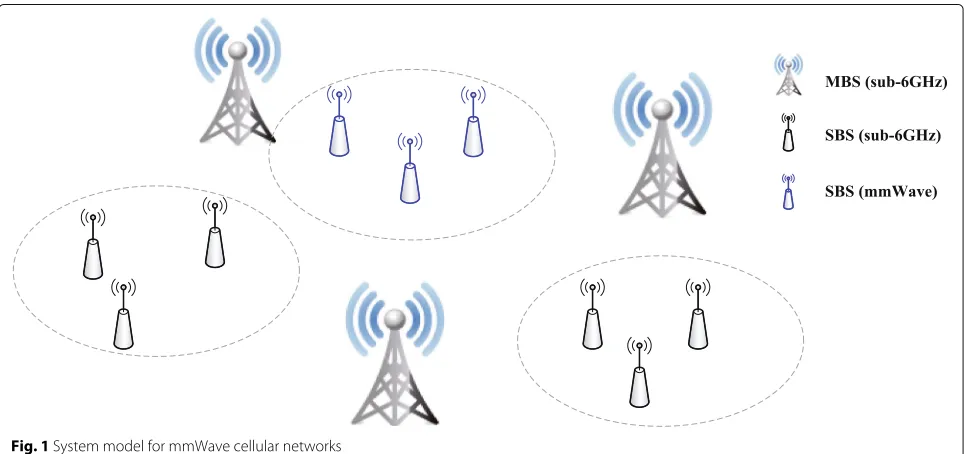
wherepsm=1−psu. Thus, we regard BS location distribu-tion as three independent tiers, i.e., sub-6 GHz MBS tier, sub-6 GHz SBS tier, and mmWave SBS tier, as is shown in Fig.1.
The two main characteristics of mmWave transmission are blockage effect and directivity at transmitter and/or receiver.
(1) The actual mmWave transmission directivity is approximated by a sectored model [3,4,6,9,10], where a UE receives a signal with directivity gain
Gmaxif the UE’s angleθwith respect to the best beam alignment is within the main beamwidth2ωof the serving mmWave cell and with directivity gain
Gminotherwise. This is formulated by
G(θ)=
Gmax |θ| ≤ω
Gmin otherwise (1)
whereasG(θ)=1under sub-6 GHz cell. Due to the fact thatθ is independent of all other variables, we simplify theG(θ)asGjfor thej -tier directivity gain. (2) We approximate the blockage effect by a modified
LOS ball model under mmWave link [4], i.e., a UE within a distanceD to an mmWave SBS is LOS link, otherwise is considered NLOS link.
Thus, the received SINR at the typical user (at origino) is
SINRk(x)=
PkGkhxx−αk I\x(x)+N0
, (2)
wherexis the location of the associated BS,is the set of all BSs’ locations, hx is the small-scale fading coeffi-cient between UE at origin and BS atxand is assumed to be independent and identically distributed (i.i.d.) Rayleigh fading [9]. The path loss exponent of an mmWave link depends on the link distance whereas the path loss expo-nent of a sub-6 GHz link is independent of the link distance. Specifically, the path loss exponentakequalsas if the link is under sub-6 GHz, equalsalif the link is LOS
under mmWave and equals an otherwise. The additive
noise is complex Gaussian distributed [19]. The trans-mit power of MBSs, SBSs operating at sub-6 GHz, and SBSs operating at mmWave frequency arePmu,Psu,Psm, respectively. The aggregated interference for UE atxcan be expressed as [4,21]
Ik,\x(x)= ⎧ ⎨ ⎩
j∈{mu,su}
z∈j\x
PjGjhzz−αj k∈ {mu, su}
0 k∈ {sm}
(3)
wherejrepresents the set ofj-tier BS locations and
• k=mumeans thatk tier is sub-6 GHz macro BS tier.
• k=smeans thatk tier is sub-6 GHz SBS tier.
• k=smmeans thatk tier is mmWave SBS tier.
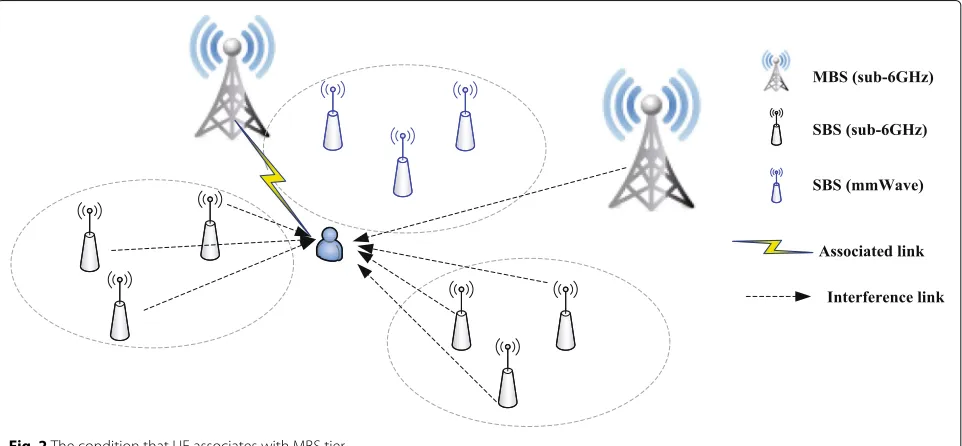
The conditions that UE associates with MBS tier, sub-6 GHz SBS tier and mmWave SBS tier are illustrated in
Figs.2,3, and4, respectively. Unlike sub-6 GHz networks, mmWave cellular systems will be noise-limited due to the directivity and blocking effects discussed earlier, in con-junction with the large bandwidth which brings in much more noise power [4,9]. In such cases, the SNR distribu-tion can be used as an approximadistribu-tion of the SINR. This is in contrast to sub-6 GHz cellular networks, which are often interference-limited, meaning SIR≈SINR instead.
In this paper, we consider an mmWave cellular network in which users intend to communicate with the BS in either mmWave or sub-6 GHz band. In this mmWave cel-lular system, we propose a centralized and a distributed user association algorithm, respectively. In Section4, we propose a centralized user association and power control algorithm. The main idea of the centralized algorithm is to design the user association and transmit power of users to maximize the network sum rate while satisfying the individual target SINR constraints for all links. Note that the centralized algorithm depends on the global channel state information (CSI) possibly at a centralized controller, which is significant to the power design. Note that the centralized algorithm requires global channel state infor-mation (CSI) possibly at a centralized controller, which may incur high CSI feedback overhead. To resolve this issue, we propose a distributed user association method in Section5, which requires distance about the link between the transmitter and its corresponding receiver only. The main goal of the distributed algorithm is to maximize the coverage probability, thereby the basis of which is to calculate the coverage probability. Therefore, we derive the coverage probability as well as average achievable rate in Section 5. Moreover, the probability distribution function (pdf ) of associated distance and the association
probability are also derived in Section 5, which are the necessary components of the expression of coverage prob-ability. Thus, we analyze the mmWave cellular network performance from the perspectives of centralized and distributed control.
4 A centralized two-stage user association and power control algorithm
A main feature of mmWave cellular networks is that the mmWave links are managed by MBSs in a centralized manner. Commonly, the centralized algorithm can pro-vide the upper performance bound for its distributed counterpart. In this section, we suppose that MBS is able to acquire global channel state information (CSI). Based
on the system model in Section2, we generate a mmWave
cellular network ofNsub-6 GHz MBSs andMmmWave
SBSs. On this basis, we would like to maximize the net-work sum rate under SINR and power consumption con-straints. The optimization problem can be formulated as
max P
M+N i=1
log(1+SINRi(x)), (P1)
s.t.(I−F)P≥b, (4)
0≤Pi ≤Pmaxmu ,i=1, 2,· · ·,N, (5)
0≤Pi ≤Pmaxsm ,i=N+1,N+2,· · ·,N+M. (6) where (4) corresponds to the SINR requirement to be satisfied at allM+N receivers. AllM+N inequalities are put together in a matrix-form inequality, as is shown
in (4). The element in the normalized gain matrix F is
Fig. 3The condition that UE associates with sub-6 GHz SBS tier
Fki= γ
Tβki
βkk , k=i,k≤N
0, otherwise , whereβki = Gkihkixki
−αk consists of the antenna gain, channel gain, and path loss from transmitterk to receiveri. The elements in b are auxiliary variables which can be considered as the
nor-malized SINR threshold for every receiver and b =
γTN0
β11 ,
γTN0
β22 , ...,
γTN0
β(N+M)(N+M)
. The power control vector
P = [P1,P2, ...,PN,PN+1, ...,PN+M]T. Pmaxmu andPmaxsm are the maximum power of MBS and mmWave SBS, respec-tively.Iis the identity matrix. In this section, we focus on the conditionpsm=1, which means that all SBSs operate
at the mmWave frequency. Without loss of generality, the results can be extended to the condition 0≤psm<1, i.e., the sub-6 GHz SBSs are included in the optimization.
We can see that the problem in (P1) is non-convex, which is difficult to obtain the optimal solution. There-fore, we decouple this problem into two subproblems, i.e., user association subproblem and power control subprob-lem. On this basis, we propose a centralized two-stage user association and power control algorithm, denoted by TS algorithm to get the closely local optimum. In the fol-lowing, we provide the solution to the two subproblems separately.
4.1 The first stage: user association
The first stage is to find the feasible user association set to satisfy (4) that can be considered as the prerequisite of the next power control. The matrixFis comprised of non-negative elements and is irreducible because all the links interfere with each other. By the Perron-Frobenious theorem [22, 23], the SINR constraint set in (4) is non-empty if and only if the maximum modulus eigenvalue of F is smaller than 1, i.e., ρ (F) < 1. Otherwise, the power control solution is infeasible. The explanation for this conclusion is that the network prefer to support more transmissions, but sometimes it has to drop some links to satisfy SINR constraints. The key idea to solve this problem is to drop communication links successively that cause the maximum sum of the interference in the net-work until the feasibility conditions are satisfied. It is worthy noting that since the mmWave BSs will not cause the interference due to the high attenuation loss, none of mmWave BSs will be dropped in the first stage.
4.2 The second stage: power allocation
After the user association, the original optimization
prob-lem (P1) can be reformulated as P2, i.e., a tractable
power-constrained sum rate maximization problem.
max P
M+N i=1
log(1+SINRi(x)), (P2)
s.t.0≤Pi≤Pmaxmu ,i=1, 2,· · ·N, (7)
0≤Pi≤Pmaxsm ,i=N+1,N+2,· · ·N+M. (8) whereNis the number of the updated sub-6 GHz BSs set after the user association stage.
Geometric programming (GP) is a widely adopted method to obtain the optimal solution to the power-constrained sum rate maximization problem [24] and binary power (BP) can provide the near optimal perfor-mance but with low complexity [25]. Therefore, we tackle the power control subproblem by BP. In addition, the optimal mmWave BS transmit power is Pi = Pmaxsm ,i = N +1, N +2, ...,N+ Mdue to the fact that mmWave link is interference-free.
The details of TS algorithm are describe below.
Centralized two-stage user association and power con-trol algorithm
Initialization: Set gain matrixFtfort = 0 according to the global CSI. All cellular and mmWave links are active.
Step 1: CalculateρFt. IfρFt < 1, solve the sum rate maximization by BP to obtain the power allocation method. Then, the algorithm stops. Otherwise, go to step 2.
Step 2: Calculateq = arg max
q∈{1,2,...,N+M}fq2, wherefq
is the column of the matrixFt, i.e.,Ft= ft1,ft2, ...,ftN+M
.
Step 3: Remove theqth column and row inFt.t←t+1. The updated matrixFtis the reduced matrix. Return to step 1.
5 Distributed user association analysis of mmWave cellular network
In the previous section, we propose a centralized two-stage user association and power control algorithm. Although centralized algorithm can achieve a good per-formance, the main challenge is the frequent coordination between transmitters and the high signaling overheads for sharing CSI. In order to solve this problem, we con-duct a distributed user association analysis for mmWave cellular network. Specifically, we derive some key perfor-mance metrics considering the directivity and blockage effect. On this basis, we propose a distributed distance-based user association method to decide the pattern of BSs (either sub-6 GHz or mmWave pattern).
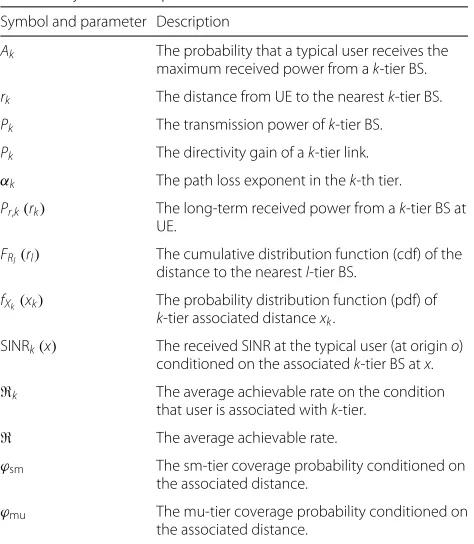
In order to enable the derivations and the theorems in this section easier to understand. Table1lists the symbols and parameters for distributed user association.
For the parametersk, i, j, and l, they represent k-tier,
i-tier, j-tier, and l-tier. The following theorem provides the per tier association probability, which is essential for deriving the main results in the sequel.
5.1 Performance analysis
In this subsection, we derive the association probability, cov-erage probability, and the avcov-erage achievable rate under mmWave cellular network.
Table 1Symbols and parameters for distributed user association
Symbol and parameter Description
Ak The probability that a typical user receives the maximum received power from ak-tier BS.
rk The distance from UE to the nearestk-tier BS.
Pk The transmission power ofk-tier BS.
Pk The directivity gain of ak-tier link. αk The path loss exponent in thek-th tier. Pr,k(rk) The long-term received power from ak-tier BS at
UE.
FRl(rl) The cumulative distribution function (cdf) of the
distance to the nearestl-tier BS.
fXk(xk) The probability distribution function (pdf) of
k-tier associated distancexk.
SINRk(x) The received SINR at the typical user (at origino) conditioned on the associatedk-tier BS atx.
k The average achievable rate on the condition that user is associated withk-tier.
The average achievable rate.
ϕsm The sm-tier coverage probability conditioned on
the associated distance.
ϕmu The mu-tier coverage probability conditioned on
The following theorem provides the per tier association probability, which is essential for deriving the main results in the sequel.
Theorem 1The association probability in the kth tier is
Ak= tribution function (cdf ) of the distance of the nearest l-tier BS.
ProofSee AppendixA.
From Theorem 1, we further derive the the distance
between a user and its serving BS, of which the premise is that the user is associated with thekth tier.
Corollary 1The probability distribution function (pdf ) of k-tier associated distance
fXk(xk)= −
is obtained through
the method to calculate Ak, in which the only difference is the integral interval over rkis xkto infinity instead of zero to infinity.
Depending on the association probability and the pdf of the associated distance, we further obtain the cover-age probability and avercover-age achievable rate, which are the two important indicators to evaluate the network performance.
In this paper, a UE is said to be in coverage if it is able to connect to at least one BS with SINR above its threshold.
Theorem 2The coverage probability is
Pr
where the first term can be calculated by averaging over xk, and the pdf of xk is given by Corollary 1.
have been derived in[19].
ProofSee AppendixB.
Last, we derive the average achievable rate of mmWave
cellular network. The average achievable rate can be
derived by the method to analyze the coverage probability in AppendixB.
Theorem 3The average achievable rate is
=
where k is the average achievable rate on the
condition that user is associated with k-tier and
PrSINRk(xk) >et−1
can be easily deduced according to(25)and(26)in AppendixB.
5.2 Distributed distance-based user association method On the basis of the expression of coverage probability, together with the known associated distance, we propose a simple method to judge which pattern of BS (sub-6 GHz or mmWave) are preferred by comparing the conditional coverage probabilities of sub-6 GHz BS and mmWave BSs. In order to make the problem mathematically trackable, we setpsm = 1 in the following analysis.
The sm-tier coverage probability conditioned on the associated distance is
ϕsm= ω
ϕmu=exp
−2πλmux2muγ 2
αs mu
B
1; 2 αs, 1−
2 αs
−B
1 1+γmu;
2 αs, 1−
2 αs
' (15)
whereB(x;y,z)is the incomplete beta function.
The user association decision is determined by the cov-erage probability conditioned on the associated distance, that is, the user will associate to the nearest mmWave BS ifϕsm≥ϕmu, otherwise associates to the nearest MBS.
Remark 1According to Jensen inequality, [26]
a1exp(−b1xαsm) + a2exp(−b2xαsm) ≥ exp(−(a1b1+ a2b2)xαsm), the sufficient condition for the inequality ϕsm ≥ ϕmu isexp(−(a1b1+a2b2)xαsm) ≥ exp
−cx2. Therefore, the user will associate with nearest mmWave BS
if D≤x≤
c a1b1+a2b2
1
αn−2
or x<min
D,
c a1b1+a2b2
1
αl−2
' .
6 Results and discussion
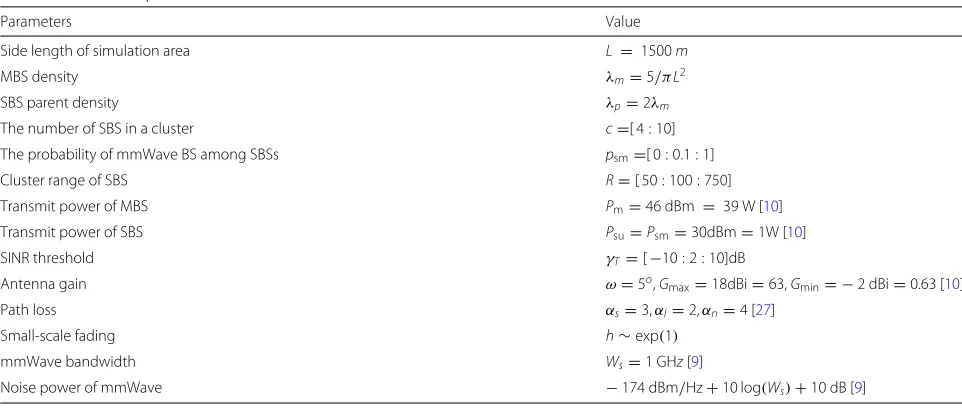
In this section, we present numerical and simulation results on association probability, coverage probability, and average rate for mmWave cellular network and then evaluates the performance of the proposed centralized TS algorithm. The simulation parameters are listed in Table2. We start by looking into the association probabili-ties and the different factors that affect the probability. Figure 5 illustrates the association probability of sub-6 GHz MBS, sub-sub-6 GHz SBS, and mmWave SBS against
the mmWave probability psm. Figure 5 shows that the
simulation results match the analytic results well, which validates our analysis. It is also seen in Fig.1that more
UEs associate with mmWave BS with the growth ofpsm,
which is in agreement with our intuition. Moreover, it can be seen that MBSs still undertake more UEs due to higher transmission power.
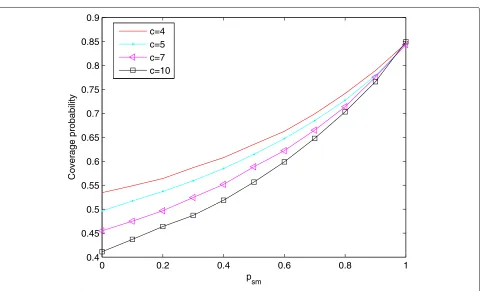
Figure6shows that coverage probability decreases with
the larger c value whereas the gap between different c
diminishes with the increasing mmWave probabilitypsm. That is because larger cvalue under low psm results in more sub-6 GHz SBSs that cause more interference.
How-ever, the effect of c on coverage probability becomes
weaker with the increasingpsmdue to the fact that more SBSs conduct in interference-free mmWave pattern with the increase ofpsm. The extreme case is that the gap disap-pears forpsm = 1, as is shown in Fig.2. Thus, the results in Fig.2demonstrates that mmWave links can contribute to coverage probability.
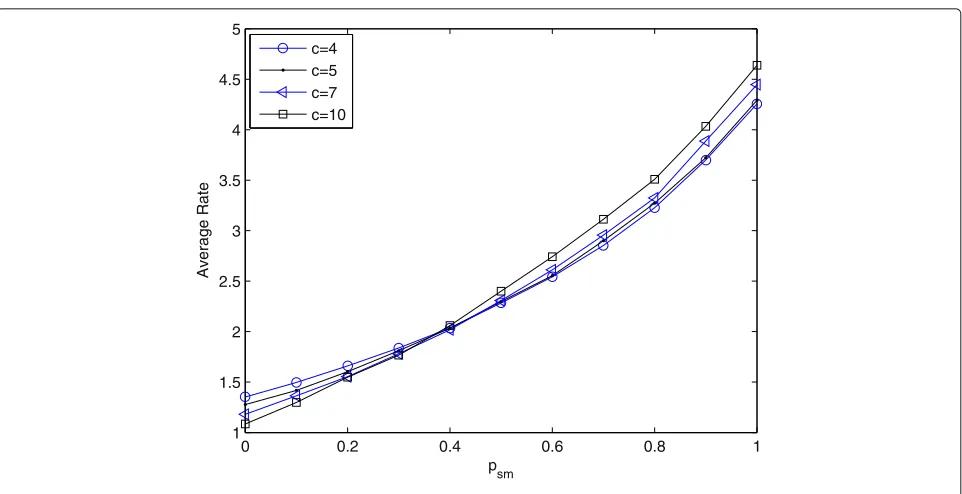
Similarly, the higher achievable average rate is along with the larger psm in Fig. 7. It is worth noting that
a cross point appears with the increasing psm under
different c. That means less sub-6 GHz SBSs (i.e.,
lower interference) or more mmWave SBSs (i.e., bet-ter channel state) can achieve higher achievable average rate.
From Fig.8, we can see that the cluster radiusRhas no strong effect on UE association when SBS density is small, which further verifies that a PCP can be approximated as a PPP under small valuec. Moreover, it is noticeable that mmWave support highest data rate even under the least
number of associated UEs by comparing Figs. 8 and9.
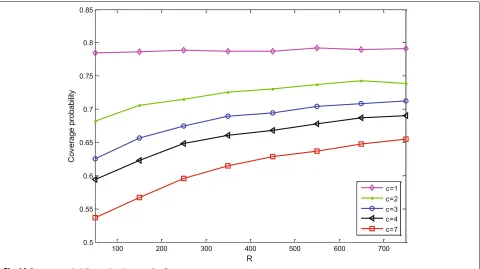
Therefore, mmWave communications outperforms sub-6 GHz communications on rate delivery for high direc-tivity and interference-free transmission environment. It can be seen in Fig.10that the coverage probability grows in accordance with the increasing cluster radius whereas it tends to keep stable for small values of c. Higher c
value results in stronger non-uniform distribution, which can implicitly confirm that non-uniformity can reduce coverage area.
This finding obtained in Fig. 11is in agreement with the published paper [6] that the coverage probability
Table 2Simulation parameters
Parameters Value
Side length of simulation area L = 1500m
MBS density λm=5/πL2
SBS parent density λp=2λm
The number of SBS in a cluster c=[ 4 : 10]
The probability of mmWave BS among SBSs psm=[ 0 : 0.1 : 1]
Cluster range of SBS R=[ 50 : 100 : 750]
Transmit power of MBS Pm=46 dBm = 39 W [10]
Transmit power of SBS Psu=Psm=30dBm=1W [10]
SINR threshold γT=[−10 : 2 : 10]dB
Antenna gain ω=5o,G
max=18dBi=63,Gmin= −2 dBi=0.63 [10]
Path loss αs=3,αl=2,αn=4 [27]
Small-scale fading h∼exp(1)
mmWave bandwidth Ws=1 GHz[9]
Fig. 5Association probability vs. the mmWave probabilitypsm
0 0.2 0.4 0.6 0.8 1 1
1.5 2 2.5 3 3.5 4 4.5 5
psm
Average Rate
c=4 c=5 c=7 c=10
Fig. 7Average achievable rate vs. the mmWave probabilitypsm
decreases with the growing SINR threshold. Also, it illustrates that more mmWave links are able to enhance the coverage probability. This is mainly due to interference-free transmission environment under mmWave communications.
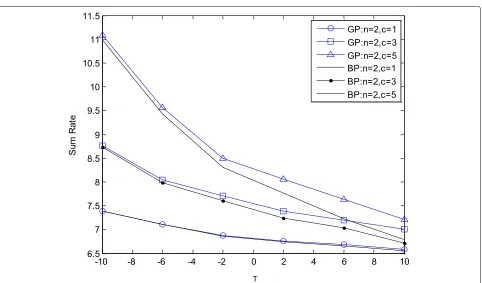
As expected, the sum rate decreases with the increasing
SINR threshold in Fig. 8. Meanwhile, we compare the
performance of the proposed centralized TS algorithm (using BP) and geometric programming (GP) algorithm where the performance of GP is commonly adopted as a
Fig. 9Average achievable rate vs. the cluster radiusR
benchmark. The observation in Fig. 12is that TS
algo-rithm is always approximate to the GP for c = 1.
Although the gap between GP and BP becomes obvi-ous with the larger c, BP is near to the optimal results under low SINR. The results demonstrate near-optimality
of BP under low SINR constraint. Moreover, the com-plexity of the BP-based transmitter design is reduced since only a two-level power control is required, which is a potential in the design and analysis of wireless networks.
Fig. 11Coverage probability vs. SINR threshold
7 Conclusion
This paper proposes a realistic multi-tier mmWave cellular framework where sub-6 GHz MBS deployment is assumed as a PPP, and SBS operating on either mmWave or sub-6 GHz follows PCP model. In this system, we propose both centralized and distributed user association algorithms. For the centralized two-step algorithm, we aim to maximize the sum rate while satisfying QoS and power consumption constraints based on eigenvalue analysis. Then, we derive the association probability, the coverage probability, and the average achievable rate, incorporat-ing directivity and blockage effect, by stochastic geometry. On this basis, the distributed user association algorithm is proposed. The simulation results demonstrate the accu-racy of our theoretical analysis and also reveal that the effect of some parameters on the network performance. In addition, the proposed centralized algorithm can achieve near-optimal sum rate with a low complexity under non-dense scenario.
Appendix
A. Proof of Theorem 1
The associated probability in thek-tier is given by
Ak=Pr
whereais given from the independence of PPP. The pdf
ofrkis given by [16].Gis a vector involving the directivity gains of all links.
First we calculate Pr
and cdf of variableYj, respectively. The cdf of variableYj is given by
EYj(y)=Pr
Yj≤y
=Prrj≤ α√jy (19)
where the last term in (19) can be calculated based on the pdf of distance between user and the nearestj-tier BS. Therefore,EYj(y)is expressed as distance of the nearestj-tier BS.
3. Ifk = sm andj∈ {mu,su}
Thus, thek-tier associated probability is
whereaaverages the directivity gain which is a trivial work due to the fact that the directivity gain of each link is inde-pendent of other variables. Additionally, averaging overrk is also a simple work once we know the pdf ofrk[10].
B. Proof of Theorem 2
The coverage probability can be expressed as
Pr
where the interference can be ignored when UE is in the
coverage of mmWave SBS, i.e.,k = smand the
interfer-ence cannot be neglected when UE is in the coverage of sub-6 GHz SBS or MBS, i.e., k ∈ {mu,su}. The follow-ing is the discussion about the associated distance-based conditionalk-tier coverage probability,
(1) Ifk=sm,
of PPP and PCP have been derived in [19], respectively.
Thus, the coverage probability is given by
Pr
where the first term can be calculated by
averag-ing over xk. The pdf of xk is given by Corollary 1.
have been derived in [19].
Abbreviations
5G: the fifth generation mobile communication network; BP: Binary power; CSI: Channel state information; GP: Geometric programming; HetNets:
Heterogeneous networks; LOS: Line-of-sight; MBS: Macro base station; MIMO: Multiple-input multiple-output; mmWave: Millimeter wave; NLOS: Non-line-of-sight; PCP: Poisson cluster point; PGF: Probability generating function; PPP: Poisson point process; QoS: Quality of service; SBS: Small-cell base station; SINR: Signal to interference plus noise ratio; UE: User
Funding
This work is supported by the National Natural Science Foundation of China (No. 61701037 and 61601503), Beijing Natural Science Foundation (No. L172033) and the 111 Project of China (B16006).
Availability of data and materials
The simulation data supporting this paper can be found and part source files can be shared.
Authors’ contributions
The idea of this work was proposed by XZ and YL. YW performed the simulation. XZ wrote the manuscript. JB has given critical revision and helped revise the manuscript. All authors read and approved the final manuscript.
Competing interests
The authors declare that they have no competing interests.
Publisher’s Note
Springer Nature remains neutral with regard to jurisdictional claims in published maps and institutional affiliations.
Author details
1National Engineering Laboratory for Mobile Network Technologies, Beijing
University of Posts and Telecommunications, 100876 Beijing, China.2Air Force
Engineering University, 710051 Xi’an, China.
References
1. J.G. Andrews, et al., What will 5G be? IEEE J. Sel. Areas Commun.32(6), 1065–1082 (2014)
2. F. Boccardi, et al., Five disruptive technology directions for 5G. IEEE Commun. Mag.52(2), 74–80 (2014)
3. M. Di Renzo, Stochastic geometry modeling and analysis of multi-tier millimeter wave cellular networks. IEEE Trans. Wirel. Commun.14(9), 5038–5057 (2015)
4. J.G. Andrews, et al., Modeling and analyzing millimeter wave cellular systems. IEEE Trans. Commun.65(1), 403–430 (2017)
5. L. Wei, et al., Key elements to enable millimeter wave communications for 5G wireless systems. IEEE Wirel. Commun.21(6), 136–143 (2014) 6. T. Bai, et al., Coverage and rate analysis for millimeter-wave cellular
networks. IEEE Trans. Wirel. Commun.14(2), 1100–1114 (2015)
7. S. Singh, et al., Tractable model for rate in self-backhauled millimeter wave cellular networks. IEEE J. Sel. Areas Commun.33(10), 2196–2211 (2015) 8. A. Ghosh, et al., Millimeter-wave enhanced local area systems: a
high-data-rate approach for future wireless networks. IEEE J. Sel. Area Commun.32(6), 1152–1163 (2014)
9. H. Elshaer, et al., Downlink and uplink cell association with traditional macrocells and millimeter wave small cells. IEEE Trans. Wirel. Commun. 15(9), 6244–6258 (2016)
10. M. Di Renzo, inIEEE International Conference on Communications (ICC). Stochastic geometry modeling and performance evaluation of mmWave cellular communications, (London, 2015), pp. 5992–5997
11. M. N. Kulkarni, A. Ghosh, J. G. Andrews, A comparison of MIMO techniques in downlink millimeter wave cellular networks with hybrid beamforming. IEEE Trans. Commun.64(5), 1952–1967 (2016)
12. F. W. Vook, et al., inIEEE 48th Asilomar Conference on Signals, Systems and Computers. Massive MIMO for mmWave systems, (Pacific Grove, 2014), pp. 820–824
13. A. Adhikary, et al., Joint spatial division and multiplexing for mm-wave channels. IEEE J. Sel. Areas Commu.32(6), 1239–1255 (2014) 14. M. Haenggi, et al., Stochastic geometry and random graphs for the
analysis and design of wireless networks. IEEE J. Sel. Areas Commu.27(7), 1029–1046 (2009)
15. R. W. Heath, M. Kountouris, T. Bai, Modeling heterogeneous network interference using Poisson point processes. IEEE Trans. Signal Pro.61(16), 4114–4126 (2013)
16. H. S. Dhillon, et al., Modeling and analysis of K-tier downlink
heterogeneous cellular networks. IEEE J. Sel. Area Commu.30(3), 550–560 (2012)
17. S. Mukherjee, Distribution of downlink SINR in heterogeneous cellular networks. IEEE J. Sel. Area Commu.30(3), 575–585 (2012)
18. N. Deng, W. Zhou, M. Haenggi, Heterogeneous cellular network models with dependence. IEEE J. Sel. Area Commu.33(10), 2167–2181 (2015) 19. Y. J. Chun, M. O. Hasna, A. Ghrayeb, Modeling heterogeneous cellular networks interference using poisson cluster processes. IEEE J. Sel. Area Commu.33(10), 2182–2195 (2015)
20. T. Bai, et al., inGlobal Conference on Signal and Information Processing (GlobalSIP). Coverage analysis for millimeter wave cellular networks with blockage effects, (Austin, 2013), pp. 727–730
21. R. K. Ganti, M. Haenggi, Interference and outage in clustered wireless ad hoc networks. IEEE Trans. Inform. Theory.55(9), 4067–4086 (2009) 22. G. J. Foschini, Z. Miljanic, A simple distributed autonomous power control
algorithm and its convergence. IEEE Trans. Vel. Technol.42(4), 641–646 (1993)
23. N. Lee, et al., Power control for D2D underlaid cellular networks: modeling, algorithms, and analysis. IEEE J. Sel. Area Commun.33(1), 1–13 (2015) 24. C. Guo, et al., -Fair power allocation in spectrum-sharing networks. IEEE
Trans. Veh. Technol.65(5), 3771–3777 (2016)
25. A. Gjendemsj, et al., Binary power control for sum rate maximization over multiple interfering links. IEEE Trans. Wirel. Commun.7(8), 3164–3173 (2008)
26. H. Alzer, On some inequalities for the incomplete gamma function. Math. Comput. Am. Math. Soc.66(218), 771–778 (1997)