Optimal Throughput and Energy Efficiency
for Wireless Sensor Networks:
Multiple Access and Multipacket Reception
Wenjun Li
Department of Electrical and Computer Engineering, North Carolina State University, Raleigh, NC 27695-7914, USA Email:[email protected]
Huaiyu Dai
Department of Electrical and Computer Engineering, North Carolina State University, Raleigh, NC 27695-7914, USA Email:huaiyu [email protected]
Received 9 December 2004; Revised 1 April 2005
We investigate two important aspects in sensor network design—the throughput and the energy efficiency. We consider the uplink reachback problem where the receiver is equipped with multiple antennas and linear multiuser detectors. We first assume Rayleigh flat-fading, and analyze two MAC schemes: round-robin and slotted-ALOHA. We optimize the average number of transmissions per slot and the transmission power for two purposes: maximizing the throughput, or minimizing the effective energy (defined as the average energy consumption per successfully received packet) subject to a throughput constraint. For each MAC scheme with a given linear detector, we derive the maximum asymptotic throughput as the signal-to-noise ratio goes to infinity. It is shown that the minimum effective energy grows rapidly as the throughput constraint approaches the maximum asymptotic throughput. By comparing the optimal performance of different MAC schemes equipped with different detectors, we draw important tradeoffs involved in the sensor network design. Finally, we show that multiuser scheduling greatly enhances system performance in a shadow fading environment.
Keywords and phrases:throughput, energy efficiency, multiuser diversity, scheduling, slotted-ALOHA, linear multiuser detector.
1. INTRODUCTION
Wireless sensor networks have become one of the burgeon-ing research fields in recent years, as they are envisioned to have wide applications in military, environmental, and many other fields [1]. Since sensors typically operate on batteries, replenishment of which is often difficult, a lot of work has been done to minimize the energy expenditure and prolong the sensor lifetime through energy efficient designs across layers [2,3,4,5,6]. Meanwhile, the sensor network should be able to maintain a certain throughput (which is equiva-lent to a certain delay constraint), in order to fulfill the QoS requirement of the end user, and to ensure the stability of the network. Typically, the throughput and the energy effi -ciency are inconsistent, and there exists a tradeoffbetween the two measures. The objective of this work is to explore the maximum achievable throughput under certain network
This is an open access article distributed under the Creative Commons Attribution License, which permits unrestricted use, distribution, and reproduction in any medium, provided the original work is properly cited.
configurations and receiver structures, as well as optimal net-work designs that achieve the desired throughput with mini-mal energy consumption.
processing routines, and good performance can be guaran-teed even with minimal transmission power.
We assume that each node constantly has packets to transmit; the transmission is slotted and the slot lengthT
equals the transmission time of one packet. The sensors and the receiver constitute a multiple access network. Un-der the traditional collision channel model (i.e., single trans-mission means success and simultaneous transtrans-missions re-sult in failure), the throughput of the multiple access net-work is limited: the maximum throughput per slot is 1 for time-division-multiple-access (TDMA), and is only 1/e
for slotted-ALOHA with optimal decentralized control [10]. Such a throughput may not be sufficient for sensor network applications. Nevertheless, advanced signal processing tech-niques such as multiuser detection [11] enable correct re-ception of simultaneous transmitted packets at the physi-cal layer, and consequently, Ghez et al. proposed the mul-tipacket reception model [12], which revolutionized the un-derlying assumption of MAC layer design. In this paper, we assume that the receiver is equipped with N antennas and a linear multiuser detector followed by single-user decoders. The packet transmission is considered successful as long as the output signal-to-interference ratio (SIR) of the linear de-tector is above a certain thresholdβ[13]. The transmitting sensors and the receive antenna array thus form a virtual multiple-input-multiple-output (MIMO) system, which can also be viewed as a space-division-multiple-access (SDMA) system. Note that due to the analogy between the direct-sequence code-division-multiple-access (DS-CDMA) system and the MIMO system, the analysis in this paper can also be adapted to the DS-CDMA system with a single receive an-tenna and spreading gain N. But since the received power adds up across the antennas, the MIMO system requires only 1/N of the transmission power of the corresponding DS-CDMA system. A hybrid of DS-CDMA and multiple receive an-tenna system is also possible, in which case the performance is further enhanced by the effect of “resource-pooling” [14].
A sensor field usually consists of hundreds or thousands of sensors, and the number of transmissions in each slot at the same frequency band is typically much smaller to avoid the excessive multiple access interference. Therefore, in ad-dition to the SDMA that defines the channelization in each slot, another level of medium access control is necessary to determine which sensors should transmit during each slot, and the MAC scheme for this purpose can be either co-ordinated or random. For coco-ordinated access, we consider round-robin, which is TDMA in essence: the adjacent sensors form a transmission group and the groups are scheduled for access one by one. For random access, we consider the sim-plest form of slotted-ALOHA, known as delayed first mission (DFT) [15]: in each slot every sensor node trans-mits a packet (new or retransmission) with the same prob-ability pindependently. We assume that the receiver trans-mits a beacon at the beginning of each slot for synchroniza-tion [9,16]. It might require some overhead for the sensor nodes to get some delay estimates for synchronization pur-pose, and then they can adjust their timing when simultane-ously transmitting. It is known that slotted-ALOHA is simple
and is preferred when the traffic is bursty, but it suffers from certain performance degradation from centrally controlled networks, and we will investigate the exact performance loss in our system. In addition to different MAC schemes, the linear multiuser detector at the receiver can be the single-user matched filter, the decorrelating detector, or the linear MMSE detector. As we will see, both the MAC scheme and receiver structure employed have significant impact on the system performance. For a given MAC scheme with a given linear detector, we optimize the transmit power, as well as the transmission group size (for round-robin) or the trans-mission probability (for slotted-ALOHA). We study two op-timization problems: one is to maximize the throughput, and the other is to minimize the energy consumption subject to a throughput constraint.
We then modify our assumption of pure Rayleigh fad-ing by admittfad-ing shadow fadfad-ing into our system model. Mul-tiuser diversity can be realized in such a system by allow-ing the sensor group with the best shadowallow-ing coefficient to transmit during each slot, and is shown to have great sig-nificance in energy conservation for sensor networks. Fair-ness concerns of multiuser scheduling can be remedied by enabling the movement of the receiver to induce a dynamic shadowing environment, or other known algorithms with lit-tle throughput sacrifice (seeSection 6).
Most related papers on the performance and optimal re-source allocation of multiple access networks are based on the collision model. The optimization of transmission prob-ability for slotted-ALOHA scheme with or without uplink CSI are studied in [17,18,19]. Relatively few works in this direction adopted the multipacket reception model [16,20]. The design of transmission probability of slotted-ALOHA scheme by exploiting uplink CSI in a distributed fashion is studied in [16]. In [20], the authors analyze slotted-ALOHA sensor networks with multiple mobile agents, whose covering areas can be optimally designed to maximize the throughput or to maximize the energy efficiency. The per-formance analysis of sensor networks using both CDMA and multiple receive antennas is presented in [21] based on the results on large random networks in [14]. The analysis in this paper does not rely on the large network approxima-tion. Meanwhile, most studies on multiuser scheduling for uplink or downlink wireless networks have focused on maxi-mizing the information-theoretic capacity [22,23,24,25]. In [26], the authors present a scheduling algorithm which max-imizes a certain performance value estimated by the user or calculated by the base station, such as a linear function of the SINR. On the other hand, we study multiuser scheduling by assuming the MPR model due to suboptimal receivers, where the main performance measure is the throughput in terms of the average number of successful packets per slot.
The main contribution of this paper is as follows. (1) We derive the throughput and the effective energy
(av-erage energy consumption for each successful packet) for multiple access network employing round-robin and slotted-ALOHA in Rayleigh flat-fading.
(a) maximize the throughput: for each MAC scheme with a linear detector, we derive the maximum asymptotic throughput when the signal-to-noise ratio goes to infinity,
(b) minimize the effective energy subject to a through-put constraint: it is shown that the minimum ef-fective energy grows rapidly as the throughput constraint approaches the maximum asymptotic throughput.
(3) By comparing the optimal performance of different MAC schemes equipped with different detectors, we draw important tradeoffs involved in the sensor net-work design.
(4) We show that multiuser scheduling can significantly enhance the system performance in a shadow fading environment.
The organization of the paper is as follows. InSection 2, we introduce the system model, some assumptions of our work, and the general measures of the throughput and the energy efficiency. InSection 3, we briefly describe the three linear detectors of interest and derive the analytical re-sults to be used later. In Section 4, we first derive the en-ergy efficiency and the throughput of the round-robin and slotted-ALOHA scheme, and then study the two optimiza-tion problems, throughput maximizaoptimiza-tion and throughput-constrained energy minimization, respectively. Numerical results and discussions are presented inSection 5.Section 6 studies multiuser scheduling in the shadow fading environ-ment.Section 7contains the concluding remarks.
2. SYSTEM DESCRIPTION
We assume that there are totallynsensors in the sensor field, the receiver is equipped withNantennas, and the SIR thresh-old isβ. The diameter of the sensor field is much smaller than the distance between the sensor field and the receiver, and there exists a rich-scattering environment between the sensor field and the receiver—for example, the sensors are deployed in a building or a forest. Therefore the channel states between each sensor and each receive antenna can be modeled as in-dependent, identically distributed Rayleigh variables. We as-sume that sensors have no knowledge of uplink channel state information (CSI), and transmit with equal power P. Ifm
sensors simultaneously transmit, themsensors andNreceive antennas form a virtual MIMO system, and the discrete-time model is given by
y=G m
i=1
hixi+n, (1)
where xi is the transmitted signal of the ith sensor and E[xi2] = P,hi is the N×1 spatial signature of the ith
sensor, whose entries are independent circularly-symmetric complex Gaussian variables with zero mean and unit vari-ance,Gis the common pathloss,nis the noise vector with zero mean circularly-symmetric complex Gaussian entries and covariance matrixσ2I, andyis the received signal vector.
The average received SNR of a packet at one receive antenna is given byρ=PG/σ2. In the following we denote the matrix
H=h1,h2,. . .,hm
.
We assume that a feedback channel exists from the re-ceiver to the sensor nodes, which is used for synchronization, acknowledgements, group selection, and other signaling on the MAC layer. The bandwidth of the feedback channel is typically small and thus the energy consumption for receiv-ing the signalreceiv-ing is assumed to be negligible throughout the paper. For simplicity, we also ignore the circuit energy con-sumption, which can be incorporated and the optimizations described in this paper can be performed with minor modifi-cations. Some measures of sensor network’s energy efficiency have been explored in the literature: in [5], theenergy con-sumption per bitto achieve a desired bit error rate is evalu-ated, and in [20], the metricefficiency, defined as the average number of successes over the total number of transmissions, is studied for SENMA networks. The former metric does not assume a multipacket reception model, and the latter does not characterize the exact energy expenditure, as a transmis-sion scheme with high efficiency is not necessarily energy ef-ficient if the transmit power is not constrained. We combine the ideas in these two papers and measure the energy effi -ciency by theeffective energy[21], defined as the average en-ergy consumption per successfully transmitted packet:
Ee= PT
Pr[succ], (2)
where Pr[succ] is the average probability of success for a transmitted packet. Note that the effective energy directly determines the number of packets a sensor can successfully transmit during its lifetime. Thethroughput, denoted byλ, is defined as the average number of successful transmissions per slot. Denoteaas the average number of transmissions per slot, then we have
Pr[succ]=λ
a. (3)
Throughout the paper we assume that the number of receive antennas N, the total number of sensorsn, the SIR thresholdβ, the common pathlossG, as well as the noise vari-anceσ2are fixed. WhenGandσ2are fixed, the optimization
of the transmission powerPis the same as the optimization ofρ.
3. LINEAR MULTIUSER DETECTORS IN RAYLEIGH FADING CHANNELS
Assume thatmsensors simultaneously transmit and the SNR isρ, then the outcome of theith transmitted packet (success is denoted by 1 and failure is denoted by 0) is a random vari-able determined by the channel realization:
oi(H)=I
SIRi≥β|m,ρ,H
, (4)
is denoted byq(m,ρ), which is the same for alli:
In an ergodic channel, the average number of successes when there aremtransmissions per slot and SNR isρis given by
EH
As we will see, the throughput and the effective energy for round-robin and slotted-ALOHA are functions of q(m,ρ), which is determined by the physical channel and the lin-ear detector used. In generalq(m,ρ) decreases withmand increases with ρ. In this section, we briefly describe the three linear detectors of interest, and derive the expression of
q(m,ρ) in Rayleigh fading channels for each detector. More-over, as we will use the asymptotic value ofq(m,ρ) asρ→ ∞ frequently in later analysis, we also derive the expression of
q(m,∞)=. limρ→∞q(m,ρ). The readers are referred to [11]
for more details of these multiuser detectors.
3.1. Matched filter
The matched filter only requires the knowledge of the spatial signature of the desired user, which is suitable for the down-link but not much of an advantage for the updown-link where the knowledge of spatial signatures of all users are known. The SIR of theith user after matched-filtering is given by
SIRi= PG
where†denotes conjugate transpose.
Lemma 1. The q(m,ρ)of the matched filter in the Rayleigh fading channel is given by
qmf(m,ρ)
where Γ(a,x) is the regularized gamma function given by Γ(a,x)=0xta−1e−tdt/
Proof. SeeAppendix A.
3.2. Decorrelating detector
The decorrelating detector is optimal according to three different criteria: least squares, near-far resistance, and maximum-likelihood when the received amplitudes are un-known [11]. When the spatial signatures are independent, the decorrelator exhibits improved performance than the matched filter except at low signal-to-noise ratios, and it con-verges to the linear MMSE detector at high signal-to-noise ratios. Generally, the decorrelator allows simpler expressions as it decomposes a multiuser channel into parallel single-user Gaussian channels. If H†H is invertible, the SIR of theith user using a decorrelating detector is given by
SIRi= ρ
Proof. SeeAppendix B.
3.3. Linear MMSE detector
The linear MMSE detector cancels the interference and noise in an optimal way, such that the mean squared error is min-imized among linear detectors. It can be shown that the lin-ear MMSE detector also maximizes the SIR [11], hence it is optimal among linear detectors under the multiple packet re-ception model where the success probability only depends on the SIR. For the linear MMSE receiver, it can be shown that the SIR of theith user is given by
where Hi denotes the matrix obtained by striking out the ith column ofH. There is no straightforward closed-form expression of q(m,ρ) for the linear MMSE detector in the Rayleigh fading channel. An approximation of qmmse(m,ρ)
detectors in large random networks [27], where the SIR is shown to approach a Gaussian distribution asNapproaches infinity, withα=m/Nfixed. However, simulations show that such approximations are not accurate enough whenNis rela-tively small, so in this paper we use exact success probabilities obtained through simulations for the linear MMSE detector. Nevertheless, whenρ→ ∞, the success probability of the lin-ear MMSE detector has a simple form, given by the following lemma.
Lemma 3. For Rayleigh fading channels (cf.(9)for the defini-tion of theI(x;a,b)function),
qmmse(m,∞)=
1, m≤N,
1−I
β
1 +β;N,m−N
, m > N. (14)
Proof. SeeAppendix C.
4. THROUGHPUT AND ENERGY OPTIMIZATIONS
In this section, we first derive the general expressions of the throughput and the effective energy for the round-robin and slotted-ALOHA schemes, and then study the two optimiza-tion problems, throughput maximizaoptimiza-tion and throughput-constrained energy minimization for both MAC schemes.
4.1. Throughput and effective energy of round-robin and slotted-ALOHA
4.1.1. Round-robin
Round-robin is a fair scheduling scheme and is relatively easy to implement:msensors in close proximity form a group. For simplicity we assume thatnis a multiple ofm, so there are to-tallyK =n/mgroups. Groups are scheduled for access one by one, and when a group is scheduled in a slot, all the sen-sors in that group transmit simultaneously. It is easily seen that in an ergodic fading channel (shown at the beginning of Section 3), the throughput of round-robin is
λrr(m,ρ)=mq(m,ρ). (15)
WithP=ρσ2/G, the effective energy of round-robin is given
by
Ee,rr(m,ρ)= ρσ2T/G
q(m,ρ). (16)
4.1.2. Slotted-ALOHA
To employ the decorrelating detector or the linear MMSE detector in a slotted-ALOHA system requires that the re-ceiver knows the number and the channels of the transmit-ting nodes. For example, the sensors can signal their inten-tion of transmission in a short reservainten-tion period at the be-ginning of each slot. We consider the type of slotted-ALOHA
where the transmission probability for all packets (new or re-transmissions) is the same. Denoting the transmission prob-ability of each user by p, the throughput of slotted-ALOHA is given by
λsa= n
k=1
n k
pk(1−p)n−kkq(k,ρ). (17)
The average number of transmissions per slot isa=np. In the casen is large and p is small, we can approximate the binomial probabilities with Poisson probabilities and obtain
λsa(a,ρ)=e−a n
k=1 ak
k!kq(k,ρ)=e
−a n
k=1 ak
(k−1)!q(k,ρ). (18)
The average success probability is Pr[succ]=λsa(a,ρ)/a, thus the effective energy is given by
Ee,sa(a,ρ)= ρσ2T/G
λsa(a,ρ)/a. (19)
The receiver can simply inform the sensors of the trans-mission probability, or the sensors can compute the opti-mum transmission probability if they have the knowledge of
n. Slotted-ALOHA also has built-in fairness, since the trans-mission probability is independent of the channel states of individual sensors.
4.2. Throughput maximization
As we have shown, the throughput depends on both the MAC scheme as well as the type of the linear detector used. For a given MAC scheme with a given linear detector, the through-put is a function of the SNRρ and the average number of transmissions per slota (for round-robin,a = m, and for slotted-ALOHA, a = np). These parameters can be cho-sen judiciously such that the throughput is maximized. The performance of various MAC schemes with different linear detectors can then be compared, in terms of the maximum throughput. In the following we focus on the joint optimiza-tion of a and ρ; the optimization of a single parameter is straightforward and is therefore omitted.
First assume thatais fixed. Since Pr[succ] increases with
ρ, the maximum throughput for any fixedais achieved when
For a given MAC scheme with a given linear detector, we define themaximum asymptotic throughputas the max-imum throughput achievable with a given number of re-ceive antennas as SNRρapproaches infinity, and denote it by
Λ(∞)=. maxaλ(a,∞). The maximum asymptotic
through-put plays an important role in throughthrough-put-constrained en-ergy minimization to be discussed inSection 4.3, in the sense that any throughput constraint larger thanΛ(∞) cannot be attained. With a general linear detector, we have the follow-ing proposition.
Proposition 1. The maximum asymptotic throughput of round-robin and slotted-ALOHA are, respectively, given by
Λrr(∞)=max
m mq(m,∞);
Λsa(∞)=max a e
−a n
k=1 ak
(k−1)!q(k,∞).
(20)
The above expressions can be evaluated for different detectors using(9),(12), and(14).
Remark 1. With the decorrelating detector, the maximum asymptotic throughput of the two MAC schemes are, respec-tively, given by
Λdec
rr (∞)=N withm=N;
Λdec
sa (∞)=maxa e−a N
k=1 ak
(k−1)!.
(21)
The above are direct consequences of applying (12). Note that with the decorrelator, the maximum asymptotic throughput of slotted-ALOHA can be much smaller than that of round-robin. For example, whenN =10, the max-imum asymptotic throughput of slotted-ALOHA with the decorrelator is 5.831, which is achieved ata=7.297.
Remark 2. While no straightforward closed-form expres-sions for maximum asymptotic throughput are available for the matched filter and the linear MMSE detector, some qual-itative results are possible. For round-robin, comparing (9), (12), and (14) reveals
(1) Λmmse
rr (∞) ≥ Λmfrr (∞), with the equality held when N=1,
(2) Λmmse
rr (∞)≥Λdecrr (∞); the equality holds if and only if
the throughput of the linear MMSE withm=N+ 1 is smaller than withm=N, that is,
(N+ 1)
1−I
β
1 +β;N, 1
≤N, (22)
which yields
β≥ 1
(N+ 1)1/N−1. (23)
In other words, the linear MMSE detector can sup-port a throughput larger than the number of receive antennasN(and surpass the decorrelator) if and only ifβ <1/((N+ 1)1/N−1). Note that the right-hand side
of the above inequality is a strictly increasing function ofN, going from 1 to +∞.
(3) The relative performance of the decorrelator and the matched filter depends on β. It can be shown that whenβ≥1,Λdec
rr (∞)≥Λmfrr (∞).
Remark 3. As for slotted-ALOHA, since we haveqmmse(m,
∞)≥max{qmf(m,∞),qdec(m,∞)}for allm, the maximum
asymptotic throughput with the linear MMSE is always the best, while it is not immediate whether the matched filter or the decorrelator is the worst.
4.3. Throughput-constrained energy minimization
In this section we study the optimization to achieve the great-est energy efficiency, that is, to minimize the effective energy. In particular, we study the minimization of the effective en-ergy subject to a throughput constraintλ≥∆. There are two reasons for doing this. First, it is only fair to compare the en-ergy efficiency of different MAC schemes if they achieve the same throughput. Second and more importantly, in a practi-cal sensor network, there is usually a minimum throughput constraint, which may arise from a QoS demand from the end user, or from a mild delay constraint to ensure the stabil-ity of the network. As discussed inSection 4.2, the maximum asymptotic throughput is the upper limit on the through-put supportable by each MAC scheme with a given linear de-tector, so the given throughput constraint must not exceed this limit, otherwise it cannot be met. Comparing (16) and (19), we observe thatσ2T/Gis a common factor and is fixed.
Therefore to minimizeEeit suffices to find
min
a,ρ aρ
λ(a,ρ) (24)
subject to
λ(a,ρ)≥∆. (25)
In the following we briefly describe both single-parameter optimization as well as joint optimization.
4.3.1. Fixedρ
For a fixedρ, the throughput constraint∆can be met if and only ifΛ(ρ)=. maxaλ(a,ρ), the maximum throughput given ρ, satisfiesΛ(ρ)≥∆. Whenρis fixed, for each MAC scheme, the values ofathat satisfyλ(a,ρ) ≥∆form a closed inter-val (of reals or integers). Since Pr[succ] decreases witha, the effective energy is minimized by the minimumawith which the throughput constraint is satisfied, that is,
0 2 4 6 8 10 12 14 16 18 20 0
5 10 15 20 25 30
Number of receive antennasN
Λ
(
∞
)
MF,β=1 Decorrelator,β=1 LMMSE,β=1
MF,β=3 Decorrelator,β=3 LMMSE,β=3
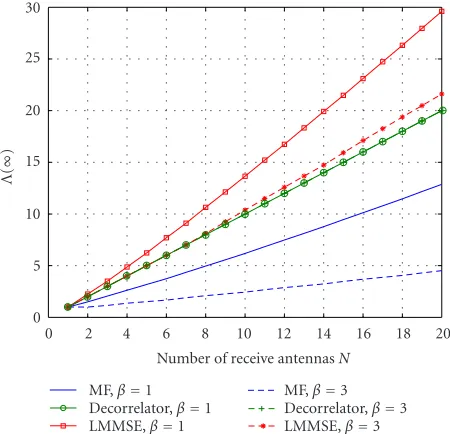
Figure1: Maximum asymptotic throughput of round-robin with different linear detectors.
4.3.2. Fixeda
Whenais fixed, the throughput constraint∆can be met if and only ifλ(a,∞)=. limρ→∞λ(a,ρ), the maximum
through-put givena, satisfiesλ(a,∞)≥∆. Since the throughput is a monotone increasing function ofρ, we can find the smallest
ρthat meets the throughput constraint, which is denoted by
ρmin(a)=min{ρ|λ(a,ρ)≥∆}. Thus the minimum effective energy for fixedais given by
Ee,min(a)= min ρ≥ρmin(a)
aρ
λ(a,ρ). (27)
4.3.3. Joint optimization
If we can jointly optimizeaandρand there is no power con-straint, the throughput constraint∆can be met as long as the maximum asymptotic throughputΛ(∞)≥∆. The joint op-timization can proceed in two steps: first, find the minimum effective energy whenais fixed, as described above; then find the global minimum across alla. This is characterized by the following proposition.
Proposition 2. For a given throughput constraint∆, if∆ ≤ Λ(∞), the minimum effective energy jointly optimized overa andρis given by
Ee,min=min
a Ee,min(a)=mina ρ≥minρmin(a) aρ
λ(a,ρ), (28)
while if∆>Λ(∞), the throughput constraint cannot be met.
5. NUMERICAL RESULTS AND DISCUSSIONS
In this section we present the numerical results and draw someobservations on the comparative performance of
0 2 4 6 8 10 12 14 16 18 20
0 5 10 15 20 25 30
Number of receive antennasN
M
aximum
asy
mpt
o
tic
thr
oug
h
put
Λ
(
∞
)
Round-robin, MF Round-robin, DEC Round-robin, LMMSE
Slotted-ALOHA, MF Slotted-ALOHA, DEC Slotted-ALOHA, LMMSE
Figure 2: Maximum asymptotic throughput of round-robin and slotted-ALOHA with different linear detectors,β=1.
different MAC schemes, as well as on the comparative per-formance of different linear detectors.
5.1. Maximum throughput
Example1 (comparison of detectors; joint optimization). In Figure 1we plot the maximum asymptotic throughput (re-sult of joint optimization) of round-robin with three linear detectors whenβ =1 andβ =3. Note that the two curves for the decorrelator coincide. When β = 1, the maximum asymptotic throughput of the linear MMSE detector exceeds that of the decorrelator (which isN) for all values ofN ex-cept N = 1, since 1/((N + 1)1/N −1) > 1 for allN > 1.
Whenβ = 3, the maximum asymptotic throughput of the linear MMSE detector exceeds that of the decorrelator when
N ≥8, with which 1/((N+ 1)1/N−1)>3. Asβgets larger,
it requires a largerN for the linear MMSE detector to sur-pass the decorrelator in terms of the maximum asymptotic throughput.
5 5.5 6 6.5 7 7.5 8 8.5 9 9.5 10 0
0.5 1 1.5 2 2.5 3 3.5 4 4.5 5
Average number of transmissions in each slot (mora)
Mi
n
imu
m
e
ff
ec
ti
ve
energ
y
Round-robin Slotted-ALOHA
Figure 3: Minimum effective energy with throughput constraint for different MAC schemes with the decorrelator (fixedmora),∆=
5,N=10,β=1,σ2T/G=1.
5.2. Minimum effective energy with throughput constraint
In the following we present the results of throughput-constrained energy minimization described in Section 4.3. We show the results of optimization with fixed aand joint optimization. For all simulations in this section we use the following values:N = 10,β = 1, andσ2T/G = 1 (scaling
factor ofEe).
Example3 (comparison of MAC schemes; fixeda). Assume that the decorrelator is used,Figure 3plots the minimum ef-fective energy of three MAC schemes with the throughput constraint ∆ = 5 when ais fixed. Note that the through-put constraint implies that m ≥ 5 for round-robin, and 5.21≤a≤9.43 for slotted-ALOHA. We observe that except form= 5 (where the minimum effective energy of robin goes to infinity and is not shown in the figure), round-robin is much more energy-efficient than slotted-ALOHA for the same value ofa.
Example 4 (comparison of MAC schemes; joint optimiza-tion). Assume that the decorrelator is used, when ∆ = 5, Figure 3 reveals that the minimum effective energy is achieved atm=6 for round-robin, and at abouta=6.2 for slotted-ALOHA. The minimum effective energy correspond-ing to different throughput constraints obtained through jointly optimizingaandρis shown inFigure 4, and the cor-responding optimal a is shown in Figure 5. Note that the largest throughput achievable by round-robin is Λ(∞) =
N=10, and that of slotted-ALOHA is 5.831. The minimum effective energy curve for round-robin is not smooth at val-ues ofmwhere a jump in the optimal group sizemoccurs. For slotted-ALOHA, the optimalais a smooth function of
0 1 2 3 4 5 6 7 8 9 10
0 1 2 3 4 5 6 7 8 9 10
Throughput constraint∆
M
inim
um
e
ff
ec
ti
ve
energ
y
Round-robin Slotted-ALOHA
Figure 4: Minimum effective energy with throughput constraint for different MAC schemes with the decorrelator (joint optimiza-tion),N=10,β=1,σ2T/G=1.
∆, and so is the minimum effective energy. It can be seen fromFigure 4that the minimum effective energy increases rapidly as∆approaches the maximum asymptotic through-put for each MAC scheme: the minimum effective energy ap-proaches infinity for slotted-ALOHA and round-robin, re-spectively, as∆→5.831 and as∆→10. When∆is relatively small (e.g., ∆ ≤ 3), slotted-ALOHA does not incur much extra energy expenditure than round-robin. As∆increases, the energy saving by round-robin relative to slotted-ALOHA becomes increasingly larger, and round-robin can support a throughput that cannot be achieved by slotted-ALOHA.
Example5 (comparison of linear detectors; joint optimiza-tion). The throughput-constrained minimum effective en-ergy for round-robin with various linear detectors is shown
in Figure 6. When N = 10, the maximum asymptotic
throughput of round-robin with the matched filter, the decorrelator, and the linear MMSE detector are about 6.4, 10, and 13.8, respectively, (cf.Figure 1). Again, it can be seen that the minimum effective energy approaches infinity as the throughput constraint approaches the maximum asymptotic throughput. When∆is small, we can use any one of the three detectors, but with different energy expenditures. As∆gets larger, we are left with fewer choices of the detector that can be used. The linear MMSE detector is certainly favorable in all scenarios.
6. MULTIUSER SCHEDULING UNDER
SHADOW FADING
0 1 2 3 4 5 6 7 8 9 10 0
1 2 3 4 5 6 7 8 9 10
Throughput constraint∆
Optim
u
m
m
or
a
Round-robin Slotted-ALOHA
Figure 5: Optimal m or a for minimum effective energy with throughput constraint for different MAC schemes with the decor-relator (joint optimization),N=10,β=1,σ2T/G=1.
applications. It has been shown that in a single-antenna sys-tem, the information capacity is maximized by the so-called “opportunistic transmission,” that is, allowing only the user with the best channel to transmit in every slot [28]. Mul-tiuser scheduling for systems with spatial diversity has been studied in [22,23,24,25], and all these works aim to max-imize the information capacity. Consider a similar setup as round-robin, that is, sensors form groups of sizem, the opti-mal schedulerunder the multipacket reception model should maximize the throughput in terms of the number of success-fully received packets in each slot. That is, in each slot, the optimal scheduler selects the group with the highest number of sensors that meet the SIR threshold. Although such an op-timal scheduler is theoretically appealing, its realization re-quires the receiver’s knowledge of the spatial signatures of all sensors at the beginning of each slot, which is infeasible when the number of sensors is large.
Another verified problem with multiuser scheduling for a system described inSection 2is that, under pure Rayleigh fading, multiuser scheduling has a vanishing relative schedul-ing gain as m and N increases (indicating a tradeoff be-tween multiple antennas and multiuser diversity) [25]. While shadow fading generally increases the dynamism of individ-ual link quantity, which leads to larger outage probability and is unfavorable to real-time applications, it can actually en-hance the scheduling gain in a multiuser environment for delay-tolerant applications [25]. By slightly modifying our system model, we can investigate the multiuser scheduling gain that is realizable under the shadow fading.
We assume that the sensors in each group are adjacent to each other such that they experience the same shadow fad-ing while sensors in different groups experience independent identically distributed shadow fading. In each slot, the sched-uler selects the group with the highest shadowing coefficient.
0 2 4 6 8 10 12 14
0 1 2 3 4 5 6 7 8 9 10
Throughput constraint∆
M
inim
um
e
ff
ec
ti
ve
energ
y
MF Decorrelator LMMSE
Figure 6: Minimum effective energy with throughput constraint for round-robin with different linear detectors (joint optimization),
N =10,β=1,σ2T/G=1.
Although this scheduler is not optimal in terms of through-put, it only requires about 1/Nmamount of channel knowl-edge compared to the optimal scheduler. Ideally, the receiver is a mobile agent which moves at the end of each slot to in-duce a dynamic environment such that all groups have simi-lar chances to enjoy the best channel in the long run. Fairness can be further guaranteed by employing other methods, such as those in [29,30].
Denote the channel gain of thekth (k=1,. . .,K) group byGk, then for thekth group the system model in (1) is
mod-ified as
y=Gk m
i=1
hixi+n. (29)
Gk is modeled as log-normal-distributed, which has area
mean E[Gk] = G = GL(dB), and decibel spread σL(dB).
The average SNR is given byρ = PG/σ2. DenoteG k =ezk,
then zk ∼ N(κGL, (κσL)2) is a Gaussian variable, where κ=ln 10/10.
Lemma 4 (see [31]). If Z1,. . .,ZK are i.i.d. Gaussian with meanµand varianceσ2, asK→ ∞,
max
1≤k≤KZk−→µ+σ
2 lnK. (30)
Applying the lemma to zk as defined above, we have
maxzk→κGL+κσL √
2 lnK(dB), or maxGk→G·eκσL √
2 lnK.
Denote the individual SNR ρk = PGk/σ2, we then have
maxρk → PG/σ2 ·eκσL √
2 lnK =. ξρ, whereξ = eκσL√2 lnK
1 2 3 4 5 6 7 8 9 10 0
1 2 3 4 5 6 7 8 9 10
Number of transmitting sensorsm
Thr
o
ug
hpu
t
Scheduling, shadowing,ρ=0 dB Round-robin, shadowing,ρ=0 dB Round-robin, no shadowing,ρ=0 dB Scheduling, shadowing,ρ= −10 dB Round-robin, shadowing,ρ= −10 dB Round-robin, no shadowing,ρ= −10 dB
Figure 7: Throughput comparison: multiuser scheduling versus round-robin (with the decorrelator),N =10,n=1000,σL=8 dB,
β=1.
of the scheduling algorithm respectively converge to
λsch(m,ρ)=mq(m,ξρ), (31)
Ee,sch(m,ρ)= ρσ2T/G
q(m,ξρ). (32)
In comparison, the throughput and effective energy of the same system via using the round-robin approach are given by
λrr(m,ρ)=Eρk
mq(m,ρk)
=m
+∞ −∞q
m,eze
−(lnz−lnρ)2/2(κσL)2 z√2πκσL dz .
=mq(m,ρ),
Ee,rr(m,ρ)=ρσ2T/G
q(m,ρ).
(33)
The throughput of multiuser scheduling and round-robin in shadow fading, both with the decorrelator, are de-picted in Figure 7, whereN = 10,n = 1000,σL = 8 dB, β=1, and two SNR values,−10 dB and 0 dB, are shown. The throughputs of round-robin without shadowing (i.e., pure Rayleigh fading) are also plotted for comparison. We observe that even for round-robin, shadowing is beneficial when the SNR is low, while the opposite is true when SNR is high:
shadowing degrades the throughput. This can be readily ex-plained by Jensen’s inequality by observing the property of theq(m,ρ) function: for all three detectors, it can be shown that theq(m,ρ) function is convex in the low-SNR range and is concave in the high-SNR range, and approachesq(m,∞) as
ρ→ ∞(see (9), (12), and (14)). Meanwhile, the throughput of multiuser scheduling is almost invariant of the SNR, and is roughly equal to the number of transmissions. This means that despite the average SNR, the group of the best channel has an effective SNR with which the success probability is 1. This demonstrates that multiuser scheduling is most useful when the SNR is low, which is of particular significance for sensor networks.
It is not difficult to show from (31) that the multiuser scheduling algorithm has the same maximum asymptotic throughput as round-robin. However, the fact thatq(m,ξρ) can be made virtually 1 for a modestρwhen the number of sensors is large implies that there is no loss in the energy con-sumption, and that the minimum effective energy remains low for all throughput constraints∆<Λ(∞).
7. CONCLUSIONS
In this paper we have presented a detailed investigation of two important aspects in the sensor network design, the throughput and the energy efficiency, which are typically two inconsistent measures. We have considered the uplink reach-back problem with simultaneous transmissions and multiple receive antennas. Simultaneous transmissions are favored for dramatically increased throughput and supported by the ad-vanced signal processing exploited in the physical layer. We consider both coordinated and random medium access con-trol schemes represented, respectively, by round-robin and slotted-ALOHA. We measure the energy efficiency with the effective energy, defined as the average energy consumption for each successfully transmitted packet. We optimize the av-erage number of transmissions per slotaand the transmis-sion power per sensor node, to meet two objectives: through-put maximization, and throughthrough-put-constrained effective en-ergy minimization. There are interesting connections be-tween these two optimization problems. In particular, the maximum asymptotic throughput as the SNR goes to infin-ity defines the upper limit on the throughput constraint that can be achieved.
APPENDICES
A. PROOF OFLEMMA 1
For the matched filter, whenm=1,
SIRi=ρ hi 2, (A.1)
where Γ(a,x) is the regularized gamma function given by
Γ(a,x) = x
whereHidenotes the matrix obtained by deleting theith
col-umn ofH.HiH†i has a complex central Wishart distribution
withm−1 degrees of freedom and covariance matrixIm−1,
denoted asHiH†i ∈CWN(m−1,Im−1). SincehiandHiare
independent, according to [32, Theorem 3.2.8] we have
Y =. h
fore, the probability of success is
PrSIRi≥β
known that whenm≤N, the determinant ofZis distributed asmi=1χ2
where Z[i] denotes the matrix obtained by striking out the ith row and theith column ofZ, andZsc[i]denotes the Schur-complement of Z[i], which is also complex Wishart
dis-tributed, that is,Zsc
[i]∈CW1(N−m+ 1,IN−m+1). Therefore,
Denote the spectral decomposition of matrix HiH†i =
UDU†, whereDis the matrix containing the eigenvalues of HiH†i in decreasing order, andUis the unitary matrix
con-taining the eigenvectors ofHiH†i. Putting in the above and evaluating the limit, we get
lim
plex Gaussian, v has the same distribution as hi.
There-fore, limρ→∞SIRi =ρ
[1] I. F. Akyildiz, W. Su, Y. Sankarasubramaniam, and E. Cayirci, “A survey on sensor networks,”IEEE Commun. Mag., vol. 40, no. 8, pp. 102–114, 2002.
[2] A. J. Goldsmith and S. B. Wicker, “Design challenges for energy-constrained ad hoc wireless networks,”IEEE Wireless Communications, vol. 9, no. 4, pp. 8–27, 2002.
[3] E. Shih, S. Cho, N. Ickes, et al., “Physical layer driven pro-tocol and algorithm design for energy-efficient wireless sen-sor networks,” inProc. 7th Annual International Conference on
Mobile Computing and Networking (MobiCom ’01), pp. 272– 287, Rome, Italy, July 2001.
[4] A. F. Dana and B. Hassibi, “On the power-efficiency of sen-sory and ad-hoc wireless networks,” submitted to IEEE Trans. Inform. Theory.
[5] S. Cui, A. J. Goldsmith, and A. Bahai, “Energy-constrained modulation optimization,” to appear inIEEE Transactions on Wireless Communications.
[6] J. Chou, D. Petrovic, and K. Ramachandran, “A distributed and adaptive signal processing approach to reducing energy consumption in sensor networks,” inProc. 22nd Annual Joint Conference of the IEEE Computer and Communications Soci-eties (INFOCOM ’03), vol. 2, pp. 1054–1062, San Francisco, Calif, USA, March–April 2003.
[7] S. Cui, R. Madan, A. J. Goldsmith, and S. Lall, “Joint routing, MAC, and link layer optimization in sensor networks with energy constraints,” inProc. IEEE International Conference on Communications (ICC ’05), vol. 2, pp. 725–729, Seoul, South Korea, May 2005.
[8] A. Ephremides, “Energy concerns in wireless networks,”IEEE Wireless Communications, vol. 9, no. 4, pp. 48–59, 2002. [9] L. Tong, Q. Zhao, and S. Adireddy, “Sensor networks with
mo-bile agents,” inProc. IEEE Military Communications Confer-ence (MILCOM ’03), vol. 1, pp. 688–693, Boston, Mass, USA, October 2003.
[10] L. Roberts, “ALOHA Packet system with and without slots and capture,”Computer Communications Review, vol. 5, no. 2, pp. 28–42, 1975.
[11] S. Verd ´u,Multiuser Detection, Cambridge University Press, Cambrige, UK, 1998.
[12] S. Ghez, S. Verd ´u, and S. C. Schwartz, “Stability properties of slotted Aloha with multipacket reception capability,”IEEE Trans. Automat. Contr., vol. 33, no. 7, pp. 640–649, 1988. [13] B. Hajek, A. Krishna, and R. O. LaMaire, “On the capture
probability for a large number of stations,”IEEE Trans. Com-mun., vol. 45, no. 2, pp. 254–260, 1997.
[14] S. V. Hanly and D. N. C. Tse, “Resource pooling and effective bandwidths in CDMA networks with multiuser receivers and spatial diversity,”IEEE Trans. Inform. Theory, vol. 47, no. 4, pp. 1328–1351, 2001.
[15] S. Ghez, S. Verd ´u, and S. C. Schwartz, “Optimal decentral-ized control in the random access multipacket channel,”IEEE Trans. Automat. Contr., vol. 34, no. 11, pp. 1153–1163, 1989. [16] S. Adireddy and L. Tong, “Exploiting decentralized channel
state information for random access,” IEEE Trans. Inform. Theory, vol. 51, no. 2, pp. 537–561, 2005.
[17] A. Chockalingam, M. Zorzi, L. B. Milstein, and P. Venkataram, “Performance of a wireless access protocol on correlated Rayleigh-fading channels with capture,” IEEE Trans. Com-mun., vol. 46, no. 5, pp. 644–655, 1998.
[18] J. T.-K. Liu and A. Polydoros, “Retransmission control and fairness issue in mobile slotted ALOHA networks with fading and near-far effect,”Mobile Networks and Applications, vol. 2, no. 1, pp. 101–110, 1997.
[19] X. Qin and R. Berry, “Exploiting multiuser diversity in wire-less ALOHA networks,” inProc. Allerton Conference on Com-munication, Control and Computing, Allerton, Ill, USA, Octo-ber 2001.
[20] P. Venkitasubramaniam, Q. Zhao, and L. Tong, “Sensor net-work with multiple mobile access points,” inProc. 38th An-nual Conference on Information Sciences and Systems (CISS ’04), Princeton, NJ, USA, March 2004.
Signal Processing (ICASSP ’05), Philadelphia, Pa, USA, March 2005.
[22] E. G. Larsson, “On the combination of spatial diversity and multiuser diversity,”IEEE Commun. Lett., vol. 8, no. 8, pp. 517–519, 2004.
[23] J. Jiang, R. M. Buehrer, and W. H. Tranter, “Antenna diversity in multiuser data networks,”IEEE Trans. Commun., vol. 52, no. 3, pp. 490–497, 2004.
[24] D. Aktas and H. El Gamal, “Multiuser scheduling for MIMO wireless systems,” in Proc. 58th IEEE Vehicular Technology Conference (VTC ’03), vol. 3, pp. 1743–1747, Orlando, Fla, USA, October 2003.
[25] B. M. Hochwald, T. L. Marzetta, and V. Tarokh, “Multiple-antenna channel hardening and its implications for rate feed-back and scheduling,”IEEE Trans. Inform. Theory, vol. 50, no. 9, pp. 1893–1909, 2004.
[26] X. Liu, E. K. P. Chong, and N. B. Shroff, “Opportunistic trans-mission scheduling with resource-sharing constraints in wire-less networks,”IEEE J. Select. Areas Commun., vol. 19, no. 10, pp. 2053–2064, 2001.
[27] D. N. C. Tse and O. Zeitouni, “Linear multiuser receivers in random environments,”IEEE Trans. Inform. Theory, vol. 46, no. 1, pp. 171–188, 2000.
[28] R. Knopp and P. A. Humblet, “Information capacity and power control in single-cell multiuser communications,” in Proc. IEEE International Conference on Communications (ICC ’95), vol. 1, pp. 331–335, Seattle, Wash, USA, June 1995. [29] P. Viswanath, D. N. C. Tse, and R. Laroia,
“Opportunis-tic beamforming using dumb antennas,”IEEE Trans. Inform. Theory, vol. 48, no. 6, pp. 1277–1294, 2002.
[30] M. Sharif and B. Hassibi, “A delay analysis for opportunistic transmission in fading broadcast channels,” inProc. 24th An-nual Joint Conference of the IEEE Computer and Communica-tions Societies (INFOCOM ’05), vol. 4, pp. 2720–2730, Miami, Fla, USA, March 2005.
[31] H. A. David and H. N. Nagaraja,Order Statistics, John Wiley & Sons, New York, NY, USA, 3ed edition, 2003.
[32] R. J. Muirhead,Aspects of Multivariate Statistical Theory, John Wiley & Sons, New York, NY, USA, 1982.
[33] B. Chen and L. Tong, “Traffic modeling and tracking for mul-tiuser detection for random access networks,” inProc. IEEE International Conference on Acoustics, Speech, and Signal Pro-cessing (ICASSP ’00), vol. 5, pp. 2601–2604, Istanbul, Turkey, June 2000.
[34] S. Cui, A. J. Goldsmith, and A. Bahai, “Energy-efficiency of MIMO and cooperative MIMO techniques in sensor net-works,”IEEE J. Select. Areas Commun., vol. 22, no. 6, pp. 1089– 1098, 2004.
[35] L. Tong, V. Naware, and P. Venkitasubramaniam, “Signal processing in random access,”IEEE Signal Processing Mag., vol. 21, no. 5, pp. 29–39, 2004.
Wenjun Lireceived the B.S. degree in elec-tronic and information engineering from Shanghai Jiaotong University, Shanghai, China, in 2002, and the M.S. degree in electrical engineering from North Carolina State University, Raleigh, NC, in 2004. She is currently working towards her Ph.D. degree in the Department of Electrical and Com-puter Engineering, North Carolina State
University, Raleigh, NC. Her current research focuses on wireless communications, and energy-efficient communications and signal processing for wireless sensor networks.
Huaiyu Dai received the B.E. and M.S. degrees in electrical engineering from Ts-inghua University, Beijing, China, in 1996 and 1998, respectively, and the Ph.D. de-gree in electrical engineering from Prince-ton University, PrincePrince-ton, NJ, in 2002. He worked at Bell Labs, Lucent Technologies, Holmdel, NJ, during the summer of 2000, and at AT & T Labs-Research, Middletown,