R E S E A R C H
Open Access
Multi-security-level cloud storage
system based on improved proxy
re-encryption
Jinan Shen
1,2*, Xuejian Deng
1and Zhenwu Xu
1Abstract
Based on the characteristics and data security requirements of the cloud environment, we present a scheme for a multi-security-level cloud storage system that is combined with AES symmetric encryption and an improved identity-based proxy re-encryption (PRE) algorithm. Our optimization includes support for fine-grained control and performance optimization. Through a combination of attribute-based encryption methods, we add a fine-grained control factor to our algorithm in which each authorization operation is only valid for a single factor. By reducing the number of bilinear mappings, which are the most time-consuming processes, we achieve our aim of optimizing performance. Last but not least, we implement secure data sharing among heterogeneous cloud systems. As shown in experiment, our proposed multi-security-level cloud storage system implements services such as the direct storage of data, transparent AES encryption, PRE protection that supports fine-grained and ciphertext heterogeneous
transformation, and other functions such as authentication and data management. In terms of performance, we achieve time-cost reductions of 29.8% for the entire process, 48.3% for delegation and 47.2% for decryption.
Keywords: Privacy preserving, Proxy re-encryption, Fine-grained, Cloud storage
1 Introduction
1.1 Motivation
Cloud computing has provided very important support for information use by government agencies and enter-prises. Security issues have restricted the development of public cloud services[1], and in particular, the prob-lem of how to protect the privacy of users has become a significant factor in their reluctance to adopt cloud com-puting[2,3]. Most existing solutions only focus on a single type of threat, and this has given rise to certain problems. Recently, the protection of data privacy for users of cloud storage has become one of the most critical issues in public cloud applications and has impeded the rapid development of cloud services. There are still many weak-nesses in the current methods for the protection of pri-vate user data in cloud environments [4, 5]. Theoretical
*Correspondence:[email protected]
1School of Information Engineering, Hubei Minzu University, Xueyuan Road, Enshi 445000, China
2School of Computing Science and Technology, Huazhong University of Science and Technology, Luoyu Road 1037, Wuhan 430074, China
research has developed many algorithms for cloud stor-age security requirements, such as distributed systems with information flow control (DIFC) [6], attribute-based encryption (ABE) [7], proxy re-encryption (PRE) [8], fully homomorphic encryption [9], ciphertext search algo-rithms, and so on. However, the most common way to share stored ciphertext is to download the ciphertext data, decrypt it into plaintext, and then re-encrypt it before sending it to users to share. This process consumes a lot of network and computing resources and loses the advantage of cloud storage [10,11].
With regard to the security issues around the privacy of users’ data in the cloud environment [6], and after investigation and study of the inadequacy of the existing solutions, we aim to develop a scheme that can pro-tect data privacy in the cloud environment. This scheme should be able to resolve the core issues preventing users from trusting cloud services; in other words, we aim to allow the users themselves to have control over their data file. Simultaneously, from a practical point of view, basic fine-grained control must be implemented, and there is also a need to carry out optimization to achieve good performance and compatibility [12–14].
1.2 Methodology
We observe that all of the existing methods of protect-ing a user’s data in a cloud environment have limitations to a greater or lesser extent, and we therefore propose a scheme that can resolve all of these problems, including key control, fine-grained control, revoking of permissions, performance optimization, and compatibility.
Firstly, in our scheme, each user has a pair of identity-based encryption (IBE)-type private and public keys, and some users may also have another pair of public key encryption (PKE)-type private and public keys. These are all generated by a trusted third party, and all private keys are kept by users themselves. There is never a need to tell other users the private key. When a user updates data in the cloud, he or she can encrypt these data using the IBE-type public key and can compute a re-encryption key that does not leak the user’s secret key. The proxy also cannot obtain the plaintext during re-encryption. We also add fine-grained control, since each time the user com-putes the re-encryption key, this applies only to the data of the designated type. The proxy cannot transform data of one type to a ciphertext using a re-encryption key of the wrong type.
Secondly, our scheme can transform IBE-type cipher-text to PKE-type ciphercipher-text; this feature means that our scheme has good compatibility, and it is straight-forward to integrate our scheme with existing sys-tems. Using optimization, we can reduce the use of bilinear mapping, which is a major influence on the performance of an algorithm, and our scheme there-fore gives acceptable performance in real-world sys-tems. We will describe this optimization in a later section.
Thirdly, we explicitly describe how to change and revoke permissions; when users do not want others to use data that were previously shared, the permissions can be con-veniently changed.
We integrate all of these capabilities into a single scheme. Our main design goal is to help users achieve fine-grained access control to the storage and sharing of files in a cloud environment. Specifically, we aim to ensure that data are under the control of data owners, rather than cloud service providers. We also aim to create a scheme that has excellent performance and has all the relevant functions, such as permission revoking, type changing, data searches, and so on, to be appropriate for a real-world system.
This paper proposes an improved PRE algorithm to sup-port fine-grained control and ciphertext heterogeneous transformation. A multi-security-level cloud storage sys-tem is designed that involves AES symmetric encryption and other algorithms. The user’s private data are pro-tected, while control over the data remains in the hands of the user.
This paper is organized as follows. In Section 2, we introduce related work on data protection using PRE in the public cloud. We carry out a formal analysis of the modeling and the macro definition of our scheme in Section3. In Section4, we introduce the associated imple-mentation issues, including the system architecture and feature model. In Section 5,we conducted a safety anal-ysis of our scheme. Section 6 presents an evaluation of our scheme. Finally, Section 7 concludes the paper and discusses future work.
2 Related work
Encryption is one of the most commonly used methods for traditional privacy data protection. Typical research results for cloud data security protection methods based on cryptography algorithms can be divided into symmet-ric and public key encryption classes, according to the type of encryption used.
Based on a symmetric encryption system, Li et al. [7] realized secure storage of cloud data and isolation of encrypted cloud data by adopting a method involving multiple keys and file partitioning. Sookhak et al. [8] com-bined the “lazy undo”, “keychain” and “broadcast encryp-tion” operations to achieve more secure updating and permission transformation of cloud data. Liu et al. pro-posed the TrustStore method and introduced a special key management service provider to realize different forms of key encryption for different files. These authors also veri-fied the integrity of cloud data by creating hash checking information [9]. Although this scheme solved the prob-lem of secure storage and access control over cloud data to a certain extent, symmetric encryption lacks flexibility when used in key management and an encryption algo-rithm. Therefore, in a cloud computing environment with fine-grained multi-tenant dynamic sharing and large-scale networks, this type of method has drawbacks.
the encrypted cloud data [18]. Jiang and Guo [19] pro-posed a PRE scheme for realizing the confidentiality of the data access control conditions of the encryption cloud. Zuo [20] proposed a PRE scheme that can be used one way and re-encrypted many times, thus realizing multi-tenant sharing of cloud data that can be transmitted. Li et al. [21] proposed an attribute-based, fine-grained autho-rization keyword search scheme for cloud computing, and Ding et al. [22] proposed a multi-keyword fuzzy search scheme, thus realizing privacy protection for encrypted data in cloud.
A symmetric, searchable encryption algorithm was pro-posed by Shen et al. [23]. Xu et al. [24] improved this scheme and gave the security definition. This scenario applies to both the data searcher and the data producer, with the main drawback being that existing solutions find a compromise between performance and functional-ity. An asymmetric searchable encryption algorithm was proposed by Ni et al. [25] and was improved by [26]. The disadvantage of this scheme is that existing asym-metric searchable encryption algorithms require ellip-tic curve pairing, which performs worse than a hash function or block cipher. The fast asymmetric search-able encryption algorithm proposed by Masayuki [27] improves the performance of the asymmetric searchable encryption algorithm but is also vulnerable to a dictio-nary attack. Guo [28] proposed a multi-user, symmetric, searchable encryption algorithm that is mainly aimed at the scenario in which encrypted data are generated by a single producer and multiple parties search these data. This not only supports the encryption of indices and the generation of search tokens, but also allows the data owner to add and revoke search rights to the data for certain users.
No complete solution exists for the dynamic protection of the user’s data privacy. Crypt DB uses an onion-based security scheme to ensure different levels of data privacy. At the same time, this method uses homomorphic encryp-tion to enable ciphertext to directly perform some simple operations, such as query and comparison, ensuring that data with a high privacy level is stored in memory as ciphertext. Holomorphic encryption refers to any oper-ation that can be performed on plaintext on encrypted data without decryption [29]. Gasti et al. [30] proposed a feasible method for full mathematically homomorphic encryption, and this represented a decisive breakthrough in this technology. At present, software algorithms can-not perform complex calculations using ciphertext, so in order to encrypt the data in memory, many researchers have used hardware to ensure the privacy of dynamic data. XOM [31] guarantees that private data are still stored in memory as ciphertext and that data are decrypted by special hardware when entering the CPU for calculation.
3 Multi-security-level cloud storage system Due to the diversity of tenants in the cloud environment, different tenants have different requirements for the secu-rity protection level of data, and even the same tenant has different requirements for the different data they own. In the cloud, user data exist in two forms: dynamic and static data. Static data refers to the information that does not participate in calculation and is mainly used for mass storage and convenient access, such as documents, pic-tures, video, reports, materials and so on stored by users for a long time. Dynamic data refers to the data that needs dynamic verification or participation in calculation, such as database files, program files, configuration files, etc. Our scheme for the protection of users data privacy in cloud storage includes the following: (1) normal inter-face and security interinter-face: normal interinter-face is used when users access public data, and security interface is used when they access data with a certain level of security; (2) security-level-based encrypted storage for static data, by applying encryption policies with different strengths to different user data, thus ensuring the user data confi-dentiality and high performance for the whole system; (3) a fine-grained access control mechanism for static data that combines PRE algorithms to support fine granular-ity and ciphertext heterogeneous conversion, web services technology, and secure plugging in client to protect the user’s privacy; (4) security-level-based segmentation age for dynamic data that provides segmentation stor-age for different user data, based on sensitivity; and (5) secure search technology for dynamic data, thus providing secure search services without exposing the data infor-mation to the cloud platform. The scheme is illustrated in Fig.1.
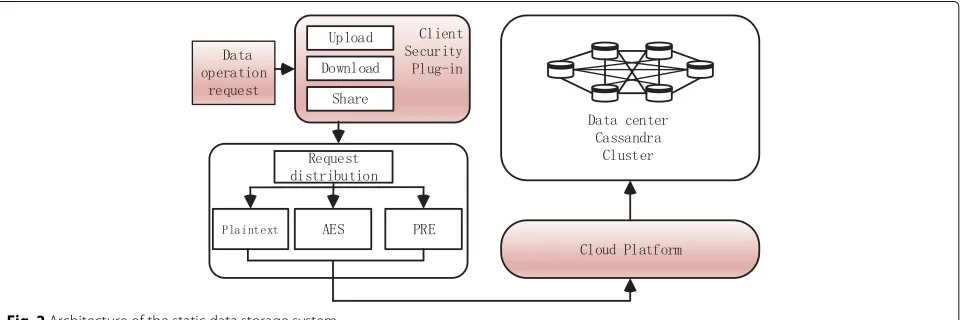
In this paper, we focus solely on static data. The func-tional architecture based on multiple security levels is shown in Fig.2. The functions on the front-end nodes of the system includes: (1) a user authentication module, (2) a client security plug-in module, (3) a multi-security-level encryption module, and (4) a data storage module. The PRE server includes the PRE service module and the client security plug-in module and provides a client security interface for users.
3.1 Enhanced RBAC
Data storage
Cloud
platform
Applicat i on
Mapreduce
Client
Data process
Norm al interface
Securit y interface
Static data
Dynamic
data
Encrypti on Based on Securit y Level
Segmentation Based on Secure Level
Securit y Pl ug-in
Fi ne-grained Acces s Cont rol
Encrypted Search
Fig. 1The multi-security-level cloud storage system
can be further strengthened by controlling the distribu-tions of secret key. The access control model of medical cloud platform is shown in Fig.3.
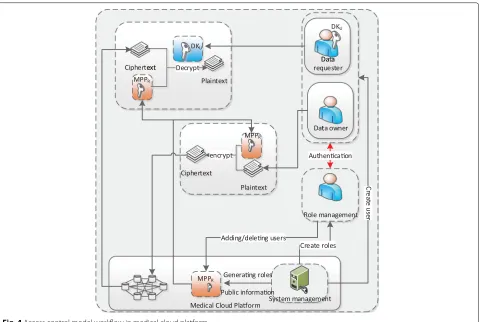
The platform realizes the access control and authoriza-tion for legal users of the system based on RBAC model. On the other hand, encryption is adopted to ensure the confidentiality of data in the cloud platform. The specific workflow is shown in Fig.4.
The system management module is operated in the sys-tem initialization stage to realize the creation of users and roles and generate the corresponding public information MppR to the roles and the secret keys of the users and roles.
The user corresponding to each role in the Role Man-agement Module ManMan-agement System will establish the relationship between the user and the role to realize the addition and deletion of users in the role. The general permission distribution corresponding to the role is ini-tialized by the system management.
MppR, the public parameter that belongs to the date owners, is used to encrypt and store the date. Meanwhile, the date owners request the role management module to encrypt the data onto the corresponding role. The role management module determines which users are assigned to roles and which are excluded from its function to control user-to-role mapping.
Fig. 3The access control enhancement model of medical cloud platform
The data requester uses the decryption key DKU
pro-vided by the system and the public information MppR of the role to decrypt the ciphertext from the cloud. It can be decrypted correctly when the data requester is a member of the data encryption or the role to which the data requester belongs inherit the ciphertext encryption role.
3.2 Design of the scheme
In this paper, the improved PRE algorithm supports fine-grained and ciphertext heterogeneous transforma-tion. Based on the traditional identity-based PRE algo-rithm, fine-grained control and ciphertext heterogeneous transformation are added to allow fine-grained control of proxy authorization. Meanwhile, using the traditional
public key system, the re-encrypted ciphertext can be decrypted.
IBE algorithm consists of four main functions:
(1) SetupIBE(k): This algorithm generates system parameter pairs(params, mk), wherek is a security parameter, and params is a collection of system parameters. This parameter will be used in later functions. mk is the system master security key, and is related to the security of the overall system. (2) KeyGenIBE(mk,params,ID): mk is the system master
security key, params is the system parameter set, and ID is the user’s identity information. ID may include a mailbox, IP, ID number or other information. This algorithm generates the private keyskID.
(3) EncIBE(ID,params,M,t): For plaintext dataM , we
use the system parameter set params, identity information ID (public key), and a type value for fine-grained controlt to compute M, which corresponds to the original ciphertext.
(4) DecIBE(skID,params,CID): If the proxy authorizer
needs to decrypt and view encrypted data, the system parameter set params and the private key he holds can be used to decrypt the original cipher.
The Setup and KeyGen algorithms are executed by a trusted third-party key generation center (KGC) during the initialization phase of the system. The tem parameters are generated and sent to the sys-tem through a secure channel for later use, while users can use their identity information to apply for the private key corresponding to the identity in the KGC.
The traditional public-key cryptographic algorithm consists of three functions(KeyGenPKE, EncPKE, DecPKE):
(1) KeyGenPKE(k,aux):k is the security parameter, and aux is the corresponding parameter. This algorithm generates a pair of public and private key pairs
(pk, sk), where pk is the public key, and sk is the private key.
(2) EncPKE(pk, aux,M): pk and aux are used to encrypt
the plaintextM to get the ciphertextCpk.
(3) DecPKE(sk, aux,CPK): Using sk and aux , the
ciphertextCpkis decrypted to get the plaintextM.
This part of the function is used when convert-ing the original ciphertext encrypted by the identity-based encryption algorithm into ciphertext that can be decrypted by the traditional algorithm, thus ensuring that the conversion process will not be affected by security problems.
The functions related to proxy re-encryption are KeyGenPRO(), ReEnc(), ReDec()and ChaType():
(1) KeyGenPRO(skID, ski, pkj,t, params): This uses the system parameter set params, the fine-grained parametert, the identity-based private keyskIDof the
proxy authorizer, the private keyskiof the traditional public key system, and the public keypkjof the traditional public key system. This algorithm generates the PRE keyrkIDand sends it to the PRE
server for storage.
(2) ReEnc(rkID, params,CID): This is the re-encryption
function. UsingrkIDand the corresponding system
parameters, the original ciphertextCIDencrypted by
IBE is re-encrypted into the ciphertextCpkof the
traditional public key system.
(3) ReDec(CPK, params, skj): The decryption function of the re-encrypted ciphertext, using the private keyskj of the agent receiver and the corresponding system parameters, is used to decrypt the ciphertextCpk
generated by re-encryption to the data plaintextM . (4) ChaType(CID, params,t): This is the fine-grained
dynamic change function. Using the changed fine-grainedtand system parameters, the fine-grained information of ciphertextCIDis
changed, and the fine-grainedt of ciphertextCIDis
changed to the fine-grainedtof ciphertextCID .
3.3 Implementation of the scheme
The basic structure described in the previous section is used for a detailed overview of the proposed algorithm:
(1) SetIBE(k): This algorithm is run by the KGC, and
generates a public parameter:
params=(G1,GT,p,g,H1,H2,ˆe, pk) (1)
wherepk=ga,is the public key for the KGC. The security parameterk is generated by a random algorithm in this system.p is a prime, producing the multiplication groupsG1andGTof orderq. g is a generator ofG1, and a numberα∈Zq∗is randomly generated as the main safety parametermk. A bilinear mapping functioneˆ:G1×G2→GTand two hash function
H1:{0, 1}∗→G1,H2:{0, 1}∗→ZP∗are used. (2) KeyGenIBE(mk, params, id): When the user logs in,
the KGC obtains the user’s legitimate identity information id , and uses params and the main security parameter mk to generate the key pair
(pkid, skid)for the user, where
pkid=H1(id), skid=pkαid (2)
(3) KeyGenPKE(params): This is run by the KGC when
the user submits the application. Like the public and private keys based on identity type,(pkid, skid)is generated by generating a random numberγ ∈Z∗p
pkid=gskid, sk
id=γ (3)
(4) EncIBE(pkid, skid, params,m,t): This algorithm is
executed when the data owner encrypts the data. The data owner uses his or her private key pair(pkid, skid)
based on identity type, type informationt for fine-grained control, and a random numberγ ∈Z∗p. The data are encrypted in plaintext to cipher
c=(c1,c2,c3), where
c1=gr,c2=m· ˆe(pkid, pk)r·H2(skid)t,c3=t (4)
(5) DecIBE(skid, params,c): This function is used when
the user decrypts a file that he or she has encrypted. Of course, the result could be obtained by requesting authorization and then re-encrypting the data, but the performance would be affected. When
decrypting, the private keyskidof the data owner is
entered, based on the identity type and the relevant system parameter params , and the cipher text params can then be decrypted to plaintextm using the following calculation:
m= c2
ˆ
e(PKid, pk)r·H2(skid)t (5)
(6) KeyGenPRO(skid, skid, pkid,t, params): When the data
owner authorizes access, this step uses theskidifor
the data owner based on the identity type,skidiof the traditional type,pkid
jof the agent receiver’s
traditional type and the fine-grained typet , to calculate the agent from useri to user j to re-encrypt and re-encrypt the key.
transparently executed on the server side, and encrypts the original ciphertext encrypted by useri into ciphertext that userj can decrypt. The
ciphertextci=(ci1,ci2,ci3)is encrypted by useri and
the agent of typet from user i to j re-encrypt the key
rkidi→idjand relevant system parameters are used as
input, and the re-encryptedcj=(cj1,cj2,cj3)is the
the ciphertext is re-encrypted. After receiving the ciphertextcj=(cj1,cj2,cj3)sent by the proxy server,
the proxy receiver uses the private keyskid iof a
traditional cryptography system to calculate the data plaintext using the following algorithm:
m= cj2
when the data owner modifies the type of a file in order to change the authorization state or revoke authorization. The original ciphertextc=(c1,c2,c3)
and the new fine-grained control typetis used to calculate the new ciphertextc=(c1,c2,c3)using the
The transformation fromc2toc2can also be obtained usingc2=mtt ·c2t
t.
4 Implementation
In this section, we introduce the system modules and functions in detail, and describe their characteristics and optimization in cloud environments. We use Cassandra as our distributed network database.
4.1 Overall architecture
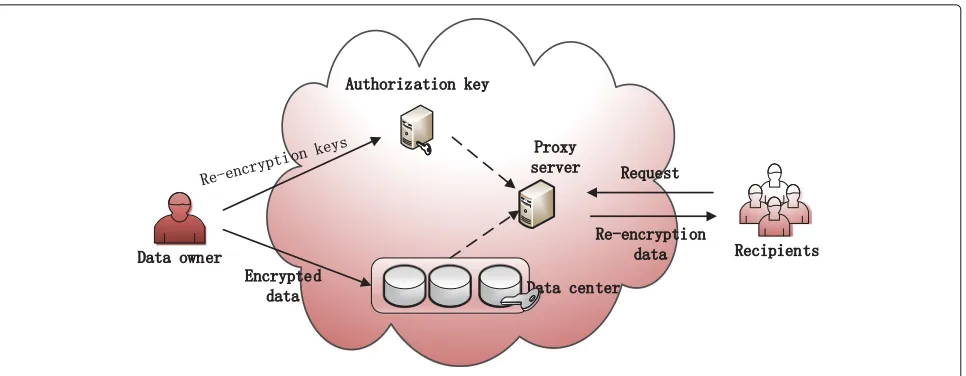
The architecture of the improved PRE module is shown in Fig.5. The user encrypts the data using key encapsula-tion via the client, by taking the following steps: (1) using AES to encrypt user data, (2) using the proxy server to re-encrypt the symmetric key for the encrypted file, and (3) storing the data from steps (1) and (2) together as the original ciphertext in the data center cluster.
Fig. 5Architecture of PRE for data protection
recipient can decrypt with his own secret key. All of these processes taking place on the proxy server are transpar-ent to the user. In this way, the user receives the required data files but they do not leave the proxy. When the recip-ient has gained access to the required files, he or she can decrypt the data using the client software.
In order to achieve the purpose of the fine-grained con-trol, we add an element named “type” to the algorithm. Users can add a file to a type or many files to a single type. The type is included in the ciphertext when a data file is encrypted, and each re-encryption key for authorization is also of the same type, since the proxy cannot re-encrypt the data file successfully using a re-encryption key and data that do not match.
In addition, if after recipient has finished processing the data file need feedback to the user, and the data will then be used by a user with a different type, this can be achieved directly by computingc=(c1,c2,c3), where
c1=c1,c2=mt·t
−1
·ct2·t−1,c3=c3
This means that we can sidestep the process of encryp-tion using the recipient’s public key and sharing with the user, followed by decryption and sharing again. Any more, if user wants to recover authority or wants to change the type, this can be conveniently achieved by computingc= (c1,c2,c3), where
c1=c1,c2=c2·(e(pkid, pk)r·H2(skidt) t·t−1
),c3=c3
4.2 System processing flow
Key management is always an important issue in sys-tem implementation. In our syssys-tem, we implement a KGC to generate and distribute key pairs. The user’s IBE-type public key is the email address that was given when reg-istering, and the IBE-type secret key is generated by KGC and held by the users themselves. The user’s PKE-type secret key and public key are generated and distributed by
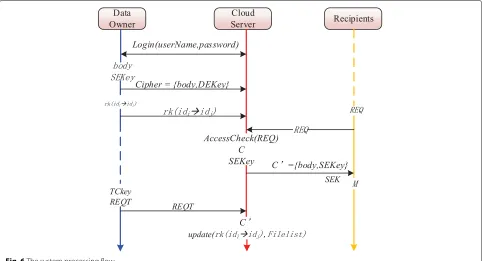
CA. The search feature in our system was implemented by using the Cassandra NoSQL database, in which we can search for a data value by key. We also implement the user authorization function and friend management scheme in order to allow sharing of data files.The process used in our scheme is illustrated in Fig.6.
The process nouns in Fig. 6 are explained in the
following.
body=symmetricEnc(M, SEK) SEKey=Encibe(id, params, SEK.t) rk(idi→idk)=KeyGenpre(sk(idi), skidi, pk
(idj),t, params) REQ=FileAccessREQ(fileKey, userName)
C=body, SEKey=getTuple(REQ) SEKeyj=ReEnc(Ci, rk(idi→idj), params) SEK=Decpke(SEKeyj, skidi, params) M=symmetricDec(M, SEK) TCkey=e(pkid, pk)r·H2(skidt)t·t−1
REQT=TypeREQ(userName, FileList, TCkey) Ci=chaType(Ci,t)
5 Security analysis
Theorem 1If the initial ciphertext and private key
are correctly generated and meet the following condi-tions: C ← EncIBPRE(PPIBPRE,URoleId,m,α),SKUserIdIBPRE ← ExtractIBPRE(MKIBPRE, UserId), and UserId ∈ URoleId. Then, the plaintext m can be calculated by executing the algorithmDecIBPRE(PPIBPRE, UserId, SKUserIdIBPRE,C,URoleId).
Proof if UserId∈URoleId, then we have
(e(c1,h(γ,URoleId))·e(SKUserIdIBPRE,c2))
1
n
j=1,j=i H1(UserIdj)
Fig. 6The system processing flow
e(gγ+H11(userId),hk· n j=1
γ+H1(UserIdj)
))
1
n
j=1,j=i H1(UserIdj)
= (e(g−k·γ,hγ (UserId,URoleId)) ·
e(g,h)
k·n j=1γ+
H1(UserIdj)
)
1
n
j=1,j=i H1(UserIdj)
=(e(g,h)
k·n j=1
H1(UserIdj)
)
1
n
j=1,j=i H1(UserIdj)
=vk m= c3
vk
Now, if UserId ∈ URoleId ,then DecIBPRE(PPIBPRE, UserId, SKUserIdIBPRE,URoleId) = m. Similarly, the selected receiver can decrypt the correctly generated initial cipher-text into the original plaincipher-text.
Theorem 2If the ciphertext is correctly
gener-ated by algorithm ReEncIBPRE() : C ← ReEncIBPRE (PPIBPRE,dUserId→U
RoleId|α,C,URoleId)
, and private key is correctly
generated by algorithm ExtractIBPRE() : SKUserId
IBPRE ←
ExtractIBPRE(MKIBPRE, UserId),
dUserId→U
RoleId|α ←
RKExtractIBPRE(PPIBPRE, UserId, SKUserIdIBPRE,URoleId ,α), C←EncIBPRE(PPIBPRE,URoleId,m,α),and
SKUserIdIBPRE ← ExtractIBPRE(MKIBPRE, UserId) are all exe-cuted correctly, and they are valid for any UserId ∈ URoleId,α = α,and UserId ∈ URoleId . Then, execute
ReDecIBPRE(PPIBPRE, UserId, SKUserId
IBPRE,C,URoleId ), thus we would obtain plaintext m.
6 Simulation results and discussion
In this section, we evaluate the performance of the encryption and decryption by the data owner, re-encryption by the cloud proxy, and the performance of decryption by the recipients. These steps are implemented using the library of miracle on IBE and an elliptic curve defined on a 512-bit prime field with a generator order of 160 bits. The embedded degree of the curve is two. The experimental environment has the following config-uration: a Ubuntu virtual machine (3.0 GHz vCPU, 1 GB RAM) running on a PC (Intel i5 3.0 GHz, 8 GB RAM).
6.1 Performance of encryption by data owner
The algorithm Enc(pk, aux,M) is executed on the client side. It does not reduce the use of bilinear mapping, and the calculation time is not significantly optimized.
Fig. 7Performance of encryption by data owner
6.2 Performance of decryption by data owner
Decryption of the original ciphertext function is per-formed by the data owner via the client. The algorithm DecPKE(sk, aux,CPK)cannot reduce the number of bilin-ear mappings. Figure8shows the computational overhead of the data owner when performing different frequency decryption operations on our system. This step is exe-cuted when the data owner downloads and decrypts data. In this step, the ciphertext is not transformed by the proxy server. The proposed scheme consumes about the same amount of time as the standard PRE scheme; this step takes less than 15 ms, and since this is carried out only once per file, this is an acceptable value.
6.3 Performance of delegation by data owner
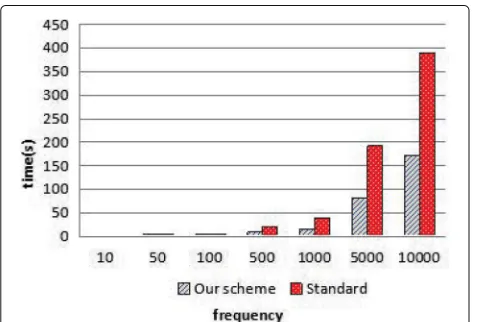
Figure 9 shows the computational overhead due to the data owner performing different frequency delegation operations on the system. This step is executed by the data
Fig. 8Performance of decryption by data owner
Fig. 9Performance of delegation by data owner
owner after the encrypted data file is uploaded. The dele-gation progress involves generating a PRE key and sending it from the data owner to a recipient of the class file of a given type. The more recipients with whom the data owner wants to share files, the more times this sharing step is performed, meaning that this step has a signif-icant impact on the overall client performance. As we can see from Fig.8, our solution takes less than half the time required by the standard PRE solution; the proposed solution takes around 20 ms, while standard PRE takes around 45 ms, meaning that the optimization of this step is significant.
6.4 Performance of re-encryption by cloud proxy
Figure10shows the computational overhead of the cloud proxy as it performs different frequency re-encryption operations in our scheme. This step transforms the ciphertext from the data owner to the recipients. The time
costs of our scheme in this process are also similar to those of standard PRE, with an average time of about 12 ms. As is well-known, the computing resources of cloud plat-forms are abundant, and the development of hardware is also taking place rapidly. Cloud service providers can therefore take many measures to speed up this process, such as dedicating more hardware resources or using visu-alization, meaning that the cost of this step would not be onerous to the cloud service provider.
6.5 Performance of decryption by recipient
The decryption algorithm is executed when the recipient decrypts the re-encrypted data shared by the data owner, and this algorithm is executed by the client. As can be seen from Fig.11, our scheme is about 47% better than the standard PRE scheme. The average times required by our scheme and the standard PRE scheme are about 21 and 40 ms respectively, giving a very high proportion of optimization.
7 Conclusion
The aim of this paper is to develop an improved PRE scheme for protecting users’ private data. Our scheme is unique in that it integrates fine-grained delegation based on the element of type and heterogeneous features that can transform ciphertext from IBE-type to PKE-type text. The fine-grained features mean that the data owner can share private data using a fine-grained approach, e.g., adding a single file or a class of files. The feature of heterogeneity greatly improves the performance of the algorithm and at the same time makes it more conve-nient and compatible with the system developed based on the traditional PKE encryption algorithm. An inter-esting direction for future work would be to make this scheme more secure by supporting other ciphertext secu-rity schemes and addressing other secusecu-rity issues. We also need to continue to optimize the performance and make
Fig. 11Performance for decryption by recipient
this scheme more practical and to carry out research into dynamic data privacy protection in the cloud.
Abbreviations
ABE: Attribute-based encryption; IBE: Identity-based encryption; PRE: Proxy re-encryption
Acknowledgements
We thank Puming Wang for feedback on the initial versions of this paper.
Authors’ contributions
JNS contributed to the main idea and drafted the manuscript, algorithm design, and performance analysis. XJD and ZWX contributed to the simulations. All authors read and approved the final manuscript.
Funding
The work was supported by the National Natural Science Foundation of China under grant no. 61662022.
Availability of data and materials
Not applicable
Competing interests
The authors declare that they have no competing interests.
Received: 10 September 2019 Accepted: 4 December 2019
References
1. X. Wang, L. T. Yang, L. Kuang, X. Liu, Q. Zhang, M. J. Deen, A tensor-based big-data-driven routing recommendation approach for heterogeneous networks. IEEE Netw.33(1), 64–69 (2019)
2. X. Wang, L. T. Yang, X. Xia, J. Jin, M. J. Deen, A cloud-edge computing framework for cyber-physical-social services. IEEE Commun. Mag.55(11), 80–85 (2017)
3. P. Wang, L. T. Yang, J. Li, J. Chen, S. Hu, Data fusion in cyber-physical-social systems: state-of-the-art and perspectives. Inf Fusion.51, 42–57 (2019) 4. L. Qi, X. Zhang, W. Dou, C. Hu, C. Yang, J. Chen, A two-stage
locality-sensitive hashing based approach for privacy-preserving mobile service re commendation in cross-platform edge environment. Futur. Gener. Comput. Syst.88, 636–643 (2018).https://doi.org/10.1016/j.future.2018.02.050
5. W. Gong, L. Qi, Y. Xu, Privacy-aware multidimensional mobile service quality prediction and recommendation in distributed fog environment. Wirel. Commun. Mob. Comput.2018(3075849), 1–8 (2018)
6. Q. GAN, X. WANG, X. FANG, Efficient and secure auditing scheme for outsourced big data with dynamicity in cloud. Sci. China Inf. Sci.61(12), 97–111 (2018)
7. R. Li, C. Shen, H. He, X. Gu, Z. Xu, C.-Z. Xu, A lightweight secure data sharing scheme for mobile cloud computing. IEEE Trans. Cloud Comput.
6(2), 344–357 (2017)
8. M. Sookhak, F. R. Yu, M. K. Khan, X. Yang, R. Buyya, Attribute-based data access control in mobile cloud computing: taxonomy and open issues. Futur. Gener. Comput. Syst.72(C), 273–287 (2017)
9. B. Liu, X. L. Yu, S. Chen, X. Xu, L. Zhu, in2017 IEEE International Conference on Web Services (ICWS). Blockchain Based Data Integrity Service Framework for IoT Data (IEEE, 2017), pp. 468–475
10. L. Qi, Q. He, F. Chen, W. Dou, S. Wan, X. Zhang, X. Xu, Finding all you need: web apis recommendation in web of things through keywords search. IEEE Trans. Comput. Soc. Syst.6(5), 1–10 (2019)
11. L. Qi, Y. Chen, Y. Yuan, S. Fu, X. Zhang, X. Xu, A qos-aware virtual machine scheduling method for energy conservation in cloud-based
cyber-physical systems. World Wide Web, 1–23 (2019).https://doi.org/10. 1007/s11280-019-00684-y
12. X. Wang, L.T. Yang, X. Chen, M.J. Deen, J. Jin, Improved multi-order distributed hosvd with its incremental computing for smart city services. IEEE Trans. Sustain. Comput., 1–14 (2018).https://doi.org/10.1109/TSUSC.2018.2881439
14. J. Zhou, J. Yan, K. Cao, Y. Tan, T. Wei, M. Chen, G. Zhang, X. Chen, S. Hu, Thermal-aware correlated two-level scheduling of real-time tasks with reduced processor energy on heterogeneous mpsocs. Inf. Fusion.82, 1–11 (2018)
15. M. B. Smithamol, S. Rajeswari, Hybrid solution for privacy-preserving access control for healthcare data. Adv. Electr. Comput. Eng.17(2), 31–38 (2017)
16. Y. He, J. Ni, X. Wang, B. Niu, F. Li, X. Shen, Privacy-preserving partner selection for ride-sharing services. IEEE Trans. Veh. Technol.67(7), 5994–6005 (2018)
17. H. Cui, R. H. Deng, J. K. Liu, Y. Li, inAustralasian Conference on Information Security & Privacy(ACISP 2017). Attribute-Based Encryption with Expressive and Authorized Keyword Search (Springer, Cham, 2017), pp. 106–126 18. M. Zhang, Y. Jiang, Y. Mu, W. Susilo, Obfuscating re-encryption algorithm
with flexible and controllable multi-hop on untrusted outsourcing server. IEEE Access.5, 26419–26434 (2017)
19. L. Jiang, D. Guo, Dynamic encrypted data sharing scheme based on conditional proxy broadcast re-encryption for cloud storage. IEEE Access.
5(99), 13336–13345 (2017)
20. C. Zuo, J. Shao, Z. Liu, Y. Ling, G. Wei, in2017 IEEE Trustcom/BigDataSE/ICESS. Hidden-Token Searchable Public-Key Encryption (IEEE, 2017), pp. 248–254 21. H. Li, D. Liu, Y. Dai, T. H. Luan, S. Yu, Personalized search over encrypted
data with efficient and secure updates in mobile clouds. IEEE Trans. Emerg. Top. Comput.6(1), 97–109 (2015)
22. X. Ding, P. Liu, H. Jin, Privacy-preserving multi-keyword top-kk similarity search over encrypted data. IEEE Trans. Dependable Secure Comput.
16(2), 344–357 (2017)
23. Z. Shen, J. Shu, X. Wei, Preferred search over encrypted data. Frontiers of Computer Science.12(3), 593–607 (2018)
24. S. Xu, G. Yang, Y. Mu, A new revocable and re-delegable proxy signature and its application. J. Comput. Sci. Technol.33(2), 380–399 (2018) 25. J. Ni, K. Zhang, X. Lin, X. S. Shen, Securing fog computing for internet of
things applications: challenges and solutions. IEEE Commun. Surv. Tutor.
20(1), 601–628 (2017)
26. P. Xu, Q. Wu, W. Wang, W. Susilo, J. Domingo-Ferrer, H. Jin, Generating searchable public-key ciphertexts with hidden structures for fast keyword search. IEEE Trans. Inf. Forensic. Secur.10(9), 1993–2006 (2015) 27. M. Abe, J. Camenisch, R. Dowsley, M. Dubovitskaya, inTheory of
Cryptography Conference(TCC 2014). On the Impossibility of Structure-Preserving Deterministic Primitives (Springer, Berlin, 2014), pp. 713–738
28. Y. Guo, F. Liu, Z. Cai, N. Xiao, Z. Zhao, Edge-based efficient search over encrypted data mobile cloud storage. Sensors.18(4), 1–14 (2018) 29. M. Kim, H. T. Lee, S. Ling, H. Wang, On the efficiency of fhe-based private
queries. IEEE Trans. Dependable Secur. Comput.15(2), 357–363 (2016) 30. P. Gasti, J. Sedenka, Q. Yang, Z. Gang, K. S. Balagani, Secure, fast, and
energy-efficient outsourced authentication for smartphones. IEEE Trans. Inf. Forensic. Secur.11(11), 2556–2571 (2016)
31. F. Tramer, F. Zhang, H. Lin, J.-P. Hubaux, A. Juels, E. Shi, in2017 IEEE European Symposium on Security and Privacy (EuroS P). Sealed-glass proofs: using transparent enclaves to prove and sell knowledge (IEEE, 2017), pp. 19–34
Publisher’s Note