DETERMINATION OF THE ORDER OF GENE FUNCTION I N
THE YEAST NUCLEAR DIVISION PATHWAY USING cs AND ts MUTANTS
DON MOIR’ A N D D A V I D BOTSTEIN
Deparlment of Biology, Massachusetts institute of Technology, Cambridge, Massachusetts 02139
Manuscript received September 24., 1981 Revised copy accepted January 5,1982
ABSTRACT
Cold-sensitive (cs) and heat-sensitive ( t s ) conditional-lethal mutations that affect specifically the cell division cycle of budding yeast (Saccharomyces cereuisiae) were used to determine the order of gene function. Reciprocal temperature-hift experiments using cs-ts double mutants revealed a detailed order of function among genes whose execution points and mutant phenotypes are very similar. The data suggest that the nuclear branch of the overall cell-cycle pathway itself contains at least one branch.
HE cell division cycle of the budding yeast Saccharomyms cerevisiae in- volves more than 50 genes whose products appear to be required specifically to carry out steps i n the pathways of cell division (HARTWELL, CULOTTI and REID 1970; HARTWELL et al. 1973, 1974; MOIR et al. 1982). Functions for some of the gene products have been deduced from the phenotypes of conditional- lethal cell-division-cycle (cdc) mutations. Temperature-shift experiments using heat-sensitive ( t s ) cdc mutants have allowed the definition of the “execution point” (Le.., the latest time at which a n essential cdc gene product can act t o
allow passage t o the next cell cycle) : the execution point appears to be approxi- mately the same for different alleles of the same cdc gene (HARTWELL et al. 1973). Some information about the organization of cdc functions into dependent pathways has beeE obtained by observing the phenotypes of double-mutant strains and by the use, in conjunction with the cdc mutations, of two specific inhibitors of the progress of the cell cycle (a-factor, which causes cells to ac- cumulate at the “start,” and hydroxyurea, which causes reversible inhibition of DNA synthesis; HEREFORD and HARTWELL 1974; HARTWELL 1976). This kind of analysis has resulted in a comprehensive view of the cell cycle genes a s spe- cifying functions that comprise dependent pathways containing at least one branch (HARTWELL et al. 1974; HARTWELL 1974,1978).
Nevertheless, many different cdc genes are functionally indistinguishable from each other by methods used thus far: such genes appear identical i n their terminal mutant phenotype, in their execution points, and i n other order of function relative to the defects caused by treatment with &-factor or hydroxyurea.
* Present addless Collaborative Research, Inc , 1365 &lain S t , Waltham, MA. 02154.
566 D. MOIR A N D D. BOTSTEIN
The accompanying paper (MOIR et al. 1982) describes the isolation of cold-sensi- tive (cs) cdc mutations, many of which define new cdc genes. These have made feasible the application to the yeast cell cycle of the reciprocal temperature-shift method. By means of cs and t s double mutants, this general method yields in- formation about the order in which two genes function.
(JARVIK
and BOTSTEIN1973).
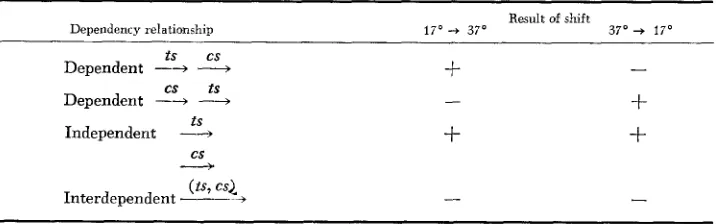
The reciprocal temperature-shift method takes advantage of the possibility in cs-ts double mutants of blocking the function of two gene products independ- ently. If one incubates cells at the high nonpermissive temperature (during which the gene bearing the ts mutation fails to function), allows the cell cycle to arrest, and then shifts to the low nonpermissive temperature (during which the gene bearing the cs mutation fails to function), progress to the next cell cycle will occur if and only if the gene carrying the cs mutation can act before the gene carrying the ts mutation. Reversing the order of incubation at the two temperatures should have the opposite result if the two genes in which the mu- tations lie are part of a dependent pathway. The possibilities and their interpre- tation are summarized in Table 1, from which it can be seen that the method not only yields information about the order of gene function when the two genes lie on a dependent pathway, but also allows one to decide whether or not two gene furxtions are arranged in such a dependent pathway. The same logic was used by HEREFORD and HARTWELL (1974) to order the function of cdc genes relative to the block imposed by treatment with a-factor;
HARTWELL
(1976) used the method to order cdc functions relative to the block imposed by treat- ment with hydroxyurea. I n all these cases the important feature is the ability to impose blocks at possibly different points i n the cell cycle independently ofone another.
This paper describes the application to the yeast cell cycle of the reciprocal temperature-shift method using t s and cs cdc mutations. The results indicate that the nuclear division branch of the cell-cycle pathway is itself branched.
TABLE 1
Results expected in reciprocal shift experiments using cs-ts cdc double mutants
Result of shift
Dependency relationship 1 7 O - t 37' 3 7 0 + 170
ts cs
Dependent -*
-
cs t s
Dependent -+
-
-t S
cs
---).
Independent -4
+
+
t
Interdependent
---~
(is, C S L +-
-
ORDER O F G E N E F U N C T I O N 567 MATERIALS A N D METHODS
[5,&3H] -uracil was purchased from New England Nuclear and N-hydroxyurea from BoehringedMannheim. Purified a-factor (CIFJEK, THORNER and GEIR 1977) was the generous gift of JEREMY THORNER.
Media and methods of mating, sporulation and tetrad analysis were essentially as previously described (BRANDRISS, SOLL and BOTSTEIN 1975; MOIR et al. 1982, accompanying paper).
Sfrains: The cold-sensitive cdc mutants csAl0 (cdc44-I) and csA18 (cdc45-I) were derived from S288C as described in the accompanying paper (MOIR et al. 1982). The temperature- sensitive allele of cdcI6, cdcZ6-201, was isolated and characterized exactly as described for the cold-sensitive cdc mutants except the restrictive temperature was 35". The execution point for
cdcI6-201 was determined by the method of HARTWELL, CULOTTI and REID (1970) to be 0.5, essentially the same value as previously determined for cdcl6-I (HARTWELL e f al. 1973). All mutants, including the temperature-sensitive cdc mutants DB375 (cdc9-I) and DB380 (cdcI4-I)
obtained from L. H. HARTWELL, were backcrossed to S288C at least four times before cs-ts
double mutants were constructed by crossing the two haploids, sporulating and dissecting the four-spored asci.
In vivo radioactive labeling of D N A : Exponential phase cultures of the strain to be labeled were adjusted to 2
x
106 celldm1 in labeling medium (HARTWELL 1970; supplsmented with40 pg/ml each of adenine and histidine) without 3H-uraci1, and 6 ml cultures were incubated with 30 U/ml a-factor for 3 hr at 26". At that point, more than 90% of the cells were arrested as unbudded cells with a "schmoo" morphology. The culture was filtered through a Millipore HAWP 0.45 p filter to remove a-factor, and the cells were washed from the filter with an equal volume of nonradioactive medium. Cells were placed in 6 ml of labeling medium containing 500 pCi 3H-uracil (830 mCi/mmole). The culture was divided into three equal portions: one part was incubated at 26" for 4 hr, one at 17" for 8 hr, and one at 26" for 0.5 hr followed by 17" for 7.5 hr. Aliquots (0.1 ml) were withdrawn periodically and added to 0.01 m l fresh 11 M
NaOH. After incubation overnight at room temperature in covered micro test tubes, samples were neutralized with 0.01 ml 10 M HCl. Most of each sample (0.11 ml) was withdrawn and pipetted directly onto 24 mm filter paper circles (Schleicher and Schuell 895-E), which had been previously soaked in 10% trichoroacetic acid containing 0.1 mg/ml uracil and then air dried. After the sample soaked in, but before it dried, the filters were dropped into ice-cold 10% trichloroaretic acid containing 0.1 mg/ml uracil (250 ml f o r up to 50 filters) and washed batchwise for 15 min on ice. The trichloroacetic acid was poured off and the washing repeated three more times with 5$% trichloroacetic acid containing 0.1 mg/ml uracil. Finally, filters were washed in 95% ethanol, aid dried under a heat lamp (10 min), and counted in a scintillation counter. In all experiments, less than 5% of the added label was incorporated into RNA and DNA.
Reciprocal temperature shiffs: An exponential phase culture in YEPD medium of a M A T a cs-ts double cell-division-cycle mutant was adjusted to 2 x 10⁸ cells/ml, and a 3 ml portion was incubated with 30 U/ml a-factor f o r 3 hr at 26". At the end of this incubation, more than 80% of the cells were synchronized at the beginning of the division cycle (at the unbudded stage as judged by microscopic examination). The culture was filtered through a Millipore H A W P 0.45 ,U filter to remove a-factor and the cells were washed twice with 5 ml of YEPD medium. After resuspension in 3 ml of fresh YEPD and brief sonication to disrupt clumps, the culture was ncubated for at least 230 min at 17" or 100 min at 37" t o arrest cells at the first conditional block. A control experiment with strain DB64Q (MATa ade2; otherwise isogenic to S288C) demonstrated that under thess conditions cells complete one division cycle in 220 min at 17" and in 120 min at 37". (These values are essentially the same as the doubling times for ex- ponential cultures of DB640 at 17" and 37"; therefore, synchronization with a-factor does n o t alter the cell division time requirement.)
568 D. MOIR A N D D. BOTSTEIN
cycle position of each cell was recorded by photography before and after the second incubation period (on solid medium) as previously described by HARTWELL, CULOTTI and REID (1970).
Experiments ordering a cold-sensitive block with the hydroxyurea block were performed in an analogous manner except the appropriate MATa cs cdc mutant was used, and incubations were for 100 min in liquid rich medium containing 0.1 M hydroxyurea and for 6 hr on solid rich medium containing 0.3 M hydroxyurea as described by HARTWELL (1976).
Calculations of the results were as follows: (1) Correction for lethality. the number of cells arrested in the first division cycle of the experimental shifts ( e . g . , 17" + 37" and 37" + 17") for the trivial reason that they are dead was calculated by multiplying the percentage of cells that did not recover from the initial conditional block (e.g., 17" + 26" and 37" 3 26" control
shifts, respectively) by the total number of cells counted in the experimental shift. This value was subtracted from the number of first cycle arresting cells and from the total number of cells counted ( i . e . , the cells are dead and thus are omitted from the final calculations) in the experi- mental shift. ( 2 ) Correction for leakiness: Similarly, the number of cells passing to the second division cycle in the experimental shifts (i.e., 17" + 37" and 37" + 17") for the trival reason that they leaked past the first cycle block was calculated by multiplying the percentage of cells that leaked past the 37" and 17" blocks (Le., 37" + 37" and 17" + 17" control shifts, respec- tively) times the total cells counted in the experimental shift. This value was subtracted from the second cycle-arresting cells and the total cells counted (i.e., they are not tightly arrested cells and are omitted from the final calculations) in the experimental shift. Finally, the cor- rected percentage of cells arresting i n the first and second cycles was calculated from these adjusted numbers. In all cases, more than 100 total cells were counted for each shift. Recovery from the initial block was generally greater than 70% (i.e., the lethality estimate was less than 30%) and leakage past the initial block was usually less than 10%.
R E S U L T S
In the accompanying paper (MOIR et al. 1982) cold-sensitive cdc mutations (csAlO, now called cdc44-I and csA18, now called cdc45-1) were found which represent new cdc genes. These mutants display a medial nuclear division termi- nal phenotype. Their execution points were found to be late in the cell cycle (about 0.7 for cdc44-1 and about 0.5 for cdc45-I), clearly after DNA synthesis. To test the implication that cdc44-1 and cdc45-I carry out the initiation and elongation functions comprising DNA synthesis at their restrictive temperature (1 T o ) , incorporation of radioactive precursors into DNA was measured in whole cells synchronized at "start" with a-factor (BUCKING-THROM et al. 1973; HERE-
FORD and HARTWELL 1974). Measurements were made periodically after re-
moval of the <a-factor and incubation of cells at the permissive temperature (26") and the restrictive temperature (1 7"). The results (Figure 1 ) show clearly that both mutants initiate and apparently complete one round of DNA synthesis at the restrictive temperature. While the time required to complete one round of DNA synthesis at 17" is somewhat longer than the doubling time of cells grow- ing exponentially at 17" (see MATERIALS A N D METHODS), this may be because
ORDER O F GENE FUNCTION 569
I I I cdc4.4
I I I I
I
I
I I I I I0 100 200 300 400 500 0 loo 200 300 400 500
TIME (minutes)
FIGURE 1 .-Incorporation of radioactivity into DNA by cdc44-1 and cdc45-I at permissive
(26") and nonpermissive (1 7") temperatures. Cells synchronized with a-factor were incubated at the indicated temperature in the presence of [3H]-uracil as described in MATERIALS A N D METHODS. The alkali-resistant, acid precipitable radioactivity is plotted as a function of time
after removal of a-factor and addition of the radioactive uracil. Less than 5,% of the total radio- activity added was incorporated into acid-precipitable form in each experiment.
shift to 17" in rich medium. Thus, recovery from or-factor arrest is rapid under our conditions, and prior arrest with or-factor has little or no effect on cell dou- bling times after removal of the peptide.
Protocol for reciprocal temperature-shift experiments: The protocol for re- ciprocal shift experiments used in all the experiments presented in this paper are described in detail in MATERIALS AND METHODS. Briefly, exponentially grow- ing MATa haploid cells of the appropriate genotype (i.e., cs-ts double mutants, in most cases) were treated with purified a-factor (CIEJEK, THORNER and GEIER 1977) which has the effect of reversibly arresting their growth at the beginning ("start") of the cell cycle (BUCKING-THROM et al. 1973). The a-factor was washed away and the cells incubated under one of the nonpermissive conditions
(i.e., 17" to block a cs function, 37O to block a ts function, or hydroxyurea at 26"
to block DNA synthesis) in liquid medium. The length of this first nonpermis- sive incubation varied i n different experiments; in all cases the incubation was longer than a single cell cycle at that temperature. Cells were then shifted to the
second nonpermissive condition by spotting onto solid medium after brief sonica-
5 70 D. MOIR A N D D. BOTSTEIN
microscopy to determine whether they arrested in the first cell cycle (i.e., only single arrested cells were ever seen) or were able to pass to a subsequent cell cycle (i.e., two arrested cells were seen).
In conjunction with each reciprocal shift experiment, control experiments were carried out simultaneously to measure lethality during the first nonpermis- sive incubation (seen as arrest in the first cycle when permissive conditions were provided in the second incubation) and to measure leakiness (seen as pas- sage to a second cell cycle when the same nonpermissive condition was main- tained in both incubations). With one exception (below)
,
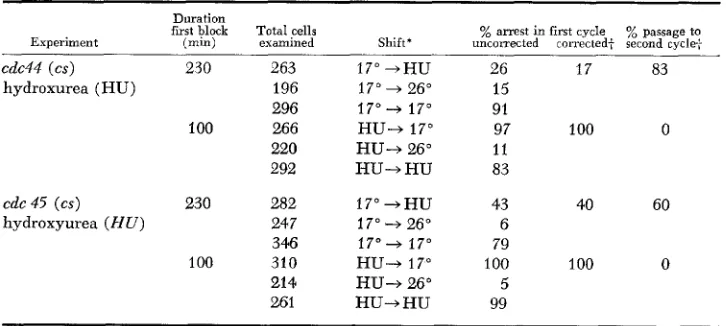
lethality was always less than about 30% and leakiness was always less than about 10%. The ob- served fraction of cells undergoing the reciprocal shifts which pass to a second cell cycle is the primary datum desired for each experiment; this number was corrected for lethality and leakiness as described in MATERIALS A N D METHODS.Reciprocal shift experiments inuolving hydroxyurea: Since we showed above that both the cs mutations cdc44-I and cdc45-I are able to synthesize DNA at the nonpermissive temperature, and because the execution points found for these mutants are so late in the cell cycle (MOIR et a2. 1982, accompanying paper), it was expected that if the cs mutations were in a dependent relationship with
DNA replication, the replication would be prerequisite to the cs function. Thus, reciprocal shift experiments
with
hydroxyurea (a reversible inhibitor ofDNA
synthesis [SLATER 19731 used previously by HARTWELL [1976] in such experi- ments) would serve as a kind of control for our protocol involving prior syn- chronization with a-factor. The results of such experiments are given in Table 2.In the case of cdc44, 83% of the cells shifted from 17" to hydroxyurea (HU)
TABLE 2
Reciprocal shift experiments inuolving hydroxyurea
Duration
first block
Experiment ( m i n )
cdc44 ( c s ) 230 hydroxurea (HU)
100
cdc 45 (cs) 230
hydroxyurea ( H U )
100
Total cells examined 263 196 296 266 220 292 282 24 7 346 310 214 261 Shift* 17"+HU 17" + 26" 17" -+ 17" HU-t 17" HU+ 26"
H U - t H U
1 7 " - + H U 17" 4 26" 17"+ 17"
HU-, 17" H U 4 26" HU-+HU
% arrest in first cycle % passage to
uncorrected corrected: second cycle:
26 17 83
15 91
97 100 0
11 83
43 40 60
6
79
100 100 0
5 99
~
* All incubations with hydroxyurea were at 26". Where a temperature is indicated, incubation
-I. Corrections for lethality during the first incubation and leakage were carried out as described was in the absence of HU.
ORDER O F GENE FUNCTION 571 passed to a second cell cycle whereas none did so when the shift was from
HU
to 17". This result clearly indicates that the HU-sensitive step is prerequisite to the cold-sensitive step;DNA
synthesis is required before the CDC44 function in a de- pendent pathway. In the case of CDC45, exactly the same conclusion can be drawn since shift from cold to HU allows 60% of the cells to pass to a second cell cycle as opposed to none when the shift is from HU to cold; DNA synthesis is required before the CDC45 function in a dependent pathway.The percentage of cells which passed to the second cell cycle in the permissive shifts (cold to HU) in these experiments was less than 100%. I t is possible that the correction for cell death is an underestimate. Alternatively, there may be some interaction between the drug and some consequence to the cell resulting from prior loss of the cs cdc function (see also DISCUSSION). Following HART-
WELL (1 976), we take passage to a second cycle as the definitive parameter (as opposed to first cycle arrest, which might reflect simple lethality beyond that indicated by our control experiments). In view of the fact that prolonged incuba- tions at the first block (to insure that all functions controlled by the second block have sufficient time to act) frequently result in unacceptably high lethality, we found (as did HARTWELL 1976) that it was necessary to compromise. Given these constraints, it seems reasonable t o accept numbers in the range of half the cells passing to a second cell cycle as indicating that the shift is a permis- sive one, again following the interpetation of HARTWELI. (1976).
Reciprocal shift experiments involving cdc24: Table 3 shows the results of reciprocal shift experiments using ts-cs double mutants. The cs mutations are again cdc44-I and cdc45-I, which are defective in medial nuclear division
TABLE 3
Reciprocal shift experiments involuing cdcl4
Duration
first block Total cells % arrest in first cycle % passage to
Experiment (min) examined Shift uncorrected corrected* second cycle*
cdc44 ( c s ) 24.0 228 17" + 37" 99 100 0
cdci4 ( t s ) 240 163 17" + 26" 7 240 335 17" + 17" 92
120 151 37" + 17" 10 5 95 120 151 37" 4 26" 5
120 159 37" 4 37" 96
cdc45 ( c s ) 240 238 17" + 37" 97 98 2
cdcl4 ( t s ) 240 265 17" + 26" 43 240 281 17" + 17" 95
270 242 17" 4 37" 96 95 3 270 203 17" + 26" 59
270 250 17" -+ 17" 95
110 21 8 37" -+ 17" 12 5 95
110 182 37" 4 26" 8 110 220 37" + 37" 98
5 72 D. M O I R A N D D. BOTSTEIN
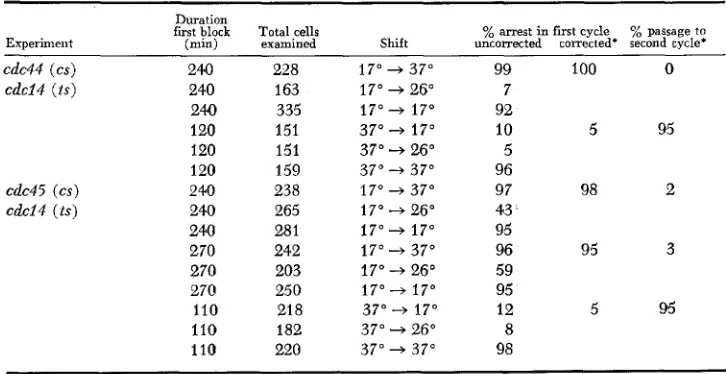
(Mom et al. 1982); the ts mutation is cdc14-I, which is defective in a late step in nuclear division (HARTWELL et al. 1973). The results are clear; essentially none of the cells (less than 3 % ) pass to a second cell cycle when the shift is from 17" (nonpermissive for cs) to 37" (nonpermissive for t s ) while essentially all the cells (more than 95%) pass to a second cell cycle when the shift is in the other direction. Clearly the cold-sensitive step (cdc44 or cdc45) is prerequisite to the heat-sensitive step ( c d c I 4 ) . Both CDC44 and CDC45 functions are re- quired before the CDC14 function on a dependent pathway. These experiments
also serve in part as controls, since the phenotypes of the mutations suggest strongly that the order of function is the one we obtain with the reciprocal shift method.
Reciprocal shift experiments involving cdc9 and cdclb: Table 4 shows the results of reciprocal shift experiments using ts-cs double mutants where the ts
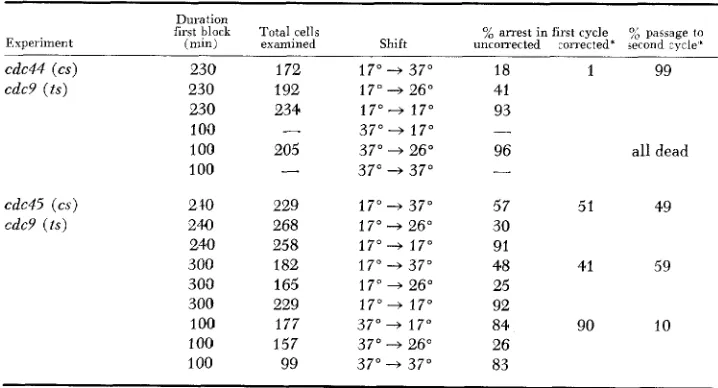
mutation is cdc9-I, which is defective, like the cs cdc mutations, in medial nu- clear division. The results, i n the case of cdc44-I, are incomplete: although the shift from 17" to 37" yields a clear result (99% passage to a second cycle), the reciprocal shift cannot be carried out. With this particular double-mutant, incu- bation at 37" results in death of all (96%) the cells, even in the case of shift back to 26", which is permissive for both the ts and cs mutations. Thus only a partial conclusion can be drawn: the CDC44 function is not prerequisite to execution of CDC9; either the two functions are independent of each other or
CDC9 function is before the CDC44 function on a dependent pathway.
TABLE 4
Reciprocal shift experimen fs involving cdc9
Duration
first block Tota1,cells % arrest in first cycle 7; passage to Experiment ( n u n ) exanlined Shift uncorrected corrected' second zycle"
cdc44 (cs) 230 172 17" --f 37" 18 1 99
cdc9 ( t s ) 230 192 17" -+ 26" 41
230 234 1 7 " + 17" 93 1 0'0
-
3 7 " - 17" -_100 205 37" + 26" 96 all dead 100
-
37" -+ 37" -cdc45 ( c s ) cdc9 (ts)
2 10 229 17" -+ 37" 57 51 49 240 268 17" -+ 26" 30
240 258 17"- 37" 91
300 182 17" -+ 37" 48 41 59 300 165 17" + 26" 25
300 229 17"- 17" 92
100 177 37"
-
17" 84 90 10 100 157 37" -+ 26" 26100 99 37" --$ 37" 83
ORDER O F G E N E F U N C T I O N 573
The results with double mutants between cdc45-1 (cs) and cdc9-1 ( t s ) are more straightforward. Cell death is not a large factor (less than 30%) and about half (50% to 60%) of the cells pass to a second cell cycle when the shift is from
17" to 37", while only 10% pass to a second cell cycle in the reciprocal shift. When the first incubation time is increased in the 17" to 37" shift (Table 4)
,
the percent of passage to the second cycle increases as well, suggesting that the event controlled by the second incubation (i.e., cdc9 function) will occur at 17" given more time. This was unexpected, since the time of the first incubation(4
hr) is equivalent to a single cell cycle at that temperature for wild-type cells either growing exponentially or previously synchronized with a-factor. Nevertheless, the effect gives increased reason to believe that passage of half the cells to the second cycle should be interpreted as a positive (as opposed to intermediate) re- sult.The results of these reciprocal shifts suggest that the heat-sensitive step (cdc9)
is prerequisite to the cold-sensitive step (cdc45); CDC9 function appears to be required before CDC45 function on a dependent pathway.
Table
5
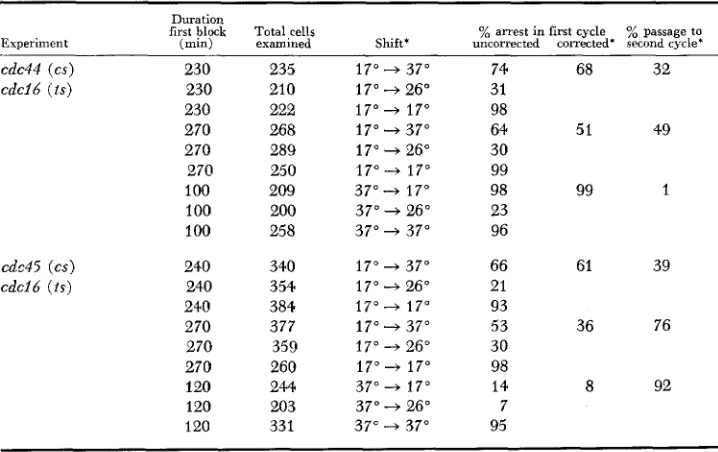
shows the results of reciprocal shift experiments using double mu- tants involving the heat-sensitive mutation cdcl6-2OI. The results with the cdc44-1(cs) cdc1&-20l(ts) strain was that 30% to 50% of the cells passed to a second cycle when the shift was from 17" to 37" while only 1% passed to aTABLE 5
Reciprocal shift experiments inuoluing cdcl6
Experiment
Duration
first block Total cells % arrest in first cycle % passage to (min) examined Shift' uncorrected corrected' second cycle'
cdc44 (CJ) 230 235
cdd6 ( t s ) 230 210
230 222
270 268
270 289
270 250
100 209
100 200
100 258
cdd5 ( c s ) 240 340
cdcl6 (Is) 240 354
240 384
270 377
270 359
270 260
I20 244
120 203
120 331
17" + 37" 17" 3 26" 17" 4 17"
17" 4 37"
17" 4 26"
17" + 17" 37" -+ 17" 37" 4 26" 37" 4 37"
17" 4 37"
17" + 26" 17" + 17"
17" -+ 37" 17" 3 26" 17" 4 17"
37" -+ 17" 37" + 26" 37" 4 37"
74 68 32
31 98
64 51 49
30 99
98 99 1
23 96
66 61 39
21 93
53 36 76
30 98
14 8 92
7 95
5 74 D. MOIR A N D D. BOTSTEIN
second cycle in the reciprocal shift. Although the former percentage is small, again increasing the length of the first incubation resulted in an increased frac- tion of passage to the second cycle. Taken together with the complete arrest in the first cycle i n the reciprocal shift, it seems likely that the heat-sensitive step ( c d c l 6 ) is prerequisite to the cold-sensitive step (cdc44) ; CDC16 function ap- pears to be required before CDC44 function on a dependent pathway.
The results with the cdc45-2 cdc16-201 strain were quite different from any of the above cases. A large fraction of cells proceeded to a second cell cycle re- gardless of the direction of the shift. I n one direction (17" to 37") there was again a n increase (39% to 76%) in passage to the second cycle when the first incubation was lengthened. This result can most readily be interpreted as indi- cating that the heat-sensitive step (cdc16) and the cold-sensitive step (cdc45) are not prerequisite to each other; CDC16 function and CDC45 function are not on the same dependent pathway, but on parallel independent branches of the nuclear division pathway.
involving cold-sensitive mutations i n genes CDC44 and CDC45, respectively. As
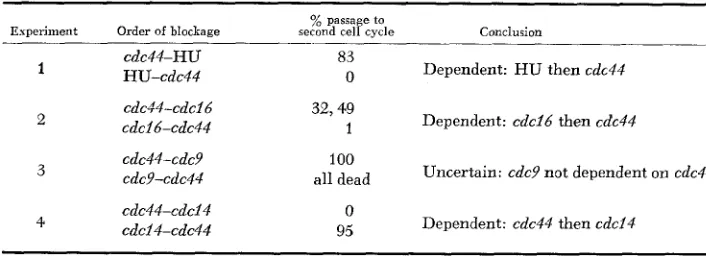
shown in Table 6 CDC44 appears to be part of a single unbranched dependent pathway: the HU-sensitive step in DNA synthesis must be executed before CDC16 (HARTWELL 1976), which in turn must be executed before CDC44 which itself must be executed before CDC14. The position i n this pathway of the CDC9 function is not determinable from our results although these data do indicate that CDCS function does not require prior execution of the CDC44 function.
Table 7 indicates that CDC45 is, in contrast, part of a branched pathway: the HU-sensitive step in DNA synthesis must be executed before CDCS (HARTWELL
1976), which in turn must be executed before CDC45. On the other hand, the CDC16 function and the CDC45 function may be executed independently, and therefore the pathway must branch. The CDC45 function is prerequisite to execution of CDC14.
DISCUSSION
Tables 6 and 7 summarize the results obtained in reciprocal shift experiments
TABLE 6
Summary of pathway relationships involving cdc44
% passage to
Experiment Order of blockage second cell cycle Conclusion
cdc44-HU HU-cdc44
1 83 0 Dependent: HU then cdc44
cdcl4-cdclb 32,49
cdcib-cdc44 1 Dependent: cdclb then cdc44
2
3
4
cdc44-cdc9 cdc9-cdc44
cdc44-cdcl4 cdei4-cdc44
100
all dead Uncertain: cdc9 not dependent on cdc44
0
ORDER O F GENE FUNCTION
TABLE 7
Summary of pathway relationships involving cdc45
5
75% passage to
Experiment Order of blockage second cell cycle Conclusion
1
2
cdc45-HU HU-tdc45
cdc45-cdc9 cdc9. -cdc45
60
0 Dependent: HU then cdc45
4 5 5 9
10 Dep2ndent: cdc9 then cdc45
cd~45-cdcl6 40,76
cdci6-cdc45 92 Independent
3
4 cdc45-cdcl4
cdc14-cdc45 Dependent: cdc45 then cdci4
2,s 95
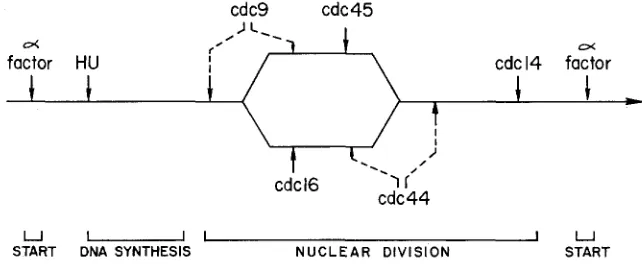
The two sets of results can be merged to produce a single pathway, shown in Figure 2. The positions of the CDC9 and CDC44 execution points are ambiguous with respect to the branch required to make CDC45 and CD.C.26 independent; otherwise the positions of the functions on this pathway are determined by the experiments reported here and by HARTWELL (1976) and
HEREFORD
andHART-
WELL (1974), who carried out reciprocal shift experiments using HU and a-factor, respectively. Not only is the position of the bifurcation of the branches determined by the shift experiments, but also the position of the rejoining, since it must be before the CDC.24 function which is dependent upon the execution of both CDC44 and CDC45.The branch in the nuclear division pathway represents the second branching in the overall array of cell division cycle pathways (HARTWELL 1978). Th' is new branch is contained entirely within the nuclear division branch defined before. At this point in our understanding, the meanir?g of branching in a pathway must
cdc9 cdc45
, J c-.
o( r'
t
o(1
I
+
+
t -
cdcl6 -=l I'
factor HU I cdcl4 factor
t
I_ ,)
t
cdc44
U
START DNA SYNTHESIS
-
I I
N U C L E A R DIVISION
U START
5 76 D. M O I R A N D D. BOTSTEIN
remain essentially a speculation. A prominent and attractive possibility is the idea that the two arms of the branch each represent the assembly of different structures which later must cooperate in some essential function. Either assem- bly can be made in the absence of the other, but both are required for completion of the pathway. This interpretation fits in well with the results of the accom- panying paper (MOIR et al. 1982), which present genetic evidence for assemblies of cdc gene products.
Our results suggest that the reciprocal shift procedure can indeed be used to distinguish order of function and to obtain dependency relationships among mu- tations with similar phenotypes and affecting functions with execution points quite near each other. On the other hand, all of the ambiguities intrinsic to the use of individual mutations remain: it is not possible to distinguish defects in synthesis of proteins from their activities in the cell cycle without different kinds of experiments.
The most difficult problem in interpreting the temperature shift data concerns the number of experiments in which passage to the second cycle was not com- plete, but showed intermediate values near 50%. A similar phenomenon was observed by HARTWELL (1976). Usually these values increased when additional time at the first incubation was provided; however, they occasionally failed to reach the high levels (more than 80%) observed in other experiments. Pro- longed incubations could not always be used since some mutants rapidly die after one cycle at nonpermissive temperature. We have no convincing explana- tion f o r the fact that such long incubations (more than 240 min) are required when a complete cell cycle at 17" takes only 240 min. The problem clearly is not leakage from the point of the first block past the second, since control experi- ments show that first-cycle arrest is tight f o r at least 18 hr.
It should also be emphasized that the phenomenon of increased passage to the second cycle with increased length of the first incubation is not observed when the majority of cells show first cycle arrest. Therefore the phenomenon is Rot
simply a general property of the double-mutants; it seems characteristic only for the cases of intermediate (30% to 60%) passage to a second cycle.
The particular case of greatest interest (CDCI6, which is apparently inde- pendent of CDC45) is further buttressed by results using a different allele of CDCIb (cdcI6-1, from the collection of L. HARTWELL). The appropriate double mutant (cdc45-I cdcl6-I) showed increased passage to the second cycle during the shift in question (80% or more; data not shown). Unfortunately, in the reciprocal shift these double mutants were not very reversible (i.e., lethality was high) and were somewhat leaky, making the experiments difficult to in- terpret.
In summary, we have applied the reciprocal shift method, using cs-ts double mutants, to determine order of function and dependent pathway structure in the yeast cell cycle. Application of the method to cdc mutations with similar phenotypes and execution points revealed a detailed order of function and a
ORDER O F G E N E F U N C T I O N 577
W e are indebted to JEREMY THORNER for the gift of generous amounts of purified or-factor and for helpful discussions. Research was supported by grants from the National Institutes of Health (GM212.53) and the American Cancer Society (VC246 and MV90). D. M. was a post- doctoral fellow of the American Cancer Society.
LITERATURE CITED
BRANDRISS, M. C., L. SOLL and D. BOTSTEIN, 1975
BUCKING-THROM, E., W. DUNTZE, L. H. HARTWELL and T. R. MANNEY, 1973
Recessive lethal amber suppressors in yeast.
Reversible ar- rest of haploid yeast cells at the initiation of DNA synthesis by a diffusible sex factor. Exptl. Cell Res. 76: 99-101.
Solid phase peptide synthesis of a-factor, a yeast mating pheromone. Biochem. Biophys. Res. Commun. 78: 952-961.
Periodic density fluctuation during the yeast cell cycle and the se- lection of synchronous cultures. J. Bacteriol. 104: 1280-1285. - , 1974 Saccharo- myces cerevisiae cell cycle. Bacteriol. Rev. 38: 164-198.
-,
1976 Sequential func- tion of gene products relative to DNA synthesis in the yeast cell cycle. J. Mol. Biol. 104: 803-817. --, 1978 Cell division from a genetic perspective. J. Cell Biol. 77: 627-637.Genetic control of the cell division cycle in yeast: a model. Science 183 : 46-51.
yeast. I. Detection of mutants. Proc. Natl. Acad. Sci. U.S.A. 66: 35S-359.
cell division in yeast, V. Genetic analysis of cdc mutants. Genetics 74: 267-286. Sequential gene function in the initiation of S. cerevisiae DNA synthesis. J. Mol. Biol. 84: 445-461.
A genetic method for determining the order of events in a biological pathway. Proc. Natl. Acad. Sci. U.S.A. 70: 20.1.6-2050. -- , 1975 Condi- tional-lethal mutations that suppress genetic defects in morphogenesis by altering structural proteins. Proc. Natl. Acad. Sci., U.S.A. 72: 2738-2742.
Cold-sensitive cell-division- cycle mutants of yeast: Isolation, properties and pseudoreversion studies. Genetics 100 : 547-563.
Effect of reversible inhibition of deoxyribonucleic acid synthesis on the yeast cell cycle. J. Bacteriol. 113: 263-270.
Corresponding editor: E. JONES Genetics 79: 551-560.
CIEJEK, E., J. THORNER and M. GEIER, 1977
HARTWELL, L. H., 1970
HARTWELL, L. H., J. CULOTTI, J. R. PRINGLE and B. J. REID, 1974
HARTWELL, L. H., J. CULOTTI and B. REID, 1970
HARTWELL, L. H., R. K. MORTIMER, J. CULOTTI and M. CULOTTI, 1973
HEREFORD, L. M. and L. H. HARTWELL, 1974
JARVIK, J. and D. BOTSTEIN, 1973
Genetic control of the cell division cycle in
Genetic control of the
MOIR, D., S. E. STEWART, B. C. OSMOND and D. BOTSTEIN, 1982