Copyright 0 1986 by the Genetics Society of America
HETEROGENEITY
OF
L E THA LS I NA
“SIMPLE” L ETH A L COMPLEMENTATION G R O U PFRANK C. JANCA,’ EFFIE P. WOLOSHYN AND DAVID NASH
Department of Genetics, University of Alberta, Edmonton, Alberta, Canada T6G 2E9
Manuscript received September 13, 1984 Revised copy accepted July 22, 1985
ABSTRACT
Of 24 ethyl methanesulphonate-induced, recessive-lethal mutations in the re- gion 9E1-9F13 of the X chromosome of Drosophila melanogaster, eight fall into a typically homogeneous lethal complementation group associated with the rasp- berry (ras) locus. Mutations in this group have previously been shown to be pleiotropic, affecting not only ras but also two other genetic entities, gual and
p u r l , which yield auxotrophic mutations-The eight new mutations have been characterized phenotypically in double heterozygotes with gual, purl and ras
mutations. Despite their homogeneity in lethal complementation tests, the mu- tations prove quite diverse. For example, two mutations have little or no effect on eye color in double heterozygotes with rm2. T h e differences between the lethals are allele-specific and cannot be explained as a trivial outcome of a hypomorphic series.-Taken alone, the lethal complementation studies mask the complexity of the locus and the diversity of its recessive lethal alleles. By exten- sion, we argue that the general use of lethal saturation studies provides an unduly simplified image of genetic organization. We suggest that the reason why recessive lethal mutations rarely present complex complementation patterns is that complex loci tend to produce mutations that affect several subfunctions.
HE great majority of recessive lethal mutations fall into simple cistrons
T
(for a discussion of this phenomenon, and some of the exceptions, seeNASH and JANCA 1983). Taken at face value, this observation would seem to indicate that the essential functions defined by recessive lethals are encoded within simply organized genes. In contrast, the elaborate patterns of comple- mentation associated with many loci that yield “visible” mutations suggest that nonessential functions are encoded in much more complex genetic structures. It is evident that this distinction is spurious, for some loci that yield complex Complementation patterns with visible mutants also yield recessive lethal alleles.
NASH et al. (1981) reported that raspberry-lethal (ras-1) mutations in D. me- lanogaster fail to complement with all of three mutually complementary classes of recessive, nonlethal mutations (two kinds of purine nucleoside auxotrophs and ras, which is defective in pteridine synthesis). A genetic complex associated with purine metabolism appears to be defined by this phenomenon, and the
Present address: Chemistry Department, South Dakota State University, Box 2170, Brookings, South Dakota 57707.
44
F. C. JANCA, E. P. WOLOSHYN AND D. NASHmost direct interpretation of the results is that r a d mutations are multifunc- tional defects.
In the present report we show that ras-Z mutations form a single lethal complementation group. However, their pattern of complementation with the nonlethal mutations in the complex is heterogeneous. These results lead us to conclude that the power of lethal complementation tests to reveal genetic complexity is seriously restricted.
MATERIALS AND METHODS
Culture methods: T h e culture methods used are described fully by EL KOUNI and NASH (1974). Cultures were normally grown o n a yeast-sucrose medium except that, when nutritional studies were involved, modified SANG’S ( 1 956) medium was used. Experiments carried out on SANG’S medium (and their yeast-sucrose controls) used axenic culture. Unless otherwise stated, flies were reared at 25”.
Stocks: Unless otherwise noted, descriptions of genetic variants used a r e found in LINDSLEY and GRELL (1 968).
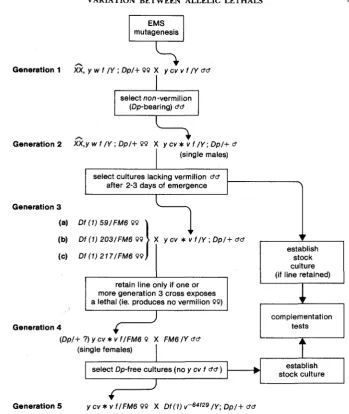
Production and cytogenetic localization of mutations in the 9E1-9F13 region: T h e 24 mutations used were isolated after EMS treatment of adult y cv v f males, as described by NASH and JANCA (1983). As an integral part of the mutation screen, which is shown in Figure 1 , the mutations were localized cytologically by crosses involving Df(1)217, y
cu ras- v f; Df(1)59, y cu ras- v f (Figure 2); Df(lJ203, y cv ras- U f (NASH and JANCA
1983) and Df(l)u64f (LEFEVRE 1969). T h e breakpoints of these deficiencies are given in Table 1.
Each new mutation was maintained in two stocks; in one it was balanced against the FA46 chromosome and in the other it was maintained in males, covered by the trans- position, Dp(l;2)u+63i (LEFEVRE 1969), against the attached-X chromosome C(l)DX, y w Eight of these mutations have been called “haplo-specific lethals” by NASH and JANCA (1983) because they are fully lethal only when uncovered by a deficiency. For purposes of simplification all will be referred to as lethals in this report, except where a distinction is essential.
Lethal complementation tests: All possible pairwise crosses (including reciprocals) were performed with 22 of the 24 mutations. These crosses used y cu l I v f/FM6 females and y cv l2 v f/Y; Dp(1;2)u+63i/+ males as parents, where 1, and l2 are two independently isolated recessive lethals. Among the progeny, the ratio of y cu U f @-free) and y cv f
(Dp-bearing) females was taken as an indication of complementation behavior. T h e two mutations not included in the complete test were tested against a representative panel of alleles. These were sufficient to give unequivocal assignments t o known complemen- tation groups. T h e tests were not completed because of stock breakdowns.
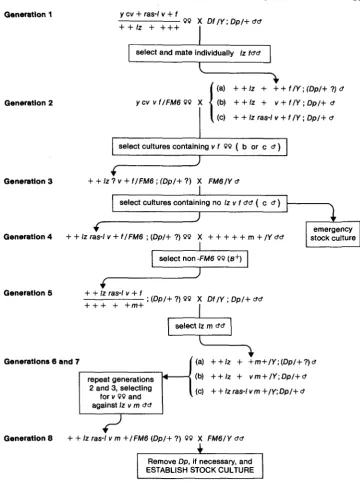
Background substitution of ras-Z mutations: In order to distinguish allele-specific differences from the effects of genetic background, seven of the eight members of the complementation group that includes raspberry-lethals were passed through the crossing scheme outlined in Figure 3. T h e final substitution of the proximal portion of the X chromosome was not accomplished (after three attempts) for the eighth mutation. T h e half-substituted stock was included in subsequent tests.
This scheme does not guarantee equivalent substitution of the genome for all strains. It achieves an effective randomization of the autosomes as a result of repeated out- crossing; a large proportion of the X chromosome is substituted quasi-mechanically.
Complementation tests with nonlethal mutations in the gual-purl-ras complex: T h e phenotypes associated with the eight ras-1 alleles in the sam le (in both “back-
NASH 1974a; JOHNSON, WOLOSHYN and NASH 1979) and 78s’. T h e crosses employed
f.
VARIATION BETWEEN ALLELIC LETHALS 45
Generation 1 X X , y w f / Y ; D p l + Q Q h X y c v v f / Y b b
select non-vermilion (Dp-bearing) do
Generation 2
Generation 3
h
X x , Y w f / Y ; DP/+ QQ X y c v * v f / Y ; Dp/+ d
I
(single males) select cultures lacking vermilion b oafter 2-3 days of emergence
1
(b) Df (1) 203IFM6 QQ y cv
*
v f l y ; D p / f bd(a) Df ( 1 ) 5SlFM6 QQ
(c) Df (7) 2 1 7 / F M 6 0 0 )
retain line only if one or more generation 3 cross exposes
:
a lethal (ie. produces no vermilion 99)Generation 4
(DP/+ ?) Y CV
*
V f I F M 6 Q X FM6 /Y dd (single females)I
establish stock culture (if line retained)
complementation tests
establish select Dp-free cultures (no y CY f d d )
stock culture
I
L I
Generation 5 y CY
*
v fIFM6 QQ X Df(7) vP64f29/Y; Dp/+ bdFIGURE 1 .-Protocol employed for isolation of recessive lethals and their cytogenetic localiza- tion. “Dp” refers to Dp(1;2)u+63i.
were similar t o those described by NASH et al. (1981). Details a r e included in the legends to Tables 3-5.
46 F. C. JANCA, E. P. WOLOSHYN AND D. NASH
I
I
I?
d-Lc:K.iy#irL.:..
7
:b-b Is
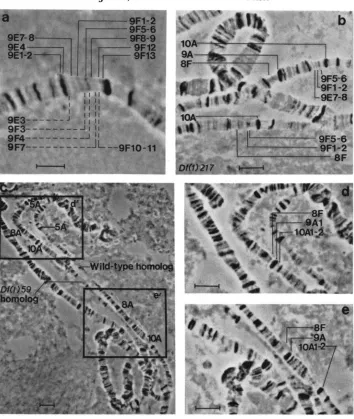
FIGURE 2.-a, The study region in a wild-type femz
_.
Presumed .-cations of all 13 bands identified by ZHIMULEV, SEMFSHIN and BELYAEVA (1981) are shown. Those bands indicated with broken lines are not evident in the photograph. b, Df(1)217/+. unsynapsed. When synapsed, all chromomeric material distal to 9F1-2 in the deficiency chromosome appears to pair distal to 9A.The bands labeled 9F1-2 usually synapse, despite the appearance of qualitative difference in this photograph. c. Df(1)59/+, unsynapsed. d, Region d' (from 2c) including Df(2)59. e, Region e'
(from 2c) showing the wild-type homolog. When synapsed, Df(1)59 shows clear evidence that a small portion of 9 A is juxtaposed to 10A. If well squashed, this material appears separated from
10A by a narrow interband region, which is most reasonably interpreted as material immediately distal to 9F12. Scale bars represent 10 pm.
Generation 1
VARIATION BETWEEN ALLELIC LETHALS
y cv
+
ras-l v+
f+ + l z
+
+++
99 X Df / Y ; Dp/+ 00I
47
Generation 2
Generation 3
(a) + + l z
+
+ + f / Y(c)
+ +
lz ras-l v+
f / Y+
+
lz 7 v+
f / F M 6 ; (Dp/+ ?) X FM6lY dI
select cultures containing no lz v f ab ( c b )
r
J
+
emergencystock culture
I
Generation 4
+ +
lz ras-l v+
f / F M 6 ; (Dp/+ ?) 99 X+ +
+
+ +
m+
/Y adGeneration 5
Generations 6 and 7
select non -FM6 99 (e+)
I
; P P I + ?) 99 X Df / Y ; Dp/+ a b
I
+ + +
+
+m++
((a) + + l z
+
+ m + / Y ; ( D p / + ? ) b (b) ++Jz+
v m + / Y ; D p / + d (c)+ +
lz ras-l v m + / Y ; Dp/+ a 2 and 3, selectingfor v 99 and against Jz v m bd
Generation 8
+
+
lz ras-l v m + / F M 6 (Dp/+ ?) 99 X FMGIY bb Remove Dp, if necessary, and.
ESTABLISH STOCK CULTUREFIGURE 3.-Protocol used in generating lz r a d m stocks. “Dp” refers to Dp(Z;2)v+63i. The three possible genotypes (a, b, c) of generation 3 and generation 6 male parents are phenotypically indistinguishable; this is resolved in subsequent generations.
given ras-llras‘ combination (both ages of flies, both genetic backgrounds) were ob- tained simultaneously a n d were r u n o n the same paper together with comparable ex- tracts of ras+ a n d ras2 flies. All flies involved were homozygous for v .
48 F . C. JANCA, E. P. WOLOSHYN AND D. NASH
ultraviolet lamp. Records of chromatographs were made with black-and-white polaroid photography.
Nomenclature: A number of the nomenclatural modifications that will be forthcom- ing in the revised version of Genetic Variations of Drosophila melanogaster (D. L. LIND- SLEY, personal communication) have been used here. These include Dp(1;2)u+"' = Dp(1;2)v+63i, D f ( I ) ~ ' - ~ ~ f l ~ = Df(l)v64f; purl-1 = purl', purl-2 = purl', and gu~1-1~' =
gual". In addition, 1(I)EM32 will become 1(1)9Ea', the group A (ras) lethals will remain ras-1 (= 1(1)9Eb), group C will become 1(1)9Ec, group B (including l(l)EM31) will become 1(1)9Ed alleles and group G will become 1(1)9Ee.
RESULTS
Cytogenetic localization
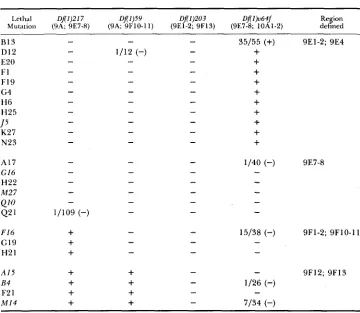
Table 1 shows the complementation pattern of the lethals with the four deficiencies. T h e deficiencies divide the region from 9E1-9F13 into four subre- gions and the lethals into four groups. T h e four patterns of complementation are compatible with the cytological observations, with Df (1)217, Df(1)59 and
Df(1)203 extending from the left-hand end of Dp(1;2)0+63i (at 9E1) progres- sively further into the region, and with Df(l)v64f starting to the right of 9E4
and extending into segment 10.
T h e equivocal situation at the left-hand end of Df(1)203, where material of doubtful origin borders the break (see NASH and JANCA 1983), is slightly clarified by the data. No mutation was obtained that is covered by Dp(1;2)v+63i
a n d exposed by either Df(1)217 o r Df(1)59, but not by Df(1)203. There- fore, Df(1)203 removes or inactivates all material at the left-hand end of
Dp(1;2)v+63i that yielded mutations in this study. T h e origin of the extra material remains problematical.
There were six cases, noted in Table 1 , in which "escapers" arose in crosses that, nevertheless, appear to indicate that the mutant is exposed by a defi- ciency. In each of these cases, there was a severe reduction in the number of experimental flies relative to controls (minimum $1) = 10.7, P
<
0.005). Inthree cases (A17, D12 and Q21) the mutation behaved as a full lethal in all other tests, and the single escaper could even have resulted from misclassifi- cation. In the other three cases of escapers (B4, F16 and M14) the ''lethal'' was, in fact, a haplo-specific lethal, and the deficiency ( D f ( l k 6 4 f ) was intro- duced from the male parent (see Figure 1). In two cases (F16 and M14),
escapers were sufficiently common to suggest a real effect. NASH and JANCA ( 1 983) point out the possibility that these escapers result from a maternal effect analogous to that discovered by ROBBINS (1983).
In no case where escapers were found does it seem reasonable to contend that the mutation is not exposed by the deficiency concerned; in five cases this would result in a complementation pattern incompatible with the remaining genetic and cytogenetic data. T h e sixth case (A17) turns out 'to have four alleles, all of which unambiguously exhibit the same complementation pattern.
The complementation tests between the induced lethals
Table 2 summarizes the results of the lethal complementation tests between
VARIATION BETWEEN ALLELIC LETHALS 49
TABLE 1
Complementation tests of lethals in the region 9El-9F13 with four
deficiencies
Region defined Lethal D f ( l ) Z l 7 Df(l)5Y Df(1)203 Df(lh64f
Mutation (SA; SE7-8) (9A; SF10-11) (9E1-2; 9F13) (9E7-8; 10Al-2) B13
D12
E20
FI
F19
G4 H6 H25
K27 N23
J5
A17 G 16
H22
M 2 7
Q10
Q21
F16 G19 H21
A 1 5 E 4
F2 1 M I 4
+
+
+
+
+
+
+
+
+
+
+
35/55 (+) 9E1-2; 9E4
+
+
+
+
+
+
+
+
+
+
15/38 (-) 9F1-2; 9F10-11
-
-
-
9F12; 9 F 1 31/26 (-1
7/34 (-)
The crosses used for the tests are shown in Figure 1. Haplo-specific lethal mutations (see NASH
and JANCA 1983) are indicated in italics. Numerical data are shown where Dflmutation double heterozygotes did survive, although significantly less well than did controls. Cases where these were presumed to be “escapers” (-) are discussed in the text. The one case where complementation is presumed to have occurred (+) shows only a marginal effect ($,, = 4.1 0.05 > P < 0.01); the deviation may therefore have arisen by sampling error.
complementation pattern: T h e r e are eight complementation groups (A-H), with 8, 4, 3, 3, 1 , 1 , 1 and 1 members, respectively.
For simplicity, the data in Table
2
have been reduced as far as possible: Crosses yielding zero experimental progeny (Dp(l;2)v+63i-free females) are in- dicated as“-.”
Usually, crosses showing no significarit reduction’ from experi- menta1:control ratio of unity (at the 5% level) are shown as“+.”
There are three exceptions to this rule, all in complementation group B. G16 and M27homozygotes and a G 16/M27 heteroallelic combination are assigned their po- sition in the matrix (and indicated as “-”) because of their behavior as haplo- specific lethals, as explained by NASH and JANCA (1983). T h e justification is
based on their severely reduced viability in heteroallelic combinations with A 17
T A B L E 2
Complementation matrix between 22 recessive lethal mutations in the region 9E1-9F13
Female Male parent (mutation/
parent (mutation/
FM6) D12 F1 F19 H6 H25 K27 N 2 3 J5 A17 H22 G16 M27
D12
F1
F19
H6
H25
K27
N23
J5
+
+
+
+'
+
+
+
+
+
+
t1-)
(-) 15/48
5/41
+
+
t
+ (+)
11/23
+
+
t
+
+
+
t(+) 30148
+
+
t+"
+
-
(-) (-)8/38 10127
(-) -
1/29 13/33 (-)
+
+
t-
(-) (-)- (-)
- (-) (-)
-
(-) (-)A17
+
+
+
+
+
+
+
+
-H22
+
+
+
+
+
+
+
+
-
-+
+
+
+
+
+
+
+
-G I 6
M 2 7
+
+
+
+
+
+
+
+
-
11/38 5/34
1/18
24/38 32/33
21/37 34/34
B13
+
+
+
+
+
+
+
+
+
+
E20
+
+
+
+
+
+
+
+
(+) +O+
28/47
G4
+
+
+'
+a+
+"
+
+
+
+
A15
+
+
+
+
+
+
+
+
+
+
+
+
B4
+
+
+
+
+
+
+
+
+ (+) ++
53/77
M 1 4
+
+
+
+
+
+
+
+
+
+
+
+
F2 1
+" +
+
+
+
+
+
+
+
+
+
+
H2 1
+
+
+
+
+
+
+
+
+
+
+
+
Q21
+
+
+
+
+
+
+
+
+
+'
+
+
F16
+
+
+
+
+
+
+
+
+
+
+
+
Group A B
Cases of allelism (lack of complementation) are indicated as complementation is indicated heterozygotes (or homozygotes, where the mutation is the same in each parent) lacking and and is indicated parenthetically in the table. Haplo-specific lethals are indicated in italics. The mu- indicated in the bottom row.
Y; DM1;2)0+63i/+)
B13 E20 G4 A15 B4 M I 4 F2 1 H2 1 4 2 1 F16
+"
+
+
+
+
+
+
+
+
+
+
+
+
+
+
+"
+
+
+
+
-
-
-
+
+
+
+
+
+
+
+
+
+
+
-
-
-
+
+
+
+
+
+
+
+
+
(+) 37/56+
+
+"
+
+
+
+
+
+
-
-
-
+
(+) 51/73+
+
+
+
+
C (+) 32/56+
+
+
+
+
+
+
+
+
+
+
+
+
+
(-) 9/28 (-1 (-) 4/55 14/93+
+
+
+
+
+
+
+
+
+
(+I
33/56+
+
+
+
+
+
+
+
(3
3/27 (-) 1/60 (-1 4/48+
+
+
+
+
+
+
+
+
+
+"
(-1 26/54 (-) 2/24 (-) 12/49+
+
+
+
+"
+
+
+
+
+
+
+
+
+
+
+
+
+
+
+
+
+
-
+
+
+
D E
+
+
+
+
+
+"
+
+
+
+
+
-
+
+
+
+O+
+
+
+
+
+
+
+
+
+
-+
+
+
+
+
+
+
+"
+
+
+
+
+
+
33/54+
(+)+
+
+
+
+
+
(-) 14/67F G H
52 F. C. JANCA, E. P. WOLOSHYN AND D. NASH
With these three exceptions, the numerical data are included only when experimental females d o survive, although significantly less well than do con- trols. Sixteen cases involve heteroallelic combinations where one or both alleles are haplo-specific lethal mutations. NASH and JANCA (1983) have argued that
these cases represent allelism. Five cases are homozygous haplo-specific lethals. T h e remaining nine numerical entries are presumed to be instances of com- plementation. These nine cases, while individually significant (3.8
<
x:l,<
6.5,0.05
<
P<
0.01), are not significant when taken as a whole: There are 382 entries in the matrix that seem to represent complementation, and of these 5 % (or 19.1) would be expected to give xfl)-values greater than 3.8, half of them as a result of reduced survival of experimental flies. Thus, the number of deviants of this kind is at the minimum expected. Increasing sample sizes would not reduce this number, but might increase it by revealing more subtle viability differences. T h e attribution of these cases to sampling error is com- patible with the observation that none are confirmed in the reciprocal cross.An equivalent number of cases in which significantly more experimental flies than control flies survive would be expected by chance. In fact, more than twice as many cases (21) were found; these are indicated by asterisks. In all probability, therefore, some of these are not chance events. T h e most likely explanation is lowered viability of control individuals. A large proportion of these cases have one parent in complementation group C; the biological sig- nificance, if any, of this clustering is not evident.
Mutations G19 and QlO were not included in the complete matrix because one of the parental stocks involved was lost before the matrix was completed. Both were tested reciprocally against a panel of representative alleles from all complementation groups. All results obtained from these mutations were com- patible with allocation of G19 to complementation group F and of QlO to group B. It was felt that reconstruction of the missing stocks would not provide useful additional information.
In total, the complementation tests, including the tests carried out with haplo-specific lethals, generate an exceedingly conventional complementation pattern. T h e eight complementation groups are exclusive of each other, and there are no examples of complex loci. T h e survival of heteroallelic combi- nations in complementation groups A, B and D can be explained as a result of haplo-specific lethal mutations, not of bona fide interallelic complementation (NASH and JANCA 1983). T h e members of a given complementation group fall
into a single cytological region: A and C are in the region 9E1-2 to 9E4; B and G are in 9E7-8; E and H are in 9F1-2 to 9F10-11; and D and F are in 9F 12-9F13.
Complementation tests between the members of complementation group A and nonlethal mutations in the gual-purl-rus complex
VARIATION BETWEEN ALLELIC LETHALS 53
lethal member of complementation group A, gives homozygous and hemizy- gous flies which are clearly ras in eye color, suggesting that the remaining members of this complementation group are ras-Z's. All 24 mutations were tested in double heterozygotes with ras' in a v background to facilitate obser- vation of the ras phenotype. Six members of group A (including J5) gave ras-
eyed flies and are therefore ras-1's; none of the remaining 18 mutants were obviously different in phenotype from v / v .
T h e two group A mutations, F1 and F19, gave ras+ eye-color in double heterozygotes with ras', so they were not classified as ras-Z on the basis of this test. T h e allelic variation implied by this observation was further investigated. In order to differentiate possible allelic variation from the effects of modi- fiers and of experimental fluctuations, each group A mutation was placed in a different genetic background, as described in MATERIALS AND METHODS. T h e
original and the substituted stocks were then used to investigate the phenotype of each mutant in heteroallelic combination with g u a l t s , p u r l ' , purl' and ras'.
In the cases of the auxotrophic mutations, survival of the heterozygotes on axenic yeast-sucrose and SANG'S nucleoside-free media was examined at 25
"
and 29 O
.
T h e rus' combinations were examined chromatographically for pter-idine content. Sample alleles from the remaining seven complementation groups gave no evidence of allelism with any of the four nonlethals (results not shown).
Survival of gual*'/ras-l combinations: guul" homozygotes and hemizygotes show about 5% survival at 29" and 50% survival at 25" when grown on nucleoside-free defined medium (FALK 1973). An approximately similar tem- perature-dependent differential is found when this mutant is exposed by a deficiency (JOHNSON, WOLOSHYN and NASH 1979). T h e same genotypes survive
as well as controls on yeast-sucrose medium at either temperature. Table 3
shows the survival of the new ras-1 mutations in combination with p a l " .
O n yeast-sucrose medium the gual'*/ras-1 flies show high levels of survival in all cases. In only one case (Zz F1 m ) is survival significantly, although mar- ginally, depressed.
On defined medium, all 32 crosses demonstrate significant depression of survival. Seven mutations (D12, F I , F19, H6, H25, K27 and N23) show low survival (less than 6%) at 29" and seem to be at least as extreme as guul"
itself. T h e eighth mutation (J5) survives considerably better and would there- fore appear to be less defective than gual". T h e 55 result is reflected in the results at 25". At 25", K27 also survives relatively well in both backgrounds; the remainder all show severely depressed survival compared with guall"/Df
(JOHNSON, WOLOSHYN and NASH 1979). This latter phenomenon, in which the
heteroallelic combination has a more extreme phenotype than the deficiency heterozygote, was previously described by NASH et al. (1981).
Survival of purl'/ras-l combinations: p u r l ' is a mutation that shows less than 5% survival on nucleoside-free medium (FALK and NASH 1974a); its sup- plementation and complementation behavior suggest a main defect in p u r l
54
F. C. JANCA, E. P. WOLOSHYN AND D. NASHTABLE 3
Survival of ras-l/gwrI' combinations under a variety of growth conditions
Medium
Yeast-sucrose Sang's
Lethal
niutation Background 25" 29" 25" 29"
D12 F1 F19 H6 H25 J5 K27 N23
Y W f
Y W f
Y C V f
Y W f
Y c u f
Y W f
Y W f
Iz
f
Y c v f l z m
l z m
lz m
lz m
l z m
l z m
l z m
385/352 227/211 1291118 112/103 93/103 267/254 195/196 189/167 243/240
21 8/189
174/189 4681479 157/150 289/325 541/534 497/533 364/326 140/152 234/267 127/175* 176/202 191/211 207/203 409/401 138/166 337/329 84/78 4 13/428
24 1 /242 409/360 167/144 152/175 10/162* 13/140* 2/129* 5/162* 10/275*
* {
61/587* 15/127* 19/17 1*
*
;{
::2 ; : : :*
{
I::;;;::4/182* 5/221* 1/197* 0/196* 2/I46* 3/231* 0/163* 2/186* 1/362* 0/102*
* {
%*
* {
:g:
4/75*
1/122* 3/68*
1/299*
Data show the number of ras-l/gual' flies/number of FM6/guaI' flies derived from the cross
ras-l/FMb X g u a P / Y . Complete substitution of K27 background was not accomplished (see text). Haplo-specific lethal is indicated in italics.
*
lndicatesx 2
values (P < 0.05): ( 1 ) in cases where the segregation represents a deviation from the expected 1:1 ratio, the asterisk follows the data; (2) in cases where the two segregations for a given lethal differ (by contingency xz), the asterisk precedes the data.NASH 1979). Table
4
shows the survival of the new ras-1 mutations in combi- nation with purl'.Previously reported results with rus-Z mutations (NASH et al. 1981) indicated that p u r l 'lras-Z exhibits similar behavior to purl
'/Of
combinations, although to a less extreme degree. They also reported that, at 25", the combination with an EMS-induced ras-1 was substantially more viable than with two X-ray- induced mutations. In this respect, the behavior of only one (H6) of the novel batch of mutations is as extreme as the EMS-induced lethal tested previously.K27, in combination with purl', survives poorly at 29", b ut does well at 25",
on yeast-sucrose medium. It is not possible to ascribe the somewhat reduced survival of F1 (in y cv
f
background) andJ5
(in Zz m background) to allelic characteristics, because in each case, survival was normal in the alternative background.Except for confirming that all eight lethals are allelic with purl I , the results
on defined medium are relatively uninformative. Survival rate falls into the comparatively narrow range of 0-11%; 30 of the 32 results are below 5%.
VARIATION BETWEEN ALLELIC LETHALS 55
TABLE 4
Survival of ras-l/purl' combinations under a variety of growth conditions
Medium
Yeast-sucrose Sang's
Lethal
niutation Background 25" 29" 25" 29"
D12 F1 F19 H6 H25 J5 K27 N23
Y W f 4471434
l z m 1661178
Y W f 109/120
l z m 9219 1
Y W f 4021393
l z m 1461138
lz m
y m f
*
1281104lz m
{
2831324Y C V f 12711 54
lz m 2921267
Y W f 1 1 611 1 1
1%
f
5641565Y W f 2951282
l z m 3831406
Y C V f
400146 1
*
* {
14811234621467 1881204 2/265* 5/295* 1501129 2421225 73/69 108/151*
1931151 * 1901194 10/550* 2/239* 3/211* 9/200* 5/380* 2/199* 0/323* 0/181*
* {
:;;:::
0/56* 7/188* 3/91* 411 14* 0/358* 0/169* 0/165* 2/250* 8/276* 4/157* 0/347* 2/46* 1/244* 0/154* 0/183* 0/58* 2/56* 2/253* 0/230* 0/190*Data show the number of ras-llpurl' flieslnumber o f F M 6 / p u r l i flies derived from the cross
ras-lIFM6 X p u r l l l Y . Complete substitution of K27 background was not-accomplished (see text).
Haplo-specific lethal is indicated in italics.
*
Indicates x 2 values (P < 0.05): ( 1 ) in cases where the segregation represents a deviation from the expected 1 : 1 ratio, the asterisk follows the data: (2) in cases where the two segregations for a given lethal differ (by contingencyx'),
the asterisk precedes the data.showed survivors in none; in general, however, there was little clear-cut cor- relation between the four results for a given mutation, so that the limited variation cannot be ascribed to allele-specific differences.
Survival of purl*/rus-Z combinations: T h e purl' allele is similar to p u r l ' ,
except that there is no evidence of a subsidiary effect on the g u a l function.
purl'/Df double heterozygotes show low viability on defined medium and at
29" on yeast-sucrose medium, but survive reasonably well. at 25" on yeast- sucrose medium (JOHNSON, WOLOSHYN and NASH 1 9 7 9 ) . Among the sample of r a d s tested by NASH et al. ( 1 9 8 1 ) , the X-ray-induced mutations behaved rather like deficiencies, but the EMS-induced mutation was less extreme. Un- like p u r l '/ras-Z, purl'/ras-1 flies survive on defined medium supplemented with adenosine and guanosine; indeed, they appear to be resistant to adenosine toxicity (NASH et al. 1 9 8 1 ) .
Table 5 shows the results of our present experiments using purl'. At 25"
on yeast-sucrose medium, only Zz N23 m exhibits lowered viability. At 29", J5
56 F . C. JANCA, E. P. WOLOSHYN AND D. NASH TABLE 5
Survival of ms-l/purle combinations under a variety of growth conditions
Medium
Lethal inutation
D12
F1
F19
H6
H25
J5
K27
N23
Yeast-sucrose Sang's
Background 2 5 " 29" 25" 29"
*{;:;E:
* {
E;;;::
* {
;;;::s*
* {
*
{
;;;;;;:
* {
;:;E*
Y W f 6801718 4881534
l z m 1381134 3071345
Y C U f 186/141* 1661147
l z m
* {
1281160 18011 60Y c v f 5631571 4391396
l z m 3941387 3361362 55/262* 22/308*
l z m 2321244 811104 1/305* 1/299*
Y C U f 5616 1 35/25
l z m 1931188 261/211*
Y C U f 80188 6811 08* 0/76* 0/124*
lz m 1861219 202/253* 1/242* 0/141*
Y W f 29813 16 12611 90* 0/214* 0/96*
l z
f
6551657 446/536* 0/178* 0/70*3 151289 24012 12 40/362*
*i
278/382* 1711196 *{
72/384*l z m
3811 12* 29/147*
46/285* 12/225*
Y C V f 27 11228 160/237* 1/259* 0/188*
Y C V f
Data show the number of ras-llpurl' flieslnumber of FM6/pur12 flies derived from the cross
ras-llFM6 X purZ2/Y. Complete substitution of K27 background was not accomplished (see text). Haplo-specific lethal is indicated in italics.
* Indicates x 2 values (P < 0.05): ( 1 ) in cases where the segregation represents a deviation from
the expected 1:l ratio, the asterisk follows the data; (2) in cases where the two segregations for a given lethal differ (by contingency x2), the asterisk precedes the data.
T h e result with J5 is unexpected, because it is the weakest mutant with gualts and is only semilethal. H6 shows overall survival of 70% (which is significantly low) in combination with purl', although in the 1% m background, survival, while reduced, is not significantly low, based on a smaller than average sample size. However, in general, the viability of the new lethals in heteroallelic com- binations with purl', on yeast-sucrose medium, was higher than that described by NASH et al. (1 981).
O n SANG'S (1956) medium, all mutations are clearly allelic with purl'. T h e somewhat reduced viability of H6, J5 and K 2 7 with purl' on yeast-sucrose medium is reflected by extremely low survival (less than 0.5%) on SANG'S
medium. pur12/D12 is consistently of fairly low viability (between 0 and 7.4%).
T h e remaining four mutations ( F l , F19, H25 and N23) range, in various tests, between 5 and 75% viability. For these mutations, the data are massively inconsistent, with variation failing to partition consistently between mutations, backgrounds o r growth temperatures.
VARIATION BETWEEN ALLELIC LETHALS
T A B L E 6
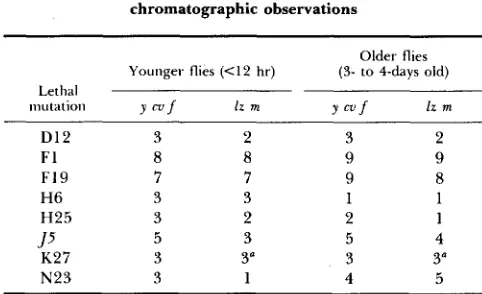
Estimates of relative drosopterin content of ras-l/ras' based on chromatographic observations
57
Older flies (3- to 4-days old)
111 U td tioil Y m f lr m Y c v f lz m
Younger flies (<12 hr)
Lethal
D 1 2 F1 F i 9
H6 H25
K 2 7 N 2 3 J 5
3 2
9 9
9 8
1 1
2 1
5 4
3 3"
4 5
Numbers represent subjective estimates on a scale of 1-9,
where 2 represents the intensity of drosopterin fluorescence in
ras2 homozygotes, and 8 represents the intensity in wild type, for flies of similar age. Haplo-specific lethal is indicated in italics.
a K27 substitution incomplete; a l z K 2 7 w f chromosome was used.
and inconsistent effects of temperature are somewhat surprising, given that survival of
pur12/Df
is strongly dependent on temperature (JOHNSON, WOLO-SHYN and NASH 1979).
Eye color and pteridine content in ras*/rus-Z combinations
Visual comparison between eye color of individual flies is difficult because pteridine content of both wild-type and, to a much greater extent, rus-eyed flies appears to change rapidly in the first few days after eclosion. In conse- quence, pteridines were extracted from bulk samples of rus2/rus-l flies and were separated by chromatography. For each lethal mutation, in both back- grounds, extracts of flies less than 12 hr old and of 3- to 4-day-old flies were prepared on the same day. These were run chromatographically with compa- rable extracts of rus+/rus+ and rus2/rus2. T h e chromatographs were analyzed subjectively under ultra-violet illumination and from black-and-white polaroid photographs. A number of minor, mainly quantitative variations were found in a variety of pteridines, but these have been ignored, in favor of a catego- rization of drosopterin contents relative to rus+/rus+ and rus2/rus2. T h e results are reported in Table 6. On the numerical scale used (1-9), rus+/ras+ is arbi- trarily given a value of 8 and rus2/rus2 a value of 2.
58 F. C. JANCA, E. P. WOLOSHYN AND D. NASH
graphic pattern are reflected in whole flies: First, the eyes of young N23 flies are much like rus‘, but pigmentation intensifies to a greater extent with age; we have not, however, identified the differences between the two N23 stocks implied by the chromatographic results. Second, the difference between y cv J5
f
and 1% J5 m is largely explained by a polymorphism in the y cv 55f
stock;a small proportion of the ras2/J5 flies have intensely pigmented, but still dis- tinguishably rus-colored, eyes, although the majority have lighter eyes similar to those of ras2/lz J5 m. T h e factor responsible is X-linked, but we have not identified its map position. Finally, the slight reduction in pigmentation in young F19 flies is real, although only evident for a few hours after eclosion, and then only if a most careful comparison is made.
None of o u r observations of whole flies confirms the existence of phenotypes corresponding to values 1 o r 9 in Table 6; it is possible, therefore, that these values may have been necessary simply to record experimental error.
DISCUSSION
The 9E1-9F13
region: Two previous studies (ZHIMULEV et al. 1981; LEFEVRE1981) have been published on the complementation pattern in 9E1-9F13. ZHI- MULEV, SEMESHIN and BELYAEVA (1 98 1) also published a definitive electron microscopic analysis of the region, showing a total of 13 bands in the region. This result is represented in Figure 2a.
Although ZHIMULEV et al. (1981) discuss the entire study region, they iso- lated lethal mutations only in its rightmost portion, 9F12-13, where two lethal loci, l(1)BPl and l(l)BP3, were found. It is possible that these loci correspond to our complementation groups D and G.
LEFEVRE (1 98 1 ) reports a total of seven lethal complementation groups in the study region, none of them in 9F12 o r 9F13. We have not concerned ourselves with equivalences between LEFEVRE’S mutations in the right-hand
(9F) portion of our study region and our own mutations. LEFEVRE shows four complementation groups in 9F, including l(l)S12, which we have reason to believe may reside in region 9E (see below).
In the left-hand portion (9E), we have ordered the complementation groups
by recombination, using 1% and m as outside markers. Results will be presented elsewhere. T h e order is A-C-B-G. A, C and B are very close together and G is some considerable distance to the right. These four groups, which appear to be contained in the region 9E, thus appear not to include all three of the groups reported by LEFEVRE (1981), since he shows one complementa- tion group (EM32) to the left of rus, which is our group A.
VARIATION BETWEEN ALLELIC LETHALS 59 9E-F;20A4-5. It is semilethal, and the surviving males are sterile. O u r data suggest allelism with only group B mutants.
A range of possibilities therefore exists concerning the region 9E. O u r results indicate a minimum of four lethal complementation groups. Two of these groups (A and C) are in 9E3-9E4. LEFEVRE’S (1981) EM32 appears to be another group (presumably located in 9E1-2), which was not represented in our sample. T w o other groups, B and G, appear to be located in 9E7-8. (Note that bands 9E5 and 6 were not identified in the electron microscopy studies of ZHIMULEV, SEMESHIN and BELYAEVA (1 98 l).) Complementation group B
and EM31 are clearly synonymous. It is probable that l(l)S12 is also part of this same locus.
At this conventional level of analysis, there is evidence for a minimum of nine (and possibly 1 1 ) lethal complementation groups between 9E1 and 9F13,
which, together with theJliK, sbr andJliG loci (ZHIMULEV et al. 1981), would account reasonably well for the 13 bands found in the region by ZHIMULEV, SEMESHIN and BELYAEVA ( 1 98 1). LEFEVRE’S (1 98 1) identification of the region as underpopulated hinges partly on an underestimate of numbers of groups and partly on BRIDGES’ (1938) cytological map, which ZHIMULEV, SEMESHIN
and BELYAEVA (1981) claim inflates the band count by ten.
Heterogeneity of raspberry-lethal alleles: In characterizing the raspberry- lethals, we had in mind three major questions about their heterogeneity: ( 1 )
How great a range of variability exists? (2) Does variability originate from allele-specific differences? (3) Do the three quasi-independent components of
gual-purl -ras function vary coordinately?
T h e data presented attest to the extent of the variability. T h e most extreme variation occurs with respect to drosopterin production. T h e r e is less variation with respect to the gual and purl functions. All ras-l mutations, in both backgrounds, give evidence for allelism with all three auxotrophic mutations. There are, however, numerous instances where survival differs strongly from the mode.
We approached the question of the origin of this variation by testing each mutation in two stocks, which should have had background differences at least as great as those differentiating the individual raspberry-lethal alleles.
Drosopterin content provides the clearest picture with respect to allelic var- iation. There is no example of radical divergence between the eye color phe- notypes exhibited by one mutation in the two backgrounds. Of the two minor differences, J5 is a special case in which a clear-cut polymorphism accrued since the initial mutation was isolated. T h e second case,
N23,
if real, involves variation in the rate of pigment formation with age. Most of the large variation in eye pigmentation is, therefore, allele-specific.60 F. C. JANCA, E. P . WOLOSHYN AND D. NASH TABLE 7
Exploratory X4-analysis of heterogeneity in expression of ras-llauxotroph double heterozygotes
Medium
Yeast-sucrose Sang's
Auxotrophic
mutation 25" 29" 25" 29"
gua 1 '' T 1 1 . 3 A 4.9 B 1.9 R 4.4
p u r l ' T 216.0**
A 194.4** B 0.1 R 21.5**
pur12 T 34.6**
A 8.1 B 4.6*
R 21.9**
24.3 13.4 0.1 10.8
632.3** 608.0** 11.9** 12.4
57.9** 47.6**
0.1 11.8
829.9** 781.1 ** 10.1** 38.7**
133.7** 55.9** 9.6* 68.1**
397.6** 334.6**
2.8 60.1**
424.6** 393.9**
2 . 5
28.2**
56.0** 40.4**
0.7 15.0*
470.7** 405.0**
0 . 4 65.4**
The analyses were carried out on data shown in Tables 3-5. T , Total heterogeneity of exper- imenta1:control ratio, with 15 d.f.; A, heterogeneity between ras-1 alleles, with 7 d.f.; B, hetero- geneit between "backgrounds," with 1 d.f.; R , T-(A
+
B), with 7 d.f.* x
Y
values having P < 0.05, by chance; * * x 2 values having P < 0.005, by chance.In eight of the ten cases where overall heterogeneity is evident, the com- ponent R contributes a significant portion of the total
x2.
However, the pro- portion ofx 2
attributable to allele-specific differences (A) is often much greater than that attributable to interaction. Indeed, in at least two of the four blocks of data associated with each auxotroph, the ratio A:R (which each have7
d.f.) is greater than 5 . We conclude, therefore, that this analysis shows that, al- though the expression of a given allelic combination in a given growth regime is by no means constant, there is strong evidence for allele-specific differences. T h e qualitative nature of these differences is discussed in the RESULTS section. I t should be noted that our genetic substitution procedure was of limited resolution, so that we are formally unable to distinguish allele-specific differ- ences from differences generated by modifiers in the segment of chromosome surrounding the gual-purl-ras complex, between lz and m.VARIATION BETWEEN ALLELIC LETHALS
TABLE 8
A summary of the expression of r a d mutations in heterozygous combinations with gual“, purl‘ and ras‘
Nonlethal mutation
61
r a d allele p a l “ purl2 ra?
D12 Strong Weak Strong
F1 Strong Weak Weak
F19 Strong Weak Weak
H6 Strong Strong Strong
H25 Strong Weak Strong
Weak Strong Strong
Weak Strong Strong
K27
N23 Strong Weak Strong
These qualitative assessments are based on data in Tables 3, 5 and 6. purl’ (Table 4) shows strong expression against all eight mutations.
J5
So far, we have considered each raspberry-lethal mutation only as it affects each of the quasi-independent functions in the gual-purl-ras complex. We now extend our analysis to the overall pattern of mutant expression and ask whether the variation observed in one function is correlated with that in other functions. Clearly it is not. Table 8 reduces the variation to its most basic form, by concentrating only on coarse differences in expression; each genotype is categorized either as “strong” or “weak.” This arbitrary, but conservative, classification yields four different classes of mutation: those that affect only the
gual function strongly ( F l , F19), those that affect the gual and ras functions strongly (D12, H25 and N23), those that affect the purl and ras functions strongly (J5 and K25) and, finally, one (H6) that affects all three functions strongly.
There is no consistent positive correlation between the strength of effect of each lethal mutation on gual, purl and ras. It is, thus, impossible to explain the phenomenology in terms of a series of hypomorphs having different de- grees of “leakiness,” interacting with differing thresholds for the expression of each pleiotropic effect. Rather, they have to be viewed as a set of qualitatively different mutations generating largely independent levels of effect on the three functional domains within the complex. This picture is compatible not only with the existence of the three mutations, gual’”, purl‘ and ras2, which com- plement inter se, but also with the dual effect of purl’ on the purl and gual
functions.
CONCLUSION
62 F. C. JANCA, E. P. WOLOSHYN AND D. NASH
Our findings confirm previous observations (NASH et al. 1981), which were made with one EMS-induced and two X-ray mutations, and confirm the pres- ence of a complex locus. T h e nature of the lethals is highly variable. There are at least four clearly differentiable classes of mutations; it is possible to argue that all eight are different. This observation lends support to the con- tention that we have isolated point mutations, as opposed to deficiencies, that would be expected to be more monotypic in effect.
Complex genes are not uncommon in D. melanogaster, although satisfactory biochemical explanations for their genetic behavior remain rare. At present, the rudimentary locus ( r , 1-54.5) provides the clearest model with which we can compare the gual-purl-ras complex. There are two levels of phenotypic complexity of rudimentary. First, the phenotypic expression of its mutations includes three components; a wing defect, female sterility and pyrimidine aux- otrophy. Expression of these three phenotypes is correlated in different alleles and appears to stem from the degree to which pyrimidine biosynthesis is de- fective (FALK and NASH 1974b); at this level there is one dimension to varia- tion, and the differences between expression of different alleles are trivial.
At a second level, variation between r mutations is nontrivial. T h e locus encodes an enzymatically trifunctional polypeptide which catalyzes three reac- tions in pyrimidine biosynthesis (MEHL and JARRY 1978). It is this aspect of r mutations that generates complex genetic behavior, including an elaborate pattern of interallelic complementation (CARLSON 197 1) which suggests that one, two, or all three enzyme activities may be reduced by a given mutation and that the severity of the effects on each activity is, at least, quasi-independ- ent. Our results with the gual-purl-ras region indicate variation of this latter kind.
VARIATION BETWEEN ALLELIC LETHALS 63
complex locus. It does yield recessive lethal mutations. Yet, paradoxically, it behaves as a simple locus when subjected to lethal complementation tests.
We suspect that the mutational spectrum that we have observed over the years provides a clue to this puzzling absence of complex lethal loci. We have found very few monofunctional mutations (two auxotrophs, and no viable rasp-
berry alleles, in about 15,000 chromosomes screened). In contrast, multifunc- tional ras lethals occur at a high frequency (eight per 7,500 chromosomes in this study). A similar predominance of multifunctional defects at an hypothet- ical complex lethal locus would obscure its complex nature.
We suggest that essential loci are likely to be as functionally complex as nonessential loci; however, the operational test of functional complexity, the complementation test, is not necessarily as appropriate for the two cases.
Now that molecular tools are available that allow direct assessment of genetic complexity, it is likely that both particular questions about the organization. and function of the gual-purl-ras complex and more general questions sug- gested by our results will soon be answered,
This work was supported by Natural Sciences and Engineering Research Council (Canada) operating grant A3269 to David Nash.
LITERATURE CITED
BRIDGES, C. B., 1938
CARLSON, P. S., 1971
EL KOUNI, M. H. and D. NASH, 1974
A revised map of the salivary gland X-chromosome of Drosophila melano-
A genetic analysis of the rudimentary locus of Drosophila melanogaster.
Biology of 5-fluoro-Z’-deoxyuridine sensitivity of Drosophila melanogaster larvae. J. Insect Physiol. 20: 1481-1490.
Control of drosopterin synthesis in Drosophila melano- gaster: Mutants showing an altered pattern of GTP cyclohydrolase activity during development. Biochem. Genet. 16: 13-26.
FALK, D. R., 1973 Sex-linked auxotrophic mutations in Drosophila melanogaster. Ph.D. Thesis, University of Alberta, Edmonton, Alberta.
FALK, D. R. and D. NASH, 1974a Sex-linked auxotrophic and putative auxotrophic mutants of
Drosophila melanogaster. Genetics 7 6 755-766.
FALK, D. R. and D. NASH, 1974b Pyrimidine auxotrophy in Drosophila: Normal-winged, auxo- trophic mutants and dominant auxotrophy at the rudimentary locus. Mol. Gen. Genet. 131: 339-349.
Correlation of guanosine triphosphate cyclohydrolase activity and the synthesis of pterins in Drosophila melanogaster.
Biochem. Genet. 1 4 271-280.
JOHNSON, M. M., E. P. WOLOSHYN and D. NASH, 1979 Cytogenetic localisation of the purine1
and guanosine1 loci of Drosophila melanogaster; the purinel locus specifies a vital function. Mol.
Gen. Genet. 174: 287-292.
LEFEVRE, G. JR., 1969 The eccentricity of vermilion deficiencies in Drosophila melanogaster. Ge- LEFEVRE, G. JR., 1981 The distribution of randomly recovered x-ray-induced sex-linked genetic
gaster. J. Hered. 2 9 11-13.
Genet. Res. 17: 53-81.
EVANS, B. A. and A. J. HOWELLS, 1978
FAN, C. L., L. M. HALL, A. J. SKRINSKA and G. M. BROWN, 1976
netics 63: 589-600.
64
LINDSLEY, D. L. and E. H. GRELL, 1968
F. C . JANCA, E. P. WOLOSHYN AND D. NASH
Genetic variations of Drosophila melanogaster. Carnegie
Developmental regulation of the first three enzymes of pyrimidine biosynthesis in Drosophila melanogaster. Dev. Biol. 67: 1 - 1 0.
Hypomorphic lethal mutations and their implications for the interpretation of lethal complementation studies in Drosophila. Genetics 105: 957-968.
Pleiotropic, recessive-lethal mutants associated with purine metabolism in Drosophila melanogaster. Can. J. Genet. Cytol.
23: 41 1-423.
ROBBINS, L. G., 1983 Maternal-zygotic lethal interactions in Drosophila melanogaster: zeste-white
SANG, J. H., 1956 The quantitative nutritional requirements of Drosophila melanogaster. J. Exp.
ZHIMULEV, 1. F., G. V. POKHOLKOVA, A. V. BGATOV, V. F . SEMESHIN and E. S. BELYAEVA, 3981 Fine cytogenetical analysis of the IOAI-2 band and the adjoining regions of the Dro- sophila melanogaster X chromosome. 11. Genetical analysis. Chromosoma (Berl.) 82: 25-40.
Fine cytogenetical analysis of the band IOAI-2 and the adjoining regions in the Drosophila melanogaster X chromosome. I.
Cytology of the region and mapping of chromosome rearrangements. Chromosoma (Berl.) 82: 9-23.
Communicating editor: A. T. C. CARPENTER
Inst. Wash. Publ. 627.
MEHL, Y.-M. and B. P. JARRY, 1978
NASH, U. and F. C. JANCA, 1983
NASH, D., E. P. WOLOSHYN, Y.-M. MEHL and F. C. JANCA, 1981
region single-cistron mutations. Genetics 103: 633-648.
Biol. 33: 45-72.