Equivalent Keys in HFE, C
∗, and variations
Christopher Wolf and Bart Preneel K.U.Leuven ESAT-COSIC
Kasteelpark Arenberg 10, B-3001 Leuven-Heverlee, Belgium
{Christopher.Wolf,Bart.Preneel}@esat.kuleuven.ac.beor [email protected] http://www.esat.kuleuven.ac.be/cosic/
Abstract
In this article, we investigate the question of equivalent keys for twoMultivariateQuadratic public key schemes HFE and C∗−− and improve over a previously known result, to appear at PKC 2005. Moreover, we show a new non-trivial extension of these results to the classes HFE-, HFEvHFE-, HFEv-HFE-, and C∗−−, which are cryptographically stronger variants of the original HFE and C∗ / MIA schemes. In particular, we are able to reduce the size of the private — and hence the public — key space by at least one order of magnitude. While the results are of independent interest themselves, we also see applications both in cryptanalysis and in memory efficient implementations.
Keywords: Multivariate Quadratic Equations, Public Key signature, Hidden Field Equations, HFE, HFE-, HFEv, HFEv-, C∗, MIA, C∗−−,
MIA-Cryptology ePrint Archive, Report 2004/360 http://eprint.iacr.org/
Current Version: 2005-08-09 First Revision: 2005-01-28
First Version: 2004-12-16
This is the extended version of the article with the same title [WP05a].
The original article has been published in Proceedings of Mycrypt 2005, volume 3715 of Lecture Notes in Computer Science, pages 33–49. Serge Vaudenay, editor, Springer, 2005.
1
Introduction
In the last 15 years, several schemes based on the problem ofMultivariateQuadratic equations have been proposed. The most important ones certainly are C∗ / MIA [MI88] and Hidden Field Equations
(HFE, [Pat96b]) plus their variations C∗−−, HFE-, HFEv, and HFEv- [KPG99, Pat96a, Pat96b].
Both have been used to construct signature schemes, namely C∗−− in Sflash [CGP03], and HFEv- in
Quartz [CGP01]. As for all systems based onMQ-equations, the public key has the form
pi(x1, . . . , xn) :=
X
1≤j≤k≤n
γi,j,kxjxk+ n
X
j=1
βi,jxj+αi,
for 1≤i≤m; 1≤j≤k≤nandαi, βi,j, γi,j,k∈F(constant, linear, and quadratic terms). We write
the set of all such equations asMQ(Fn,Fm). Moreover, the private key consists of the triple (S,P0, T)
whereS∈Aff−1(Fn), T ∈Aff−1(Fm) are affine transformations (cf Sect. 2.2) and P0 ∈ MQ(Fn,Fm)
is a polynomial-vectorP0 := (p0
1, . . . , p0m) withm components; each component is a polynomial inn
variablesx0
1, . . . , x0n. Throughout this paper, we will denote components of this private vectorP0 by a
prime0. In contrast to the public polynomial vectorP ∈ MQ(Fn,Fm), the private polynomial vector
P0 does allow an efficient computation ofx0
1, . . . , x0n for given y10, . . . , y0m. Hence, the goal of
betweenMQ-schemes lies in their special construction of the central equationsP0 and consequently
the trapdoor they embed into a specific class ofMQ-problems.
In this paper, we investigate the question of equivalent keys for selected MQ-schemes. Due to space limitations, we concentrate on HFE, HFE-, HFEv, HFEv-, C∗, and C∗−−. As outlined above,
they are quite important as they have been used in constructions submitted to the NESSIE project [NES]. However, we want to point out that the techniques outlined here are quite general and can also be applied to other schemes. The first paper on the topic of equivalent keys is [WP05b]. In this paper, we introduce the Frobenius sustainer and are hence able to improve over the results from [WP05b]. Moreover, this paper is the first to deal with variations of MQ-schemes, cf [WP05c] for the terminology ofMQ-trapdoors. To this aim, we needed to develop the reduction sustainer, as we would not have been able to deal with the HFE- and the C∗−− modification otherwise.
This paper is outlined as follows: after this general introduction, we move on to the necessary math-ematical background in Sect. 2. This includes particularly a definition of the termequivalent keys. In Sect. 3, we concentrate on a subclass of affine transformations, denoted sustaining transformations, which can be used to generate equivalent keys. These transformations are applied to different varia-tions ofMultivariateQuadratic equations in Sect. 4. This paper concludes with Sect. 5, cf [WP05b] for results on Unbalanced Oil and Vinegar schemes (UOV). A general overview ofMQ-schemes can be found in [WP05c].
2
Mathematical Background
In this section, we outline some observations useful in the remainder of this paper.
2.1
Basic Definitions
We start with a formal definition of the term “equivalent private keys”:
Definition 2.1 We call two private keys
(T,P0, S),( ˜T ,P˜0,S˜)∈Aff−1(Fm)× MQ(Fn,Fm)×Aff−1(Fn)
“equivalent” if they lead to the same public key, i.e., if we have
T◦ P0◦S=P = ˜T◦P˜0◦S .˜
In order to find equivalent keys, we consider the following transformations:
Definition 2.2 Let(S,P0, T)∈Aff−1(Fm)× MQ(Fn,Fm)×Aff−1(Fn), andσ, σ−1∈Aff−1(Fn)plus
τ, τ−1∈Aff−1
(Fm). Moreover, let
P =T◦τ−1◦τ◦ P0◦σ◦σ−1◦S (1)
We call the pair(σ, τ)∈Aff−1(Fn)×Aff−1(Fm) “sustaining transformations” for an MQ-system if
the “shape” ofP0 is invariant under the transformationsσandτ. For short, we write(σ, τ)•(S,P0, T)
for (1) and(σ, τ)sustaining transformations.
Remark. In the above definition, the meaning of “shape” is still open. In fact, its meaning has to be defined for eachMQ-system individually. For example, in HFE, it is the bounding degreed∈N
of the polynomial P0(X0). In the case of C∗ / MIA, the “shape” is the fact that we have a single
monomial with factor 1 as the central equation. However, forσ, τ sustaining transformations, we are now able to produce equivalent keys for a given private key by (σ, τ)•(S,P0, T). A trivial example of
Lemma 2.3 Let (σ, τ)be sustaining transformation. IfG:= (σ,◦)and H := (τ,◦) form a subgroup of the affine transformations, they produce equivalence relations within the private key space.
Proof. We start with a proof of this statement for G := (σ,◦). First, we have reflexivity as the
identity transformation is contained inG. Second, we have symmetry as subgroups are closed under inversion. Third, we also have transitivity as subgroups are closed under composition. Therefore, the group G partitions the private key space into equivalence classes. The proof for H := (τ,◦) is
analogous. ¤
Remark. We want to point out that the above proof does not use special properties of sustaining transformations, but the fact that these are a subgroup of the group of affine transformations. Hence, the proof does not depend on the term “shape” and is therefore valid even if the latter is not rigorously defined yet. In any case, instead of proving that sustaining transformations form a subgroup of the affine transformations, we can also consider normal forms of private keys. As we see below, normal forms have some advantages to avoid double counts in the private key space.
After these initial observations over equivalent keys, we concentrate on bijections between ground fields and their extension fields as both HFE and C∗ / MIA use an extension field to define their
central equationsP0. Let Fbe a finite field with q :=|F| elements. Using a polynomial i(t)∈F[t],
irreducible overF, we generate an extension fieldE:=F[t]/i(t) of dimensionn. This means we view
elements ofEas polynomials intof degree less thann. Addition and multiplication are defined as for
polynomials moduloi(t). In addition, we can view elements fromEas vectors over the vector-space Fn. We will therefore view elementsa∈Eandb∈Fn as
a:=αn−1tn−1+. . .+α1t+α0andb:= (β1, . . . , βn),
for αi−1, βi ∈ F with 1 ≤ i ≤ n. Moreover, we define the canonical bijection between E and Fn
by identifying the coefficients αi−1 ↔ βi. We use both this bijection φ : E → Fn and its inverse
φ−1:Fn→E.
2.2
Affine Transformations
In the context of affine transformations, the following lemma proves useful:
Lemma 2.4 Let F be a finite field with q := |F| elements. Then we have Qn−1
i=0 q
n −qi invertible
(n×n)-matrices over F.
Next, we recall some basic properties of affine transformations over the finite fieldsFandE.
Definition 2.5 Let MS ∈ Fn×n be an invertible (n×n) matrix and vs ∈ Fn a vector and let
S(x) :=MSx+vs. We call this the “matrix representation” of the affine transformation S.
Definition 2.6 Moreover, lets1, . . . , snbenpolynomials of degree 1 at most overF, i.e.,si(x1, . . . , xn) :=
βi,1x1+. . .+βi,nxn +αi with 1 ≤ i, j ≤ n and αi, βi,j ∈ F. Let S(x) := (s1(x), . . . , sn(x)) for
x:= (x1, . . . , xn) as a vector over Fn. We call this the “multivariate representation” of the affine
transformationS.
Remark. The multivariate and the matrix representation of an affine transformation S are inter-changeable. We only need to set the corresponding coefficients to the same values: (MS)i,j ↔ βi,j
and (vS)i↔αi for 1≤i, j≤n.
In addition, we can also use the “univariate representation” over the extension field E of the
Definition 2.7 Let0≤i < nandA, Bi ∈E. Moreover, let the polynomialS(X) :=Pn−1
i=0 BiXq
i +A be an affine transformation. We call this the “univariate representation” of the affine transformation S(X).
Lemma 2.8 An affine transformation in univariate representation can be transfered efficiently in multivariate representation and vice versa.
Proof. This lemma follows from [KS99, Lemmata 3.1 and 3.2] by a simple extension from the linear
to the affine case. ¤
3
Sustaining Transformations
In this section, we discuss several examples for sustaining transformations. In addition, we will consider their effect on the central transformationP0. The authors are not convinced that the transformations
stated here are the only ones possible but encourage the search for other and maybe more powerful sustaining transformations.
3.1
Additive Sustainer
Forn=m, letσ(X) := (X+A) andτ(X) := (X+A0) for some elementsA, A0∈E. Moreover, as long
as they keep the shape of the central equationsP0 invariant, they form sustaining transformations.
In particular, we are able to change the constant partsvs, vt∈Fn orVS, VT ∈Eof the two affine
transformationsS, T∈Aff−1(Fn) to zero,i.e., to obtain a new key ( ˆS,Pˆ0,T) with ˆˆ S,Tˆ∈Hom−1(Fn).
Remark. This is a very useful result for cryptanalysis as it allows us to “collect” the constant terms in the central equationsP0. For cryptanalytic purposes, we therefore need only to consider the case
of linear transformationsS, T ∈Hom−1(Fn).
The additive sustainer also works if we interpret it over the vector space Fn rather than the
extension fieldE. In particular, we can also handle the casen6=mnow. However, in this case it may
happen that we have a0 ∈ Fm and consequently τ : Fm→ Fm. Nevertheless, we can still collect all
constant terms in the central equationsP0.
If we look at the central equations as multivariate polynomials, the additive sustainer will affect the constantsαi andβi,j∈Ffor 1≤i≤m and 1≤j ≤n. A similar observation is true for central
equations over the extension fieldE: in this case, the additive sustainer affects the additive constant
A∈Eand the linear factorsBi ∈Efor 0≤i < n.
3.2
Big Sustainer
We now consider multiplication in the (big) extension field E, i.e., we have σ(X) := (BX) and
τ(X) := (B0X) forB, B0 ∈E∗. Again, we obtain a sustaining transformation if this operation does
not modify the shape of the central equations as (BX),(B0X)∈Aff−1(Fn).
The big sustainer is useful if we consider schemes defined over extension fields as it does not affect the overall degree of the central equations over this extension field.
3.3
Small Sustainer
We now consider multiplications over the (small) ground fieldF,i.e., we haveσ(x) :=Diag(b1, . . . , bn)x
andτ(x) :=Diag(b0
1, . . . , b0m)xfor the coefficientsb1, . . . , bn, b01, . . . , b0m∈F∗ andDiag(b) the diagonal
In contrast to the big sustainer, the small sustainer is useful if we consider schemes which define the central equations over the ground fieldF as it only introduces a scalar factor in the polynomials
(p0
1, . . . , p0m).
3.4
Permutation Sustainer
For the transformationσ, this sustainer permutes input-variables of the central equations while for the transformation τ, it permutes the polynomials of the central equations themselves. As each permutation has a corresponding, invertible permutation-matrix, bothσ ∈Sn and τ ∈ Sm are also
affine transformations. The effect of the central equations is limited to a permutation of these equations and their input variables, respectively.
3.5
Gauss Sustainer
Here, we consider Gauss operations on matrices,i.e., row and column permutations, multiplication of rows and columns by scalars from the ground fieldF, and the addition of two rows/columns. As
all these operations can be performed by invertible matrices; they form a subgroup of the affine transformations and are hence a candidate for a sustaining transformation.
The effect of the Gauss Sustainer is similar to the permutation sustainer and the small sustainer. In addition, it allows the addition of multivariate quadratic polynomials. This will not affect the shape of someMQ-schemes.
The sustainers given so far have been already outlined in [WP05b]. To the knowledge of the authors, the following sustainers are new and to the knowledge to the authors have not been considered previously in the literature.
3.6
Frobenius Sustainer
Definition 3.1 Let F be a finite field with q := |F| elements and E its n-dimensional extension.
Moreover, let H := {i ∈ Z : 0 ≤ i < n}. For a, b ∈ H we call σ(X) := Xqa and τ(X) := Xqb
Frobenius transformations.
Obviously, Frobenius transformations are linear transformations with respect to F. The following
lemma establishes that they also form a group:
Lemma 3.2 Frobenius transformations are a subgroup in Hom−1(Fn).
Proof. First, Frobenius transformations are linear transformations, so associativity is inherited
from them. Second, the set H from Def. 3.1 is not empty for any given F and n ∈ N. Hence, the
corresponding set of Frobenius transformations is not empty either. So all left to show is that for any given Frobenius transformationsσ, τ, the compositionσ◦τ−1 is also a Frobenius transformation.
Letσ(X) :=Xqa
andτ(X) :=Xqb
for somea, b∈H. Working in the multiplicative groupE∗ we
observe that we needqb·B0 ≡1 (modqn−1) forB0 to obtain the inverse function ofτ. We notice
that B0 :=qb0
forb0 :=n−b (mod n) yields the required and moreover τ−1 :=Xqb0
is a Frobenius transformation asb0 ∈H.
So we can writeσ(X)◦τ−1(X) =Xqa+b0
. Ifa+b0 < nwe are done. Otherwisen≤a+b0 <2n,
so we can writeqa+b0
=qn+s for somes∈H. Again, working in the multiplicative groupE∗ yields
qn+s ≡qs (mod qn−1) and hence, we established that σ◦τ−1 is also a Frobenius transformation.
Frobenius transformations usually change the degree of the central equationP0. But takingτ :=
σ−1 cancels this effect and hence preserves the degree ofP0. Therefore, we can speak of a Frobenius
sustainer (σ, τ). So there arenFrobenius sustainers for a given extension fieldE.
It is tempting to extend this result to the case of powers of the characteristic ofF. However, this
is not possible asxcharF is not a linear transformation inFforq6=p.
Remark. We want to point out that all six sustainers presented so far form groups and hence partition the private key space into equivalence classes (cf Lemma 2.3).
3.7
Reduction Sustainer
Reduction sustainers are quite different from the transformations studied so far, because they are applied with a different construction of the trapdoor of P. In this new construction, we define the public key equations as P := R◦T ◦ P0 ◦S where R : Fn → Fn−r denotes a reduction or
projection. In addition, we have S, T ∈ Aff−1(Fn) and P0 ∈ MQ(Fn). Less loosely speaking, we
consider the function R(x1, . . . , xn) := (x1, . . . , xn−r), i.e., we neglect the last r components of the
vector (x1, . . . , xn). Although this modification looks rather easy, it proves powerful to defeat a wide
class of cryptographic attacks against severalMQ-schemes, including HFE and C∗ / MIA,e.g., the
attack introduced in [FJ03].
For the corresponding sustainer, we consider the affine transformationT in matrix representation, i.e., we haveT(x) :=M x+vfor some invertible matrixM ∈Fm×mand a vectorv∈Fm. We observe
that any change in the lastrcolumns ofM orvdoes not affect the result ofR(and henceP). Hence, we can choose these lastr columns without affecting the public key. Inspecting Lemma 2.4, we see that this gives us a total of
qr
n−1
Y
i=n−r−1
¡
qn−qi¢
choices forv andM, respectively, that do not affect the public key equationsP.
When applying the reduction sustainer together with other sustainers, we have to make sure that we do not count the same transformation twice, cf the corresponding proofs.
4
Application to
M
ultivariate
Q
uadratic Schemes
In this section, we show how to apply the sustainers from the previous section to severalMQ-schemes. Due to space limitations in this paper, we will only outline some central properties of each scheme and sketch the corresponding proofs. We want to stress that the reductions in size we achieve represent only lower, no upper bounds: additional sustaining transformations can reduce the key space of these schemes further.
4.1
Hidden Field Equations
The Hidden Field Equations (HFE) have been proposed by Patarin [Pat96b].
Definition 4.1 Let Ebe a finite field and P(X) a polynomial over E. For
P(X) := X
0≤i,j≤d qi+qj≤d
Ci,jXq
i+qj
+ X
0≤k≤d qk≤d
BkXq
k +A
where
Ci,jXq
i+qj
forCi,j∈Eare the quadratic terms,
BkXq
k
forBk ∈Eare the linear terms, and
and a degreed∈N, we say the central equationsP0 are in HFE-shape.
Due to the special form of P(X), we can express it as a Multivariate Quadratic equation P0 over
F, cf [Pat96b]. Moreover, as the degree of the polynomial P is bounded by d, this allows efficient
inversion of the equationP(X) =Y for givenY ∈E. So theshape of HFE is in particular this degree
dof the private polynomialP. Moreover, we observe that there are no restrictions on its coefficients Ci,j, Bk, A∈E fori, j, k∈Nand qi, qi+qj≤d. Hence, we can apply both the additive and the big
sustainer (cf sect. 3.1 and 3.2) without changing the shape of this central equation.
Theorem 4.2 ForK:= (S, P, T)∈Aff−1(Fn)×E[X]×Aff−1(Fn)a private key in HFE, we have
n.q2n(qn−1)2
equivalent keys.
Proof. To prove this lemma, we consider normal forms of private keys: let ˜S ∈ Aff−1(Fn) being
the affine transformation we start with. First we compute ˆS(X) := ˜S(X)−S(0),˜ i.e., we apply the additive sustainer. Obviously, we have ˆS(0) = 0 after this transformation and hence a special fix-point. Second we defineS(X) := ˆS(X).S(1)ˆ −1,i.e., we apply the big sustainer. As the transformation
ˆ
S:E→Eis a bijection and we have ˆS(0) = 0, we know that ˆS(1) must be non-zero. Hence, we have
S(1) = 1,i.e., we add a new fix-point but still keep the old fix-point as we have S(0) = ˆS(0) = 0. Similar we can compute an affine transformation T(X) with T(0) = 0 and T(1) = 1 as a normal form of the affine transformation ˜T ∈Aff−1(Fn). Note that both the additive sustainer and the big
sustainer keep the degree of the central polynomialP(X) so we can apply both sustainers on both sides without changing the “shape” ofP(X).
Applying the Frobenius sustainer is a little more technical. First we observe that this sustainer keeps the fix-pointsS(0) =T(0) = 0 andS(1) =T(1) = 1 so we are sure we still deal with equivalence classes, i.e., each given private key has a unique normal form, even with the Frobenius sustainer applied. Now we pick an elementC ∈ E\{0,1} with g := S(C) is a generator ofE∗, i.e., we have
E∗={gi |0≤i < qn}. AsEis a finite field we know that such a generatorgexists. Given thatS is
injective we know that we can find the correspondingC ∈E\{0,1}. Now we compute gi :=S(C)q
i
for 0≤i < n. Using any total ordering “<”, we obtain gc := min{g0, . . . , gn−1} for some c∈ Nas
the smallest element of this set. One example of such a total ordering would be to use a bijection between the sets E ↔ {0, . . . , qn−1} and then exploiting the ordering of the natural numbers to
derive an ordering on the elements of the extension field E. Finally, we define S(X) := [S(X)]qc
as new affine transformation. To cancel the effect of the Frobenius sustainer, we moreover define T(X) := [T(X)]qn−c
.
Hence, we have now computed a unique normal form for a given private key. Moreover, we can “reverse” these computations and derive an equivalence class of sizen.q2n.(qn−1)2 this way as we
have
(BXqc+A, B0Xqn−c
+A0)•(S,P0, T) forB, B0 ∈E∗, A, A0 ∈Eand 0≤c < n .
¤
Remark. To the knowledge of the author, the additive sustainer for HFE has first been reported in [Tol03] and used there for reducing the affine transformations to linear ones. In addition, a weaker version of the above theorem can be found in [WP05b].
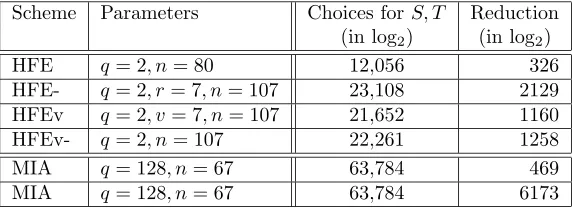
Forq= 2 andn= 80, the number of equivalent keys per private key is≈2326. In comparison, the
number of choices forS and T is≈212,056. This special choice of parameters has been used in HFE
4.1.1
HFE-We recall that HFE- is the original HFE-class with the minus modification (cf Section 3.7). In particular, this means that the “shape” of the central polynomial P0(X0) is still the same, i.e., all
considerations from the previous theorem also apply to HFE-.
Theorem 4.3 For K := (S, P, T) ∈ Aff−1(Fn)×E[X]×Aff−1(Fn) a private key in HFE and a
reduction parameterr∈Nwe have
n.q2n(qn−1)(qn−r
−1)
n−1
Y
i=n−r−1
(qn−qi)
equivalent keys. Hence, the key-space of HFE- can be reduced by this number.
Proof. This proof uses the same ideas as the proof of Theorem. 4.2 to obtain a normal form of
the affine transformationS,i.e., applying the additive sustainer, the big sustainer and the Frobenius sustainer on this side. Hence, we have a reduction byn.qn(qn−1) keys here.
For the affine transformationT, we also have to take the reduction sustainer into account: we use ˜
T(X) :Fn→Fn−r and fix ˜T(0) = 0 by applying the additive sustainer and ˜T(1) = 1 by applying the
big sustainer, which gives usqn−r andqn−r−1 choices, respectively. To avoid double counting with
the reduction sustainer, all computations were performed in ˜E := GF(qn−r) rather than E. Again,
we are able to compute a normal form for a given private key and reverse these computations to obtain the full equivalence class for any given private key in normal form. Moreover, we observe that the resulting transformation ˜T actually allows forqrQn−1
i=n−r−1(q
n−qi) possible choices for the
original transformationT :Fn→Fnwithout affecting the output of ˜T and hence, keeping the two fix
points ˜T(0) = 0 and ˜T(1) = 1. Therefore, there are a total ofqn−r.qr.(qn−r−1).Qn−1
i=n−r−1(q
n−qi)
possibilities for the transformationT without changing the public key equations. Multiplying out the
intermediate results forS andT yields the theorem. ¤
Forq = 2, r = 7 andn = 107, the number of equivalent keys for each private key is≈22129. In
comparison, the number of choices for S and T is ≈223,108. This special choice of parameters has
been used in the repaired version Quartz-7m of Quartz [CGP01, WP04].
4.1.2 HFEv
The following modification, due to [KPG99], uses a different form for the central equationsP0.
Definition 4.4 Let Ebe a finite field with degree n0 overF, the number of vinegar variablesv ∈N,
and P(X) a polynomial over E. Moreover, let (z1, . . . , zv) := sn−v+1(x1, . . . , xn), . . . , sn(x1, . . . , xn)
forsi the polynomials of S(x) in multivariate representation and X0 :=φ−1(x01, . . . , x0n0), using the
canonical bijectionφ−1: Fn →E andx0
i :=si(x1, . . . , xn)for 1≤i≤n0 as hidden variables. Then
define the central equation as
P0
z1,...,zv(X
0) := X
0≤i,j≤d qi+qj≤d
Ci,jX0q
i+qj
+ X
0≤k≤d qk≤d
Bk(z1, . . . , zv)X0q
k
+A(z1, . . . , zv)
where
Ci,jX0q
i+qj
forCi,j∈Eare the quadratic
terms, Bk(z1, . . . , zv)X0q
k
forBk(z1, . . . , zv)depending
linearly on z1, . . . , zv and
A(z1, . . . , zv) forA(z1, . . . , zv)depending
and a degreed∈N, we say the central equationsP0 are in HFEv-shape.
The condition that the Bk(z1, . . . , zv) are affine functions (i.e., of degree 1 in the zi at most) and
A(z1, . . . , zv) is a quadratic function overFensures that the public key is still quadratic overF.
Theorem 4.5 ForK:= (S, P, T)∈Aff−1(Fn)×E[X]×Aff−1(Fm)a private key in HFEv,v∈Nthe
number of vinegar variables,Ean n0-dimensional extension ofF wheren0:=n−v=m we have
n0qn+n0+vm
(qn0
−1)2
v−1
Y
i=0
(qv−qi)
equivalent keys. Hence, the key-space of HFEv can be reduced by this number.
Proof. In contrast to HFE-, the difficulty now lies in the computation of a normal form for the
affine transformationSrather than the affine transformationT. For the latter, we can still apply the big sustainer and the additive sustainer and obtain a total ofqm.(qm−1) =qn0
.(qn0
−1) equivalent keys for a given transformationT. Moreover, the HFEv modification does not change the “absorbing behaviour” of the central polynomialP and hence, the proof from Theorem. 4.2 is still applicable.
Instead, we have to concentrate on the affine transformation S here. To simplify the following argument, we apply the additive sustainer onS and obtain a linear transformation. This reduces the key-space byqn. To make sure that we do not count the same linear transformation twice, we consider
a normal form for the now (linear) transformationS
µ
Em Fvm
0 Iv

withEm∈Fm×m, Fvm∈F m×v
In the above definition, we also haveIv the identity matrix inFv×v. Moreover, the left-lower corner
is the all-zero matrix in Fv×m. The reason for this non-symmetry: we may not introduce vinegar
variables in the set of oil variables, but due to the form of the vinegar equations, we can introduce oil variables in the set of vinegar variables. This is done by the following matrix. In particular, for each invertible matrixMS, we have a unique matrix
µ
Im 0
Gv m Hv

with an invertible matrix Hv ∈Fv×v.
which transfers MS to the normal form from above. Again, Im is an identity matrix in Fm×m.
Moreover, we have some matrixGv m∈F
v×m. This way, we obtainqvmQv−1
i=0(q
v−qi) equivalent keys
in the “v” modification alone. As said previously, the identity matrixImensures that the input of the
HFE component is unaltered. However, we do not have such a restriction on the input of the vinegar part and can hence introduce the two matricesGv
m and Hv: they are “absorbed” into the random
terms of the vinegar polynomialsBk(z1, . . . , zv) andA(z1, . . . , zv).
For the HFE component over E, we can now apply the big sustainer to S and obtain a factor
of (qn0
−1). In addition, we apply the Frobenius sustainer to the HFE component, which yields an additional factor of n0. Note that the Frobenius sustainer can be applied both to S and T, and
hence, we can make sure that it cancels out and does not affect the degree of the central polynomial Pz1,...,zv(X). Again, we can reverse all computations and therefore, obtain equivalence classes of equal
size for each given private key in normal form. ¤
For the caseq= 2, v= 7 andn= 107, the number of equivalent keys for each private is≈21160.
4.1.3
HFEv-Here, we combine both the HFEv and the HFE- modification to obtain HFEv-. In fact, the original Quartz scheme was of this type.
Theorem 4.6 ForK:= (S, P, T)∈Aff−1(Fn)×E[X]×Aff−1(Fm+v,Fm+r) a private key in HFEv,
v∈Nvinegar variables, a reduction parameterr∈NandE ann0-dimensional extension of F where
n0:=n−v andn0 =m+rwe have
n0qr+2n0+vn0
(qn0
−1)2
v−1
Y
i=0
(qv−qi) n0−1
Y
i=n0−r−1
(qn0
−qi)
equivalent keys. Hence, the key-space of HFEv can be reduced by this number.
Proof. This proof is a combination of the two cases HFEv and HFE-. Given that the difficulty
for the HFE- modification was in the T-transformation while the difficulty of HFEv was in the S-transformation, we can safely combine the known sustainers without any double-counting. ¤
For the case q= 2, r= 3, v= 4 andn= 107, n0 := 103, the number of redundant keys is≈21258.
In comparison, the number of choices forS andT is≈222,261. This special choice of parameters has
been used in the original version of Quartz [CGP01], as submitted to NESSIE [NES].
4.2
Matsumoto-Imai Scheme A
Definition 4.7 LetEbe an extension field of dimensionnover the finite fieldFandλ∈Nan integer
withgcd(qn−1, qλ+ 1) = 1. We then say that the following central equation is of MIA-shape:
P0(X0) :=X0qλ+1.
The restriction gcd(qn −1, qλ+ 1) = 1 is necessary first to obtain a permutation polynomial and
second to allow efficient inversion ofP0(X0). In this setting, we cannot apply the additive sustainer,
as this monomial does not allow any linear or constant terms. Moreover, the monomial requires a factor of one. Hence, we have to preserve this property. At present, the only sustainers suitable seem to be the big sustainer (cf Sect. 3.2) and the Frobenius sustainer (cf Sect. 3.6). We use both in the following
Remark. In the paper [MI88], MIA was introduced under the name C∗. Moreover, it used the
branching modifier [WP05c, 4.4] by default. As branching has been attacked very successfully, C∗
has been used without this modification for any later construction,e.g., [CGP00b, CGP02, CGP00a, CGP03]. However, without the branching condition, the scheme C∗ coincides with the previously
suggested “Scheme A” from [IM85]. To acknowledge this historical development, we decided to use the earlier notation and call the scheme presented in this section “MIA” for “Matsumoto-Imai Scheme A”.
Theorem 4.8 ForK:= (S, P, T)∈Aff−1(Fn)×E[X]×Aff−1(Fn)a private key in MIA we have
n(qn−1)
equivalent keys. Hence, the key-space of MIA can be reduced by this number.
Proof. To prove this statement, we consider normal forms of keys in MIA. In particular, we
enforce thatS(0) = 0, so we may have S(1) = 0. However, in this case set B := S(0). Applying σ−1(X) :=B−1X will ensure a normal form forS. In order to “repair” the monomialP(X), we have
to apply an inverse transformation toT. So letτ(X) := (Bqλ+1
)−1X. This way we obtain
P = T ◦τ−1◦τ◦P◦σ◦σ−1◦S = T˜◦(B(qλ+1).(−1).Bqλ+1.Xqλ+1)◦S˜
= T˜◦P◦S ,˜
where ˜Sis in normal form. In contrast to HFE (cf Theorem. 4.2), we cannot chose the transformations σandτindependently: each choice ofσimplies a particularτand vice versa. However, the fix point 1 is still preserved by the Frobenius sustainer and so we can apply this sustainer on the transformation S. As for HFE, we compute a normal form for a given generator and a total ordering ofE; again, we
“repair” the monomialXqλ+1
by applying an inverse Frobenius sustainer toT and hence have
(BXqc, B−qλ−1Xqn−c
)•(S, P, T) whereB ∈E∗ and 0≤c < nforc∈N
which leads to a total ofn(qn−1) equivalent keys for any given private key. Since all these keys form
equivalence classes of equal size, we reduced the private key space of MIA by this factor. ¤
Corollary 4.9 For K := (S, P, T)∈Aff−1(Fn)×E[X]×Aff−1(Fn) a private key in MIO [WP05c,
Sect. 7.1] we have
n(qn−1)
equivalent keys. Hence, the key-space of MIO can be reduced by this number.
The above corollary can be proven in exactly the same way as Theorem 4.8. In particular, the fact that MIO is defined over odd rather than even characteristic does not impose a restriction in this context.
Remark. Patarin observed that it is possible to derive equivalent keys by changing the monomialP [Pat96a]. As the aim of this chapter is the study of equivalent keys by chaining the affine transforma-tionsS, T alone, we did not make use of this property. A weaker version of the above theorem can be found in [WP05b]; in particular, it does not take the MIO class into account.
Moreover, we observed in this section that it is not possible for MIA to change the transformations S, T from affine to linear. But in [GSB01] Geiselmannet al.showed how to reveal the constant parts of these transformations. Hence, having S, T affine instead of linear does not seem to enhance the overall security of MIA.
For q = 128 and n = 67, we obtain ≈ 2469 equivalent private keys per class. The number of
choices forS, T is≈263,784 in this case. This special choice of parameters has been used in Sflashv3,
cf [CGP03].
4.2.1
MIA-As we recall from the cryptanalysis section, MIA itself is insecure, due to a very efficient attack by Patarin [Pat95]. However, for well-chosen parametersq, r, its variation MIA- (or C∗−−) is actually
secure: as in the case of HFE and HFE-, we use the original MIA scheme and apply the minus modification.
Theorem 4.10 For K := (S, P, T) ∈ Aff−1(Fn)×E[X]×Aff−1(Fn) a private key in MIA and a
reduction numberr∈Nwe have
n.(qn−1)qr n−1
Y
i=n−r−1
equivalent keys. Hence, the key-space of MIA- can be reduced by this number.
Proof. This proof is similar to the one of MIA, i.e., we apply both the Frobenius and the big
sustainer toSand the corresponding inverse sustainer to the transformationT. This way, we “repair” the change on the central monomialXqλ+1
. All in all, we obtain a factor ofn.(qn−1) equivalent keys
for a given private key.
Next we observe that the reduction sustainer applied to the transformation T alone allows us to change the last r rows of the vectorvT ∈Fn and also the lastrrows of the matrixMT ∈Fn×n. This
yields an additional factor ofqrQn−1
i=n−r−1(qn−qi) on this side.
Note that the changes on the side of the transformation S and the changes on the side of the transformationT actually are independent: the first computes a normal form for S while the second computes a normal form onT. Hence, we may multiply both factors to obtain the overall number of
independent keys. ¤
Forq= 128, r= 11 andn= 67, we obtain≈26180 equivalent private keys per class. The number
of choices forS, T is ≈263,784 in this case. This particular choice of parameters has been used in
Sflashv3 [CGP03].
5
Conclusions
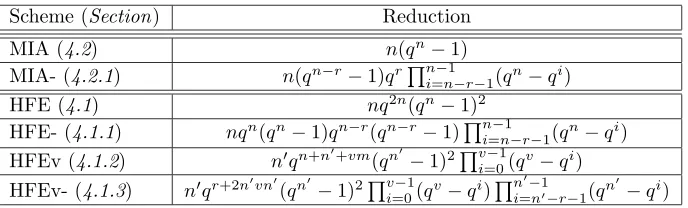
In this paper, we showed through the examples of Hidden Field Equations (HFE) and MIA that MultivariateQuadratic systems allow many equivalent private keys and hence have a lot of redun-dancy in this key space, cf Table 1 and Table 2 for numerical examples; the symbols used in Table 1 are explained in the corresponding sections. TheMQ-scheme Unbalanced Oil and Vinegar (UOV) has been discussed in [WP05b, Sect. 4.3]. A general overview ofMQ-schemes can be found in [WP05c].
Table 1: Summary of the Reduction Results of this Paper
Scheme (Section) Reduction
MIA (4.2) n(qn−1)
MIA- (4.2.1) n(qn−r−1)qrQn−1
i=n−r−1(qn−qi)
HFE (4.1) nq2n(qn−1)2
HFE- (4.1.1) nqn(qn−1)qn−r(qn−r−1)Qn−1
i=n−r−1(qn−qi)
HFEv (4.1.2) n0qn+n0+vm
(qn0
−1)2Qv−1
i=0(qv−qi)
HFEv- (4.1.3) n0qr+2n0vn0
(qn0
−1)2Qv−1
i=0(qv−qi)
Qn0−1
i=n0−r−1(qn
0
−qi)
We see applications of our results in different contexts. First, they can be used for memory efficient implementations of the above schemes: using the normal forms outlined in this paper, the memory requirements for the private key can be reduced without jeopardising the security of these schemes. Second, they apply to cryptanalysis as they allow to concentrate on special forms of the private key: an immediate consequence from Sect. 3.1 (additive sustainers) is that HFE does not gain any additional strength from the use of affine rather than linear transformations. Hence, this system should be simplified accordingly. Third, the constructors of new schemes may want to keep these sustaining transformations in mind: there is no point in having a large private key space — if it can be reduced immediately by applying sustainers.
Table 2: Numerical Examples for the Reduction Results of this Paper
Scheme Parameters Choices forS, T Reduction (in log2) (in log2)
HFE q= 2, n= 80 12,056 326
HFE- q= 2, r= 7, n= 107 23,108 2129
HFEv q= 2, v= 7, n= 107 21,652 1160
HFEv- q= 2, n= 107 22,261 1258
MIA q= 128, n= 67 63,784 469
MIA q= 128, n= 67 63,784 6173
multivariate schemes which have not been discussed in this paper, due to space and time limitations. These schemes include (non-exhaustive list) enTTS [YC04], STS [WBP04]), and PMI [Din04]. We also invite to apply the techniques used in this paper to these schemes to compare the effect of these sustainers to different classes ofMQ-schemes.
Acknowledgements
We want to thank Patrick Fitzpatrick (BCRI, University College Cork, Ireland) for encouraging this direction of research. In addition, we want to thank An Braeken (COSIC) who pointed out the existence of Frobenius sustainers (cf Sect. 3.6) for fields of even characteristic; in addition we want to thank her for helpful remarks. Moreover, we want to thank Magnus Daum (CTSC, Ruhr-University Bochum, Germany) for comments on some early results presented in this paper.
This work was supported in part by the Concerted Research Action (GOA) GOA Mefisto 2000/06, GOA Ambiorix 2005/11 of the Flemish Government and the European Commission through the IST Programme under Contract IST-2002-507932 ECRYPT.
Disclaimer
The information in this document reflects only the authors’ views, is provided as is and no guarantee or warranty is given that the information is fit for any particular purpose. The user thereof uses the information at its sole risk and liability.
References
[BWP05] An Braeken, Christopher Wolf, and Bart Preneel. A study of the security of Unbalanced Oil and Vinegar signature schemes. InThe Cryptographer’s Track at RSA Conference 2005, volume 3376 of Lecture Notes in Computer Science. Alfred J. Menezes, editor, Springer, 2005. 13 pages, cfhttp://eprint.iacr.org/2004/222/.
[CGP00a] Nicolas Courtois, Louis Goubin, and Jacques Patarin. Flash: Primitive specification and supporting documentation, 2000. https://www.cosic.esat.kuleuven.ac.be/nessie/ workshop/submissions/flash.zip, 9 pages.
[CGP01] Nicolas Courtois, Louis Goubin, and Jacques Patarin. Quartz: Primitive specification (sec-ond revised version), October 2001. https://www.cosic.esat.kuleuven.ac.be/nessie Submissions, Quartz, 18 pages.
[CGP02] Nicolas Courtois, Louis Goubin, and Jacques Patarin. SFlash: Primitive specification (second revised version), 2002. https://www.cosic.esat.kuleuven.ac.be/nessie, Sub-missions, Sflash, 11 pages.
[CGP03] Nicolas Courtois, Louis Goubin, and Jacques Patarin. SFlashv3
, a fast asymmetric sig-nature scheme — Revised Specificatoin of SFlash, version 3.0, October 17th 2003. ePrint
Report 2003/211, http://eprint.iacr.org/, 14 pages.
[Din04] Jintai Ding. A new variant of the matsumoto-imai cryptosystem through perturbation. In Public Key Cryptography — PKC 2004, volume 2947 of Lecture Notes in Computer Science, pages 305–318. Feng Bao, Robert H. Deng, and Jianying Zhou (editors), Springer, 2004.
[FJ03] Jean-Charles Faug`ere and Antoine Joux. Algebraic cryptanalysis of Hidden Field Equations (HFE) using gr¨obner bases. InAdvances in Cryptology — CRYPTO 2003, volume 2729 of Lecture Notes in Computer Science, pages 44–60. Dan Boneh, editor, Springer, 2003.
[GSB01] W. Geiselmann, R. Steinwandt, and Th. Beth. Attacking the affine parts of SFlash. In Cryptography and Coding - 8th IMA International Conference, volume 2260 of Lecture Notes in Computer Science, pages 355–359. B. Honary, editor, Springer, 2001. Extended version: http://eprint.iacr.org/2003/220/.
[IM85] Hideki Imai and Tsutomu Matsumoto. Algebraic methods for constructing asymmetric cryptosystems. In Algebraic Algorithms and Error-Correcting Codes, 3rd International Conference, AAECC-3, Grenoble, France, July 15-19, 1985, Proceedings, volume 229 of Lecture Notes in Computer Science, pages 108–119. Jacques Calmet, editor, Springer, 1985.
[KPG99] Aviad Kipnis, Jacques Patarin, and Louis Goubin. Unbalanced Oil and Vinegar signature schemes. InAdvances in Cryptology — EUROCRYPT 1999, volume 1592 ofLecture Notes in Computer Science, pages 206–222. Jacques Stern, editor, Springer, 1999.
[KS99] Aviad Kipnis and Adi Shamir. Cryptanalysis of the HFE public key cryptosystem. In Advances in Cryptology — CRYPTO 1999, volume 1666 of Lecture Notes in Computer Science, pages 19–30. Michael Wiener, editor, Springer, 1999. http://www.minrank.org/ hfesubreg.psor http://citeseer.nj.nec.com/kipnis99cryptanalysis.html.
[MI88] Tsutomu Matsumoto and Hideki Imai. Public quadratic polynomial-tuples for efficient signature verification and message-encryption. In Advances in Cryptology — EURO-CRYPT 1988, volume 330 ofLecture Notes in Computer Science, pages 419–545. Christoph G. G¨unther, editor, Springer, 1988.
[NES] NESSIE: New European Schemes for Signatures, Integrity, and Encryption. Information Society Technologies programme of the European commission (IST-1999-12324). http: //www.cryptonessie.org/.
[Pat96a] Jacques Patarin. Asymmetric cryptography with a hidden monomial. In Advances in Cryptology — CRYPTO 1996, volume 1109 ofLecture Notes in Computer Science, pages 45–60. Neal Koblitz, editor, Springer, 1996.
[Pat96b] Jacques Patarin. Hidden Field Equations (HFE) and Isomorphisms of Polynomials (IP): two new families of asymmetric algorithms. In Advances in Cryptology — EURO-CRYPT 1996, volume 1070 ofLecture Notes in Computer Science, pages 33–48. Ueli Mau-rer, editor, Springer, 1996. Extended Version: http://www.minrank.org/hfe.pdf.
[Tol03] Ilia Toli. Cryptanalysis of HFE, June 2003. arXiv preprint server, http://arxiv.org/ abs/cs.CR/0305034, 7 pages.
[WBP04] Christopher Wolf, An Braeken, and Bart Preneel. Efficient cryptanalysis of RSE(2)PKC and RSSE(2)PKC. InConference on Security in Communication Networks — SCN 2004, volume 3352 of Lecture Notes in Computer Science, pages 294–309. Springer, September 8–10 2004. Extended version: http://eprint.iacr.org/2004/237.
[Wol02] Christopher Wolf. Hidden Field Equations (HFE) - variations and attacks. Diplomarbeit, Universit¨at Ulm, December 2002. http://www.christopher-wolf.de/dpl, 87 pages.
[Wol04] Christopher Wolf. Efficient public key generation for HFE and variations. InCryptographic Algorithms and Their Uses 2004, pages 78–93. Dawson, Klimm, editors, QUT University, 2004.
[WP04] Christopher Wolf and Bart Preneel. Asymmetric cryptography: Hidden Field Equations. In European Congress on Computational Methods in Applied Sciences and Engineering 2004. P. Neittaanm¨aki, T. Rossi, S. Korotov, E. O˜nate, J. P´eriaux, and D. Kn¨orzer, editors, Jyv¨askyl¨a University, 2004. 20 pages, extended version: http://eprint.iacr.org/2004/ 072/.
[WP05a] Christopher Wolf and Bart Preneel. Equivalent keys in HFE, C∗, and variations. In
Proceedings of Mycrypt 2005, volume 3715 of Lecture Notes in Computer Science, pages 33–49. Serge Vaudenay, editor, Springer, 2005. Extended version http://eprint.iacr. org/2004/360/, 15 pages.
[WP05b] Christopher Wolf and Bart Preneel. Superfluous keys in Multivariate Quadratic asym-metric systems. In Public Key Cryptography — PKC 2005, volume 3386 ofLecture Notes in Computer Science, pages 275–287. Serge Vaudenay, editor, Springer, 2005. Extended versionhttp://eprint.iacr.org/2004/361/.
[WP05c] Christopher Wolf and Bart Preneel. Taxonomy of public key schemes based on the problem of multivariate quadratic equations. Cryptology ePrint Archive, Report 2005/077, 12th of
May 2005. http://eprint.iacr.org/2005/077/, 64 pages.
[YC04] Bo-Yin Yang and Jiun-Ming Chen. Rank attacks and defence in Tame-like multivariate PKC’s. Cryptology ePrint Archive, Report 2004/061, 29rd September 2004. http://