Approximate Analysis of
Discrete-Time Tandem Queueing
Networks with Customer Loss
Dooyeong Park
Hany G. Perros
Center for Communications and Signal Processing
Department of Computer Science
North Carolina State University
Approximate Analysis of Discrete-time Tandem
Queueing Networks with Customer Loss
*
Dooyeong Park
Department of Eletrical and Computer Engineering, and
Center for Communications and Signal Processing
North Carolina State University
Raleigh, NC 27695
Harry G. Perro!
Department of Computer Science, and
Center for Communications and Signal Processing
North Carolina State University
Raleigh, NC 27695
Ab,tract- We first approximate the departure process of an IBP /Geo/l/K queue
by an Interrupted Bernoulli Process (IBP). We consider several different approxima-tion models and their accuracy is examined through extensive validaapproxima-tion tests. These models are then used in a simple decomposition algorithm to analyze a tandem config-uration of finite capacity queues with customer loss. The decomposition algorithm is validated by comparing it against simulation and it i. shown to have a good accuracy.
1
Introduction
In recent years there has been a lot of interest in the development of high-speed
communi-cation networks. The most promising design for high-speed networks is the Asynchronous
Transfer Mode (ATM). The need for performance evaluation of ATM networks has given rise
to a widespread in terest for the analysis of discrete- time queueing systems. Discrete- time
single server queues with or without finite capacity have been extensively analyzed. For a
review of relevant results see Pujolle and Petros [10]. However, little has been done for the
analysis of networks of discrete-time finite capacity queues.
A network of discrete-time finite capacity queues can be used to model the queueing
within an ATM switch, or the queueing within a network of ATM switches. Two different
assumptions can be made regarding such a network:(l) A customer gets lost when it arrives
to a full queue.(2) A customer cannot start its service until there is space in the destination
queue. This is similar to the blocking-before-service mechanism that has been extensively
studied in continuous-time queueing networks of finite capacity queues. In
telecommunica-tion systems, this mechanism is often referred to as back pressure.
The external arrival process to the network is assumed to be bursty. Typically, a bursty
arrival process is represented by an Interrupted Bernoulli Process (IBP). In an IBP, we have
a geometrically distributed period during which no arrivals occur, followed by a
geomet-rically distributed period during which arrivals occur in a Bernoulli fashion. The IBP is
a special case of the Markov Modulated Bernoulli Process (MMBP), which has a slightly
more complex structure and it captures the notion of the burstiness and the correlation of
successive interarrival times.
In this paper, we analyze a tandem queueing network of discrete-time finite capacity
queues with customer 108s. The arrival process to the first queues is assumed to be an IBP.
The service times at each queue are assumed to be geometrically distributed. The choice
of the geometric distribution was motivated by ATM networks. In general, a service time
as celQ is constant, and therefore the transmission time is const an t as well. However, in
some ATM switch architectures a cell may be re-transmitted several times due to possible
collisions with other cells. In this case, the total transmission time is typically modelled
by a geometric _distribution. Queueing networks of discrete-time finite capacity queues with
customer loss do not lend themselves to an exact analysis. However, they can be ana.lyzed
approximately using the notion of decomposition. That is, the network is decomposed into
individual queues, and each queue is then analyzed separately. The most important aspect of
such a decomposition is the characterization of the arrival process to an intermediate queue.
In continuous-time queueing networks, typically, such as an arrival process is characterized
approximately by a two-phased Coxian distribution, or by a more general phased-type
dis-tribution. Also, it has been characterized by a general distribution defined by the mean and
squared coefficient of variation. In this paper, the departure process from one queue, which
becomes the arrival process to the next downstream queue is characterized approximately
by an IBP. Various fitting models, motivated by the method of moments, are examined and
compared. These models are then used in the approximate analysis of a tandem queueing
network with discrete-time finite capacity queues.
The interdeparture distribution of a discrete-time GI/G/l queue has been obtained by
Tran-Gia [11] using the Fast Fourier Transform. He also derived the idle period
distribu-tion from the equilibrium distribudistribu-tion of the virtual unfinished work. Ohba, Murata and
Miyahara [8] analyzed a discrete-time single-server queue with the following three arrival
streams: 1) arrivals with a general interdeparture time distribution, 2) Bernoulli arrivals in
batches, and 3) IBP. Discrete-time queueing networks have been analyzed by Morrison [6],
Hsu and Burke [3], Ohba, Murata, and Miyahara [8] and Pujolle [9] assuming infinite
capac-ity queues. Bhargava et
a1
[1] and Bocharov and Albores [2] analyzed tandem configurationsof finite capacity queues with customer 108S, hut in continuous-time. Finally, Morris and
Perros [5] analyzed an ATM switch architecture, which basically involved the analysis of a
discrete-time tandem configuration of finite capacity queues with blocking-before-service.
I-p
:
l-qFigure 1: The Markov chain for an IBP
The generating function of the interdeparture time of an IBP /Geo/l/K queue is obtained
in section 3. In section 4, we present various fitting models for characterizing the departure
process as an IBP and examine their accuracy. In section 5, we analyze a tandem
configura-tion of finite capacity queues with cell loss using some of the approximaconfigura-tion models obtained
in section 4. The approximate results are compared against simulation in section 5, and
conclusions are given in section 6. We note that in accordance with the terminology of ATM
networks, we shall refer to a customer as a cell.
2
The Interrupted Bernoulli Process
The Interrupted Bernoulli Process (IBP) is defined over a slotted (discrete-time) time axis
and it comprises two states, an active state and an idle state, which alternate. The time
the process spends in each state is geometrically distributed. Arrivals occur in a Bernoulli
fashion when the process is in the active state. No arrival occurs if the process is in the idle
state. Given that the nrocess is in the active state (or idle state) at slot i, it will remain in
the same state in the next slot i
+
1 with probability p(or q),or will change to the idle state (or active state) with probability 1 - p (or 1 - q). The transitions between the active andidle states are governed by a two state Markov chain as shown in Figure 1. During the active
state, a slot contains a cell with probability Q. a=l means that every busy slot contains a
cell.
Let t be the interarrival time of a cell. It can be shown that the mean interarrival time,
arrivals, ClBP are as follows (see
[7]):
E{t} 2-p-q
a(1 - q) ,
Var(t) E{t}2
=
1
+
a [(1-
p)(p+
q) -1]
(2 -
p - q)2 .(1)
(2)
The average arrival rate, i.e. the probability that any slot contains a cell, PrBP is given by
a(l - q)
PrBP
=
2 .-p-q (3)
By varying p and q, we can increase the traffic and at the same time change the burstiness
of the process.
3
The Departure Process of an IBP /Geo/l/K Queue
Let us consider a discrete-time single server queue. Let K be the maximum capacity of the
queue. The service time is defined over a slotted time axis. For presentation purposes, a slot
will be referred to as a service slot. A service always starts at the beginning of a service slot
and the service time is assumed to be a geometric number of service slots with parameter tr,
The arrival process is also defined over a slotted time axis with the same slot size, and it is
assumed to be an IBP with parameters PA, qA, and QA. The boundaries of the slots of the
arrival process is assumed to be in-between the boundaries of the service slots (as shown in
Figure 2). An arriving cell to an empty queue cannot start its service until the beginning
of the next service slot, even though the server is free at the time instant of its arrival. A
departure is assumed to take place just before the end of service slot. Finally, as it will be
seen below we examine this queue at the boundary of each service slot.
In order to analyze the departure process of an IBP /Geo/l/K, we first need to obtain its
slot n
Arrival
slot
n+1
Departure
Figure 2: The arrival and the departure time instants
states for the queue length at the end of every service slot, and subsequently we generate
the rate matrix Q. The stationary probability vector x is then obtained by solving the
linear equations xQ
=
o.
We define the state of the queue by the variables(s,n).
Variables represents the state of the arrival process at the end of a service slot and it takes the
values: 0 if the arrival process is in the idle state, 1 if the arrival process is in the active
state. Variable n indicates the number of cells in the system at the end of a service slot. We
have n=O,l, ..,K, where K is the capacity of the system including the cell in service. Using
the stationary probability vectorx, that can be obtained numerically as described above, we
compute the generating function of the probability distribution of the interdeparture time
of the IBP /Geo/l/K queue as follows.
Let I be a random variable representing the time the server is idle (i.e. the system is idle). This is the time elapsing from the moment a departure occurs to the end of service
slot during which an arrival occurs. Also, let S be a random variable representing the service
time, and let D be a random variable representing the interdeparture time. These random
variables are discrete-time and they take values which are integer multiples of a service slot.
Let us consider two consecutive departure instants corresponding to the two departures of
the (m - l)st and mth customer. The interdeparture interval D is equal to the sum of a
case
1
mel .~ Departure
o
P+(s,n>O)
~fIII::t--- S
o 0 ~
1
0 ~tim. .lot
m-~hDeparture
case 2
Arrival
P(s,n>O)
I - t - O + C I - - S
tc:I"---D----~ tim• •lo~
mel .1: Departure m-1:h Departure
Figure 3: The interdeparture time
empty system, or it is equal to a service time if the system is not empty after the (m - 1)st
departure. These two cases are shown in Figure 3. I can be expressed as follows:
1 -
p+(0, 0) -
P+(1,0)
P+(O,O) P+(l,O)
(4)
where 10, II is a random variable indicating the time elapsing from the moment a departure
occurs leaving the system in state (0,0) respectively(1,0) to the end of the service slot during
where an arrival occurs. P+(~,n) is the probability that immediately after a departure the
system is in the state [s,n).
10' II'
and P+[s,n) can be obtained as follows:(1 - qA)aA qA
(1 - qA)(l -
(lA)
(5)
1
1
+
1
01
+
1
1PAaA 1- PA
PA(1 -
(lA)
P+(s,n)
=
Pr{The system is in state (s,n)I
a departure has occurred}=
Pr{The system is in (s,n) and a departure has occurred}Pr{A depart ure occurs}P+(O,O)
=
(1 - u)[qAP(O, 1)+
(1 - PA)P(I, 1)] (1 - u)[1 - P(O,O) - P(I,O)]qAP(O, 1)
+
(1 - PA)P(I, 1)(7)
=
1 - P(O,O) - P(1,O)P+(l,O)
=
(1 - qA)(I -OA)P(O,
1)+
PA(1 - oA)P(l,1)
(8)
1 - P(O,O) - P(l, 0)
By taking the z-transform of the equation (5) and (6) we can get:
where 10(z) and 11(z) are the z-transforms of 10 and II' respectively. Using (4), (7), (8),
(9) and (10) we can obtain the following expression for
I(z),
the. generating function of I:I(z)
=
1 - P+(O,O) - P+(l,O)+
P+(O,O)Io(z)
+
P+(1,0)I
1(z)We define D( z) as the generating function of the probability distribution of the
interde-parture time. We haveD=S+I. Since S and I are independent,
D(z)
=
E{zD}
=
8(z)1(z),
where S(z) is the generating functions of S, and it is equal to S(z)
=
(~=:~J:. Thus, we havewhere
D(z)
=
a3z3+
a2 z 2+
al za2
=
(1 -U){(PA
+
qA)[(I- OA)P+(O,O)
+
P+(I,O) -
1]+
OA[P+(O,O)
+
PAl}
at
=
(1 - 0-)[1 - P+(O,0) - P+(I, 0)]b3
=
-0-(1 - QA)(PA+
qA - 1)b2
=
(1 -OA)(PA
+
qA -
1)+
U[qA
+
PA(1 - OA)]
bt
=
-[0-+
qA+
PA(1 - QA)].The moments of the time between successive departures can be obtained by differentiating
D(z) given by (11). In particular, the mean interdeparture time E{D} and the squared
coefficient of variation of the interdeparture time C2 , are as follows:
where
E{D}
= D'(l),02 = Var(D)
E{D}2
D"(l)
+
D'(l) - [D'(I)]2
-[D'(I)]2
(12)
(13)
D'(l)
D"(l)
=
1+
P+(O,O)
[(1 -QA)(1 -
PA - qA)+
1]
+
P+(l,O)) [2 - PA - qA]1 - QA
QA(l -
qA) QA(l - qA)__ +( )
[2(1 -
QA)(PA+
qA -l)[QA(1 -
qA)+
PA(1 - aA)+
qA -4]]
P
0,°
[oA(l -qA)]2
+
[2(1 -
PA - qA) 2(2 - PA - qA)[(1 - QA)(PA+
2qA - 2) - qA]]+P
(1 .ft) oA(1 _qA)
-
[OA(1 - qA)]2
2
[P+(O,O)(1 -
QA)(l -
PA - qA)+
1 P+(1,0)(2 - PA - qA)]+
1 - tT oA(1 -qA)
+
<lA(1 - qA)
[
2[qA
+
PA(l - QA)]]
20'+P+(O,O)
[<lA(l _qA)]2
+
(1 _u)2'
The link utilization, p, i.e., the probability that any slot contains a cell is:
1
and the third moment of the interdeparture time,
E{D
3} , is:E{D3}
=
D"'(1)+3D"(1)+D'(1)D'''(1)
+
~[3(C2
+
1) - 2p]p2 (15)
The probability distribution of the interdeparture time can be obtained by inverting
the generating function,
D{z).
This is done as follows (see Kobayashi [4]). Let Pi be theprobability that the interdeparture time is equal to i slots. Then, we have
D(z)
3
Laiz i
i=O
3
L
bizii=O
where bo= l . Multiplying both sides by the denominator and then equating the coefficients
of zi on both sides, we obtain the following set of linear difference equations:
min{3,i} { . · _ 0 1 2 3
~ b a, I - , , ,
L...J Pi-j j
=
0 · 3 ·. 0 I
>
3=
We can then solve for Pi, i
=
0,1, · · ., recursively as follows:1 [ min{3,i} ]
Pi
=
b
ai - ~ bjPi-j ,o 3=1
where ai
=
0 for i>
3."i
=
0, 1, · · · ,4
Characterizing the Departure Process by an IBP
As mentioned in section 2, an IBP can be expressed by the three parameters, P, q, and Ct.
Therefore, in order to characterize the departure process by an IBP, we have to estimate p,
section, we can obtain the first three moments of the distribution of the interdeparture time.
Matching these three moments against the three moments of the IBP, we can obtain three
equations from which the three parameters can be computed. This is how the para.meters
of a two-phased Coxian distribution are commonly obtained. However, in the
discrete-time case, this is not a simple task since the third moment of an IBP is a fairly complex
expression (see equation (22)). Also, it cannot be guaranteed that there is a feasible solution
for the parameters of the IBP. In this section, we examine several models for characterizing
approximately the departure process by an IBP.
4.1
Modell
Let us consider the set of all states of the queue from which it is possible to have an attempted
departure. If the queue is in one of these states, then the departure process is assumed to be
in its active state. The set of all these states will be referred to by the symbol A. Probability
p can then be obtained as the probability that the queue will be in an active state in the next
slot, given that it is currently in an active state. Probability q can be obtained similarly by
considering the set of states of the queue from which it is not possible to have a departure.
If the queue is in one of these states, then the departure process is assumed to be in its idle
state. We shall refer to these states as the idle states and their set will be referred to by the
symbol
I.
We define the idle states to be the state in which the queue is empty and arrivalprocess is in the idle state, i.e. I
=
{(O,O)}.
Alternatively, we can define I=
{(0,0),(1,0)},i.e, we can also include the state where the queue is empty and the arrival process is in the
active state. Empirically, we found that the latter definition does not give as good result as
the former one. Consequently, we will set I
=
{(O,O)}.
Using the steady-stateprobability.Pfs,n) and the transition probabilities from state(8,n)
Morris and Perros [5]).
p
and
q
L
P(s,n) [
L
t[(s,n)
~
(8,n)]]
(l,n)EA (J,n)EA
L
P{s,n)
(l,n)eA
L
P(s,n) [
L
t[(s,n)
~
(8,ft)]]
(l,n)EI (J,n)EI
L
P{s,n)
(l,n)EI
(16)
(17)
Using the above approach, we can estimate p or q or both. In modell, we estimate p (or
q) and the other two unknowns q (or p) and a are obtained from p and C2 of the departure
process. In particular, we have the following two cases:
Model la : p is estimated using (16). qand a are then estimated as follows. We first
calculate p and C2 of the departure process using (14) and (15) respectively.
Then, we set PIBP
=
Pand ClBP = C2 in (3) and (2) and solve for q and Q.We have:
o
Modellb qis estimated using (17). p and a are estimated as in model 1a from
(2) and (3). We have:
{
2(1 - q)a2
+
[02- 1 - 3p - (C2 - 1 - p)q]a
+
2p2=
0 p = 2-q-~p
We note that in either case it is possible to have two roots for a which means that in model
la (model Ib) we may have two different values for
q (p).
Models Ia and Ib can not be guaranteed to give a feasible solution for the two parameters
q (or p) and a may violate the basic conditions, 0
<
p<
1, 0<
q<
1, and 0<
a S; 1.(Expression (16) and (17) always satisfies the basic condition.)
4.2
Model 2
Unlike model 1, we obtain both parameters, p and q using (16) and (17). a is calculated by matching either P with PrBP in (3)or G2 with G1B P in (2). We have the following two
cases:
Model 2a (matching p):
Model 2b (matching C2) :
o p(2 - p - q)
1- q (18)
o (C2 -
1)(2 _
p _ q)2(1 - p)(p
+
q) - (2 - p - q)2· (19)If we use equation (18) to obtain 0, then the solution for 0 is always feasible. However,
from equation (19) we do not always obtain a feasible solution for 0, i.e. a is not always
within the range 0
<
0 ~ 1.4.3
Model
3
Unlike models 1and 2, we do not estimate p or q from equations (16) and (17). Given 0, where 0
<
aS
1, we can obtain p and qby matching p and C2with PrBP and ClBPin (3)and
(2)
respectively. From equations(2)
and (3) we haveand
p
=
(C2 - 1)0+
3ap - 2p 2(C2 - 1)a - ap
+
202 (20)q
=
a - 2p+
ppo-p
(C2- l)a - 3ap
+
2a2+
2p2
p and q are feasible, i.e, 0
<
p<
1 and 0<
q<
1 if the following conditions hold (for aproof see Appendix):
p<o~l
(C2
- 1)0
+
30p - 2p2>
0(C2
- 1)0 - 30p
+
202+
2p2>
0 o is obtained as follows.Model3a:
condition(1)
condition(2)
condition(3)
Among all feasible solutions for 0 which satisfy the above conditions, we select 0 so that the
resulting IBP has the smallest error f. This error is calculated as follows. Let Pezoct{D
=
i}
be the exact probability that the interdeparture time is equal to i slot(s). Let Pe,t{D = i}
be the estimated probability that the interdeparture time is equal to i slot( s). Then, we have
n
e
=
L
IPeeoct{D=
i} - Pe.t{D=
i}l·i=l
where n is the number of distribution points to be compared. Model 3& is summarized as
follows:
step 0: Set 0
=
p, D=
1.0E - 6, and e(O)=
1.0E+
30.step 1: Set 0
=
0+
D. Ifa>
1, Stop.step 2: Check for condition(2) and (3). If not satisfied, go to step 1. Else calculate p and q using equations (20) and (21).
step 3: Compute the distribution of the interdeparture time, and calculate f(l)
=
f.If f(O)
>.
(1), f(O)=
f(I). Go to step 1Model3b:
In order to speed up the above algorithm, we introduce the following modification. Instead
of comparing the distribution of the interdeparture time, we compare the third moment of
the interdeparture time with the estimated one. The expression for the third moment of an
IBP is:
6 [_2(__
1_-_0_)+
q _2(1 - 0) _
q+
(1 - 0)2]
302
+
3 -2p+
.
p2 (22)
We obtain a value for a for which the set (p, q,a) is such that the difference between the
value of the third moment of the interdeparture time from equation (15) and the value from
equation
(22)
by substituting the set of (p, q,a) is minimum.A further speed-up can be obtained by determining a intuitively (for instance, we can
set a
==
1 - 0-) and then we obtain p and q in terms of p, C2 and a using equations (20)and
(21).
This method is much faster than model 3a or 3b, but it is difficult to determinethe value of a so that we can get a feasible solution for Pand q and a good fit. The value of
a
==
1 - 0- does not always give good results.4.4
Validation
We tested 9 different departure processes. Each process corresponds to a combination of
small, medium and large p and C2• The results are given in tables 1 to 9. Each table gives
the values for p, C2
, and the third moment,
E{D3},
obtained using models la, 1b, 2a, 2b,3a, and 3b. The exact values for p, and C2
, and
E{D3}
are also given. For each model wegive the error computed using the expression
60
Error
=
L
IPell:oct{D=
i} - Pe.t{D=
i}l_i=l
The parameters of the arrival process
(PA'
qA,CtA),
u;and buffer capacity K of the queueunder study are given in the legend.
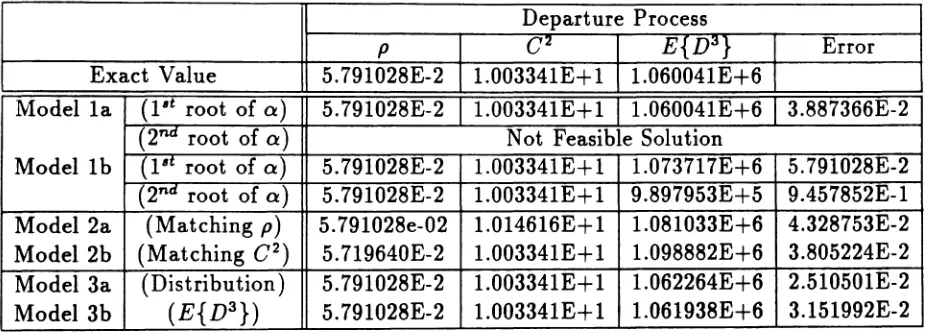
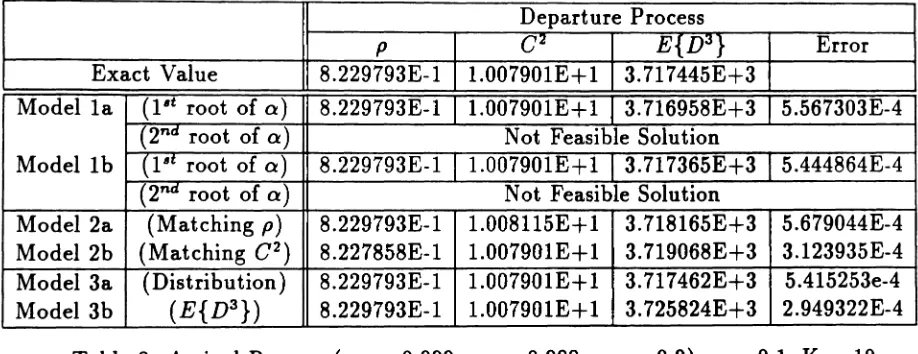
From tables 1-9, we see that model la, Ib, 2a, 3a, and 3b give good results. Model 3&
gives the best results since it selects a set of
(p, q,
a) for which the difference between theexact and estimated distribution is minimal. However, it is time-consuming, especially when
p is small, since a large number of feasible solutions have to be tested in order to find the
minimum. The accuracy of model 3a depends on the number of points along the distribution
from the exact value. Finally, in some cases, the accuracy of the estimated distribution of
the interdeparture time and the estimated p using model 2b is not as good as in the other
models.
Experimentation has shown that model l a gives good results ifthe estimated parameters
of the IBP are all feasible. Hence, the following strategy can be used for fitting an IBP. Use
model la if the parameters of the IBP are all feasible. If the solution is not feasible, then
use model 2a.
The goodness of fit depends on the characteristics of the departure process. Generally
speaking, for a departure process with large C2 and p, we can have a comparatively good
fit. When pis small we can still obtain good results if
C2
is large. For the departure processwith very high p, we can also obtain good results even when the C2 of the departure process
Departure Process
p C2 E{D3
} Error
Exact Value 5.000000E-2 9.059736E-l 4.354422E+4
Model la (l·t root of Q) 5.000000E-2 9.059736E-l 4.355227E+4 2.522580E-2 (2Jl d root of Q)
5.000000E-2 9.059736E-l 4.353728E+4 9.117865E-2 Model Lb (l·t root of Q) 5.000000E-2 9.059736E-l 4.355339E+4 4.698988E-2
(2n d
root of Q) Not Feasible Solution
Model2a (Matching p) 5.000000E-2 9.068966E-l 4.359605E+4 3.593454E-2 Model2b (Matching C2
) 5.049569E-2 9.059736E-l 4.228298E+4 4.070677E-2
Model3a (Distribution) 5.000000E-2 9.059736E-l 4.355231E+4 2.501073E-2 Model3b
(E{D
3} ) 5.000000E-2 9.059736E-l 4.354422E+4 6.874012E-2
Table 1: Arrival Process (PA :=: 0.1, qA
==
0.1, QA :=: 0.1), a==
0.1, K=
10Departure Process
p
C
2 E{D3} Error
Exact Value 5.791028E-2 1.003341E+ 1 1.060041E+6
Modelia (I·t root of a) 5.791028E-2 1.003341E+1 1.060041E+6 3.887366E-2
(2nd
root of a) Not Feasible Solution
Model 1b (16t root of a) 5.791028E-2 1.003341E+l 1.0737I7E+6 5.791028E-2
(2n d root ofa) 5.791028E-2 1.003341E+l 9.897953E+5 9.457852E-l
Model2a (Matching p) 5.791028e-02 1.014616E+1 1.081033E+6 4.328753E-2 Model2b (Matching C2
) 5.719640E-2 1.OO3341E+l 1.098882E+6 3.805224E-2
Model3a (Distribution) 5.791028E-2 1.OO3341E+l 1.062264E+6 2.510501E-2 Model3b
(E{D
3} ) 5.791028E-2 1.003341E+l 1.061938E+6 3.151992E-2
Table 2: Arrival Process (PA = 0.931, qA= 0.99, llA = 0.458), a = 0.5, K
=
10Departure Process
p 02 E{D3
} Error
Exact Value 5.152882E-2 4.547770E+2 2.579378E+9
Modella
(l·
t root of a) 5.152882E-2 4.547770E+ 2 2.579377E+9 7.258830E-4(2
ndroot of a) Not Feasible Solution
Modellb (l·t root of a) 5.152882E-2 4.547770E+2 2.579381E+9 7.203384E-4
(2
n d root of a) Not Feasible SolutionModel2a (Matching
p)
5.I52882E-2 4.547778E+2 2.579386E+9 7.265276E-4 Model2b (Matching C2) 5.152872E-2 4.547770E+2 2.579391E+9 7.257103E-4
Model3a (Distribution ) 5.152882E-2 4.547770E+2 2.579598E+9 5.619398E-4 Model3b
(E{D
3} ) 5.152882E-2 4.547770E+2 2.579378E+9 7.139101E-4Depart ure Process
p
C
2 E{D3} ErrorExact Value 4.536092E-l 5.125532E-l 3.486905E+l
Model la (l"t root of Q) Not Feasible Solution
(2~d root of Q) Not Feasible Solution
Model l b (l"t root of Q) 4.536092E-l 5.125532E-l 3.520111E+l 2.368045E-2
(2
n-a root of Q) Not Feasible Solu tionModel2a (Matching p) 4.536092E-l 5.798944E-l 3.970193E+l 5.798405E-2 Model2b (Matching C2
) 5.263209E-l 5.125532E-l 2.318192E+ 1 1.942099E-l
Model3a (Distribu tion) 4.536092E-l 5.125532E-l 3.518739E+l 2.160386E-2 Model3b (E{D3
} ) 4.536092E-l 5.125532E-l 3.518739E+ 1 2.143936E-2
Table 4: Arrival Process (PA == 0.38, qA == 0.35, aA == 0.9), a == 0.5, K
==
10Departure Process
p
C
2 E{D3} ErrorExact Value 4.442376E-l 1.154362E+l 8.887376E+3
Model la (l"t root of Q) 4.442376E-l 1.154362E+l 8.843527E+3 2.988950E-3 (2n d root of Q) Not Feasible Solution
Modellb (1"t root of 0) 4.442376E-l 1.154362E+ 1 8.920011E+3 1.432366E-3
(2n d root of a) Not Feasible Solution
Model2a (Matching
p)
4.442376E-l 1.172159E+l 9.062557E+3 5.744578E-3 Model2b (Matching C2) 4.368380E-l 1.154362E+l 9.230488E+3 1.416369E-2
Model3a (Distribution) 4.442376E-l 1.154362E+l 8.901693E+3 6.735641E-4 Model3b (E{D3
} ) 4.442376E-l 1.154362E+l 8.887359E+3 9.321133E-4
Table 5: Arrival Process (PA
==
0.99, qA==
0.98, 0A==
0.92), (J'==
0.4, K==
10Departure Process
p C2 E{D3
} Error
Exact Value 4.343637E-l 4.667238E+2 7.821237E+6
Modella (l·t root of a) 4.343637E-l 4.667238E+2 7.821195E+6 5.623969E-4 (2nd root of a) Not Feasible Solution
Model1b Il·t root of a) 4.343637E-l 4.667238E+2 7.821347E+6 5.344818E-4 (2nd root of a) Not Feasible Solution
Model2a (Matching
p)
4.343637E-l 4.667373E+2 7.821572E+6 5.76030IE-4 Model2b (Matching C2) 4.343511E-l 4.667238E+2 7.821800E+6 5.362369E-4 Model3a (Distribu tion ) 4.343637E-l 4.667238E+2 7.822625E+6 3.000837E-4 Model3b (E{D3} ) 4.343637E-l 4.667238E+2 7.821239E+6 5.540679E-4Depart ure Process
p
C
2 E{D3} Error
Exact Value 8.946945E-l 1.051590E-l 1.998816E+0 Model la (l·t root of 0:)
Not Feasible Solution
(2-n d root of0:)
Not Feasible Solution Model Lb (l·t root of0:) Not Feasible Solution
(2
n droot of0:) Not Feasible Solution
Model2a (Matching p) 8.946945E-l 1.053550E-l 2.000522E+O 3.068693E-4 Model2b (Matching C2
) 8.948905E-I 1.051590E-l 1.998057E+0 6.164025E-4
Model3a (Distribu tion) 8.946945E-l 1.051590E-l 1.998700E+0 1.837207E-5 Model3b (E{D3
} ) 8.946945E-l 1.051590E-l 1.998700E+0 1.835226E-5
Table 7: Arrival Process (PA == 0.9999, qA== 0.4999, 0A == 0.91), a == 0.1, K == 10
Departure Process
p
0
2 E{D3} Error
Exact Value 8.229793E-l 1.007901E+1 3.717445E+3
Model 1a (1·t root of a) 8.229793E-l 1.007901E+l 3.716958E+3 5.567303E-4
(2n d
root of a) Not Feasible Solution
Model1b (l·t root of a) 8.229793E-l 1.007901E+l 3.717365E+3 5.444864E-4
(2
nd root of Q) Not Feasible SolutionModel2a (Matching p) 8.229793E-l 1.008115E+l 3.718165E+3 5.679044E-4 Model2b (Matching C2
) 8.227858E-1 1.007901E+1 3.719068E+3 3.123935E-4
Model3a (Distribution) 8.229793E-l 1.007901E+l 3.717462E+3 5.415253e-4 Model3b
(E{D
3} ) 8.229793E-1 1.007901E+1 3.725824E+3 2.949322E-4
Table 8: Arrival Process (PA == 0.999, qA == 0.988, QA
=
0.9), a == 0.1, K=
10Departure Process
p
C
2 E{D3} ErrorExact Value 7.613183E-1 3.909688E+2 3.373541E+6
Modella (l·t root of a) 7.613183E-1 3.909688E+2 3.373439E+6 1.013476E-5
(2
nd root of a) Not Feasible SolutionModellb (l·t root of
a)
7.613183E-l 3.909688E+2 3.373582E+6 3.755092E-5 {2nd root ofa)
Not Feasible SolutionModel2a (Matching
p)
7.613183E-l 3.909993E+2 3.373846E+6 2.187076E-5 Model2b (Matching C2) 7.612587E-l 3.909688E+2 3.374110E+6 1.190766E-4Model3a (Distribution) 7.613183E-l 3.909688E+2 3.373545E+6 5.881160E-7 Model3b
(E{D
3} ) 7.613183E-l 3.909688E+2 3.373545E+6 5.881123E-75
Analysis of a Tandem Configuration with Cell
Loss
In this section, we analyze approximately a tandem configuration of discrete-time finite
capacity queues using the fitting models described in the previous section. Let us consider
an open queueing network consisting of N nodes linked in tandem as shown in figure 4. The
nodes are numbered from 1 to N starting from the leftmost node. We assume that each node has a finite capacity. Let K, be the maximum capacity of node i, i
=
1,2, ... ,N. Acell enters a node if it arrives at a time when the node is not full. Otherwise, it gets lost.
The arrival process to the first node is assumed to be an IBP. For eachnode i, the service
time is assumed to be geometrically distributed with probability O'i. We note that the N
servers are not synchronized. That is, the service slots of a server begin at a different time
than the service slots of the other servers. However, all service slots of all servers are equal.
Finally, we assume that cells in a node are served in a FIFO manner.
The approximation algorithm decomposes the queueing network into individual nodes,
and each node is analyzed in isolation. Let us consider node i. We can obtain the generating
function of the interdeparture time of node i using equation (11). Using one of the fitting models mentioned above, we can then obtain the set of parameters
{p,q,a}
of an IBP whichcharacterizes approximately the departure process of node i. This IBP becomes the arrival
process to the next down-stream node i
+
1. Since the arrival process to node i+
1 is modeled as an IBP, node i+
1 can also be analyzed as an IBP /Geo/l/Ki+1 queue. In theexamples given below, each queue is analyzed numerically using the Gaussian elimination
method. In this manner, we can analyze all queues individually starting from the first node and proceeding sequentially to the last node. A summary of the algorithm is given below.
step 0: Set i = 1.
step 1: Obtain the queue length distribution and the cell loss probability at node i.
Ifi
<
N, go to step 2. Else, stop.step 2: Compute the generating function of the distribution of the interdeparture time of node i. From the generating function, calculate p, C2 and third moment.
IBP
Figure 4: An open tandem queueing network under investigation
step 4: Set i
=
i+
1 and go to step 1.The accuracy of the approximation algorithm was tested by analyzing a 10 node ta.ndem
configuration. Two different examples were considered, one corresponding to a case of small
buffers and the other to a case of large buffers. The parameters of the arrival process to the
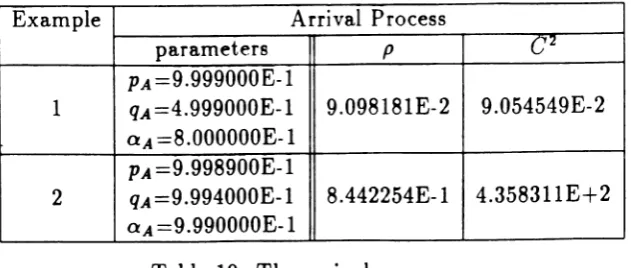
first node for the two examples are given in Table 10. The values of K, and lTi for example
1 are: Ki== 5 for i
==
1,3,4,7,8,9, Ki== 10 for i=
2,5,6,10, lTi=0.1 for i=
1,3,4,6,7,8,9,and 0',:==0.2 for i
==
5,10. The values of K, and U'i for example 2 are: Ki= 32 and a,=
0.1for i
=
1,2,···,10. The approximation results were compared against simulation data in Figures 5-15. In particular, figures 5-10 are for example 1, and figures 11-15 for example 2.The approximate results for example 1 were obtained using model 2a. (Model 3b was
also used but it gave identical results. The estimated squared coefficient of variation of the
interdeparture time, however, obtained using model 2a has 8. slightly larger relative error
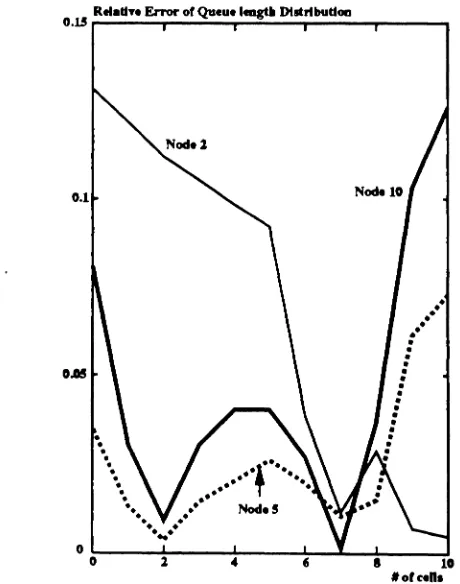
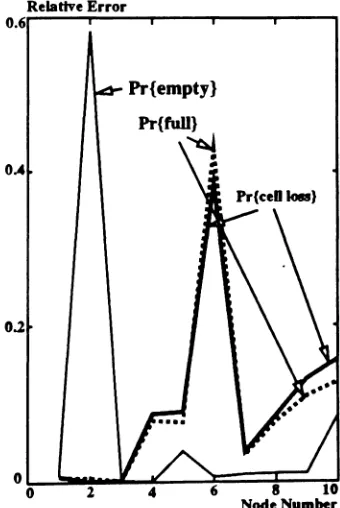
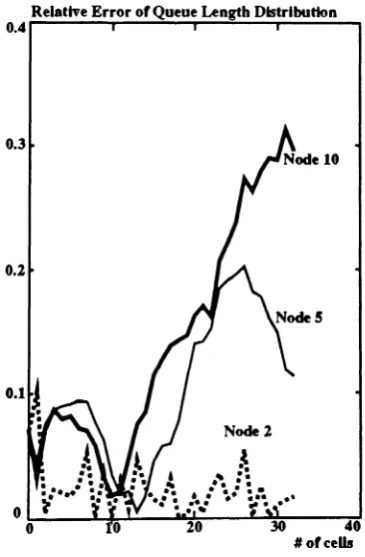
than that of model 3b.) In Figure 5 we give the queue length distribution for nodes 2, 5,
and 10. In Figure 7 we give the Pr{empty}, Pr{full}, and cell loss for each queue. The cell
loss probability at a node is
Pr{Node is full
I
an arrival occurs}=
KP(O, K)(l - qA)aA+
P(l,K)PACtAL[P(O,n)(l - qA)aA
+
P(l,n)PAoA]n=O
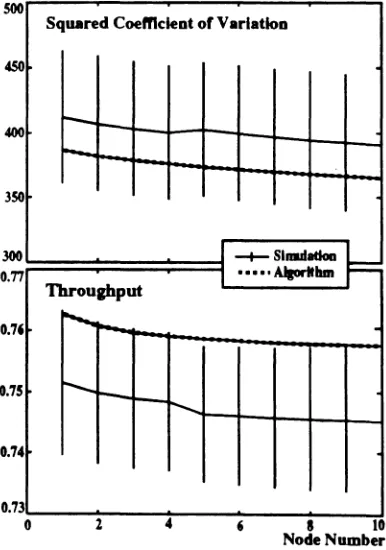
Finally, in Figure 9 we give the throughput and squared coefficient of variation of the
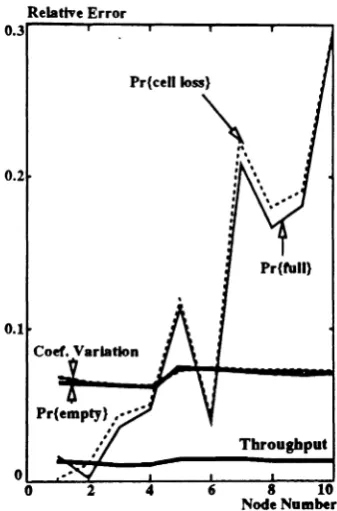
inter-departure time for each node. Relative errors are given in Figures 6, 8, and 10. We note
that the confidence intervals were not plotted as they were extremely small. Also, the large
Example Arrival Process
parameters p
C
2PA=9.999000E-l
1 qA=4.999000E-l 9.098181E-2 9.054549E-2
0A=8.000000E-l
PA=9.998900E-l
2 qA =9.994000E-l 8.442254E-I 4.35831IE+2
0A=9.990000E-I
Table 10: The arrival processes
are extremely smallIi.e. less than 10-3 ) .
The approximate results for example 2 are given in Figures 11- 15. These results are
presented in the same way as in example 1. Model 28., 3b, and a combination of models la
and 2a were used. Models La and 2a were combined as follows: use model la if it gives a
feasible solution. If the solution is not feasible, then use model 2&. The results obtained
using these fitting models are identical. (The estimated squared coefficient of variation of
the interdeparture time was the same for all models.) In view of this, we are only present
the results obtained using model 2a.
In general, all fitting models give about the same accuracy. Model 3 gives the best
esti-mate for the distribution of the interdeparture time of each queue but it is time consuming.
The other models, such as model 2a or the combined models la and 28., can give better
estimates for the queue-length distribution or the cell loss probability. As mentioned earlier,
model 2a gives estimates of the squared coefficient of variation of the interdeparture time that
has a larger relative error than those obtained using other models. The combined method
of model laand 2& seems to provide the best approach as it has a satisfactory accuracy and
6
Conclusion
In this paper, we proposed various models for characterizing the in terdepart ure time of a
discrete-time IBP /Geo/l/K queue by an IBP. We applied these models to analyze a tandem
Queue Length Dtatribudon
0..5~---..,..---...----r---""'T"----'
0.4
-+-Simulation ••• Alaortthm
0.2
0.1
Figure 5: Queue length distribution (example 1)
R".U~.Error ofQueueIeagtIIDllItrtbutioo
0.15 ....- - - . ...- - - - . - - - -...- - -...- - -..
0.05
10 'olcen.
ProbablUty
O.IS
Pr{empty}
Pr{ceU loss}
O_ _-..._ _....r..- ~ _ ~ _ . _ _ .
o
0.1
O.M
Figure 7: Pr{ empty}, Pr{full}, and Pr{ cell loss} (example 1)
Relative Error 0.6
4
Pr{empty}
Pr{full}
~•
-oL~o ...L.L.-~==;=~
0.2 OA
0.8 Throughput
0.6
-+- Simulation •••• Algortthm
0.4
Squared Coef. Variation 0.1
6 8 10
Node Number 4
2
O"",,"-_~_ _... ~_--....
o
Figure 9: Throughput and squared coefficient of variation (example 1)
RelatmError
O.n"tr---...---y---r---...----.
O.OIS
0.01
o.OOS
Throaghput
...
•••••...
...
.
4 6 8 10
Node Number
0.2,..Q_ueue_ _Len...at_h.,.D_I8tr_ Ibu_ tlQ_n---r r - - _
O.IS
-+-SI.uI.tlon ••• AJaorfthlll
0.1
O.OS
o
, ofcelli
Figure 11: Queue Length Distribution (example 2)
Relative Error of Queue Length Dktrlbutton
0.4
ProbabDHy
0.2
0.1~ Pr{empty)
0.1 Pr{ctO10M}
Pr(faB)
0.05
~S"'aI.tIoD
•••• AJIO"Ulam
6 8 10
Node Number
Figure 13: Pr{ernpty}, Pr{full}, and Pr{cellioss} (example 2)
soo
Squared CoemcleDt of VartatloD
4SO
400
350
.
Throughput
...
~I""~~~~
...
.J300
r
-+-Sh..d8doa0.77=======:::::::::=::::1
1 •••••AJaorIthm0.75
0.74
2 4
,
8 10Node Number
Relative Error 0.3
0.2
Pr{tull}
0.1
4
Throughput
6 8 10
Node Number
A
Appendix
Given a value of 0, where 0
<
a ~ 1, we can obtain the following solution for p and q (see section 4.3).p
q
(02
- 1)a
+
3ap - 2p2(C2 - l)« - ap
+
2a2'
(C2 - 1)a - 3ap
+
2a2+
2p 2(C2 - 1)a - ap
+
2a2(23)
(24)
we show that if conditions (1) to (3) hold then 0 <p< 1and 0 < q < 1.
(a) If(C2 -l)a
+
3ap - 2p2 >0 then 0
<
p < 1.proof:
Since the following relation
is always true, we have that the relation,
2(0: - p)2
>
0(02
- 1)0: - ap
+
20.2>
(02 - 1)0:+
30.p - 2p2>
0is also always true if (C2 - l)a
+
30:p - 2p2 >0. Since the numerator and denominator inequation (23) are all positive and the denominator is larger than the nominator, we have
that 0
<
P<
1.(b) If(C2
- 1)0. - 30:p
+
2p2+
20.2 >0 and and p<
a ~ 1 then 0<
q<
1.proof:
If can be easily shown that following relation
is true if p
<
a. Hence, if p<
a and (02REFERENCES
[1] A. Bhargava, J. Kurose, D. Towsley, and G. Vanleemput. Performance comparison of error control schemes in high-speed computer communication network. IEEE J. Select.
Areas Commun., (9), Dec. 1988.
[2]
P. P. Bocharov andF. K.
Albores. On two-stage exponential queueing system with internal losses or blocking. Probe Control Inform. Theory, 1980.[3] J. Hsu and P. Burke. Behavior of tandem buffers with geometric input and Markovian output. IEEE Trans. Commun., Mar. 1976.
[4]
H. Kobayashi, Modeling and Analysis: An introduction to system performance evalua-tion methodology. Reading, MA: Addison- Wesley Publishing Company, 1978.[5] T. D.
Morris andH. G.
Perros. Performance analysis of a multi-buffered BanyanATM
switch under bursty traffic. to be presented in INFOCOM '91.[6] J. Morrison. Two discrete-time queues in tandem, IEEE Trans. Commun., (3):563-573,
Mar. 1979.
[7] A. Nilsson, F. Lai, and H. G. Perros. An approximate analysis of a bufferless NxN synchronous class ATM switch. In Queueing Performance and Control in AT~[. Cohen, and Pack, Eds. North Holland, 1991.
[8] Y.
Ohba,M.
Murata, andH.
Miyahara. Analysis of interdeparture process for bursty traffic in ATM networks. IEEE J. Select. Areas Commun., (3), Apr. 1991.[9]
G. Pujolle. Multiclass distrete-time queueing systems with a product form solution.Int'l. Seminar on the Performance of Distributed and Parallel Systems, Sept. 1991.
[10]
G. Pujolle and H. G. Perros. Queueing systems for modelling ATM networks. Proc.of the Int'l. Conf. on the Performance of Distributed SY6tems and Integrated Comma Networks, Kyoto, Sept. 1991.
[11]
P. Tran-Gia. Discrete time analysis for the interdeparture distribution of GI/G/1 queue. In TeletraJfic Analyl" and Computer Performance Evaluation, pages 341-357. O. J.