Augmenting a Small Parallel Text with Morpho-syntactic Language
Resources for Serbian-English Statistical Machine Translation
Maja Popovi´c, David Vilar, Hermann Ney Lehrstuhl f¨ur Informatik VI
Computer Science Department RWTH Aachen University D-52056 Aachen, Germany
{popovic,vilar,ney}@informatik.rwth-aachen.de
Slobodan Joviˇci´c, Zoran ˇSari´c Faculty of Electrical Engineering
University of Belgrade Serbia and Montenegro [email protected]
Abstract
In this work, we examine the quality of several statistical machine translation sys-tems constructed on a small amount of parallel Serbian-English text. The main bilingual parallel corpus consists of about 3k sentences and 20k running words from an unrestricted domain. The translation systems are built on the full corpus as well as on a reduced corpus containing only 200 parallel sentences. A small set of about 350 short phrases from the web is used as additional bilingual knowledge. In addition, we investigate the use of mono-lingual morpho-syntactic knowledge i.e. base forms and POS tags.
1 Introduction and Related Work
The goal of statistical machine translation (SMT) is to translate a source language sequence f1, . . . , fJ
into a target language sequencee1, . . . , eI by
max-imising the conditional probabilityP r(eI1|f1J). This probability can be factorised into the translation model probability P(f1J|eI1) which describes the correspondence between the words in the source and the target sequence, and the language model proba-bilityP(eJ1)which describes well-formedness of the produced target sequence. These two probabilities can be modelled independently of each other. For detailed descriptions of SMT models see for exam-ple (Brown et al., 1993; Och and Ney, 2003).
Translation probabilities are learnt from a bilin-gual parallel text corpus and language model proba-bilities are learnt from a monolingual text in the
tar-get language. Usually, the performance of a trans-lation system strongly depends on the size of the available training corpus. However, acquisition of a large high-quality bilingual parallel text for the de-sired domain and language pair requires lot of time and effort, and, for many language pairs, is even not possible. Besides, small corpora have certain advan-tages - the acquisition does not require too much effort and also manual creation and correction are possible. Therefore there is an increasing number of publications dealing with limited amounts of bilin-gual data (Al-Onaizan et al., 2000; Nießen and Ney, 2004).
For the Serbian language, as a rather minor and not widely studied language, there are not many language resources available, especially not parallel texts. On the other side, investigations on this lan-guage may be quite useful since the majority of prin-ciples can be extended to the wider group of Slavic languages (e.g. Czech, Polish, Russian, etc.).
2 Language Resources
2.1 Language Characteristics
Serbian, as a Slavic language, has a very rich inflec-tional morphology for all open word classes. There are six distinct cases affecting not only common nouns but also proper nouns as well as pronouns, adjectives and some numbers. Some nouns and ad-jectives have two distinct plural forms depending on the number (if it is larger than four or not). There are also three genders for the nouns, pronouns, ad-jectives and some numbers leading to differences be-tween the cases and also bebe-tween the verb participles for past tense and passive voice.
As for verbs, person and many tenses are ex-pressed by the suffix, and the subject pronoun (e.g. I, we, it) is often omitted (similarly as in Spanish and Italian). In addition, negation of three quite impor-tant verbs, “biti” (to be, auxiliary verb for past tense, conditional and passive voice), “imati” (to have) and “hteti” (to want, auxiliary verb for the future tense), is done by adding the negative particle to the verb as a prefix.
As for syntax, Serbian has a quite free word or-der, and there are no articles, neither indefinite nor definite.
All these characteristics indicate that morpho-syntactic knowledge might be very useful for sta-tistical machine translation involving Serbian lan-guage, especially when only scarce amounts of par-allel text are available.
2.2 Parallel Corpora
Finding high-quality bilingual or multilingual paral-lel corpora involving Serbian language is a difficult task. For example, there are several web-sites with the news in both Serbian and English (some of them in other languages as well), but these texts are only comparable and not parallel at all. To our knowl-edge, the only currently available Serbian-English parallel text suitable for statistical machine trans-lation is a manually created electronic version of the Assimil language course which has been used for some preliminary experiments in (Popovi´c et al., 2004; Popovi´c and Ney, 2004). We have used this corpus for systematical investigations described in this work.
2.2.1 Assimil Language Course
The electronic form of Assimil language course contains about 3k sentences and 25k running words of various types of conversations and descriptions as well as a few short newspaper articles. Detailed cor-pus statistics can be seen in Table 1. Since the do-main of the corpus is basically not restricted, the vo-cabulary size is relatively large. Due to the rich mor-phology, the vocabulary for Serbian is almost two times larger than for English. The average sentence length for Serbian is about 8.5 words per sentence, and for English about 9.5. This difference is mainly caused by the lack of articles and omission of some subject pronouns in Serbian .
The development and test set (500 sentences) are randomly extracted from the original corpus and the rest is used for training (referred to as 2.6k).
In order to investigate the scenario with extremely scarce training material, a reduced training corpus (referred to as 200) has been created by random ex-traction of 200 sentences from the original training corpus.
The morpho-syntactic annotation of the
En-glish part of the corpus has been done by the con-straint grammar parser ENGCG for morphological and syntactic analysis of English language. For each word, this tool provides its base form and sequence of morpho-syntactic tags.
Table 1: Statistics of the Serbian-English Assimil corpus
Serbian English
Training: original base forms original no article
full corpus Sentences 2632 2632
(2.6k) Running Words + Punct. 22227 24808 23308
Average Sentence Length 8.4 9.5 8.8
Vocabulary Size 4546 2605 2645 2642
Singletons 2728 1253 1211
reduced corpus Sentences 200 200
(200) Running Words + Punct. 1666 1878 1761
Average Sentence Length 8.3 10.4 8.8
Vocabulary Size 778 596 603 600
Singletons 618 417 395
Dev+Test Sentences 500 500
Running Words + Punct. 4161 4657 4362
Average Sentence Length 8.3 9.3 8.7
Vocabulary Size 1457 1030 1055 1052
Running OOVs - 2.6k 12.1% 5.2% 4.8%
Running OOVs - 200 34.5% 27.6% 21.4%
OOVs - 2.6k 32.7% 19.5% 19.7%
OOVs - 200 76.2% 66.0% 66.8%
External Test Sentences 22 22
Running Words + Punct. 395 446 412
Average Sentence Length 18.0 20.3 18.7
Vocabulary Size 213 176 202 199
Running OOVs - 2.6k 44.3% 35.4% 32.1% 34.7% Running OOVs - 200 53.7% 44.6% 43.7% 47.3 %
OOVs - 2.6k 61.5% 45.4% 44.0% 44.7%
OOVs - 200 74.6% 63.1% 63.9% 64.8%
Table 2: Statistics of the Serbian-English short phrases
Serbian English
Phrases original base forms original no article
Entries 351 351 351 351
Running Words + Punct. 617 617 730 700
Average Entry Length 1.8 1.8 2.1 2.0
Vocabulary Size 335 303 315 312
Singletons 239 209 209 208
New Running 2.6k 20.6% 14.4% 11.8% 11.8%
Words 200 50.6% 41.3% 36.7% 37.8%
New Vocabulary 2.6k 30.1% 22.1% 21.6% 21.2%
[image:3.612.109.521.529.689.2]2.2.2 Short Phrases
The short phrases used as an additional bilingual knowledge source in our experiments have been col-lected from the web and contain about 350 standard words and short expressions with an average entry length of 1.8 words for Serbian and 2 words for En-glish. Table 2 shows that about 30% of words from the phrase vocabulary are not present in the origi-nal Serbian corpus and about 70% of those words are not contained in the reduced corpus. For the English language those numbers are smaller, about 20% for the original corpus and 60% for the reduced one. These percentages are indicating that this par-allel text, although very scarce, might be an useful additional training material.
The phrases have also been morpho-syntactically annotated in the same way as the main corpus.
2.2.3 External Test
In addition to the standard development and test set described in Section 2.2.1, we also tested our translation systems on a short external parallel text collected from the BBC News web-site contain-ing 22 sentences about relations between USA and Ukraine after the revolution. As can be seen in Ta-ble 1, this text contains very large portion of out-of-vocabulary words (almost two thirds of Serbian words and almost half of English words are not seen in the training corpus), and has an average sentence length about two times larger than the training cor-pus.
3 Transformations in the Source Language
Standard SMT systems usually regard only full forms of the words, so that translation of full forms which have not been seen in the training corpus is not possible even if the base form has been seen. Since the inflectional morphology of the Serbian language is very rich, as described in Section 2.1, we investigate the use of the base forms instead of the full forms to overcome this problem for the transla-tion into English. We propose two types of trans-formations of the Serbian corpus: conversion of the full forms into the base forms and additional treat-ment of the verbs.
For the other translation direction, we propose re-moving the articles in the English part of the corpus as the Serbian language does not have any.
3.1 Transformations of the Serbian Text
3.1.1 Base Forms
Serbian full forms of the words usually contain information which is not relevant for translation into English. Therefore, we propose conversion of all Serbian words in their base forms. Although for some other inflected languages like German and Spanish this method did not yield any translation improvement, we still considered it as promising be-cause the number of Serbian inflections is consider-ably higher than in the other two languages. Table 1 shows that this transformation significantly reduces the Serbian vocabulary size so that it becomes com-parable to the English one.
3.1.2 Treatment of Verbs
Inflections of Serbian verbs might contain rel-evant information about the person, which is es-pecially important when the pronoun is omitted. Therefore, we apply an additional treatment of the verbs. Whereas all other word classes are still re-placed only by their base forms, for each verb a part of the POS tag referring to the person is taken and the verb is converted into a sequence of this tag and its base form. For the three verbs described in Sec-tion 2.1, the separaSec-tion of the negative particle is also applied: each negative full form is transformed into the sequence of the POS tag, negative particle and base form. The detailed statistics of this corpus is not reported since there are no significant changes, only the number of running words and average sen-tence length increase thus becoming closer to the values of the English corpus.
3.2 Transformations of the English Text
3.2.1 Removing Articles
4 Translation Experiments and Results
4.1 Experimental Settings
In order to systematically investigate the impact of the bilingual training corpus size and the effects of the morpho-syntactic information on the trans-lation quality, the transtrans-lation systems were trained on the full training corpus (2.6k) and on the re-duced training corpus (200), both with and with-out short phrases. The translation is performed in both directions, i.e. from Serbian to English and other way round. For the Serbian to English trans-lation systems, three versions of the Serbian corpus have been used: original (baseline), base forms only (sr base) and base forms with additional treatment of the verbs (sr base+v-pos). For the translation into Serbian, the systems were trained on two versions of the English corpus: original (baseline) and without articles (en no-article).
The baseline translation system is the Alignment Templates system with scaling factors (Och and Ney, 2002). Word alignments are produced using GIZA++ toolkit without symmetrisation (Och and Ney, 2003). Preprocessing of the source data has been done before the training of the system, there-fore modifications of the training and search pro-cedure were not necessary for the translation of the transformed source language corpora.
Although the development set has been used to optimise the scaling factors, results obtained for this set do not differ from those for the test set. There-fore only the joint error rates (Development+Test) are reported.
As for the external test set, results for this text are reported only for the full corpus systems, since for the reduced corpus the error rates are higher but the effects of using phrases and morpho-syntactic infor-mation are basically the same.
4.2 Translation Results
The evaluation metrics used in our experiments are WER (Word Error Rate), PER (Position-independent word Error Rate) and BLEU (BiLin-gual Evaluation Understudy) (Papineni et al., 2002). Since BLEU is an accuracy measure, we use 1-BLEU as an error measure.
4.2.1 Translation from Serbian into English
Error rates for the translation from Serbian into English are shown in Table 3 and some examples are shown in Table 6. It can be seen that there is a significant decrease in all error rates when the full forms are replaced with their base forms. Since the redundant information contained in the inflection is removed, the system can better capture the relevant information and is capable of producing correct or approximatively correct translations even for unseen full forms of the words (marked by “UNKNOWN ” in the baseline result example). The treatment of the verbs yields some additional improvements.
From the first translation example in Table 6 it can be seen how the problem of some out-of-vocabulary words can be overcomed with the use of the base forms. The second and third example are showing the advantages of the verb treatment, the third one illustrates the effect of separating the negative parti-cle.
Reduction of the training corpus to only 200 sen-tences (about 8% of the original corpus) leads to a loss of error rates of about 45% relative. However, the degradation is not higher than 35% if phrases and morpho-syntactic information are available in addi-tion to the reduced corpus.
The use of the phrases can improve the transla-tion quality to some extent, especially for the sys-tems with the reduced training corpus, but these im-provements are less remarkable than those obtained by replacing words with the base forms.
The best system with the complete corpus as well as the best one with the reduced corpus use the phrases and the transformed Serbian corpus where the verb treatment has been applied.
4.2.2 Translation from English into Serbian
Table 4 shows results for the translation from En-glish into Serbian. As expected, all error rates are higher than for the other translation direction. Trans-lation into the morphologically richer language al-ways has poorer quality because it is difficult to find the correct inflection.
Table 3: Translation error rates [%] for Serbian→English
Serbian→English Development+Test Training Corpus Method WER PER 1-BLEU
2.6k baseline 45.6 39.6 70.0
2.6k sr base 43.5 38.2 68.9
2.6k sr base+v-pos 42.5 35.3 66.2
2.6k+phrases baseline 46.0 39.6 69.5 2.6k+phrases sr base 44.6 39.1 70.2 2.6k+phrases sr base+v-pos 42.1 35.3 66.0
200 baseline 66.5 61.1 91.6
200 sr base 63.2 58.2 90.3
200 sr base+v-pos 63.3 56.2 88.5
200+phrases baseline 65.2 59.5 90.2
200+phrases sr base 62.3 56.9 87.7
[image:6.612.180.451.319.469.2]200+phrases sr base+v-pos 61.3 53.2 86.2
Table 4: Translation error rates [%] for English→Serbian
English→Serbian Development+Test Training Corpus Method WER PER 1-BLEU
2.6k baseline 53.1 46.9 78.6
2.6k en no-article 52.6 47.2 79.4
2.6k+phrases baseline 52.5 46.5 76.6
2.6k+phrases en no-article 52.3 47.0 79.6
200 baseline 73.6 68.0 93.0
200 en no-article 71.5 66.5 93.4
200+phrases baseline 71.7 66.7 92.3 200+phrases en no-article 67.9 62.9 92.1
Table 5: Translation error rates [%] for the external test
Serbian→English External Test Training Corpus Method WER PER 1-BLEU
2.6k baseline 72.2 64.8 92.2
2.6k sr base 66.8 61.4 86.9
2.6k sr base+v-pos 67.5 61.4 88.3
2.6k+phrases baseline 71.3 63.9 91.9 2.6k+phrases sr base 67.0 61.2 88.4 2.6k+phrases sr base+v-pos 69.7 61.2 89.8
English→Serbian
2.6k baseline 85.3 77.0 96.4
2.6k en no-article 77.5 69.9 95.8
[image:6.612.173.456.506.695.2]The importance of the phrases seems to be larger for this translation direction. Removing the English articles does not have the significant role for the translation systems with full corpus, but for the re-duced corpus it has basically the same effect as the use of phrases. The best system with the reduced corpus has been built with the use of phrases and removal of the articles.
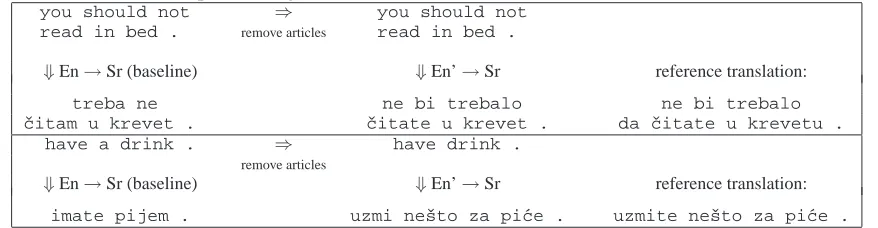
Table 7 shows some examples of the translation into Serbian with and without English articles. Al-though these effects are not directly obvious, it can be seen that removing of the redundant information enables better learning of the relevant information so that system is better capable of producing seman-tically correct output. The first example illustrates an syntactically incorrect output with the wrong in-flection of the verb (“ˇcitam” means “I read”). The output of the system without articles is still not com-pletely correct, but the semantic is comcom-pletely pre-served. The second example illustrates an output produced by the baseline system which is neither syntactically nor semantically correct (“you have I drink”). The output of the new system still has an error in the verb, informal form of “you” instead of the formal one, but nevertheless both the syntax and semantics are correct.
4.2.3 Translation of the External Text
Translation results for the external test can be seen in Table 5. As expected, the high number of out-of-vocabulary words results in very high error rates. Certain improvement is achieved with the phrases, but the most significant improvements are yielded by the use of Serbian base forms and re-moval of English articles. Verb treatment in this case does not outperform the base forms system, prob-ably because there are not so many different verb forms as in the other corpus, and only a small num-ber of pronouns is missing.
5 Conclusions
In this work, we have examined the possibilities for building a statistical machine translation system with a small bilingual Serbian-English parallel text. Our experiments showed that the translation results for this language pair are comparable with results for other language pairs, especially if the small size of the corpus, unrestricted domain and rich inflectional
morphology of Serbian language are taken into ac-count. With the baseline system, we obtained about 45% WER for translation into English and about 53% for translation into Serbian.
We have systematically investigated the impact of the corpus size on translation quality, as well as the importance of additional bilingual knowledge in the form of short phrases. In addition, we have shown that morpho-syntactic information is a valuable lan-guage resource for translation of this lanlan-guage pair.
Depending on the availability of resources and tools, we plan to examine parallel texts with other languages, and also to do further investigations on this language pair. We believe that more refined use of the morpho-syntactic information can yield better results (for example the hierarchical lexicon model proposed in (Nießen and Ney, 2001)). We also be-lieve that the use of the conventional dictionaries could improve the Serbian-English translation.
Acknowledgement
This work was partly funded by the Deutsche Forschungsgemeinschaft (DFG) under the project “Statistical Methods for Written Language Transla-tion” (Ne572/5).
References
Y. Al-Onaizan, U. Germann, U. Hermjakob, K. Knight, P. Koehn, D. Marcu, and K. Yamada. 2000. Translat-ing with scarce resources. In National Conference on
Artificial Intelligence (AAAI).
Peter F. Brown, Stephen A. Della Pietra, Vincent J. Della Pietra, and Robert L. Mercer. 1993. The mathe-matics of statistical machine translation: Parameter es-timation. Computational Linguistics, 19(2):263–311.
Sonja Nießen and Hermann Ney. 2001. Toward hi-erarchical models for statistical machine translation of inflected languages. In 39th Annual Meeting of
the Assoc. for Computational Linguistics - joint with EACL 2001: Proc. Workshop on Data-Driven Ma-chine Translation, pages 47–54, Toulouse, France,
July.
Sonja Nießen and Hermann Ney. 2004. Statistical ma-chine translation with scarce resources using morpho-syntactic information. Computational Linguistics,
30(2):181–204, June.
Table 6: Examples of Serbian–English translations with and without transformations
to je suvishe skupo . ⇒ to biti suvishe skup . ⇒ to SG3 biti suvishe skup .
base forms verb treatment
⇓Sr→En (baseline) ⇓Sr’→En ⇓Sr”→En
it is it is it is
too UNKNOWN skupo . too expensive . too expensive . on ne igra . ⇒ on ne igrati . ⇒ on ne SG3 igrati .
base forms verb treatment
⇓Sr→En (baseline) ⇓Sr’→En ⇓Sr”→En
he he does not . he do not play . he does not play . da , ali nemam ⇒ da , ali nemati ⇒ da , ali SG1 ne imati mnogo vremena . base forms mnogo vreme . verb treatment mnogo vreme .
⇓Sr→En (baseline) ⇓Sr’→En ⇓Sr”→En
yes , but I have yes , but not yes , but I have not got much time . much time . much time .
Table 7: Examples of English–Serbian translations with and without transformations you should not ⇒ you should not
read in bed . remove articles read in bed .
⇓En→Sr (baseline) ⇓En’→Sr reference translation:
treba ne ne bi trebalo ne bi trebalo ˇ
citam u krevet . ˇcitate u krevet . da ˇcitate u krevetu . have a drink . ⇒ have drink .
remove articles
⇓En→Sr (baseline) ⇓En’→Sr reference translation:
imate pijem . uzmi neˇsto za pi´ce . uzmite neˇsto za pi´ce .
machine translation. In Proc. 40th Annual Meeting of
the Assoc. for Computational Linguistics (ACL), pages
295–302, Philadelphia, PA, July.
Franz J. Och and Hermann Ney. 2003. A systematic comparison of various statistical alignment models.
Computational Linguistics, 29(1):19–51, March.
Kishore Papineni, Salim Roukos, Todd Ward, and Wie-Jing Zhu. 2002. BLEU: a method for automatic eval-uation of machine translation. In Proc. 40th Annual
Meeting of the Assoc. for Computational Linguistics (ACL), pages 311–318, Philadelphia, PA, July.
M. Popovi´c and H. Ney. 2004. Towards the use of word stems and suffixes for statistical machine translation. In Proc. 4th Int. Conf. on Language Resources and
Evaluation (LREC), pages 1585–1588, Lisbon,
Portu-gal, May.
M. Popovi´c, S. Joviˇci´c, and Z. ˇSari´c. 2004. Statistical machine translation of Serbian-English. In Proc. of
Int. Workshop on Speech and Computer (SPECOM),
pages 410–414, St. Petersburg, Russia, September.
A. Ratnaparkhi. 1996. A maximum entropy model for part-of-speech tagging. In Proc. Conf. on Empirical
Methods for Natural Language Processing (EMNLP),
[image:8.612.95.534.294.408.2]
![Table 5: Translation error rates [%] for the external testSerbian EnglishExternal Test](https://thumb-us.123doks.com/thumbv2/123dok_us/742982.1084688/6.612.176.455.77.282/table-translation-error-rates-external-testserbian-englishexternal-test.webp)