•
n
Mrt,men\
0'
StatistiCS
The l\btafY
of
\be
vet'" "C
<\'oa State
UmvefS1t'J
North am'
< :Assessing the effects of measurement errors in line
transect sampling
Russell Alpizar-Jara, L. A. Stefanski,
K. H. Pollock, and J.L. Laake*
Department of Statistics
North Carolina State University
Box
8203,
Raleigh, NC
27695-8203
National Marine Mammal Laboratory*
Alaska Fisheries Science Center
NMFS,
7600
Sand Point Way N.E.
Seattle, WA
98115
Institute of Statistics
11imeograph Series No.
2508
North Carolina State University
Raleigh, North Carolina
"
Abstract
We evaluate the effects of measurement error in population parameter estimation from a line transect sampling model,. characterize the error. distribution, and illustrate . using data from a controlled field experiment (Stakes data set, Laake 1978). We de-scribe a methodology to estimate the measurement error variance from a replicated experiment assuming an additive measurement error model, and correct for system-atic measurement error bias in the population estimates using calibration (Carroll et al. 1995). A simulation based method of inference for parametric measurement er-ror models is suggested to correct for random effects measurement erer-ror biases (Cook and Stefanski 1994). A simulation study is conducted to show the potential effects of measurement error in a line transect studies. Two main sources of measurement error biases were found in the stake data set, systematic and random effects. In this particular study, the systematic measurement error bias causes overestimation, and the random effects measurement error biases cause underestimation of population size and density. The random effects biases were not as severe as the systematic bias.
KEY WORDS: Calibration, line transect, SIMEX, systematic and random measure-ment error, wildlife density estimation.
.1
Introduction
One of the fundamental assumptions of line transect sampling is that distances from the transect line are measured without error (Buckland
et aI.,
1993). Enough evidence exists in the literature to show that measurement errors have an important effect on the estimates of population size, N, and density D. However, sound approaches to quantify and account for this effect in population estimates have not received enough attention.problem of measurement errors using some data from Robinette et al. (1974). Their analysis suggests that considerable measurement and rounding errors occurred near the transect line. Buckland et al. (1993, p.317) include a section on measurements and emphasize the importance of collecting accurate measurements in distance sampling, and someimplicati~ns of errors in the measurements. The authors mention several reasons to support the use of perpendicular rather than radial distance models, and discuss possible solutions to cope with measurement errors in distance sampling data. Buckland and Anganuzzi (1988) proposed an
ad hocmethod of estimating the smearing parameters, and compared their method with other existing methods. "Smearing" is a method that has been often used to analyzed cetacean shipboard surveys where sighting distance and angle data are more likely to be collected. The concept of smearing was first introduced by Butterworth (1982). For a description of this method see Buckland et al. (1993, p. 319).
Borchers and Haw (1990) pointed out the need for more accurate estimation methods when analyzing data based on radial distances (sighting distances and angles) rather than perpendicular distances. They conducted experiments on Antarctic sighting surveys and identified several sources of biases and imprecision in the measurements. Schweder et al. (1991) attempted to estimate error and bias in radial measurements based on triangulated data from the parallel ship experiments. 0ien and Schweder (1992) obtained estimates of bias and variability in visual distance measurements made by observers.
Recently, a more formal treatment to the problem of measurement error in line transect surveys has been addressed by Chen (1997). Chen proposes a method of moments estimator to correct for measurement error induced bias, and assumes an exponential power series detection function. He also assumes up to a fourth moment of the error distribution, and his method requires knowledge of the side of the transect on which an observation has been collected (i.e. signed perpendicular distances).
by Carroll et al. (1995). The next section introduces the basic line transect model and some notation. Section three introduces key concepts of measurement error models as they apply to a line transect sampling study with measurement error. Section four describes a controlled line transect study which is used to illustrate the methods suggested in this paper (Stake data set, Laake 1978). Section five characterizes the distribution for the stake data set using some exploratory data analysis techniques. An additive measurement error model and measurement error variance estimation is discussed in section six. Bias correction using calibration and SIMEX is discussed in section seven. Finally, a discussion and future research directions in section eight concludes.
2
Basic line transect model
A brief description of this model is given here. See Buckland et al. (1993) for a good detailed exposition on theory and applications.
Line transect sampling consists of defining straight lines across an area of known bound-aries. Observers travel along the lines (walking, riding on horseback, on a ship, on an airplane, etc.) detecting a sample of target objects, and recording at the moment of detec-tion the perpendicular distance from the line to a detected object, or the sighting distance from the observer and the angle between the line of travel and the line of sight to the ob-ject. Ifpossible perpendicular distances are measured, but if not then the sighting distance and angle are usually converted to perpendicular distance by a trigonometric relation (i.e. perpendicular distance equals sighting distance times sine of the sighting angle) (Buckland et al. 1993).
2.1
Assumptions
The basic assumptions underlying the line transect sampling model are:
(i)
Objects directly on the line have probability one of being detected.(iii)
The measurements of distances and angles are exact (i.e. there are no measurementerrors or rounding errors).
(iv)
The sighting of one animal is independent of the sighting·of another.These assumptions can easily be violated according to the particular practical conditions
of each study. The validity of the model will depend on there being little violation of the
assumptions; therefore, the design of the study should attempt to minimize all possible
violations. This paper focus on issues related to assumption
(iii).
This assumption isviolated if measurements are only roughly estimated. Extensive work have been done to
relax the other assumptions, but little have been done on measurement errors. See Buckland
et al. (1993) for a detailed discussion of assumption violations.
2.2
Notation
Nw is the population size in the surveyed area.
L is the total line length in a line transect survey.
w is the half-width of a strip transect of L length.
Aw
=
2wL is the surveyed area.i
=
1, ,Nw is used to index the observations (i.e. objects, animals).j
=
1, ,]{ is used to index the replicates (i.e observers in the stakes study).ki is the number of replicates in which observation i is detected.
nj is the number of observations (sample size) detected in replicatej.
Xi
are the exact perpendicular sighting distances.Wij are the observed perpendicular sighting distances measured with error.
Uij are the errors associated to the measurements.
ft
is the vector parameter describing the detection function.g( .
1ft)
is the detection function.f( .
1ft)
is the probability density function of perpendicular distances.(1)
to be detected. Objects that are far away from the transect center line usually have lower probability of being detected than those closer to the transect center line. Modeling this drop in detection probability is central to line transect sampling. This drop is modeled with a decreasing function relating the probability of detecting an animal and its perpendicular distance from the line. This function is known as the detection or sighting function,
g(X
i ),which properly scaled can be used as a probability density function,
!(Xi).
Thus, population and density estimates are directly dependent on accurate measurement of the distances becauseg(Xi)
needs to be estimated from the available distance information. Ifdistances are measured inaccurately, the estimate of the detection function will be biased. It can be shown that if the above assumptions, in particular assumption (i), are satisfied then the estimators of density and population size are given byb
=
N
w=
nj(O)Aw 2L
where
N
w is an estimator of the total population in the area covered, Aw=
2wL. L isthe total length of the transect strips of width w. It is extremely important to randomly locate lines in the area; otherwise, is necessary to assume that objects are randomly and independently distributed over the population area which in many cases it is an unreasonable assumption. Also, it is recommended that several random lines be used so that robust variances of estimates can easily be obtained.
In equation (1), note that the key parameter to estimate is
!(O),
the probability density function evaluated at distance zero. This parameter is directly proportional to the population size estimatorN
w = nwj(O), and if distances near the line are measured with error, theestimators of Nand D are biased.
3
Measurement error models
mea-surement error in linear models, and more recently Carroll et al. (1995) on meamea-surement error in nonlinear models. In the remainder of this paper, some of the key concepts of mea-surement error models as they apply to a line transect sampling study with meamea-surement errors are introduced. The effect of measurement errors on the estimators of density and population size is assessed.
The discussion is based on the existence of an exact predictor X and measurement error models which provide information about this predictor. Our exact predictor is the per-pendicular distance measured without error, sometimes also referred as "true" or "exact" distance.
In line transect surveys, we are interested in modeling the probability density function,
f(XI!l), as a function of the exact perpendicular distance, the predictor X. In practice, X
can not be observed exactly for all individuals in the study. However, we can observe a variable W (Le. observed perpendicular distance) which is related to X. The parametric modelf(XI!l) can not be estimated directly by fittingJ(·lfD toX. SubstitutingW forX, but making no adjustments in the usual fitting methods (i.e. maximum likelihood or nonlinear least squares) for this substitution, leads to estimates that are biased, sometimes seriously (Carroll et al. 1995). The goal of using measurement error modeling is to obtain nearly unbiased estimates of!l.
4
A controlled field study: the stake data set
Laake (1978) conducted an investigation of line transect sampling by placing a known number of wooden stakes in a rectangular area of sagebrush meadow east of Logan, Utah. The stakes were randomly placed and uniformly distributed as a function of distance from the line. Eleven independent observers walked along a transect line of length L
=
1000 meters and a fixed half- width strip of w=
20 meters.The stake data is a very well known data set that has been analyzed on several occasions. Burnham
et ai.
(1980) analyzed this data set and found that the number of observed stakes varied substantially among observers, and that the underlying detection functionsg(X)
differed greatly among observers. The data provided an estimate of the average density of 31.6 stakes per ha., but the true density was 37.5. Burnham
et
al. (1981) considered that this negative bias is at least partially due to the failure of the assumption that all stakes on the centerline were detected. Bucklandet ai.
(1993) have done some additional analyses and found that some of the negative biases in the population estimates are due to measurement error for stakes near the line. Measurement errors in the stake data could also be related to heaping and rounding effects when observers estimate distances from the centerline.For the stake data set, the exact location of each stake was known, and also the estimated distances for the stakes seen by each of the eleven observers are available. Itis possible to identify which stakes were seen by each observer, and an estimate of the measurement error variance can be obtained as we shall show. Another advantage of using the stake data set is that the population size is known (N
=
150 stakes), hence our population estimates can be compared to the true population parameter. Also, it is an immobile population, and thus we do not have to worry about violation of the assumption that objects do not move before being detected,(ii),
which also introduces an effect in the measurement of the distances.of the measurement error variance. In this study, each observer's estimated distance to a detected stake was considered to be a replicate measurement of the distance to that stake.
5
Characterization of the error distribution
To evaluate the effect of measurement errors in the stake data set, an exploratory data analy-sis was carried out using the distances measured by the eleven observers. Often, measurement errors are assumed to be normally distributed to simplify analysis and the construction of confidence intervals for population parameters. The error distribution is first characterized instead of blindly assuming normality.
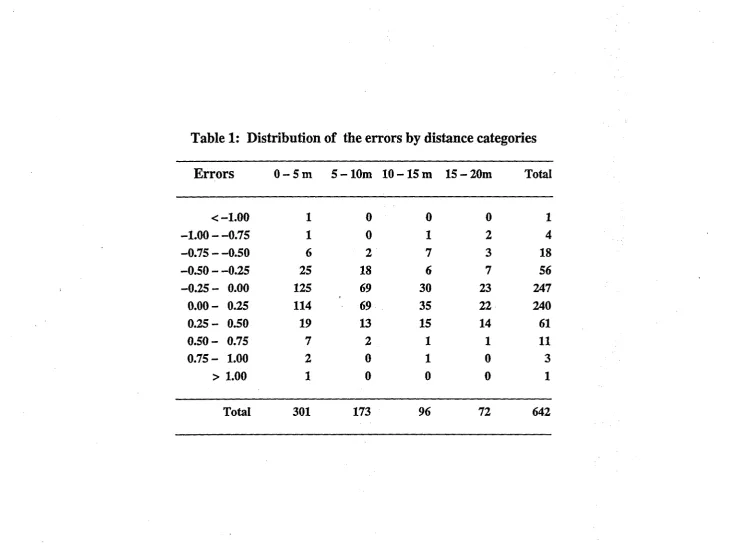
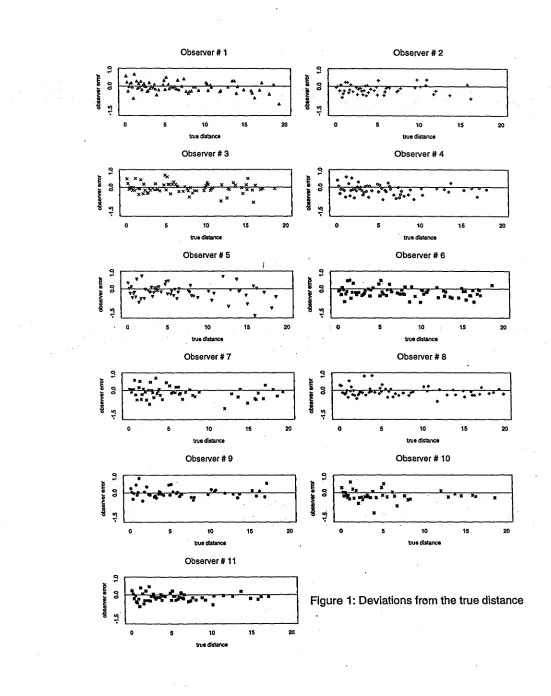
Figure 1 displays the observers errors vs. the "true" distances. Important features of this line transect study can be obtained from examining this plot. Notice for instance that there is a concentration of points near to zero distance, and sometimes a few points far away from the line. There is a clear drop in the sightings as distance increases. Itis also possible to appreciate the magnitude and direction of the error. Sometimes errors were as large as one meter or more, and there is a slight tendency to underestimate the true distance. Table 1 summarizes the distribution of the errors by distance categories.
[Table 1 and Figure 1 near here]
[Figures 2a,b near here]
6
The
effects of measurement error and estimation of
measurement error variance
A simple univariate additive error model is considered, where conditional on X, the errors have mean zero and constant variance, O"~. For a single observation, assume the model
Wij
= {3o+
{3xXi
+
Uij
withUij
rv (0,O"~).For each stakei that was detected by at least one observer, we compute the average of the observed distances given that a stake was located at true distance
Xi
(fixed by design). It is reasonable to assume that ifthere is no effect of measurement errors, the plot of the average of the observed distances(Wd
versus the true distances(Xi)
should fall on a straight line with slope one and intercept zero. We then hypothesize the following model for the average of observed distances,(2)
where
2
Note also that
E(Wi.\Xi)
=
(30+{3xXi,
andVar(Wi.IXi)
=
~;,
whereO"~
is the measurement error variance for a single observation.To find out ifthere is any systematic measurement error bias the following hypotheses need to be tested,
Ho : {3x
=
1and
Ho :
(3o=
o.
the distances. Determining the magnitude and direction of this effect is also of interest. If
H
o :f30
= 0 is rejected, then this indicates that measurement errors have a strong effect ondistance measurements close to line (at zero distance).
Since an observation depends on whether a stake was detected or not, the number of
replicates for each stake is not fixed. Observations do not contribute equally to the fit.
We use weighted least squares (Draper and Smith, 1981) to estimate the parameters of this
model. After fitting the model, the data can be calibrated by adjusting the observed averages
to obtain the additive error model
(3)
where
~w.
= Wi. -,80
~U.
- U
i.and
~U
N (
a~)
(4)
t·
,8x'
t' -,8x
i· '" 0,,8; .
Under these model assumptions, an estimate of the measurement error variance after
cali-bration is given by
A2
A2 au ( )
aU"
=
- A , 5f3-;
which is estimated dividing the mean squared error of the fitted weighted regression model
by the the estimate of the slope.
To determine whether there is some degree of heteroscedasticity in the measurement error
variance given the "true" distance, one could hypothesize that the variance of the observed
distances would increase for observations further away from the transect line. The following
could be used as a baseline model,
(6)
1 k·
2 ~ - 2
Si
=
k. _ 1?---(Wij -
Wd ,, 3=1
and then fit the model using least squares weighting by the number of observations in which 2 each
Sl
is based (i.e. ki -
1). Note thatE(SlIXi)
=
10+
lxXi,
andVar(SlIXi)
=
~.
ki - 1
We are interested in testing the following hypothesis,
Ho : IX = 0
IfHo :IX = 0 is rejected then the variance of the observed measurements given the true distance increases linearly as true distance increases. IfIX = 0, then constant variance should be assumed and an additive model is appropriate. Also, an estimate of the measurement error variance for a single observation is given by the estimate of the intercept
(10)
sinceE(SlIXi)
=
10.Results from the fitted models,
Wi.
=
fJO+fJxXi
andSf
=
10 +1xXi,
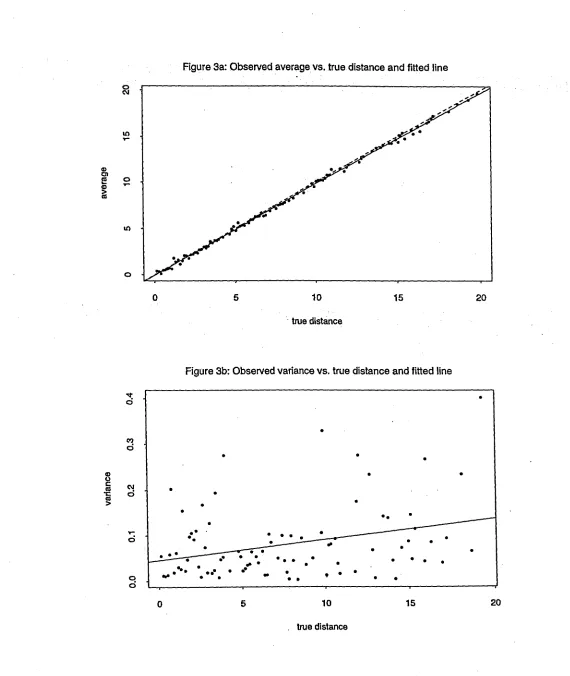
using the stake data set are given in Table 2. We used SAS procedure REG (SAS Users Guide) for the analysis. Plots corresponding to these fits are given in Figure 3.[Table 2 and Figures 3a,b near here]
The null hypothesis Ho : f3x = 1 is rejected in favor of the alternative Ho : f3x
<
1.A
f3x = 0.989, with standard error 0.004. This result indicates that there is a systematic effect of the measurement errors in the measures of perpendicular distances. Observers tend to underestimate the true perpendicular distance. This result is also confirmed by the exploratory data analysis form the previous section (Figure
1),
in which generally more than half of the observations detected by each observer are below the zero line. An estimate of the measurement error variance of the calibrated measurements is given by~;
=
0.2826=
0.2888.Although we reject the null hypothesis Ho : IX
=
0,(p
=
0.0154), the model does not give a good fit to the data(r
2=
0.067) (Figure 3). Also, the exploratory data analysis does not suggest strong evidence of heteroscedasticity for this model (Figure 2).
In assessing the measurement error effects we also fitted several parametric models to the data collected by each observer. Models were fitted to both, "true" and observed per-pendicular distances. Program DISTANCE (Laake et al. 1993) was used for model fitting using maximum likelihood estimation, and model selection was carried out using the Akaike Information Criteria (Akaike 1973). Models that "best" fitted the data with the correspond-ing population estimates are shown in Table 3. Note that in most cases a half-normal model was selected as the "best" fit, and in some occasions a uniform detection function with up to three cosine adjustment terms (see models for Observer 6).
[Table 3 near here]
These results suggest that there may be some effects of measurement errors in model selection. For instance, for Observer 1 a uniform model with one adjustment cosine term was selected when fitting the model with the true distances, but a half-normal model with no adjustment terms was selected when using the observed distances. Also, note that in most cases the true population size N = 150 is underestimated although the true value is generally contained in the confidence intervals. Possibly, this negative bias is largely due to violation of the assumption that stakes on the centerline have probability one of being observed rather than to the effect of measurement errors.
distances were consistently underestimated. To correct for this systematic bias, calibration
of the data is required.
7
Bias correction using calibration and SIMEX
In this section we use some stake data and simulations to illustrate bias correction using
calibration to account for the systematic measurement error effects, and to demonstrate
the random measurement error effects on population size. We also describe and suggest
the SIMEX algorithm (Cook and Stefanski, 1994) to correct for bias due to the random
component.
For the sake of illustration the data collected by Observer 4 has been chosen, and fitted a
half-normal model with no adjustment terms for the true and observed distances. The
max-imum likelihood estimates of population size and their standard errors obtained from these
fits are
N
w=
122(19.3) andN
w=
125(19.6) for the true and observed distances respectively.As noticed from the data analyses for all the observers in the preceding section,
overesti-mation is caused by the tendency of each observer to underestimate the true perpendicular
distances. Observer 4 was not an exception. We calibrate the observed data as described
earlier, (see equation 4 in previous section), to reduce this systematic bias. After calibration
of the observed distances, we fitted the same model and obtained an estimate of population
size of
N
w=
123(19.3). Note that this population estimate is now closer to the error-freepopulation estimate and we have corrected for some of this systematic effect.
The simulations to be described are based on the SIMEX algorithm. SIMEX is a
simulation-based method of inference for parametric measurement error models to adjust
for the random effects of measurement error bias (Cook and Stefanski 1994, and Stefanski
and Cook 1995). The authors show that the magnitude of this random effect bias in the
estimates depends on the size of the measurement error variance. The simulation step of
SIMEX is used to examine the effect of the random component. The method requires that
set the random measurement error effects are not large enough, we do not use the extrap-olation step of the SIMEX algorithm to correct for this effect. If the effects of random measurement errors were large, we suggest using the full SIMEX algorithm to correct for bias due to the random component.
Cook and Stefanski (1994) developed a simulation-based estimation procedure for mea-surement error models known as SIMEX (Simulation-Extrapolation). The SIMEX method has been shown to produce less biased parameter estimates. The main idea using SIMEX is to experimentally determine the random effect of measurement errors on an estimator via simulation. Ifan estimator is influenced by random measurement errors, simulation exper-iments can be considered in which the level of the measurement error, (i.e. its variance), is intentionally varied (Carroll et al. 1995, p.80). SIMEX estimates are obtained by adding additional measurement error-induced bias versus the variance of the added measurement error, and extrapolating this trend back to the case of no measurement error. In synthesis, the SIMEX algorithm consists of four main steps:
(i)
Additional measurement error is added in known increments to the observed data.(ii)
For each increment of added measurement error, parameter estimates are computed from the further-contaminated data.(iii)
A trend is established between the parameter estimate and the added measurement error. (iv) The trend is extrapolated back to the case where there is no measurement error. Details on the theoretical support of the SIMEX estimate can be found in Stefanski and Cook (1995). SIMEX is best suited to problems with additive measurement error models, but additivity of errors is not crucial and the method can be extended to more general models (Carroll et al. 1995). Although the focus in this paper has been an additive measurement error model, additional analyses have been done assuming a multiplicative error model. For reasons of space, these analyses are not presented here.of the half-normal detection probability density function,
/('10).
In the simulation step we create additional data sets of increasingly larger measurement error (1+
>,)(J~,>.
={O.O,
0.25, 0.50, ... , 2.0}. The measurement error variance estimate obtained in the previoussection, given by (5) was used as an estimate of(J~. For any
>.
~ 0, we defineWb,i
=Wi
+
..r>.Ub,i,
i = 1, ... ,n,b
= 1, ... ,B,
(7)
where the computer-generated pseudo-errors,
{Ub,i}i=l'
are mutually independent, indepen-dent of all the observed data, and iindepen-dentically distributed normal random variables with mean zero and variance (J~. Once the new predictors are created, the average of the estimates ob-tained from a large number of experiments, (B=
500 in our study), with the same amount of measurement error are computed and plotted versus the amount of error added(>.).
The estimated value at>.
= 0 (i.e. no measurement error added to the contaminated data) is known as the the NAIVE estimator. The extrapolation step consists of modeling these av-erages as a function of>.,
for .>.>
0, and extrapolating the fitted models back to>.
=
-1. The extrapolated value at>.
=
-1 corresponds to the SIMEX estimator.A simulation study was carried out in which known amount of measurement error can be added to error-free line transect data (i.e. true perpendicular distances) to determine the effects of random measurement error in the parameter estimates. If we were to do the extrapolation step, it would not make sense to extrapolate for the true distance data because the SIMEX and the NAIVE estimators are equivalent since the data are known to be error-free. The SIMEX simulation step was used to compare population estimates obtained from fitting the true, observed and calibrated perpendicular distances while adding known amounts of random measurement errors.
When fitting the calibrated perpendicular distances, we account for heteroscedasticity of the measurement error variance by modeling it as a function of distance as described in the previous section (see equation 6). Pseudo-data sets are generated using an estimate of the
t . . b A
2
1'0
+
1'x
X
imeasuremen error varIance gIVen y (Ju = A •
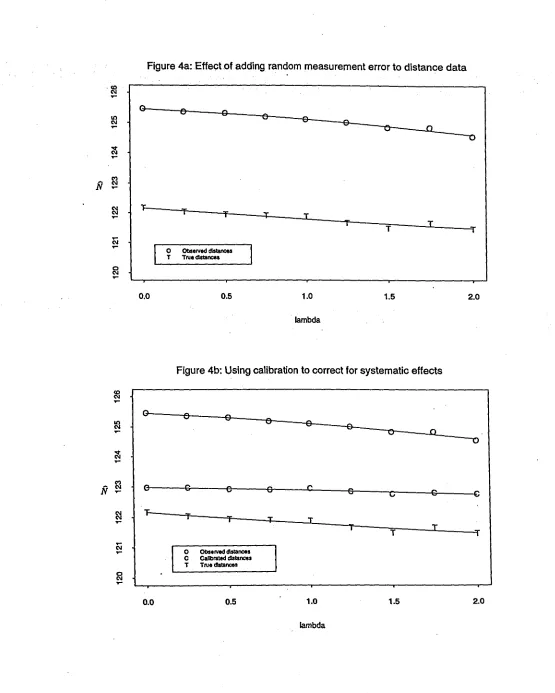
Results from these simulations are summarized in Figure 4. The solid line corresponds to fits of a quadratic extrapolant function. Clearly, adding more random measurement error to distance data causes underestimation of the population size estimates. The same declining trend is observed for analyses of the observed and true perpendicular distance data. Note however, that the random effect of measurement errors in the population estimates is minimal since the lines are almost flat curves (Figure 4a). Also note that the calibrated data produce estimates that are closer to those estimates obtained from the true distances even after adding large amounts of random measurement error (Figure 4b). This result suggests that a combination of calibration and SIMEX analysis removes of most of the measurement error.
[Figures 4a,b near here]
8
Discussion and future research
In this paper, the stake data set was used to obtain an estimate of the measurement error variance. The stake data set also allows characterization of the error distribution. Several advantages of using the stake data set are that the true distances at which the stakes were placed are known, and there were eleven observers walking along the line which allows reasonable estimation of the measurement error variance. The true population size is also known. Two main sources of measurement error biases were identified and quantified for this study, systematic and random measurement errors. Calibration was used to correct for systematic measurement error bias, and the simulation step of the SIMEX algorithm to examine the effects of random measurement error bias. For simplicity, a univariate model for the detection function (half-normal) is considered to illustrate the estimation methods. In synthesis, this paper suggests a general but simple methodology to assess the effect of measurement errors in line transect surveys, and to correct for measurement error bias.
in model selection using Akaike information criteria and maximum likelihood ratio tests also needs to be assessed. The robustness of estimation methods (Le. maximum likelihood esti-mation, nonlinear least squares, kernel density estiesti-mation, etc.) to measurement errors can be evaluated. Violation of the assumption of constant variance and the use of an alternative multiplicative model need to be investigated since the measurement error variance may be a nonlinear function of the distances (i.e. quadratic or exponential function). Some analyses in this direction have been done, but because strong evidence of heteroscedasticity was not found, and for reasons of space they are not included here.
References
Akaike, H. (1973) Information theory and an extension of the maximum principle. In
International Symposium on Information Theory, 2nd edn(edsB. N. Petran and F. Csaaki),
Akadeemiai Kiadi, Budapest, Hungary, pp. 267-81.
Borchers, D. L. and M. D. Haw. (1990). Determination of minke whale response to a
transiting survey vessel from visual tracking of sightings. Report of the International Whaling
Commission, 40, 257-69.
Buckland, S.T., D.R. Anderson, K.P. Burnham, and J.L. Laake. (1993) Distance
sam-pling: Estimating abundance of biological populations. Chapman and Hall, London. 446pp.
Buckland, S. T. and A. A. Anganuzzi. (1988). Comparison of smearing methods in the
analysis of Minke sighting data from IWC /IDCR Antarctic cruises. Report of the
Interna-tional Whaling Commission, 38, 257-63.
Burnham, K.P., D.R. Anderson, and J.L. Laake. (1980). Estimation of density from line
transect sampling of biological populations. Wildlife Monographs, 72, 202 pp.
Carroll R.J. and L.A. Stefanski. (1990). Approximate quasi-likelihood estimation in
models with surrogate predictors. Journal of the American Statistical Association., Theory
and Methods. 85(411), 652-663.
Carroll R.J., D. Ruppert, and L.A. Stefanski. (1995). Measurement errors in nonlinear
models. Monographs on statistics and applied probability 63. Chapman and Hall, London.
305pp.
Char, B.W et al. (1991) Maple
V
Library reference manual. Waterloo Maple Software.Springer-Verlag, New York.
Chen, S.
X.
(1997). Measurement errors in line transect surveys. Technical papersub-mitted for publication to Biometrics.
Cook, J.R. and L.A. Stefanski. (1994). Simulation-extrapolation estimation in
paramet-ric measurement error models. Journal of the Ameparamet-rican Statistical Association., Theory and
'.
Draper, N. R. and H. Smith (1981). Applied regression analysis. John Wiley and Sons,
New York, New York, U.S.A.
Laake, J. L. (1978) Line transect estimators robust to animal movement, MS Thesis,
Utah State University, Logan, UT, USA, 55pp.
Laake, J. L., Buckland, S. T., Anderson, D.R. and Burnham, K. P. (1993) DISTANCE
User's Guide. Colorado Cooperative Fish and Wildlife Research Unit, Colorado State
Uni-versity, Fort Collins, CO 80523, USA.
MathSoft, Inc. (1995). S-PLUS Guide to Statistical and Mathematical Analysis. Version
3.3 for Windows and Unix. Seattle, WA. U.S.A.
0ien, N. and T. Schweder. (1992). Estimates of bias and variability in visual distance
measurements made by observers during shipboard surveys of northeastern atlantic minke
whales. Report of the International Whaling Commission, 42, 407-412.
Robinette, W. L., Loveless, C. M. and Jones, D. A. (1974). Field tests of strip census
methods. Journal of Wildlife Management, 38, 81-96.
SAS Institute Inc., (1990). SAS/STAT User's Guide, Version 6, Fourth Edition, Volume
2. Cary, North Carolina, 846 p.
Schweder, T. (1977). Point process models for line transect experiments, in Recent
De-velopments in Statistics (eds). J.R. Barba, F. Brodeau, G. Romier and B. Van Cutsem),
North-Holland Publishing Company, New York, USA, pp. 221-42.
Schweder, T., G. H~st, and N. 0ien. (1991). Estimates of the detection probability for
shipboard surveys of Northeastern Atlantic Minke whales, based on a parallel ship
experi-ment. Report of the International Whaling Commission, 41, 417-432.
Stefanski, L. A. (1985). The effects of measurement error on parameter estimation.
Biometrika 72(3):583-92.
Stefanski, L. A. and Cook, J. R. (1995). Simulation-Extrapolation: The measurement
Table 1: Distribution of the errors by distance categories
Errors
0- 5 m 5 - 10m 10 - 15 m 15 - 20mTotal
<-1.00 1 0 0 0 1
-1.00 - -0.75 1 0 1 2 4
-0.75 - -0.50 6 2 7 3 18
-0.50 - -0.25 25 18 6 7 56
-0.25 - 0.00 125 69 30 23 247
0.00 - 0.25 114 69 35 22 240
0.25 - 0.50 19 13 15 14 61
0.50 - 0.75 7 2 1 1 11
0.75 - 1.00 2 0 1 0 3
>
1.00 1 0 0 0 1TABLE2: ANOVA tables for models described In section6
MODELl AVERAGE = Bo+Bx*TRUE+Ui. MODEL2 VARS = Go+Gx*TRUE+EI.
Dependent Variable: AVERAGE Dependent Variable: VARIANCE
Source DF SS MS F-value Prob>F Source DF SS MS F-value Prob>F
Model 1 17182.9 17182.9 60805.8 0.0001 Model 1 0.1720 0.1720 6.120 0.0154
Error 99 28.0 0.28259 Error 85 2.3886 0.0281
C-Total 100 17210.8 C-Total 86 2.5606
Root MSE 0.53159 R-square 0.9984 Root MSE '0.16763 R-square 0.0672
Dep Mean 6.49621 Adj-Rsq 0.9984 Dep Mean 0.07178 Adj-Rsq 0.0562
C.V. 8.18304 C.V. 233.53414
Parameter R"lflmafes Parameter E."ltlmlltes
Parameter Standard T for Ho: Parameter Standard T for Ho:
Variable DF Estlm~te Error Param=O Prob>ITI Variable DF Estimate Error· Param=O Prob>1T1
NTERCEP 1 -0.0543 0.0339 -1.604 0.1120 INTERCEP 1 0.0498 0.0114 4.359 0.0001
TRUE 1 0.9892 0.0040 246.588 0.0001 TRUE 1 0.0035 0.0014 2.474 0.0154
Test ror Ho: Slope:1 df Test for Ho: Slope:0 df
SLO~El Numerator: 2.0586 1 F-vnlue: 7.2850 SLOPE2 Numerator: 6.1720 1 F-vnlue: 6.1205
Table 3: Estlmation orpopulat1oD size and density using the mQdd Hlect10D procedureInprogramDISTANCE
EstIDuotc 'JoeY dl 95'Jo-C1 EstImate 'JoeY dl 95'M-CI
OBSERVER 1 OBSERVER 7
TRUE-DISTANCE TRUE-DISTANCE
UaltonnlCoslne (I)' Ball-DOrmaIICosI.e (1)
'oD 0.0030 14.15 71 0.0021 0.0039 D 0.0034 21.57 53 0.0022 0.0052
N 1., 14.16 71 90 158 N 136 21.57 53 89 208
OBSERVED-DISTANCE OBSERVED-DISTANCE
Hall-.onn21 BaJr-DormallCosl.e (1)
D 0.0030 15.15 71 0.0023 0.0041 D 0.0035 21.21 53 0.0023 0.0053
N 122 15.15 71 90 16-1 N 138 21.21 53 91 210
OBSERVER 2 OBSERVER I
TRUE-DISTANCE TRUE-DISTANCE
Hltr-DOrmai Bltr-DOrmaIICosI.e (2)
D 0.0021 17.67 47 0.0020 0.0040 D 0.0031 20.75 58 0.0011 0.0048
N 113 17.67 47 10 151 N 117 20.75 58 14 191
OBSERVED-DISTANCE OBSERVED-DISTANCE
Hlll-DOnn2I BaJr-DOrmallCosIj,e (2)
D 0.0029 17.60 47 0.0010 0.0041 D 0.0031 20.67 58 0.0021 0.0041
N 116 17.'0 47 II 165 N 119 20.67 58 15 .,4
OBSERVER 3 OBSERVER
,
TRUE-DISTANCE TRUE-DISTANCE
Hall-Dormol HaJr-DOmW
D 0.0030 15.6-1 73 0.0022 0.0041 D 0.0011 18.61 45 0.0015 0.0031
N 220 15.6-1 73 18 163 N 15 lUI 45 5' 114
OBSERVED-DISTANCE OBSERVED-DISTANCE
H~II-DOrmol Hall-DomW
D 0.0030 15.63 73 0.0022 0.0041 D 0.0011 111.5' 45 0.0015 0.0031
N 121 l5.63 73 19 165 N 15 11.56 45 59 114
OBSERVER 4 OBSERVER 10
TRUE-DISTANCE TRUE-DISTANCE
Hall-DormollCos1De (1) HaJr-DOrmallCosine (1)
D 0.0037 1",0 58 0.0025 0.0055 D 0.0031 21.85 39 0.0010 0.0048
N 148 1930 58 100 220 N 115 21.15 39 II 194
OBSERVED-DISTANCE OBSERVED-DISTANCE
Hatr-Dormal/Cosine '(1) HIlI-Dormal/Cosine (1)
D 0.003' 19,47 58 0.0027 0.0058 D 0.0032 21.85 39 0.0021 0.0050
.N 157 .,A7 58 10' 220 N 11' 21.85 3' 13 199
OBSERVER 5 OBSERVER 11
TRUE-DISTANCE TRUE-DISTANCE
Holl-DOrmollCosiDe (1) Hall-DOrmal
D 0.0034 2D.26 51 0.0022 0.0051 D 0.0030 15.51' . 53 0.0022 0.0041
N 136 10.16 58 '1 203 N 110 15.51 53 16 167
OBSERVED-DISTANCE OBSERVED-DISTANCE
Hall-DOrmollCosIae (1) HaJr-DO"""I/Coslne (1)
D 0.0035 20.12 58 0.0023 0.0052 D 0.0037 1935 51 - 0.0025 0.0055
N 138 20.12 58 '3 206 N 14' 1935 51 100 m
OBSERVER 6.
TRUE-DISTANCE Ualtonn1CosIDe (3)
D 0.0034 17.06 69 0.0025 0.0048
N 131 17.06 69 '8 .,3
OBSERVED-DISTANCE UallonnlCosIDe (3)
D 0.0035 lUI 69 0.0026 0.0047
Observer # 1 Observer#2
~
.. ..
~g
0 .... ",fA ..
"A ....
4>....
..
~...
+ • +D •
~
~ d ...~.... _ . y ..
..
-
~....
"
..
.~ +.t.t+T.;>....++. + .;
..
+. ++. '++ ++ •D
..
..
i
+.l!
~
..
0 "1
..
0 5 10 15 20 0 5 10 15 20
lNecllstanc:e lNecfostanea
Observer # 3 Observer # 4
~ ~
g x x x 'S<
x ~ : v g
00
D
~ X X X xm. .Ii\: • C! o 0 0 Go • •
~ xx'llC x x xX"'ll'" xX' "" xxx'" A
~ 0
0:::'
-z>:
0 , 0 1 . :-.
0 •
x xX • •
D
i
• • •~ "1
..
x "1..
0 5 10 15 20 0 5 10 15 20
llUecllstanc:e lNe alslance
Observer # 5 Observer # 6
~
,,"
" ~
g
..
._ l' " g-
-.
•
0 ~
"
" • ~...
..
-
•
~ d
"[.
~"r"
vl,,:
....
" """'"
" " ~..
.,
:.,;
.,..;-...
.
...
.
':_.-
...
j "1
..
""
"
"
..
"
i
"1..
•
• •
•
•
0 5 10 15 20 0 5 10 15 20
lNecllstanc:e lNe cI1stance
Observer#7 Observer#S
~ • ~ o 0
g
••
..
..
.
•
..
g •-
••
• ••
• •..
C! • ~ •~ 0 -':.::~
... 'X-
••
...
•.-
~"'."r·-·· ...•-
• •.
...
• • 0•
j •
•
•"1 • ~ "1
..
..
0 5 10 15 20 0 5 10 15 20
lNecllstanc:e lNealslance
Observer # 9 Observer # 10
~ • ~
•
g • .-
•
g a• •
."
a a. a..
..
C!..,
..
,.
...
,.
•••
.
.
i
~~ 0
.,
•
•
• • ~a~a.aa a . a a •• a• •
D
i
• a~ ~ uj a
..
0 5 10 15 20 0 5 10 15 20
lNecIlstane:e lNealslance
Observer # 11
~
g
I" "
'S-.A'... •
•..
~
•
•
• •1 •Figure 1: Deviations from the true distance
•
D
:.\~~
~
0 5 10 15 20
Figure·2a. Exploratory data analysis for measurement errors based on true distance.
~ ::! ~
..
' i ~ ~,
~ ~...
i C!..
Ii)III•.
a ~...
Ii) Cla
~
a i ) (
..,
III...
~_II
q cl 0 2 N Cl cl ~ -;a - Cl
a
-1.0 ·0.0 1.0 -1.5 -0.5 0.5 1.5
-3 -2 -1 0 1 2 3
enor error
OuanllIes 01 Standard Normal
Ii! ~
======
::! ~ f"~ i
...
:;l Cl,
:l ClIi)
a C)
a
) (0 2
..1
111-...
...
~ cl ~..,
S! ...:... Cl a -C)-1.0 45 0.0 0.5 -1.0 0.0 .1.0
-2 -1 0 1 2
error error
QuanllIes 01 Stlndard No(lt18l
::!
:;l
~ ~ III
~ C) ~
=1=
... cl ~ Ii) 2 Cl ..., C) Ii) :l )(a
..,
__III
It
~"": ~ ... S!
-L
C) 0 "I ... C) Cl ~ ~ -;..
C)
--1.0 0.0 0.5 -1.5 -0.5 0.5 -2 -1 0 1 2
enor enar QuanllIesolStlndardNonnU
::! on
..
C)
~ cl
...
.
~
;
Cl ~ Cl
...
•
C)..
:;l C)Ii) C! ..., C) Ii) on
a
~ "'!)( q
0 2 C)
~ ...:... Cl Cl "':
1-C) -;
.
..,
S!__I
-;.
Figure 2b. Exploratory data analysis for measurement errors based on observed average of the distances.
~ ~ ~
~ ~ ,I
1tI
1tI
t
Ii! cSi : ;
0
...
i ~ ~ 0 >< ~ E! cS lQ ~ 1tI~ ~ 1tI
c
___.1
1.__-
q= 9 2 ~ 0 ~ 0 ";" 0
-1.0 0.0 1.0 ·1.5 -0.5 0.5 . 1.5
-3 ·2 ·1 0 1 2 3
8ml' etn:l'
Quandles 01 Slandard Normal
lil
d ~
~
0
.., 51 ~
..
~ "I ~ 0;=
0...
~ ~ E!til ~ ~ >< ~
c
....
"I"I
.
lil 91tI 9 lQ cS S!
:.... :....
-.., 0 "! 0 q cS 9-0.8 00.4 0.0 0.4 -1.0 -0.5 0.0 0.5
-2 ·1 0 1 2
errtl' etn:l' Ouanllles 01 Stanc:lard Normal
1tI
~
N
~
~
en lil ~
..
T
~ III .... :!! cS 0 ~ ~El >< 0
lQ S!
....
~ 1tI 04
c 9
-:....-....
1tI---
C! 0 C!0
";" cS
..
-1.0 0.0 0.5 1.0 -1.5 00.5 0.5 1.5 ·2 -1 0 1 2
errtl' ttn:l, Ouantlles of Stanc:lard Normal
1tI ~ ~
~ d :!!
,
~ 0 Gl Cl ., 0..
~ S! d 0..•1
III .... >< ~ da
0~ ~0 1tI
9 C'l 1tI
I
I "I \l) -:....-0..
...
0 ~ ~ ~...
-1.0 00.5 0.0 0.5 -1.5 00.5 0.5 ·2 -1 0 1 2
Figure 3a: Observed averagevs. true distance and fitted line
10
,...
o
,...
10
o
o 5 10 15 20
. true distance
Figure 3b: Observed variance vs. true distance and fitted line
•
•
•
•
•
•
•
• • •
•
• •
..
-
.
• • •
•
•• ••
•
•
,....--.!.._.:-.-.•.---~--••- .•
...
.
....
o
d
C')
d
Gl
U
c: C'J
III
'C d III
::-,... d
Figure 4a: .Effect of adding random measurement error to distance data
-co
C\l
...
G-
o
eIt) 0 e
C\l e
0 0
...
---0
~
...
CO)
N
C\l...
~ "'F- T
l' T T
...
T
T T T
...
C\l...
0 Observed ells_aT TNedIstance8 0
C\l
...
0.0 0.5 1.0 1.5 2.0