NURUL WAHIDA BINTI ROSLI
COST BREAKDOWN STRUCTURE FOR LIFE CYCLE COST OF WATER PUMP
NURUL WAHIDA BINTI ROSLI
A thesis submitted in fulfilment of the requirements for the award of the degree of Doctor of Philosophy (Facilities Management)
Faculty of Environment and Surveying Universiti Teknologi Malaysia
ACKNOWLEDGEMENT
In the name of Allah, the Most Gracious, the Most Merciful. Praises are only to Allah, the Lord of the universe.
Firstly, I want to dedicate my appreciation to my thesis supervisor, Professor Sr. Dr. Abdul Hakim Mohammed and my co-supervisor, Dr. Mohd Shahril Bin Abdul Rahman for their support, critics, supervision, and tolerance along my journey of my PhD study. Thanks to: All PhD colleagues, Ooi Chu Hui, Ezdihar, Nik Iezuan, Shubashini, Gunavathy, and many more friends that I might disremember mentioned their names here. Big thanks to all the academic and non-academic staffs of the faculty especially from the Property Management Department.
Also my appreciation to the Pengurusan Aset Air Berhad (PAAB) Malaysia especially to Encik Mohd Hazley Halim who that had given me a chance to be in their asset management team along my data collection. Also to Puan Rohizan Mohamed who also helped me during the survey distribution among the PAAB staff. Not to mentioned, the entire person who directly and indirectly involved in my PhD journey.
I also would like to express my appreciation to Universiti Teknologi Malaysia that provides the financial support in the form of Zamalah scholarships.
ABSTRACT
ABSTRAK
TABLE OF CONTENT
CHAPTER TITLE PAGE
TITLE PAGE DECLARATION DEDICATION
ACKNOWLEDGEMENT ABSTRACT
ABSTRAK
TABLE OF CONTENT LIST OF TABLES LIST OF FIGURES
LIST OF ABBREVIATIONS LIST OF APPENDICES
i ii iii iv v vi vii xii xiv xvi xvii
1 INTRODUCTION 1
1.1 Background of the Research 1
1.2 Problem statement 4
1.3 Objectives of the Research 8
1.4 Scope of the Research 8
1.5 Research Methodology 9
1.5.1 Literature Review 9
1.5.2 Interview question 9
1.5.3 Questionnaire surveys 10
1.5.4 Analytical Hierarchy Process (AHP) approach 10
1.6 Significance of the Research 11
1.7 Organization of the study 12
2 LITERATURE REVIEW 14
2.1 Introduction 14
2.2 Asset management concept 14
2.3 Asset management and its relation with life cycle cost 16
2.4 Drinking water system 17
2.5 Pumping system in water distribution system 19 2.6 Treated Water Pump system in Malaysia 20
2.7 Life Cycle Costing (LCC) 22
2.7.1 LCC: The definition and implementation 22
2.7.2 The History of LCC 23
2.7.3 LCC and data: The issues 24
2.7.4 LCC and Cost Breakdown Structure (CBS) 25 2.8 Cost Breakdown Structure (CBS): The Definitions 27
2.8.1 CBS: The data structure 28
2.8.2 CBS: The Characteristics 31
2.8.3 CBS: The dependability of data required with the life cycle stages
32
2.8.4 CBS: The previous research 34 2.8.5 The further consideration in CBS 37
2.9 Life cycle cost elements 40
2.10 LCC of pump 42
2.10.1 Initial cost 42
2.10.2 Installation Cost and Commissioning Cost 44 44
2.10.3 Energy Costs 45
2.10.4 Operating Costs 45
2.10.5 Maintenance and Repair costs 45
2.10.6 Replacement cost 46
2.10.7 Spare part inventories 47
2.10.9 Down Time and Loss of Production Cost 47 2.10.10 Decommissioning and Disposal cost 47
2.11 Summary 48
3 RESEARCH METHODOLOGY 49
3.1 Introduction 49
3.2 Research Methods 49
3.3 Research methods to achieve First Research Objective 51
3.3.1 Literature Review 51
3.3.2 The design of the questionnaire during the Delphi method
52
3.4 Research methods to achieve Second Research Objective
53
3.4.1 Questionnaire survey 53
3.4.1.1 Develop Questionnaire 55 3.4.2 Analytic Hierarchy Process (AHP) Approach 56
3.4.3 The Combined method Delphi and Analytic
Hierarchy Process (AHP) previous research 57 3.4.4 Data analysis using Analytic Hierarchy Process
(AHP) 60
3.4.4.1 The step in Analytic Hierarchy Process (AHP)
60
3.4.4.2 Hierarchical structure 61
3.4.4.3 Pair wise comparisons 63
3.4.4.4 Comparison matrix 64
3.4.4.5 Priority Vectors 65
3.4.4.6 Consistency Index and Consistency Ratio
67
3.5 Research Methodology to achieve Third Objective 68
3.5.1 Interview Research Question 68
3.5.1.1 Design of the interview research 70
3.5.2 Delphi Method 73
3.5.2.2 Expert Selection 77 3.5.2.3 Sampling Method of Respondents 80 3.5.2.4 Conducting the Delphi Study to
develop CBS
81 3.5.2.5 First Round of Delphi Method 82 3.5.2.6 Second Round of Delphi Method 82 3.5.2.7 Third Round of Delphi Method 83 3.5.2.8 Four Round of Delphi Method 83 3.6 Expert opinion and formation of Cost Breakdown
Structure (CBS)
84 3.6.1 Data analysis using content analysis 84 3.6.2 Validation process for CBS developed 86
3.7 Summary 88
4 DATA COLLECTION AND ANALYSIS 89
4.1 Introduction 89
4.2 Literature Review Results 90
4.3 Analytical Hierarchy Process (AHP) result and Analysis
90
4.4 Experts’ Opinions during the Delphi method 95 4.5 Results of Delphi analysis techniques 97 4.6 Development of CBS hierarchy for LCC treated
water pump in Malaysia
97 4.7 Life Cycle Cost Breakdown Data Structure
For Treated Water Pump : Initial Phase cost
102
4.8 Life Cycle Cost Breakdown Data Structure for Treated Water Pump : Operating cost phase
109 4.9 Life Cycle Cost Breakdown Data Structure for
Treated Water Pump : Maintenance and Repair cost phase
114 4.10 Life Cycle Cost Breakdown Data Structure for
Treated Water Pump: Disposal and Upgrading cost phase
4.11 Summary 122
5 RESULTS AND DISCUSSION
123
5.1 Introduction 123
5.2 First objective: Literature review comparison 124 5.3 Second objective: The weightage and prioritization of
every main cost elements in CBS for Treated Water
Pump LCC in Malaysia 128
5.3 Third objective: CBS developed for Treated Water Pump
129
5.3.1 Initial cost phase 130
5.3.2 Operating cost phase 130
5.3.3 Maintenance and Repair cost phase 130
5.3.4 Disposal and Upgrading cost 131
5.5 The validation of CBS developed 131
5.6 Summary 134
6 CONCLUSIONS AND RECOMMENDATIONS 135
6.1 Introduction 135
6.2 Conclusions 137
6.3 Implications and Contribution to the Knowledge 137
6.4 Implications to the Industry 137
6.5 Thesis Limitations 138
6.6 Directions for Further Research 140
REFERENCES 142
LIST OF TABLES
TABLE NO. TITLE PAGE
2.1 2.2 2.3 3.1 3.2 3.3 3.4 3.5 3.6 3.7 3.8
The CBS Characteristics summarization Life cycle phases associated with industries Cost Elements in previous studies
Example of AHP Rating scale table
The previous research of combined Delphi method and AHP approach
Scale of Relative Importance
Example Primary questionnaire design: effective criteria and pair wise comparison
Example of Pair wise comparison matrix tabulation for treated water pump
Random Consistency Index (RI)
Respondent’s background and their experiences in Malaysia’s water industry
The example of table content analysis for cost elements selected by the respondents
31 33 40 54 58 63 64 65 67 80 86 4.1 Result computed from the AHP survey among ten
respondents
91
4.2 Group judgment matrix derived from WGMM 92
4.3 Final results computed for each cost category 93 4.4 Water Industry Experts selected as the respondents
for Delphi Method Participation 96
4.5 Description for each level of CBS and its explanation for Initial Phase cost
4.6 Description for each level of CBS and its
explanation for Operating Phase cost 111 4.7 Description for each level of CBS and its
explanation for Maintenance and Repair Phase cost
116
4.8 Description for each level of CBS and its
explanation for Disposal &Upgrading Phase cost 121 5.1 Comparison between Two Sources of Cost
Elements for Development of CBS of Treated Water Pump in Malaysia
125
5.2 Comparison of Cost Element between the LCC
Formulas and CBS Developed 127
LIST OF FIGURES
FIGURE NO. TITLE PAGE
2.1 Water Treatment Process 18
2.2 Life Cycle Cost Adoption by sectors 24
2.3 LCC Process 26
2.4 LCC Process and the stages 27
2.5 Level of data structure 30
2.6 CBS of the cost of each phase of project(construction industry)
35
2.7 Life cycle stages 36
2.8 Example Draft of Cost Breakdown Structure for Life Cycle Costing
39
2.9 The Elements of Pump LCC 42
2.10 Top Level of LCC Tree 43
2.11 Acquisition Cost Tree 44
3.1 Flowchart of the research methodology
Forecasting method 51
3.2 Expected hierarchical structure of CBS treated
water pump in Malaysia 62
3.3 Flow chart for AHP weighting 68
3.4 Example validation of CBS during Delphi Method Fourth Round Analysis on Planning and Design Phase
87
4.1 Decision Hierarchy for the selection of most budget spent and important phase in life cycle Stages for treated water pump
94
4.3 Final Draft of CBS for Treated Water Pump in
Malaysia 101
4.4 Breakdown structure of Initial Phase cost 103 4.5 Breakdown structure of Operating Phase Cost 110 4.6 Breakdown structure of Maintenance and Repair
cost 115
4.7 Breakdown structure of Disposal and Upgrading
Phase cost 120
5.1 The CBS developed with weightage percentage
from AHP analysis 133
LIST OF ABBREVIATIONS
AHP - Analytical Hierarchy Process CAPEX - Capital Expenditure
CBS - Cost Breakdown Structure
CI - Consistency Index
CR - Consistency Ratio
CSF - Critical Success Factor JKR - Jabatan Kerja Raya KKH - Kos Kitar Hayat LCC - Life Cycle Costing
LCCBS - Life Cycle Cost Breakdown Structure MPAM - Manual Pengurusan Aset Menyeluruh OPEX - Operating Expense
RCI - Random Consistency Index SPK - Struktur Pecahan Kos
SPAN - Suruhanjaya Perkhidmatan Air Negara
LIST OF APPENDICES
APPENDIX TITLE PAGE
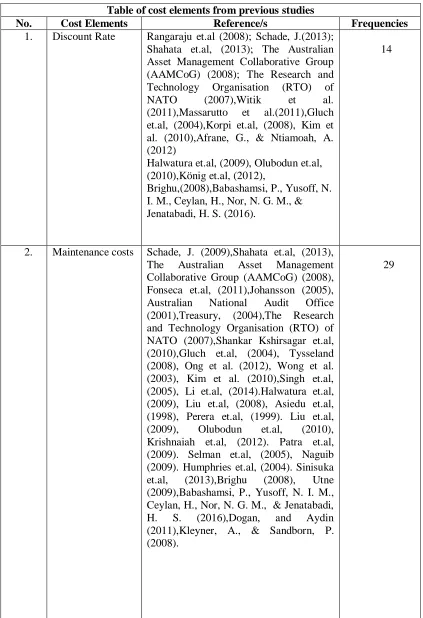
A Table of cost elements from previous studies 170 B Questionnaire to determine the weightage of most
budget spent and important phase in life cycle
stages for treated water pump 176
C Interview Questions for Expert Opinion on the Cost Elements For Cost Breakdown Structure of
Treated Water Pump 177
C1 Final Draft of Cost Breakdown Structure Treated Water Pump
176
CHAPTER 1
INTRODUCTION
1.1 Background of the Research
Asset management is noticeable by its highly structured approach to identify assets and to be familiar with the assets very well (Harlow, 2001). Besides, it can be defined as a set of processes managing assets through their life cycles and must be practicably implemented in a systematic way. Asset management also mentioned as an holistic approach to run infrastructures that combines engineering principles with well business practices, economic theory and information management as well as the traditional operational matters related to the maintenance of assets (USEPA, 2006). However, the asset management process should draw out from design, procurement and installation to achieve even better value through operation, maintenance and retirement of the complete life cycle (Schuman, 2005). Thus, all life cycles within a system must be included. Asset life-cycle considers the design, construction, commissioning, operating, maintaining, repairing, modifying, replacing and the disposal of assets (Ambrose et al. 2008).
pressure and energy costs, pressure hesitancy, faulty pressure at customers’ premises and problems with water quality. This is why the system of water supply infrastructures throughout the world became deteriorated (Watson et al., 2001; Engelhardt et al., 2003; Rahman and Vanier, 2004). Hence, water utilities must analyse asset condition, performance, remaining life and risks to facilitate improved asset maintenance investment decision-making (Urquhart, 2006).
Considering the issue of deterioration and high cost in water asset, Engelhardt et al. (2003) proposed Life Cycle Costing (LCC) concept to water distribution system management, which aims at attaining the lowest network provision and operating cost when all private and societal parties consider achieving the standards enforced by regulation. Based on Too (2010), LCC is an essential concept in asset management where all costs are reduced. It begins with the initial investment through operation and maintenance, and ends up with disposal. LCC or Whole Life Cycle Cost (WLCC) is sometimes considered as the exercises to identify, track, quantify and calculate the lifetime of an asset. In such a way, LCC has been defined as a decision support tool to prioritise alternatives (Engelhardt et al., 2003). In addition, The American Public Works Association stated that it is crucial for the industry to move from a low bid procurement strategy to LCC strategy (Ambrose et al., 2008). In short, the significances of the strategic level in asset management are the cost optimisation, performance and risk at the design, procurement and decision-making of the infrastructure based on the LCC (Too et al. 2006).
decision-making based on life cycle costs among pump system users (Tutterow et al., 2006). Moreover, many water facilities in pump system have their life cycle costs dominated by energy and maintenance costs (Tutterow et al., 2006).
To decide whether to purchase new pumps or to prolong the pump’s life even though they are usually purchased as individual component, pump will only provide service when it is operating as part of a system (Frenning, 2001). To ensure the efficiency of a pump, it must be consciously matched with its effective lives to obtain the lowest energy and maintenance costs (Frenning, 2001). Moreover, by understanding all the components making up the total cost of a pump system, the energy, operation, and maintenance costs of a pump can be essentially reduced. Thus, LCC has to be considered when designing a system to achieve the aforementioned objective (Hodgson et al., 2002).
Previous study claimed that the success implementation of LCC is based on the availability of data. According to Barringer (2003) and Smit (2009), LCC is a data driven process.. However, Barringer (2003) argued that LCC is lack of data and reliable information (Bull, 1993; Goh et al., 2010). This issue therefore brings difficulties in forecasting beyond a long period of time specifically for component life cycle and performance, future operating and maintenance plans and cost as well as the discount rate. Besides, Hodgson et al. (2002) suggested that all of these costs were hidden from the objective when making decision. As a result, LCC implementation became slow as there is a lack of trusted past data of LCC (Korpi, 2008).
El-Haram et al., (2002) in their study have developed a framework to collect LCC data in building industry. They tried to solve the main barriers to the succesfully implement WLC (also referred as LCC) despite the lack of reliable and consistent data elements including capital cost, facilities management and disposal cost. They also explained how to develop a consistent and flexible framework to collect data for WLC of buildings by looking at the breakdown of cost elements included in LCC. Their study aimed at giving value to all the project team members such as designer, facilities manager, contractor, supplier, and the entire person involved in the project management by concerning the development of Cost Breakdown Structure (CBS) prior making LCC estimation.
Cost Breakdown Structure (CBS) is generally used to confirm that all related cost elements of the system are recognised, convinced and considered. This term may reflect a structured list of all items needed during the LCC process. However, the LCC adoption is lack of generic breakdown structure. In a word, CBS is crucial before applying LCC model. However, not all pump users and asset managers in water industry are aware with LCC. Even Korpi et al. (2008) has conducted a review on constructions with the leasing industry that applied LCC. He had reviewed about 55 published case studies of LCC. The review involved a total of 38 cases from the year 2000 until the year 2007, which produced the list of LCC implementation’s areas including construction, transportation, manufacturing, energy, research and real estate. It was observed that there is only one study of LCC in real estate with none in water industry.
1.2 Problem statement
Works Department (PWD) has published a guideline in 2012 specially to introduce LCC with the cost elements and the guideline named “Garis Panduan Kos Kitaran Hayat” (KKH). Thus, the same alternative is going to be implement in water industry. However, LCC is actively applied within construction industry (Korpi et.al, 2008). Also happens in Malaysia the basis of purchasing pumps in the department is by choosing a pump only with the least price quoted and not a pump with low LCC (PAAB, 2015). Not only that, Malaysia also lack with framework and mechanisme to collect and store the LCC data or mechanisms to collect and store the data (Lindholm et al., 2004; Bakis et al., 2003; Schade, 2007; PAAB, 2015).
Thus, in order to solve the LCC “data issue” (lacking of framework and mechanisme to collect and store data), the development of Cost Breakdown Structure (CBS) is need to be concern prior making LCC estimation (El-Haram et al., 2002; Jeong et al. 2012; Smit, 2012). At the same time, a LCC framework is a helpful idea to encourage many researchers and practitioners to practice LCC. CBS might counter the problems by enhancing the CBS to increase and standardise the use of LCC (El-Haram et al., 2002; Jeong et al. 2012). Not to mention, the proposed framework is purposively used to collect cost data and to ensure consistency and flexibility of data collection (El-Haram et al., 2002). By doing so, all cost elements can be included without any ignoration (Kishk et al., 2003). Smit (2012) has also explained how NATO develops the generic life cycle cost breakdown structure in the framework for LCC in multinational defence programme. Nevertheless, LCC must be carefully broken down to avoid the “epistemic uncertainty” or uncertainties in results if there is lack of definition in developing the CBS or in excluding any less important cost elements (Goh et al., 2010).
Management Company (WAMCO) established on 5th May 2006 as a wholly owned company under the Minister of Finance Incorporated. PAAB forms a part of the Federal Government’s efforts to restructure the water services industry in the country to achieve better efficiency and quality (PAAB, 2015). Plus, according to report of Water Services Industry Performance published by Suruhanjaya Perkhidmatan Air Malaysia (SPAN) in 2009, the high rate in energy cost was created by the water treatment by 56% in the year 2009. The high electricity tariff was resulted due to many old and inefficient treatment plants that are in operation. Besides, treated water pump stations were declared as the largest consumers of energy in water treatment plant (Headquarters, Department of the Army, 1992). Apart from that, SPAN has also put the KPI on PAAB to calculate the LCC for every water asset leased to the water operator companies migrated to PAAB (PAAB, 2015).
In the meantime, the complexity of asset management is often collaborated with lack of finance, skills and information disrupting the processes of acquiring, commissioning, maintaining, overhauling, and replacing assets at optimum time. A number of decisions such as what assets to acquire, when to carry out maintenance and when to renew or replace assets is to be answered in asset management (Asian Development Bank, 2013). Yet, hundreds of billions of dollars are spent to manage assets all around the world (Frolov et al., 2010). Mostly, the operating cost (for depreciation, maintenance and energy) is driven by the asset base. Plus, the annual expenses for new assets and asset renewal are significant.
decision, which leads to the difficulties in managing the financial as the lifespan of the assets is longer than normal borrowing periods and where revenues are defenceless on asset valuations. At the same time, the same issue of funding has occurred in the Malaysian water industry, which often turns out to be a critical issue.
1.3 Objectives of the Research
Based on the problem statement, the main purpose of this study is to provide the systematic LCC Cost Breakdown Structure (CBS) for treated water pump in Malaysia. Hence, the following objectives were formulated including: 1. To identify the cost element needed for estimating LCC for treated water pumps in Malaysia.
2. To identify the weightage of each LCC main cost element in life cycle phases for treated water pump in Malaysia.
3. To develop cost breakdown structure (CBS) for treated water pumps in Malaysia.
1.4 Scope of the Research
1.5 Research Methodology
To achieve the stated objectives, this research was carried out using the following methodologies:
1. Literature review;
2. Interview research question; 3. Questionnaire surveys;
4. Analytical Hierarchy Process (AHP); and 5. Delphi method;
1.5.1 Literature Review
The literature review is based on the previous studies related or similar to that of LCC implementation or treated water pump. The cost elements required for the development of LCC model are selected by looking at the frequency it is cited. Next, the most cited cost elements are validated by the opinion of the experts and practitioners through interview session during Delphi Analysis. Once validated, it is included in the Cost Breakdown Structure (CBS) before developing the model. In addition, the review of previous literature also covers the readiness and critical success factors determining the LCC readiness and its implementation factors. Then, these studies are picked to be included in the questionnaire survey based on their suitability to be applied together to overcome the LCC barriers.
1.5.2 Interview question
1.5.3 Questionnaire surveys
Questionnaire surveys were used in this study to achieve the third and fourth objectives based on CBS developed to determine which of the phase in lifespan of treated water pump that affect the budget allocation. At the same time, it guides the decision makers to properly allocate future budget based on LCC of treated water pumps in Malaysia. The objective of using questionnaire in the third objective is to collect the information and opinions among the experts regarding to the most spent budget along the lifespan of treated water pump. This questionnaire is distributed during the last round of Delphi process.
Another survey is conducted to achieve the fourth objective to determine the readiness level among Malaysian water industry towards the implementation of LCC and CBS developed. However, the survey conducted at this level is in the form of response survey, which is called Likert-scale questionnaire.
1.5.4 Analytical Hierarchy Process (AHP) approach
As the financial issue arisen in the water industry leads to the deterioration of water assets, which is crucial in ensuring the better management of budget allocation. Garcia et al. (2004) mentioned that the reason behind the difficulty in allocating the cost is that water services require great capital investments that are fixed, which is equal to the quantity of water consumed.
by looking into the priority of cost spent along the life cycle of a plant or equipment.
1.5.5 Delphi method
Delphi method is used to collect the data and validate the collected data where the experts’ opinions are used with the Delphi undergoing four rounds. Jeong et al. (2012) mentioned that Delphi method is an analysis that involves expert’s opinions and advices to collect certified opinions and to produce a combined judgment. The idea of applying Delphi method is to ensure the validity and neutrality of CBS development. Agreed by Okoli et al. (2004), this method in various past studies was not only applied for “Forecasting and Issue Identification/ Prioritisation”, but also in the “Concept/Framework Development”. This has actually supported the reason of selecting Delphi method as this research objective is to develop Cost Breakdown Structure (CBS) for treated water pump.
1.6 Significance of the Research
The significance of the study commonly outlines the importance, practice and future of the study. Thus the significances of this research can be seen in four aspects:
a) The result contributes to the academic world in term of the compilation of cost elements needed to estimate LCC for water pump in Malaysia; b) The result contributes in the future research to calculate the LCC of
water pump with the real value and numbers;
d) Results from this study also propose a systematic and structured data cost to develop LCC for water pumps in Malaysia;
e) The results of the analytical study on the identifing the weightage of each LCC main cost element in life cycle phases for water pump in Malaysia can be use to help the Malaysia’s water industry practitioners to allocate budget wisely in future;
f) The results of this study may be a beginning for the Malaysia’s water industry to implement LCC using the CBS developed.
g) The result will contributes consultants, water asset managers, municipalities, and others a relevant overview of all the key factors essential for making the better decision to lower the cost over the total lifetime of a pump system.
1.7 Organisation of the Study
This thesis is divided into six chapters;
Chapter 1 introduces the whole picture of the study consisting research background, problem statement, objectives of the study, scope of the study, methodology, significance of the study and the organisation of the study.
Chapter 2 highlights the review on the concept of asset management and its relations with LCC. Furthermore, an overview on cost elements cited in previous study of LCC is presented, which is used to develop the interview questions during the first round of Delphi method. It describes the cost elements involved to develop a CBS for LCC model. Subsequently, the LCC concepts and its descriptions are explored by looking at the literature and past studies.
session is explained. The Analytical Hierarchy Process (AHP) method is described as well as its purposes in this study are reviewed.
Chapter 4 reports the data collected and analysis conducted based on the responses from interview session during the Delphi study. Besides, this chapter reports the result from AHP calculation to determine the weightage for each main cost and CBS developed for treated water pump. Then, the result from all the data analyzed is presented at the end of this chapter.
Chapter 5 discusses the findings from the analysis of the questionnaires and experts’ opinions in answering the objectives of the study. The discussion refers the results of analysis of the experts’ opinions from Delphi analysis to the the Analytical Hierarchy Process (AHP) result presented in Chapter 4 and next , to the development of cost breakdown structure (CBS). This chapter discusses the agreement or contradiction and difference between the outcomes of the literature review, the results derives from Analytical Hierarchy Process (AHP) and the results of the experts’ opinions during Delphi study.
REFERENCES
Afrane, G., & Ntiamoah, A. (2012). Analysis of the life-cycle costs and environmental impacts of cooking fuels used in Ghana. Applied energy, 98, 301-306.
Alabi, M. O. (2010). Prioritizing factors of failure in controlling physical development in Nigerian cities. Journal of Sustainable Development in Africa, 12(2), 215-231.
Albee, S. and Byrne, R. (2007). A global vision for driving infrastructure asset management improvement. Leading-edge asset management: Reports and abstracts book, 17-19 October 2007, Lisbon, pp. 27.
Alegre, H. (2006). Performance Indicators for Water Supply Services Manual of best practice. International Water Association. Publisher : IWA Publishing, ISBN 1843390515, 9781843390510. Length : 289 pages.
Ambrose, M., Burn, S., DeSilva, D., & Rahilly, M. (2008, September). Life cycle analysis of Water Networks. In Plastics Pipe XIV: Plastics Pipes Conferences Association (Vol. 22).
Annamraju, S., Calaguas, B., & Gutierrez, E. (2001). Financing water and sanitation. Key issues in increasing resources to the Sector, Water Aid briefing paper.
Armstrong, J. S. (2006). Findings from evidence-based forecasting: Methods for reducing forecast error. International Journal of Forecasting, 22(3), 583-598. Asian Development Bank, (2013). Water Utility Asset Management A Guide for
Asiedu, Y., & Gu, P. (1998). Product life cycle cost analysis: state of the art review. International Journal Of Production Research, 36(4), 883-908.
Australian Asset Management Collaborative Group (AAMCoG) (2008). Life Cycle Cost Analysis (LCC Report). Public Sector Asset Performance Measurement and Reporting, Australian Asst Management Collaborative Group (AAMCoG) and Cooperative Research Centre for Integrated Engineering Asset Management (CIEAM).
Australian National Audit Office (2001). Life Cycle Costing: Better practice guide. December 2001. Australian National Audit Office (2001). ISBN : 064280608X, 9780642806086. 30 pages.
Babashamsi, P., Yusoff, N. I. M., Ceylan, H., Nor, N. G. M., & Jenatabadi, H. S. (2016). Evaluation of pavement life cycle cost analysis: Review and analysis. International Journal of Pavement Research and Technology, 9(4), 241-254. Bakis, N., Amaratunga, R. D. G., Kagioglou, M., & Aouad, G. (2003). An integrated
environment for life cycle costing in construction. The 20th CIB W78 Conference on Information Technology in Construction, Auckland, New Zealand, 23-25 April 2003.
Bankston, J. D., & Baker, F. E. (1994). Selecting the Proper Pump. Southern Regional Aquaculture Center.
Barringer, H. P. & Weber, D. P., (1996). Life Cycle Cost Tutorial. Houston, Gulf Publishing Company and Hydrocarbon Processing.
Batagarawa, R., Williams, J. B., Potts, J. S., & Brown, J. C. (2015). Use of analytic hierarchy process (AHP) as an instrument to develop a solid waste
management assessment tool. Global Journal of Advanced Engineering
Technologies, 4(2), 70.
Beech, B.F., 1997. Studying the future: A Delphi survey of how multi-disciplinary clinical staff view the likely development of two community mental health
centres over the course of the next two years. Journal of Advanced Nursing 25, 331±338.
Beech, B. (1999). Go the extra mile--use the Delphi Technique. Journal of Nursing Management, 7(5), 281-288.
Bello-Dambatta, A., Farmani, R., Javadi, A. A., & Evans, B. M. (2009). The Analytical Hierarchy Process for contaminated land management. Advanced Engineering Informatics, 23(4), 433-441.
Bhuasiri, W., Xaymoungkhoun, O., Zo, H., Rho, J. J., & Ciganek, A. P. (2012). Critical success factors for e-learning in developing countries: A
comparative analysis between ICT experts and faculty. Computers & Education, 58(2), 843-855.
Biloslavo, R., & Dolinšek, S. (2010). Scenario planning for climate strategies development by integrating group Delphi, AHP and dynamic fuzzy cognitive
maps. Foresight, 12(2), 38-48.
Bloomfield, P., Dent, S., and McDonald, S. (2006). Incorporating Sustainability Into Asset Management Through Critical Life Cycle Cost Analyses. Water Environment Foundation WEFTEC®.06.
Bolger, F. & Wright, G. (1994). Assessing the quality of expert judgment: Issues and analysis. Decision Support Systems, 11(1), 1 – 24.
Brighu, U. (2008). Asset management in urban water utilities: Case study in India. PhD Thesis. Cranfield University, 2008.
Bryant, J. E., Pead, E. F., Polonski, S., Sabrsula, J., & Spiller, J. V. (2001). Elements of Mechanical Equipment Life-Cycle Cost Analysis. unbekannt. S, 177-182. Brunelli, M. (2015). Introduction to the Analytic Hierarchy Process. SpringerBriefs
Bull, J. W. (1993). The Way Ahead for Life Cycle Costing in the Construction Industry. In Bull, J. W. (ed.) Life Cycle Costing for Construction. Blackie Academic & Professional, Glasgow, UK.
Burns, N. and Grove, S.K. (2001). Practise of nursing Research: Conduct, critique and utilization. Philadelphia: Saunders.
Caputo, A. C., & Pelagagge, P. M. (2008). Parametric and neural methods for cost estimation of process vessels. International Journal of Production Economics, 112(2), 934-954.
Cavanagh, S. (1997). Content analysis: concepts, methods and applications. Nurse Researcher, 4(3), 5-16.
Chan, A., Keoleian, G. and Gabler, E. (2008). Evaluation of life cycle cost analysis practices used by the Michigan Department of Transportation. Journal of Transportation Engineering, ASCE, Vol. 134 No. 6, pp. 236-45.
Cheng, J. H., & Tang, C. H. (2009). An application of fuzzy Delphi and fuzzy AHP for multi-criteria evaluation on bicycle industry supply chains. WSEAS Transactions on Systems and Control, 4(1), 21-34.
Clarke, C. (2005). The Australian influence: Asset Management - a CEO's point of view. Water asset management international, vol. 1, no. 2, pp. 3.
Coffelt, D. P., & Hendrickson, C. T. (2010). Life-cycle costs of commercial roof systems. Journal of Architectural Engineering, 16(1), 29-36.
Coffey, A., & Atkinson, P. (1996). Making sense of qualitative data: Complementary research strategies. Thousand Oaks: Sage.
Cramer, R. H. (1990). Issues related to the education of gifted children in the United States: A Delphi study. Digital Abstracts International, 51 (05), 1574. (UMI No. 9028025).
Dell'Isola, A., & Kirk, S. (2003). Life Cycle Costing for Facilities. Kingston: Reeds Construction Data. ISBN: 0-87629-702-5.
Dhillon, B. S. (2009). Life cycle costing for engineers. CRC Press.
DiCicco‐Bloom, B., & Crabtree, B. F. (2006). The qualitative research interview. Medical education, 40(4), 314-321.
Dogan, I., & Aydin, N. (2011). Combining Bayesian Networks and Total Cost of Ownership method for supplier selection analysis. Computers & Industrial Engineering, 61(4), 1072-1085.
Dong, Y., Xu, Y., Li, H., & Dai, M. (2008). A comparative study of the numerical scales and the prioritization methods in AHP. European Journal of Operational Research, 186(1), 229-242.
Duverlie, P., & Castelain, J. M. (1999). Cost estimation during design step: parametric method versus case based reasoning method. The International Journal Of Advanced Manufacturing Technology, 15(12), 895-906.
Earles, D.R. (1976). Techniques For A Multifaceted Discipline. Def. Mgmt Jl 38-47. Economic Unit Planning (EPU) (2006). The Ninth Malaysia Plan. Economic
Planning Unit, Putrajaya.
Edwards, M. L., & Smith, B. C. (2011). The effects of the neutral response option on the extremeness of participant responses. Incite, 6, 177-192.
El-Haram, M. A., Marenjak, S., & Horner, M. W. (2002). Development of a generic framework for collecting whole life cost data for the building industry.
Journal of Quality in Maintenance Engineering, 8(2), 144-151.
Ellram, L. M., & Siferd, S. P. (1998). Total Cost of Ownership: A. Key Concept in Strategic Cost Management Decisions. Materials Engineering, 288(288), 288.
Elo, S., & Kyngäs, H. (2008). The qualitative content analysis process. Journal of advanced nursing, 62(1), 107-115.
Emblemsvåg, J. (2003). Life-cycle costing: using activity-based costing and Monte Carlo methods to manage future costs and risks. John wiley & sons.
Engelhardt, M., Savic, D. A., Skipworth, P., Cashman, A., Saul, A. J., and Walters, G. A. (2003). Whole life costing: Application to water distribution network. Water Sci. Technol.: Water Supply, 31–2, 87–93.
Environmental Finance Center, New Mexico Tech (2009). Asset Management: A Guide for Water and Wastewater Systems. Environmental Finance Center, New Mexico Rural Water Association, and Rural Community Assistance Corporation.
Environmental Protection Agency (EPA) Of United States (2003). Asset Management: A Handbook for Small Water Systems One of the Simple Tools
for Effective Performance (STEP) Guide Series. Office of Water (4606M). EPA 816-R-03-016. www.epa.gov/safewater. September 2003.
Environmental Protection Agency (EPA) of Ireland (2011). Water Treatment Manual: Disinfection. Environmental Protection Agency PO Box 3000, Johnstown Castle Estate County Wexford, Ireland.
Ewusi-Mensah, K. (1997). Critical issues in abandoned information systems development projects. Communications of the ACM, 40(9), 74-80.
Fabrycky W., Blanchard, B., (1991). Life Cycle Cost and Economic Analysis. PrenticeHall, Inc., Englewood Cliffs, New Jersey.
curriculum in department of risk management and insurance. J Soc Sci, 19(1), 1-8.
Federal Highway Administration (1993). Number 12, Federal Highway Administration, Washington, DC. Life Cycle Cost Analysis: Summary of
Proceedings, FHWA Life Cycle Cost Symposium : December 15-16, 1993,
Part 3. U.S. Department of Transportation, Federal Highway Administration, 1994. Original from: Northwestern University. Digitized: 12 Jun 2013. Length 52 pages
Fernández, I., & Kekale, T. (2008). Better models with Delphi and analytic hierarchy process approaches: the case of reverse logistics. International Journal of Logistics Systems and Management, 4(3), 282-296.
Ferry D J O and Flanagan R (1991). Life cycle costing – a radical approach. CIRIA, London.
Fielding, N. G. and Lee, R. M. (1991). Using Computers in Qualitative Research. London: Sage.
Fink, A. & Kosecoff, J. (1985). How to conduct surveys: A step-by-step guide. London, UK, Sage Publications.
Finnveden, G., Michael Z. H. , Ekvall, T. , Guinée, J., Heijungs, R., Hellweg, S., Koehler, A., Pennington, D. and Suh, S. (2009). Recent developments in life cycle assessment. Journal of environmental management 91, no. 1 (2009): 1-21.
Foley, A. (2005). Benchmarking asset management. Water Asset Management International, Vol. 1, No. 1, Pp. 22.
Folgado, R., Peças, P., & Henriques, E. (2010). Life cycle cost for technology selection: A Case study in the manufacturing of injection moulds.
Fonseca, C., Franceys, R., Batchelor, C., McIntyre, P., Klutse, A., Komives, K. ... & Potter, A. (2011). Life cycle costs approach. IRC International Water and Sanitation Centre, 38.
Frenning, L (Ed.). (2001). Pump Life Cycle Costs: A Guide to LCC Analysis for Pumping Systems. Hydraulic Institute, Europump, and the US Department of Energy’ s Office of Industrial T echnologies (OIT).
Friend, J. G. (2001). A Delphi study to identify the essential tasks and functions for ADA coordinators in public higher education. Digital Abstracts International, 62 (04), 1339. (UMI No. 3012967).
Frolov, V., Ma, L., Sun, Y., & Bandara, W. (2010). Identifying core functions of asset management. In Definitions, Concepts and Scope of Engineering Asset Management (pp. 19-30). Springer London.
Fuller, S. and Petersen, S. (1995). Life-Cycle Costing Manual for the Federal Energy Management Program: NIST Handbook 135, 1995th ed. US Department of Commerce, Washington, DC.
Garcia, S. and Reynaud, A. (2004). Estimating the benefits of efficient water pricing in France. Resource and Energy Economics 26 (2004) 1–25.
Garman, E. T and Sorhaindo, B (2005). Delphi Study of Experts’ Rankings of Personal Finance Concepts Important in the Development of the InCharge
Financial Distress/Financial Well-Being Scale. Consumer Interest Annual. Volume 51, 2005.
Gerdsri, N., & Kocaoglu, D. F. (2007). Applying the Analytic Hierarchy Process (AHP) to build a strategic framework for technology roadmapping.
Mathematical and Computer Modelling, 46(7), 1071-1080.
Gluch, P. and Henrikke, B. (2004). The life cycle costing (LCC) approach: a conceptual discussion of its usefulness for environmental decision-making.
Goedecke, M., Therdthianwong, S., & Gheewala, S. H. (2007). Life cycle cost analysis of alternative vehicles and fuels in Thailand. Energy Policy, 35(6), 3236-3246.
Goh, Y. M., Newnes, L. B., Mileham, A. R., McMahon, C. A., & Saravi, M. E. (2010). Uncertainty in Through-Life Costing–-Review and Perspectives. Engineering Management, IEEE Transactions on, 57(4), 689-701.
Good, J. J. (1998). Recommendations for change in physical education: A survey of selected physical education professionals. Digital Abstracts International, 59 (07), 2417. (UMI No. 9839207).
Green B., Jones M., Hughes D. & Willimas A. (1999). Applying the Delphi technique in a study of GP's information requirements. Health and Social Care in the Community 7(3), 198±205.
Green, A. C., Armstrong, J. S., & Graefe, A. (2007). Methods to elicit forecasts from groups: Delphi and prediction markets compared. Foresight: The International Journal of Applied Forecasting (Forthcoming) And Munich
Personal Repec Archive. MPRA Paper, 4663.
Hall, R., & Dimitrov, E. (2009). The Application of Cost Management and Life-Cycle Cost Theory to Homeland Security National Priorities. Homeland Security Affairs, 5(2).
Halwatura, R. U., & Jayasinghe, M. T. R. (2009). Influence of insulated roof slabs on air conditioned spaces in tropical climatic conditions—a life cycle cost
approach. Energy and Buildings, 41(6), 678-686.
Hartman, F. & Baldwin, A. (1995). Using technology to improve the Delphi method. Journal of Computing in Civil Engineering, 9, 244 – 249.
Harlow, V. K. (2001). Asset Management: The life-cycle approach. Proceedings of the Water Environment Federation, 2001(11), 1-8.
Hodgson, J., & Walters, T. (2002, February). Optimizing pumping systems to minimize first or life-cycle cost. In Proceedings of The International Pump Users Symposium (Pp. 1-8).
Hunter PR, MacDonald AM, Carter RC (2010). Water Supply and Health. PloS Medicine 7(11): e1000361. doi:10.1371/journal.pmed.1000361. Published November 9, 2010
Headquarters Department Of The Army, (1992). Water Supply: Pumping Stations. Technical Manual. No. 5-813-6. Tm 5-813-9. Washington, Dc, 6 October 1992.
Hickey, H. E. (2008). Water Supply Systems and Evaluation Methods: Volume I: Water Supply System Concepts. United States Fire Administration. Web link:
www. usfa. dhs.
gov/downloads/pdf/publications/Water_Supply_Systems_Volume_I. pdf. Hinow, M., Waldron, M., Müller, L., Aeschbach, H., & Pohlink, K. (2008).
Substation life cycle cost management supported by stochastic optimization
algorithm. 42nd General Session of CIGRE (International Council on Large Electric Systems), Paris, France.
Hodges, C.P., (2005). A facility manager's approach to sustainability. Journal of Facilities Management, Vol. 3 Iss: 4 pp. 312 – 324.
Hong, T., Han, S., & Lee, S. (2007). Simulation-based determination of optimal life-cycle cost for FRP bridge deck panels. Automation in Construction, 16(2), 140-152.
Hsieh, H. F., & Shannon, S. E. (2005). Three approaches to qualitative content analysis. Qualitative health research, 15(9), 1277-1288.
Hsueh, S. L., & Yan, M. R. (2011). Enhancing sustainable community developments a multi-criteria evaluation model for energy efficient project selection.
Energy Procedia, 5, 135-144.
Huang, C.C., Chu, P.Y. and Chiang, Y.H. (2008). A fuzzy AHP application in government sponsored R&D project selection. Omega, Vol. 36, No. 6, pp.1038–1052.
Huang, C. S., Lin, Y. J., & Lin, C. C. (2008). Determination of insurance policy using a hybrid model of AHP, fuzzy logic and Delphi technique: a case study.
WSEAS Transactions on Computers, 7(6), 660-669.
Huang, G. L., Hsu, H. L., & Cheng, W. S. (2010). The key factors to the successful generation of intellectual capital: The bank corporate loans department
example. International Journal of Electronic Business Management, 8(2), 81. I
Humphries, J., McCaleb, B., (2004). Optimizing total cost of ownership. July 2004. Plant Engineering; July 2004, Vol. 58 Issue 7, p23. Trade Publication
Ibrahim, A. D., & Price, A. D. F. (2006). The development of a continous improvement framework for long-term partnering relationships. Journal of Financial Management of Property and Construction, 11(3), 149-163.
Ilangkumaran, M. (2010). Hybrid Multi Criteria Decision Making Techniques For Selection of Maintenance Strategy. PhD Thesis. Anna University Chennai Chennai.
Jeong, J. H., Sinin, H. W., Ryu, H. G., Kim, G. H., & Kim, T. H. (2012). Life Cycle Cost Breakdown Structure Development of Buildings through Delphi
Analysis. Journal of the Korea Institute of Building Construction, 12(5), 528-39.
Jiang, R., Zhang, W. J., & Ji, P. (2003). Required characteristics of statistical distribution models for life cycle cost estimation. International Journal of Production Economics, 83(2), 185-194.
Johansson, D. (2005). Modeling Life Cycle Cost for Indoor Climate Systems. Doctoral Thesis. Building Physic LTH, Lund University, Box 118, S-221 00 Lund, Sweeden.
Keil, M., Cule, P. E., Lyytinen, K., & Schmidt, R. C. (1998). A framework for identifying software project risks. Communications of the ACM, 41(11), 76-83.
Kelley, K., Clark, B., Brown, V., & Sitzia, J. (2003). Good practice in the conduct and reporting of survey research. International Journal for Quality in Health Care, 15(3), 261-266.
Kidane, F. (2012). The Role of Cost Analysis in Managerial Decision Making: A Review of Literature. Asian Journal of Research in Banking and Finance. Volume 2, Issue 3 (March, 2012). Ph.D Research Scholar, Lecturer in Accounting and Finance College of Business and Economics, Mekelle University, Mekelle, Ethiopia.
Kim, G. T., Kim, K. T., Lee, D. H., Han, C. H., Kim, H. B., & Jun, J. T. (2010). Development of a life cycle cost estimate system for structures of light rail
transit infrastructure. Automation in Construction, 19(3), 308-325.
Kincaid, S. O. (2003). Web-based courses in human services: A comparison of student and faculty perceptions of factors that facilitate or hinder learning.
Digital Abstracts International, 64 (07), 2403. (UMI No. 3098041).
Kishk, M., Al-Hajj, A., Pollock, R., Aouad, G., Bakis, N. And Sun, M., (2003). Whole life costing in construction: a state of the art review. Available from OpenAIR@RGU. [online]. Available from: http://openair.rgu.ac.uk.
Kmenta, S., & Ishii, K. (2000). Scenario-based FMEA: a life cycle cost perspective. In Proc. ASME Design Engineering Technical Conf. Baltimore, MD.
Ko, W. H., & Chiu, C. P. (2006). A new coffee shop location planning for customer satisfaction in Taiwan. International Journal of the Information Systems for Logistics and Management, 2(1), 55-62.
Kondracki, N. L., &Wellman, N. S. (2002). Content analysis: Review of methods and their applications in nutrition education. Journal of Nutrition Education and Behavior, 34, 224-230.
König, H., & De Cristofaro, M. L. (2012). Benchmarks for life cycle costs and life cycle assessment of residential buildings. Building Research & Information, 40(5), 558-580.
Korpi, E., & Ala-Risku, T. (2008). Life cycle costing: a review of published case studies. Managerial Auditing Journal, 23(3), 240-261.
Krebsbach, S. J. G. (1998). A set of learning outcomes for the learner in the two-year institution of higher education in order to function in work, community, and
family at the beginning of the twenty-first century. Digital Abstracts International, 59 (09), 3329. (UMI No. 9907508).
Krishnaiah, T., Rao, S. S., & Madhumurthy, K. (2012). The Life Cycle Cost Analysis of a Solar Stirling Dish Power Generation System. Energy Sources, Part B: Economics, Planning, and Policy, 7(2), 131-139.
Krosnick, J.A. (1991). Response strategies for coping with the cognitive demands of attitude measures in surveys. Applied Cognitive Psychology, 5, 213-236. doi: 10.1002/acp.2350050305.
Krosnick, J. A., & Presser, S. (2010). Question and questionnaire design. Handbook of survey research, 2, 263-314.
Journal of Facilities Management. Vol. 8 No. 3, 2010. pp. 162-178 q Emerald Group Publishing Limited 1472-5967. DOI 10.1108/14725961011058811. Kuczenski, B., Davis, C. B., Rivela, B., & Janowicz, K. (2016). Semantic catalogs
for life cycle assessment data. Journal of Cleaner Production, 137, 1109-1117.
Kumar, R (2005). Research Methodology: A Step-by-Step Guide for Beginner. Edition illustrated. Publisher: SAGE Publications, 2005. ISBN 141291194X, 9781412911948. Length: 332 pages.
Lam, S. S. Y., Petri, K. L., & Smith, A. E. (2000). Prediction and optimization of a ceramic casting process using a hierarchical hybrid system of neural
networks and fuzzy logic. IIE Transactions, 32(1), 83 - 92.
Langdon, D. (2007). ―Life cycle costing (LCC) as a contribution to sustainable construction: A common methodology – Final Report‖. London.
Lax, R., Seneca Falls, N. Y., Sanchez, K., Morton Grove, I. L., & Tutterow, V. (2006). Energy and Life Cycle Cost Savings in Pumping Systems. In 2006 AWWA DSS: The Conference and Exposition for Water Distribution & Plant Operations Professionals.
Lecklitner, G. L. (1984). Protecting the rights of mental patients: A view of the future. Digital Abstracts International, 46 (01), 306. (UMI No. 8504044). Lee, A. H., Kang, H. Y., Hsu, C. F., & Hung, H. C. (2009). A green supplier
selection model for high-tech industry. Expert systems with applications, 36(4), 7917-7927.
Levary, R. R., & Wan, K. (1999). An analytic hierarchy process based simulation model for entry mode decision regarding foreign direct investment. Omega, 27(6), 661-677.
Lewis, M. (2006). Loopy about assets. Utility week, vol. November, pp. 24-24. Li, W. W., Yu, H. Q., & He, Z. (2014). Towards sustainable wastewater treatment
by using microbial fuel cells-centered technologies. Energy & Environmental Science, 7(3), 911-924.
Lim, S.R and Park, J.M. (2007). Environmental and Economic Analysis of a Water Network System Using LCA and LCC. American Institute of Chemical Engineers.
Lindholm, A., & Suomala, P. (2004). The possibilities of life cycle costing in outsourcing decision making. Frontiers of E-business Research, 226-241. Linstone, Harold A., and Murray Turoff (2002). The Delphi Method. Techniques and
applications 53.
Liu, H., Gopalkrishnan, V., Ng, W-K. Song, B.,and Li, X. (2008). An intelligent system for estimating full product Life Cycle Cost at the early design stage.
International Journal of Product Lifecycle Management, 3, 2/3, 96–113. Liu, H., Gopalkrishnan, V., Quynh, K. T. N., and Ng, W. K. (2009). Regression
models for estimating product life cycle cost. Journal of Intelligent Manufacturing, 20(4), 401-408.
Liyanage, J.P. and Kumar, U. (2003). Towards a value-based view on operations and maintenance performance management. Journal of Quality in Maintenance Engineering, Vol. 9 No. 4, pp. 333-50.
López-Ibáñez, M., Prasad, T. D., & Paechter, B. (2011). Representations and evolutionary operators for the scheduling of pump operations in water
Macharia, P. M., Mundia, C. N., & Wathuo, M. W. (2015). Experts’ Responses Comparison in a GIS-AHP Oil Pipeline Route Optimization: A Statistical
Approach. American Journal of Geographic Information System, 4(2), 53-63. Mahlia, T. M. I., Saidur, R., Husnawan, M., Masjuki, H. H., & Kalam, M. A. (2010). An approach to estimate the life-cycle cost of energy efficiency improvement
of room air conditioners. Energy Educ Sci Technol Part A, 26, 1-11.
Mahlia, T. M. I., Razak, H. A., & Nursahida, M. A. (2011). Life cycle cost analysis and payback period of lighting retrofit at the University of Malaya . Renewable and Sustainable Energy Reviews, 15(2), 1125-1132.
McKee, K. K., Forbes, G., Mazhar, I., Entwistle, R., and Howard, I. (2011, May). A review of major centrifugal pump failure modes with application to the water
supply and sewerage industries. In Asset Management Council, ICOMS Asset Management Conference, Gold Coast, QLD, Australia (Vol. 16). Manual Pengurusan Aset Menyeluruh (MPAM), (2009). Pekeliling Am Bil 1 Tahun
2009 - MPAM . Jabatan Perdana Menteri, Malaysia.
Marlow, D. and Burn, S. (2008). Effective use of condition assessment with asset management. American water works association. Journal, vol. 100, no. 1, pp. 54.
Markus, M.L. and Tanis, C. (2000). The enterprise system experience - from adoption to success. in Zmud, R.W. (Ed.), Framing the Domains of IT Management: Projecting the Future Through the Past, Pinnaflex Educational Resources, Inc., Cincinnatti, OH, pp.173-207.
Mason, J. (1996). Qualitative researching. Thousand Oaks, USA: Sage Publications. Massarutto, A., de Carli, A., and Graffi, M. (2011). Material and energy recovery in
integrated waste management systems: A life-cycle costing approach. Waste management, 31(9), 2102-2111.
Proceedings The 36th International Conference on Computers and Industrial Engineering, pages pp. 3788-3798, Howard Hotel, Taipei, Taiwan.
Mayring, P. (2014). Qualitative content analysis—theoretical foundation and basic procedures. Klagenfurt. Retrieved February, 14, 2015.
Miller, R. S. (1992). Corrosion in Pumps. In Proceedings of the Ninth International Pump Users Symposium, Turbomachinery Laboratory, Department of Mechanical Engineering, Texas A&M University, College Station, Texas (pp. 119-127).
Mitchell, J.S., Carlson, J. (2001). Equipment asset management – what are the real requirements?. Reliability Magazine, October, pp.4-14.
Moon, F.L., Aktan, A.E., Furuta, H. and Dogaki, M. (2009). Governing issues and alternate resolutions for a highway transportation agency’s transition to
asset management. Structure and Infrastructure Engineering, Vol. 5 No. 1, pp. 25-39.
Mun, J. (2010). Modeling risk: Applying Monte Carlo risk simulation, strategic real options, stochastic forecasting, and portfolio optimization. (Vol. 580). John Wiley & Sons.
Naguib, R. (2009). Total cost of ownership: for air-cooled and water-cooled chiller systems. Ashrae Journal, 51(4), 42-47.
Namdeo,A and Pandey, R (2014). A Investigation On The Performance Of Water Pumping Station On Adoption Of Throttling For Flow Control In Water
Works Of Jabalpur Mu-Nicipal Corporation. International Journal of Advancements in Research & Technology, Volume 3, Issue 6, June-2014 46 .ISSN 2278-7763.
NATO RTO TR-SAS-054, (2007). Methods and models for life cyclecosting. RTO-SAS-054 Task Group Technical Report.
NATO RTO TR-SAS–069, (2009). Code of Practice for Life Cycle Costing. Task Group Technical Report; September 2009.
NATO RTO-MP-SAS-080, (2010). NATO Initiatives to Improve Life Cycle Costing.TNO Defence, Security and Safety Oude Waalsdorperweg 63 P.O. Box 96864 2509 JG The Hague The Netherlands.
Nicklow, J., Reed, P., Savic, D., Dessalegne, T., Harrell, L., Chan-Hilton, A., ... & Zechman, E. (2009). State of the art for genetic algorithms and beyond in water resources planning and management. Journal of Water Resources Planning and Management, 136(4), 412-432.
Nilsson, J., & Bertling, L. (2007). Maintenance management of wind power systems using condition monitoring systems—life cycle cost analysis for two case
studies. IEEE Transactions on energy conversion, 22(1), 223-229.
Olubodun, F., Kangwa, J., Oladapo, A., & Thompson, J. (2010). An appraisal of the level of application of life cycle costing within the construction industry in
the UK. Structural Survey, 28(4), 254-265.
Okoli, C., & Pawlowski, S. D. (2004). The Delphi method as a research tool: an example, design considerations and applications. Information & management, 42(1), 15-29.
Omran, A. (2011). Factors influencing water treatment management performance in Malaysia, a case study in Pulau Pinang. Annals of Faculty Engineering Hunedoara ‐ International Journal of Engineering , 2011, 1, 53‐62.
Ong, H. C., Mahlia, T. M. I., Masjuki, H. H., & Honnery, D. (2012). Life cycle cost and sensitivity analysis of palm biodiesel production. Fuel, 98, 131-139. Orencio, P. M., & Fujii, M. (2013). A localized disaster-resilience index to assess
coastal communities based on an analytic hierarchy process (AHP).
Ormsbee, L.E. and K.E. Lansey, (1994). Optimal Control of Water Supply Pumping Systems. Journal of Water Resources Planning and Management, ASCE, 120(2), 237-252.
Ormsbee, L., Lingireddy, S., & Chase, D. (2009). Optimal pump scheduling for water distribution systems. In Multidisciplinary International Conference on Scheduling: Theory and Applications (MISTA 2009) (pp. 10-12).
O'Connor, P. (2001b). Developing an Evaluation Model for Hotel Electronic Channels of Distribution. Tourism & Hospitality, Queen Margaret University College, Edinburgh, UK.
Ozbay, K., Ozmen-Ertekin, D. and Berechman, J. (2003). Empirical analysis of the relationship between accessibility and economic development‖. Journal of Urban Planning and Development, Vol. 129 No. 2, pp. 97-119. p) Parsons, S.A. and Jefferson, B. (2006). ―Introduction to Potable Water Treatment Processes‖. School of Water Sciences Cranfield University. Blackwell Publishing Ltd.
Parente, F. J., Anderson, J. K., Myers, P., & O’Brien, T. (1994). An examination of factors contributing to Delphi accuracy. Journal of Forecasting, 3(1), 173 - 183.
Parker, K.R. (1991). A Generic Life-Cycle Cost Model for an Embedded Controller. A Thesis Submitted in Partial Fulfillment of the Requirements for the Degree of Master of Science in Computer Science at Texas Tech University.
Patel, P. (2009). Introduction to Quantitative Methods. In Empirical Law Seminar. (2009, October).
Patra, A. P., Söderholm, P., & Kumar, U. (2009). Uncertainty estimation in railway track life-cycle cost: a case study from Swedish National Rail Administration.
Paul Guyer, J. (2013). An Introduction to Pumping Stations for Water Supply System. CreateSpace Independent Publishing Platform, 2013. ISBN 1490342575, 9781490342573. 40 pages
Pengurusan Aset Air Berhad (PAAB), (2015). Summary of Cost Database 2014- 2015. Pengurusan Aset Air Berhad, Kuala Lumpur, Malaysia.
Pfoser, S., Treiblmaier, H., & Schauer, O. (2016). Critical Success Factors of Synchromodality: Results from a Case Study and Literature Review.
Transportation Research Procedia, 14, 1463-1471.
Pirdashti, M., Omidi, M., Pirdashti, H., & Hassim, M. H. (2011). An AHP-Delphi multi-criteria decision making model with application to environmental
decision-making. Iranian Journal of Chemical Engineering, 8(2).
Polkinghorne, D.E (2005). Language and Meaning: Data Collection in Qualitative Research. Journal of Counseling Psychology 2005, Vol. 52, No. 2, 137–145. Poompipatpong, C., & Kengpol, A. (2013). A group decision support methodology
to weight diesel engine’s operating parameters by using analytical hierarchy
process and Delphi. International Journal of Industrial Engineering and Technology, 5, 47-61.
Powell, A. E. (2010). Special Report: The Infrastructure Roundtables: Address Life-Cycle Costs and Ongoing Maintenance. Civil Engineering—ASCE, 80(4), 71-79.
Prestamo, A. M. (2000). A comprehensive inventory of technology and computer skills for academic reference librarians. Digital Abstracts International, 61 (09), 3401. (UMI No. 9987367).
Public Works Department (PWD) (2012). GarisPanduan Kos KitaranHayat - Life Cycle Cost LCC. Pekeliling Am Bil 2 Tahun 2012. SuratArahan KPKR Bil.23/2012.
Rahman, S. and Zayed, T. (2008). Performance of Water Treatment Plant Elements. World Environmental and Water Resources Congress 2008.
Rangaraju, P. R., Amirkhanian, S. N., & Guven, Z. (2008). Life cycle cost analysis for pavement type selection. (No. FHWA-SC-08-01). South Carolina Department of Transportation.
Real, S. F. (2010). Contribution of Life Cycle Cost Analysis to Design Sustainability in Construction. (Doctoral dissertation in Civil Engineering, Department of Civil Engineering and Architecture-Instituto Superior Técnico-Technical University of Lisbon, Lisbon, Portugal. 153 p).
Rebitzer, G., Ekvall, T., Frischknecht, R., Hunkeler, D., Norris, G., Rydberg, T., & Pennington, D. W. (2004). Life cycle assessment: Part 1: Framework, goal and scope definition, inventory analysis, and applications. Environment international, 30(5), 701-720.
Reich, M. C. (2005). Economic assessment of municipal waste management systems—case studies using a combination of life cycle assessment (LCA)
and life cycle costing (LCC). Journal of Cleaner Production, 13(3), 253-263. Resurreccion, E. P., Colosi, L. M., White, M. A., & Clarens, A. F. (2012).
Comparison of algae cultivation methods for bioenergy production using a
combined life cycle assessment and life cycle costing approach. Bioresource Technology, 126, 298-306.
Richardson, S. J., & Hodkiewicz, M. R. (2011). Modeling tool to support budgeting and planning decisions for pump overhauls. Journal of Water Resources Planning and Management, 137(4), 327-334.
Delphi Method Survey of Professional Video Communicators. Digital Abstracts International, 46 (09), 2548. (UMI No. 8525512).
Rossiter, J. R. (2011). Measurement for the Social Sciences: The C-OAR-SE Method and Why It Must Replace Psychometrics. New York: Springer.
Saaty, T.L., 1980. The Analytic Hierarchy Process. McGraw-Hill, New York. Saaty, T. L. (1990). How to make a decision: the analytic hierarchy process.
European journal of operational research, 48(1), 9-26.
Saaty, T.L. (1990). Eigenvector and logarithmic least squares. European Journal of Operational Research 48: 156-160.
Saaty, T. L. (2003). Decision-making with the AHP: Why is the principal eigenvector necessary? . European journal of operational research, 145(1), 85-91.
Saaty, T. L., & Shih, H. S. (2009). Structures in decision making: On the subjective geometry of hierarchies and networks. European Journal of Operational Research, 199(3), 867-872.
Sato, Y. (2003). Comparison between Ranking Method and the Analytic Hierarchy Process in Program Policy Analysis. The Proceeding on the Seventh International Symposium on the Analytic Hierarchy Process 2003, 429-439. Sato, Y. (2004). Comparison between Multiple-choice and Analytic Hierarchy
Process: Measuring Human Perception. International Transactions in Operational Research, 11(1), 77-86.
Sato, Y. (2005). Questionnaire design for survey research: Employing weighting method. In Proceedings of the Eighth International Symposium on the Analytic Hierarchy Process.