ABSTRACT
PEERY, ANNETTE IVEY. Caring and Burnout in Registered Nurses: What’s the Connection? (Under the direction of Dr. Duane Akroyd.)
In order to prevent burnout among nurses, key causes of burnout must be identified and targeted for direct intervention. The literature discusses burnout among nurses, focusing on burnout due to task-related variables and not patient-related (caring) variables. Two major problems exist with research on burnout and caring in registered nurses (RNs). The first is the lack of robust methods of research utilized to study the concept of caring. The second is the lack of research on the link between caring and burnout in RNs.
The purpose of this study was to examine the relationship between caring and burnout in a sample of RNs in North Carolina. The major hypothesis for this research, was that as RNs report increased levels of caring, they also report higher levels of burnout. Four research questions are addressed in this project.
The population for this study consisted of all RNs within the state of North Carolina. Subjects were selected randomly to obtain a sample of 3,500 to receive a mailed survey. The revised Caring Behaviors Inventory was used to measure the five dimensions of caring (independent variables) and the Maslach Burnout Inventory to measure the three dimensions of burnout (dependent variables). A multiple regression analysis was conducted between each dimension of burnout and four carative factors. This study revealed that the four
carative factors identified do impact a nurse’s level of burnout and had the greatest impact on the burnout dimension of reduced personal accomplishment. The carative factor of
CARING AND BURNOUT IN REGISTERED NURSES: WHAT’S THE CONNECTION?
By
ANNETTE IVEY PEERY
A Dissertation
Submitted to the Graduate School Of North Carolina State University In Partial Fulfillment of the Requirements
For the Degree of Doctor of Education
ADULT AND COMMUNITY COLLEGE EDUCATION
Raleigh, N.C. 2006
Approved by:
______________________________________ _________________________________
Dr. Duane Akroyd Dr. Conrad Glass
Chair of Advisory Committee
______________________________________ _________________________________
Dedication
To my husband, Bill, And
My sons, Roger and Ben,
For their endless supply of love, encouragement, prayers and patience, As well as your many sacrifices during this endeavor.
Also,
To my parents, Billy and Sarah Ivey, For their love, encouragement and support of
Biography
Sarah Annette Ivey Peery was born July 20, 1961, in Scotland Neck, Halifax County, North Carolina. She received a Bachelor of Science in Nursing from the University of North Carolina at Chapel Hill in May 1983 and a Master of Science in Nursing from East Carolina University, Greenville, North Carolina in May 1996. Annette Peery is also certified as a Diabetes Educator. At the time of this dissertation completion, she is a Clinical Assistant Professor in the School of Nursing at East Carolina University.
Ms. Peery is a member of the nursing honor society, Sigma Theta Tau International and is currently president of the Beta Nu Chapter of this society. She is also a member of Phi Kappa Phi and the National League for Nurses. She was award the Excellence in Education Award from Sigma Theta Tau International Beta Nu Chapter in 2002 and 2004. In 1997 she led the diabetes care path team which was award the Department of Family Medicine Team Recognition Award for the Diabetes Care Path Team at the East Carolina University
Department of Family Medicine.
Acknowledgements
There are many people without whom this dissertation would have never become a reality. I hope that I am not remiss in acknowledging everyone. First, I would like to think Dr. Duane Akroyd, chair of my committee. He remained patient through my “dry spells” and continued to offer advice and encouragement. I would also like to thank my committee members, Dr. Conrad Glass, Dr. John Pettitt and Dr. Kathy Kolasa.
I’d like to say a special “thank you” to Dr. Kolasa. Kathy has served as a mentor for many years and is a very special friend. She strongly supported my decision to begin this educational endeavor and has encouraged me throughout the process.
None of this would have occurred without some tremendous assistance with data entry from nearly 800 surveys – certainly not a feat I could have completed on my own in a timely fashion. Thanks to Dr. Marti Engelke in the East Carolina University School of Nursing Office of Scholarship and Research for assisting me in finding student workers to help enter data. My family went over and beyond the call of duty in this area as well. A big thanks to my aunt, Bobbie Edwards, for the hundreds of surveys she entered and to my mom, Sarah Ivey, for her assistance in helping me track the surveys. Dr. Mel Swanson, also in the ECU SON Office of Scholarship and Research, was a tremendous help in assisting with interpretation of statistical data. And lest, should I never forget that all of the surveys first had to be mailed and labels placed on envelopes! Thank you to Bill, Roger and Ben – my boys – for their hours of sitting in the living room floor doing just that!
encouragement and brainstorming were priceless! Also, thanks to Dr. Robin Webb-Corbett for unending support and editorial assistance.
Table Of Contents
Page List Of Tables ---
List Of Figures ---
viii ix Chapter I: Introduction and Overview --- Introduction --- Theoretical Perspectives --- Conceptual Framework --- Significance of the Problem--- Statement of the Problem --- Purpose of the Study --- Research Questions --- Definition of Terms ---
1 1 3 7 8 10 14 14 15 Chapter II: Literature Review ---
Literature Review: Caring --- Literature Review: Burnout --- Literature Review: Caring and Burnout ---
17 17 26 30 Chapter III: Methodology ---
Study Design --- Population and Sample --- Instrumentation --- Data Collection --- Data Analysis ---
34 34 34 35 38 39 Chapter IV: Results --- Demographics ---
Research Question #1: Results --- Caring Behaviors Inventory: Factor Analysis --- Research Question #2: Results --- Research Question #3: Results --- Research Question #4: Results --- Limitations ---
43 43 45 48 52 56 58 61 Chapter V: Discussion ---
Summary and Conclusions --- Discussion ---
Discussion and Conclusion for Research Question One --- Discussion and Conclusion for Research Question Two---Discussion and Conclusion for Research Question Three --- Discussion and Conclusion for Research Question Four--- Implications for Practice --- Implications for Education ---
Future Research --- Conclusion ---
95 98 References --- Appendix A: Cover letter and Survey ---
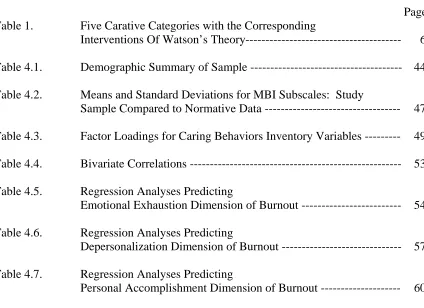
List Of Tables
Page Table 1. Five Carative Categories with the Corresponding
Interventions Of Watson’s Theory--- 6 Table 4.1. Demographic Summary of Sample --- 44 Table 4.2. Means and Standard Deviations for MBI Subscales: Study
Sample Compared to Normative Data --- 47 Table 4.3. Factor Loadings for Caring Behaviors Inventory Variables --- 49 Table 4.4. Bivariate Correlations --- 53 Table 4.5. Regression Analyses Predicting
Emotional Exhaustion Dimension of Burnout --- 54 Table 4.6. Regression Analyses Predicting
Depersonalization Dimension of Burnout --- 57 Table 4.7. Regression Analyses Predicting
List Of Figures
Page
Chapter I: Introduction
Figure 1. Conceptual Framework --- 8 Chapter IV: Results
Figure 4.1. Scree Plot for Factor Analysis --- Figure 4.2. Revised Conceptual Framework ---
Chapter I
Introduction and Overview
Introduction
“Caring” is a commonly used word in the English language. Nurses thinking about, doing, and describing nursing, know that caring has unique and particular meanings to them. Caring is one of the first synonyms for nursing offered by nursing students and is surely the most frequent word used by the public in talking about nursing (Boykin and Schoenhofer, 1993). Caring is an essential value in the personal and
professional lives of nurses. Understanding the act of caring in its fullest sense, and within both professional and human contexts, is essential.
Nursing is a nurturing profession, and caring is the essential component of its holistic practice. Nursing literature gives emphasis to the value of investigating caring and the way in which it is expressed. Nurses are assumed to develop those psychological characteristics that allow them to provide services in which holistic and individualized care is apparent. Nursing leaders should emphasize the preparation of professionals who are able to care for health and wellness in a manner that contributes to the development of both nurses and patients, and underlines the nature of nursing as a human science
(Patistea, 1999).
approaches to patient problems and issues and to advocate ethical positions on behalf of the patients (Bevis and Watson, 2000).
Patients and patient care are stressors. This may include caring for the long-term, chronically ill patient, the aged patient, the dying patient, the patient who makes no progress, the patient who acts in an “unacceptable” manner, and the patient who is unable to communicate. However, stress is very individualized – what is stressful to one
individual, may not be to another. In caring for others, nurses give much of themselves. When people care, or give, too much for too long, and receive too little in return, the stress accumulates and burnout occurs (Schaufeli and Enzmann, 1998).
Stress and burnout have been identified as reasons nurses leave the profession (Chung & Corbett, 1998; Gray-Toft & Anderson, 1981; Kennedy & Barloon, 1997; Walsh & Dolan, 1999). The word “burnout” did not appear in the nursing literature until 1978 in an article by Schubin (McConnell, 1982). Nursing research on stress and burnout has traditionally focused on task-related variables such as workload, caring for the
critically and terminally ill, inadequate preparation, lack of staff support, conflict with other nurses, supervisors and physicians (Gray-Toft and Anderson, 1981).
examined these empathy variables and found that empathetic concern and communicative responsiveness are negatively associated with burnout, while emotional contagion is positively associated with burnout. Their recommendations for interventions focused on nursing education and administration.
Theoretical Perspectives
Caring and burnout are the two theoretical concepts that guided this research. Before examining the problem addressed in this research, an overview of the theoretical framework is necessary to set the stage. Two conceptual models, or theories, guided this research – Jean Watson’s Theory of Human Caring (1979) and Maslach and Jackson’s Theory of Burnout (1986).
Jean Watson’s Theory of Human Caring. When Florence Nightengale published her theory of nursing in 1860, she reflected a caring philosophy in which caring implied a moral imperative in nursing. Since the emergence of modern nursing, care has been at the core of this service. Jean Watson’s Theory of Human Caring emphasizes the moral and ethical dimensions of care. She based her theory of caring and human care on the assumption that health refers to harmony within the mind-body-spirit as a whole being and is expressed by the congruency between the perceived and experienced self (Kim and Kollak, 1999). Watson views nursing as both scientific and artistic, and as a therapeutic interpersonal process. In her theory, caring is considered core to nursing, meaning that caring is intrinsic to the actual nurse-patient process that produces therapeutic results in the person being served (Watson, 1979).
individual gain self-knowledge, self-control, self-care, self-healing, and ultimately, inner harmony (Oermann, 1991). The Theory of Human Caring is based on a value system associated with great respect for life, an acknowledgement of a spiritual dimension to life, and an acknowledgement of the internal power of the human caring process (Oermann, 1991). The theory proposes that individuals engaged in the human caring process must possess a high regard for people and for human life and a high respect for human autonomy and freedom of choice (Oermann, 1991).
Watson (1979) believes that the goal of nursing is to help persons gain a higher degree of harmony within the mind, body, and soul, which generates self-knowledge, self-reverence, self-healing and self-care processes while increasing diversity. This goal may be attained through the implementation of ten carative factors, or interventions. The ten carative interventions are:
• The formation of a humanistic-altruistic system of values.
• The instillation of faith-hope.
• The cultivation of sensitivity to one’s self and to others.
• The development of a helping-trusting relationship.
• The promotion and acceptance of the expression of positive and negative feelings.
• The systematic use of the scientific problem-solving method for decision-making.
• The promotion of interpersonal teaching-learning.
• The provision for a supportive, protective and/or corrective mental, physical,
sociocultural, and spiritual environment.
• Assistance with the gratification of human needs.
Watson (1979) contends that the carative interventions are interdependent. According to her grouping of the carative interventions based on their interdependency, the ten carative interventions will be combined to produce five carative categories (Table 1). These categories are not progressive and order does not matter. Wolf (1986) and Wolf, Giardino, Osborne and Ambrose (1994) conceptualized the five carative categories in their work.
The first category is that of “assurance of human presence.” This category combines the three carative interventions of formation of a humanistic-altruistic system of values, instillation of faith-hope, and cultivation of sensitivity to one’s self and to others. The category of “assurance of human presence includes such caring activities as helping the patient, talking with the patient, appreciating the patient as a human being and responding quickly to the patient’s call (Brunton & Beaman, 2000).
The second category is that of “respectful deference.” This category combines the two carative interventions of development of a helping-trusting relationship and promotion and acceptance of the expression of positive and negative feelings. The category of “respectful deference” includes caring activities such as being honest with the patient, showing respect for the patient and giving the patient information to make
decisions (Brunton & Beaman, 2000).
category, “positive connectedness,” contains only the carative intervention of provision for a supportive, protective, and/or corrective mental, physical, sociocultural, and spiritual environment. This category includes such activities as being hopeful for the patient, allowing the patient to express feelings and trusting the patient (Brunton & Beaman, 2000).
The final category is that of “attentive to other’s experience.” This category is comprised of the two carative interventions of assistance with the gratification of human needs and allowance for existential-phenomenological forces. Activities included in this category are relieving the patient’s symptoms, putting the patient first and giving good physical care (Brunton & Beaman, 2000).
Table 1
Five Carative Categories with the Corresponding Carative Interventions of Watson’s Theory
5 Carative Categories Corresponding Carative Interventions of Watson’s Theory
I. Assurance of Human Presence • Formation of humanistic-altruistic system of values
• Instillation of faith-hope
• Cultivation of sensitivity to one’ self and to others
II. Respectful Deference • Development of a helping-trusting relationship
• Promotion and acceptance of expression of positive and negative feelings
III. Professional Knowledge and Skill • Systematic use of scientific problem-solving method for decision making
• Promotion of interpersonal teaching-learning
IV. Positive Connectedness • Provision for a supportive, protective and/or corrective mental, physical, sociocultural, and spiritual environment
V. Attentive to Other’s Experience • Assistance with gratification of human needs
existential-phenomenological-Maslach and Jackson’s Theory of Burnout. Maslach and Jackson’s theory of burnout is the most widely used theory in burnout research (Schaufeli and Enzmann, 1998). Maslach and Jackson describe burnout as a three-dimensional syndrome characterized by emotional exhaustion, depersonalization, and reduced personal accomplishment. They define burnout as a psychological syndrome of these three dimensions that can occur among individuals who work with other people in some capacity (Schaufeli, Maslach and Marek, 1993).
The first dimension is that of emotional exhaustion. In this dimension of burnout, the individual has feelings of being emotionally overextended and depleted of emotional resources. The second dimension, depersonalization, is characterized by negative or excessively detached response to other people, usually the recipients of one’s care. The third dimension, reduced personal accomplishment, refers to an individual having a decrease in feelings of competence and successful achievement in work (Schaufeli, Maslach and Marek, 1993). Research by Maslach and Jackson (1982) indicates that an accumulation of a variety of stressors (individual, interpersonal and organizational stress) drives the burnout process.
Caring and burnout are both important and interesting concepts related to nursing that deserve a greater focus in nursing research. Nursing research must ground its research in theory such as this in an effort to prove or disprove theory and/or identify appropriate interventions to prevent and reduce burnout within the profession.
Conceptual Framework
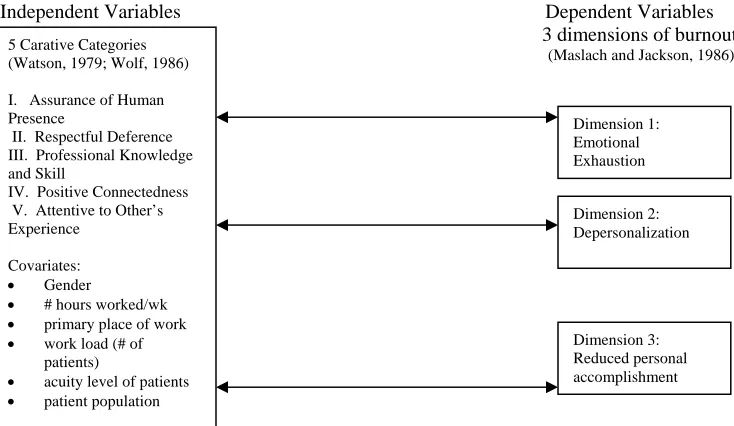
variables, which act on the three dimensions of burnout. The additional independent variables were used as covariates in the model: gender, number of hours worked per week, workload (average number of patients per day), patient acuity level, primary place of work and patient population. These variables were considered as covariates as
previous research has indicated that one’s brurnout is impacted by them (Um & Harrison, 1998; Akroyd & Adams, 2000; Leiter, Harvie & Frizzell, 1998; Chung & Corbett, 1998; Kennedy & Barloon, 1997; Omdahl & O’Donnell, 1999; Moffett, 2002).
Independent Variables Dependent Variables 3 dimensions of burnout (Maslach and Jackson, 1986)
Figure 1: Conceptual Framework
Significance of the Study
In professional nursing from Nightingale to the present, the concept of caring has been dominant. Traditionally, caring has been projected more as an attitude than an action, although without the action, the attitude becomes mere rhetoric (Barker, 2000). Caring science is an evolving field that is grounded in the discipline of nursing and evolving nursing science, but is rapidly becoming an interdisciplinary or
5 Carative Categories (Watson, 1979; Wolf, 1986)
I. Assurance of Human Presence
II. Respectful Deference III. Professional Knowledge and Skill
IV. Positive Connectedness V. Attentive to Other’s Experience
Covariates: • Gender
• # hours worked/wk • primary place of work • work load (# of
patients)
• acuity level of patients • patient population
transdicsciplinary field of study. It has relevance to all the health, education, and human service fields and professions (Watson, 1999).
As previously mentioned, caring for others is stressful. The literature provides insights into how caring affects, or leads to, increased levels of stress, and how increased levels of stress may lead to increased levels of burnout. A gap exists in the literature in examining how caring directly affects burnout. This study helps to narrow this gap, thereby expanding nursing’s body of knowledge.
Previously, the applied nature of burnout research has prompted calls for effective intervention throughout the research literature. This perspective has encouraged
considerable effort, but relatively little systematic research. Various intervention strategies have been proposed – some try to treat burnout after it has occurred, whereas others focus on how to prevent burnout. Most discussions of burnout interventions focus primarily on individual-centered solutions, such as removing the worker from the job, or individual strategies for the worker, in which one either strengthens one’s internal resources or changes one’s work behaviors. This is particularly paradoxical given that research has found that situational and organizational factors play a bigger role in burnout than individual ones. Individual-oriented approaches may help individuals to alleviate exhaustion, but do not really deal with the other two dimensions of burnout. Also, individual strategies are relatively ineffective in the workplace, where a person has much less control over stressors (Maslach, Schaufeli, & Leiter, 2001).
prevent burnout in the future. Additionally, it will be important to note the levels of burnout in various healthcare environments, as organizational interventions might be appropriate in preventing and/or treating high levels of burnout among the nursing staff. This is a very important issue in this time of a nursing shortage and changes in healthcare delivery. However, the literature is extremely limited in research related to interventions to prevent burnout.
Statement of the Problem
If burnout among nurses is to be prevented, it is critical that key causes of burnout be identified and targeted for direct intervention. The literature discusses burnout among nurses, but has primarily focused on burnout due to task-related variables. Yet some evidence indicates that aspects of caring for others, or client-related variables, are just as predictive or more predictive of burnout (Schaufeli and Enzmann, 1998).
of client-related stressors in relation to burnout, specifically contact with terminally ill patients and conflicts in interactions.
Zapf et al. (2001) reported that early research on burnout indicated that common job-related stressors (such as workload, time pressure, or role conflicts) correlated more highly with burnout than client-related stressors (such as problems in interacting with clients, frequency of contact with chronically or terminally ill patients, or confrontation with death and dying). However, the authors discuss the fact that more recent research has focused explicitly on emotion-work variables, such as requirement to display or suppress emotions on the job and the requirement to be emotionally empathic, and has found that these emotion factors do account for additional variance in burnout scores over and above job stressors.
The literature is very weak at best on studies focusing on the caring behaviors and attitudes of nurses and their level of burnout related to it. The one qualitative case study by Kennedy and Barloon (1997) found that high levels of caring, especially with
chronically ill pediatric clients, leads to increased levels in stress and burnout, and suggests possible interventions for prevention of burnout in pediatric critical care (Kennedy and Barloon, 1997). Due to the fact that the study is qualitative, the findings are typically not considered to be generalizable. The study also did not take into account previously studied variables related to burnout.
Two over-arching problems exist – methodological concerns and lack of research directly linking caring and burnout. First, the concept of caring is one of the least
concept by some (Kyle, 1995). Others (Hegedus, 1999; McCance, McKenna & Boore, 1997) view caring as an extremely complex concept, with high levels of caring often attributed to higher burnout rates. The etiology of burnout is multifactorial and is determined by complex interactions of occupational and nonoccupational factors and numerous mediators and moderators (Gulielmi and Tatrow, 1998). In studying such a complex concept, descriptive statistics and bivariates may not be complex enough to examine the impact of multiple independent variables on each dimension of burnout. Gulielmi and Tatrow (1998) contend that the etiology of most diseases (including burnout) is multifactorial and is probably determined by a complex interaction of a large number of occupational and nonoccupational factors, a complex interaction of numerous mediators and moderators, and a complex interaction of the two former interactions. Bivariate designs and analytical strategies are not equipped to deal with these entangled relationships (Gulielmi & Tatrow, 1998).
How much of the variance in burnout could possibly be explained by a nurse’s level of caring? Previous studies on burnout and caring (Chung and Corbett, 1998; Kennedy and Barloon, 1997; Omdahl and O’Donnell, 1999; Dyson, 1996; Brunton and Beaman, 2000; Watson, Dreary and Lee, 1999; Dillon and Stines, 1996) have utilized descriptive statistics, ranking of caring attitudes and behaviors, t-tests to measure
differences between pre- and post-test, and qualitative methods of research. These types of research methodology are not the best to examine such complex phenomenon. Very few studies (Simmons and Cavanaugh, 2000) have utilized multiple regression to examine caring and its effect on burnout. This study utilized multiple regression.
between dimensions of burnout and the five carative categories, if the relationship is statistically significant, and the amount of variance in burnout accounted for by the five carative categories (Hatcher and Stepanski, 1994).
Second, there are a number of studies conducted by nurse researchers, which have focused on caring in nursing practice. These studies have investigated nurses’ and
patients’ perceptions of effective caring (Kyle, 1995), but very few, if any, which
examine the possible predictive value of caring on burnout. Walsh and Dolan (1999), in their study of emergency nurses and their perceptions of caring, concluded that caring may be a casualty of stress and burnout in these nurses, but did not investigate the connection further.
Furthermore, burnout is most often related to quantitative workload instead of qualitative demands resulting from problems in interacting with difficult recipients and dealing with emotional problems of others. Traditionally, emotionally charged
Purpose of the Study
The purpose of this study was to examine the relationship between caring and burnout in a sample of registered nurses in North Carolina. The study attempted to narrow or close a gap in the literature by examining the effect of caring on burnout directly, as opposed to the effect of caring on stress and then the effect of stress on burnout.
Research Questions
1. What are the levels of caring and burnout for registered nurses?
2. What is the predictive value of the five carative categories (assurance of human presence, respectful deference, professional knowledge and skill, positive connectedness, and attentive to other’s experience) on the first dimension of burnout (emotional exhaustion), holding constant gender, number of hours
worked per week, work load (average number of patients per day), acuity level of patients, primary place of work and patient population?
3. What is the predictive value of the five carative categories (assurance of human presence, respectful deference, professional knowledge and skill, positive connectedness, and attentive to other’s experience) on the second dimension of burnout (depersonalization), holding constant gender, number of hours worked per week, work load (average number of patients per day), acuity level of patients, primary place of work and patient population?
burnout (reduced personal accomplishment), holding constant gender, number of hours worked per week, work load (average number of patients per day), acuity level of patients, primary place of work and patient population?
Definition of Terms
Burnout: A psychological syndrome of three identified stages (emotional exhaustion, depersonalization, and reduced personal accomplishment) that can occur among
individuals who work with other people in some capacity (Schaufeli, Maslach and Marek, 1993).
Caring: Transpersonal processes designed to help a person find meaning in illness, suffering, pain, and existence and to help an individual gain self-knowledge, self-control, self-care, self-healing, and ultimately, inner harmony. Individuals engaged in the human caring process must possess a high regard for people and for human life and a high respect for human autonomy and freedom of choice (Oermann, 1991).
Carative factors: In contrast to curative factors, carative factors are factors that the nurse uses in the delivery of health care to the patient. These factors aim at the caring process that helps the person attain (or maintain) health or die a peaceful death (Watson, 1979). Depersonalization: The second stage of burnout, characterized by negative or
excessively detached response to other people, usually the recipients of one’s care. Emotional exhaustion: The first stage of burnout in which the individual has feelings of being emotionally overextended and depleted of their emotional resources.
Registered nurse (RN): An individual who has completed a nursing degree from an accredited school of nursing, either associate degree, diploma or baccalaureate degree, and has successfully completed the National Licensure Examination for registered nurses (NCLEX-RN).
Chapter II Literature Review
The purpose of this study was to examine the correlation between the five categories of carative factors and the three dimensions of burnout. The literature review for this study therefore focused on two concepts – caring and burnout, with an emphasis on the concepts as they related to nursing. The first part of this chapter consists of a review of caring literature. The second half of the chapter provides a review of the literature on burnout. Finally, there is a review of the literature that specifically examines the concepts of caring and burnout together.
Literature Review – Caring
The concept of caring has been nearly exclusively studied within the profession of nursing. Studies on caring tend to focus on caring behaviors as perceived by three main groups – patients, practicing nurses and nursing students. In order to gain a better
understanding of the concept of caring, it is important that one review the literature for all three groups. The following literature review is divided into patient perceptions,
perceptions of practicing nurses and perceptions of student nurses.
The literature review presented shows that whereas nurse clinicians focus on the psychosocial aspects of caring, patients assign the highest value to technical skills and professional competence. Similarly to patients, a small proportion of nurses view competent clinical expertise as the fundamental component of caring. Noncaring
behaviors included physical and emotional absence, belittling and inhumane actions, and lack of recognition of a patient’s uniqueness. Patients’ participation in decisions
regarding their care may or may not have been an element of a caring interaction. From this literature review, the authors conclude that caring meanings and behaviors are context specific and suggest that nurse clinicians should determine caring needs and actions in the context of practice (Patistea and Siamanta, 1999).
Marini (1999) completed a pilot study to identify which behaviors performed by nursing staff were important indicators of caring as perceived by older adults residing in institutional settings. This study used Watson’s Theory of Human Caring as a framework and the Caring Behavior Assessment (CBA) instrument to interview residents. A
convenience sample of 21 residents residing in long-term care and assisted-living facilities answered the CBA. The analyses revealed that the highest indicator of nurse caring focused on the nurses’ technical competency. The study also noted a significant gender-specific perception of caring, which may reflect differences in gender
From this review of the literature, it appears that patients perceive caring in relation to a nurse’s ability to provide safe and competent care. It is extremely important to patients that nurses “know what they are doing” and that they are proficient in the technical aspects of nursing care. Additionally, patients expect nurses to treat them with respect and dignity while providing competent technical care.
Dyson (1996) completed a pilot study in which she investigated nurses’ conceptualizations of caring. A sample of nine qualified nurses was used and Kelly’s repertory grid technique employed to elicit constructs within the concepts of caring attitudes and caring behaviors. After grid data were analyzed, nine common themes were identified. These nine themes were: consideration and sensitivity, giving of self, work style, motivation, communication and meeting needs, knowledge and learning, individual approach, general approach, and honesty and sincerity. The findings of this study largely supported the concept that caring is a combination of what the nurse does and what the nurse is like as a person. The results from this study highlighted some of the key elements in nurses’ conceptualizations of care. These largely supported the findings of previous studies, with the emphasis on the humanistic and psychosocial components of care (Dyson, 1996).
Hegedus (1999) examined providers’ and consumers’ perspectives of nurses’ caring behaviors. The purpose of her study was to develop and test a scale designed to examine nurses’ caring behaviors. She reported on a pilot study conducted with a convenience sample of 42 nurses (providers) and 39 patients (consumers) in two
patients to express and vent their feelings. The findings of this study might allow
clinicians to be sensitized to their caring behaviors by increasing their realization of how behaviors are perceived by patients. The author concluded that the instrument being developed needed minor revisions and further testing (Hegedus, 1999).
Brunton and Beaman (2000) explored nurse practitioners’ perceptions of their own caring behaviors, the relationship between sociodemographic variables,
environmental factors, and nurse practitioner’s perceptions of their caring behaviors. Perceptions of 40 caring behaviors were measured using a revised Caring Behaviors Inventory (CBI). The inventory assessed five dimensions of caring: courteous regard, investment in other’s needs, readiness to help, knowledge and skill, and appreciation of other’s perspective. Additionally, several sociodemographic and professional
characteristics were assessed. Surveys were mailed to 200 members of an Illinois nurse practitioner group, with a return rate of 140 surveys. After the data was analyzed, the top ten caring behaviors, in rank order, were appreciating the patient as a human being, showing respect for the patient, being sensitive to the patient, talking with the patient, treating patient information confidentially, treating the patient as an individual,
encouraging the patient to call with problems, being honest with the patient, and listening attentively to the patient. The authors conclude that caring is nurses’ hidden work that may go unrecognized, except when the caring behaviors are missed by the patients or their families (Brunton and Beaman, 1999).
perceive caring as an issue of choice. Hopefully, nurses choose to promote trust and respect in relationships with patients and families, provide individualized care and collaborate with the patients regarding decisions pertinent to their health care.
Student nurses’ perceptions of caring. Simonson (1996) reports on
phenomenological research designed to discover how caring was taught in an associate degree nursing education program. Three basic questions were: 1) What is the meaning of caring to the faculty and students, 2) How do the faculty communicate this meaning to the students; and 3) How does this meaning shape the experience of the students? Data were collected using semi-structured interviews with all faculty and selected students, classroom observations, and a review of documents. Data was analyzed for and found to have content explaining the meaning of caring, how caring is being taught and what students are learning about caring. Four carative factors (from Watson’s Theory of Human Caring) emerged as descriptions for the major themes and helped explain how caring and caring values were communicated in the nursing program. The meaning of caring as essential to what nursing is and what nurses do came across in the words and behaviors of faculty and students. Faculty practiced values congruent with caring and were able to actualize these values in the classroom – a major means of communicating them to students. Implications derived from this study speak to the need for faculty to have caring or a way of being if they wish to communicate caring as the essence of nursing to students (Simonson, 1996).
female baccalaureate nursing students. The participants narrated their stories about learning caring by first describing their understanding of how they created caring with patients. After discussing their patient care interactions, they were then able to answer the research question of how they learned caring in clinical. From the data analysis, two constitutive patterns were identified – creative caring (containing seven themes) and learned caring (containing five themes). The students became aware that they simultaneously created and learned caring and personified it into a way of acting,
thinking, and feeling about the patient care experience that characterized caring for them (Kosowski, 1995).
Dillon and Stines (1996) state that caring is an essential component in nursing that must be affirmed and nurtured. They completed a phenomenological study of faculty-student caring interactions by exploring the perceptions of faculty caring behaviors as experienced by students at the practical nurse and nurses’ aide levels. Their study replicated a previous phenomenological study of baccalaureate nursing students. The results indicated that the participants perceived caring as recognition of their unique individuality and the sharing and giving of self and time by the faculty. The authors of this study believe that the knowledge acquired in this study could be utilized by nursing faculty in order to reinforce or enrich caring interactions with students (Dillon and Stines, 1996).
interviewed. Transcripts were analyzed using Giorgi’s technique. Significant statements were identified, meaning units were developed, and themes were extracted and abstracted into the categories of recognition, connection, and confirmation/affirmation. General structural descriptions of the phenomena of a caring and not-so-caring interaction were constructed. The results have implications for nurse educators. Providing a caring environment not only serves a humanistic purpose of enhancing students’ positive feelings and self-esteem, but also relates to increasing motivation to study and learn and affirming students’ choice of nursing as a profession (Hanson and Smith, 1996).
Watson, Deary and Lea (1999) completed a longitudinal study with nursing students to determine if their perceptions of caring changed over time, throughout nursing school. Another purpose of their study was to determine if the Caring Dimensions
Inventory (CDI) instrument could detect any changes in the students’ perceptions of caring. The CDI was developed in 1997 and consists of 25 operationalized statements of nursing actions. Subjects are asked to indicate their agreement that each statement constitutes caring by using a 5-point Likert scale (1=strongly disagree to 5=strongly agree). The instrument focuses on two dimensions of caring – the “psychosocial”
(emotional) and the “professional and technical” (physical). The psychosocial dimension includes listening to the patient and sitting with the patient. The professional and
technical aspects of caring increased over the time of the study. However, a similar increase was not found in the other dimensions of caring (psychosocial, inappropriate aspects of nursing, being cheerful with a patient). Th authors suggested that further research be done with nurses in clinical practice to see if increases occur in these areas after individuals complete their undergraduate nursing education and become less “task oriented” (Watson, Deary, and Lea, 1999).
Simmons and Cavanaugh (2000) reported on a longitudinal study of the development of caring ability in registered nurses. A nationwide sample of female graduates of United States baccalaureate nursing programs was resurveyed three years after the survey was taken during nursing school. The purpose of this study was to evaluate variables contributing to the development of professional caring ability. Caring ability was measured using the Caring Ability Inventory, maternal and paternal care was measured using the Parental Bonding Instrument and the caring climate of the nursing schools was assessed using the School climate Profile. Caring ability scores significantly increased after entry into practice (paired student’s t-test, P<.001). The strongest
predictor of postgraduate caring ability was the student’s caring ability scores (r=.58, P<.001). When student caring ability scores were excluded as a potential predictor, school climate scores were the strongest predictor of postgraduate caring ability (r=.17, P<.05). This suggests that development of professional caring ability is related to caring school environments. Additionally, caring ability as a student predicts further
The literature related to students’ perceptions of caring tend not to look at specific caring characteristics, but instead how caring is conveyed within faculty-student interactions and the nursing school environment. Overall, the research indicates that a student’s
perception of caring is greatly influenced by the caring they have experienced with faculty and within their nursing school.
One’s perception and level of caring – whether positive or negative – may be a source of increased stress. Throughout the literature, it has been documented that increased levels of stress, particularly when coupled with highly technical work environments, may lead to burnout. Therefore, this study will look at the concepts of both caring and burnout.
Literature Review – Burnout
The concept of burnout has been studied within many professions and occupations. While a great deal of literature on burnout exists, this literature review focused on burnout within human services occupations. The first part of this literature review focuses on burnout in general, while the last part discusses literature that speaks to burnout in nursing.
First, their proposed model specified interrelationships among work stressors and burnout, the intervening factors between burnout and job satisfaction, and the final outcome variable, job satisfaction. Then, the theoretical model was translated into an empirically testable model. Finally, the model was tested with a sample of 165 clinical social workers in Florida. The results of analysis of components fit indicated that role conflict did intensify the amount of burnout and job dissatisfaction. Social support acted as an intervening and moderating factor between burnout and job dissatisfaction (Um and Harrison, 1998).
Gulielme and Tatrow (1998) provided a review of the literature on the effect of occupational stress and burnout on health in teachers. Their review brings to light many of the problems associated with methodological and conceptual considerations in
previous studies done on the concepts of burnout, occupational stress, and health. In general, the literature supported the view that occupational stress and burnout are associated with poor health in teachers (Gulielmi & Tatrow, 1998). This view held true regardless of the measures used and the subject population (regular, special education, or college teachers). However, the authors caution that the methodological rigor and
sophistication of the studies could be more sound, as these studies have relied exclusively on self-report intervention and on more descriptive than correctional analyses (Gulielmi & Tatrow, 1998).
relationship between the number of patients treated per week and the levels at each stage of burnout. The authors sampled 1,200 radiation therapists (603 returned), and collected data using the Maslach Burnout Inventory (MBI). The study results indicated that the therapists had high levels of emotional exhaustion and depersonalization and relatively low to moderate levels of personal accomplishment. Additionally, radiation therapists had significantly greater levels of emotional exhaustion and depersonalization than mental health workers and medical workers. The therapists also had a significantly lower level of personal accomplishment than mental health workers and medical workers. Therapists indicated significantly lower levels of burnout related to personal
accomplishment than did nurses. Finally, as the number of patients treated each week increased, the levels of burnout increased, with the greatest increase in emotional
exhaustion and depersonalization (Akroyd & Adams, 2000). Potential interventions were also briefly discussed.
or more frequently expressed the intention to quit were less satisfied with the various components of their care. No significant correlations were found between nurse professional efficacy and any of the patient satisfaction components measured (Leiter, Harvie, and Frizzell, 1998).
Chung and Corbett (1998) conducted a pilot study to compare the burnout of nursing staff who worked with clients who displayed challenging behavior in hospital-based bungalows and a community unit in the United Kingdom. Twenty-six and twelve nursing staff were randomly chosen form four hospital-based bungalows and a
community unit. Staff assessed their clients’ behavior using the Aberrant Behavior Checklist and were later interviewed, using a self-constructed Staff Questionnaire and the Maslach Burnout Inventory. The results showed that clients in the hospital-based
bungalows were more severe in challenging behavior than those in the community unit. The staff in the hospital-based bungalows were less satisfied with their salaries and enjoyed their client contact less. They complained more than the community unit staff and felt that their present training was inadequate. They were also more emotionally exhausted and experienced more depersonalization towards clients than the community unit staff. The level of personal accomplishment was, however, similar in the two groups. Correlations showed that there were significant associations between staff burnout and management issues rather than clients’ behavior, particularly in the hospital-based bungalow group (Chung and Corbett, 1998).
they love only to develop exhaustion, cynicism and an inability to provide adequate care to their patients. Ask a nurse how they feel when they leave their job for the day. Unfortunately, common answers might include “I feel frustrated that I could not provide what I feel is adequate care for my patients;” “I feel exhausted and too tired to go home to take care of my family and myself;” or “I feel powerless in the agency and no one listens to what we, as staff nurses, have to say.” Burnout is not unique to nursing, but often seems to occur earlier in the careers of nurses – often within the first four years of practice.
Literature Review – Caring and Burnout
A review of the literature in education, health care in general, and nursing was extremely limited in research which examined the relationship(s) directly between caring and burnout. Of the three studies located, one was qualitative and the other two were quantitative studies, one using multiple regression analysis.
for the child with a chronic illness, as they often do not recover (Kennedy and Barloon, 1997).
Omdahl and O’Donnell (1999) collected data from registered nurses at two hospitals to examine the extent to which empathy variables contributed to nursing stress and occupational commitment. The empathy variables examined were emotional contagion (sharing the emotions of patients), empathic concern (being concerned for patients) and communicative effectiveness (effectively communicating with patients and their families). Nursing stress and burnout were explored through variables of emotional exhaustion, depersonalization, and reduced personal accomplishment. Multiple
regression analyses revealed that the combination of the three emotional communication variables explained significant proportions of the variance in all three of the stress variables, as well as occupations commitment. The analyses further revealed that a lack of empathic concern and poor communicative responsiveness and high emotional contagion significantly contributed to reduced personal accomplishment. Emotional contagion explained a significant proportion of the variance in emotional exhaustion. Emotional contagion also significantly reduced occupational commitment (Omdahl and O’Donnell, 1999).
workload. The researcher found a significant negative correlation between scores on the CI-N and the emotional exhaustion and depersonalization sub-scales of the MBI. Using linear regression, caring accounted for 17% of the variance in scores on emotional
exhaustion and 7% of the variance in scores on personal accomplishment. Perceptions of changes in workload over the last two years was significantly correlated with the
depersonalization and emotional exhaustion sub-scales of the MBI. No relationship was found between caring and the perception of workload. This study concluded that caring attitudes can serve as a mediator of burnout in nurses and enhance the feeling of personal accomplishment (Moffett, 2002).
As previously mentioned, research is limited on the concepts of caring and burnout alone. It is well documented in the literature that increased levels of stress, which may be due, in part, by higher levels of caring and empathy, leads to increased incidence of burnout. Research should begin to focus on the factors that lead to increased stress and how these factors, independently, impact burnout. This study proposes to do this by looking at the impact of caring on burnout.
The literature on caring and burnout provides an overview of the two concepts, but none of the reviews provided studies as the one proposed here. Based upon the literature review, this study identified the problem discussed in Chapter I. This study examined the correlation between the five carative categories and the three dimensions of burnout. The plan to examine these concepts is explained in the following chapter.
Chapter III Methodology
Study Design
The purpose of this study was to examine the relationship between caring and burnout in a sample of registered nurses in North Carolina. The study attempts to close a gap in the literature by examining the effect of caring on burnout directly, as opposed to the effect of caring on stress and then the effect of stress on burnout. A correlational design was used in this study to examine the aforementioned relationships.
The purpose of the correlational design was to generalize from a sample to a population so that inferences can be made about the relationship(s) between caring and burnout (Creswell, 1994). A correlational design using a survey to collect data was preferred for this study due to the ease of distributing the survey and collecting data from the population throughout North Carolina. A mailed survey was the most feasible and economical method to utilize in obtaining these data from a diverse sample of the population. The survey was cross-sectional.
Population and Sample
The sample for this project was randomly chosen from a listing of all registered nurses, currently employed in nursing, in North Carolina. The sampling design for this population was single stage. Subjects were selected randomly via use of a random number table to ensure a systematic sample. The use of a random sample allows the research findings to be more generalizable to the population as this design is more rigorous. Tabachnick and Fidell (1989) suggest that if multiple regression is used, one would like to have 20 times more cases than independent variables, but preferable no fewer than 100 cases as this may make the power unacceptably low. As this study had eleven independent variables, a sample size of at least 220 was preferred. Therefore, surveys were mailed to 3,500 RNs in North Carolina in hopes of obtaining a sample size of at least 1,000 RNs. The criteria for the sample population included that they were: 1) currently licensed to practice as a registered nurse in North Carolina, and 2) were currently employed full-time as a registered nurse in North Carolina.
Instrumentation
One survey, combining three instruments, was used for this study. Demographic information questions were also added for a final single survey to be mailed. The instrument consisted of three sections.
frequency with which the respondent experiences each item is measured on a seven-point Likert-type scale anchored by Never (0) and Every Day (6). The scores thus can range from 0 – 54 on the emotional exhaustion subscale, 0 – 30 on the depersonalization subscale, and 0 – 48 on the personal accomplishment subscale. Because burnout is conceptualized as three separate dimensions, three scores are used for each factor (emotional exhaustion, depersonalization, personal accomplishment). Higher mean scores on the emotional exhaustion and depersonalization subscales correspond to higher levels of burnout, whereas lower mean scores on the personal accomplishment subscale correspond to higher levels of burnout (Maslach and Jackson, 1986). Levels of emotional exhaustion were categorized within ranges of 0-16 (low), 17-26 (moderate), and 27 or over (high), whereas levels of depersonalization ranged from 0-6 (low), 7-12 (moderate), and 13 or over (high).
MBI: Reliability. Internal consistency was estimated using Cronbach’s coefficient alpha and reported reliability coefficients of .90 and .79 for the emotional exhaustion and depersonalization subscales, respectively, and 0.71 for personal accomplishment
(Maslach, Jackson & Leiter, 1996). Test-retest reliability coefficients for the emotional exhaustion and depersonalization subscales were .82 and .60, respectively.
Caring Behaviors Inventory. The second section of the survey was comprised of the Caring Behaviors Inventory (CBI), which measures nurses, and/or patients,
perceptions of nurses caring attitudes and actions, and separates these into the five carative categories. Wolf (1986) devised the CBI by selecting from the literature, words, or phrases that represented caring. The CBI includes 43 items, with a 4-point Likert-type scale used to elicit responses (1 = strongly disagree; 2 = disagree; 3 = agree; 4 = strongly agree) to each of the caring words or phrases (Kyle, 1995; Wolf et al., 1994).
The CBI results in five carative categories, which fit with Watson’s Transpersonal Caring Theory (Kyle, 1995; Wolf et al., 1994). The five carative categories of the CBI include: assurance of human presence (12 items); respectful deference to the other (12 items); professional knowledge and skill (5 items); positive connectedness (9 items); and attentiveness to the other’s experience (4 items) (Wolf et al., 1994).
CBI: Reliability. Cronbach’s alpha coefficients for the five categories and/or overall instrument scores have been reported by other researchers using the CBI (Coogan, 1996; Swan, 1998; Urden, 1996). All coefficients were high, ranging from .93 to .99. Test-retest reliability was established ( r = .96, p < .0001; rho = .88, p < .0001) on a nurse sample. The alpha coefficient was .83.
types. While evidence of content validity is the weakest type of evidence, and given the limited evidence of construct validity in this study, an exploratory factor analysis will be performed on the data. A factor analysis of the CBI was not reported in the literature to delineate the factor structure of the theory for the CBI used with nurses only and
information was not provided on construct validity of the instrument (previous factor analysis was completed using combined nurse and patient responses (Wolf et al., 1994), which are not consistent).
Demographic Data. The third section of the survey consisted of demographic data. This part included age, gender, type of employment within nursing (full-time or part-time), number of hours worked per week, average number of patients cared for per week, site of primary nursing employment, patient population and level of patient acuity. Refer to Appendix A for the actual cover letter and survey.
Data Collection
Data Analysis
Data collected from returned surveys were entered into a computer database by the researcher. This database file was then processed using SAS Version 8 (SAS Institute, 1999-2001) for analysis. The following procedures were utilized for each research question.
Research Question #1: What are the levels of caring and burnout for registered
nurses?
Data regarding the three dimensions of burnout and the five carative categories were analyzed. Univariate statistics on the three dimensions of burnout and the five categories of carative factors were examined to determine the levels of caring and burnout for the sample of registered nurses. Burnout means for the sample were compared with National Norms for each dimension of burnout.
Research Question #2: What is the predictive value of the five carative categories
(assurance of human presence, respectful deference, professional knowledge and skill,
positive connectedness, and attentive to other’s experience) on the first dimension of
burnout (emotional exhaustion), holding constant gender, number of hours worked per
week, work load (average number of patients per day), acuity level of patients, primary
place of work and patient population?
those independent variables that were significantly correlated with the dependent variables. Covariates (gender, number of hours worked per week, work load (average number of patients per day), acuity level of patients, primary place of work and patient population) were added to hold their effect constant. Multiple regression analysis was chosen because this study used a single continuous dependent variable and two or more independent variables measured on an interval/ratio scale. Multiple regression allowed the researcher to 1) determine if linear combination of variables significantly effects variance in the independent variable; 2) determine which independent variable
significantly (p < .05) contributed to variance in the dependent variable, while holding constant the covariates (gender, number of hours worked per week, work load, acuity level of patients, primary place of work and patient population); and 3) determine the magnitude of the effect of significant predictors (Hatcher and Stepanski, 1999).
Research Question #3: What is the predictive value of the five carative categories
(assurance of human presence, respectful deference, professional knowledge and skill,
positive connectedness, and attentive to other’s experience) on the second dimension of
burnout (depersonalization), holding constant gender, number of hours worked per week, work load (average number of patients per day), acuity level of patients, primary place of
work and patient population?
categories comprising the independent variables and depersonalization as the dependent variable. Covariates (gender, number of hours worked per week, work load (average number of patients per day), acuity level of patients, primary place of work and patient population) were added to hold their effect constant. Multiple regression analysis was chosen because this study uses a single continuous dependent variable and two or more independent variables measured on an interval/ratio scale. Multiple regression allowed the researcher to 1) determine if linear combination of variables significantly effects variance in the independent variable; 2) determine which independent variable
significantly (p < .05) contributes to variance in the dependent variable, while holding constant the covariates (gender, number of hours worked per week, work load, acuity level of patients, primary place of work and patient population); and 3) determine the magnitude of the effect of significant predictors ( Hatcher and Stepanski, 1999).
Research Question #4: What is the predictive value of the five carative categories
(assurance of human presence, respectful deference, professional knowledge and skill,
positive connectedness, and attentive to other’s experience) on the third dimension of
burnout (reduced personal accomplishment), holding constant gender, number of hours
worked per week, work load (average number of patients per day), acuity level of
patients, primary place of work and patient population?
First bivariate correlations were examined between reduced personal accomplishment (dependent variable) and all five carative categories (independent
with the five carative categories comprising the independent variables and reduced personal accomplishment as the dependent variable. Multiple regression analysis was chosen because this study uses a single continuous dependent variable and two or more independent variables measured on an interval/ratio scale. Multiple regression allowed the researcher to 1) determine if linear combination of variables significantly effects variance in the independent variable; 2) determine which independent variable
Chapter IV Results
Demographics
Of the approximately 70,000 registered nurses (RNs) working full time in North Carolina, 3,500 (5% of the population) were surveyed. The initial surveymailing for this study consisted of 3,500 survey questionnaires mailed to a random sample of theseRNs. Of these 3,500 questionnaires, 818 (23.4%) were returned. There were 2,682
nonrespondents on the first mailing. A second mailing was sent to a random sample of 350 individuals from the initial group of 2,682 nonrespondents. The number of
questionnaires returned was 70 (20%). The final rate of return for all questionnaires (first and second mailing combined) was 888 (25.4%). The variables studied in this project were the three dimensions of burnout – emotional exhaustion, depersonalization and personal accomplishment; five carative factors – assurance of human presence, respectful deference to the other, professional knowledge and skill, positive connectedness and attentiveness to the others experience; and demographic data including age, gender, number of hours worked per week, average number of patients cared for per week, site of primary nursing employment and level of patient acuity.
sample was reasonably close to the national percentages. Nationally, 31.7% of nurses are between the ages of less than 25 years to 39 years, 34.4% between the ages of 40 and 49, Table 4.1: Demographics of Sample, North Carolina and National
Variable Frequency (%) N.C. National
Age (N = 872)
• 23 – 39 years 275 (32%) 31.7%
• 40 – 49 years 329 (38%) 34.4%
• 50 – 70 years 265 (30%) 33%
Gender (N = 726)
• Male 39 (5.37%) 7% 5.4%
• Female 687 (94.63%) 93% 94.6%
Place of Work (N = 714)
• Hospital 440 (61.62%) 52.5% 59.1%
• Ambulatory Care 47 (6.58%) * 9.5%
• Community Health 24 (3.36%) 5.7% 12.8%
• Mental Health 22 (3.08%) 1.9% *
• Nursing Education 16 (2.24%) 2% 2.1%
• Long-term care 27 (3.78%) 6.4% 6.9%
• School nurse 10 (1.40%) * 2.6%
• Other 128 (17.93%) * *
Patient Population (N = 688)
• ICU /trauma 86 (12.50%) * 16.9%
• Emergency Dept. 48 (6.98%) 5.6% 7.9%
• Administration 40 (5.81%) 2.8% 5.7%
• Education 32 (4.65%) 3.3% 2.8%
• Ambulatory Care 50 (7.27%) * *
• Medical-surgical floor 76 (11.05%) 11.7% 32.4%
• Pediatric floor 18 (2.62%) 4.4% 6.6%
• OB-GYN floor 50 (7.27%) 6.8% 8.2%
• Oncology 27 (3.92%) 2.7% *
• Other 261 (37.94%) * *
Patient Acuity Level (N = 699)
• 0 = self-care 77 (11.02%) * *
• 1 = minimal assistance 96 (13.73%) * *
• 2 153 (21.89%) * *
• 3 253 (36.19%) * *
• 4 = total care 120 (17.17%) * *
Highest Degree Earned (N = 722)
• Diploma 94 (13.02%) 13.2% 22.3%
• Associate degree 281 (38.92%) 40.2% 34.3%
• BSN 266 (36.84%) 30.8% 30.7%
• MSN 57 (7.89%) 7.1% 7.5%
• Other Masters 19 (2.63%) 2.9% 2.0%
• PhD (nursing) 4 (0.55%) 0.3% 0.3%
and 33% ages 50 years and older (USDHHS, 2002), compared to the sample with percentages of 32% between the ages of less than 25 years to 39 years, 38% between the ages of 40 and 49 years, and 30% between the ages of 50 years to 65 years and over. The sample has a higher percentage of nurses in the 40 to 49 year old age group, making the sample group slightly younger than the national population. Employment settings reported nationally were 59.1% employed in a hospital setting, 6.9% in long term care and 2.1% in nursing education (USDHHS, 2002). In North Carolina, 52.5% reported employment in an in-patient hospital setting, 6.4% employed in long term care and 2% employed in nursing education. In terms of employment for this sample, 61.62%
reported employment in a hospital setting, 3.78% employed in long term care and 2.24% in nursing education. While the sample is representative of and relatively reflective of the national and state populations, those individuals in the sample are more likely to work in a hospital setting and less likely to work in long term care. Generally, the sample respondents are reasonably close to state and national demographics. Demographic data related to the sample is summarized in Table 4.1.
Research Question #1: Results
Research Question #1: What are the levels of caring and burnout for registered nurses?
The Caring Behaviors Inventory (CBI) measured the nurses’ perceptions of caring attitudes and actions. The CBI is designed to assess perceptions in five carative
that the majority perceived all of the attitudes and actions as “caring” in 96% to 99% of the sample. The first carative category was respectful deference to others, which includes caring activities such as being honest with the patient, showing respect for the patient and giving the patient information to make decisions (Brunton & Beaman, 2000). A second carative category was assurance of human presence and attentiveness to others’
experiences. Assurance of human presence includes such caring activities as helping the patient, talking with the patient, appreciating the patient as a human being and responding quickly to the patient’s call (Brunton & Beaman, 2000). Attentiveness to others’
experiences includes activities that relieve the patient’s symptoms, put the patient first and just giving good physical care (Brunton & Beaman, 2000). A third carative category was positive connectedness and includes such activities as being hopeful for the patient, allowing the patient to express feelings and trusting the patient (Brunton & Beaman, 2000). A fourth, and final, carative category was professional knowledge and skill and includes activities such as watching over the patient, being confident with the patient and paying special attention to the patient on the first visit (Brunton & Beaman, 2000).
Burnout is separated into three dimensions – emotional exhaustion, personal accomplishment and depersonalization. All questions were measured on a seven-point Likert-type scale anchored by Never (0) and Every Day (6).
Total emotional exhaustion was measured by combining responses to nine questions related to this dimension of burnout. Total emotional exhaustion scores had a possible range of 0 to 54 with a higher score being indicative of a higher level of
of 20.99. Additionally, 313 (43%) scored above the mean while the remaining 57% scored below the mean on this dimension. Therefore, 43% indicated an increased level of burnout in the area of emotional exhaustion.
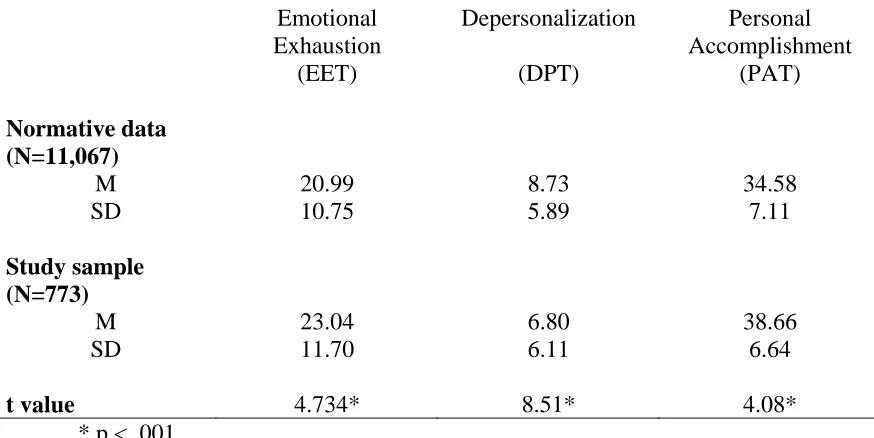
Table 4.2
Means and Standard Deviations for MBI Subscales: Study Sample Compared to Normative Data Emotional Exhaustion (EET) Depersonalization (DPT) Personal Accomplishment (PAT) Normative data (N=11,067)
M 20.99 8.73 34.58 SD 10.75 5.89 7.11 Study sample
(N=773)
M 23.04 6.80 38.66 SD t value 11.70 4.734* 6.11 8.51* 6.64 4.08* * p < .001
The highest level and incidence of burnout for this sample was noted in the burnout dimension of emotional exhaustion. Table 4.2 compares the means and standard deviation for the scores for this sample to the MBI-HSS normative data (Maslach and Jackson, 1996).