DEVELOPMENT AND EVALUATION OF ANTI-DIABETIC POLYHERBAL
FORMULATION ON ALLOXAN INDUCED RATS
*
Rajput Rekha
1, Chandra Amrish
21
Bhagwant University, Ajmer
2 Amity Institute of Pharmacy, Amity University, Uttar Pradesh,201301
INTRODUCTION
Diabetes mellitus is a metabolic disorder characterized by hyperglycemia, glycosuria, hyperlipemia, negative nitrogen balance and sometimes ketonemia1 due to deficient insulin secretion, factor opposing the tissue effects of insulin or both.2 It has recently broken the age barrier and appears even in younger people. It is debilitating metabolic disorder and robs persons of their energy and vitality.3 Several oral hypoglycemic agents are the primary forms of treatment for diabetes. However, prominent side effects of such drugs are main reason for an increased number of people seeking alternate therapies that may have less severe or no side effects.4Thus plants are a potential source of anti-diabetic drugs.5Therefore the search for more effective and safer hypoglycemic herbal formulation has continued to be as aim of present study. Hence the polyherbal formulation was prepared in the form of suspension by using five different plants indigenous to India.
MATERIAL AND METHODS:
2.1. Collection of plant material: Air dried barks of
Albizzia odoratissima, barks of Anoegeissus latifolia, roots of Chonemorpha fragrans, barks of Diospyros malabarica and flowers of Woodfordia fructicosa
were collected from local market of Khari Babri, Dehli. They were authenticated by Dr. Seema Bhadhauria, Head of Department of Botany, R.B.S College, Agra and specimens of all plants were submitted to the R.B.S.College, Agra.
International Journal of Therapeutic Applications
ISSN 2320-138X
ABSTRACT
The polyherbal anti-diabetic formulation is prepared in suspension form by mixing the petroleum ether and chloroform extracts of five medicinal plants which are indigenous in India with other excipients because plants are a potential source of anti-diabetic drugs. The anti-diabetic effect of prepared suspension was evaluated at two different doses which were decided by acute toxicity studies by using OECD (Organization for Economic Co-operation and Development) guideline 420.The results of acute toxicity study was revealed that there was no mortality observed at 2000mg/kg for the formulation in mice. Therefore 2000mg/kg dose was considered as cutoff dose so 1/10th and 1/5th of maximum dose was selected i.e.200mg/kg and 400mg/kg, for anti-diabetic studies. It was found that the anti-anti-diabetic activity of formulation in suspension form at a dose of 400mg/kg of body weight (253.33± 0.71) more effective than 200mg/kg of body weight (283.33 ±0.49) on wistar albino rats. It was also showed that the anti-diabetic activity of polyherbal formulation in suspension form is nearly comparable with standard drug glibenclamide (261.5 ±0.56) and the formulation at the dose of 200mg/kg was showed more significant anti-diabetic effect at 1st hour(336.5± 0.76) after single dose drug administration than 400mg/kg body weight but the formulation at dose of 400mg/kg was also showed more significant effect at 4th hours(304.16± 1.01) when its compare with the standard group ( 302.33±0.88) on wistar albino rats and continue this significant effect till 24th hours. So it was concluded that the formulation have significant anti-diabetic activity and also stable till the 3 month which was observed by the stability testing by using different parameters used for evaluation of suspension
Key words: Polyherbal formulation, Glibenclamide, Suspension
*Corresponding author:
2.2. Preparation of extracts 6,7,8: About 800 grams(each plants) of air dried barks of Albizzia odoratissima, barks of Anoegeissus latifolia, roots of
Chonemorpha fragrans, barks of Diospyros
malabarica and flowers of Woodfordia fructicosa
were powdered and subjected to extraction with various solvents such as chloroform and petroleum ether at room temperature for seven days by simple maceration method according to the Pandey et al. The extracts were filtered and concentrate to dryness at room temperature to avoid the decomposition of natural metabolites. The dried extracts were stored carefully for other investigation.
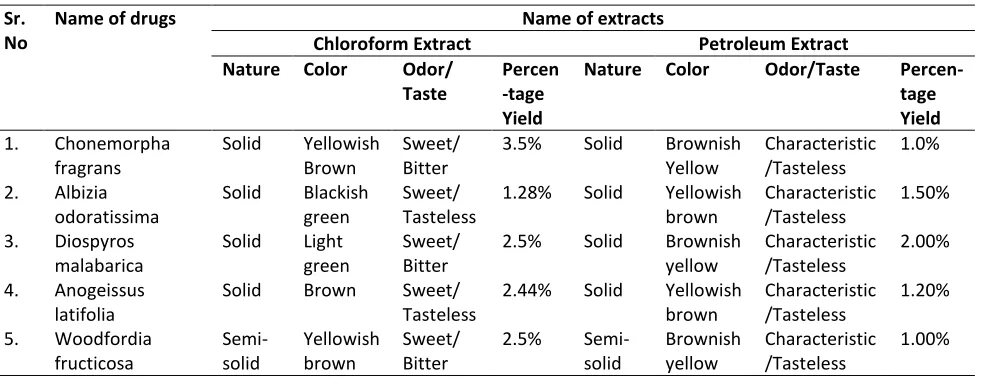
2.3Physical tests of extracts: Physical tests of extracts done by sensory observation and the percentage yield was also found out. The results of physical tests of extracts was shown in Table no.1
2.4Phytochemical investigation: All the Preliminary qualitative phytochemical analysis of all the extracts were carried out by employing standard conventional protocols.9
2.3. Preparation of polyherbal formulation 10,11: The evaporated residue extracts were mix in water and the different additives likeTween-80, Sodium CMC, sweetening agent (Sodium saccharin), Flavouring agent (Lemon oil) used for its better stability during shelf life of formulation. The residual extracts were mixed in the same ratio to make 4% w/v solution dosage form.
2.4. Maintenance of animals: Healthy wistar albino rats of either sex were used in the present study. They were housed in standard condition of temperature (25±20) with 12 hour light per day cycle.
2.5. Acute toxicity studies 12: The acute oral toxicity study was carried out as per the guidelines set by Organization for Economic Co-operation and Development (OECD) guidelines 420.A single oral administration of the dose from 300mg/kg body weight to 2000 mg/kg body weight in different group of mice. In each steps three animals were used in each group. The animals were observed continuously for the 24 hours. There was no mortality observed at 2000mg/kg for the formulation. Therefore 2000mg/kg dose was considered as cutoff dose so 1/10th and 1/5th of maximum dose was selected i.e.200mg/kg and 400mg/kg, for anti-diabetic studies. The results of acute toxicity study was shown in Table no.3
2.6. Induction of diabetes 13,14,15: The acclimatized animals were kept fasting for 24 hrs with water ad libitum and injected intraperitoneally at a dose of 150mg/kg b.w. of alloxan monohydrate (S.D. Fine Chemicals Ltd., Biosar) freshly prepared in normal saline solution. Before starting the experiment, animals were separated according to their body weight. After one hour of alloxan administration, animals were given feed ad libitum and 1 ml of 100mg/ml glucose I.P. to combat ensuring severe hypoglycemia after 72 hours of alloxan injection, the animal were tested for evidence of diabetes by estimating their blood glucose level by using Glucometer. The blood glucose level more than 250 mg/ml of blood was criteria.
Anti-diabetic activity: The animals were grouped as follow:
a) Diabetic control: (Normal saline solution) b) Formulation Group A: (200mg/kg) c) Formulation Group B :( 400mg/kg)
d) Standard group: Glibenclamide: (10mg/kg b.w. orally by dissolving in normal saline solution)
A 0.2 ml of blood was withdrawn at an interval of initial (0 hr), 1st ,2nd ,4th and 8th hours after administration of single dose for anti-diabetic activity and the blood glucose level was measured in all groups by using Glucometer (Pulsatum, Pulsatum Health Care Pvt.Ltd., Bangalore). The blood is again withdrawn at interval of 24th hours followed by second dose administration ( after twelve hours of first dose
2.7. Statistical analysis: All the values were expressed as Mean ±S D. The data were statically evaluated by using one way analysis of variance (ANOVA) followed by dunnetts test. Values of P<0.001 were considered as more significant.
2.8. Stability studies of polyherbal formulation:
These studies were performed to determine the stability of formulation and to check the effect of environmental factor.
2.4 Accelerated Stability Studies 16: The accelerated stability studies were carried out for polyherbal formulation for the period of three months. The different parameter such as sedimentation volume, redispersibility, rheology, flow rate ,viscosity, pH, particle size analysis, crystal growth were studied for the formulation at 1st ,2nd and 3rd months. The observations were recorded in table 5,6.
1) Sedimentation volume: The sedimentation volume is ratio of the ultimate height (Hu) of the sediment to the initial height (Ho) of the total suspension as the suspension settles in a cylinder under standard conditions. It was determined by keeping a measured volume of suspension in a graduated cylinder in an undisturbed state for a certain period of time and note that the volume of the sediment which is expressed as ultimate height.
2) Redispersibility: Redispersibility can be estimated by shaking the suspension with the help of a mechanical device which stimulate motions of human arm during shaking. The fixed volume(50 ml)of each suspension was kept in calibrated tubes which were then stored at room temperature for various time interval (5,15,25 days) at regular interval of 5 day one tube was removed and shaken vigorously to redistribute the sediment and the presence of deposit if any is recorded.
3) Rheology: The time required for each suspension sample to flow through a 10 ml pipette was determined the apparent viscosity by using the equation.
The viscosity of the sample was determined at 250C using Brookfield viscometer at 50 rpm by using spindle no.3. All determinations were made in at least triplicate and the results obtain are expressed as the mean values.
4) pH: The pH of suspension was determined at intervals of one week for 3 months using pH meter.
5) Particles size analysis: After shaking 10 ml of each sample was separately transferred into 200 ml cylinder and add distilled water (150ml) was then added, mixed and 10ml aliquot was removed at a distance of 10 cm below the surface of the mixture at 1,5,10,15,20,25 and 30 min. This was subjected to evaporation to dryness in an oven at 105 0C, then the residue weighed. The particle diameter (d in cm) was then calculated by using stokes equation.
Where,
h= Distance of fall of the particle (cm)
t= Time in seconds
n =Viscosity of dispersion medium (poise)
PS-PO= Density between dispersed particle and
the liquid (g/cm3)
g- Gravitational constant (cm/s2)
Table No. 1: Physical tests for different extracts Sr.
No
Name of drugs Name of extracts
Chloroform Extract Petroleum Extract Nature Color Odor/
Taste
Percen -tage Yield
Nature Color Odor/Taste Percen-tage Yield
1. Chonemorpha fragrans
Solid Yellowish Brown
Sweet/ Bitter
3.5% Solid Brownish Yellow
Characteristic /Tasteless
1.0%
2. Albizia odoratissima
Solid Blackish green
Sweet/ Tasteless
1.28% Solid Yellowish brown
Characteristic /Tasteless
1.50%
3. Diospyros malabarica
Solid Light green
Sweet/ Bitter
2.5% Solid Brownish yellow
Characteristic /Tasteless
2.00%
4. Anogeissus latifolia
Solid Brown Sweet/ Tasteless
2.44% Solid Yellowish brown
Characteristic /Tasteless
1.20%
5. Woodfordia fructicosa
Semi-solid
Yellowish brown
Sweet/ Bitter
2.5% Semi-solid
Brownish yellow
Characteristic /Tasteless
RESULTS
The dried barks of Albizzia odoratissima, barks of
Anoegeissus latifolia, roots of Chonemorpha fragrans, barks of Diospyros malabarica and flowers of Woodfordia fructicosa were powdered and subjected to extraction with various solvents such as chloroform and petroleum ether at room temperature for seven days by simple maceration method. The extracts were filtered and concentrate to dryness at room temperature to avoid the decomposition of natural metabolites. The dried extracts were stored carefully for the phytochemical analysis.
The Physical tests for different extracts were shown in Table no.-1
The preliminary phytochemical investigation showed that all the drug extracts contain mainly glycosides, triterpenoid, flavonoids and alkaloids.
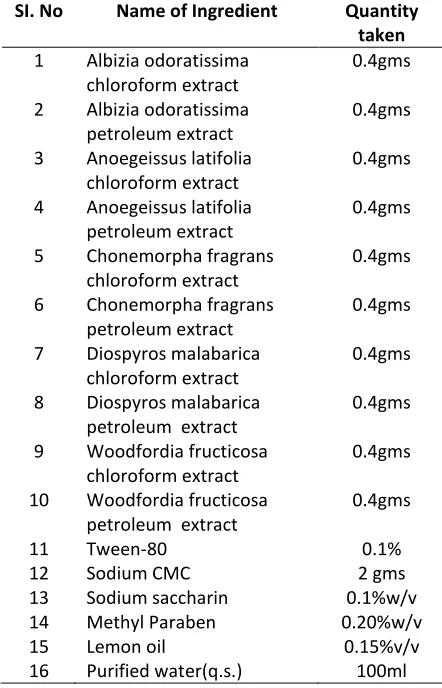
The formulation was developed by using the above mentioned formula in Table no.-2
There was no mortality observed at 2000mg/kg for the formulation. Therefore 2000mg/kg dose was considered as cutoff dose so 1/10th and 1/5th of maximum dose was selected i.e.200mg/kg and 400mg/kg, for anti-diabetic studies.Thr results of acute toxicity study was shown in Table no.3
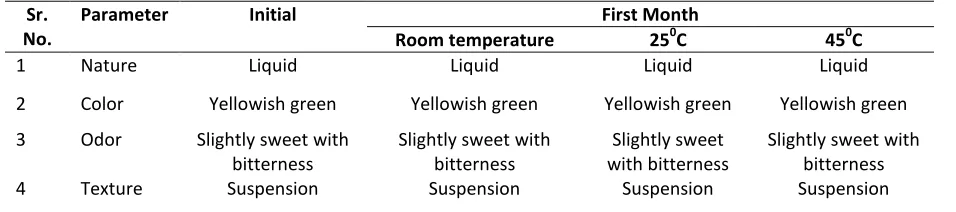
Anti-diabetic activity: It was found that the anti-diabetic activity of polyherbal formulation in suspension form at a dose of 400mg/kg of body weight (253.33± 0.71) more effective than 200mg/kg of body weight (283.33 ±0.49) on wistar albino rats when compared with standard drug glibenclamide (261.5 ±0.56). It was also found that the formulation at the dose of 200mg/kg of body weight in 1st hour (336.5± 0.76) after single dose administration was more effective or significant compared to 400mg/kg body weight but at the 4th hours (304.16± 1.01) When it compare with standard group( 302.33±0.88) the formulation was more significant at a dose of 400mg/kg body weight compared to 200mg/kg body weight So it was concluded that the anti-diabetic activity of polyherbal formulation in suspension form is nearly comparable with standard drug glibenclamide (261.5 ±0.56) at a dose of 400mg/kg body weight than the dose of 200mg/kg body weight. The developed formulation was yellowish green in color, liquid in nature, somewhat bitters with sweet in taste, the texture was suspension.
CONCLUSION
The developed formulation in suspension form showed the significant anti-diabetic activity when it
Table No. 2: General Formula adopted for Developed Polyherbal Formulation SI. No Name of Ingredient Quantity
taken
1 Albizia odoratissima chloroform extract
0.4gms
2 Albizia odoratissima petroleum extract
0.4gms
3 Anoegeissus latifolia chloroform extract
0.4gms
4 Anoegeissus latifolia petroleum extract
0.4gms
5 Chonemorpha fragrans chloroform extract
0.4gms
6 Chonemorpha fragrans petroleum extract
0.4gms
7 Diospyros malabarica chloroform extract
0.4gms
8 Diospyros malabarica petroleum extract
0.4gms
9 Woodfordia fructicosa chloroform extract
0.4gms
10 Woodfordia fructicosa petroleum extract
0.4gms
11 Tween-80 0.1%
12 Sodium CMC 2 gms
13 Sodium saccharin 0.1%w/v 14 Methyl Paraben 0.20%w/v
15 Lemon oil 0.15%v/v
16 Purified water(q.s.) 100ml
Table No. 3: Dose Selection and Finalising LD50
Cut-Off value of Polyherbal Formulation Sr.
No.
Name of formulation
LD50 Cut-Off
mg/kg.b.w.
Therapeutic dose(effective
dose)
1 Polar polyherbal formulation
2000mg/kg b.w.
1/10th of lethal dose 200mg/kg b.w.
2 2000mg/kg
b.w.
1/5th of lethal dose
is compared with the standard drug glibenclamide and the stability of suspension was best for three month.
ACKNOWLEDGEMENT
I am highly grateful to Dr. Seema Bhadhauria for her timely support, my guide Dr. Amrish Chandra for guiding me in each and every steps of my research work and Dr.T.S. Gouda from Shrikrupa institute for helping in pharmacological screening.
REFERENCE
1) Tripathi KD.Text book of essential of medical pharmacology,Jaypee brothers medical publisher,2008,6th edition,pp236.
2) Sujatha S,Swaroopa Ravi V and Ravikumar B. Antidiabetic effects of flower extract of
Antigonon leptopus hook and Arn in alloxan induced diabetic rats. Indian Journal of
Table no.-4: Anti diabetic activity of polyherbal formulation against alloxan induced diabetic rats Group O hour 1hour 2 hour 4 hour 8 hour 24 hour
Diabetic control
367.83±0.32 363.83±0.57 376±0.63*** 372.33±0.83*** 391±0.37*** 425±0.57
Formulation (200mg/kg)
345.83±0.70 336.83±0.76*** 324.5±0.42*** 316.5±0.76*** 295.5±0.99*** 283.33±0.49***
Formulation (400mg/kg)
383.83±0.60 355.83±0.90*** 343.66±0.66*** 304.16±1.01*** 293.5±0.76*** 253.33±0.71***
Diabetic + Glibenclamide (10mg/kg)
344.33±0.53 323.83±0.53*** 309±0.81*** 302.33±0.88*** 273±0.43*** 261.5±0.56***
Values are the mean±S.E.M.,n=6,*P<0.05,**p<0.01,***p<0.001(vs.Control)
Table No. 5:Physical tests for Polyherbal formulation Sr.
No.
Parameter Initial First Month
Room temperature 250C 450C
1 Nature Liquid Liquid Liquid Liquid
2 Color Yellowish green Yellowish green Yellowish green Yellowish green
3 Odor Slightly sweet with bitterness
Slightly sweet with bitterness
Slightly sweet with bitterness
Slightly sweet with bitterness 4 Texture Suspension Suspension Suspension Suspension
Same results were observed in 2nd and 3rd month also.
Table No. 6: Accelerated Stability Studies of Formulation Sr.
No.
Accelerated Stability Studies of Formulation During Storage
Redispersibility pH Flow rates(5ml) 1st
month
2nd month
3rd month
1st month
2nd month
3rd month
1st month
2nd month
3rd month
Pharmaceutical Education and Research,Jan-march-2012;46(1):9-16..
3) Pattan SR,Kekare PG,Musmade DS,Pattan JS and Kothiwale VA. Treatment of diabetes mellitus through herbal remedy. Indian drugs,May 2010; 47(5):5-10.
4) Jena S,Mishra SK,Ghosh G. and Chand PK.Antidiabetic activity of root of Sida acuta Linn in normal glycemic and alloxan induced diabetic rats,Indian Drugs,March-2011;44(03):27-32
5) Sahu NP,Panda N,Mandal NB,Banerjee S,Koikea K,Nikadio T.Polyoxy pregnane glycosides from the flowers of Dregea volubilis. Phytochemistry 2002;61:383-387.
6) Harbone J.B., Phytochemical Methods- A Guide to Modern Techniques of Plant Analysis, Published by Chapman and Hall Ltd:New Fetter Lang: 1984,pp100-236.
7) Ergon Stahl: Thin Layer Chromatography –A laboratory Hand Book:Second Edition, New York:Springer International Student Edition; 1969.
8) Kokate CK, Purohit AP, Gokhale SB, A Text Book of Pharmacognosy, Nirali Prakashan: 1999, pp 549.
9) Khandelwal KR,Practical Pharmacognosy Technique and Experiments .Nineth edition,Pune ,Nirali Prakashan,2002:149
10) Dandagi PM,Patil MB,Mastiholimath VS,Gadad AP etc. Development and evaluation of hepatoprotective polyherbal formulation containing some indigenous medicinal plants.Indian Journal of Pharmaceutical Science, 2008; 70(2):263-265.
11) Pandey VN,Rajagopalan et. al. An effective ayurvedic hypoglycemic formulation. Journal of Res Ayur Siddha, 1995; 16:1-14.
12) OECD/OCDE,Guidelines for the testing chemicals,draft guidelines 420:Acute Oral Toxicity-Acute Toxic Class Method, Document 2001 December.
13) Resmi CR,Aneez Fatima et al.,Antidiabetic effects of herbal drug in alloxan –diabetic rats,Indian Drugs,2001 ;38(6):319
14) Satyanarayan K,Mangathayary V,Sreekanth J,Kokate CK,Studies on hypoglycemic and cardiotonic effect of roots of Cocculus hirsutus,Indian Journal of Pharmaceutical Sciences,2001;63(1):30-35.
15) Chude MA,Orisakwe OE,Afonne OJ,Gamaniel KS and Vongtall OH,Hypoglycemic effect of the aqueous extract of Boerhavia diffusa
leaves,Indian Journal of Pharmacology,2001;33:215-16.
16) Yeole NB,Sandhya P,Chaudhari PS,Bhujbal PS.Evaluation of malva sylvestris pedalium murex mucilage as a suspending agent.International Journal of Pharmaceutical Technical Research, 2010;2(1): 385-89.