ABSTRACT
MEHLTRE'ITER GLENN WILLIAM, JR. The Contribution of Complexity of Mental Processing and Stage of Ego Development to Transforming Leadership. (Under the direction of Robert Emery Wenig.)
The purpose of this research was to determine if a manager's performance as a transforming leader is related to that manager's method of interpreting information. The emerging term "meaning-making" was operationally examined using two variables: stage of ego development and relative complexity of mental processes. Relative complexity of mental processing is the difference between the manager's complexity of mental processing and the complexity of his or her assigned role when transformation is not required. As an ancillary issue, the relationship between stage of ego development and complexity of mental processing was also examined.
The variable, performance as a transfOrming leader, was determined by identifying each subject as having, or as not having, brought about a successful organizational transformation. Stage of ego development was measured using a written sentence completion test developed by Jane Loevinger. Complexity of mental processing was determined by applying a method developed by Elliott Jaques to observe the structure of thought in persons dealing with the complexities associated with doing work. Role complexity was measured using a methodology called time-span measurement also
developed by Dr. Jaques.
The study showed strong evidence that transforming leaders possess complexity of mental processing at least one stratum above that required to operate at the level of complexity of their role were transformation not required. No evidence was found to indicate that a transforming leader must operate at a post-formal stage of ego
development. Little evidence was found that the distribution of stage of ego development among transfOrming leaders was any different than the distribution among managers in
general: Some evidence was found to support prior findings that there is a relationship between stage of ego development and complexity of mental processing.
TIlE CONfRlBUTION OF COMPLEXITY OF MENTAL PROCESSING AND STAGE OF EGO DEVELOPMENT TO TRANSFORMING LEADERSHIP
by
GLENN W. MEHLTRE'ITER. JR
A dissertation submitted to the Graduate Faculty of North Carolina State University
in partial fulfillment of the requirements for the Degree of Doctor of Education
ADULT AND COMMUNITY COLLEGE EDUCATION TRAINING AND DEVELOPMENT'IRACK
Raleigh
1995
APPROVED BY:
R. W. Shearon, Minor Representive
R G. aylor, Jr.
~1:f,
R. E. Wenig,
DEDICATION
To my Lord Jesus Christ Whose I am and whom I selVe.
BIOGRAPHY
Glenn William Mehltretter Jr.
Born in Bayonne, New Jersey, November 26, 1942, to Glenn W1lliam Sr., and Eileen (Carroll). Married Betsy-Jo, the joy ofrny life, in June of 1965, and graduated Carnegie Mellon University two days later, with a Bachelor of Science degree in Mechanical Engineering. Began professional employment in Jones & Laughlin's integrated steel mill in Pittsburgh, Pennsylvania. Left J&L to fulflll a two year RarC commitment. Received an Honorable discharge after two years of service in the U. S. Army during the Viet Nam era. Joined Piper Aircraft as a project engineer. After three years, left Piper to pursue studies at the Amos Tuck School of Business Adm1nJstration at Dartmouth College. Received MBA degree from Amos Tuck School in 1972.
Joined Corn1ng Glass Works after Amos Tuck graduation, and held a variety of manufacturing, production, and engineering management positions until 1981. In 1981 left Corn1ng to pursue independent consulting actMties focusing on the issues of manufacturing competitiveness. Through the present time these consulting interests have broadened beyond manufactUring to Issues of overall organizational effiCiency and effectiveness.
Up to this point in time there have been a number of adventures. The chief began with raising three wonderful children, Heidi, Glenn III, and Daniel. Some of the other adventures are evidenced by various certifications, or activities (some of which are no longer current): Eagle Scout: Scabbard and Blade military honor society (RarC):
member of National Ski Patrol: private pilot: registered professional engineer (for over 20 years): ran! marathon: Dale Carnegie Instructor: trained trainers for clients of Corn1ng International in Baldrige Self Assessment, and in all aspects of Total Quality
ACKNOWLEDGMENTS
As this dissertation has come to completion it has been a humbling. as well as gratifying experience. to recall the support. encouragement. and concrete help that has been enthusiastically given by a lot of people. Chief among these has been the sage and patient gUidance of my advisor Dr. Robert Wenig.
My dissertation saga started with a growing desire to understand why it was that so many of the firms that were attempting to transform themselves were falling flat. while a few were achieving. as Juran says. Msturming results." I still remember the assignment that Dr. Linda Dillon gave to read through the 1987 version of Craig's Training & Development Handbook. It was during that tlme that I discovered for the first tlme. on page 155. the work of Dr. Elliott Jaques. While the discovery laid dormant for a year. it turned out to be an occasion that has literally changed the direction of my life. Around that same time. in the Summer of 1989 I came across an article by Kerry Bunker in Issues & Obsexvations. a quarterly publication of the Center for Creative Leadership. I visited Kerry and he introduced me to the Center's research into how managers face difficult learning demands. I was taken by the title of the program Mgoing against the grain." or simply MGAGGING!"
Shortly after that Kerry transferred from research to training delivery and Dr. Palus took over responsibility for the Center's developmentally based research. Dr. Paluso has been a continuous supporter. encourager. and expert resource during the full course of this work. He also provided the link that led to my first contact with Dr. Jaques. In addition to Dr. Palus a number of others at the Center for Creative Leadership provided invaluable support. Wilfred Drath. deSCribed developmental learning in an exemplary way-each of the many times that were needed to shoot the information video that was used in seeking research partners. Along the way Jill Pinto. John Fleenor. and David Horth along with the Leading Creatively design team were supportive in material ways.
. At this point I must express my deepest profeSSional. and personal gratitude to Dr. Elliott Jaques. whom history will acknowledge as having changed the course of organizational design through his insight into the nature of work and complexity. After our initial contact. Dr. Jaques has guided me in the field application of his work. After applying his model in six widely varying organizations. and involving over 500 different roles and individuals. I am convinced that he has contributed powerful. practical. and robust methodologies that will greatly enhance the effectiveness of management into the future.
Tom Carter. Sr. Vice President for Quality at ALCOA played a critical role in the success of the research: he caught the vision and provided the first opportunity to test the emerging design in the field. Tom is a brilliant model buUder and has continued to provide a willing ear to test theory against his years of pragmatic management
experience.
Patrick Norauski. Vice President for Quality at Dresser-Rand. provided very concrete help on a number of critical junctures as well as needed encouragement during some difficult times.
Jack Powers. director of Human Resources for Criovac division of the W. R Grace Co .. was my first close encounter with a transfonnlng leader. Jack demonstrated to me the power that can be loosed in an organization through the practical (he prefers MpragmaticW
) application of theory grounded practices in operating organizations.
Two others invested many hours in their thoughtful review of both early and later drafts: my good friend and associate Dr. Neal Kenny. and my always supportive dad. Glenn Sr. Dr. Kenny. as my kids !mow him. always provided insight into writing style and clarity. and sometimes issued challenges that cut to core issues. My dad was the critical test. Having retired as Executive Vice President of a division of International Nickel. he was a Mhard sell. W If he bought it. I mew I had something worthwhUe. Neal
and Dad were not the only ones who contributed excellent suggestions and feedback through their many readings. Thanks also goes to Dr. Robert Beckley. my father-in-law. Brian and Rebecca Wilkie. and Ceri Usmar for their careful proofing the final drafts.
Dr. Owen Jacobs. retired Chief of the Strategic Leadership Technical Area. of the U. S. Army Research Institute for the Behavioral and Social Sciences. provided
invaluable insight on the relationship between complexity of mental processing and stage of ego development.
Dr. William Torbert. Professor of Organizational Behavior at Boston University. contributed greatly through his participation in the informational video. his excellent research and insight into the relationship between leadership and stage of ego
develol?ment. and his patience when I challenged aspects of work.
Special thanks to Heidi, my daughter, for her help in putting together the early materials used in seeking research partners, for capturing the essence of the problem in a single lllustration, and for her professional execution of the informational video.
Wh}rdo
few)
<
i)getthe .
BIGR~SU t:t§~
•...•.•••••••••••••••••••• ?\ •••
? •.•. \ •.•.•.•.•...
.--: :-:.:
Thanks also to Scott Rucci for his help on the 7 am
to 3 am production shoot.
I also express my appreciation to the members of my graduate advisOry committee,
Doctors, Gary Moore, Ron Shearon, and Ray Taylor. Dr. Moore had a great influence on my thinking through introducing me to the philosophy of education. I want to thank Dr. Shearon, one of the finest facilitators of learning I have met, for
introducing me of the work of Bolman & Deal. Dr. Taylor's knack of cutting to the quick and asking the difficult questions, proved quite helpful in focusing the research questions.
Finally, thanks to Betsy-Jo, my faithful wife, who patiently postponed her current desires for a longer term goal. For her unwavering support I will be forever grateful.
TABLE OF CONTENTS
Page
LIST OF TABLES ...
.x
LIST OF FIGURES ...
.xu
CliAPTER I INIRODUCTION ... 1The problem ... 2
The problem statement ... 3
Objective ... 3
Questions to be answered ... 3
Research questions ... 3
Outline of the dissertation ... 4
Justification ... 7
L1rn1ts of the study ... 7
Assumptions ... 7
Definitions ... 8
Chapter sununary ... 9
CliAPTER II REVIEW OF TIlE LITERATURE ... 11
Leaders who transfonn organizations ... 11
Meaning-making and leadership ... 12
Meaning-making processes ... 15
Plaget and cognitive development ... 15
General gUidelines for identifying Plagetlan cognitive stages ... 18
"Hard" and "soft" stage theories ... 18
Kohlberg's theory of moral development ... 19
Ego development ... 19
Ego or self development vs. Kohlberg's moral development.. ... 20
Loev1nger's theory of ego development ... 23
Stage transitions ... 24
Kegan and the evolution of the self ... 25
Subject, object, and embeddedness ... 26
Developmental stages as a clusters of values ... 27
~omplexity of mental processing ... 29
Jaques and the concept of complexity of mental processing ... : ... 29
A model for the mental processing of complexity ... 30
Description offour types of "complexity mental processing" ... 30
Explanation of four "orders of infonnation complexity" ... 31
The maturation of complexity of mental processing ... 33
TABLE OF CONTENTS (CONTINUED)
Page
Research relating leadership and meaning-making ... 35
Ego development ... 35
The institutional manager and empowerment.. ... 35
On development and transforming leadership ... 36
Torbert's stage descriptions ... 38
The developmental stage of organizational development consultants ... .41
Complexity of mental processing ... 43
Complexity of mental processing-necessary but not sufficient.. ... 43
Complexity of organizational roles ... 43
Research on both factors ... 44
Strategy formulation among practicing professionals ... 44
Individual differences in strategic leadership capacity ... 47
Chapter summary ... 48
CIiAPTER In DESIGN OF lliE STUDY ... 51
The research model ... 51
The variables ... 52
Successful transformation vs. stage of ego development ... 52
Successful transformation vs. complexity of mental processing ... 54
Operational measures ... 55
Question 3a. Performance as a transforming leader ... 55
Question 3b. Stage of ego development.. ... 56
Question 3c. Complexity of mental processing ... 56
Question 3d. Relationship between complexity of mental processing and complexity of assigned role ... 57
Complexity of assigned role ... 57
Relative complexity of mental processing ... 57
Question 3e. Relationship between stage of ego development and complexity of mental processing ... 58
Sampling plan ... 62
Statistical analysis ... 62
Managing the study ... 63
Phase 1: Preparation ... 64
Choice ofpsychometrtc methods and data analysis plan ... : ... 64
Design and testing of interview protocol & validation of assessor ... 65
Testing of the time-span measurement methodology ... 65
Phase 2. Partner & funding ... 66
Phase 3. Data collection, analysis, & conclusions ... 67
The total sample ... 67
Collection of site data ... 67
Scoring of the written responses ... 67
Conducting the interviews and verifying the assessments ... 67
The engagement interview ... 67
Time-span interviews ... 68
TABIE OF CONfENTS (CONTINUED)
Page
CHAP1ER IV DATA AND ANALYSIS ... 69
Abalone site data and analysis ... 70
Abalone data 1: Identification of transfonning perfonnance ... 70
Abalone data 2: Stage of ego development ... 71
Abalone data 3: Time span of role ... 71
Abalone data 4: Complexity of mental processing ... 72
Abalone data 5: Relative complexity of mental processing ... 72
Abalone site data and Question 4 ... 73
Transfonning success vs. stage of ego development (Abalone data) ... 73
Transfonning vs. relative mental processing (Abalone data) ... 73
Summary (Abalone data) ... 74
Preliminary & combined data & analysis ... 74
Transfonning vs. stage of ego development (preliminary & combined data) .. 75
Transfonning vs. relative mental processing (preliminary data) ... 76
Relationship between stage of ego dev. and complexity of mental processing ... 77
Minimum requirements for transfonning perfonnance ... 78
Minimum stage of ego development ... 78
Minimum relative complexity of mental processing ... 79
Minimum complexity of mental processes ... 80
Minimum stratum of organizational role ... 80
Summary of minimum indicators ... 81
Chapter summary ... 81
CHAP1ER V. SUMMARY. CONCLUSIONS. IMPLICATIONS AND RECOMMENDATIONS ... 83
Summary ... 83
The problem being studied ... 83
The problem statement ... 83
Review of the Literature ... 83
Leaders who transfonn organizations ... 84
Meaning-making processes ... 84
Choice of ego development and complexity of mental processing ... 85
Ego development ... 85
Complexity of mental processing ... : ... 86
Combining and contrasting the two ... 87
Research relating leadership and meaning-making ... 87
Design of the study ... 89
Choice of measures ... 90
Stage of ego development ... 90
Relative complexity of mental processing ... 90
Perfonnance as a transfonning leader ... 90
Criterion for the sample ... 91
Data collection ... 91
Data and analysis ... 92
ConcluSions ... 92
Implications ... 94
Based on this study it is the authors o.pinion ... 95
Recommendations ... 95
Apply Requisite Organization principles ... 95
LIST OF TABLES
Table II-I. Kohlberg's six moral stages ... 21
Table 11-2. Classification of moral judgments ... 22
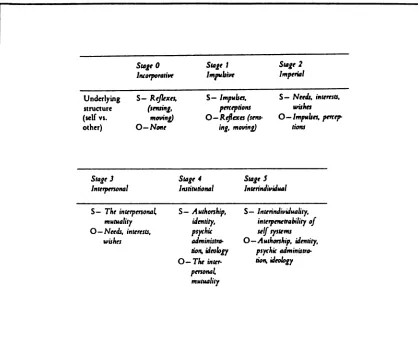
Table 11-3. Kegan's subject object transitions ... 27
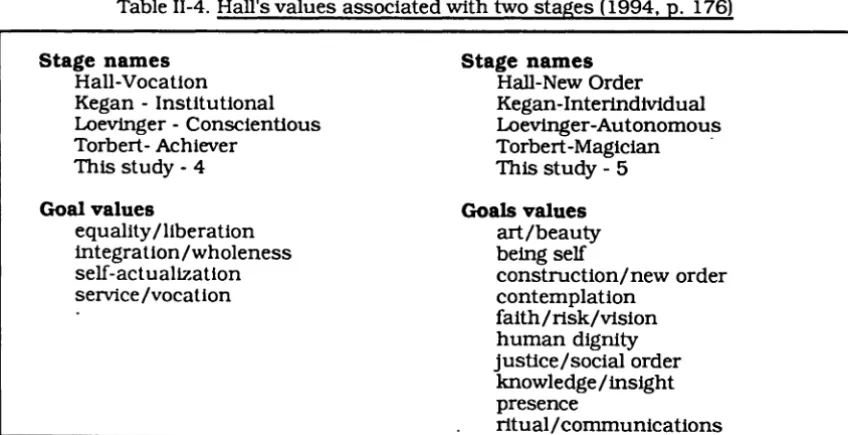
Table 11-4. Hall's values associated with two stages ... 27
Table 11-5. Hierarchy of mental processing, from most to least complex ... 32
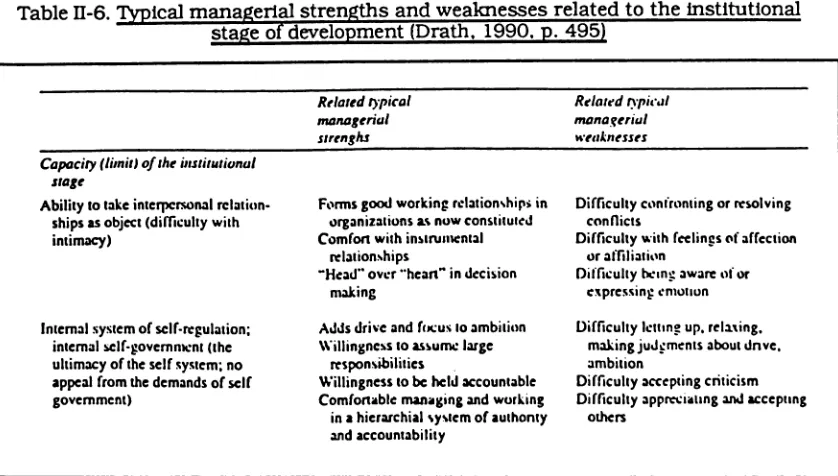
Table 11-6. Typical managerial strengths and weaknesses related to the institutional stage of ... 36
Table 11-7. Distribution of Loevinger stages among various groups ... 37
Table 11-8. Torbert's stage descriptions ... 39
Table 11-9. Torbert's stage descriptions ... 40
Table 11-10. Stages of personal and organizational development.. ... 4l Table 11-11. Bushe's propositions about cormnitment based organizations and developmental level. ... 42
Table 11-12. Hirsch's stage and revenue data with assessments of mental processing ... 46
Table TIl-I. Transforming performance vs. stage of ego development.. ... 53
Table TII-2. Transforming performance vs. relative mental processing ... 54
Table III-3. Multitrait-multimethod matrix for comparing stage of ego development and complexity of mental processing ... 60
Table III-4. Expected correlations if stage of ego development and complexity of mental processing are related constructs ... 62
Table IV-I. Abalone site data ... 70
Table IV -2. Abalone complexity of mental processing. inter-rater correlation ... 72
Table IV-3. Abalone data: Transforming performance vs. stage of ego development.. ... 73
Table IV-4. Abalone data: Transforming performance vs. relative mental processing ... 74
Table IV-5. Preliminary data ... 75
Table N -6. Abalone plus preliminary data Question 4a: Transforming performance vs. stage of ego development ... 76
Table IY-7. Preliminary data Question 4b: Transforming performance vs. relative mental processing ... 77
Table IV-8. Combined data: TransfOrming performance vs. relative mental proceSSing .. 78
Table IV-9. Correlation matrix: Ego development. mental processing. and time span .... 78
Table IV-lO. Combined data: Distribution of ego development stage among transforming performers ... 79
Table N-l1. Distribution of complexity of mental processing (combined datal ... 70
Table IV-12. Distribution of organizational roles by stratum (combined datal ... 81
Table A-I. Relevant managerial competencies in private sector organizations ... 104
Table A-2. Ten skills most frequently reported by senior executives ... 105
Table A-3. Sixteen managerial skills and perspectives ... 106
Table E-I. Abalone site summary of data ... 122
Table E-2. Abalone Site nOminations for successful transformations ... 123
Table E-3. Abalone site complexity of mental processing ... 124
Table E-4. PreUrninary data summary ... 125
Table E-5. Inter-rater correlations for complexity of mental process observations ... 126
Table E-6. Abalone correlations ... 1 27 Table E-7. Full data set correlation matrix ... 128
Table E-8. Significance of correlation values ... 129
Table E-9. Distribution of ego development among transfOrming leaders. Four & five with transforming results ... 130
Table E-lO. Fisher exact probability for ego stage vs. transforming For Table 4-3 ... 131
Table E-II. Fisher exact probability for ego stage vs. transfOrming For Table 4-6 ... 132
UST OF FIGURES
FIgure I-l. V8I1ables and their measumnent ... 5
FIgure 1-2. Flow chart of methodology ... 6
FIgure
n
-1. Developmental stage theory: Roots related to managerta1leadershlp ... 16FIgure n-2. LoevInger's stage character1sUcs ... 24
FIgure
n-3.
The maturatlon of complexity of mental ... 34FIgure IV-I. Number of exemplary nommatlons recetved by IndMduals ... 71
CHAPTER I INTRODUCTION
At this time in history, we face formidable economic and political change
(Drucker, 1989). Leaders of organizations from small business to national governments are seeking strategies to allow their organizations to adapt to the changing competitive environment (Magaziner & Patinkim, 1989).
The 20th century has seen a significant evolution in the principles of
management. The century began with Frederick W. Taylor's introduction of scientific management to improve productivity (Kreitner, 1992, p. 45). By the 1930's, the human relations movement was seeking to counteract the harshness of the control and command elements found within scientific management (Kreitner & Kinicki, 1989). In 1960, Douglas McGregor encouraged a management environment that would give employees an opportunity to do "great things," which he called Theory Y. Today ideas like high-involvement management (Lawler, 1986), learning organizations (Senge, 1990), and delighting the customers (Peters, 1987) appear frequently within the management literature.
Paralleling the evolution in management theory has been an equally significant advance in the understanding of leadership. Throughout history, studies had adopted a trait view ofleaders (Kreitner, 1992). In the late 1940's, the famed Ohio State studies of leadership behavior initiated a movement away from the trait-based view of leadership. By 1951 studies had begun at the University of Illinois which led to Fiedler's work on sittiationalleadership in the late 1960's and 1970's (Hampton, Summer: & Webber, 1982). James MacGregor Bums focused the next major shift in leadership thought with his introduction of the concept of transforming leadership (1978). As the knowledge of leadership was growing, so also was the evidence that there was a shortage of effective leaders who could bring about deSired change. Bennis (1989) for one, in describing "Why Leaders Can't Lead," expressed our need as a society for leaders who can transform their organizations.
With the current emphasis on the need for leaders who can transform
organizations, there is also a resurgence of interest in leadership traits (Kirkpatrick & Locke, 1991) and behaviors (Kouzes & Posner." 1987). A number of well executed studies (Boyatzis, 1982; Bragar, 1990; Kouzes & Posner, 1987) provided descriptions of the leadership behaviors that are needed to transform organizations.
of the most universal cravings of our time is a hunger for compelling and creative leadership" (1978, p. 1). Eight years later, Bennis & Nanus (1985) reiterated that this need for effective leaders is still evident in all aspects of society in the United States. This year John Kotter (1995) reviewed one hundred transformation attempts since Bennis & Nanus wrote-and the shortage is still painfully evident.
During the preceding decade attempts at organizational transformation have appeared under a progression of titles: total quality management, empowerment, participative management, and self-managed teams. More recently we read of process re-engineering and continuous leanling organizations. Whatever the title, organizations desiring to transform themselves and their value structure require leaders who can transform.
Quantifiable data on the shortage of transforming leaders is difficult to gather. But there are some indicators. For example, among the managers attempting to implement Total Quality Management, Juran (1991 a & b) found that only a few were effective at achieving the significant improvements that are available. Kotter (1995) stated:
A few of these corporate change efforts have been very successful. A few have been utter failures. Most fall somewhere in between, with a distinct tilt toward the lower end of the scale.
In this author's contact with managers responsible for change in two of large management consulting firms, the consensus was that the number of successful transformation attempts is about 20%. Why do so few achieve the big results?
The problem
Organizations in the United States need more managers who can lead change in their organizations-a specifiC kind of change-change that results in a culture built on customer satisfaction (Peters, 1987), systematic management of processes (Jaques, 1989), and a high level of employee involvement (Lawler, 1986). Research has identified many of the leadership behaviOrs that would facilitate the desired change. However, little is understood to explain why otherwise competent managers are unable to bring about ~ransformation in their organization.
In recent years much has been said about the role played by the interpretation of information in determining leadership success. Senge (1990). for one, devoted
considerable attention to what he calls mental models. He defined these models in terms of the way that people interpret reality based upon ingrained beliefs and assumptions. Senge examines the ability of these mental models to cause poor performance by preventing "brilliant strategies" from getting "translated into action" (p.
172). Joel Barker provides another look at the same topic which he calls paradigms.
Barker demonstrated the power of paradigms to prevent people from "even seeing" the data that opposes their paradigm. De Pree expanded the idea further when he stated 'The first responsibility of a leader is to define reality" (1989, p. 11). From De Pree's viewpoint, defining reality is the essential act of interpreting the meaning of information and thereby providing the "reality" that will be acted upon by the organization. Each of these authors recognized that the way a manager interprets information will have a significant influence on his or her performance, particularly when transfOrming change is required.
In the United States many organizations are pursuing significant change in response to pressures created by increasing competition (DertollZos, Lester & Solow,
1989). Successful transforming change results in an organization in which the people adopt new behaviOrs. Waitley (1979) links behavior to a person's perception of reality. He states that, "individuals behave, not in accordance with reality, but in accordance with their perception of reality" (p. 130). Yet a person's perception of reality results from the way that person interprets the information which he or she has received (Kegan,
1982). How a person interprets information is influenced by a number of things. Two of these are the focus of this study: stage of ego development (Loevinger & Wessler,
1970), and complexity of mental processes (Jaques & Cason, 1994).
A possible reason for a manager's failure to exhibit transforming behaviors is that the person's stage of ego development prevents the manager from perceiving that those behaviors would be effective (Torbert, 1991). A second reason may be that the manager's complexity of mental processing falls short of the level needed to deal with the information complexity associated with the task of transformation (Jaques & Clement.
1991).
The problem statement
Therefore, the problem of major concern is to gain greater understanding of the influence that stage of ego development and complexity of mental processing have on a manager's ability to transform his or her organization.
Objective
. The objective of this study is to assess the influence of these two variables-stage of ego development and complexity of mental processing-on the ability of a manager to bring about transformation.
Questions to be answered Research questions
2. What does existing research show concerning:
a. the relationship between a manager's success in transforming an organization and his or her stage of ego development?
b. the relationship between a manager's stage of ego development and his or her complexity of mental processing, and/or
c. the relationship between a manager's complexity of mental processing and his or her success in transforming an organization?
3. What operational methods can be used to:
a. measure performance as a transforming leader, b. measure stage of ego development,
c. obseIVe complexity of mental processing,
d. measure the complexity of work associated with a given organizational role, and/or
e. examine the relationship between stage of ego development and complexity ofrnentalprocessing?
4. Does performance as a transforming leader require that a manager: a. be above stage four of ego development,
b. possess complexity of mental processing above that which would be required to operate successfully in the same role if transformation were not required, and/ or
c. possess some minimum stage of ego development and relative complexity of mental processing?
5. Can the success rate of efforts to transform organizations be increased through selection of individuals that takes into account stage of ego developrnent, cornplexity of mental processing, and time span of organizational role?
OutHne of the dissertation
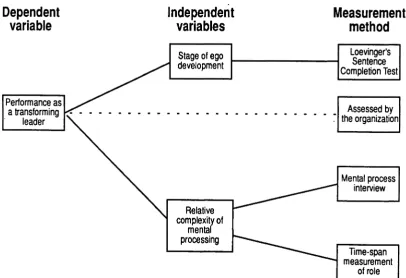
The five chapter format of the dissertation is outlined below. Figure 1-1. Variables and their rneasurement, provides a pictorial view of the variables, their relationship, and the methods that will be used to rneasure thern. Figure 1-2. Flow chart of methodology, outlines the methodology used in the study. A detailed discussion of that rnethodology is included in Chapter III.
Chapter
I. Introduction
II. Review of the literature III. Design of the
study
IV. Data & Analysis
V. Findings & conclusions
Dependent
variable
Performance as a transforming . leader
Content
Introduces the problem and identifies the dependent and independent variables
Addresses research question 2 by providing a review of the related literature.
Addresses research question 3 by describing the methods used to measure the variables being studied. The chapter then describes the design of the study which is being used to answer questions 4 & 5.
Provides an analysis of the data that will be used to answer questions 4 & 5.
Addresses research questions 4 & 5 based on the data analysis provided in Chapter IV. Then, using question 1 to provide focus, summarizes the study.
Independent
variables
Stage of ego development
Relative complexity of
mental processing
Figure I-I. Variables and their measurement
Measurement
method
Loevinger's Sentence Completion Test
Assessed by
~ the organization
Mental process interview
Time-span measurement
TIiE CON1RIBtmON OF COMPLEXITY OF MENTAL PROCESSING AND STAGE OF EGO DEVELOPMENT TO TRANSFORMING LEADERSHIP
by
GLENN W. MEHLTRETIER. JR
A dissertation submitted to the Graduate Faculty of North Carolina State University
in partial fulfillment of the requirements for the Degree of Doctor of Education
ADULT AND COMMUNITY COLLEGE EDUCATION TRAINING AND DEVELOPMENT TRACK
Raleigh
1995
APPROVED BY:
R E. Wenig.
DEDICATION
To my Lord Jesus Christ
BIOGRAPHY
Glenn W1ll1am Mehltretter Jr.
Born in Bayonne. New Jersey. November 26. 1942. to Glenn WUliam Sr .. and Eileen (Carroll). Married Betsy-Jo. the joy of my life. in June of 1965. and graduated Carnegie Mellon University two days later. With a Bachelor of Science degree in Mechanical Engineering. Began professional employment in Jones & Laughlin's integrated steel m1l1in Pittsburgh. Pennsylvania. Left. J&L to fulfill a two year ROTC commitment. ReceiVed an Honorable discharge after two years of service in the U. S. Army during the Viet Nam era. Joined Piper Aircraft. as a project engineer. After three
years. left. Piper to pursue studies at the Amos lUck School of Business Adm1n1stratlon at Dartmouth College. Received MBA degree from Amos lUck School in 1972.
Joined Comtng Glass Works after Amos lUck graduatlon. and held a variety of manufacturing. production. and engineering management positlons until 1981. In 1981 left. Comtng to pursue independent consulting actMtles focusing on the issues of manufactUring competltlveness. Through the present time these consulting interests have broadened beyond manufacturing to Issues of overall organJzational emdency and effectiveness.
Up to this point in Ume there have been a number of adventures. The chief began with raising three wonderful children. Heidi. Glenn DI. and Daniel. Some of the other adventures are evidenced by various cert.tOcaUoll8. or acUvities (some of which are no longer current): Eagle Scout; Scabbard and Blade rnil1tary honor society (ROTC);
member of National Ski Patrol; private pilot; registered profeSSiOnal engineer (for over 20
ye~); ran! marathon; Dale Carnegie Instructor; trained trainers for cUents of COming
IntemaUonalin Baldrtge Self Assessment. and in all aspects o(Total Quality
Management; 4-Ma~ Instructor; ordained minister; deUvered seminars for the North Carolina State Industrial Extension Service; appointed to the academic Honor Society of Phi Kappa Phi.
ACKNOWLEDGMENTS
As this diSsertation has come to completlon it has been a humbling. as well as gratlfying experience. to recall the support. encouragement. and concrete help that has been enthusiastically given by a lot of people. Chief among these has been the sage and patient guidance of my advisor Dr. Robert Wenig.
My dissertation saga started with a growing desire to understand why It was that so many of the firms that were attempting to transfonn themselves were falltng flat. while a few were achieving. as Juran says. "stunning results." I still remember the assignment that Dr. Linda Dillon gave to read through the 1987 version of Craig's Training & Development Handbook. It was during that time that I discovered for the first time. on page 155. the work of Dr. Elliott Jaques. While the discovery laid donnant for a year. It turned out to be an occasion that has Uterally changed the dlrectlon of my life. Around that same time. in the Sununer of 1989 I came across an article by Keny
Bunker in Issues & ObgeJVatlons. a quarterly pubUcation of the Center for Creative Leadership. I visited Keny and he introduced me to the Center's research into how managers face difIlcult learning demands. I was taken by the title of the program "going against the grain." or SimPly "GAGGING'"
Shortly after that Keny transferred from research to training delivery and Dr. Palus took over responsJbtUty for the Center's developmentally based research. Dr. Paluso has been a continuous supporter. encourager. and expert resource during the full course of this work. He also provided the UnIt that led to my first contact With Dr. Jaques. In addiUon to Dr. Palus a number of others at the Center for Creative Leadership prOVided invaluable support. Wilfred Drath. deSCribed developmental learning in an exemplary way~ach of the many times that were needed to shoot the infonnation Video that was used in seeking research partners. Along the way Jill Pinto. John Fleenor. and David Horth along with the Leading Creattvely destgn team were supportive in material ways .
Tom Carter. Sr. Vice President for Quality at ALCOA played a critical role in the success of the research: he caught the vision and provided the first opportunity to test the emerging design in the field. Tom is a brilliant model butlder and has continued to provide a willing ear to test theory against his years of pragmatic management
experience.
Patrick Norauski. Vice Prestdent for Quality at Dresser-Rand. provided very concrete help on a number of critical Junctures as well as needed encouragement during some dtfilcult times.
Jack Powers. director of Human Resources for Criovac dJvision of the W. R Grace Co .• was my first close encounter with a transfOrming leader. Jack demonstrated to me the power that can be loosed in an organization through the practical (he prefers "pragmatic·) application of theory grounded practtces in operating organJzatlons.
Two others tnvested many hours in their thoughtful review of both early and later drafts: my good friend and associate Dr. Neal Kenny. and my always supportive dad. Glenn Sr. Dr. Kenny. as my ldds know htm. always provided insight into writing style and clarity. and somettmes issued challenges that cut to core issues. My dad was the critical test. HaVing retired as Executive VICe President of a divis10n of International Nickel. he was a "hard sell.· If he bought It. I knew I had something worthwhile. Neal and Dad were not the only ones who contributed excellent suggestions and feedback through their many readings. Thanks also goes to Dr. Robert Beckley. my father-in-law. Brian and Rebecca W1lld.e. and Ceri Usmar (or their careful proofing the final drafts.
Dr. Owen Jacobs. retired ChteC of the Strategic leadership Technical Area. of the U. S. Army Research InsUtute for the BehaVioral and Social Sciences. provided
invaluable insight on the relaUonship between complexity of mental processing and stage of ego development.
Dr. William Torbert. Professor of OrgaruzaUonal BehaVior at Boston University. contributed greatly through his partlc1paUon in the infonnaUonal video. his excellent research and insight into the relaUonship between leadership and stage of ego
development. and his patience when I challenged aspects of work.
Dr. Kenneth Clark. Emeritus from the Center for Creative leadership provtded encouragement at a critical point by confirming that the research dlrecUon was indeed an Important one.
Special thanks to Heidi, my daughter, for her help in putting together the early materials used in seeking research partners, for capturing the essence of the problem in a single lllustration, and for her professional execution of the informational video.
Thanks also to Scott Rucci for his help on the 7 am
to 3 am production shoot.
I also express my appreciation to the members of my graduate advisory committee,
Doctors, Gary Moore, Ron Shearon, and Ray Taylor. Dr. Moore had a great influence on my thinking through introducing me to the philosophy of education. I want to thank Dr. Shearon, one of the finest facilitators of learning I have met. for
introducing me of the work of Bolman & Deal. Dr. Taylor's knack of cutting to the quick and asking the difficult questions, proved quite helpful in focusing the research questions.
TABLE OF CONTENTS
Page LIST OF TABLES ...
.x
LIST OF FIGlJRES ....xu
CI-iAP1ER I INIRODUCTION ... 1The problem ... 2 The problem statement ... 3 Objective ... 3 Questions to be answered ... 3 Research questions ... 3 Outline of the dissertation ... 4 Justification ... 7 LiInits of the study ... 7 .Assumptions ... 7 Definitions ... S Chapter summary ... 9
CI-iAP1ER II REVIEW OF TIiE LITERATURE ... 11 Leaders who transform organizations ... 11 Meaning-making and leadership ... 12 Meaning-making processes ... 15 Piaget and cognitive development ... 15 General guidelines for identifying Piagetian cognitive stages ... lS "Hard" and "soft" stage theories ... IS Kohlberg's theory of moral development ... 19 Ego development ... 19 Ego or self development vs. Kohlberg's moral development.. ... 20 Loevinger's theory of ego development ... 23 Stage transitions ... 24 Kegan and the evolution of the self ... 25 Subject. object, and embeddedness ... 26 Developmental stages as a clusters of values ... 27 Complexity of mental processing ... _ ... 29 Jaques and the concept of complexity of mental processing ... 29 A model for the mental processing of complexity ... 30 Description offour types of "complexity mental processing" ... 30 Explanation offour "orders of information complexity" ... 31 The maturation of complexity of mental processing ... 33 A summary of meaning-making ... 34
TABLE OF COmENTS (CONTINUED)
Page Research relating leadership and meaning-making ... 35
Ego development ... 35 The institutional manager and empowerment ... 35 On development and transforming leadership ... 36 Torbert's stage descriptions ... 38 The developmental stage of organizational development consultants ... 41 Complexity of mental processing ... 43 Complexity of mental processing-necessary but not sufficient ... 43 Complexity of organizational roles ... 43 Research on both factors ... 44 Strategy formulation among practicing professionals ... 44 IndMdual differences in strategic leadership capacity ... 47 Chapter surrunary ... 48 CHAPfER III DESIGN OF mE snJDy ... 51 The research model ... 51 The variables ... 52 Successful transformation vs. stage of ego development ... 52 Successful transformation vs. complexity of mental processing ... 54 Operational measures ... 55 Question 3a. Performance as a transforming leader ... 55 Question 3b. Stage of ego development.. ... , ... 56 Question 3c. Complexity of mental processing ... 56 Question 3d. Relationship between complexity of mental processing and
complexity of assigned role ... 57 Complexity of assigned role ... 57 Relative complexity of mental processing ... 57 Question 3e. Relationship between stage of ego development and
TABLE OF CONIENTS (CONTINUED)
Page CIiAPTER IV DATA AND ANALYSIS ... 69
Abalone site data and analysts ... 70 Abalone data 1: Identification of transfonnlng performance ... 70 Abalone data 2: Stage of ego development ... 71 Abalone data 3: Time span of role ... 71 Abalone data 4: Complexity of mental processing ... 72 Abalone data 5: Relative complexity of mental processing ... 72 Abalone site data and Question 4 ... 73 Transforming success vs. stage of ego development (Abalone data) ... 73 Transforming vs. relative mental processing (Abalone data) ... 73 Summary (Abalone data) ... 74 Prel1mtnary & combined data & analysts ... 74 Transforming vs. stage of ego development (prel1mtnary & combined data) .. 75 Transforming vs. relative mental processing (prel1mtnary data) ... 76 Relatlonship between stage of ego dev. and complexity of mental processing ...
n
Minimum requirements for transforming performance ... 78Minimum stage of ego development ... 78 MtnJmum relative complexity of mental processing ... 79 Minimum complexity of mental processes ... 80 Mtntmum stratum of organizational role ... 80 Summary ofmtntmum Indicators ... 81 Chapter summary ... 81 CIiAPTER V, SUMMARY, CONCLUSIONS, IMPUCATIONS AND
RECOMMENDATIONS ... 83 Summary ... 83 The problem being studied ... 83 The problem statement ... 83 Review of the Literature ... 83 Leaders who transform organizatlons '" ... 84 Meaning-making processes ... 84 ChOice of ego development and complexity of mental processlng ... 85 Ego development ... 85 Complexity of mental processing ... 86 Combining and contrasting the two ... 87 Research relating leadership and meantng-making ... 87 Design of the study ... 89 Choice of measures ... 90 Stage of ego development ... 90 Relative complexity of mental processing ... 90 Performance as a transforming leader ... 90 Criterion for the sample ... 91 Data collection ... 91 Data and analysts ... 92 Conclusions ... 92 Implicatlons ... 94 Based on this study it is the authors optnion ... 95 Recommendations ... 95 Apply Requisite Organizatlon principles ... 95 Further research ... 95
LIST OF TABLES
Table IT-I. Kohlberg's six moral stages ... 21 Table 11-2. Classification of moral judgments ... 22 Table 1I-3. Kegan's subject object transitions ... 27 Table 11-4. Hall's values associated with two stages ... 27 Table 11-5. Hierarchy of mental processing. from most to least complex ... 32 Table 11-6. Typical managerial strengths and weaknesses related to the institutional
stage of ... 36 Table 11-7. Distribution of Loevinger stages among various groups ... 37 Table 11-8. Torbert's stage descriptions ... 39 Table 11-9. Torbert's stage descriptions ... 40 Table 11-10. Stages of personal and organizational development ... 4l Table 11-11. Bushe's propositions about commitment based organizations and
developmental level. ... 42 Table IT-12. Hirsch's stage and revenue data with assessments of mental processing ... 46 Table 1lI-1. 'Ii'ansforming performance vs. stage of ego development.. ... 53 Table 1lI-2. Transforming performance vs. relative mental processing ... 54 Table II1-3. Multitrait-multimethod matrix for comparing stage of ego development and
complexity of mental processing ... 60 Table I11-4. Expected correlations if stage of ego development and complexity of mental
processing are related constructs ... 62 Table IV-I. Abalone site data ... 70 Table IV-2. Abalone complexity of mental processing. inter-rater correlation ... 72 Table IV-3. Abalone data: Transforming performance vs. stage of ego develbpment.. ... 73 Table IV-4. Abalone data: Transforming performance vs. relative mental processing ... 74 Table IV-5. Preliminary data ... 75 Table IV-6. Abalone plus preliminary data Question 4a: 'Ii'ansforming performance vs.
stage of ego development ... 76 Table 1\!-7. Preliminary data Question 4b: Transforming performance vs. relative mental
processing ... 77 Table IV -8. Combined data: Transforming performance vs. relative mental processing .. 78 Table IV-9. Correlation matrix: Ego development. mental processing. and time span .... 78 Table IV-lO. Combined data: Distribution of ego· development stage among transfOrming
Table IV-12. Distribution of organizational roles by stratum (combined data) ... 81 Table A-I. Relevant managerial competencies in private sector organizations ... 104 Table A-2. Ten skills most frequently reported by senior executives ... 105 Table A-3. Sixteen managerial skills and perspectives ... 106 Table E-I. Abalone site summary of data ... 122 Table E-2. Abalone site nominations for successful transformations ... 123 Table E-3. Abalone site complexity of mental processing ... 124 Table E-4. PreliIninary data summary ... 125 Table E-5. Inter-rater correlations for complexity of mental process observations ... 126 Table E-6. Abalone correlations ... 127 Table E-7. Full data set correlation matrix ... 128 Table E-8. Significance of correlation values ... 129 Table E-9. Distribution of ego development among transfOrming leaders. Four & five
with transforming results ... 130 Table E-lO. Fisher exact probability for ego stage vs. transforming For Table 4-3 ... 131 Table E-II. Fisher exact probability for ego stage vs. transforming For Table 4-6 ... 132 Table E-12. Fisher exact probability for complexity of mental processing vs.
transforming For Table 4-4. 7 & 8 ... 133
usr
OF Jl'lGUJaCS~ 1-1. V ... 11lI .ad tIIeIr
m e
lliilEiiEiJl ... 5f'IIure 1-2. Flow c:bart
or
IIIeIIIodok:e ...
8f"II\1ft B-3.
n.e
III8turatIDDor
« ...
t,
or
1III!IIIaI ... 34~ IV-I. ~ af
&Hi"',
A . . . itcelSCd.., . . . .-0 ... ... 71Piaget focused on structure while studying a range of content areas. He published three volumes on epistemology which covered such content areas as mathematics, physics, psychology, and logic (Ginsburg & Opper, 1969, p. 10). He provided four general gUidelines for identifying cognitive stages. Note that each of these gUidelines focus on structure rather than content.
General guidelines for identtfying Piagetian cognitive stages
1. Stages imply a distinction or qualitative difference in structures (modes of thinking) that still serve the same basic function (for example, intelligence) at various pOints in development.
2. These different structures form an tnvariant sequence, order, or succession in individual development. While cultural factors may speed up, slow down, or stop development, they do not change its sequence.
3. Each of these different and sequential modes of thought forms a ·structural whole." A given stage response on a task does not Just represent a specifiC response determined by lmowledge and familiarity with that task or tasks similar to it: rather, it represents an underlying thought organization. The imp}Jcation is that various aspects of stage structures should appear as a consistent cluster of responses in development.
4. Stages are hierarchical integrations. As noted, stages form an order of increasingly differentiated and integrated structw"es to fulfill a common function. Accordingly, higher stages displace (or, rather, integrate) the structures found at lower stages.
(Kohlberg, 1984, p. 238)
These four principles can be used to distingUish between two types of stage theories. ·Hard" and ·soft" stage theories
Kohlberg provides an extenSive discussion of the topic (1984, ch. 3). Hard stage theories apply rigorously Piaget's four gUidelines for identifying cognitive stages. Hard stage theories focus on the structure of the cognitive processes. Kohlberg's work on "moral" development follows the hard stage approach. In analyzing a person's response to an ethical dilemma, Kohlberg was concerned with the structure of the response rather than the specifiC chOices that were made. For example, did the person choose to act in accorqance with a moral principle or an organizational rule? The person whose
structure gave them the ability to recognize a conflict between a moral principle and an organizational rule is at a higher stage of moral development than the person who sees the dilemma only in terms of organizational rules. The content, consisting of the specific rules and principles that the person conSidered, is not taken into account in determining the stage of moral development. The relevant thing is the structure that is used to evaluate, weigh, and balance the content.
By using this structural approach, Kohlberg argues that the stage
determinations will be free of cultural bias. Edwards (1985) reviewed studies from 22 nations representing The Americas, Asia, Africa, Europe, and New Zealand, and found that most supported Kohlberg's assertion.
Kohlberg's theory of moral development
Kegan believes that MLawrence Kohlberg's study of the development of moral reasoning has represented the single most significant extension of the Piagetian framework" (1980, p. 50). Kohlberg has identified six stages of moral development and grouped them in three categories: preconventional, conventional, and postconventional or principled (1984, p. 174-176). In describing each stage he examines what a person believes to be the Mright thing to do" and the reasoning behind that determination. Given what a person believes to be right along with their reasoning, Kohlberg identifies that person's Msocial perspective."
At the lowest stage of moral development a person sees the Mright" thing to do is to avoid breaking rules that are backed by pUnishment. This is right because the authority has superior power and the person wants to avoid punishment. This viewpoint leads to an egocentric perspective-Mall I can see is my own interest."
At a higher stage of moral development, stage 4 for example-akin to the
Machiever" stage that Torbert (1991, p. 43) reported as representing over a third of senior managers and executives-the Mright" thing has become Mfulfilling the actual duties to which you have agreed." The manager does this to Mkeep the institution going as a whole, to avoid breakdown in the system." A manager at this stage looks from the perspective of an institution that defines roles and rules-he or she differentiates social relationships from interpersonal agreements. A manager at this stage might describe his or her behavior by saying, MI do what needs to be done for the sake of the" organization, even if it involves some tough personnel decisions."
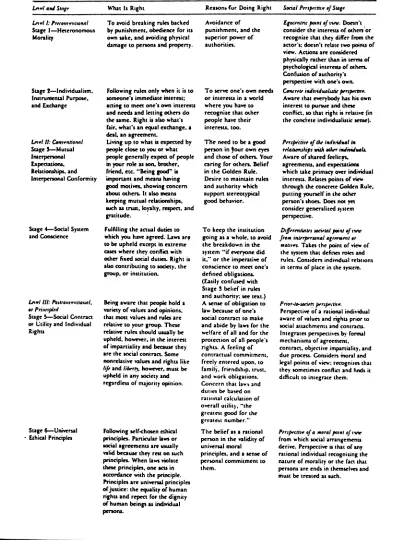
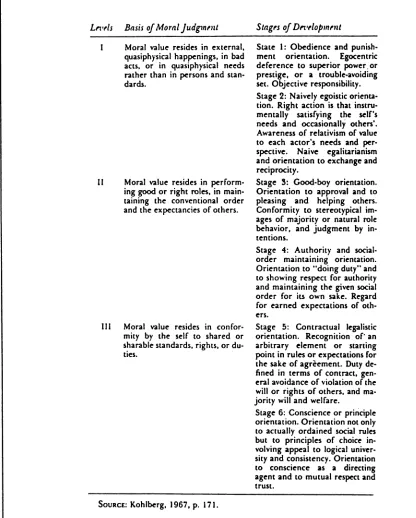
A complete description of Kohlberg's Mright," reasons, and social perspective at each stage is given in Table II-I. His basis for classification of moral judgments is given in Table 11-2.
Ego development
Ego or self development vs. Kohlberg's moral development
Kohlberg. in commenting on these more totalistic views states:
An ethical philosophy is more than a structure of moral reasoning defined by Justice and conflict resolution. It also includes a conception of human nature.
of society. and of the nature of ultimate reality. Classics such as Aristotle's
Ethics or Spinoza's Ethics represent total world views within which moral reasoning 15 embedded. (p. 237)
It 15 at this point that the difference between hard and soft stage concepts becomes relevant. Kohlberg (1984) believes that those seeking to examine a more totalistic meaning-making find it necessary to mix structure and content in their analysis-a violation of the Piagetian guidelines for identifying cognitive stages.
Kohlberg (1984. p. 241-243) descnbes Loevinger's approach as conforming closely to the Piagetian guidelines. except regarding the issue of content over structure .
. . . it is only the fonnal organization of reasoning operations that defines a
structure ....
In contrast, Loevtnger's scheme considers structure less as a fonn of thinking and more in tenns of fairly stable personality functions and contents. . . . Structure In Loevinger's tenns 15 a hypothetical. underlying entity of
personality. like that entity defined by the psychoanalytic concept of the ego. Because structure is an underlying hypothetical construct. it can never be directly observed .... Loevinger's actual assessment measure is based on
categones of content. or mixtures of content and structure. as probabilistic signs of an underlying structure. (p.242)
In responding to Kohlberg, Loevinger (1985a) states that MKohlberg's conception of the moralization of Judgment has been hedged about almost from the begJnnJng by the larger issue of maturation ofpersonaUty generally" (p. 183). Further. MKohlberg's model assumes a fonnal and ngid structure appropriate. if anywhere, only to a narrowly conceived concept" (p. 183).
Based on Kohlberg's and Loev1nger's arguments. a structured approach has the advantage of precision. while a softer approach can look at the more general case of
personality development. Because both strengths are desirable. this study will apply Loevinger's soft model for measuring personality (ego) development (the first independent variable), and a hard, structural model, developed by Elliott Jaques (Jaques & Cason
1994), for measuring complexity of mental processing (the second Independent variable).
Table II-I. Kohlberg's six moral stages (1984. p, 174-176)
u,'rl J: "trtnnv,UIDMI Stogc I-H ... ronomou, 1oI0nli17
Stogc 2-lndi';duali,m, Ins.rumentol Purpooc.
and Exchange
"".111: Com .. IIIi ... 1
Sca~ ~loIu.ual I",~I
Expccwiona, Rela.ionships, and
In.~1 Confonni.y
Scag. _Social Sy"em and Conscience
l.It"llIl: PoJlftJlI1""ui",UlI.
• r Pri"npl",
S.ag. !>-Social Con ... ct or I,;.ili.y and Individual lighu
Stage 6-Uni..,,..1
• Ethical Principles
WlIa. Is Righ.
To awid breaking rulcs backed by punishment, obeodience (or its
own sake. Ind .... iding ph}"inl damage
'0
persons and propcny.Following ruin only when it is to IOmeone', immediate interest: lainglo meet one', own inleresu
and needs and leuing othen do
.~ same. Righ. is also wha.', fair. wha.', In "",al exchange. a
dca~ an agr ... nL
Li';ng up '0 wha. is expected by people close
'0
you or what people gene,.IIy npect of peopl.in your role as son. brother. friend. etc. "aeing pxI" is
imponanl and mona h3ving
iood motiW'l. Ihowinl concern
lbou. oth.,.. I. also IM3ns keeping mu.ual rela.ionships. such as .rust, loyalty. respect, and gra.i.ude,
Fulfilling.h. actual duties '0 which you h..., agr..,.j. Laws ."
'0
be upheld ."cop. in ex.,.mecues whe-re the)' conflict with
other fixed social du.ies. Righ. i,
abo contributing to lCIciet.y. the group. or institution.
aeing lwa~ .hal pcopIc hold a
wriety of values and opinions .
thll most valurs and ndes are
r~btiW'e' 10 )'Our group. Thne ",lali~ rul .. ,hould usually be
upheld. hOwt!Wr I in the interf"St of impaniali'y and because th.),
are the sncial contnCL Some nonrelalive values and righu like
/if, Ind li"'r". ho_r. must be
up~ld in an'y soci •• y and
re-prdleu of majority opinion.
Following self<ho5cn ethical principles. hnicul., laws or
IOcia.laglft'menu an' uMlllly
... Iid becauae .hey rest Oft such principles. When laws .;ola.e
thete principlft. one acu in
accordanc. wi.h .h. principle.
Principles are uni.enai principles
of ju"ice: .h. "","Ii.y of human riChu and ropcct for .he dignily of human beings as indMdual
persons.
Renon. fur Doing Right
Avoidance of
punishment, and the superior powc:r of authorities.
To sene one', own nftds
or int~rtsu in a world where you have to
recognil~ that 04.h~r
peopl. ha~ .h.ir
inrernu. too.
Th. need '0 be a zood penon in 'our own ." ..
and .hose of OIh.,.. Your caring for othe,.. aelicf in .he Colden Rule,
Desirto 10 maintain rules
and authority which
.uppon "erCOl)'Pial good beh • .;or.
To keep the inuitution going as a whole. to avoid the breakdown in the
.)'"em "if everyone did
h. " or the impenti.e of conscience to mee1 one's
d.fined obliga.ions. (E.asily confused wi.h S.age , beltcf in rulcs
and authority: tore Int.)
A sense or obliga.ion '0
bw beaus.e of one's
social conU;1;C1 to mak~
and abid. by laws for .he welf.,. of all and for .h. prolection or an poopl.·, righu. A f • .ring of
contractual commitment,
rreely enltored upon. to ramil;·. friendship. trust. and ""'ork obligations. Conct'rn that la",·~ and
dUI in bfo b .. sed on ulional calculation of ow-rail utilit)". "thr grt'alnt good for l~
grt'ate3l1 number."
The belief as a rational
penon in .h .... Iidi.y of
uniw-rul moral principles. and a sense of perlOnal commitmrnt 10
them.
SotiJJl p",prtit •• J S"l'
£(O<,./ri< ,...., .f .w. ~n'.
con.idn the inttre'JtJ n( Olhen'or
rrcogni ••• ha •• h.y diff.r from .h.
actor',: doesn', relate IWO poinu of view. Actions are cOMide~
ph}"ically .. ther than in
,nmI
of psychological in •• r .... of 0Ihcn.Confusion or authority'S penp«tive with one', own.
C-.,,, iun'4lUdistir />",pKtrr<.
Awa~ .ha. e>n)'body ha, his own
inlern. 10 punue and these
conRia, 10 that rilh, is rt'iati,'e (in
the (oootle individualistic Imiot).
P",p.'iii~ .f tJv iodn;d . . 1 ill
rrio-.IU/I' ...uA IlAn ialirNI .. u.
Awa~ of ,hared f..,lir.n, agree menu. and n~tiona
which take primacy _ r indimual
interesu. Relatf'l points of rinr
through the caner .. e GoId<n Rule. putting you.,.,lf in .h. ~
penon" ,hO<S. ~ not YCl
consider genenlizC'Cl I)"iltom
penpccti~.
Dlff""'"''', JDti",,1 poi'" 'J'VII'
fro. irau",,,»n/d .,'''''''''' .r
IIfDlu.., .. Takes the point of ";ew of
.he ,}".em .ha. deb., roIcs and
rules. Considen indiondual relJUOni in terms of place in the system.
PritJr-l~J«ill'J /l'rJjJ'l·ln",.
Penpective of a ratioml indi"idual aware or YlIIluf"S and rilhu prior to JOCial au~chmenu and conlnru.
In.egra ... perspcc.i,ft bl' fonnal
mechanisms or agre-emenl, contract. objeC1i\"e' impaniality. and due proceu. Comiden moral Jnd
~gal poinls of v~·: rr:cognilel 'hill
they IOmelimH conflicl and flnds it difficult 10 inlC'grate Ihem.
PlrJ"C,"'" of d ".Dral pmll' "/1""
Table 11-2. Classification ofrnoral judgments (Kohlberg, 1984, p. 44)
Lrwls Basis of Moral Jud~nflli
Moral value resides in external, quasiph}·sical happenings, in bad acts, or in quasi physical needs rather than in persons and
stan-dards.
II Moral value resides in
perform-ing good or right roles, in main-taining the conventional order and the expectancies of others.
III Moral value resides in
confor-mity by the self to shared or sharable standards, rights, or du-ties.
SOURCE: Kohlberg, 1967, p. 171.
22
Slag's of Dn.orlopmml
State 1: Obedience and
punish-ment orientation. Egocentric
deference to superior power _ or
prestige, or a trouble-avoiding set. Objective responsibility. Stage 2: Naively egoistic orienta-tion. Right action is that instru-mentally satisfying the self's needs and occasionally others'. Awareness of relativism of value to each actor's needs and per-spective. Naive egalitarianism and orientation to exchange and reciprocity.
Stage S: Good-boy orientation. Orientation to approval and to pleasing and helping others. Conformity to stereotypical im-ages of majority or natural role behavior, and judgment by in-tentions.
Stage 4: Authority and
social-order maintaining orientation. Orientation to "doing duty" and to showing respect for authority and maintaining the given social order for its own sake. Regard for earned expectations of oth-ers.
Stage 5: Contractual legalistic orientation. Recognition of· an arbitrary element or starting point in rules or expectations for the sake of agreement. Duty de-fined in terms of contract, gen-eral avoidance of violation of the will or rights of others, and ma-jority will and welfare.
Loevinger's theory of ego development
Loevinger & Wessler (1970) differentiate among stages by exc'UIlining a person's responses to a series of 36 sentence stems. Figure ll-2 Loevinger's stage characteristics, provides a synthesis of the characteristics of the various ego stages that she has identified. The stage entitled "conscientious" corresponds to Kohlberg's stage 4, and Torbert's "achiever" stage that were referred to earlier as being common among managers. Her more totalistic view of meaning-making enriches Kohlberg's description. Kohlberg would say that the "conscientious" manager can separate moral issues from rule issues. Loevinger would add that the manager: values achievement, is capable of perceiving multiple possibilities, tends to be reflective, and is able to vividly describe individual differences (from Figure ll-2.).
The stage evaluation process itself is somewhat complex. Loevinger (Loevinger & Wessler, 1970) provides 700+ pages of instruction for the scoring of "The Sentence Completion Test" (SCT) which she developed to assess stage of ego development. In spite of the complexity, this test has been widely used. The SCT appears to be the only well established, validated, pencil and paper test for the measurement of ego development (Loevinger, 1979). A copy of the version of the test used appears as Appendix B.
Stage tranSitions
Up to now we have spoken of stages, their identification and the characteristics of two theories of stage development. Stages can be thought of as positions of
eqUilibrium, or perhaps as places of rest between changes (Peny, 1981). A person at a given stage finds that their view of the world allows them to function effectively within the world as they see it. In effect, a person can be conSidered well adjusted at any particular stage (Loevinger & Wessler, 1970). When a person begins to en~ounter issues that are not satisfactorily dealt with using their present perspective, they are faced with changing their perspective, or ignoring the dilemma (Kegan, 1882; Kohlberg, 1984, Loevinger & Wessler, 1970; Peny, 1981). If they choose to address the dilemma they will
~
~
~ t::I , tvS
j
~. f/l ~~
g.
~
,.... n~
n
f/lTransitions from one world view to a new world view. or from stage to stage. tend to span several years. and are marked with considerable discomfort on the part of the person experiencing the change. Perry (1981) describes some of the emotions that can accompany stage transitions:
in the process of growth. .. Each of the upheavals of cognitive growth threatens the balance between vitality and depression. hope and despair. It may be a great JoY to diScover a new and more complex way of thtnktng and seeing: but
yesterday one thought in simpler ways. and hope and aspiration were embedded in those ways. Now that those ways are to be left behind. must hope be
abandoned too? (p. 108).
Transitions are not a lot of fun! Yet. developmental growth requires transition. For that reason it is relevant to look at the work of Robert Kegan (1982) who has developed a theory which rationalizes the evolution from stage to stage.
Kegan and the evolution of the self
Kegan (1982) conceives of a person's personality development as resulting from the balancing of tension between two poles: the desire for independence and the desire for Inclusion. He is particularly Interested in the tensions that occur leading to and during the transitions between the stages.
For illustration let us return to the previously discussed manager who is at Kohlberg's stage 4 (Loevtnger's conscientious. Torbert's achiever). Kegan calls thIs stage institutional. Not because the person sees from the institution's point of view, but because the person sees himself or herself ~ an institution. Institutions run by rules: they make treaties and agreements with other institutions: they are self-sustatntng entities within a world of other self-sustatntng entities. The institutional person does the same.
Kegan states that "the strength of the institutional balance is its autonomy~ (p. 223). The institutional person has found a stable place near the pole defined by the desire for Independence. It is thiS very view of the world that allows the institutional manager to make the statement cited earlier: "I do what needs to be done for the sake of the organization, even if it involves some tough personnel deCiSions. ~ The institutional mange~ can take this position because relationships are akin to agreements between institutions, they can be changed when business conditions warrant. Just as nations can dissolve treaUes as they desire~ven unilaterally.
The Interlndlvldual stage is Kegan's next developmental step-it deals with issues of mutuality and Interdependence. When the institutional manager, who values
intertndMdual stage it is necessary to introduce three additional tenns, those of: subJect, object, and embeddedness.
Subject, object, and embeddedness
To develop his model. Kegan (1982) changes the tenns mentioned earlier, structure and content, to subject and object. He does this because of a third concept called embeddedness. Stmply put, embeddedness refers to the idea that we cannot perceive that in which we are embedded. For purpose of illustration, suppose a tadpole does not perceive water untll it is removed from the water.
A person is embedded in the particular structure they use for interpreting their environment. The institutional manager is embedded in concerns of "personal
autonomy" and "self-system identity" (p. 191). Kegan would refer to these items as "subject."
"Object" refers to things that the "subject" can examine. Back to the tadpole. In the water, the tadpole can examine a pebble on the bottom. The weight of the pebble (object) is perceived in terms of its presence in the water (subject). When the tadpole develops to a frog the water changes from subject to object. The pebble can now be examined from a different structure (subject = out of the water). The perception of the pebble changes in a number of ways: heavier with buoyancy removed, possibly more clearly defined than if the water were cloudy etc. The tadpole can now examine the water (object) and see what influence the water had on its prior perceptions of the pebble. In Kegan's terms the water, which was "subject," has now become "object." The water has been "objectified" by the tadpole.
Let us return to the institutional manager for another illustration. For a person at the institutional stage, the self is inseparable from performance of commitments. Performance can not be viewed tmpersonally and studied as an "object." Performance of agreed upon commitments ~ the self-it is "subject." Criticism which challenges
performance is seen as feedback which attacks the person's self. It is likely to produce self-anger, self-shame, and fear, as a reaction. As the person begins to move to the next stage they will begin to "objectify" their performance on agreed-upon commitments. They wtll begm to examine their performance as an object, separated from-no longer a part of-themselves. As they can objectify performance, they can become more rational in their examination. CritiCism can be seen as feedback, and not as a personal attack. More wtll be said about this when we look at Drath's (1990) comments on the institutional manager.
The complete sequence of the subject object transitions outlined by Kegan appear as Table 11-3.