The University of San Francisco
USF Scholarship: a digital repository @ Gleeson Library |
Geschke Center
Master's Theses Theses, Dissertations, Capstones and Projects
Spring 5-19-2017
The Acquisition and Analysis of
Electroencephalogram Data for the Classification
of Benign Partial Epilepsy of Childhood with
Centrotemporal Spikes
Jessica A. ScarboroughUniversity of San Francisco, [email protected]
Follow this and additional works at:https://repository.usfca.edu/thes
Part of theDiagnosis Commons,Longitudinal Data Analysis and Time Series Commons,
Neurology Commons,Neurosciences Commons,Numerical Analysis and Scientific Computing
Commons, and theSleep Medicine Commons
This Thesis is brought to you for free and open access by the Theses, Dissertations, Capstones and Projects at USF Scholarship: a digital repository @ Gleeson Library | Geschke Center. It has been accepted for inclusion in Master's Theses by an authorized administrator of USF Scholarship: a digital repository @ Gleeson Library | Geschke Center. For more information, please [email protected].
Recommended Citation
Scarborough, Jessica A., "The Acquisition and Analysis of Electroencephalogram Data for the Classification of Benign Partial Epilepsy of Childhood with Centrotemporal Spikes" (2017).Master's Theses. 221.
UNIVERSITY OF SAN FRANCISCO
SCHOOL OF NURSING AND HEALTH PROFESSIONS
The Acquisition and Analysis of Electroencephalogram Data for the Classification of
Benign Partial Epilepsy of Childhood with Centrotemporal Spikes
A thesis submitted in partial satisfaction of the
requirements for the degree Master of Science in Health Informatics
by
Jessica Anne Scarborough
Thesis Supervisor:
William J. Bosl, Ph.D., Chair
Director of Health Informatics
School of Nursing and Health Professions
University of San Francisco
The thesis of Jessica Anne Scarborough is approved.
_______________________________5/18/2017
William J. Bosl,
Director of Heallth Informatics Program Director
Committee Chair
The Acquisition and Analysis of Electroencephalogram Data for the Diagnosis of Benign Partial
Epilepsy of Childhood with Centrotemporal Spikes
Copyright © 2017
by
ACKNOWLEDGEMENTS
I would first like to thank my wonderful advisor, Dr. William Bosl, for his unfailing support over
the last two years. He helped me discover the magnificent and frustrating world of health
informatics, and always left his door (or inbox) open for questions and inspiration during the
process of creating this thesis.
Next I would like to thank Dr. Tobias Loddenkemper and his team, including Jack Connely, at
Boston Children’s Hospital, for their willingness to share their time, resources, and insights with
me. This work would not be possible without them.
A very special thank you goes to the University of San Francisco’s Faculty Development Fund
which supported the work in this thesis and beyond.
Finally, I wish to thank my family and partner, who have unfailingly encouraged me to follow
my passions. I will be forever indebted to you all for your motivation in times of sorrow and
celebration in times of achievement.
Jessica Scarborough
The Acquisition and Analysis of Electroencephalogram Data for the Diagnosis of Benign Partial
Epilepsy of Childhood with Centrotemporal Spikes
by
Jessica Anne Scarborough
In this thesis, I will expand upon each step in the process of acquiring and analyzing
electroencephalogram (EEG) for the classification of benign childhood epilepsy with
centrotemporal spikes. Despite huge advancements in the field of health informatics—natural
language processing, machine learning, predictive modeling—there are significant barriers to the
access of clinical data. These barriers include information blocking, privacy policy concerns, and
a lack of stakeholder support. We will see that these roadblocks are all responsible for stunting
biomedical research in some way, including my own experiences in acquiring the data for the
second chapter of this thesis.
This second chapter expands upon just one possible advancement that can be achieved
when researchers attain clinical data (in this case, EEG data). BECTS is a type of epilepsy that
only displays epileptiform activity on night-time EEGs. We hypothesize that a brain affected by
BECTS is also developmentally different during the daytime, and based on this assumption, our
analysis aims to uncover these electrodynamic distinctions. After course-graining raw EEG
recurrence quantitative analysis. Our results displayed two major findings. First, awake BECTS
and control patients can be classified with no overlap using all of these features. Second, BECTS
patients show differences in sleep state RQA values from centrotemporal and
non-centrotemporal regions. We cannot confirm if these differences display epileptiform activity,
however, because we do not have controls for sleep studies. With proper development and
implementation, this research has the potential to become a clinical decision support tool and
Table of Contents
I. ACCESSING CLINICAL DATA FOR RESEARCH... 8
A. BACKGROUND... 8
B. BARRIERS TO CLINICAL DATA ACCESS... 8
Information Blocking... 9
Privacy Law Concerns ... 15
Lack of Stakeholder Support ... 20
C. CASE STUDY:ACQUIRING CLINICAL DATA FROM BOSTON CHILDREN’S HOSPITAL’S CHILD NEUROLOGY DEPARTMENT... 23
Background ... 23
Results ... 24
Discussion ... 27
D. CONCLUSION:OVERCOMING BARRIERS TO CLINICAL DATA ACCESS... 28
II. BENIGN PARTIAL EPILEPSY OF CHILDHOOD WITH CENTROTEMPORAL SPIKES 31 A. BACKGROUND... 31
Benign Childhood Epilepsy with Centro-Temporal Spikes... 31
Techniques for Complex Systems Analysis... 32
B. METHODS... 32
Study Population ... 33
Data Collection:... 34
Signal processing ... 34
C. RESULTS... 37
D. DISCUSSION... 42
E. CONCLUSION... 43
III. REFERENCES ... 45
IV. APPENDIX ... 49
I.
Accessing Clinical Data for Research
A.
Background
Despite a large push for health scientists to explore the world of big data (Khoury &
Loannidis, 2014; Margolis et al., 2014), attaining useful health data remains a firm roadblock in
much of health informatics research. The United States government has invested almost $30
billion into the development, regulation, and incentivizing of electronic health records (EHRs),
yet the promises of an interoperable health information exchange (HIE) have not been realized
(Marchibroda, 2014). Individual EHR vendors often act as data silos, and institutions are unable
to effectively communicate with each other. Likewise, researchers often report unreasonable
challenges when attempting to gather data in a usable manner from third-party EHRs, medical
devices, and medical data collection software. In some cases, these third-party vendors may be
attempting to block the transfer of information to make it difficult to change software, known as
“locking in” users (ONC, 2015, pp. 13, 17-18). Ubiquitous and often unfounded fears of the
HIPAA Privacy Rule can be heard in research laboratories and institutional review board (IRB)
meetings in academic medical centers across the country. Many of these challenges can be
overcome with the if stakeholders to health software development, government policy, and
hospital administration support the needs of researchers. In this chapter, I will discuss why
access to clinical data remains a significant barrier to biomedical research and recent policy and
culture changes that have the potential to ease these burdens.
There is a scarcity of formal studies regarding the complications in attaining medical data
for biomedical and public health research (ONC, 2015, p. 7). Despite this, there is significant
anecdotal evidence from conference proceedings and online informatics discussions that points
to significant limitations faced by researchers trying to obtain data. Using these complaints as a
foundation, I procured empirical evidence and government reports regarding significant
obstructions researchers find when attempting to utilize biomedical research data. Throughout
this chapter, I will demonstrate three major barriers in accessing medical data for research:
1. Information Blocking
2. Privacy Law Concerns
3. Lack of Stakeholder Support
As defined by the ONC, information blocking occurs “when persons or entities
knowingly and unreasonably interfere with exchange or use of electronic health information”
(ONC, 2015, p. 11). Next, concerns related to the Health Insurance Portability and
Accountability Act (HIPAA) are often misdirected (Herdman, Moses, States, & (U.S.), 2006), as
protected health information is removed from most research data in a process known as
de-identification. Despite this, these concerns play a significant role in stunting medical research
(Dunlop, Graham, Leroy, Glanz, & Dunlop, 2007). The final barrier, a lack of stakeholder
support, is demonstrated with anecdotal evidence and the need for government intervention to
achieve “meaningful use” of electronic health records.
Information Blocking
Information blocking, a term that was first formally defined by the Office of the National
to actions taken by individuals or entities who purposefully block or hinder the transfer of health
information without reason (ONC, 2015, p. 11). Information blocking is an act that is difficult to
define, because an individual or entity is only committing information blocking (as defined by
the ONC) if they are aware that their actions are preventing the reasonable transfer of health
information. Purposefully preventing information exchange to comply with privacy laws is a
“reasonable” action; therefore, doing so would not be considered information blocking.
Conversely, deliberately citing a privacy law (e.g. HIPAA’s Privacy Rule) as an excuse for not
sharing patient health information is considered an act of information blocking (ONC, 2015, p.
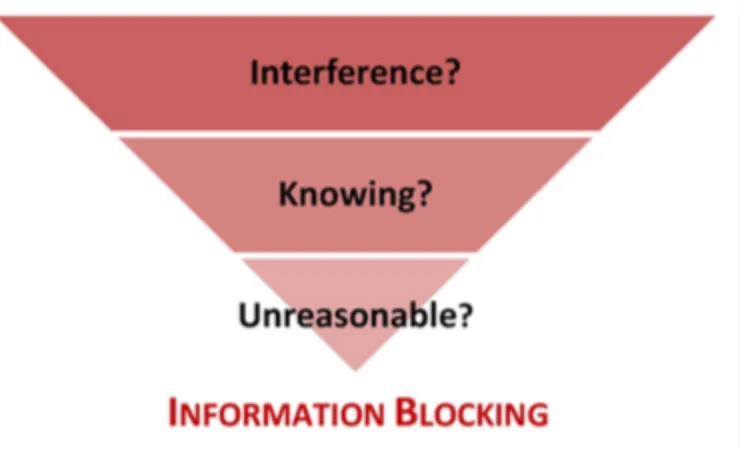
16). Figure 1 below visualizes these three requirements in order for an act to be considered
information blocking.
Figure 1. Requirements to categorize an action as information blocking, as defined by the ONC.
Taken from (ONC, 2015, p. 11)
There are many motivations for individuals or entities to block the exchange of health
evidence. Although health IT developers (software vendors) are the primary culprits of
information blocking (ONC, 2015, p. 15), some providers may see an economic incentive to
preventing the authorized transfer of medical records in order to impede patients from leaving
their practice. Vendors may purposefully not pursue reasonable technological advances that
increase interoperability in order to “lock-in” providers to one system (ONC, 2015, p. 13).
Information blocking has been discussed anecdotally since the advent of the Health
Information Technology for Economic and Clinical Health (HITECH) Act and the subsequent
push for interoperability in healthcare. These concerns were brought to a national stage when the
ONC published an information blocking report in April 2015 (ONC, 2015). This report took aim
at EHR vendors who are believed to partake in the majority of information blocking, outlined
mechanisms used to unnecessarily impede the transfer of health data, and laid out steps for
remedying the situation. This report, however, is not intended to act as the final investigation into
information blocking (ONC, 2015, pp. 19-20, 29). There are approximately 60 unsolicited
complaints made to the ONC regarding information blocking in 2014 alone (ONC, 2015, p. 15).
These complaints, along with some empirical evidence, are at the foundation of the report to
Congress. Even with this evidence, the ONC strongly recommends that additional research is
performed to confirm or disprove anecdotal complaints and gather more information from the
perspective of providers and vendors being accused of information blocking (ONC, 2015, pp.
19-20).
In this report and later publications, the ONC outlines various methods that vendors and
providers use to block the appropriate transfer of patient information; many of these information
blocking techniques affect research in addition to clinical care. For example, the ONC states that
as a means of ‘locking in’ providers and consumers to rigid technologies and information sharing
networks that reinforce the market dominance of established players and prevent competition
from more innovative technologies and services” (ONC, 2015, pp. 17-18). When EHRs act as
data silos, clinical experiences suffer. Providers are unable to access family history, drug
allergies, or previous test results if the patient hasn’t been seen at provider’s institution yet.
Likewise, researchers may be unable to attain data, despite IRB approval for its extraction. The
report continues, “Some of these developers cite security concerns and business justifications for
these practices, while others provide no justification or, in some cases, appear to acknowledge a
strong preference not to exchange information using federally adopted standards and to instead
drive more users to exchange information using proprietary platforms and services.” This blatant
preference for preventing data liquidity is damaging to current patients (who may receive
sub-optimal care when their medical records are not shared with authorized providers) and future
patients (who could benefit from ground-breaking research that requires a decreased burden for
HIE). The upcoming case study will demonstrate tangible consequences incurred when software
developers force proprietary formatting of health data. Additionally, the inaccurate citation of
HIPAA’s Privacy Rule will be discussed in the next section of this chapter. Although
information blocking can occur in many forms, the outcomes are strikingly consistent to medical
researchers—sample sizes drop, the significance of results is diminished, and/or research
pursuits are abandoned altogether.
The wide-ranging reactions to this report demonstrate that information blocking remains
a contested issue. A letter of dissent, signed by the executives of Epic, Allscripts, McKesson, and
other prominent EHR vendors, was presented to the ONC shortly after the publication of their
blocking” in the report was not intentional, but rather, a result of the high cost of developing and
maintaining an interoperable interface. In this letter, the vendors maintain that there aren’t
enough users who want these features to justify their development. The ONC report, which was
based significantly on anecdotal evidence, admits that further research must be done. Within the
report, they state, “There is little quantitative data available with which to reliably identify and
measure the extent of information blocking… In particular, ONC lacks methods and data to
precisely determine why a provider is not exchanging when they should have the capability to do
so.” Due to its recent publication, there has been minimal follow-up research published regarding
information blocking since this report to Congress. Yet, the ONC is not the only organization
that believes EHR vendors are purposefully failing to deliver products that allow for data
transfer. In a 2012 article titled Escaping the EHR Trap—The Future of Health IT, Dr. Kenneth
Mandl and Dr. Isaac Kohane lament:
We believe that EHR vendors propagate the myth that health IT is qualitatively different
from industrial and consumer products in order to protect their prices and market share
and block new entrants… This attitude has thwarted medicine's decades-long quest for an
electronic information infrastructure capable of providing a dynamic and longitudinal
view of the health care of individuals and populations. EHR companies have followed a
business model whereby they control all data, rather than liberating the data for use in
innovative applications in clinical care (Mandl & Kohane, 2012).
These authors, representing the Children’s Hospital Informatics program, the
Harvard-MIT Division of Health Sciences and Technology, and the Center for Biomedical Informatics at
Harvard Medical School, note that despite general advancements in the field of data
silo patient data. Although the ONC report is clearly based on anecdotal evidence, these
complaints represent industry-wide concerns that cannot be dismissed.
In order to understand the causes of information blocking, EHR vendors must grant
some transparency regarding their practices and contracts. The ONC expressed concern that
attaining quantitative answers regarding the prevalence and mechanisms of information blocking
(i.e. differences in charges for transferring data between institutions) is particularly challenging
due to “gag clauses” often found in vendor agreements between providers and EHR companies
(ONC, 2015, p. 16). Said gag clauses can prevent providers from discussing details of their
contract, particularly cost. Given that intentionally prohibitive pricing is frequently referenced as
a source of information blocking (ONC, 2015, p. 13), these restrictions limit the quantitative
conclusions of any research on the matter (ONC, 2015, pp. 31-32).
Despite previously stated concerns regarding the shortage of empirical evidence related
to information blocking, congress has moved quickly to improve standards for HIE. The 21st
Century Cures Act, written and passed with bipartisan support, was signed into law by President
Obama at the end of 2016. In addition to increasing funding to medical research substantially,
this legislation aims to improve HIE interoperability by setting data exchange standards and
barring acts of information blocking("21st Century Cures Act," 2016). Due to its recent
enactment, the long-term effects of this law are unknown, but it is undoubtedly a step towards
progress in achieving an interoperable healthcare system. Given that most EHR vendors appear
to believe that their practices do not constitute information blocking, it is possible that more
action will be necessary to create change in the private sector. This legislation does, however, set
a tone for the expectations vendors will be held to for achieving continued Meaningful Use
addition to this redefined tone, the United States healthcare system will take a large step towards
interoperability—leading to an improved standard of care and biomedical research.
Privacy Law Concerns
The introduction and implementation of the Health Insurance Portability and
Accountability Act (HIPAA) was not met with enthusiasm from all providers. In theory, HIPAA
was designed to improve patient privacy and electronic billing, yet many practitioners saw these
rules as onerous, costly, and unconducive to quality care (Barieri, 2003; Bowers, 2001;
Kumekawa, 2005). As a field, healthcare is notoriously resistant to change; still, over 20 years
later, HIPAA has become an accepted industry standard, safeguarding the privacy of patients and
their protected health information (PHI) (Solove, 2013). Despite this acceptance in the clinical
world, concerns related to HIPAA (some reasonable and some unfounded) continue to hinder the
progress of medical research (Dunlop et al., 2007; Gostin & Nass, 2009; Wei, 2015).
Apprehensions related to the inappropriate disclosure of PHI typically reference
HIPAA’s Privacy Rule. This rule sets standards for the protection of PHI within a covered entity.
These covered entities include health plans, health clearinghouses, and healthcare providers. Per
Susan McAndrew, the Deputy Director for Health Information Privacy in the Office for Civil
Rights (OCR), data that have already been excised from a covered entity (e.g. de-identified and
moved into a data warehouse) are no longer a concern of the Privacy Rule (Herdman et al., 2006,
p. 8). Regulations are concerned with patient information that is being transferred between
covered entities or between a covered and non-covered entity. In these circumstances, the
With biomedical research in mind, the Privacy Rule creates several approaches for the
transfer of identified medical records outside of one covered entity. These include the following:
(Herdman et al., 2006, pp. 8-9)
1. Acquiring informed consent from each patient before recruitment into a study
2. Obtaining institutional review board (IRB) approval for the use of a limited data
set (may contain broad geographical information and some dates)
3. (In very limited cases) Attaining IRB approval to use PHI without the patient’s
consent, stipulating that this PHI will be protected and remain unpublished
Although these procedures may delay research temporarily, it is not without good reason.
This purpose is stated by Dr. Roberta Ness of the University of Pittsburg: “Researchers
fundamentally believe in and are engaged in protecting confidentiality as much as is possible,
because they fundamentally understand… that without the protection of confidentiality, there
will be no trust in research and, therefore, [they] will be unable to conduct research.” In addition
to the ethical obligation to protect patient confidentiality, scientists also have benevolently
selfish reasons for ensuring that PHI in their control remains secure. If the public’s faith in the
protection of PHI is diminished, less patients will agree to sharing their data, leading to reduced
research opportunities and weaker results. With that being said, these sensible privacy
requirements may inherently cause a delay to biomedical research. For example, obtaining
informed consent, writing IRB proposals, and attending IRB meetings all require time and
resources. Even given these acceptable burdens, the observed impact to biomedical research is
disproportionate to the intended pauses set forth by the Privacy Rule (Ness, 2007).
Some inadvertent burdens that stem from the Privacy Rule are caused by confusion
for interpreting HIPAA regulations; as such, these review boards can waive requirements as they
see fit (NIH, 2003). Nevertheless, according to Paul Feldman, Director of the Health Privacy
Project, “IRBs believe they have no authority to approve alterations to or waivers of
authorization for protocols not subject to the Common Rule. They do” (Herdman et al., 2006, p.
21). This statement was made at a forum regarding the effect of the HIPAA Privacy Rule on
health research in 2006. It is now over 10 years later and there is little written about whether
current IRBs are willing to waive HIPAA requirements when given the appropriate
documentation of purpose and security. It is likely that a lack of discussion on this topic is a
positive outcome—fewer researchers are experiencing this issue making further investigations
unnecessary. Lessons learned from the confusion surrounding the initial roll-out of HIPAA
regulations should be documented in order to improve the implementation of future health
privacy policies.
De-identification, the process of removing PHI from medical records, is a common
option for researchers wishing to attain patient data and avoid HIPAA constraints. There are two
methods of de-identification, the “Expert Determination” method and the “Safe Harbor” method.
The “Expert Determination” method, also known as the statistician method, requires that a
person with appropriate field knowledge and statistical skills declares that the data is not
individually identifiable ("Health Insurance Portability and Accountability Act of 1996," 1996).
Next, the “Safe Harbor” method, doesn’t require a statistician’s approval. Instead,
de-identification requires the removal of the 18 individual identifiers from medical records("Health
Insurance Portability and Accountability Act of 1996," 1996). These identifiers can be found in
despite the possibility of gaining valuable demographic information in a secure manner through
the “Expert Determination Method.”
The Privacy Rule stipulates that records de-identified with “expert determination” can be
shared freely (Amatayukal, 2003; NIH, 2004); nonetheless, misguided concerns regarding the
ability to share identified data are often accepted as valid. The statistician method of
de-identifying data is not universally accepted by IRBs, because these boards are often unsure of
how to regulate whether it is being done properly (Herdman et al., 2006, p. 22). A statistician’s
endorsement that data has been appropriately de-identified is only as infallible as the
assumptions said statistician made during the evaluation process (Herdman et al., 2006, p. 17).
For example, the statistician is only required to certify that the risk of re-identification is “very
small,” but per guidance published by the Department for Health and Human Services (HHS),
there is no definition for what “very small” is. Given these uncertainties, IRB concern may be
warranted.
In addition to good faith concerns, IRBs can be unsure of their liability for guaranteeing
that de-identification is performed to adequate standards. By the very nature of IRB
independence from a central agency, board requirements and decisions can differ widely
between organizations (Herdman et al., 2006, pp. 25-28). While some variation is inevitable, not
permitting a Privacy Rule-approved method of de-identification because of unfamiliarity with
the technique may create unfair differences between institutions. Resolving these concerns will
require addressing IRB reservations and unfamiliarity with the statistician method. First and
foremost, detailed documentation of the de-identification process should be provided to the IRB,
including assumptions made and steps taken to ensure there’s a “very small” chance of
explanation of the “Expert Determination” technique, can be found online (OCR, 2017). And
IRBs that are unfamiliar with their role in overseeing a statistician de-identification process
should be provided with mechanisms to increase their understanding and awareness of this
method.
The 21st Century Cures Act, touched upon in the “Information Blocking” section of this
chapter, also works to improve medical research by lightening Privacy Rule restrictions for
medical researchers. Before this update, PHI could be utilized by a covered entity for health care
operations, including treatment, billing, and hospital procedures. This legislation now classifies
research as part of “health care operations,” giving researchers and business associates within
covered entities autonomous access to medical records. Additionally, when authorization forms
are required, the forms specify “one-time” consent, where the authorization to use said data is
indefinite unless the patient later revokes authorization. This PHI is still protected by the HIPAA
Privacy and Security Rules, involving significant protection standards and breach notification
rules. These alterations to the Privacy Rule have the potential to make a large impact by giving
researchers access to data. In order to realize this full impact, however, IRBs must be informed
and educated on these changes.
HIPAA was not created with research as a priority. (Herdman et al., 2006, p. 13). This
lack of foresight demonstrates a consequence of inconsistent stakeholder support in the pursuit of
improving health research, which will be discussed further in the next section of this chapter. For
good reason, obtaining medical records with PHI does require extra effort in obtaining patient
consent or IRB approval. Yet, without the appropriate training in how to navigate these
Lack of Stakeholder Support
Clinical research has stakeholders in various sectors, ranging from clinicians to
policymakers to medical institutions. In a clinical setting, the ability to acquire clinical data
begins with data collection and storage mechanisms. The advent of electronic health records
centered around improving patient care with increased safety, efficacy of treatments, and ease of
billing. These are all crucial goals; yet, for the purposes of this discussion, these objectives make
it clear that research was not a priority. We can therefore postulate that this lack of forethought
provides some explanation for the difficulties encountered in obtaining data from electronic
medical records. Stakeholders in clinical data collection and storage mechanisms traditionally
include patients, clinicians, IT personnel, data warehouse engineers, hospital administrators, and
corporate employees. Medical centers may choose to prioritize research as an institutional
objective, adding additional stakeholders related to research and education. Simply put, there are
fundamental differences in how various stakeholder prioritize institutional objectives. When
choosing between electronic health record vendors and investment into backend design,
corporate employees and administrators may focus on institutional reputation and budget-saving
measures. When expressing their opinions regarding the use of technology in a clinical setting,
clinicians and patients may believe improved workflow and diagnostic rates are fundamental to
success. Research principle investigators, on the other hand, may prioritize a well-defined data
warehouse that allows for the institution’s researchers to access de-identified data with ease. A
primary step to improving access to medical data in research must be coordinating stakeholder
support of these goals.
When included in the planning stages, these research stakeholders can influence
attitudes related to the secure transfer of medical records. To do so, however, all stakeholders
must be invited to provide their expertise and opinions. According to Marcy Wilder, Esq., the
lead lawyer working on HIPAA’s Privacy Rule, their team was not able to expand upon research
regulations during the writing process, because there simply was a lack of expertise in the matter
(Herdman et al., 2006, p. 14). As discussed previously, some fundamental concerns related to
the Privacy Rule may have been avoided if clinical research stakeholders played a role in writing
said policy. And despite significant alterations to the Privacy Rule, which simplify the transfer of
PHI to covered entity researchers, the academic field will need to be educated on these changes
in order for them to be implemented fully.
The Centers for Medicare & Medicaid (CMS) has created more recent policy
incentivizing electronic health records (EHRs) that adhere to Meaningful Use standards. These
standards are an example of creating policies that work to appropriately prioritize research goals
in addition to clinical health. Meaningful Use regulations incentivize eligible providers and
institutions to utilize EHRs that meet or exceed expectations of utilizing electronic health records
in a “meaningful” way. In addition to increasing patient safety (e.g. requiring EHRs to perform
drug-drug or drug-allergy interaction checks in Stage 1), this program requires participants to
eventually utilize EHRs that promote public health (e.g. standards for reporting to public health
repositories) (CMS, 2010). Additionally, in the beginning of 2017, CMS created a centralized
repository for this reporting (CMS, 2017). Agencies that are able to accept public health and/or
clinical data may sign up to be included, allowing clinical data sources to report to multiple
agencies connected through this centralized repository. Here, we can see a path towards the
Finally, the importance of economic incentive cannot be understated. There is little
speculation regarding why vendors and institutions may want to prevent the easy transfer of
medical information; easily transferred data can lead to easily changed systems. To some degree,
this economic incentive needs to be respected, because it is precisely why developers work to
create innovative products; it is why large academic medical centers exist. However, the EHR
software industry has been made possible by Meaningful Use incentives that have a clear
intention of promoting a health care system that benefits from easy, secure information
exchange. Software developers, therefore, must recognize when benefits to consumers greatly
outweigh economic incentives. Likewise, economic interests could and should be leveraged as an
advantage to creating interoperable systems. From the perspective of institutions, academic
medical centers that invest in software that easily transfers health data can produce research with
more impressive sample sizes, more impressive results. Good research encourages additional
funding; additional funding improves hospital and medical school rank, attracting even better
talent to pursue even better research. Vendors, too, can benefit from this cycle. Institutions that
wish to leverage data-driven research will invest in EHR systems and other health IT software
(i.e. EKG analysis software) that makes the transfer and de-identification of medical records
simple. Vendors may be concerned about making their software interoperable, but the
consequence of not doing so could be much worse—isolating themselves from a market that is
C.
Case Study: Acquiring Clinical Data from Boston Children’s Hospital’s
Child Neurology Department
Background
Since the advent of health informatics, Boston Children’s Hospital (BCH) has been a
leader in striving for innovative techniques that improve health care with the use of information
technology (IT). Their Computational Health Informatics Program (CHIP) was awarded “Best
Health Care Organization” by Health 2.0. In an award that took into consideration the last 10
years of health technology innovation, Boston Children’s Hospital’s global reputation was
clearly demonstrated with this recognition. Furthermore, research division has created an
Innovation and Digital Health Accelerator, which hopes to vet and foster technologies that
advance the field of digital health. With a focus in remote care, clinical decision support, and
innovation platforms (i.e. Fast Healthcare Interoperability Resources, also known as FHIR),
Boston Children’s Hospital is a clear forerunner in the health informatics field. This
forward-thinking institution stands out with their investment in informatics, clearly recognizing the role
that data-driven research will play in the future of medicine.
Research pursued by CHIP includes Health Data Fusion, SMART Health IT, HealthMap,
and Apache cTakes. Each of these endeavors requires significant amounts of health data
(sometimes millions of patient records) and the infrastructure necessary to obtain, process, and
store large amounts of data. Of note, SMART Health IT is a platform comprised of open
standards and open source software that allows external innovators and researchers to design
health applications that can be used across the healthcare field. For example, “Cardiac Risk” is
an app that uses an interactive interface to show a patient’s risk of heart attack or stroke within
App Gallery at no charge. These applications can be “bolted on” to various health IT platforms.
The very foundation of SMART Health IT relies on developers who are willing to share their
standards, software, and applications with clinical and academic communities around the world.
It is this culture of open innovation that feeds the research at Boston Children’s Hospital. Yet,
despite a strong concentration in big data research, this case study will demonstrate that BCH
researchers are not without their own plights when attempting to access clinical data.
My time spent at Boston Children’s Hospital enlightened me to the realities of accessing
clinical records for biomedical research. To expand upon the research discussed in the following
chapter, I traveled to BCH with the goal of extracting de-identified electroencephalogram (EEG)
records from the Neurology Department’s electronic medical record system. We worked in
conjunction with Dr. Tobias Loddenkemper, an Associate Professor of Neurology at Harvard
Medical School, with over 250 publications. At BCH, he is the Director of Clinical Epilepsy
Research within the Neurology Department. As seen in many departments at Boston Children’s
Hospital, both excellence in clinical care and pioneering research are Neurology Department
stakeholder priorities. During my time, I found that despite being a world leader in informatics
and data-driven research, this clinical department still faces difficulties with fragmented, difficult
to extract data.
Results
I traveled to Boston Children’s Hospital with the goal of learning how to extract
de-identified EEG records to be included in on-going epilepsy research with Dr. William Bosl. Our
research required de-identified EEGs stored in the European Data Format (EDF), a standard
format for the storage and transfer of time series data (e.g. EEG data) (Kemp, Varri, Rosa,
normal patients and patients who are diagnosed with Benign Epilepsy with Centro-Temporal
Spikes.
Appropriate precautions were taken to adhere to the HIPAA Privacy Rule, but none of
these proved onerous. For one, I completed HIPAA training modules to ensure my understanding
and awareness of the policies researchers are expected to follow. Because my machine was not
issued by Boston Children’s Hospital, virtual private network (VPN) software was installed.
Within this VPN, I could access clinical data in a secure, HIPAA-friendly manner. Although
these steps required additional time and resources, the value of keeping clinical data secure and
private is worth these minimal burdens.
With the goal of learning how to independently extract de-identified EEG records, I met
with clinicians, researchers, and IT experts within the department of Neurology. In these
meetings, I learned that in the Department of Neurology, EEG data is not stored within or
attached to the EHR system that contains the majority of each patient’s clinical data. This
translates to manually searching the EEG collection software for each individual patient.
Additionally, the EHR software has no querying capabilities. To a clinician, this is likely of little
to no consequence. There’s little need for them to see “All patients billed with ICD code X” or
“What percentage of patients are taking medication Y?” Yet, these capabilities may be
fundamental to a researcher’s workflow. Without the ability to search for patients who were
diagnosed with BECTS, Dr. Bosl and I relied on a list of patients provided by Dr.
Loddenkemper. With this list, we could search through the EEG collection software to obtain the
After selecting a patient of interest, a user selects the data they wish to extract (i.e. time
segments of a chosen EEG recording), and they begin the export process. The EEG collection
software exports data in the following two outputs:
1. De-identified EEG data in proprietary formatting
2. Identifiable EEG data in EDF formatting
Unfortunately, neither of these options works, as we needed de-identified data in a
research-friendly (EDF) format. To achieve this desired output, researchers devised a workaround. First,
they exported using the first option, de-identified data in the proprietary format. This file was
then re-uploaded to the EEG collection software and re-exported in EDF using the second
option. This left us with an EDF-formatted file with no PHI. This new procedure is relatively
simple in theory, but in practice it changes a 5-minute export process to a 20-minute export
process per patient. To achieve a 40-person sample-size, the export task went from requiring less
than 3.5 hours to over 26.5 hours. In short, an assignment that could be accomplished in one
morning now requires at least three full days’ worth of work.
Plainly, this workaround is not ideal, and the researchers in this department have been in
contact with the software developers for the EEG collection program. A continuing request for
an option to download de-identified data into EDF format has been communicated to the
developers for over a year with no response. Anecdotally, researchers have reported that other
bugs and complaints have been addressed in software updates, but this request has been largely
Discussion
This experience at Boston Children’s Hospital demonstrates many of the barriers
researchers face when attempting to access appropriate clinical data. Although extra steps were
taken to adhere to the HIPAA Privacy Rule, they were not unreasonable. Conversely, despite
being part of an institution that actively strides to promote research utilizing patient data,
software shortcomings made the process decidedly difficult.
An issue that effects both clinicians and researchers, it is disappointing to see clinical
data such as EEG recordings not connected to a patient’s electronic medical record. Having data
linked appropriately is an unobtrusively helpful feature to any medical team. Linked data allows
clinicians to perform fundamental tasks, such as viewing both patient history and testing data
(e.g. radiology report, blood test results, etc.) in the same application. In the Neurology
Department at BCH, if a researcher comes across an anomaly in an EEG recording, there is no
clinical data attached to the file to help elucidate this finding. Instead of an integrated platform,
where the EEG results can be viewed within a patient’s EHR, researchers and clinicians are
faced with two isolated systems.
The demand to develop interoperable health systems is likely just breaching the market,
and finding vendors that are willing to integrate with each other is difficult. SMART Health IT
and SMART on FHIR hope to solve this issue by opening the market to software developers who
are motivated to create health technology that prioritizes interoperability over data silos with
“locked-in” customers.
The additional barriers I came across, namely the inability to query the EHR and a
challenging data export procedure, are prime examples of the consequences that stem from a lack
development and resources, and discussing the logistics of creating such software could be a
topic for another thesis. As most EHR software makes querying prohibitively difficult,
organizations that wish to perform these tasks choose to export their data into a second, more
analytics-friendly database (Mandl & Kohane, 2012). Still, an integrated querying feature would
be a powerful tool in EHR software. If more research stakeholders were included in the planning
stages of software development, these benefits could be articulated and the query functionality
may be prioritized.
Another instance of absent stakeholder support, EEG collection software developers are
not prioritizing the production of the specified format export feature. Of note, stakeholder
support of research needs is likely minimal within a clinical software company. It is likely that
more important features are taking precedence, but without the company’s feedback it is
impossible to be sure. There are always going to be “new and improved” features on the horizons
for health IT development, and there is no shortage of wants from clinicians, researchers, and
security specialists. Without a seat at the table, however, the wants and needs of researchers will
be continually overlooked.
D.
Conclusion: Overcoming Barriers to Clinical Data Access
As future informaticists, nearly every student in University of San Francisco’s Master of
Science in Health Informatics (MSHI) program will face the persistent issue of encountering
enticing data that is difficult to access, de-identify, or reformat. As such, it is imperative to
understand these data acquisition challenges in order to achieve sought-after goals—the
development of learning systems, clinical decision support tools, and natural language
Government policy has been an incredible driver in the advancement of the U.S. health
care system, promoting HIE and interoperability, but some health policy did lead to unintended
consequences. In both the case of HIPAA and Meaningful Use, the government stepped into the
private health care sector in order to foster a secure and productive healthcare industry. Despite
these common goals, the clear difference in consequences to biomedical research demonstrates
that biomedical research was given much more consideration during the development of
Meaningful Use. The HIPAA Privacy Rule was not intended to stymie research; that was made
clear by the open-minded discussions and policy changes that followed the significant feedback
submitted by medical researchers after deployment. Additionally, researchers are not advocating
for weaker protection of PHI, especially when concerns are still being raised about the risks of
re-identification (Benitez & Malin, 2010). Yet, it is now clear that creating policy that affects
research without including research stakeholders in the process led to unexpected results—
confusion on IRB responsibility, exceedingly cautious restrictions to access of patient data, and
information blocking through inapplicable claims of Privacy Rule restrictions.
Changes in policy (i.e. The 21st Century Cures Act) and culture surrounding the transfer
of health information to research professionals within a covered entity will require time and
resources. Many organizations have decided to stop relying on third-party software vendors to
prioritize the needs of research stakeholders; instead, they have sought in-house solutions. For
example, academic medical centers in Cleveland, Ohio, have organized a research-friendly data
warehouse that includes de-identified patient data from Cleveland Clinic, University Hospitals,
and Metro Health Medical Center. All students and employees at any of these institutions are
covered under the same IRB approval, allowing them to access this de-identified data without
Institute for Computational Biology. BCH’s SMART Health IT is another demonstration of the
changing culture surrounding health care interoperability. With developers striving to create
open-API software that is accessible across platforms, SMART Health IT has created a path
towards interoperability. There are plenty of viable means to achieving interoperability, and
choosing just one is wholly unnecessary. The most important step in accomplishing the goal of
effortless HIE is continued motivation and stakeholder support; without it, incredible technology
(such as the SMART “Cardiac Risk” platform) will remain isolated from health care clinicians
II.
Benign Partial Epilepsy of Childhood with Centrotemporal Spikes
A.
Background
Epileptic encephalopathies are a relatively new category for seizures that present with
developmental delays or even regression. These conditions are correspondingly associated with
neurocognitive and behavioral dysfunction that may persist long after seizures cease, usually in
early adolescence (Engel, 2001). While most research has focused on early warning signs of
seizure onset, another significant challenge is to monitor brain development. In doing so, it may
be possible to detect functional characteristics—biomarkers—that indicate the brain has entered
a dynamical state in which seizures are likely to occur and to predict the developmental
trajectory.
Benign Childhood Epilepsy with Centro-Temporal Spikes
Benign childhood epilepsy with centro-temporal spikes (BECTS), also known as
Rolandic Epilepsy, is the focus of this research. With a typical onset age of 7-10, BECTS usually
remits before the age of 18 (Callenbach et al., 2010). BECTS seizures typically occur during
sleep and can be characterized as simple partial seizures that lead to motor, hemifacial, and rapid
spasms (Miziara & Manreza, 2002). Despite its name, this “benign” epilepsy is associated with
developmental delays. Rarely, BECTS has been shown evolve into more severe epilepsy types
(e.g. continuous spike-and-wave during slow-wave sleep syndrome, Landau-Kleffner syndrome,
intractable seizures, etc.) leading to even more severe neurological impairment (Callenbach et
diagnosed with BECTS (Callenbach et al., 2010), it is often left untreated due to comparable
long-term effects from taking anti-epileptic medication (Kwan & Brodie, 2001; Shields & III,
2009).
Techniques for Complex Systems Analysis
An automated method for quantifying epileptiform discharges in children has been
developed by a co-investigator using a wavelet transform (Chavakula et al., 2013). Automated
detection of continuous epileptiform activity is important because it can be present in the absence
of overt seizures, yet has serious consequences. The complex systems methods developed in this
project may be considered a further step in the development of automatic methods for detecting
continuous spikes and waves during slow sleep (CSWS) and assessing severity. In another study
by the co-investigator, spike counts were found to be relatively unaffected by confounding
factors such as timing of epilepsy onset, clinical seizure type and frequency, and medication
treatment and dose (Azhar, et al, in preparation). Furthermore, recently published research (W. J.
Bosl, Tager-Flusberg, & Nelson, 2011) demonstrated that MSE could be used to distinguish
infants at high risk for autism spectrum disorder (ASD) from those at low risk (on the basis of
sibling history). A number of studies are beginning to show that patterns in nonlinear EEG
features can be used as biomarkers for many neuropsychiatric disorders (Stam, 2005).
B.
Methods
Invariant measures convey information about the dynamics of the system from which
they are derived. The challenge for clinical neuroscience is to determine which invariant
measures, if any, are most relevant to detection and monitoring of specific conditions of clinical
patients with a condition of interest, and from controls, then use statistical learning algorithms to
find the combinations of features, or feature patterns, that are most highly associated with the
condition of interest. This data-driven approach may not be sufficient for a complete scientific
understanding of the relationship between brain dynamics and behavioral, cognitive, or affective
conditions, but may be sufficient for discovering useful clinical biomarkers. Data-driven
discovery may also point in the direction of the most likely neural correlates of relevant
behavioral constructs or cognitive phenotypes (W. Bosl, 2017).
The primary goal of the methods and results presented in this paper are clinical. We seek
clinical decision support methods that will eventually provide the practicing physician,
psychologist, or neurodiagnostic technologist with tools to enable risk assessment for BECTS
during a child’s routine neurological examination. The ultimate goal is avoiding unnecessary and
expensive overnight EEG monitoring when possible.
Study Population
Epilepsy patients and a control group were seen at a tertiary epilepsy center in the
Division of Epilepsy and Clinical Neurophysiology, Department of Neurology, Boston
Children’s Hospital (BCH). Patients with benign focal epilepsy of childhood were selected
retrospectively. BECTS was confirmed by clinical history and EEG findings by an experienced
neurologist. Patients were consecutively selected from the epilepsy outpatient clinic at
Children’s Hospital Boston, and were included if they were between 4 and 16 years old,
presented with unilateral nocturnal motor seizures, and exhibited uni-or bilateral
age-matched controls with normal EEG were also selected from the same clinical database. In total,
19 BECTS patients and 11 controls were used for this study.
Data Collection:
EEG data was sampled at 200 Hz for all Epilepsy Center subjects. Based on the Nyquist
criterion, this implies that frequencies up to 100 Hz are included. From the BECTS cases, an
experienced neurophysiology resident not directly involved in this study used visual review to
select 30-second samples containing no spikes or evidence of epileptiform activity from awake
EEG data. Similarly, 30-second segments were selected from awake subjects in the control group
after visual review. A single segment of equal length was collected on 19 channels located
according to the standard 10-20 system. EEG samples that were taken during sleep sessions with
the BECTS patients. These segments were classified into sleep stages 2 and 3 by an experienced
polysomnographic technologist and reviewed by the resident neurophysiologist. All awake EEG
samples collected that were chosen, both BECTS cases and controls, appeared normal to the
neurophysiologist on visual analysis. The sleep segments (BECTS cases only) were likely to
contain nocturnal epileptiform spikes, but were not reviewed further for this study. No other
filtering was performed on the EEG signals.
Signal processing
Multiscale entropy and recurrence quantitative analysis (RQA) values were computed
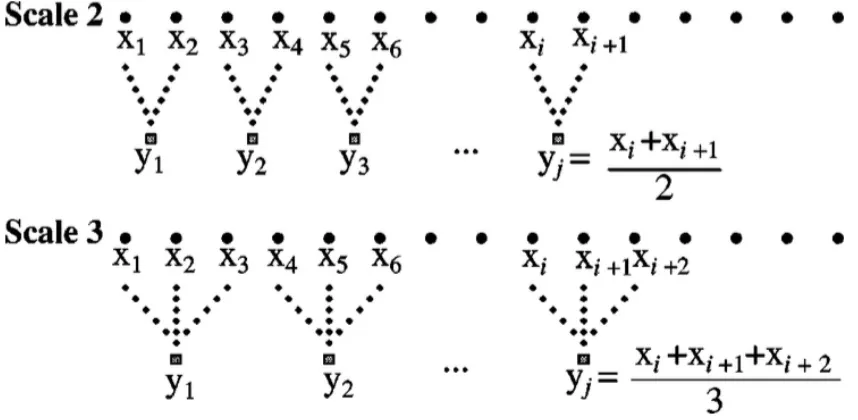
from EEG signals using two steps. First, the coarse-graining described by (Costa et al., 2005)
window size t, t = 1, 2, … j, the jth coarse-grain series, ytj, is computed by averaging
non-overlapping windows, as shown in the figure below:
Figure 2. Schematic illustration of the coarse-graining procedure. Adapted from (Costa,
Goldberger, & Peng, 2005)
Multiscale entropy (MSE) was computed using the modified sample entropy defined in
(Xie, He, & Liu, 2008), which has been used in other studies for complexity analysis of
physiological time series. Details about computing MSE are discussed in (Bosl et al. 2011).
Multiscale entropy is a useful nonlinear method for analyze biological signals and distinguishing
healthy from pathological states (Catarino, Churches, Baron-Cohen, Andrade, & Ring, 2011;
Costa et al., 2005; Norris, Stein, & Morris, 2008; Takahashi et al., 2010; Vandendriessche et al.,
2014).
Another approach to computing nonlinear time series properties is recurrence quantitative
analysis (RQA). RQA is an empirical approach to analyzing time series data and is in principle
analyzing “real-world, noisy, high dimensional data” (Webber & Zbilut, 2005). It has proven to
be a powerful tool already in physics, geophysics, engineering and biology (Komalapriya et al.,
2008; Norbert Marwan, Romano, Thiel, & Kurths, 2007). Applications to neurology and
neuroscience are in the early stages. In principle, RQA is capable of detecting significant state
changes in a dynamical system (Norbert Marwan et al., 2007; Schinkel, Marwan, & Kurths,
2009; Webber & Marwan, 2015), which suggests that it may be appropriate for detecting
developmental changes in brain function that are associated with chronic neurological and
mental dysfunction.
RQA values were computed for all of the scales derived from each EEG channel using
publicly available software (N. Marwan, 2012; Norbert Marwan et al., 2007). For input to the
algorithms, the embedding dimension (m) was 10, the time delay was 2, and the threshold for the
recurrence plot (tau) was 30. For detailed discussions of how these values may be determined,
see (Chen, Zou, & Zhang, 2013; Niknazar, Mousavi, Vahdat, & Sayyah, 2013; Webber &
Marwan, 2015).
Multiscale sample entropy was also computed and included in this set of EEG signal
features and is denoted by SampE as in (W. J. Bosl et al., 2011). Sample entropy and the entropy
derived from RQA, denoted “L_entr”, are expected to be similar quantitative measures, but
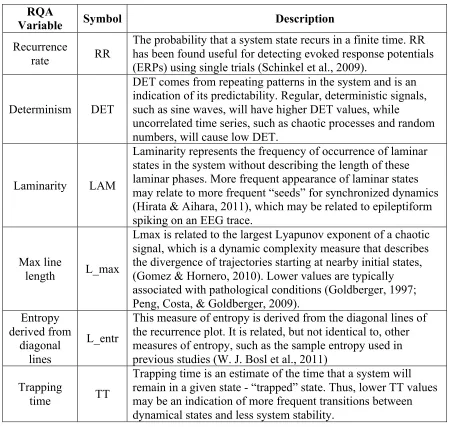
derived from different algorithms. Thus, multiscale curves were computed for eight features or
values and each EEG sensor time series. Table 1 lists the nonlinear values computed for this
RQA
Variable Symbol Description
Recurrence
rate RR
The probability that a system state recurs in a finite time. RR has been found useful for detecting evoked response potentials (ERPs) using single trials (Schinkel et al., 2009).
Determinism DET
DET comes from repeating patterns in the system and is an indication of its predictability. Regular, deterministic signals, such as sine waves, will have higher DET values, while
uncorrelated time series, such as chaotic processes and random numbers, will cause low DET.
Laminarity LAM
Laminarity represents the frequency of occurrence of laminar states in the system without describing the length of these laminar phases. More frequent appearance of laminar states may relate to more frequent “seeds” for synchronized dynamics (Hirata & Aihara, 2011), which may be related to epileptiform spiking on an EEG trace.
Max line
length L_max
Lmax is related to the largest Lyapunov exponent of a chaotic signal, which is a dynamic complexity measure that describes the divergence of trajectories starting at nearby initial states, (Gomez & Hornero, 2010). Lower values are typically associated with pathological conditions (Goldberger, 1997; Peng, Costa, & Goldberger, 2009).
Entropy derived from
diagonal lines
L_entr
This measure of entropy is derived from the diagonal lines of the recurrence plot. It is related, but not identical to, other measures of entropy, such as the sample entropy used in previous studies (W. J. Bosl et al., 2011)
Trapping
time TT
Trapping time is an estimate of the time that a system will remain in a given state - “trapped” state. Thus, lower TT values may be an indication of more frequent transitions between dynamical states and less system stability.
Table 1. Recurrence Quantitative Analysis variables and their interpretation.
C.
Results
Significant group differences were found for several RQA features, including recurrence
rate, determinism, and laminarity, as well as sample entropy. The awake BECTS patients can be
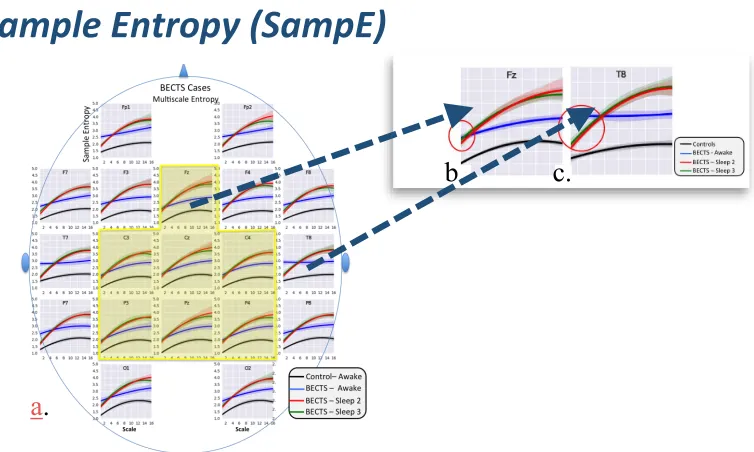
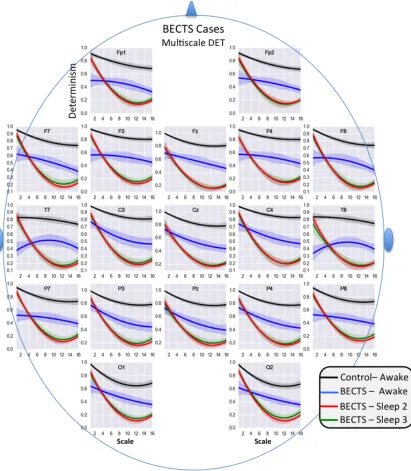
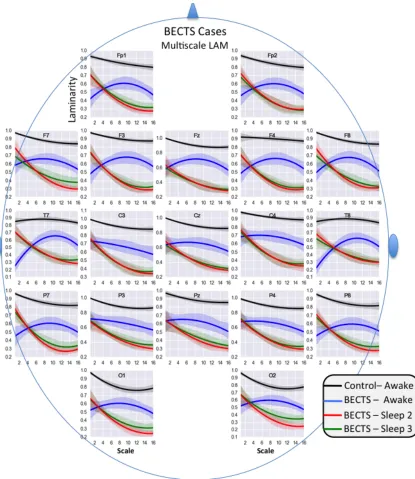
The scalp plots in the figures show multiscale curves for SampE, RR, DET, and LAM.
95% confidence intervals are shaded around the curves, demonstrating the relatively small
variance.
Figure 3. a. Multiscale curve with centrotemporal region highlighted; b. Multiscale
curves typical of centrotemporal sensors; c. Multiscale entropy curves typical of
non-central region
Determinism (DET) and Laminarity (LAM) have been found in previous studies to be
lower closer to the epileptic zone in patients with focal epilepsies (Ngamga et al., 2016)
b.
c.
Sample Entropy (SampE)
Figure 4. Multiscale RR curves for awake and asleep cases.
The separation in BECTS patients between awake multiscale RR curves and the sleep-2
and sleep-3 curves in the centro-temporal region (Fz, C3, Cz, C4, P3, Pz, P4) is greater than
Figure 5. Multiscale DET curves for awake and asleep cases.
Lower scale multiscale DET curves show differences in awake BECTS patients between
Figure 6. Multiscale LAM curves for awake and asleep cases.
Similarly, multiscale LAM curves reveal differences in lower scales within the
Taken together, multiscale entropy, recurrence rate, determinism, and laminarity appear
to be potential biomarkers for BECTS, and may also be useful as research methods for
understanding the role of sleep in BECTS nighttime seizures.
D.
Discussion
Multiscale analysis, which gives insight into frequency dependence, provides more
discriminatory information than quantitative EEG analysis nonlinear analysis of original EEG
signals alone.
Our results suggest that changes in the nonlinear values (entropy, RR, DET, and LAM)
from awake to sleep 2 and 3 are different in the centrotemporal region from other regions. This
raises the question: is this because of epileptiform activity in this region, or are sleep-potentiated
dynamical changes in this region of the brain promoting epileptic activity in this region. This
study would be much stronger if sleep stage 2 and 3 EEG measurements were available for the
control subjects for comparison. It cannot be determined if the differences between awake and
sleep multiscale curves for BECTS patients are significantly different from differences that
would be observed in controls in equivalent awake or sleep stages. Although the analysis to
answer this question would be relatively straightforward, all-night EEG studies are not
commonly done on patients who do not have a suspected sleep disorder or sleep-potentiated
epilepsy such as BECTS. Hence, this data may be difficult to obtain. Given the challenges faced
when trying to access clinical data, as discussed in chapter 1, this was an insurmountable
Although it is clear that significant differences were found between awake BECTS
subjects and controls, further analysis is required to determine what neurophysiological
differences in the BECTS patients is causing the differences. Nevertheless, our analysis
demonstrates that functional brain differences may be present in BECTS patients even when
visual review of the awake EEG does not reveal any abnormalities.
E.
Conclusion
Modern classification or statistical learning methods present a challenge for the clinician
who wants clinical decision support methods that improve patient outcomes through better
detection or monitoring of treatment progression. Some data analytics methods find patterns in
data that are correlated with outcomes, as we have shown in our results, yet are somewhat
opaque. It is difficult to interpret the features and patterns that are predictive in a scientific or
biomedical conceptualization. This may be secondary to the clinician, but the research scientist
needs to understand the causes that are producing observed results. Simpler models, such as
linear regression, make the relationship between the outcome variable and the predictors
relatively easy to interpret. However, these simple models are unable to discover more complex
relationships between predictor variables. More complex modeling methods, such as support
vector machines, decision trees, random forests, and even nearest neighbor methods are more
difficult to interpret (James, Witten, Hastie, & Tibshirani, 2013). They often give better
predictive results, which may be the primary clinical goal and thus more desirable than
immediate scientific understanding.
With the successful implementation of our results into a clinical setting, we can reduce
the need of overnight EEG monitoring. This is helpful for both patients and families, who can be
however, is simply the first step in an implementation process. In order to be implemented as
clinical decision support, we will need clinical trials with much larger patient populations, sleep
EEGs for control subjects, and the development of software to analyze EEG data for real-time
III.
References
Adler-Milstein, J., & Pfeifer, E. (2017). Information Blocking: Is It Occurring and What Policy Strategies Can Address It? The Milbank Quarterly, 95(1), 117-135.
Amatayukal, M. (2003). Another Layer of Regulations: Research Under HIPAA. Journal of AHIMA, 74(1), 16A-D.
Barieri, R. L. (2003). HIPAA: The good, the bad, and the ugly. OBG Management, 15(7), 8-11. Benitez, K., & Malin, B. (2010). Evaluating re-identification risks with respect to the HIPAA
privacy rule. Journal of the American Medical Informatics Association, 17(2), 169-177. doi:https://doi.org/10.1136/jamia.2009.000026
Bosl, W. (2017). EEG-Derived Endophenotypes In S. L. Santangelo & V. Jagaroo (Eds.),
Cognitive and Behavioral Phenotypes: New Trends for Research, Classification, and Diagnosis in Neuropsychology and Psychiatry. New York: Springer.
Bosl, W. J., Tager-Flusberg, H., & Nelson, C. A. (2011). EEG Complexity as a Biomarker for Autism Spectrum Disorder. BMC Medicine, 9(18).
Bowers, D. (2001). The Health Insurance Portability and Accountability Act: is it really all that bad? Baylor University Medical Center Proceedings, 14(4), 347-348.
Burchell, L., Corley, S., Chapman, P., Loomis, R., Marshall, M., Reeves, R., . . . TerMaat, S. (2015). [EHRA Information Blocking Response Letter].
Callenbach, P. M. C., Bouma, P. A. D., Geerts, A. T., Arts, W. F. M., Stroink, H., Peeters, E. A. J., . . . Brouwer, O. F. (2010). Long term outcome of benign childhood epilepsy with centrotemporal spikes:
Dutch Study of Epilepsy in Childhood. Seizure, 19, 501-506.
Catarino, A., Churches, O., Baron-Cohen, S., Andrade, A., & Ring, H. (2011). Atypical EEG complexity in autism spectrum conditions: a multiscale entropy analysis. Clin
Neurophysiol, 122(12), 2375-2383. doi:10.1016/j.clinph.2011.05.004 Chavakula, V., Fernández, I. S., Peters, J. M., Popli, G., Bosl, W., Rakhade, S., . . .
Loddenkemper, T. (2013). Automated quantification of spikes. Epilepsy and Behavior, 26(2), 143-152. doi:https://doi.org/10.1016/j.yebeh.2012.11.048
Chen, L., Zou, J., & Zhang, J. (2013). Dynamic feature extraction of epileptic EEG using
recurrence quantification analysis. Paper presented at the Proceedings of the 10th World Congress on Intelligent Control and Automation (WCICA2012).
CMS (Producer). (2010). Meaningful Use Stage 1 Requirements Overview. [Presentation] Retrieved from
https://www.cms.gov/Regulations-and-Guidance/Legislation/EHRIncentivePrograms/downloads/MU_Stage1_ReqOverview.pdf
CMS. (2017, January 24). Centralized Repository. Retrieved from
https://www.cms.gov/Regulations-and-Guidance/Legislation/EHRIncentivePrograms/CentralizedRepository-.html
Costa, M., Goldberger, A. L., & Peng, C. K. (2005). Multiscale entropy analysis of biological signals. Phys Rev E Stat Nonlin Soft Matter Phys, 71(2 Pt 1), 021906.
Dunlop, A., Graham, T., Leroy, Z., Glanz, K., & Dunlop, B. (2007). The Impact of HIPAA Authorization on Willingness to Participate