KEYSTROKE DYNAMIC AUTHENTICATION IN MOBILE CLOUD COMPUTING
MAHNOUSH BABAEIZADEH
A dissertation submitted in partial fulfillment of the requirements for the award of the degree of Master of Computer Science (Information Security)
Faculty of Computing Universiti Teknologi Malaysia
iii
iv
ACKNOWLEDGEMENT
First and foremost, I would like to express heartfelt gratitude to my supervisors Prof. Dr. Mohd Aizaini Maarof and Dr. Majid Bakhtiari for his constant support during my study at UTM. He inspired me greatly to work in this project. His willingness to motivate me contributed tremendously to our project. I have learned a lot from him and I am fortunate to have him as my mentor and supervisor
v
ABSTRACT
vi
ABSTRAK
vii
TABLE OF CONTENTS
CHAPTER TITLE PAGE
DECLARATION ii
DEDICATION iii
ACKNOWLEDGMENT iv
ABSTRACT v
ABSTRAK vi
TABLE OF CONTENTS vii
LIST OF TABLES xi
LIST OF FIGURES xii
1 INTRODUCTION 1
1.1 Introduction 1
1.2 Problem Background 3
1.2.1 Challenges in Mobile Communication 4
1.2.2 Issues in Computing Side 4
1.2.3 Privacy of Authentication in MCC 5
1.3 Problem Statement 7
1.4 Purpose of Research 8
1.5 Objectives 8
1.6 Scope of the Project 8
1.7 Significant of study 8
1.8 Organization of Project 9
2 LITERATURE REVIEW 10
viii
2.2 Authentication in Mobile Cloud Computing 10
2.3 Username and Password Authentication 15
2.4 Public Key Infrastructure (PKI) 15
2.5 Multifactor Authentication 17
2.5.1 One Time Password 18
2.5.2 Advantages of One Time Password 18 2.5.3 Drawbacks of One Time Password 18
2.6 Single Sign On 19
2.6.1 a of Single Sign On 19
2.6.2 Type of Single Sign On 19
2.7 Mobile Trusted Module 20
2.8 Behavior Authentication 21
2.8.1 Trust Cube Authentication 21
2.8.1.1 Trust Cube Infrastructure 22 2.8.1.2 Trusted Network Connect (TNC) 22
2.8.1.3 Trusted Platform Module 23
2.8.1.4 Trust Cube Infrastructure Workflow 25
2.8.2 Implicit Authentication System 26
2.8.3 Implicit Authentication and Trust Cube 26 2.8.3.1 Two kinds of Data Collected 30 2.8.3.2 Two kinds of Web Service Interfaces
of Implicit Authentication
30
2.8.3.3 Two interfaces of the service 31
2.8.3.4 Open ID Protocol 31
2.9 Biometric Authentication 31
2.9.1 Finger Print Recognition 33
2.9.2 Face Recognition 33
2.9.3 Hand Geometry Technology 34
2.9.4 Iris Scan 34
2.9.5 Retina Scan 35
ix
2.9.7 Advantage of Biometric Authentication 36 2.9.8 Weakness of Biometric Authentication 36 2.9.9 Two Categories of Biometric Approach 37
2.9.9.1 Physiological 37
2.9.9.2 Behavioral Biometric 37
2.9.10 Behavioral Biometric Techniques 38
2.9.10.1 Behavior Profiling 38
2.9.10.2 Linguistic Profiling 39
2.9.10.3 Keystroke Dynamic Authentication 39 2.9.11 Advantage of KDA over the Biometric 46
2.10 Architecture of Android 46
2.10.1 Features of Android 49
2.11 Linux as Base of Android Application 50
2.12 Advantage of Android Application 50
2.13 Summary 51
3 RESEARCH METHODOLOGY 53
3.1 Introduction 53
3.2 Research Framework 53
3.2.1 Phase I: General Study on MCC 55
3.2.2 Phase II: Design 56
3.2.3 Phase III: Implementation and Test 58 3.2.4 Parameters of Measuring Keystroke 59
3.3 Summary 60
4 DESIGN 62
4.1 Introduction 62
4.2 Keystroke Dynamic Authentication Architecture 62
4.3 Flowchart of the Application 63
4.4 Summary 69
x
5.1 Introduction 70
5.2 Android Application Developer 70
5.3 System Architecture 73
5.4 Android Application Test 81
5.5 Testing the Application in Client Side 82
5.6 Testing the Application by using PHP Server 87 5.7 Testing the Application in Cloud Server 91
5.8 Summary 94
6 CONCLUSION 95
6.1 Introduction 95
6.2 Contribution 98
6.3 Future Work 98
xi
LIST OF TABLES
TABLE NO. TITLE PAGE
2.1 Different methods of keystroke dynamic 47
xii
TABLE OF FIGURES
FIGURE NO. TITLE PAGE
1.1 Security services on MCC 3
2.1 Architecture of mobile cloud computing 11
2.2 Three layers of cloud computing 12
2.3 Different type of authentication in MCC 14
2.4 Type of Single Sign On 20
2.5 Trusted Network Connect 23
2.6 TrustCube Infrastructure 24
2.7 Authentication Flow in Trusted Platform Module 25
2.8 TrustCube Infrastructure Workflow 26
2.9 Implicit Authentication Architecture and TrustCube 28
2.10 Learning a User Model 29
2.11 OpenID Protocol 32
2.12 Keystroke Pattern when User Types String 41
2.13 Three Steps of KDA 41
2.14 Keystroke Pattern for the same User on the same text 42 2.15 Keystroke Pattern for different User on the same text 43
2.16 Architecture of Android 48
3.1 Research Framework 54
3.2 Diagram of Phase I 55
3.3 Design of Method 58
3.4 Implementation and Test 59
4.1 Three Steps of keystroke based Authentication 63
4.2 Flowchart of the Application 64
xii
4.4 Process of Changing Username in the Application 67
4.5 Process of login to the Application 68
5.1 Android Developer 71
5.2 Android Virtual Device 72
5.3 Design of Proposed Application 73
5.4 Guidance for login to the Proposed Application 74 5.5 Java Code related to Changing Username 75 5.6 Insert Incorrect Password for Changing Username 76 5.7 Changing Username after Inserting Correct Password 77
5.8 Check Contexts of each box 78
5.9 Java class of Changing Password of Mobile User 79 5.10 Java Code for Calculating Keystroke duration 79
5.11 Password Successfully Change 80
5.12 Login to the Application 80
5.13 Keypress time Tolerance 84
5.14 Percentages of reasons of Unsuccessfully login 85 5.15 Number of Occupancies of different UPT 85
5.16 Performance of Proposed Application 86
5.17 Process of first time Login 87
5.18 Process of matching values 88
5.19 Getting response from Local Server 88
5.20 Java code of Getting respond from PHP Server 89
5.21 PHP code of Registered User 89
5.22 MySQL Part One 90
5.23 Performance of the Application based on obtained result of the server
91 5.24 General Workflow of Communicating the Application
and Cloud Server using Google Drive
91
5.25 Developing Key Number 92
5.26 Test Client and Backend Communication 93
5.27 Deploy the Backend 93
CHAPTER 1
INTRODUCTION
1.1 Overview
The Cloud Computing (CC) became widespread from the 1997 year. The main purpose of CC is providing services via the Internet. CC is a computing method, where a large group of systems are associated with public or private networks.In this case, users able to store their data on Cloud Service Provider (CSP) and access the data on it, everywhere and anytime they need shared information.
Public clouds offer services that are available wherever the end user might be located. This approach cause to easy access to information and accommodates the needs of users in different time and locations. Private Cloud use for a specific group or organization. Shared data in private cloud are accessible to just that group. Private clouds can also support a hybrid cloud model by supplementing local infrastructure with computing capacity from an external public cloud (Sotomayoret al., 2009; Zissis and Lekkas, 2012).
CC has some benefits by permitting users to use infrastructure, platforms, and software provided by CSP. One of the advantage of using CC is reducing the costs for installing softwares as well as hardware. Another advantage is that, you no more have to support the infrastructure. In this case, no need to have the knowledge to develop and maintain the infrastructure.
2
In this case, mobile users can access to the different type of mobile application and services with the lower price. MCC is combination of cloud computing and mobile communication. It helps to mobile’s users to utilize variety software, data, applications,infrastructure and services via the Internet.
MCC is an infrastructure which processing of data occurs outside the domain of mobile set. Mobile cloud applications transfer the data storage and computing power from mobile sets to the CSP. In this case, the procedure of processing data is getting more faster.
In addition, mobile cloud applications bring mobile computing and applications to not just user’s mobile set but a much broader range of mobile subscribers. Therefore, the mobile devices do not require a powerful conformation (for example, memory capacity and CPU speed) since all the complicated processing and storing the information in memory can be processed in the cloud services.
On the other hand, mobile handsets have found an important place in modern society, with hundreds of millions currently in use. Therefore, authentication plays an important role in preserving security and privacy. It helps to protect mobile systems and shared information from unauthorized persons. An authentication mechanism determines how user identified and verified to access to sensitive information (Altinkemer and Wang, 2011).
Verification of user’s identity is the most important goal behind an authentication. Personal identification number (PIN) is often adopted as the only security mechanism for mobile devices. It is obvious that, PIN is not very secure mechanism for authenticating users because of its limitation, as well as it is difficult to confirm that the demand is from the rightful owner (Altinkemer and Wang, 2011).
3
1.2 Problem Background
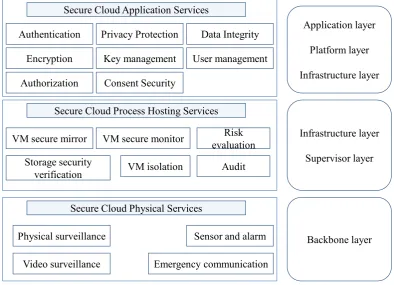
MCC has a direct relationship with CC. Therefore, all the security issues in CC can be use in MCC. However, these security services should have an additional limitation of resource constraint mobile devices. Hence, it requires lightweight secure structure. In addition, MCC should provide privacy and security with lowest amount of processing and communication. Figure 1.1 shows the different security services that may run on different layers to supply a secure mobile cloud computing environment.
Application layer Platform layer Infrastructure layer Infrastructure layer Supervisor layer Backbone layer Secure Cloud Application Services
Secure Cloud Process Hosting Services
Secure Cloud Physical Services Authentication
Encryption
Authorization
Privacy Protection Data Integrity
Key management
VM secure mirror
Storage security
verification VM isolation
VM secure monitor Risk
evaluation
Audit
Physical surveillance
Video surveillance Emergency communication
Sensor and alarm User management
Consent Security
Figure 1.1: Security services on MCC (Khanet al., 2012)
One of the important points in MCC is relate to, providing secure and trustable communication channel among mobile device and CSP. The physical security of the data center has an essential role to achieve privacy and security of user’s information.
4
protocols to protect the communication channel.
MCC is the combinations of two different fields’ mobile network and cloud computing. In this case mobile cloud computing faces many technical challenges. These challenges are categoried as two important folds as following:
1.2.1 Challenges in Mobile Communication
There are some fundamental issues in mobile communication that are as following:
i. Low Bandwidth
It is one of the necessary issues in MCC. One way to impede low bandwidth is to share the restricted bandwidth between mobile users who are involved in the same content and located in the same area.
ii. Availability
It means CSP should be available at all time and every where the mobile users requested to access the services. Mobile users may not be capable to communicate with the CSP due to network failures, traffic congestion, and the out-of-signal. Therefore, they can communicate with the cloud services through their neighboring nodes, as an alternative, having a direct effective on the cloud. Also, each node regularly broadcasts control messages to notify other nodes of its new local content and status.
1.2.2 Issues in Computing Side
There are three fundamental issues in mobile communication that are as following:
5
performance of applications. Also, it can categories to two types offloading in the static environment and offloading in the dynamic environment.
ii. Protecting Privacy and Security Protecting data secrecy and user privacy play crucial role to preserve user’s trust in the mobile technology, especially in MCC (Jeong and Choi, 2012). These issues are in three types security of mobile users, security and privacy of mobile applications, as well as privacy (Corapi et al., 2010).
1.2.3 Privacy of Authentication in MCC
One of the most challenges in MCC related to authentication (Nauman et al., 2011). There is increasing demand for suitable authentication method to access services, application, and data for both consumers and enterprisers. There are several authentication schemes that we can classify them in three folds something the user knows, something the user has, something the user is.
Password can be observed, forgotten, or shared. Moreover, in electronic world people should remember a multitude of Personal Identification Number ( PIN) and passwords for e-mail, security code of phone, computer accounts, as well as Automated Teller Machine (ATM). Therefore, it is so difficult to memories all these passwords. Biometric authentication methods are not face with these issues. It holds the promise of accurate, fast, less expensive, reliable authentication for a difference applications (Bhattacharyyaet al., 2009).
Biometric authentication is applied to recognize the characteristics of an input sample compare with a template, employ in cases to identify specific people by particular characteristics. It can categories in two types, physiological characteristics, and behavioral characteristics. Physiological biometrics relies onsomething the users are. It performs authentication based on physical characteristics such as retinal scan, face recognition, and fingerprint. By contrast, behavioral biometrics perform authentication based on the way people do things, such as typing rhythm, voice and signatured (Bhattacharyyaet al., 2009).
6
Keystroke static authentication can identify keystroke of users only at particular times, for example the time that user wants to login. This is a huge draw back as anyone can then use the system once the user is authenticated at login (Choras and Mroczkowski, 2007).
KDA continuously observes the style of typing of the users throughout the whole stage of interaction even after a successful login. In the other words, the typing patterns of users are constantly analyzed and when they do not match accessing of users will block (Bhatt and Santhanam, 2013; Tehet al., 2013).
One of the first researches on keyboard biometrics was carried out by (Gaines et al., 1980). Seven secretaries took part in the experiment in which they were asked to retype the same three paragraphs on two different occasions in a period of four months. Keystroke latency timings were collected and analyzed for a limited number of digraphs and observations were based on those digraph values that occurred more than 10 times.
Base on study of (Clarke and Furnell, 2007), keystroke based authentication is not suitable for all users, specifically types of user with large changes in their handset interactions. Also, this technique will not be suitable for users who do not regularly use their mobile handset and in particular.
Keystroke based authentication can categories in two important folds, static and dynamic. Static keystroke analysis is performed on typing samples produced using predetermined text for all the individuals under observation. Dynamic analysis implies a continuous or periodic monitoring of issued keystrokes. It is performed during the log-in session and continues after the session (Karnanet al., 2011).
Keystroke dynamics is a behavioral measurement and it aims to identify users based on the typing of the individuals or attributes such as force of keystrokes, key hold time, latency of keystrokes, typing error, etc.
Keystroke dynamic authenticate has some advantages over other biometric authentication methods as following:
7
ii. The mechanism of this type of authentication no need any further inconvenience to do by user.It means that the process of login is easy.
iii. Scanned iris or fingerprint needs a large space of memory, a higher computing power than keystroke timing vectors.
iv. The effectiveness of KDA is very significant in mobile communication which attends to have a lower computing power,smaller memory.
v. KDA can help to improve privacy and security of mobile cloud computing.
1.3 Problem Statement
Mobile handsets have found an important place in modern society, with hundreds of millions currently in use. The majority of these devices use inherently weak authentication mechanisms, based upon passwords and Personal Identification Number(PINs). But it is not secure way for authenticating users because of its limitation, as well as it is difficult to confirm that the demand is from the rightful owner. This study focus on a type of behavioral biometric authentication that is called Keystroke Dynamic Authentication (KDA) to identify mobile users and improve the authentication mechanism in MCC.
The sub-questions of using KDA in MCC are as following:
How to trust on the pattern of user’s keystroke reported by the client side (mobile set) ?
How to measure keystrokes of mobile’s user? What is the advantage of using KDA in MCC?
How to extend KDA to improve security and privacy of user authentication in MCC?
8
1.4 Purpose of Research
The purpose of this research is, developing an android application. This application is able to authenticate mobile users based on KDA authentication. There are different parameters for measuring keystrokes of users in MCC. In this study, we defined keystrokes duration as an attributes to measuring keystrokes of mobile users in MCC. In other words, the proposed application is able to authenticate mobile users based on measuring their keystroke duration. Applying KDA in MCC cause to to improve the security and privacy of authentication mechanism in MCC.
1.5 Objectives
The main objectives of this research are as following:
i. To study and analyze the current method of authentication in MCC. ii. To design the keystroke dynamic confirmation in MCC.
iii. To implement and test the method of authentication in MCC by using KDA.
1.6 Scope of the Project
The scope of this research includes:
i. Applying KDA in MCC.
ii. Android SDK for developing the proposed android application. iii. Keystrokes duration as an attributes for verification of mobile’s user.
1.7 Significant of Study
9
this study, keystrokes duration is defined as an attributes to identify users. Because keystrokes duration is relate to the behavioral characteristics of users, it is so difficult for attackers to pretend as user. Therefore, the proposed application helps to improve the security and privacy of authentication in MCC.
1.8 Organization of Project
REFERENCES
Abhishek, K., Roshan, S., Kumar, P. and Ranjan, R. (2013). A Comprehensive Study on Multifactor Authentication Schemes. In Advances in Computing and Information Technology. (pp. 561–568). Springer.
Altinkemer, K. and Wang, T. (2011). Cost and benefit analysis of authentication systems.Decision Support Systems. 51(3), 394–404.
Araujo, L., Jr, L. S., Lizarraga, M., Ling, L. and Yabu-Uti, J. (2005). User authentication through typing biometrics features. Signal Processing, IEEE Transactions on. 53(2), 851–855.
Bartlow, N. and Cukic, B. (2006). Evaluating the reliability of credential hardening through keystroke dynamics. InSoftware Reliability Engineering, 2006. ISSRE’06. 17th International Symposium on. IEEE, 117–126.
Bergadano, F., Gunetti, D. and Picardi, C. (2002). User authentication through keystroke dynamics. ACM Transactions on Information and System Security (TISSEC). 5(4), 367–397.
Bhatt, S. and Santhanam, T. (2013). Keystroke dynamics for biometric authenticationA survey. In Pattern Recognition, Informatics and Medical Engineering (PRIME), 2013 International Conference on. IEEE, 17–23.
Bhattacharyya, D., Ranjan, R., Farkhod, A. and Choi, M. (2009). Biometric authentication: A review. International Journal of u-and e-Service, Science and Technology. 2(3), 13–28.
Card, S., Moran, T. and Newell, A. (1987). Computer text-editing: An information-processing analysis of a routine cognitive skill. In Human-computer interaction. Morgan Kaufmann Publishers Inc., 219–240.
Cho, S. and Hwang, S. (2005). Artificial rhythms and cues for keystroke dynamics based authentication. InAdvances in Biometrics. (pp. 626–632). Springer.
101
Clarke, N. and Furnell, S. (2007). Authenticating mobile phone users using keystroke analysis.International Journal of Information Security. 6(1), 1–14.
Corapi, D., Russo, A. and Lupu, E. (2010). Inductive logic programming as abductive search. In 26th International Conference on Logic Programming, Leibniz International Proceedings in Informatics. Schloss Dagstuhl Research
Online Publication Server.
Dabbah, M., Woo, W. and Dlay, S. (2007). Secure authentication for face recognition. InComputational Intelligence in Image and Signal Processing, 2007. CIISP 2007. IEEE Symposium on. IEEE, 121–126.
De, R., Willem, G. and Eloff, J. H. P. (1997). Enhanced password authentication through fuzzy logic.IEEE Expert. 12(6), 38–45.
Gaines, R., Lisowski, W., Press, S. and Shapiro, N. (1980).Authentication by keystroke timing: Some preliminary results. Technical report. DTIC Document.
Giot, R., El-Abed, M. and Rosenberger, C. (2009). Keystroke dynamics authentication for collaborative systems. In Collaborative Technologies and Systems, 2009. CTS’09. International Symposium on. IEEE, 172–179.
Haidar, A. N. and Abdallah, A. E. (2009). Formal modelling of pki based authentication.Electronic Notes in Theoretical Computer Science. 235, 55–70. Hoang, T. D., Chonho, L., Dusit, N. and Ping, W. (2011). A survey of mobile cloud
computing: architecture, applications, and approaches. Wireless Communications and Mobile Computing. ISSN 1530-8677.
Hong, L. and Jain, A. (1998). Integrating faces and fingerprints for personal identification. Pattern Analysis and Machine Intelligence, IEEE Transactions on. 20(12), 1295–1307.
Hwang, S., Cho, S. and Park, S. (2009). Keystroke dynamics-based authentication for mobile devices.Computers & Security. 28(1), 85–93.
Jakobsson, M., Shi, E., Golle, P. and Chow, R. (2009). Implicit authentication for mobile devices. In Proceedings of the 4th USENIX conference on Hot topics in security. USENIX Association, 9–9.
Jeong, H. and Choi, E. (2012). User Authentication using Profiling in Mobile Cloud Computing.AASRI Procedia. 2, 262–267.
Joyce, R. and Gupta, G. (1990). Identity authentication based on keystroke latencies. Communications of the ACM. 33(2), 168–176.
102
3–11.
Karnan, M., Akila, M. and Krishnaraj, N. (2011). Biometric personal authentication using keystroke dynamics: A review.Applied Soft Computing. 11(2), 1565–1573. Khan, A., Kiah, M., Khan, S. U. and Madani, S. A. (2012). Towards secure mobile
cloud computing: a survey.Future Generation Computer Systems.
Kim, M., Ju, H., Kim, Y., Park, J. and Park, Y. (2010). Design and implementation of mobile trusted module for trusted mobile computing.Consumer Electronics, IEEE Transactions on. 56(1), 134–140.
Lin, D. (1997). Computer-access authentication with neural network based keystroke identity verification. In Neural Networks, 1997., International Conference on, vol. 1. IEEE, 174–178.
Loy, C., Lai, D. and Lim, D. (2005). Development of a pressure-based typing biometrics user authentication system. ASEAN Virtual Instrumentation Applications Contest Submission.
Magalhaes, M., Paulo, S. and Santos, H. D. (2005). An improved statistical keystroke dynamics algorithm.
Mario, C., Penedo, M., Penas, M., Carreira, M. and Gonzalez, F. (2006). Personal authentication using digital retinal images.Pattern Analysis and Applications. 9(1), 21–33.
Monrose, F. and Rubin, A. (1997). Authentication via keystroke dynamics. In Proceedings of the 4th ACM conference on Computer and communications
security. ACM, 48–56.
Monrose, F. and Rubin, A. (2000). Keystroke dynamics as a biometric for authentication.Future Generation Computer Systems. 16(4), 351–359.
Nauman, M. and Ali, T. (2010). Token: Trustable keystroke-based authentication for web-based applications on smartphones. In Information security and assurance. (pp. 286–297). Springer.
Nauman, M., Ali, T. and Rauf, A. (2011). Using trusted computing for privacy preserving keystroke-based authentication in smartphones. Telecommunication Systems, 1–13.
Obaidat, M. S. and Sadoun, B. (1997). Verification of computer users using keystroke dynamics.Systems, Man, and Cybernetics, Part B: Cybernetics, IEEE Transactions on. 27(2), 261–269.
103
Recordon, D. and Reed, D. (2006). OpenID 2.0: a platform for user-centric identity management. In Proceedings of the second ACM workshop on Digital identity management. ACM, 11–16.
Robinson, J. A., Liang, V., Chambers, J. M. and MacKenzie, C. L. (1998). Computer user verification using login string keystroke dynamics. Systems, Man and Cybernetics, Part A: Systems and Humans, IEEE Transactions on. 28(2), 236–241.
Saevanee, H., Clarke, N. L. and Furnell, S. M. (2012). Multi-modal Behavioural Biometric Authentication for Mobile Devices. InInformation Security and Privacy Research. (pp. 465–474). Springer.
Shi, E., Niu, Y., Jakobsson, M. and Chow, R. (2011). Implicit authentication through learning user behavior. InInformation Security. (pp. 99–113). Springer.
Song, Z., Molina, J., Lee, S., Lee, H., Kotani, S. and Masuoka, R. (2009). Trustcube: An infrastructure that builds trust in client. In Future of Trust in Computing. (pp. 68–79). Springer.
Sotomayor, B., Montero, R. S., Llorente, I. M. and Foster, I. (2009). Virtual infrastructure management in private and hybrid clouds. Internet Computing, IEEE. 13(5), 14–22.
Teh, P. S., Teoh, A., Tee, C. and Ong, T. S. (2010). Keystroke dynamics in password authentication enhancement. Expert Systems with Applications. 37(12), 8618– 8627.
Teh, P. S., Teoh, A. B. J., Tee, C. and Ong, T. S. (2011). A multiple layer fusion approach on keystroke dynamics. Pattern Analysis and Applications. 14(1), 23– 36.
Teh, P. S., Teoh, B. and Yue, S. (2013). A Survey of Keystroke Dynamics Biometrics. The Scientific World Journal. 2013.
Tripathi, A. and Mishra, A. (2011). Cloud computing security considerations. InSignal Processing, Communications and Computing (ICSPCC), 2011 IEEE International
Conference on. IEEE, 1–5.
Wang, X., Fangxia, G. and Jian-feng, M. (2012). User authentication via keystroke dynamics based on difference subspace and slope correlation degree.Digital Signal Processing. 22(5), 707–712.
104
Young, J. R. and Hammon, R. W. (1989). Method and apparatus for verifying an individual’s identity. US Patent 4,805,222.