I n t er n a t i on a l J ou r n a l
of
I n n ova t i ve Com p u t i n g
Journal Homepage: http://se.fsksm.utm.my/ijic/index.php/ijic
33
ITRU: NTRU-Based Cryptosystem Using Ring
of Integers
Juliet Nyokabi Gaithuru
Mazleena Salleh
Ismail Mohamad
Faculty of Computing Faculty of Computing Faculty of Science
Universiti Teknologi Malaysia Universiti Teknologi Malaysia Universiti Teknologi Malaysia
Skudai 81310 Johor Skudai 81310 Johor Skudai 81310 Johor
Malaysia Malaysia Malaysia
[email protected] [email protected] [email protected]
Abstract— NTRU is a public key cryptosystem whose structure is based on the polynomial ring of integers. We present ITRU, an NTRU-like cryptosystem based on the ring of integers. We discuss the parameter selection procedure and provide an implementation of ITRU using an illustration. A comparison of the performance of ITRU and NTRU is provided which highlights the difference in parameter selection, invertibility and successful message decryption. We show that ITRU is an improvement of NTRU in that, it ensures successful message decryption upon implementation using the proposed parameter selection algorithm.
Keywords — Cryptography, NTRU, integer ring.
I. INTRODUCTION
NTRU (Nth Degree Truncated Polynomial Ring) is
a lattice-based public key cryptosystem which was presented by Jeffrey Hoffstein, Jill Pipher and Joseph H. Silverman in the rump session at CRYPTO '96 in 1996 and was published in 1998 [1]. It was later standardized as IEEE 803.11 (2008), ANSI X9.8 and EESS 1v2 (2003) and EESS 1v3(2015) [2-4]. NTRU operates in the polynomial ring with integer coefficients. Due to its lattice-based structure, the security of NTRU is based on the difficulty in solving the closest-vector problem, which is considered to be NP-hard. NTRU is a fast due its convolution multiplication operation involving small coefficients. However, NTRU has a problem of decryption failure whose probability can be reduced by selecting parameters which have a small probability of decryption failure. NTRU is resistant to quantum algorithm attacks, as opposed to other public key cryptosystems such as ECC and RSA.
In order to further enhance the security of NTRU, research has been conducted on other variants of NTRU. Some variants propose the use of polynomial rings with coefficients in other rings. In 2002, Gaborit suggested the use of the ring of polynomials instead of the ring of integers and presented CTRU [5]. Kouzmenko suggested the use of Gaussian Integers and presented GTRU in 2006 [6].
Other variants use alternative rings. In 2005, Coglianese & Goi suggested the use of matrices and presented MaTRU [7].
In 2011 and 2015 Jarvis and Nevins suggested the use of the ring of Eisenstein integers and presented ETRU [8, 9]. In 2009 Malekian et al. suggested the use of the ring of Quaternions and presented QTRU in 2015 [10, 11].
Other NTRU variants use varying commutative structures. In 2002, Banks presented a variant of NTRU which uses non-invertible polynomials [12]. In 2003, Rourke and Sunar presented a variant of NTRU which uses Montgomery multiplication [13]. In 2007, Truman presented the use of a non-commutative NTRU [14].
Furthermore, work by [15] presents a simplified version of NTRU referred to as mini-NTRU, which provides a generalized parameter selection criteria and reduced parameter sets which foster understanding of the NTRU public key cryptosystem.
34
message decryption, which provides more assurance of security in comparison to NTRU.
The paper is organized as follows. We begin with a description of the mathematical background of the NTRU lattice structure in Section II. Furthermore, we described the structure of the classical NTRU public key cryptosystem along with the parameter selection criteria. In Section III, we present the theoretical model of ITRU, a variant of NTRU using the ring of integers. A parameter selection criteria for ITRU is also presented. This is followed by an example of ITRU’s implementation in Section IV. In Section V, a performance comparison of ITRU and NTRU is provided. Finally, in Section VI, we present a conclusion and discuss avenues for future work.
II. RELATED BACKGROUND
A. Mathematical Background
NTRU is a lattice-based cryptosystem. A lattice is a regular arrangement of points in Euclidean space. Given the following set of linearly independent vectors in , the lattice is the set of linear
combinations of with coefficients in
(integers). Therefore, the lattice is given by
(1) where is the rank and is the dimension of lattice [16, 17]. The basic computational problems in lattices are; the shortest vector problem, abbreviated as SVP, and the closest vector problem, abbreviated as CVP. The SVP is the problem of finding a shortest non-zero vector in a lattice that minimizes the Euclidean
norm
while the CVP refers to the problem whereby given a vector which is not in , find a vector that is closest to that minimizes the Euclidean norm
[16]. The CVP is known to be NP-hard while the SVP is NP-hard under certain “randomized reduction hypothesis”. A solution to the SVP could be used to break various cryptosystems [16].
B. NTRU Cryptosystem
NTRU (Nth Degree Truncated Polynomial Ring),
pronounced as en-tru, is a lattice-based public key cryptosystem whose structure is based on polynomial convolution rings. A ring is a set of elements which is closed under addition and multiplication operations which are associative and commutative. In a ring, an additive inverse and a multiplicative identity exists. The security of NTRU is based on the difficulty in solving the SVP or CVP.
The parameters used in NTRU include a parameter
size (where and is prime), two moduli
and which are relatively prime. The polynomial convolution rings which are based on these three parameters are given by:
(2) Polynomials in and have their coefficients reduced moduli and respectively. The parameter size implies that there are at most terms and that all
polynomials have a maximum degree of thus
all polynomial products are reduced modulo .
Multiplication in the polynomial convolution ring is denoted by *. NTRU has various variants: binary, ternary (or trinary) and product form polynomials [1, 16].
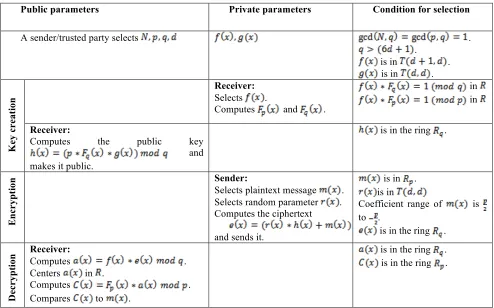
TABLE 1: NTRU PARAMETERS, KEY GENERATION, ENCRYPTION AND DECRYPTION
Public parameters Private parameters Condition for selection
A sender/trusted party selects .
.
is in .
is in .
Ke
y
cr
ea
ti
on
Receiver:
Selects .
Computes and .
in in
Receiver:
Computes the public key
and makes it public.
is in the ring .
En
cr
yp
ti
on Sender: Selects plaintext message .
Selects random parameter .
Computes the ciphertext
and sends it.
is in . is in
Coefficient range of is
to .
is in the ring .
De
cr
yp
ti
on
Receiver:
Computes .
Centers in .
Computes .
Compares to .
35
Binary polynomials have 0’s and 1’s as coefficients whereas the set of coefficients for ternary polynomials
are expressed as where is the number of
1’s, is the number of -1’s and the rest are 0 coefficients [16, 18]. Product form polynomials provide for a private key which is always invertible [18].
The parameters used in NTRU are the public
parameters where is the number of 1
coefficients. The rest of the NTRU parameters are polynomials.
The private parameters and are used for
private and public key generation. The parameter
is chosen in and has multiplicative inverses
modulo and . In the event that the selected parameter is not invertible, it is discarded and a new
parameter selected. The parameter is a random
one-time parameter which is different for each encryption operation. The message is expressed as the
parameter . The computed parameters are the
public key parameter , the ciphertext , the
parameter and the decrypted message which
is then compared to the plaintext . Table 1 shows
the NTRU parameters, the conditions for their selection, the key generation, encryption and decryption processes.
As illustrated in the Table 1, the operation of the NTRU public key cryptosystem begins when the trusted
authority/sender chooses the parameters . The
receiver selects the private parameters . After
which the receiver generates the private key by computing the multiplicative inverse of in given
by resulting in the private key pair .
Afterwards, the multiplicative inverse of in
given by is computed. Furthermore, the public
key is generated by computing
in and the
polynomial is published.
What follows is the initialization of the plaintext
message polynomial in whose coefficients
range between and . The sender then goes on to
select a random polynomial which will be used for
encryption. The message is then encrypted by
generating the ciphertext
. The ciphertext is then sent to its intended receiver.
Upon receiving the ciphertext, the receiver decrypts
it using the private key by computing
. The coefficients of are then adjusted to an element of . Finally, the plain
text message is recovered by computing
which is eventually
verified to confirm that .
III. THE PROPOSED ITRU ALGORITHM- NTRU
USING RING OF INTEGERS
A. Parameters and Notation
The proposed ITRU cryptosystem operates in the
ring of integers modulo , denoted as . The ring
of integers modulo is the set of equivalence classes of integers modulo . A ring is a set of values which are commutative, that is closed under addition
(+) and multiplication (×) [19]. Addition and
multiplication is carried out using regular integer operations and the result is then reduced modulo .
The ITRU consists of integer parameters whose descriptions and compositions are shown in Table 2.
The parameters are computed in the rings and
where is set to 1000 while is a large prime integer.
TABLE 2: ITRU PARAMETERS
Parameter Description Small modulus Large modulus
Private integer for private key generation Private random integer for public key generation
Private random integer for cipher-text generation
Decimal representation of the message
Private key pair
Public key parameter h Intermediate parameter Decrypted message
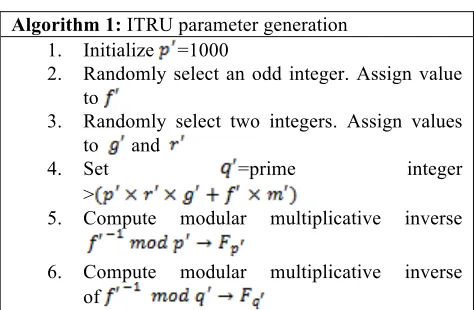
In ITRU, the parameters are selected
using the Algorithm 1.
Algorithm 1: ITRU parameter generation
1. Initialize =1000
2. Randomly select an odd integer. Assign value
to
3. Randomly select two integers. Assign values
to and
4. Set =prime integer
>
5. Compute modular multiplicative inverse
6. Compute modular multiplicative inverse
of
As shown in Algorithm 1, the ITRU parameter selection is carried out as follows:
1) is set as 1000.
36
comprised of alphabetical characters of upper case (A-Z) or lower case (a-z), which implies that the range is 65-90 and 97-122 respectively. 2) is a representation of the message in decimal
form.
3) is a private integer, which is randomly selected as an odd integer so as to have a multiplicative inverse modulo .
4) and are private integers which are selected as any random integer. is used to generate the public key while is used for generating the cipher-text.
5) Select a large prime .
should be set as the next large prime integer
greater than .
B. Key Creation
To generate the private and public key pairs, the sender takes the selected private integer and then
computes the modular multiplicative inverse
of and which are labelled as
and respectively. The inverses obtained satisfy the conditions
(3) (4)
The parameter selected must have an inverse modulo
and . The modular multiplicative inverse is
computed using the Extended Euclidean algorithm. The
modular inverse algorithm utilized in this
implementation of ITRU is as shown in Algorithm 2.
Algorithm 2: Finding Modular Inverse using Extended
Euclidean Algorithm
1. procedure EXTENDED EUCLIDEAN(a, b)
2. Input:
3. Output:
4. Initialize
5. while do
5.1. ,
5.2.
5.3. , , ,
6. Return
7. Return
8. If then
8.1.
9. Else
9.1. 10. Return
As indicated in Algorithm 2, the modular multiplicative inverse is computed using a function where the inputs
into the function are ( ) and ( ) so as to obtain
the inverse and respectively. The algorithm
works using a series of successive divisions of by and then the product of the resulting quotient with is computed and then subtracted from . The next row of values is obtained by a series of cyclic shifts to the right. In the event that obtained inverse is a negative integer, the positive modular equivalent is computed. For instance, the function call EXTENDED
EUCLIDEAN( ) finds the modular multiplicative
inverse such that 7 mod 960=1. It should be noted
that GCD( , that is and
must be relatively prime in order to find a multiplicative inverse.
The sender then obtains his private key pair (5)
The public key is obtained by computing
(6)
C. Encryption
To encrypt a message, the sender takes the randomly selected integer and the message which is converted to its decimal representative. The conversion can be done using ASCII conversion tables, in the case of alphabetical character messages.
The sender then encrypts the message by computing
(7) The cipher-text is then sent to its intended recipient.
D. Decryption
To decrypt the received cipher-text, the recipient first computes
(8) Finally, recovering the message by computing
(9)
The recovered should be equal to .
E. Why Decryption Works
In the decryption step, using Eq. 7 the receiver has
(10)
Given that , then
.
Since then
(11) Putting into consideration that the parameter
, the value will
evaluate to
(12) The original message is then recovered by multiplying
with in the ring resulting in
Considering that and
, the decrypted
message evaluates to
37
IV. ITRU ENCRYPTION EXAMPLE
An implementation of the proposed ITRU is illustrated using the following example. Suppose a sender wants to use ITRU to encrypt and send the message “hi”.
A. Parameter Selection
He starts off by establishing the ITRU encryption
parameters. Selecting the parameters
. The parameter is then set as the next large prime greater than
. In this case
, resulting in
.
The message is initialized by representing the
plaintext message in decimal form using ASCII conversion tables.
(14)
B. Key creation
The private key pair is created by finding the
modular multiplicative inverse and using
Algorithm 1 resulting in
(15)
(16) Thus, the private key pair is
(17)
While the public key is obtained by computing
(18)
C. Encryption
The message is encrypted and sent to its intended recipient by computing
(19)
D. Decryption
Upon receiving the cipher text, the recipient decrypts it by computing
(20)
Then retrieves the original message by computing
”hi”. (21)
V. PERFORMANCE COMPARISON
The comparison of the classical NTRU [1] and our proposed ITRU cryptosystem is as follows:
• The generation of ITRU parameters requires
less pre-computation, as shown in Algorithm 1. ITRU requires the random selection of 2
integers and , and one odd integer
whose inverse is then computed. Provided is prime and all parameters are selected in accordance with the prescribed criteria, is always invertible. This differs from the classical NTRU which has a more elaborate parameter selection criteria and is not always invertible.
• The computational complexity for key
generation in the ITRU algorithm is O , since it only involves the application of the Extended Euclidean algorithm. In classical NTRU, the key generation algorithm which is an adaptation of the adaptation of the ”Almost Inverse Algorithm” [20] has computational
complexity of O [21].
• The proposed ITRU algorithm results in
successful message decryption, provided that the parameter selection criteria is adhered to. On the other hand, the classical NTRU public key cryptosystem has a probability of decryption failure of 2-145 [18] for the most recent version of NTRU which uses product-form polynomials.
• ITRU is based on integer rings as opposed to the lattice structure of the classical NTRU. The security of ITRU is based on the integer factorization problem.
• Evaluations conducted by running NTRU and
ITRU on the Magma Computational Algebra System V2.22-7 running on a 3.60GHz i7 Windows 10 operating system showed that the key generation process in ITRU is less complex and faster. In addition, the cipher text in ITRU had a message expansion factor of 3.
VI. CONCLUSION
In this study, an NTRU-based cryptosystem using the ring of integers, referred to as ITRU is presented. The proposed algorithm uses integers as opposed to polynomials, as is the structure of the classical NTRU. The paper describes a description of the theoretical model of ITRU, the parameter selection conditions as well as an illustration of its implementation using an example. The performance of ITRU is then contrasted with that of NTRU.
38
Further research may be conducted on the corresponding ITRU parameters for comparative security levels with the classical NTRU. This will provide opportunities to compare public key sizes and running times at equivalent security levels.
REFERENCES
[1] Hoffstein, J., J. Pipher, and J.H. Silverman, NTRU: A Ring-Based Public Key Cryptosystem, in Algorithmic Number Theory. 1998, Springer. p. 267-288.
[2] IEEE Draft Standard Specification for Public- Key Cryptographic Techniques Based on Hard Problems over Lattices. IEEE Unapproved Draft Std P1363.1/D12, Oct 2008, 2008: p. 1.
[3] IEEE, Efficient Embedded Security Standards (EESS), in EESS #1: Implementation Aspects of NTRUEncrypt and NTRUSign. 2003, Consortium for Efficient Embedded Security. p. 78.
[4] Security, C.F.E.E., Efficient Embedded Security Standard (EESS) #1 in Version 3.0, 2015,. 2015. [5] Gaborit, P., J. Ohler, and P. Solé, CTRU, a
Polynomial Analogue of Ntru. 2002, INRIA. [6] Kouzmenko, R., Generalizations of the NTRU
Cryptosystem. Diploma Project, École Polytechnique Fédérale de Lausanne,(2005–2006), 2006.
[7] Coglianese, M. and B.-M. Goi, MaTRU: A New NTRU-Based Cryptosystem, in Progress in Cryptology - Indocrypt 2005: 6th International Conference on Cryptology in India, Bangalore, India, December 10-12, 2005. Proceedings, S. Maitra, C.E. Veni Madhavan, and R. Venkatesan, Editors. 2005, Springer Berlin Heidelberg: Berlin, Heidelberg. p. 232-243.
[8] Jarvis, K., NTRU over the Eisenstein Integers. 2011, Université d'Ottawa/University of Ottawa. [9] Jarvis, K. and M. Nevins, ETRU: NTRU over the
Eisenstein Integers. Designs, Codes and Cryptography, 2015. 74(1): p. 219-242.
[10] Malekian, E., A. Zakerolhosseini, and A. Mashatan, QTRU: A Lattice Attack Resistant Version of NTRU PKCS Based on Quaternion Algebra. preprint, Available from the Cryptology ePrint Archive: http://eprint. iacr. org/2009/386. pdf, 2009. [11] Malekian, E., A. Zakerolhosseini, and A. Mashatan, QTRU: Quaternionic Version of the NTRU Public-Key Cryptosystems. The ISC International Journal of Information Security, 2015. 3(1).
[12] Banks, W.D. and I.E. Shparlinski. A Variant of NTRU with Non-Invertible Polynomials. in International Conference on Cryptology in India. 2002. Springer.
[13] Rourke, C.O. and B. Sunar, Achieving NTRU with Montgomery Multiplication. IEEE Transactions on Computers, 2003. 52(4): p. 440-448.
[14] Truman, K., Analysis and Extension of Non-Commutative NTRU. 2007, University of Maryland.
[15] Gaithuru, J.N., M. Salleh, and I. Mohamad. Mini N-Th Degree Truncated Polynomial Ring (Mini-NTRU): A Simplified Implementation Using Binary Polynomials. in 2016 IEEE 8th International Conference on Engineering Education (ICEED). 2016.
[16] Nguyen, H.B., An Overview on the NTRU Cryptographic System. 2015, San Diego State University.
[17] Hoffstein, J., J. Pipher, J.H. Silverman, and J.H. Silverman, An Introduction to Mathematical Cryptography. Vol. 1. 2008: Springer.
[18] Hoffstein, J., J. Pipher, J.M. Schanck, J.H. Silverman, W. Whyte, and Z. Zhang, Choosing Parameters for NTRUEncrypt, in Report 2015/708. 2015, IACR: Cryptology ePrint Archive.
[19] Stein, W., The Ring of Integers Modulo N, in Elementary Number Theory: Primes, Congruences, and Secrets: A Computational Approach. 2009, Springer New York: New York, NY. p. 1-27. [20] Silverman, J.H., Almost Inverses and Fast NTRU
Key Creation. NTRU Cryptosystems,(Technical Note#014):http://www.ntru.com/cryptolab/pdf/NTR U Tech014. pdf, 1999.