1
Charged Dark Matters, Missing Neutrinos, Cosmic Rays and Extended Standard Model
Jae - Kwang Hwang
JJJ Physics Laboratory, Brentwood, TN 37027, USA E-mail: [email protected]
In the present work, the charged B1, B2 and B3 bastons with the condition of k(mm) = k >> k(dd) > k(dm) = k(lq) = 0 are explained as the good candidates of the dark matters.The proposed rest mass (26.12 eV/c2) of the B1 dark matter is indirectly confirmed from the supernova 1987A data. The missing neutrinos are newly explained by using the dark matters and lepton charge force. The neutrino excess anomaly of the MinibooNE data is explained by the B1 dark matter scattering within the Cherenkov detectors. And the rest masses of 1.4 TeV/c2 and 42.7 GeV/c2 are assigned to the Le particle and the B2 dark matter, respectively, from the cosmic ray observations. In the present work, the Q1 baryon decays are used to explain the anti-Helium cosmic ray events. Because of the graviton evaporation and photon confinement, the very small Coulomb’s constant (k(dd)) of 10x-54k and gravitation constant (G
N(dd)) of 10xGN for the charged dark matters at the present time are proposed.The x value can have the positive, zero or negative value around zero. Therefore, Fc(mm) > Fg(dd) (?) Fg(mm) > Fg(dm) > Fc(dd) > Fc(dm) = Fc(lq) = 0 for the proton-like particle.
Key words: charged dark matters, missing neutrinos, cosmic rays, gravitation constant, Coulomb’s constant, extended standard model, anti-Helium cosmic ray
1. Introduction
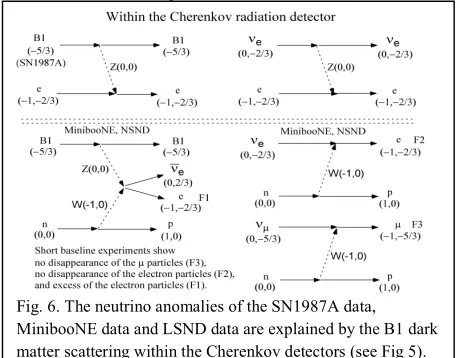
The standard model has been well established. However, several new discoveries like the dark matter need the extended standard model. The present extended standard model [1] is compared with the standard model in Fig. 1. For example, the Z, W- and W+ bosons in the standard model do not have the lepton charge (flavor) dependence but the quarks and leptons have the lepton charge dependence in Fig. 1. Therefore, the quark mixing (CKM matrix) and lepton mixing (oscillation) are required in order to explain the particle decays. But, in the present extended standard model, the force carrying bosons of Z, W and Y have the lepton charge dependence in Fig. 1 like the quarks and leptons have the lepton charge dependence. In this case, the quark mixing (CKM matrix) and lepton mixing (oscillation) are not needed in order to explain the particle decays. The missing neutrinos are newly explained by using the dark matters and lepton charge force rather than the neutrino oscillation and sterile neutrino in section 3. The neutrino anomalies of the SN1987A data and MinibooNE data are explained by the B1 dark matter scattering within the Cherenkov detectors.
The dark matters have been known to have two properties. First the electromagnetic interactions between the dark matters (d) and normal matters (m) are zero. Secondly, the electromagnetic interactions between the dark matters are zero. Therefore, the zero Coulomb’s forces of Fc(dm) = 0 and Fc(dd) = 0 have been proposed. Here, d and m represent the dark matter and normal matter, respectively. Because of the zero Coulomb’s force, the electrically neutral particles have been proposed as the most possible candidates of the dark matters. In other words, the electric charges (EC) of
2
these dark matters are zero in Fc(EC) = k . Also, the mini-charged particles (or milli-charged particles) with the near-zero EC charge [2] have been proposed as other possible candidates of the dark matters which give the very small Coulomb’s forces between the dark matters and normal matters and between the dark matters. In this case, the same Coulomb’s constant of k is applied for both of dark matters and normal matters.
In the present work, the zero Coulomb’s constant of k(dm) = 0 in Figs. 1 and 2 is applied between the dark matters and normal matters in order to meet the first condition. In order to meet the second condition, the very small k(dd) values for the dark matters and the k(mm) = k values for normal matters are proposed. Therefore, the relation of k(mm) = k >> k(dd) > k(dm) = 0 is shown in Figs. 1 and 2. In this case, the dark matters can have the EC charges close to the EC charge of the electron. The B1, B2 and B3 bastons with the tentative electric charges of 2/3e, 5/3e and -8/3e, respectively, were, for the first time, reported as the possible candidates of the dark matters in Ref. [1]. The B1 and B2 dark matters are expected to be relatively stable because of the lack of the decaying channels. Therefore, in the present work, the B1, B2 and B3 bastons with the condition of k(mm) = k >> k(dd) > k(dm) = 0 are explained as the good candidates of the dark matters. The relations of GN(ll) = GN(qq) = GN(mm) and k(ll) = k(qq) = k(mm) = k are assumed for the simplicity in Figs. 1 and 2. Here, l and q represent the leptons and quarks, respectively. Then, note that k(dm) = k(lq) =0. Then the normal matters consist of leptons, quarks and hadrons, and the dark matters are the three bastons of B1 with -2e/3, B2 with -5e/3 and B3 with -8e/3 [1]. In Fig. 2, the Coulomb’s constant (k) and gravitation constant (G) have been changed in terms of the conserved charges and conserved rest masses of the particles. Because the correct evolution curves of k and G are not known, these curves are tentatively drawn for the explanation in Fig. 2. And the effective charges
3
and effective rest masses of the particles are defined in terms of the fixed Coulomb’s constant (k) and fixed gravitation constant (GN). Then, the effective charge of the B1 dark matter with EC =− e is (EC)eff = − 10( )/ e depending on the x value. Here k(dd) = 10 k. And the effective rest mass of the dark matter with the rest mass of m is meff = 10 / m depending on the x value. Here GN(dd) = 10 GN. Therefore, Fc(mm) > Fg(dd) (?) Fg(mm) > Fg(dm) > Fc(dd) > Fc(dm) = Fc(lq) = 0 for the proton-like particle in Fig. 2. In Fig. 2, the cases of x = 6 and Fg(dd) > Fg(mm) are shown for the explanation purpose. Note that Fg(dd) = Fg(mm) for the x=0 case and Fg(dd) < Fg(mm) for the x < 0 case in Fig. 2.
In Figs. 1 and 2, the new concepts of the photon confinement and graviton evaporation are introduced. The Coulomb’s constant should be constant with increasing of the time because of the photon confinement. The gravitation constant
has been changed since the big bang because of the graviton evaporation. It is shown that the relation of, at the present time, Fc(mm) > Fg(dd) (?) Fg(mm) > Fg(dm) > Fc(dd) > Fc(dm) = 0 for the proton-like particle could explain the universe evolution including the B1, B2 and B3 dark matters by giving the tentative values of the Coulomb’s constants (k) and gravitation constants (G) for the explanation purpose in Fig. 2. It is discussed that the gravitation constant (GN(mm)) could be decreased from the very large value like 1036G
N down to the very small value like GN near the inflation period in Fig. 2. Therefore, during most of the universe evolution the gravitation constant could be taken as GN(mm) = GN. The inflation of the x1x2x3 space is caused by the huge repulsive Coulomb force (Fc(dd)) between dark matters in the x1x2x3 space and huge graviton evaporations into the x1x2x3 space in Fig. 2.
4
The rest mass of 1.4 TeV/c2 is assigned to the Le particle with the EC charge of -2e from the cosmic ray observations [1]. This rest mass of Le is smaller than the tentative previous rest mass (25.3 TeV/c2) of Le [1]. The proposed rest mass (26.12 eV/c2) of the B1 dark matter [1] is indirectly confirmed from the supernova 1987A data. In the present work, the Q1 baryon decays are used to explain the anti-Helium cosmic ray events.
2. Charged dark matters and gravitation constant
The baston dark matters have only the electric charges (EC) [1]. Then, the bastons can be described as (EC). For example, the B1 dark matter with the electric charge of -2e/3 is defined as B1(-2/3). The dark photon of (0) and the dark graviton of g(0) are associated with the bastons in Figs. 1 and 2. The leptons have the electric charges (EC) and lepton charges (LC). Then, the leptons can be described as (EC,LC) [1]. For example, the electron neutrino and electron are defined as e(0,-2/3) and e(-1,-2/3). The normal photon of (0,0) and the graviton of g(0,0) are associated with the leptons in Figs. 1 and 2. The quarks have the electric charges (EC), lepton charges (LC) and color charges (CC). And the quarks can be described as (EC,LC,CC) [1]. For example, the u and d quarks are defined as u(2/3,0,CC) and d(-1/3,0,CC). The photon of (0,0,0) and the graviton of g(0,0,0) are associated with the quarks in Figs. 1 and 2. Also, note that three charges of EC, LC and CC are tentatively quantized based on the systematics [1]. And, the baryons can be described as (EC,LC,-5) or (EC,LC) in Figs. 1 and 2 [1]. For example, the proton is defined as (1,0,-5) or (1,0). The fact that the baryons and mesons can be defined as (EC,LC) in the electromagnetic interactions is called as the hadronization in Figs. 1 and 2 in terms of the electromagnetic interaction. Then, the hadrons can emit and absorb both photons of (0,0) and (0,0,0). Therefore, the charged baryons and charged mesons are interacting with the leptons like the electrons through the normal photons of (0,0) in Fig. 1.
5
dark matters is nearly zero. So, the very small k(dd) value like k(dd) = 10x-54k for the charged B1, B2 and B3 dark matters can meet the second condition in Figs. 1 and 2.
Three things have been observed for the gravitational force at the present time. First, the gravitational force (Fg(dm)) between dark matters and normal matters is not zero as seen in the galaxy structures. Secondly, the gravitational force (Fg(mm)) between the normal matters is very weak compared with the electromagnetic force (Fc(mm)) between the normal matters. For example, for the proton Fg(mm) = 0.8 10-36 Fc(mm). Thirdly, the gravitational force is dominating over the electromagnetic force for the dark matters. Because Fg(mm) is so small in the second condition, Fg(dd) could be larger than Fg(mm) for the proton-like particle. And the gravitational force of Fg(dm) could be smaller than the gravitational forces of Fg(mm) and Fg(dd) because Fc(dm) = 0 is smaller than the Coulomb forces of Fc(mm) and Fc(dd). This gives the relations of Fg(dd) > Fg(mm) > Fg(dm) > 0 and GN(dd) > GN(mm) > GN(dm) > 0 because the gravitational force formula is Fg(dd) = GN(dd) . The non-zero gravitational force of Fg(dm) indicates that three gravitons of g(0), g(0,0) and g(0,0,0) are changed to each other. This is called as the graviton evaporation in the present work in Figs. 1 and 2. These relations between the gravitational forces can be compared with the relations of Fc(mm) > Fc(dd) > Fc(dm) = Fc(lq) = 0 and k(mm) = k >> k(dd) > k(dm) = k(lq) = 0. In order to make dark matters to be controlled by the attractive gravitational force in the third condition, the attractive gravitational force (Fg(dd)) between the charged dark matters should be greater than the repulsive Coulomb force (Fc(dd)) between the charged dark matters. Therefore, Fg(dd) > Fc(dd). Therefore, the relation of Fc(mm) > Fg(dd) > Fg(mm) > Fg(dm) > Fc(dd) > Fc(dm) = Fc(lq) = 0 for the proton-like particle is obtained for the x = 6 case as shown in Fig. 2.
6
of the time since the inflation in Fig. 2. Therefore, Fc(mm) >> Fg(mm) at the present time in Fig. 2.
Also, in Figs. 1 and 2, the photons are confined within the corresponding space. This indicates that the Coulomb’s constant (k) does not change since the inflation. Therefore, always k(mm) >> k(dd) and k(mm) = k. However, the gravitation constant of GN is different because the gravitons can evaporate into other spaces in Figs. 1 and 2. This indicates that the gravitation constant of Ghas been changing since the inflation. In other words, near the inflation period, Fg(mm) >> Fg(dd) and Fc(mm) ≫ Fc(dd) with the condition of GN(mm) >> GN(dd) and k(mm) >> k(dd) in Figs. 1 and 2. Then, because of the graviton evaporation, GN(mm) has been decreased and GN(dd) has been increased since the inflation. At the present time, Fg(dd) > Fg(mm), Fg(dd) > Fc(dd) and Fg(mm) ≪ Fc(mm) with the condition of GN(mm) < GN(dd) and k(mm) >> k(dd) in Figs. 1 and 2. At the present time, Fc(mm) > Fg(dd) > Fc(dd) in the force strength and Fg(dd) > Fg(mm). In other words, it is assumed that GN(dd) > GN(mm) = GN= GN(qq) ≈ GN(ll).
The tentative numerical values of k and G in Fig. 2 are added just in order to show that the graviton evaporation and photon confinement can explain the relative force strengths of the electromagnetic interactions and gravitational interactions well. For example, near the inflation GN(mm) ≈ 1036GN, and GN(dd) = 10-12GN in Fig. 2. At the present time, GN(mm) = GN, and GN(dd) ≈ 106GN because of the graviton evaporation in Fig. 2. And, always k(mm) = k ≈ 1048k(dd). This can be generalized as GN(dd) = 10xGN and k(mm) = k ≈ 10x- 54k(dd) in Figs. 1 and 2. The x=6 case is shown in Fig. 2. Therefore, in general, Fc(mm) > Fg(dd) (?) Fg(mm) > Fg(dm) > Fc(dd) > Fc(dm) = Fc(lq) = 0 for the proton-like particle in Fig. 2. In Fig. 2, the cases of x = 6 and Fg(dd) > Fg(mm) are shown for the explanation purpose. Note that Fg(dd) = Fg(mm) for the x=0 case and Fg(dd) < Fg(mm) for the x < 0 case in Fig. 2. It will be interesting to look for the proper x value for the further studies.
At the present time, Fg(mm) = 8 10-37Fc(mm) ≈ 10-36Fc(mm) for the proton. Fc = Fc(EC) + Fc(LC) + Fc(CC) ≈ Fc(EC) = k because k(EC) > k(LC) > k(CC) [3,4]. The lepton charge force of Fc(LC) plays an important role for the neutrinos with the zero EC charges and non-zero LC charges [3,4]. The missing neutrino fluxes can be studied again by using the lepton charge force of Fc(LC) rather than the neutrino oscillation explanation as shown in section 3. Here it is assumed that the k and G values are similar for the leptons and quarks. Then Fc(mm) ≈ 1036Fg(mm), Fg(dd) = 10xFg(mm) and Fc(dd) = 10x-18Fg(mm) for a proton-like particle in Fig. 1. This assumption can explain the relation of, at the present time, Fc(mm) > Fg(dd) (?) Fg(mm) > Fg(dm) > Fc(dd) > Fc(dm) = Fc(lq) = 0 for the proton-like particle in Fig. 2. For the B1 dark matter with the rest mass of 26.12 eV/c2 [1], F
7
is so weak compared with the electromagnetic force strength (Fc(mm)) between the matters at the present time. Therefore, it is concluded that the Coulomb’s constant is constant because of the photon confinement but the gravitation constant has been changed since the inflation because of the graviton evaporation along with the space evolution in Figs. 1 and 2. It is expected that the changing process of the gravitation constant between the matters from GN(mm) ≈ 1036GN to GN(mm) = GN happened mostly near the inflation period in Fig. 2. Therefore, during most of the universe evolution the gravitation constant could be taken as GN(mm) = GN. This explanation with the possible numerical values of k and G in Fig. 2 is only the example which needs to be further investigated in the future.
In Figs. 1 and 2, if the gravitons are confined within the corresponding space like the photons, the gravitation constant of GN(mm) could be much larger than the gravitation constant of GN(dd) like k(mm) is larger than k(dd). And the gravitation force strength (Fg(mm)) should be similar to the electromagnetic force strength (Fc(mm)). But because the gravitation force strength (Fg(mm)) is much weaker than the electromagnetic force strength (Fc(mm)), it is clear that the gravitons are not confined but evaporated to other spaces as shown in Figs. 1 and 2. In Figs. 1 and 2, it is proposed that k(dd) is much smaller than k(mm) in order to explain the charged dark matter distribution of the galaxy cluster. And if the gravitons are evaporated to other spaces, the gravitation constant of GN(mm) could be similar to the gravitation constant of GN(dd). Experimentally, Fg(mm) = 8 10-37 Fc(mm) for the proton. Therefore, the GN(mm) value is so small at the present time when compared with the k(mm) value in terms of the force strength. This indicates that the gravitons are evaporated as shown in Fig. 2. Because of the huge number (N) of the evaporated gravitons into the x1x2x3 space, the gravitational force between the dark matters on the x1x2x3 space should be stronger than the electromagnetic force between dark matters. Because of the strong gravitational force between the dark matters, the charged dark matters of the B1, B2 and B3 bastons are distributed following the gravitational forces rather than the electromagnetic force between the dark matters. The observed dark matter distributions around the galaxies and galaxy clusters support the strong gravitational force between the dark matters. As shown in Figs. 1 and 2, for the dark matters Fg(dd) > Fc(dd), for the matters Fg(mm) << Fc(mm) and between the matter and dark matter Fg(dm) > Fc(dm) = 0. Here Fg and Fc are the gravitational force strength and electromagnetic force strength, respectively. Also, it is assumed that GN (dd) = 10xGN(mm) > GN (dm) for the gravitation constant and k(dm) = k(lq) = 0, k(mm) = k >> k(dd) = 10x-54k for the Coulomb’s constant in Figs. 1 and 2. Here d and m mean the dark matter and (normal) matter, respectively. Then, Fc(dm) = 0, Fc(mm) >> Fc(dd) for the proton-like particle and Fg(mm) (?) Fg(dd) > Fg(dm) for the proton-like particle. Also, Fc(mm) > Fg(dd) in Figs. 1 and 2.
8
the dark matters are distributed as observed in the gravitational lensing measurements [5,6,7]. In other words, these gravitational lensing measurements [5,6,7] are the direct evidence of the weak gravitational force with the small GN(dm) value between the dark matters and normal matters. Therefore, the dark matters and normal matters around the galaxies are connected by the weak gravitational force which can affect the rotational motions of the normal matters. For the bullet cluster [5], the dark matters and normal matters are taking the head and tail parts, respectively, when the
corresponding galaxy cluster is moving. The non-zero rest mass of a graviton is mg for the dark matters in Fig. 1. Then the non-zero rest mass of a graviton is 3mg for the normal matters of the hadrons in Fig. 1. The strong gravitational force with the longer force range of the g(0) graviton between the dark matters can make the location and shape of the dark matter distributions different from those of the normal matter distributions as observed in the Abell 1689 cluster [6] and Abell 520 cluster [7]. The weak gravitational force with the shorter force range of the g(0,0,0) graviton between the baryonic normal matters can make the location and the shape of the normal matter distributions as observed in the Abell 1689 cluster [6] and Abell 520 cluster [7], which have mostly the normal matters (galaxies) in the outside area and dark matters in the inside center area. Recently, the ultra-diffuse galaxy called as NGC1052-DF2 without the dark matters was found [8]. The formation of the galaxy without the dark matters could be explained with increasing of Fg(dm) as a function of the time as shown in Figs. 2 and 3. The transition from the galaxy without the dark matters to the galaxy with the dark matters could be explained, too, as shown in Fig. 3. Therefore, the galaxies can be classified as the oldest galaxies, middle aged galaxies and the youngest galaxies as shown in Fig. 3. The ultra-diffuse galaxy called as NGC1052-DF2 without the dark matters was found [8] and is classified as the oldest galaxy. Then the dark matter galaxy and matter galaxy classified as the middle aged galaxies can rotate as the pair by the Fg(dm) force. Therefore, looking for the rotating pair of the dark matter and matter galaxies will be interesting. See Ref. [9] for the gravitational force range for the dark matters in Fig. 3.
Fig. 3. The transition from the galaxy without the dark matters to the galaxy with the dark matters is shown (see Figs. 1 and 2). The decay channels of several Q1 baryons related to anti-Helium cosmic ray events are shown.
N(Q1,u,u)(0,0,-5) p + e +
e(Favored)
R(Q1,d,u)(-1,0,-5) p + 2e + 2
e(Favored)
pR pp + 2e + 2
e 2He + 2
epn + e +
ed +
eppQ ppn + 2e + 2
e 3He + 2
e
+ e
+(Favored)
ppRR ppnn + 2e + 2
e 4He + 2
e+ 2e
+9
3. Missing neutrinos, Le lepton, Q1 quark and B1 dark matter
In Ref. [1], three heavy leptons (Le, L, L) with the EC charge of -2 are proposed. The rest mass energy of the Le particle is expected between 3 1011 eV and 3 1013 eV because the gamma ray excess was reported from the TeV gamma ray spectrum from RX J1713.7-3946 with HESS and Fermi-LAT data [10,11]. In the present work, this gamma ray excess around 1.4 TeV is proposed as the gamma ray peak from the annihilation peak of Le and anti Le particles as shown in Fig. 4. And the cosmic-ray electron and positron excess at the energy range between 1011 eV and 2 1012 eV was observed from the data of DAMP (Dark Matter Particle Explorer) [12]. Also, the 1.4 TeV electron and positron peak was observed from the same data. And the 1.4 TeV peak observed at the cosmic ray is explained as the annihilation peak of Le and anti
Le particles as shown in Fig. 4. Then, the rest mass of 1.4 TeV/c2 is assigned to the Le particle with the EC charge of -2e. This rest mass of Le is smaller than the tentative previous rest mass (25.3 TeV/c2) of Le [1]. And the cosmic-ray electron and positron excess at the energy range between 1011 eV and 2 1012 eV, which was observed from the data of DAMP (Dark Matter Particle Explorer) [12], is explained to be originated from the decay of Le particle of 𝐿 → 2𝑒 + 𝜈 . And the cosmic gamma ray spectrum by CALET 5 year measurements [13] was observed from the Galactic center including galactic diffusing background. The 1.4 TeV gamma ray peak which was originated from annihilation peak of Le and anti Le particles was found [13]. Also, Planck collaboration [14] indicates that the electron and positron cosmic ray data observed around 1.4 TeV by the Fermi/HESS and AMS/PAMELA are excluded from the dark matter candidates by CMB. These electron and positron data can be explained by the decay and annihilation of the new Le particle. The rest masses of Le, L and L leptons can be tentatively calculated by E = 0.4498 1038+2F
10
and F(EC,LC) = -23.24488 + 7.26341 |EC| - 1.13858 EC2 + 0.62683 |LC| + 0.22755 LC2. These data support the existence of heavy leptons like Le, L and L.
In Ref. [1], the B1, B2 and B3 dark matters (bastons) are proposed. These B1 and B2 dark matters are very stable because of the lack of the decaying channels [1]. Their possible rest masses have been tentatively calculated in Ref. [1] under the assumption that the B2 dark matter has the 42.7 GeV/c2 [12]. The 42.7(7) GeV peak was identified in the gamma-ray spectrum from the Fermi Large Area Telescope (LAT)
in the directions of 16 massive nearby Galaxy Clusters [1,15]. The 42.7 GeV peak is proposed as the B2 annihilation peak. Then, the rest mass of the B2 dark matter is 42.7 GeV/c2 [1]. Also, the proposition of the 42.7 GeV/c2 B2 dark matter is consistent with the dark matter rest mass energy predicted by the Fermi Galactic center excess, AMS anti-proton excess, thermal cross-section and the CMB condition [14]. Planck collaboration [14] reported recently the possible rest mass energy range of the dark matter in Fig. 46 of the paper on Planck 2018 results. VI. Cosmological parameters [14]. This rest mass energy range [14] is consistent with the present B2 dark matter rest mass energy of 42.7 GeV/c2.
The Cherenkov radiation of the electrons produced from the elastic scattering of the anti-neutrino and electron was observed by the Kamiokande II detector, Irvine-Michigan-Brookhaven detector (IMB) and Baksan neutrino observatory detector (BNO) [16]. And the anti-neutrino data emitted from SN 1987A [16] were explained by using the annihilation of B1 and anti-B1 dark matters [1]. In the present work, the alternative explanation is tried to explain the SN 1987A data [16]. It is proposed in Fig. 6 that the Cherenkov radiation of the electrons produced from the elastic scattering of the B1 dark matter and electron was observed by the Kamiokande II detector, Irvine-Michigan-Brookhaven detector (IMB) and Baksan neutrino
11
observatory detector (BNO) [16]. In Fig. 5, the curve A fits the observed data well except the 6 BG data. The equation of 2E2t = m2c4t
0 is taken from the paper by Ehrlich [16]. Here, t0 is the travel time of the light from SN 1987A to the earth. The background data are expressed as BG in Fig. 5. The 5 data detected by the BNO detector considered as the background data are not shown in Fig. 5 [16]. The curve A uses the proposed dark matter mass of B1. It is proposed that the B1 particles come from SN 1987A to the earth. The energies, E() of the observed neutrinos are re-interpreted as the energies, E(B1) of the B1 dark matters. This supports indirectly that the rest mass of the B1 dark matter is 26.12 eV/c2. The curve B fitted with all data in Fig. 5 is shown for the comparison with the curve A.
In Figs. 5 and 6, the missing neutrinos are newly explained by using the B1 dark matters and lepton charge force. Fc = Fc(EC) + Fc(LC) + Fc(CC) ≈ Fc(EC) = k because k(EC) > k(LC) > k(CC) [3,4]. The lepton charge force of Fc(LC) = k(LC)
plays an important role for the neutrinos with the zero EC charges and non-zero LC charges in Fig. 5 [3,4]. The missing neutrino fluxes can be studied again by using the lepton charge force of Fc(LC) rather than the neutrino oscillation explanation as shown in section 3.The neutrino anomalies of the SN1987A data, MinibooNE data [17,18] and LSND data [19] are explained by the B1 dark matter scattering within the Cherenkov detectors in Figs. 5 and 6. Also, the reactor missing antineutrino anomaly can be explained by the condition of Nd < N(LCF) in Fig. 5.
In the present extended standard model, the force carrying bosons of Z, W and Y have the lepton charge dependence in Fig. 1 like the quarks and leptons have the lepton charge dependence. In this case, the quark mixing (CKM matrix) and lepton
12
mixing (oscillation) are not needed in order to explain the particle decays. Then, it is concluded that the B1 dark matters were already observed in the SN1987A data [16] and MinibooNE data [17,18].
Six anti-3He cosmic ray events and two anti-4He cosmic ray events were observed by AMS-02 measurements [20]. Anti-matter clouds and anti-matter stars are proposed by Poulin et al. as their origins [20]. However, in the present work the Q1 baryon decays are used to explain the anti-Helium cosmic ray events. It indicates that the enhanced anti- 3He events are originated from the anti- (ppQ) decay in Fig. 3. And the anti- 4He events are originated from the anti- (ppRR) decay in Fig. 3. Also, the ultra high energy cosmic rays can be explained by the decaying channels of the Q1, Q2 and Q3 baryons [1] as shown in Fig. 3. This supports the existence of the new heavy Q1, Q2 and Q3 quarks with the charge of EC = -4e/3 [1].
4. Elementary particles and the extended standard model
The relations of GN(ll) = GN(qq) = GN(mm) and k(ll) = k(qq) = k(mm) = k are assumed in Fig. 2. Here, l and q represent the leptons and quarks. Then, note that
k(dm) = k(lq) =0. And the normal matters consist of leptons, quarks and hadrons, and the dark matters are the B1, B2 and B3 bastons [1]. Then the B1, B2 and B3 dark matter particles exist since the big bang along with the photons and gravitons [9]. Therefore, all elementary particles including the B1, B2, B3 dark matters are created
13
near the inflation. The particles with the rest mass (m) of m > Ep/c2 and the radius (r) of r < R become the virtual black hole particles from the condition of the Schwarzschild radius of R = 2Gm/c2. E
p/c2 = mp is the Planck mass which is the black hole. The real particles are defined as the particles with the radius (r) of r > R. Therefore, the B1, B2 and B3 dark matters are the real particles. And it is proposed that the force carrying bosons of gravitons and Z/W/Y bosons with the non-zero rest masses have the radii equal to the Planck length (lp0) in Fig. 7 [9,1,4]. Therefore, the force carrying Z/W/Y bosons and gravitons are always the real particles because the radii of the force carrying bosons and gravitons are lp0 = 1.6 10-35 m larger than their Schwarzschild radii given by R = 2Gm/c2. The size of the photon with the zero rest mass cannot be defined. These Z/W/Y bosons exist only during the very short time allowed by the uncertainty principle. These Z/W/Y bosons are created from the decay of the vacuum energy in Fig. 7. Therefore, the first Z(0,0) and W(-1,0) particles with the rest mass energies of 91 GeV/c2 and 80 GeV/c2, respectively, were the real particles that were created from the decay of the vacuum energy. The pair of the matter universe with the charge configuration of -Q and anti-matter universe with the charge configuration of Q could be created from the big bang because our universe is full of the matters in Fig. 7 [9]. In this case, if the matter universe is defined to be negatively charged for the EC, LC and CC charges, the anti-matter universe should be defined to be positively charged for the EC, LC and CC charges. Then, the matters can be created from the decay of the matter universe with decreasing of the gravitation constant (G(mm)) in Fig. 2. Also, the pair of the matter and anti-matter can be created from the vacuum energy fluctuation with decreasing of the gravitation constant (G(mm)) in Fig. 2. The anti-particles created by the pair production of the particle and anti-particle are later changed to the photons by the pair annihilation of the particle and anti-particle. And the particles created by the decay of the matter universe survive to form the galaxies and stars. This is the reason why our matter universe is full of the particles. The decay of the matter universe to create the new particles takes place mostly near the inflation period through the formation of the universe particle and galaxy particles [9,4]. But the pair production of the particle and anti-particle to be created from the vacuum energy fluctuation takes place always from the big bang time up to the present time. Also, the pair production of the matter universe and anti-matter universe can explain the CP symmetry problem of why the matters are dominating over the anti-matters on the present universe.
14
from the high energy graviton. The high energy graviton is made by the constructive interference of the many low energy gravitons. The connection of the elementary bosons with the gravitons are for the first time proposed in the present work in Fig. 7. In other words, the gravitons and the Z/W/Y bosons are created by the fluctuations (T fluctuation) along the time axis of the space and time and the photons and the elementary fermions are created by the fluctuations (S fluctuation) along the space axis of the space and time in Fig. 7 [9,4]. The vacuum energy can be described as the 3-dimensional and 1-dimensional space and time fluctuations of ST(0), ST(0,0) and ST(0,0,0) in Fig. 7. These ST(0), ST(0,0) and ST(0,0,0) fluctuations can be exchanged to each other. Therefore, these vacuum energies are not confined within the corresponding space but evaporated to other space like the gravitons do. And the gravitons (T fluctuation) and photons (S fluctuation) can be combined to form the vacuum energy (ST fluctuation). Also, the vacuum energy (ST fluctuation) can decay to the gravitons (T fluctuation) and photons (S fluctuation). Therefore, the gravitons and photons are originated from the same space-time (ST) fluctuations [4,9]. The vacuum energy density including the photons and gravitons is defined as the ST(0), S(0) and T(0) vacuum energy density of the x1x2x3 space. If the ST(0) vacuum energy is larger than the rest mass energy of two electron neutrinos, the ST(0) energy will be changed to the ST(0,0) energy which makes the pair production of the electron neutrino and anti-electron neutrino. And the increasing of the new g(0) gravitons (T(0) fluctuation) can increase the ST(0) vacuum energy by combining with the (0) photons (S(0) fluctuation). The increasing of this ST(0) vacuum energy can cause the accelerated expansion of the x1x2x3 space and the inflation of the x1x2x3 space since the big bang as explained in Ref. [9]. This should be further studied in terms of the 3-dimensional quantized space model.
5. Summary
In the present work, the charged B1, B2 and B3 dark matters are expected to be relatively stable because of the lack of the decaying channels. When the proper values of the gravitation constants and Coulomb’s constants are given for the normal matter and dark matters, the charged dark matters like the B1, B2 and B3 dark matters can be the good candidates of the dark matters. Here it is assumed that the k and G values are similar for the leptons and quarks. Then Fc(mm) ≈ 1036Fg(mm), Fg(dd) = 10xF
g(mm) and Fc(dd) = 10x-18Fg(mm) for a proton-like particle in Fig. 2. This assumption can explain the relation of, at present time, Fc(mm) > Fg(dd) (?) Fg(mm) > Fg(dm) > Fc(dd) > Fc(dm) = Fc(lq) = 0 for the proton-like particle in Fig. 2. For the B1 dark matter with the rest mass of 26.12 eV/c2 [1], F
15
force (Fc(dd)) between the dark matters. Therefore, Fg(dd) > Fc(dd). Therefore, it is concluded that the Coulomb’s constant is constant because of the photon confinement but the gravitation constant has been changing since the inflation because of the graviton evaporation along with the space evolution in Fig. 2. This assumption can explain the reason why the gravitational force strength (Fg(mm)) between the matters is so weak compared with the electromagnetic force strength (Fc(mm)) between the matters.
The rest mass of 1.4 TeV/c2 is assigned to the Le particle with the EC charge of -2e [2,24,25]. This rest mass of Le is smaller than the tentative previous rest mass (25.3 TeV/c2) of Le [1]. The proposed rest mass (26.12 eV/c2) of the B1 dark matter [1] is indirectly confirmed from the supernova 1987A data [16]. The neutrino anomalies of the SN1987A data and MinibooNE data are explained by the B1 dark matter scattering within the Cherenkov detectors. The missing neutrinos are newly explained by using the dark matters and lepton charge force in section 3. Then, it is concluded that the B1 dark matters were already observed in the SN1987A data and MinibooNE data. In the present work the Q1 baryon decays are used to explain the anti-Helium cosmic ray events and ultra high energy cosmic rays.
Finally, I thank the conference organizers for giving me the opportunity to talk on these challenging topics at the 2018 new trends in high energy physics conference.
References
[1] Jae-Kwang Hwang, Mod. Phys. Lett. A32, 1730023 (2017). [2] R. Barkana et al., arXiv:1803.03091v2 (2018).
[3] Jae-Kwang Hwang, https://www.researchgate.net/publication/311312119 [4] Jae-Kwang Hwang, https://www.researchgate.net/publication/297270485 [5] D. Clower et al., Astrophys. J. 604, 596 (2004).
[6] A.N. Taylor et al., Astrophys. J. 501, 539 (1998). [7] M. Jee et al., Astrophys. J. 783, 1 (2014). [8] P. van Dokkum et al., Nature 555, 629 (2018).
[9] Jae-Kwang Hwang, https://www.researchgate.net/publication/325553139 [10] V. Gammaldi, arXiv: 1412.7639 (2014).
[11] S. Federicici et al., arXiv: 1502.06355v1 (2015). [12] S.F. Ge and H.J. He, arXiv: 1712.02744 (2017). [13] O. Adriani et al., EPJ Web of Conf. 95, 04056 (2015). [14] Planck collaboration et al., Arxiv: 1807.06209v1 (2018).
[15] Y.F. Liang et al., Phys. Rev. D93, 103525 (2016).
[16] R. Ehrlich, Astropart. Phys. 35, 625 (2012).
[17] A.A. Aguilar-Arevalo et al., Phys. Rev. Lett. 121, 221801 (2018). [18] G. Cheng et al., Phys. Rev. D86, 052009 (2012).
![Fig. 1. Charged dark matters, leptons, quarks and hadrons are compared [1].](https://thumb-us.123doks.com/thumbv2/123dok_us/8050634.1341292/2.612.164.446.223.381/fig-charged-dark-matters-leptons-quarks-hadrons-compared.webp)


![Fig. 4. Cosmic gamma ray and cosmic ray [1,6].](https://thumb-us.123doks.com/thumbv2/123dok_us/8050634.1341292/9.612.214.407.283.474/fig-cosmic-gamma-ray-and-cosmic-ray.webp)