A New Software Quality Model For Academic
Information Systems "Case Study E-Learning
System"
Asmaa Jameel Al_Nawaiseh, Yehia Helmy, Emadeldin Khalil
Abstract: The evaluation of software quality is one of the key things in the success of universities, so this study focuses on the study of technical quality measurement factors in the Information Systems, which include software quality, applied in Universities. A novel model is use to verify whether the implementation of E-learning systems will succeed or fail in higher educational institutions. The scope of this investigation is the evaluation of free and open source e-learning systems at the universities according to our suggested software quality model that measures and evaluates the qualit y of the Academic Information System (AIS), which mix several software quality standards, to assist system analysts, system developers, and s ystem programmers in their AIS projects. Six quality characteristics are suggested to be minimum requirements for creating the quality model, the new model has been further enhanced through expanding a standard approach to measure the quality of the AIS based on a mix of several software quality standards used in these educational systems with new features. A novel model is use to verify whether the implementation of E-learning systems will succeed or fail in higher educational institutions. This will be discussed throw our contributions and developments. The objectives of this new model is to guide academic institutes that are in the process of building their E-learning systems to evaluate and choose the appropriate software attributes that is essential to the success of the entire system. In addition, this paper provides a review of several existi ng methods used for selecting AIS components, and outlines their disadvantages with respect to our enhanced model.
Index Terms: Academic, Information System, E-learning System, Software Quality Model, ISO9126.
—————————— ——————————
1.
INTRODUCTION
An academic Information System (AIS) is a system that provides academic services in an educational institute, helps users manage their Academic operational including its activities which to take effect in terms of marketing of educational institutions based on its purpose. AIS become an important form in an Academic Institution because this facility can manage a huge business process in a college. Software quality model plays an important role in the success of the Information System; it is a critical and essential type of organization’s Quality consists of
many characteristics usually captured
a model that explain these characteristics and
their relationships (Rochimah, Rahmani, & Yuhana, 2015). The information quality model and its yields are the fundamental targets of all advanced education divisions like universities. To guarantee the quality, it was important to ensure the idea of an Information System, including the product utilized by understudies and workers whether instructive projects, financial systems or Resource System (HR). To measure the quality of software in common, ISO/ICE 9126 and ISO/ICE 25010: 2011 are one of the software quality standards that are extensively used (Yuhana, Saptarini, & Rochimah, 20l5). One weakness of the present quality standard is more accentuation on the users' viewpoint, the data contained, and profitability, wherein an academic field it is vital to worry in
the educational quality side view, not a
profit side view (Franco, Hirama, & Carvalho, 2017). Those side views cause the academic web applications
are generally utilized for conveying the profitable information and ignore the perfect and comprehensive software. There are a few specialized viewpoints, which are just found in educational website applications, for example, utilizing different programming languages, and the heterogeneous and complex programming structure. Furthermore, the capacity to adjust many platforms, all these qualities are incorporated into AIS (Alrawashdeh, Muhairat, & Alqatawneh, 2014). In addition, AIS organizes inputs, outputs, process improvement and support of an exhaustive useful. Those issues bring that extensive issue potentially.
2 IMPORTANCE OF RESEARCH.
The important of this study to creating new Academic model that is suitable to work for a variety of academic systems for instance E-learning systems. The starting point for building our model is the ISO 9126, simply because it includes the common software quality characteristics that the other six models consist of. This novel model Identify basic attributes and their sub-attributes for measuring software quality in Information Systems. Then identifying relationships between them in preparation for comparison with each other, to detect potential weaknesses. Then build a standard approach that measures and evaluates the quality of the AIS, which mix several software quality standards to assist system analysts, system developers, and system programmers in their AIS projects.
All universities can benefit from this novel model to construct their own academic system that meets all the qualities and conditions recommended in this research and becomes a measure of the efficiency their systems, besides they will save their time and efforts in selecting high-efficiency software to support the Information Systems within their high education sector. Our novel model will reflect the image of the university externally, so the university’s systems is the road map for the guest of the page whether he or she is a new student or the student's guardian, in addition Save time and effort in selecting high-efficiency software to support the Information Systems within the high education sector.
————————————————
Asmaa Jameel Al_Nawaiseh, [email protected],
Helwan University, Egypt
Dr.Yehia Helmy, [email protected] , Helwan University, Egypt.
Dr. Emadeldin Khalil, [email protected], National Telecom
3823
3 SUGGESTED METHODOLOGY.
In order to set guidelines for our work here, to build a new quality model for Information System evaluation, a suggested methodology is presented, and concluded in the following steps:
One: Identify high-level quality attributes, and then in a top-down fashion decompose each attribute into a set of subordinate attributes.
Two: Construct a new model that implements ideas from international standards model identify attributes for every sub characteristic, use asset of characterizing to measure quality model, which contain all characteristics and sub _characteristics to evaluate the Information Systems at the high educational sectors, like the universities.
Three: Put the pieces together; constructing the new model that implements ideas from international standards. Four: Identify attributes for every sub-characteristic at a
product level.
Five: Finds a way to measures a weight of these attributes, maybe questionnaire, which is easy, inexpensive, effective, and efficient ways to collect data in scientific investigations.
Six: Draw a framework (shows Information Systems Software Quality-Attributes).
In future work we will Apply Data Analysis techniques; our selection would be the integrated analytical hierarchy process with fuzzy set theoryProcess in order to evaluate a proposed model among universities.
2.3 Figures
3.1 Integration between Fuzzy Set Theory and AHP.
The disadvantage of AHP when applied to handle the inherent uncertainty and impression of a decision maker's perception to get exact real value, so the natural way to cope with uncertainty conditions is to pass the comparison ratios as fuzzy sets or fuzzy numbers (charu saini, 2013). the priority weight which it extraction from AHP method is input in fuzzy set theory evaluative judgment resulting from the comparison of any two elements at the same level of the decision hierarchy can be represented by Triangle Fuzzy Number( TFN) by using MATLAB fuzzy tools.
Figure 1: Membership Function in Matlab
4 RESEARCH CONTRIBUTION
The contribution of this study is identified the key attributes for Information System’s Software Quality (ISSQ) from the users' perspective within a proposed quality framework to measure -learning System as an Academic System.. New software model consists of six standard characteristics with their sub-characteristics and attributes the first five standard characteristics extracted from ISO 9126, after making improvements and enhancements. The last one was content quality, which add as a contribution based on user reviews. These characteristics distributed over three carefully selected levels, Depending on a comprehensive study of previous researches and studies on the quality of Information Systems software attributes. This study has added some new features and characteristics to measure the quality of software such as System Content Quality with its new sub characteristics , consist from students oriented domain, online services and content quality, it will be discuss later. The enhanced model will be test by AHP integrated with Fuzzy theory for addressing uncertainty and imprecision in-service evaluation during analysis stages, where comparative judgments of decision makers are represented as fuzzy triangular numbers. A new fuzzy prioritization method, which derives crisp priorities from consistent and inconsistent fuzzy comparison matrices, through an empirical study to evaluate and select the favorable Academic Information System (AIS) attributes among other alternative systems. This model also impacts on both the development and maintenance of the target system (E-learning), its effects last for the lifetime of the target system. In addition, there is no studies in Jordan about the Software Quality (SQ) for any kind of academic systems especially E-Learning systems in universities.
5 ACADEMIC INFORMATION SYSTEMS:
Academic Information Systems (AIS) are an Information System that supported learning teaching and organized the institutions business process. AIS become an important form in an academic institution because this system can manage a huge business process in a college (Rochimah, Rahmani, & Yuhana, 2015). AIS help users manage institution operational including its activities in which to take effect in terms of marketing of educational institutions. Based on its purpose, system. The advantage of AIS web-based is managed by centralized data; AIS have a similar scope with the other web-based applications that are used for public services like health care services, government services, and banking services. Some similarities between them are not only in a large number of users, but also provide high availability, reliability, interoperability, and accountability services (Paredes J. L., 2016). The different aspects between AIS and the other public Information Systems are its content and business process. AIS must provide a real-time progression and trustable system so it can handle the secure academic results like the Test score, Student graduation, and Student payment.
5.1 E-Learning As Acdemic Information System.
its traditional boundaries of time and space (Al-Shboul & Rababah, 2013)The example of E-Learning proves that this system is a comprehensive system necessity of integrating all subsystems in universities as a platform mainly addresses education. The combination includes three aspects: participation with data and administration systems of the universities coupling to existing authoring systems integration of computerized libraries or substance the board systems. Now E-Learning systems include some administrative rules, as they are known from conventional software, like enrollment in a course. Yet, such a system is not capable to consider all the regulations and additional restrictions. Without connecting to administrative systems, the online-registration is not error free and may result in manual corrections of the enrollment lists (Nagarajan, 2010).That causes a special need for interoperability that includes the support of numerous formats and the access of metadata. Besides describing the content of the course, the metadata are data about data in other administration systems for education. Therefore, there is a big potential for the re-use of teaching material in digital learning systems.
6 SOFTWARE QUALITY
Software quality is a very abstract phrase it is relative to define its presence, but its absence is noticeable. Therefore, the desire to improve the software quality goes up.
Here, we present some definitions of international and standard organizations for software quality.
1. (ISO/IEC TR, 9126-3, 2003): "Software quality characteristics is a group of attributes of the software product by which its quality is described and evaluated".
2. German Industry Standard55350 Part II: ―Quality comprises all characteristics and significant features of a product or an activity which relate to the satisfying have given requirements‖.
3. ANSI Standard American Society for Quality Statistics Division (ANSI/ASQC A3/1978): "Quality is the totality of features and characteristics of a product or a service that bears on its ability to satisfy the supposed, needs".
4. IEEE (Institute of Electrical and Electronics Engineers) suggested some definition of quality "The composite characteristics of software that determine the degree to which the software in use will meet the expectations of the customer".
All these definitions give separate views on quality. Thus, we need to organize, clarify, and standardize a large number of quality-related definitions to obtain the best definitions for quality.
6.1 Software Quality as a Part of Information System Quality.
Investigate the software and Information Systems previous studies, Gives us a clear idea of the depth of the relationship between the of software quality to global software development industries and supports the improvement of software quality through structured and holistic quality models such as Total Quality Management (TQM) (Xydias-Lobo M. , 2015). Information Quality may include quality data, measures, and metrics that may be quantitative or qualitative in nature, Good Examples of software quality data may be customer feedback reports, market reports, employee time records, and customer requirements documents.
We can say that quality performance measures, quality
software characteristics, quality-related information, documentation, reports and analysis tools comprise an organization’s Quality Information System (QIS). Our study, involving Jordan high educational found very little use of software quality, it would appear useful to examine the features of actual QIS models and frameworks, then investigate their applicability to a software development context in universities. This paper summarizes and integrates the limited literature on software quality models and frameworks then build new model to evaluate their relevance to Information System quality (Target system E-Learning) in Jordanian universities in this study.
6.2 Pioneer Quality Models.
3825
internal and external quality characteristics. On the other hand, it does not show very clearly, how these aspects can be measured ( Franco , Hirama , & M, 2017). Dromey proposed a model consisting of eight high-level quality attributes, namely the same six from ISO 9126 plus Reusability and Process Maturity .He suggested a more dynamic idea for modeling the process on three prototypes concerning quality. Dromey’s model seeks to increase understanding of the relationship between the attributes and the sub-attributes of quality. It also attempts to pinpoint the properties of the software product that affect the attributes of quality (Paredes J. L., 2016). The cons of the Dromey model is associated with Reliability and Maintainability. It is not fair to judge both attributes Reliability and Maintainability of a system before it is actually operational in the production area.
6.2.1 Comparative Analysis of Most Standard Hierarchy Models.
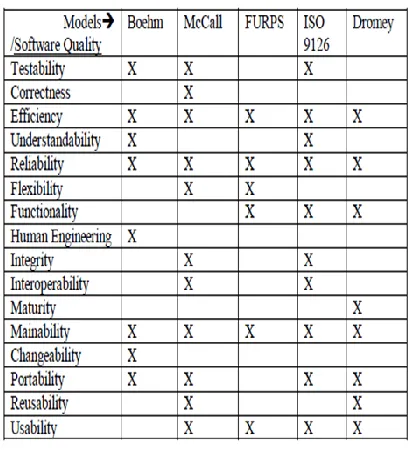
With this tabular design, it becomes easy to observe the models that support a wider range of characteristics in comparison to the ones that support fewer features. so, it can be seen clearly that ISO 9126 and McCall support more characteristics than Boehm, FURPS, and Dromey. Also, we will observe the shared attributes that are supported by most of the models, namely: Efficiency, Reliability, Functionality, Machinability, Portability, and Usability.
Table 1: Quality characteristics in previous models.
7 OVERVIEW ON PREVIOUS STUDIES.
(Baklizi & Alghyaline, 2011) Publish a study about how to evaluate The E-Learning website of Jordan universities based on ISO/IEC 9126 standard, which uses six main characteristics to evaluate software, and each characteristic includes its own sub-characteristics. The results show that the average of quality in E-Leaning websites is 65.45 %. The results reflect the student's opinion about the website and might be use to improve the quality of E-Learning website for those universities. This paper evaluates the quality of E-Learning website for Jordan universities based on ISO/IEC 9126 standard by used the six characteristics: functionality, reliability, usability, efficiency, maintainability, portability, and its
ISO/IEC 9126 a standard software quality . ISO/IEC 9126 usability characteristic has six sub-characteristics i.e. understandability, learnability, operability, attractiveness, and usability compliance. Each characteristic and sub characteristic have metrics to determine the results of the evaluation.. Attributes of software that is used are the feature, interface, message, operation, input, and regulation. Overall results show that it is required an evolution in AIS so that the quality value will be better. The lake of this study is to determine measure the usability characteristic only as evaluation tools based on ISO/IEC 9126, while ISO/IEC 9126 has comprehensive measurement metrics, there are six sub-characteristics, the functionality, efficiency, reliability, usability, portability, and maintenance so the results of this research based on usability characteristics only. Later the same authors Yuhana et.al(2015) made an experimental study to evaluate their proposed quality model which called Academic Information System Quality Instrument (AISQI) which proposed in 2014 . They study the characteristics of portability on Assessment Module of ITS’s Academic Information System (SIAKAD ITS), using Academic Information System Quality Instrument (AISQI) which proposed by Yuhana et.al (2014) to assess the quality of academic Information System as it mentions previously. This study aims to show how the internal metrics of AISQI, particularly portability characteristic can be used to measure the quality of academic Information Systems with case studies of SIAKAD ITS Assessment Module. According to (Xydias-Lobo M. , 2015) There is a relationship between software quality and Quality Information System (QIS) she examines the features of QIS models and frameworks then investigates their applicability to a software development. To build up a QIS model relevant to the software environment it is valuable to investigate what software development firms at present practice, and what their views are in relation to QISs. The study has integrated the relevant characteristics of Agreed theoretical QIS models with those of a recently innovated empirical software development QIS model to derive a refined QIS model for the modern software development firm. However, as (Nyhan , Reifler, Richey, & Freed, 2015) advocates a graphical representation of information reduces misperception. Today’s technological advancements and people’s mindsets make it possible to make decisions based on visual presentation. Users are interested in detailed information and finding up-to-date to make an effective decision. Another study conducted by (Almarabeh, Yousef, & Majdalawi, 2015) to find out the impact of E-Learning management system in the University of Jordan, they survey the students’ acceptance for this new educational system and address the challenges facing the students while using the E-Learning management system. Their study mention that The University of Jordan is trying to use Information and Communication Technology (ICT) in education and moving forward by introducing the latest version of E-Learning management systems (LMSs) to keep with the technological revolution in the higher education. The University of Jordan’s students addressed some of problems; such as lacking self-assurance and experience with the use of computers, lacking skills in commonly used applications, self-motivation, time-management, language problems, privacy, security, and technical problems. This study focuses on the students only, not all the users of this academic system like instructors, developers, and technical employee. (Paredes, 2016) conducted a study to evaluate the software quality
characteristics of Academic Information System (AIS) on mobile application using ISO 9126 criteria in terms of functionality, reliability, usability, efficiency, maintainability, and portability. (Marly & Franco, 2017) Proposed an approach for identifying characteristics and attributes; they suggest looking at the relationship and impact of each characteristic, sub-characteristics and attributes of software in terms of the quality requirement of the users. This technique facilitates the identification of quality attributes by balancing the quality requirement from the users and the capabilities exhibited by software products. (Tabrizi, Tufekci, Gumus, & Cavus, 2017) Have carried out a study at their university to evaluate the usability characterizes which extract from ISO/IEC 9126: Understandability, Learnability, Operability, Attractiveness, and Compliance of the Near East University (NEU) Student Information System (SIS). According to authors, the results will be helpful for the NEU-SIS developer team when considering improvement possibilities for future versions of the system. According to (Gürkut & Nat, 2018) Student Information System (SIS) is one of the key systems for facilitating the management and development of Higher Education Institutions (HEI). Course advisors use the SIS to decide courses that the students will be based on their performance, students use SIS to make online course registration, to check their timetable, exam schedules, exam results and transcript. The results show that System Quality has positive effect on decision-making satisfaction and the Information Quality, which means information accuracy, completeness, and relevance, content needs, and information timeliness, affect the overall satisfaction of the SIS users. Previous research (Bharati & Chaudhury, 2004) cited in (Gürkut & Nat, 2018) show that Information Presentation which means image formats, colors and graphics in contrast to tables, Interfaces and incorrectly designed screens can badly affect users and cause unnecessary work in decision-making . (Al Adwan, 2018) Conduct Ph.D. thesis about Development of E-Learning in the Higher Education Systems in Jordanian universities, his study aimed to assess the abilities of full-time students and faculty members of Two Jordanian Universities to get effectively involved in E-Learning programmers. The study sample included students and faculty members of the English department at the two universities, it was conducted to investigate the technological factors that could influence the involvement of both sides in participating in eLearning programs and explore their attitudes and readiness to integrate ICT into their education.
8 THE NEW QUALITY MODEL.
The starting point for building our model is the ISO/IEC 9126, simply because it includes the common software quality characteristics that are supported by the other five models. ISO/IEC 9126 has four parts, such as ISO/IEC 9126-1, ISO/IEC 9126-2, ISO/IEC 9126-3 and ISO/IEC 9126-4. ISO/IEC 9126 issued by the International Organization for Standardization and International Electro-technical Commission. The next step is to apply some modifying on the ISO 9126 that fits with the evaluation requirements for the new model. The six areas of importance for a software evaluation, as proposed by ISO 9126 as a standard, The following is the discussion of the high-level set of characteristics, along with their associated sub-characteristics.
3827
8.1 Defining the Terminology of New Model.
In order to define a software quality model, which should comprise all the features of AIS systems, the new features of systems should be recognized. Characteristics and sub-characteristics are required to be involved, which can cover the new features of the AIS system including information synchronization, system complexity, and modularity of systems and modules reusability. Redefining existing quality characteristics and sub-characteristics according to end-users, developers and analyst's requirements. Our model categories are matched with appropriate characteristics that each one of the stakeholders is concerned about.
Our new quality model for AIS evaluation, a suggested terminology and matrices rules are presented and concluded in the following:
• Characteristic: is a high-level software quality feature that can be decomposed into sub characteristics.
• Sub-characteristic: is an object that is to be characterized by measuring its attributes.
• Attribute: is an inherent property of a sub-characteristic that can be distinguished quantitatively or qualitatively by human or automated means.
The following are the main characteristics, sub characteristics of new and development features with their respective attributes were used in this study with briefly explain.
1. Functionality: The first software quality characteristic of interest in this study is Functionality, which means is a set of attributes that bear on the existence of a set of functions and their specified properties ( Al rawasdeh & Al matalqa, 2006). The sub characteristics of the functionality characteristic are interopratability, suitability, compliance and security. The following are the sub characteristics of Functionality with their respectively attributes were used in this study:
1.2 Interopratability: Interoperability is the capability of the software product to interact with one or more others systems. The degree to which, a system or one of its components is properly connected to, and operates with something else (Fleming, 2014). Here in the Interoperability attributes will be decomposed into the following:
- Data compatibility: Attribute used for indicating whether the format of the data handled by the Information System (IS) component is compatible with an international standard or convention. A Presence metric indicates this ability and, if so, which standard format is used (e.g. ANSI, ANSI X.12, and XML).
- Platform Compatibility: Attribute used for indicating whether the component is platform-compatibility or not. If so, this means upgrade or replaces their hardware system without having to worry about changing, redesigning or rebuilding their applications.
1.3 Suitability: Which means the capacity of the software product to provide an appropriate set of functions for specified tasks and user objectives here in the Suitability attributes will be decomposed into the following according to (Padayachee, Paula, & Altavan, 2014).
- Application domain: the system achieve its objective that have been designed for teaching.
- Function specification changes: It is the number of changes in the functionality of the system; the change includes the addition of the new features and new services (Olsina, Godoy, Lafuente, & Rossi, 1999).
1.4 Compliance: software Attribute that make the software adhere to application-related standard of conventions or regulations in laws and similar prescriptions (Baklizi & Alghyaline, 2011). According to (Padayachee, Paula, & Altavan, 2014)it means Complies with standards for accessibility of Web content and Complies with instructional Standards for sharing instructional materials with other online learning systems. Here in the Compliance attributes will be decomposed into the following:
- Standardization: This attribute indicate the IS component conformance to international standards or the techniques used to integrate the E-learning into the system, Open System Interconnection (OSI),Transport Control Protocol/Internet Protocol (TCP/IP) are two examples of standard protocols. 1.5 Security: Which can be described as the capability of the software product to protect information and data so that unauthorized persons or systems cannot read or modify them and authorized persons or systems are not denied access to them (Etaati, Sadi-Nezhad, & Makue, 2011) and ( Al rawasdeh & Al matalqa, 2006) and (ISO/IEC TR, 9126-3, 2003). Herein we believe that Security attributes can be decomposed into: - Privacy: the personal information, which has been kept, on the system not share database with anyone else without permission (ISO 27001 Information Security Standards). - Authentication: which means that the origin of message or transaction is correctly identified and the originator is who they claim to be (ISO/IEC TR, 9126-3, 2003).
Identification and authentication of staff and students where username and
Fig 2: functionality in new model.
2. 2 Reliability: The second software quality characteristic in this study is reliability, which mean the capability of the software product to maintain a specified level of performance when used under specified conditions (Al-Adwan, 2017). The capability of the software product to be modified to make corrections, improvements or adaptations of the software to change in their requirements and functional specifications (Baklizi & Alghyaline, 2011) and (Padayachee, Paula, & Altavan, 2014).
Figure 3: Reliability in new model
2.1 The Recoverability: The ability of software to re-establish a specified level of performance and recover the data directly affected in the case of failure (Paredes J. L., 2016). It tries to measure whether the module of system is able to recover from unexpected failures, and how it implements these recovery mechanisms.
- Time to recover: the time needed to recover the data in the case of failure and resuming work soon after a failure (Padayachee I. K., 2010).
- Error Reporting: The system provide the users with tracking, notification and reporting errors occurs.
2.2 Availability: is the probability that a system will work as required when required during the period of a mission, with high loading and high transaction speed.
- Planned Downtime: is the time for scheduled maintenance and upgrade during which a system cannot be used for normal productive operations (Techopedia Inc, 2019).
2.3 Maturity: sub-characteristic is measured in terms of the number of commercial versions and the time interval between
them; it means the capability of the software product to avoid failure caused by software defects ( Al rawasdeh & Al matalqa, 2006) and (ISO9126/IEC, 2001).
-Fault Tolerance: The capability of the system to maintain a specified level of performance in case of E-learning system faults or of violation of its specified interface (Etaati, Sadi-Nezhad, & Makue, 2011).
- Evolvability: The number of versions that have been marketed for a given system component may provide an indication about the product maturity, and how it has evolved from its first version.
3. Usability: The capability of the software product to be easy to learn, easy to understand , when used under specified conditions (Mall, Prasant, & Pattnaika, 2014) .
Different software quality models (i.e. IEEE, Boehm, McCall and ISO 9126) provide variety sub characteristics of usability (Seffah et al., 2001). For example, according to ISO (2001) and Seffah et al. (2001) the sub characteristics of the usability characteristic are understandability, learnability, operability and attractiveness, we replace user interface instead of
attractiveness.
The following are the sub characteristics of usability with their respectively attributes were used in this study.
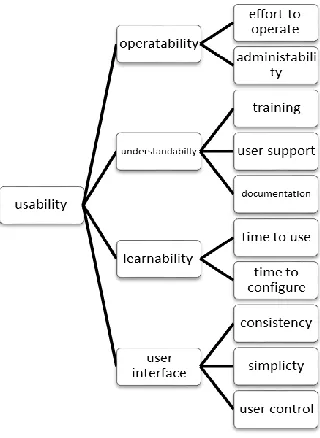
Figure 4: Usability in new model
3.1 Opreatability: The capability of the system to enable the user to operate and control it (Al-Adwan, 2017) , or the ease of operating a program. Here in the Operability attributes will be decomposed into the following:
- Effort to operate: Attribute indicates the level of effort needed to properly operate the system component (ISO9126/IEC, 2001) and (Padayachee I. K., 2010).
- Administrability: Attribute indicates the level of effort needed to properly administer the system component (Sanga, 2010) and (Etaati, Sadi-Nezhad, & Makue, 2011).
3829
understood first. Thus, under these characteristics we have grouped those attributes that facilitate the understandability of a component, and therefore influence its Learnability. Here in the Understandability attributes will be decomposed into the following:
- Training : Attribute is measured by a Presence metric that indicates whether training course are available for the system component, and information about them if this is the case. - User support: Ease at which the interface of the software is supportive to fulfill the intended aim/goal and there is enough information on the screen when it is needed (Sanga, 2010). - Documentation: Here in this study we measure the computer documentation not user documentation, which means whether the component provides any kind of documentation that can be used by component tools for understanding its services or the ease at which the technicality of the system software is explained in the manual (e.g. UML, ERM, DFD, etc).
3.3 learnability. The capability of the software product to enable the user to learn its application (ISO9126/IEC, 2001). Learnability requires attention to the needs of the beginner and uninitiated users that has no previous experience with the software or similar software. There is a set of attributes that try to measure the time needed to learn the system, such as usage or configuration. Here in, Learnability attributes will be decomposed into the following according to ISO9126 (Rochimah, Rahmani, & Yuhana, 2015).
- Time to Use: Attribute measures the average time needed for a user to learn how to correctly use the AIS component. - Time to Configure: Attribute measures the Average time needed for a developer to learn how to correctly configure the component, and for properly understanding its configuration parameters.
3.4 User Interface: In academic Information Systems, most stakeholders are the application developers that have to build application systems, and end-users who interact with like instructors, students, and employee. Thus, the Usability of a component should be interpreted as its ability to be used by the application developer and designer when constructing a new software product ( Al rawasdeh & Al matalqa, 2006).Under this characteristic, we add a new character user interface that measures the component’s Usability during operate of the system, from the end users perspective.
User interface is new sub character added to our new model with three attributes (consistency, simplicity) this characteristic aims to measure the user satisfaction of using and integrating the component into the final system.
User Interface (UI) is an essential part of interactive systems that directly connected to end user to access the functionalities of a system; users use a small portion of the offered functionality and usability. Major part goes underutilized due to poor UI. Furthermore, the UI element usage are differ among different users; Input/output capabilities, interaction modalities, mark-up languages, user-working environments, and contextual variability ( Hussain, et al., 2018).
(Sanga, 2010) Declared in her thesis that user interface "refers to the uniformity of the user interface in conveying the intended meaning which means interactions between users and software throw the screen (color, graph, and link)". Here the sub attributes of User Interface in this study.
- Consistency: Such as using the same terminology across the application or system interface , using a similar color theming throughout, or displaying system messages to the user in
identical fashion in different cases, in other words Consistent user interface and system metaphor for all tools (Saarijärvi, 2017). (Shawgi & Noureldien, 2015) develop a conceptual model that measure usability of web based Information System, the Usability Measurement Model (UMM) is built on the advantages and strength of usability models.
- Simplicity: software is easy to use with a simple interface. Helping the users achieve their goals faster and more efficiently, all while enjoying a great user experience, if the system design has too much extraneous information, users will have trouble navigating the system (Yuhana, Saptarini, & Rochimah, 20l5) and (Sanga, 2010).
4. Efficiency: The fourth software quality characteristic in this study is Efficiency the capability of the software product to provide appropriate performance, relative to the amount of resources used, under stated conditions. Efficiency is the degree to which something effectively uses its resources (Xydias-Lobo M. , 2015). These may include all resources such as computing software, hardware, and network.
In fact, Efficiency will used in our new model as it is described in the ISO9162
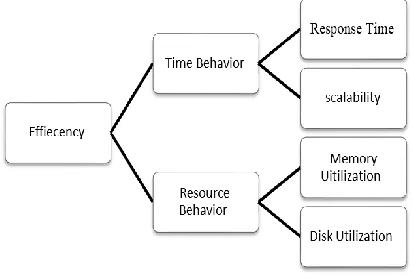
Figure 5: Efficiency in new model
4.1 Time Behavior: Which can be described as the capability of the software product to provide appropriate response and processing time and throughput rates when performing its function (ISO/IEC 9126-1, 2001) .Here in we believe that Time Behavior attributes can be decomposed into:
- Response Time: This attribute can be associated to any of the methods implemented in any of the system interfaces, and measures the time taken since a request is received until a response has been sent.
- Scalability: the ease of system software to support the incremental growth of data volumes from user as well as modify to expand its capabilities. Also regardless of the data growth, the software must be efficiency (i.e. processing capacity).
4.2 Resource Behavior: Which can be described as the capability of the system product to use appropriate amounts and types of resources when the system perform its function under stated condition (ISO/IEC 9126-1, 2001). Here in we believe that Resource Behavior attributes can be decomposed into:
5.Maintainability: is the capability of the software product to be modified. Modifications may include corrections, improvements or adaptations of the software to change in an environment, in requirements and in functional specifications (ISO/IEC 9126-1, 2001) .
In addition, a set of attributes that bear on the effort needed to make specified modifications, the degree of changing or modifying the components to correct errors, to improve performance, or to adapt for changing the environment (ISO/IEC TR, 9126-3, 2003) .
The user of a component (i.e. the developer) does not need to do the internal modifications but he does need to adapt it, re-configure it, and perform the testing, self-testing before installation and test site(e.g. performance) of the component before it can be included in the final product. Thus, Stability and Analyzability are deleted from our model.
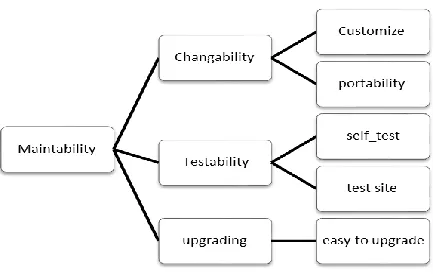
Figure 6: Maintainability in new model
Here are sub characteristics with their attributes of main character maintability.
5.1 Changeability: The attributes of software that bear on the effort needed for modification, fault removal or for environment change (ISO/IEC TR, 9126-3, 2003). Herein the Changeability attributes will be decomposed into the following:
- Customizability: This attribute given us an indication of its ability to be customized. Thus, a component with very few interfaces and many parameters will probably be very customizable. On the other hand, a component with many interfaces but very few parameters does not offer a high degree of customizability.
- Portability: Portability is the capability of the software product to be transferred from one environment to another (Alrawashdeh, Muhairat, & Ahmad, 2013) and (Fleming, 2014). In addition, the effort required transferring a program from one hardware configuration and/or software system environment to another. Portability is the ease with which an application or component can be moved from one environment to another (Yuhana, Saptarini, & Rochimah, 20l5). In Academic System, it is important to note that in E-Learning systems re-use means not only to use more than once, but also to be reused in different environments. Thus, Portability is not a main character its sub character here.
5.2 Testability: Testability is the ease with which an application or component facilitates the creation and execution of successful tests (i.e. tests that would cause failures due to any underlying defects. Here in the Testability attributes will be two kinds of tests:
- Self Test: This mean the behavior of software to test itself
before installation. Automatic tests performed by a device test upon itself when switched on, to detect any malfunction, a missing component, or a change in its configuration. In case of a problem, the device displays an error message to indicate what has happened and what the user must do to rectify it. Also called auto test or self-check (Sanga, 2010). - Test Site: Attribute indicates whether some test suites are provided for checking the functionality of the component or for measuring some of its properties (e.g. performance).
- Up Grading: Easy to upgrade refers to easiness of the software to be upgraded to a new version of the free and open source software (E-learning system) (Sanga, 2010).
In Information Systems, an upgrade is generally a
replacement of hardware, software or firmware with a newer or better version, in order to bring the system up to date or to improve its characteristics (Upgrade, 2019).
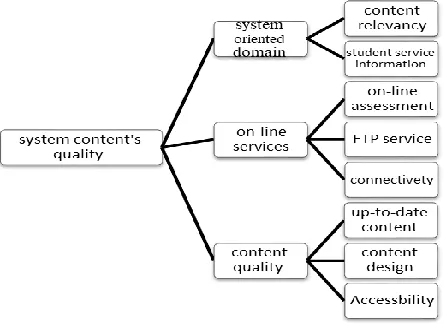
6. System Content's Quality: In order to empower our model with new feature, the characteristic System content has been added. System content is concerned with developing and refining the content of Academic system that must be sufficient, relevant, useful, and up-to date content.
(Etaati, Sadi-Nezhad, & Makue, 2011) As mention previously in related work section. They evaluated some e-learning system by considering ISO 9126 attributes and of e-learning success factors from other researches, before they build their own new model they studying e-learning literature. After this, by comparing E-learning success factors with quality attributes in ISO9126 the attributes that do not exist in this model they added in our model. Their model consist of learning community, system content and personalization of Wang model. System content has the sub attributes up-to-date, sufficient and useful content. (Wang,2003) cited in (Etaati, Sadi-Nezhad, & Makue, 2011) contends that "specifying the domain of the construct, generating items that exhaust the domain, and subsequently purifying the resulting scale should create a measure which is content or face valid and reliable." Therefore, the procedures used in conceptualizing the E-learning System (ELS) construct, generating items, and purifying the ELS measures suggest that the ELS instrument has strong content quality. Wang (2003) identified four main character and twelve sub-character for them to evaluate E-learning system, many researchers depend on Wang's model and success factors. In addition, in 2008 he proposed an AHP as a good evaluation method to evaluate this success factor. Table 5 illustrate these criteria with their sub criteria.
Table 5 : Wang's E-learning factors.
Main criteria sub-criteria
Learning interface Ease of user, user friendly, ease of understanding Operational stability. Learner community Ease of discussion with other student,
teacher and sharing data.
System content Up-to-date content, sufficient content, useful content.
Personalization capability of controlling and recording learning performance and process.
3831
usability in ISO/IEC 9126 standard, ease of use, user friendly, operational stability and ease of understanding (Nezhad, Etaati, & Makue, 2010). For evaluating E-learning system many factors must be considered during the assessment process, which affect such system in addition, the E-learning system interface and all transaction depend on web tecchnology.so the quality of E-learning system related to the quality of web pages and web services (Behkamal, Kahani, & Akbari, 2009) . Moreover, there are several studies discuss and investigate the E-learning success factors (Colace et al, 2006; Chao and Chen, 2009; Tzeng et al.2005) which are Cited in (Etaati, Sadi-Nezhad, & Makue, 2011).
( Uppal, Ali , & Gulliver, 2018) .Also declare that Content quality factors identified in their studies were thematically grouped, and cited in their studies. They considered the following concept groups: presentation style and content structure (Teo & Gay, 2006), level and type of interactivity (Siau, Sheng, & Nah, 2006), language and communication (Akinyemi, 2002; Hollins & Foley, 2013) and delivery mode (Gulliver & Kent, 2013). In this study, we construct the new quality software model by considering both ISO 9162 attributes and of E-learning characteristics from previous study. Then we asked some experts in field of E-learning and other Academic systems to judge about these factors and assign weights to them. To empower our model we added new characterizes, System Content's Quality with four sub-characterizes system domain, on-line services, and content quality with their attributes to measure these sub-characteristic. Content quality related to the quality of a system used to present and lay out information and the presence of technical attributes that affect student perception of system platform with on-line service quality. This new characteristic with their new attributes added to ISO software quality model in order to evaluate E-learning system as a target system of Academic Information System.
Figure 7: System content quality in new model
The following are the sub characteristics of System Content Quality with their respectively attributes were used as a contribution in this study.
6.1 Student Oriented Domain: Academic System services geared specifically to the student, to serve the students in their all-academic activities during their study years.
- Content relevancy: (Alkhattabi, Neagu, & Cullen, 2010) they define accessibility character as the quality aspects concerned into accessing distributed information. Measure by sub attributes relevancy, response time and availability they
consider relevancy as sub attributes of accessibility. In our model means, the system has a relevance content that enables the students or instructor to be informed correctly to their right information extracted from another system such as enrollment, academic degrees, and researches.
- Student services Information: this mean that the system provide students with academic and services information like, housing, healthcare, scholarships…etc., which means the system, integrates with other systems.
6.2 On-Line Services: refers to any information and services provided over the Internet. This system provides on-line service, for instance enrollment, grades, fees, web services such as ftp, news group, chatting, assessment…etc.
- On-Line Assessment: the system has A grading service for e_Exams and assignments, which provide the grade immediately to students and instructors after finish attempt, the survey can be embedded in course contents by the instructor to get students opinions toward the course or anything the instructors need.
- FTP Service: end users can sending and receiving files across the E-Learning system (download and upload) easily. Students are expected to download course materials from dedicated course web sites; access course-management systems, such as WebCT and Blackboard; and make presentations using PowerPoint ( Uppal, Ali , & Gulliver, 2018) .
- Connectivity: the students connect with the instructors easily with communication tools provide by the system forums, chat, and e-mail.
6.3 Content Quality: ( Uppal, Ali , & Gulliver, 2018) introduce ―Learning content‖ as information and ―Course website‖ as system constructs. In the current work, ―Learning content‖ refers to accessible and accurate learning material provided to students in timely manner as up to date content in our new model.
(Hein, 2014) , also declare the content of E-Learning system relevant to the learning objectives, succinct and design. - Up-to-Date Content: This website is regularly updated in terms of semester and course information in order to keep their academic material up-to-date.
- Content Design: Significant factors impacting perceived content quality, were grouped and cited by (Etaati, Sadi-Nezhad, & Makue, 2011) as relating to: interface design (Cho, Cheng, & Lai, 2009), navigation ( Volery & Lord, 2000), attractiveness ( Lin, 2010) and ease of use (Selim, 2007). Students can access class notes, handouts on course web sites without assistance, assuming the course web sites are designed to be accessible, and the students have access to information and computer communication technologies. (Cidral, Oliveira, Di Felice, & Aparicio, 2018).
The content design in our model means the elements organize in an attractive and consistent way, and the system provides the end users with multimedia elements such as videos, presentations, and eBooks on the courses directly, without having to search the web for multimedia that relates to the content.
-Accessibility: (Alkhattabi, Neagu, & Cullen, 2010) proposed a new quality framework to measure the quality of the content provided by e-learning systems they define accessibility character as the quality aspects concerned into accessing distributed information, and measure by sub attributes relevancy ,response time and availability.
system, end users and developers can easily access to their account on E-earning through many any Devices like pc, laptop, tablet and Mobile phone and they can access website most of the time.
At last, our final model consist of six main characterizes with nineteen sub-character, supported with related attributes must be tested and evaluate.
Table 4: Quality software for new Model for AIS Components
Goal (Level-0)
Characteristics (Level-1)
SubCharacteristics (Level-2)
Attributes (Level-3)
Choosing The Best Academic
System
Functionality Interoperability Platform- Compatibility Data compatibility Suitability Application-
Domain Function specification changes. Compliance Standardization Security Privacy
Authentication Reliability Recoverability Time to recover.
Error reporting. Availability Planned Down
Time
Maturity Fault Tolerance Evolvability. Usability Opreatability Effort for
Operating Administrability Understandability Documentation
Training User Support Learnability Time to Use
Time-to- Configure. User Interface Consistency
Simplicity User control Efficiency Time behavior Response Time
Scalability Resource behavior Memory-
utilization. Disk utilization. Maintainability Changeability Customizability.
Portability. Testability Self-test.
Test Site. Upgrading Easy to upgrade System content
quality.
System oriented domain
Content relevancy Student service information On-line services On-line
assessment. Ftp service. Connectively. Content quality Up to date
content. Content design. Accessibility.
9 CONCLUSIONS:
The study building the quality concepts related to improving the quality of higher education system, including the quality of course contents in E-learning System for students, and teachers. In addition, the research also explains the different types of models in software quality. Then build a standard approach that measures and evaluates the quality of the AIS
in universities, which mix several software quality standards to assist system analysts, system developers, and system programmers in their AIS projects. All universities can benefit from this novel model to construct their own E-learning system that meets all the qualities and conditions recommended in this research and becomes a measure of the efficiency their systems, besides they will save their time and efforts in selecting high-efficiency software to support the Information Systems within their high education sector.
10 FUTURE WORK
later this new model will be evaluate on a case study using questionnaires will aiming to reveal students’ opinions about the importance of attribute's quality in the E-learning system in Jordan universities. The data will be collect by (AHP ) questionnaires was further analyzed and comparisons, by the Analysis of pairwise compassion between criteria and alternatives using standards AHP approach, then Fuzzy membership function to get the best alternative .
REFERENCES
[1] Al rawasdeh, A., & Al matalqa, B. (2006). a new software quality model for evaluating COTS components. journal of computer science 2(4),373-381.
[2] Al Adwan, A. S. (2017). Development of E_learning in the Higher Education Systems. German: Deutsh Nationalbibliothek. [3] Al Adwan, A. S. (2018). Development of E_learning in the
Higher Education Systems. German: Deutsh Nationalbibliothek. [4] Almarabeh, T. (2014). Students’ perceptions of e-learning at the
University of Jordan. International Journal of Emerging Technologies in Emerging Technologies in Elearning.
[5] Almarabeh, T., & Mohammad, H. (2013). E-learning in the Jordanian higher education system: strengths, weakness, opportunities, and threats. Journal of American Science, 9(3), 281- 287.
[6] Journal of American Science, 9(3) 281-287.
[7] Almarabeh, T., yousef, R., & Majdalawi, Y. (2015). The university of Jordan e-learning platform: state, students’acceptance and challenges. (Vols. 7, 999- 1007). Journal of Software Engineering and Applications,.
[8] Alrawashdeh, T. A., Muhairat, M. I., & Alqatawneh, S. M. (2014). Quantitative Evaluation of ERP Systems Quality Model. In Information Technology: New Generations (ITNG) (pp. 46-49A). IEEE 11th International Conference.
[9] Alrawashdeh, T. A., Muhairat, M., & Ahmad, A. (2013). Evaluating the Quality of Software in ERP Systems Using the ISO 9126 Model. International Journal of Ambient Systems and Applications (IJASA), 1-9.
[10]Amal, A., Weam, A., & Azrilah, A. (2017). Total Quality Management for Software Development. International Journal of Computer Applications.
[11]Ansar, D., Khalifa, M., & Mohammed, Q. (2018). Information System Evaluation based on Multi Criteria decision Making:comprsion of two sectors. nternational Journal of Advanced Computer Science and Applications(IJACSA), Vol. 9. [12]Baklizi, M., & Alghyaline, S. (2011). Evaluation of E-Learning
websites in Jordan universities based on ISO/IEC 9126 standard. IEEE 3rd International Conference (pp. 71-73). IEEE,In Communication Software and Networks (ICCSN). [13]Boehm, B. W., brown, J. R., & Lipw, M. (1976). quality evaluation
3833
http://portal.acm.org.
[14]Etaati, L., Sadi-Nezhad, S., & Makue, A. (2011). Using fuzzy group analytical network process and ISO 9126 quality model in software selection: A case study in e-learning systems. Journal of Applied Sciences. Journal of Applied Sciences, 11 (1), 96-103. doi:10.3923/jas.2011.96.103
[15]Fleming, I. (2014). ISO 9126 Software Quality Characteristics. Retrieved from www.SQA.net: http://www.sqa.net/iso9126.html. [16]Franco, E. F., Hirama, K., & Carvalho, M. M. (2017, August 26).
Applying system dynamics approach in software and information system projects. ScienceDirect Information and Software Technology journal, pp. 58-73.
[17]Gade D. (2013). the quality of software. Industrial and Management Systems Engineering -- Dissertations and Student Research.
[18]Gürkut, C., & Nat, M. (2018). Important Factors Affecting Student Information System Quality and Satisfaction. EURASIA Journal of Mathematics, Science and Technology Education , ISSN:1305-8223.
[19]Indrayani, E. (2013). Management of Academic Information System (AIS) at Higher Education in The City Of Bandung. 13th International Educational Technology Conference (pp. 628-636). ELESIVER.
[20]ISO/IEC 9126-1. (2001). Retrieved from Institute of Electrical and Electronics Engineering, Part 1,2,3: Quality Model: http://www.iso.ch
[21]ISO/IEC TR, 9126-3. (2003). Software Engineering – Product Quality – Part3:International Organization for Standardization. Retrieved 2003, from https://www.iso.org/standard/22891.html [22]Komka, J. (2010). Information System of University: Goals and
Problems. Daunoravicius Vilnius Gediminas Technical University.
[23]Lupu, A. R., Bologa, R., Sabau, G., & Muntean, M. (2008). Integrated Information Systems in Higher Education. WSEAS Transactions on Computers, 7(5), 473-482.
[24]Padayachee, i., Paula, K., & Altavan, D. (2010). "ISO 9126 external systems quality characteristics, sub-characteristics and domain specific criteria for evaluating e-Learning systems. university of south africa.
[25]Paredes, J. L. (2016). Evaluation of Software Quality Characteristics of Academic Information System Mobile Application. International Journal of Scientific and Research Publications, 6(11 ).
[26]Puchola, b., Sanchez, F., & Joan, A. (2017). Towards an Unified Information Systems Reference Model for Higher Education Institutions. International Confrence On ENTERprise Information System/ProjMAN. Barcelona, Spain: ELSEVIER. Retrieved from www.sciencedirect.com
[27]Rawashdeh , A. A., & Matalkah, B. M. ( 2007). Enhancing A COTS Software Quality Model With New Attributes. Mu’tah Lil-Buhuth wad-Dirasat No. 2, 22.
[28]Rochimah, S., Rahmani, I., & Yuhana, u. (2015). Usability Characteristic Evaluation On Administration Module of Academic Information System Using ISO/IEC 9126 Quality Model. International Seminar on Intelligent Technology and Its Application, 361-366.
[29]Sanga, C. (2010). A technique for the evaluation of free and open source e-learning systems (Doctoral dissertation, University of the Western Cape).
[30]Suman, & Manoj , W. (2014). A Comparative Study of Software Quality Models. Suman et al, / (IJCSIT) International Journal of Computer Science and Information Technologies, Vol. 5 (4). [31]Tabrizi, S. S., Tufekci, C., Gumus, O., & Cavus, A. (2017).
Usability Evaluation for Near East University Student Information System. New Trends and Issues Proceedings on Humanities and Social Sciences [Online]., pp 235-243.
[32]Tate, J. (2003). Software Process Quality Models: A comparative evaluation(doctoral dissertation,Durham University).
[33]Uppal ،.M.A, Ali. .A ,R . Gulliver )2018 ( .Factors determining e‐learning service quality .British Journal of Educational Technology, 412-426.(3)
[34]Xydias-Lobo, M. (2015). The Role and Attributes of Quality Information Systems (QISs) in the Management of Quality in Software Development Companies in Australia.
[35]Yuhana, u., Rahardjo, A., & Rochimah, S. (2014). Academic Information System Quality Measurement using Quality Instrument. A Proposed Model, Proceeding of International Conference on Data and Software Engineering (pp. 231-236). Indonesia: ICoDSE.