Is extracting data the same as possessing data?
Douglas R. Stinson∗ and Jalaj Upadhyay David R. Cheriton School of Computer Science
University of Waterloo, Waterloo, Ontario, N2L 3G1, Canada
September 22, 2013
Abstract
Proof-of-retrievability schemes have been a topic of considerable recent interest. In these schemes, a clientCgives a fileM to a serverSwith the understanding thatSwill securely store M. A suitable challenge-response protocol is invoked by C in order for C to gain confidence that M is indeed being correctly stored by S. The definition of proof-of-retrievability schemes is based on the notion of an extractor E that can recover the file once the challenge-response protocol is executed a sufficient number of times.
In this paper, we propose a new type of scheme that we term a proof-of-data-observability scheme. Our definition tries to capture the stronger requirement thatS must have an actual copy of M in its memory space while it executes the challenge-response protocol. We give some examples of schemes that satisfy this new security definition. As well, we analyze the efficiency and security of the protocols we present, and we prove some necessary conditions for the existence of these kinds of protocols.
1
Introduction
There has been considerable recent interest in proof-of retrievability and proof-of-data-possession schemes for cloud storage [1, 3, 4, 8, 11, 13]. We begin by briefly introducing these schemes. Suppose a clientC gives a fileM (also called a message) to a serverS(e.g., a cloud storage service provider) with the understanding that S will securely store M. A suitable challenge-response protocol is invoked byCin order forCto gain confidence thatM is indeed being correctly stored byS, without actually requiring S to transmit the entire file to C. The server constructs a proving algorithm P
that it uses to respond toC’s challenges. The success probability ofP, denotedsucc(P), is defined to be the probability thatP gives a correct response to a random challenge. We consider the server
Salong with the proving algorithmP (which is constructed byS) to comprise theadversary in one of these schemes.
Suppose that the message M = (M1, . . . , Mm), where M1, . . . , Mm are the message blocks.
Typical challenge-response protocols require S to supply a certain subset of the message blocks (e.g., [8, 11]), or to compute a specified linear combination of a subset of the message blocks (e.g., [13]). In these example schemes, the challenge would specify the message blocks and (if required) the exact linear combination that the server is required to compute. Note that C might store the file M (in this case it can verify the response of S by performing the same computation as S).
∗
Alternatively, C might have precomputed and stored one or more responses (in this case it would not be necessary for C to store M). Finally, C might have a “key”, which is smaller than the file, but which still can be used to verify responses.
In a proof-of-retrieval scheme(POR scheme) (e.g., [8]), it is required that there should exist an
extractorE with the property that it can recoverM, givenP, wheneversucc(P) is sufficiently high. In general,E will perform the following operations:
• E is given read access to the code describing P,
• E is allowed to run P on challenges that are chosen by E,
• E can perform additional computations, and
• E should compute and correctly output the entire file M.
The effectiveness of an extractor E for a POR scheme is usually quantified as follows. Let 0 < δ ≤ 1 and let 0 < ≤ 1. We say that E is a (δ, )-extractor provided that the success probability of E is at least whenever succ(P)≥δ. Recall that succ(P) is the probability thatP
gives the correct response to a random challenge; the success probability of E is the probability that it is able to extract the entire fileM correctly. The success probability ofE takes into account any random choices it makes during its execution.
POR schemes can be analyzed in the setting of computational security [1, 3, 4, 8, 13] or uncon-ditional security [4, 11]. In the setting of computational security,E,SandP would be modelled as polynomial-time probabilistic Turing machines. In the setting of unconditional security, we would not place any restrictions on the computations that E,S andP are allowed to perform.
The idea of aproof-of-data-possession scheme(PDPscheme) is also found in the literature, e.g., a formal definition can be found in [1, Definition 4.2]. This definition also requires an extractorEto actually recover or restore the data whose “possession” is guaranteed by the responses received by
Cwhen the challenge-response protocol is carried out. Furthermore, in [1], it is explicitly permitted forSto store the file in altered form (e.g., using some form of lossless data compression). Thus, it seems in the literature that there is little or no fundamental difference between aPORscheme and a PDPscheme.
Our main goal is to separate the notions of retrievability and possession. (Before proceeding further, we note that all the results presented in this paper are in the standard client-server model in which proof-of-retrievability schemes and proof-of-data-possession schemes have been studied.) To make a distinction between retrievability and possession, it is helpful to ask what it means conceptually or philosophically for S to actually “possess” data. We might argue that possessing data should mean thatShas anexact copy of the fileM in its storage at some given time. However, it would be difficult to force S to do this, because (as mentioned above) S can store M in some altered form, e.g., involving encryption or (lossless) compression. However, it is conceivable that the challenge-response protocol P might necessitate the reconstruction of M, in the sense that a response cannot be generated without first restoring M to its initial form. In this case, an exact copy of M would exist in the memory space of S at the time the response to the challenge is computed, and we could say that theS “possesses” the data at this point in time.
1.1 Formal Definitions for Proof-of-data-observability
M in its memory space during the execution of P. To formalize this stronger security notion, we consider anobserverO, who has considerably less power thanE. Ois permitted to do the following:
• O is given read access to the code describingP,
• Ois allowed to observe asingle runof the challenge-response protocol with arandomchallenge supplied byC,
• O can perform additional computations, and
• O should copy the correct file M from the contents of S’s memory space to an output tape, at some time during the execution ofP.
Intuitively, this definition is trying to capture the idea that it is possible to take a “snapshot” of
S’s memory space (at an appropriate time) that precisely contains the file M.
For a PDO scheme, we have a somewhat different objective than we did for a PORscheme. As before, let 0< δ≤1 and let 0< ≤1. We say that an observerOis a (δ, )-observerprovided that the expected fraction of M that O copies is at least whenever succ(P)≥δ. That is, on average,
Ois able to copy at least nbits ofM, whereM isnbits in length. This average is computed over the random challenge chosen by C, as well as any random choices O makes during its execution.
It is important to emphasize thatOwatches a single run of the challenge-response protocol that is being executed with a random challenge that is chosen byC (i.e., the challenge isnotchosen by
O). Based on O’s knowledge of the how the proving algorithmP works,O is able to recognize the presence of the file M in the memory space of SasP is executed, and copyM to its output tape.
Remark 1. It is most useful to think of E and O as conceptual entities employed in the security proof. They are not normally used in the standard operation of aPORorPDOscheme (respectively).
It is reasonable to ask why this new notion of observability might be preferable in practice to the standard notion of retrievability. One of the motivations of cloud computing is to outsource computations to the cloud. In general, performing some computation on data stored at a remote serverSwill be possible only if Shas the actual data M in hand. The notion of retrievability does not guarantee that the actual file is readily available. This is because the operations performed by the extractor E may be very complicated (even if they are required to be polynomial-time operations). We would argue that a PDOscheme provides a better guarantee than a PORscheme that the fileM is “available” at a given point in time.
Suppose that an n-bit file M consists of m message blocks, and assume that a response in a challenge-response protocol depends on a random subset of m0 message blocks chosen by C. For
δ >0, the best observer we could hope for would be a (δ, m0/m)-observer, because a single run ofP
only requires performing a computation onm0n/mbits of the file M. On the other hand, a trivial example of a PDO scheme that has a (1,1)-observer would be one in whichS must give the entire fileM toC.
1.2 A Basic PDO Scheme
defined in [2], where h is regarded as a function that takes a binary string of arbitrary length as input and produces a completely randomd-bit output. We call this output the message digest or
hash value. An important property of random oracles is that any hash value h(x) is completely independent of all the other hash valuesh(x0),x0 6=x. This fact is used either implicitly or explicitly in our analyses of the protocols we discuss.
Here is some intuition regarding the schemes we analyze. Because h is a random oracle, the only way to compute h(M k c) is to supply h with all the bits in M and c. However, a possible complication is that a response h(M k c) could be precomputed ahead of time, instead of being computed online during the execution of the proving algorithm P. Nevertheless, if we upper-bound the number of oracle accesses that are permitted in the pre-computation stage, then we can upper-bound the number of precomputed responses that P can utilize. If P is required to have a sufficiently high success probability and c is chosen from a large enough challenge space, then it must be the case that, with high probability, h(M kc) will be computed online duringP’s execution. In this case, the file M is necessarily stored in S’s memory space immediately prior to the call h(M k c) that is made to the random oracle h. Therefore we will have a PDO scheme, according to our definition given above.
We note that we are not placing any restrictions on the computations performed byP orS. That is, we analyze our schemes in the setting of unconditional security. However, we will be bounding the storage available toSand/or the number of calls to the random oracle thatS orP are allowed to make. Basically, it is impossible to prove anything meaningful without some restrictions of this type: ifS can precompute and store the responses to all possible challenges, then it does not need to store the fileM at all. In this case, the challenge-response protocol cannot serve to provide any guarantee at all to C. When we consider “reasonable” parameters for our schemes, we will allow large number of accesses to the random oracle, e.g., 260 or 280, which would make the resulting security guarantees meaningful and believable.
1.3 PDO is a Stronger Notion than POR and PDP
We describe a simple example of aPOR/PDPscheme that is not aPDOscheme. Suppose a message
M = (M1, . . . , Mm), whereFq is a finite field andMi ∈Fq for 1≤i≤m. A challenge consists of a
random vectorc= (c1, . . . , cm)∈(Fq)m and the corresponding response isr =c·M ∈Fq. This is
easily seen to be a PORscheme (e.g., see [11]). However, there exists P that can generate correct responses to challenges without explicitly storing or performing computations on the original file
M; the existence of thisP shows that we do not have a PDO scheme. WhenS is originally given the file M, it chooses a random γ ∈ Fq such that γ = 1. Then6 S computes M0 = γM. M0 and
γ are stored and M is discarded. Later, when P receives a challengec, it computes the (correct) responser =γ−1(c·M0). This computation does not useM, so no observer can obtain M simply by observing the online computations ofP.
1.4 Our Contributions
In Section 2, as a warm-up, we analyze our basic hash-based challenge-reponse scheme when the server Sstores part of the file M along with some number of precomputed responses. We analyze the associated proving algorithmP and show, under reasonable assumptions regarding the storage available toS, that this scheme is indeed a practical PDO scheme.
In Section 3, we consider a more general adversarial situation, whereSandP are only restricted in the number of accesses to the random oracle that they can make. Here we show that the scheme is still aPDOscheme in this stronger adversarial setting, and we provide a concrete bound forδ as a function of.
The schemes in Section 2 and Section 3 require hashing the entire file every time a response is computed. This may not be desirable. Therefore, in Section 4, we consider observers who are allowed to watchσ >1 executions of the challenge-response protocol, obtaining part of the file each time the protocol is run. This permits schemes where responses can be computed more efficiently. In this section, we study another simple protocol and analyze its properties as a PDO scheme.
1.5 Previous Work on POR/PDP and Related Concepts
In recent literature, there has been a considerable amount of work on various notions related to proof-of-storage on a cloud. All this research involves a client C who wants to verify whether S is storing its file properly or not. Here are a few papers on this general topic. Naor and Rothblum [10] studied primitives calledmemory checking and sublinear authenticatorsand gave lower bounds on the efficiency of these systems in Yao’s simultaneous message model [14]. Juels and Kaliski [8] and Ateniese et al. [1] independently introduced the concept of of-retrievability and proof-of-data-possession, respectively. Ateniese et al.[1] also introduced the idea of using homomorphic authenticators to reduce the communication complexity of the system. Shacham and Waters [13] showed that the scheme of Atenieseet al. can be transformed to aPORscheme by constructing an extractor that extracts the file from the responses of the server to the challenges. Bowers, Juels, and Oprea [3] used error-correcting codes, in particular the idea of an “outer” and an “inner” code (in much the same vein as concatenated codes), to get a good balance between the server storage overhead and computational overhead in responding to the audits. Dodis, Vadhan and Wichs [4] used hardness amplification and error-correcting codes to propose a more efficient POR scheme, with extraction performed through list decoding and an almost-universal hash function. Paterson, Stinson and Upadhyay [11] studied POR schemes in the setting of unconditional security, as well as their connections to error-correcting codes.
A related line of research investigates the question ofstorage enforcement, wherein, if the server passes the challenge-response protocol, then the client is assured that the server has allotted the amount of storage that it committed to the client. This problem is studied, for example, in [5, 6, 7]. In these types of schemes, the prover does not prove directly that it is storing the actual file, but it proves that it is has allotted sufficient resources to do so.
2
Analysis of the Basic
PDO
Scheme
Figure 1: Basic Random Oracle PDO scheme
Initialization: The client C and the server S are given access to a random oracle h that maps an arbitrary length input to a d-bit output. C gives a file M to S, where the length of M is n bits. S is permitted to access h some fixed number of times, and thenS creates a proving algorithmP.
Challenge: C chooses an`-bit random challenge,c, and sends it toS.
Response: S uses P to compute the response r=P(c) and sends it to C.
Verification: C accepts the response r as valid if and only ifr =h(M kc).
stored inS’s memory.
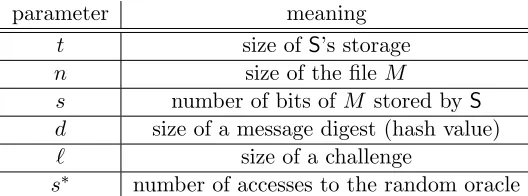
For future reference, we list the parameters of our scheme in Table 1. In this scheme, dand `
will typically be much smaller than n. As an illustrative example, we could take`= 100, d= 256, and n= 225.
Remark 2. We will be analyzing the scheme in Figure 1 in the random oracle model. Nevertheless, it might be of interest to consider how this scheme might be instantiated in practice, where one would replace the random oracle with a “real” hash function. We note that this would have to be done carefully in order to prevent certain types of attacks. For example, ifh is an iterated hash function, then h(M) can be precomputed and stored, and then h(M kc) can be computed from h(M) and c. These types of issues are studied in detail in [12]. A good practical solution might be to use a zipper hash [9].
In this section, we give an exact combinatorial analysis of a specific type of adversary that we name A(t, s). This adversary incorporates a storage-bounded server S who has access to t bits of storage. This storage will be used to store part or all of the file M and/or some number of precomputed responses. Although not completely general, this type of adversary is a very natural and plausible one to consider.
It may be useful to distinguish adversaries according to their intent. Perhaps the adversary is just being selfish in that it wants to achieve a “reasonable” success probability without actually storing the whole file. The adversary A(t, s) would be selfish only if t < n. Alternatively, the adversary could be malicious, which means that he might be willing to devote a large amount of storage to precomputed responses in an attempt to deceive the clientCwho is expecting the server
S to store the file. The adversaryA(t, s) would be considered to be malicious only ift≥n.
The adversary A(t, s) storess bits of M, along with s∗ precomputed responses obtained from
s∗ accesses to the random oracle. Clearly, s≤min{n, t}. Since each response hasd bits, it must be the case that
s∗≤
t−s d
.
Additionally, there are 2` possible responses, so s∗ ≤2`. Therefore, we have
s∗ = min
2`,
t−s d
Table 1: Parameters of aPDO Scheme
parameter meaning
t size of S’s storage
n size of the file M
s number of bits of M stored byS d size of a message digest (hash value)
` size of a challenge
s∗ number of accesses to the random oracle
for the adversary A(t, s).
Remark 3. The data precomputed by A(t, s) can be thought of as a list of of ordered pairs of the form (c, h(M k c). In our analysis, we are only counting the storage needed for the responses h(M kc), as various methods could be used to reduce or even eliminate the storage required for the challenges (i.e., thecvalues). For example, the stored responses might correspond tos∗ consecutive values of c.
Given a challenge c, the proving algorithm P operates as follows:
1. If the (correct) responser=h(M kc) has been precomputed and stored, then P outputsr.
2. Otherwise (when the response has not been precomputed and stored),P randomly guesses the
n−snon-stored bits of M, creating a file M∗. The adversary then computesr=h(M∗ kc) and outputs r.
Note thatP makes at most one (on-line) call to the random oracle each time the challenge-response protocol is run.
The case where t ≥ 2`d is not very interesting. Here the adversary can precompute all 2` possible responses when s= 0. Therefore, the resulting proving algorithm has success probability equal to 1 and no bits of the file M are stored. Therefore, in what follows, we will assume that
t <2`d, which will imply that
s∗=
t−s d
. (1)
Theorem 1. Assume that t <2`d. Then the success probability of A(t, s) is
p(t, s) = 1−
1− 2 s
2n 1−
1
2d 1−
t−s
2`d
. (2)
Proof. Let E1 denote the event that A(t, s) has precomputed the response to a given random
challenge. LetE2 denote the event thatP correctly guesses then−snon-stored bits ofn. Finally,
let E3 denote the event that the on-line output of the random oracle on an incorrect input yields
the correct response (i.e.,h(x) =h(M kc) for a givenx 6=M kc). For 1≤i≤3, letpi =Pr[Ei].
Clearly, from (1), we have
p1=
s∗
2` =
t−s
Here, we are assuming for convenience that (t−s)/d is an integer, so we can omit the “floor” computation. It is also clear that
p2=
2s
2n and p3 =
1 2d.
Now the success probability of A(t, s) is
p(t, s) =p1+ (1−p1)(p2+ (1−p2)p3) = 1−(1−p1)(1−p2)(1−p3), (3)
which simplifies to give the desired result.
Suppose we fix a value of t <2`dand, for brevity, we denotep(s) =p(t, s). We will analyze the
behaviour of p(s) as a function ofs. In order to do this, it is helpful to define
q(s) = (2`d−t+s)(2s−2n).
It is easy to see that
q(s) =C(p(s)−1), (4)
whereC is a constant (independent ofs). Using elementary calculus, we have
q0(s) = 2s(1 + (2`d−t+s) ln 2)−2n. (5)
From (5), we see that q00(s) >0 for all s > 0. Therefore, from (4), we also have p00(s) >0 for all
s >0, so the function p(s) is “concave up”.
First, let’s consider the situation where s= 0. We have
q0(0) = (1 + (2`d−t) ln 2)−2n.
Under the reasonable assumption that 2`d2n, we will haveq0(0)<0 and p0(0)<0.
At this point, we have shown that p0(0) < 0 and p0(s) is an increasing function of s. The maximum value of p(s) must occur at one of the two endpoints (i.e., when s = 0 or when s = min{n, t}). Therefore, there are two possibilities to consider:
case (1) The maximum value of p(s) is attained when s= 0.
case (2) The maximum value of p(s) is attained when s = min{n, t}. Note that this case can happen only whenp0(min{n, t})>0.
In order to determine which case would apply to a given parameter situation, it is helpful to estimate the value ˜s >0 such thatp(0) =p(˜s). From (2), we see thatp(0) =p(˜s) if and only if
1− 1
2n 1−
t
2`d
=
1− 2
˜
s
2n 1−
t−s˜ 2`d
.
If we ignore terms that are products of two “small” numbers, then the equation to be solved for ˜s
can be approximated as
t
2`d+
1 2n ≈
t−s˜ 2`d +
If ˜s is reasonably large, then we can ignore the term 1/2n. In this case, our equation can be rewritten as
2s˜ 2n ≈
˜
s
2`d,
which is equivalent to
˜
s+`+ log2d≈log2s˜+n.
Ignoring the term log2s˜, we finally obtain the estimate ˜s≈s0, where
s0 =n−`−log2d. (6)
We see thats0 >0 because we assumed that 2`d < n. Now, in order forcase (2)to occur, we need
s0≤min{n, t}. It is clear that s0< n. However, it may or may not be the case that s0 ≤t.
The two possible cases mentioned above will be distinguished by whether s0 ≤ t or s0 > t. Roughly speaking, we have the following possibilities:
1. Ift < s0, thenp(s)≤p(0) for 0< s <min{n, t}.
2. Ift≥s0, thenp(s)> p(0) fors0 < s <min{n, t}.
The second case is of course the more interesting one. This is because, in the first case, the adversary is better off storing nothing.
The above discussion can be rephrased by saying that, if the adversary’s success probability exceeds p(0), then t≥s0, s≥s0 and s≤t. In this situation, the adversary must be storing all of the file M, except for `+ log2d(or fewer) bits.
We present some numerical examples.
Example 1. Suppose n = 212 = 4096, ` = 50 and d = 64. Then s0 = 4040. The exact value for ˜s is s˜ = 4041, so the estimated value s0 from (6) is very accurate. Suppose the adversary’s storage is t=s0 bits (this would be a selfish adversary). Then p(0) = 5.6×10⁻¹⁴. Therefore, if the adversary’s success probability exceeds5.6×10−14, it must be the case that the adversary is storing
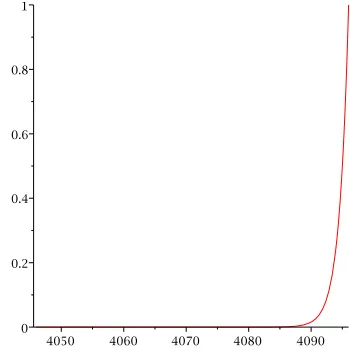
at least 4041 of the 4096 bits of M (i.e., all but 55 bits). Figure 2 presents a graph of p(s) as a function of s. Note that p(s) is very close to 0 until s is almost n, and then p(s) increases very quickly to 1. This behaviour is typical of most “reasonable” parameter situations.
Example 2. Suppose n = 225 = 33554432, ` = 100 and d = 256. Then s0 = 33554324. The exact value for ˜siss˜= 33554329, so the estimated value s0 from (6) is very accurate. Suppose the (selfish) adversary’s storage is t=s0 bits. Then p(0) = 1.03×10⁻²⁵. Therefore, if the adversary’s success probability exceeds 1.03×10⁻²⁵, it must be the case that the adversary is storing at least
33554329 of the 33554432 bits of M (i.e., all but 103 bits).
Now we consider how to construct an observerO(t, s) for the adversaryA(t, s) and we analyze the success probability of the observer we construct. O(t, s) will simply copy any value M where the output ofP is obtained by an online evaluation of h(M kc), wherec is the challenge. Suppose we define events Ei and probabilities pi (1≤i≤3) as in the proof of Theorem 1. It is clear that O(s, t) outputs the correct fileM whenever E2 holds and E1 does not hold. Therefore the success
probability ofO(s, t) is
(1−p1)p2 =
1−t−s
2`d
Figure 2: Success probability as a function ofswhen n= 4096,`= 50 and d= 64.
If the success probability of O(s, t) is denoted by , then, from (3), we can compute
=p(t, s)−p1−(1−p1)(1−p2)p3.
It is clear that
> p(t, s)−p1−p3. (7)
For most “reasonable” parameter values, p1 and p3 are very small, and hence is very close to
p(s, t).
2.1 A Variation
One possible variation/generalization of the adversaryA(t, s) would be to consider storingpartial
precomputed information about responses rather than “all or nothing”. However, it is not hard to see that this will not increase the adversary’s success probability. Suppose that an adversaryAstores
d1 bits of the responseh(M k c1) and d2 bits of the response h(M kc2), where 0 < d1 ≤d2 < d.
Consider the modified adversaryA0 who storesd1−1 bits of the response h(M kc1) andd2+ 1 bits
of the response h(M k c2). These two adversaries have the same storage requirement. However,
we show below that the success probability ofA0 is at least as large as the success probability ofA. Iterating this process enough times, we can transform the adversaryAinto one that does not store any “partial” responses.
Here is the proof of the claim: The probability of Aguessing the response is 2−d+d1 when the challenge is c1, and 2−d+d2 when the challenge is c2. For the adversary A0, the probabilities are
2−d+d1−1 when the challenge is c
1, and 2−d+d2+1 when the challenge isc2. The claim is proven by
observing that
2.2 Discussion
We conclude this section by discussing how the results presented in this section should be inter-preted. Theorem 1 gives an exact success probability of a particular type of bounded storage adversary in terms of different parameters. If parameters of the scheme are chosen in a suitable way, this probability is close to 1 only when ˜s, the number of bits of the file stored properly by the server S, is very close to the actual size of the file. Therefore, if the adversary succeeds in the challenge-response protocol with a probability close to 1, then this implies that it has stored almost all of the file. The construction of the observer and equation (7) then guarantee that O outputs almost all of the file with probability very close to the success probability of the adversary.
3
A General Bound
In this section, we consider a much more general adversary than the one studied in Section 2. We consider an arbitrary proving algorithmP for which succ(P)≥δ. Instead of bounding the storage utilized byS(as we did in the previous section), we upper-bound the number of calls to the random oracle that the adversary is allowed to make. We denote the maximum allowed number of random oracle calls bys∗ and we permitSto store all the responses to these calls. We can assume without loss of generality that s∗ ≤ 2`, since there are only 2` challenges h(M k c) that are pertinent to the challenge-response protocol. We refer to this adversary as a (δ, s∗)-adversary. The proving algorithm P can be either a deterministic or a randomized algorithm.
We want to quantify observability as a function of the success probability of P. in order to do this, it is helpful to define some notation. First, we define
SP ={c:h(M kc) has been precomputed}.
Observe that|SP| ≤s∗.
Second, for c6∈SP, letpc denote the probability thatP computesh(M kc) online, in response
to the challenge c. It is possible that a given value pc 6= 0 or 1, because P is permitted to be a
randomized algorithm.
The next theorem upper-bounds the success probability of P in terms ofs∗ and thepc values.
Theorem 2. Suppose that P is a (δ, s∗)-adversary for a challenge-response protocol. Then
2`δ ≤
1− 1
2d
s∗+ X
c6∈Sp
pc
+ 2`−d. (8)
Proof. There are |SP| values of c for which h(M k c) has been precomputed. For a challenge
c6∈SP,h(M kc) is computed online with probabilitypc. Ifc6∈SP, then with probability 1−pc,
the responseh(M kc) is not computed online and in this situation the probability that the response given byP is correct is 2−d. It follows that
succ(P)≤ |SP|
2` +
1 2`
X
c6∈Sp
pc+ (1−pc)2−d
.
After some simplification, the right-hand side of the above inequality can be rewritten as
1 2`
1− 1
2d
|SP|+ X
c6∈Sp
pc
Using the fact that |SP| ≤s∗, we obtain
succ(P)≤ 1
2`
1− 1
2d
s ∗
+ X
c6∈Sp
pc
+ 2 −d.
Since succ(P)≥δ, the inequality (8) follows.
Next, we consider how to construct an observer O and we relate the success probability of
O to the success probability of P. The basic idea is to copy any value M such that the output of P is obtained by an online evaluation of h(M k c), where c is the challenge. However, a possible complication would be arise if h(M k c) = h(M0 k c) for some M0 6= M and for some
c. For example, perhaps P computes h(M k c), and then it manages to find M0 6=M such that
h(M kc) =h(M0 kc). It might not be obvious toO whether to copyM orM0.
One possible way to address this issue would be restrict relevant parameters of the scheme so that it is very unlikely thatanycollision will ever be encountered by the adversary. In general, this will follow from the birthday paradox provided that
s∗ 2d/2. (9)
In the following analysis, we will assume that (9) holds and hence we can assume that the adversary is not able to find any M 6=M0 such thath(M kc) =h(M0 kc) for some c.
Theorem 3. Suppose that A is a (δ, s∗)-adversary for a challenge-response protocol for a PDO
scheme, and suppose that (9) holds. Then there exists a(δ, )-observer, where
≥ 2 dδ−1
2d−1 −
s∗
2`. (10)
Proof. As described above, the observerOcopies any valueM such that the output ofP is obtained by an online evaluation of h(M kc), wherec is the challenge. Denote
p∗= X
c6∈Sp
pc.
Since (9) holds, it follows that any value M copied by O is correct (except with negligible prob-ability). Therefore O is a (δ, )-observer, where = p∗/2`. Applying (8) from Theorem 2 and simplifying, it follows that
= p
∗
2` ≥
2dδ−1 2d−1 −
s∗
2`.
4
Multiple Runs of the Challenge-Response Protocol
Our definition of an observer given in Section 1 requires that an fraction of the file M can be obtained from asingle run of the challenge-response protocol. This is a strong requirement, obvi-ously, and protocols satisfying this requirement must necessarily involve challenges that “depend on” an fraction (or more) of M. For close to 1, this could be problematic because a frequent goal of POR-type protocols is to only require responses that depend on a “small” part of the whole fileM (this is important mainly for efficiency reasons). In this section, we give a relaxation of our definition of an observer that allows a prover to respond to the challenges more efficiently while preserving the same type of security guarantees considered in Section 2 and Section 3. Specifically, we allow the O to watch some number σ ≥ 1 of executions of the challenge-response protocol, possibly copying part of M from each run. Afterσ runs of the protocol, O should have copied an
fraction of file M, on average.
More precisely, let 0< δ ≤1, let 0< ≤1 and letσ ≥1 be an integer. We say that an O is a (δ, , σ)-observer provided that the expected fraction of M that O copies is at least whenever
succ(P) ≥δ, where O watches σ runs of the challenge-response protocol with random challenges chosen byC. In general,will increase asσ is increased.
We give an analysis of a simple scheme in this setting. Suppose that a challenge c consists of a randomly-chosen k-subset of {1, . . . , m}, say c ={i1, . . . , ik}, where i1 <· · · < ik. The correct
response is r = (Mi1,· · ·, Mik). This scheme has been called the “Multiblock Challenge Scheme” and a detailed analysis of it, from the point of view of coding theory, can be found in [11].
Theorem 4. For any integer σ ≥ 1, there is a (δ, , σ)-observer for the Multiblock Challenge Scheme, where =δ1− 1−mkσ.
Proof. Denote σ random challenges byc1, . . . , cσ. The observer O will simply copy every message
block supplied byP during the σ executions of the challenge-response protocol. It is possible that
O observes a message blockMi and later observes a possibly different version of the same message
block Mi, because some of the adversary’s responses might be erroneous. In this case, only the
“last” copy of Mi is retained. However, any specific copy of Mi obtained by O is correct with
probability at leastδ.
For 1≤j≤m, define a random variableXj, where
Xj =
(
1 ifj∈Sσi=1ci
0 otherwise.
Then defineX=Pmj=1Xj. It is easy to see that
E[Xj] =Pr[Xj = 1] = 1−
1− k
m
σ
for 1≤j≤m. By linearity of expectation, we have
E[X] =m
1−
1− k
m
σ
.
This says that the expected fraction of message blocks that are queried is 1− 1−mkσ.
The probability that a specific response to a query is correct is at least δ. Therefore, our observer is a (δ, , σ)-observer, where =δ1− 1− k
m σ
For fixed k and m, we have that 1− k m
σ
≈ e−kσ/m, so approaches δ exponentially quickly as a function ofσ. This is exactly what we want to happen.
5
Summary and Conclusion
We have introduced the new notion of proof-of-data-observability as a strengthening of the now-standard concepts of proof-of-recovery and proof-of-data-possession schemes for cloud storage. This new concept provides stronger guarantees relating to the server’s behaviour than the traditional notions do. We described and analyzed some simple schemes for proof-of-data-observability in the random oracle model. We also proved some general necessary conditions for the existence of these schemes, and we studied an extension where the observer is allowed to accumulate the stored file over time, by observing a sequence of runs of the challenge-response protocol.
References
[1] G. Ateniese, R.C. Burns, R. Curtmola, J. Herring, L. Kissner, Z.N.J. Peterson and D.X. Song. Provable data possession at untrusted stores.ACM Conference on Computer and Communi-cations Security, 2007, 598–609.
[2] M. Bellare and P. Rogaway. Random oracles are practical: a paradigm for designing efficient protocols.ACM Conference on Computer and communications security, 2003, 62–73.
[3] K.D. Bowers, A. Juels and A. Oprea. Proofs of retrievability: theory and implementation.
Proceedings of the First ACM Cloud Computing Security Workshop(2009), 43–54.
[4] Y. Dodis, S. Vadhan and D. Wichs. Proofs of retrievability via hardness amplification.Lecture Notes in Computer Science5444(2009), 109–127 (TCC 2009).
[5] P. Golle, S. Jarecki, and I. Mironov. Cryptographic primitives enforcing communication and storage complexity. Lecture Notes in Computer Science 2357(2002), 120–135 (FC 2002).
[6] M.I. Husain, S. Ko, A. Rudra and S. Uurtamo. Storage enforcement with Kolmogorov complexity and list decoding. ArXiv report 1104/3025, 2011,
http://arxiv.org/abs/1104.3025.
[7] M. I. Husain, S. Ko, A. Rudra and S. Uurtamo. Almost universal hash families are also storage enforcing. ArXiv report 1205/1462, 2012,http://arxiv.org/abs/1205.1462.
[8] A. Juels and B.S. Kaliski Jr. PORs: Proofs of retrievability for large files. ACM Conference on Computer and Communications Security (2007), 584–597.
[9] M. Liskov. Constructing an ideal hash function from weak ideal compression functions.Lecture Notes in Computer Science4356(2007), 358–375 (SAC 2006 Proceedings).
[11] M.B. Paterson, D.R. Stinson and J. Upadhyay. A coding theory foundation for the analysis of general unconditionally secure proof-of-retrievability schemes for cloud storage. To appear inJournal of Mathematical Cryptology.
[12] T. Ristenpart, H. Shacham and T. Shrimpton. Careful with Composition: Limitations of the Indifferentiability Framework.Lecture Notes in Computer Science6632(2011), 487–506 (EUROCRYPT 2011).
[13] H. Shacham and B. Waters. Compact proofs of retrievability. Lecture Notes in Computer Science5350(2008), 90–107 (ASIACRYPT 2008).