CBEAM: Efficient Authenticated Encryption from
Feebly One-Way
φ
Functions
Markku-Juhani O. Saarinen
Kudelski Security, Switzerland
Abstract. We show how efficient and secure cryptographic mixing functions can be constructed from low-degree rotation-invariantφfunctions rather than conven-tional S-Boxes. These novel functions have surprising properties; many exhibit inherent feeble (Boolean circuit) one-wayness and offer speed/area tradeoffs un-obtainable with traditional constructs. Recent theoretical results indicate that even if the inverse is not explicitly computed in an implementation, its degree plays a fundamental role to the security of the iterated composition. To illustrate these properties, we present CBEAM, a Cryptographic Sponge Permutation based on a single5×1-bit Boolean function. This simple nonlinear function is used to con-struct a 16-bit rotation-invariantφfunction of Degree 4 (but with a very complex Degree 11 inverse), which in turn is expanded into an efficient 256-bit mixing function. In addition to flexible tradeoffs in hardware we show that efficient im-plementation strategies exist for software platforms ranging from low-end micro-controllers to the very latest x86-64 AVX2 instruction set. A rotational bit-sliced software implementation offers not only comparable speeds to AES but also in-creased security against cache side channel attacks. Our construction supports Sponge-based Authenticated Encryption, Hashing, and PRF/PRNG modes and is highly useful as a compact “all-in-one” primitive for pervasive security.
Keywords: CBEAM, Authenticated Encryption, Cryptographic Sponge Functions, Trap-doorφfunctions, Lightweight Cryptography.
1
Introduction
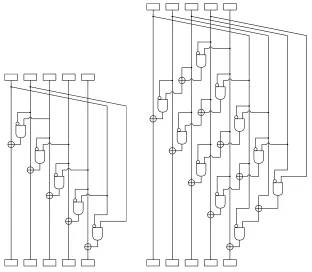
The only nonlinear component of the SHA-3 algorithm KECCAK [1, 2] is not a tra-ditional S-Box but a rotation-invariantφfunction [3]. It has been widely observed [4] that this5×5- bit function, χ, has a lower algebraic degree and circuit complexity than its inverseχ−1(See Figure 1). This is a desirable quality in a Sponge-based
cryp-toprimitive as computation of inverse is not required in normal operation. Boura and Canteaut have showed that complex inverse makes the resulting iteration strong even if it is not explicitly computed [5]. We have discovered new functions ofφtype which exhibit much more radical asymmetry than theχfunction of KECCAK.
Our contributions and structure of this paper. We first give some basic observations on φ functions and their cryptanalysis in Section 2. Inspired by our discovery of a unique, particularly strong 5-inputφfunction, we propose a cryptographic permutation named CBEAM which can be used for hashing, authenticated encryption, and other purposes. Section 3 gives a formal definition of the CBEAM Sponge Permutationπ, followed by analysis in Section 4.
This “Cryptographic Swiss Army Knife” Sponge primitive uses a fast16×16-bit φfunction of Degree 4, with 13 terms in its ANF polynomial for each output bit. Its asymmetry is evident as its inverse has degree 11 and 13465 terms for output each bit – see Section 4.3 and Appendix D.
Based on extensive experimentation we conjecture that these functions exhibit in-herent feeble one-wayness as defined by Hiltgen for circuit complexity. This indicates high algebraic resistance for our construct [5] and shows thatφfunctions are in some ways superior to conventional designs based on S-Box lookups.
In Section 5 we describe implementations of CBEAM for x86-64 AVX2 instruction set and for the 16-bit MSP 430 ultra-low power microcontroller. CBEAM is as fast as fastest AES implementations (without dedicated AES hardware) on both of these platforms, but has significantly smaller implementation footprint on both. Significant area-speed trade-offs are possible in hardware, as demonstrated by our two reference VHDL implementations.
Our conclusions in Section 6 are followed by test vectors and cryptanalytic tables in Appendices.
2
Rotation-Invariant
φ
Functions
Introduced in Daemen’s 1995 PhD Thesis [3],φfunctions are rotation-invariantn-bit invertible (bijective) functions. We use a slightly different notation from Daemen who usedφto denote non-invertible as well as invertible rotation-invariant functions.
Definition 1. Let f : {0,1}n 7→ {0,1}n be a function fromn-bit vectors to n-bit
vectors.f is aφfunction if it is bijective (uniquely invertible) and rotation-invariant:
f(x) =y⇒f(x≪r) =y≪rfor allr.
Lemma 1. Anyn×n-bitφfunctionf is unambiguously characterized by ann×1 -bit functionf(1)that satisfiesf(1)(x) =f(x)∧1.
Proof. Directly from rotation invariance. Constant 1 has Hamming weight 1. ut
Each output bit of the function may be dependent only on some subset ofninput bits. This subset is not arbitrary; we found that neighboring input bits are more likely to yield invertible functions. In the present workφ5is a specific5×1- bit function and
φ16is a16×16- bit function defined by it as per Lemma 1. We note that each output
bit of the inverse functionf−1may be dependent on all input bits even though this is
2.1 Invertibility
It is easy to see that there are invertiblen×n - bit φfunctions for anyn > 1 by consideringf(x) =cx(mod 2n−1), wheregcd(c,2n−1) = 1. Rotation invariance:
2n
≡1 (mod 2n
−1)andf(2kx) = 2kcx(mod 2n
−1). For invertibilityf−1(x) =
c−1x(mod 2n
−1).
The inverse functionf−1can also be characterized by ann×1- bit functionf−1 (1)
(Lemma 1) since the inverse of anyφfunction is clearly also aφfunction. It may also be the case thatf =f−1. Hummingbird-2νis an example of a cipher that utilizes two
16-bitφfunctions which are in fact involutions [11]. The SIMON family of block ciphers from NSA is an example of a cipher that utilizes a non-surjective rotation-invariant functionfas part of a Feistel construction [12].
It is nontrivial to characterize which one-bitf(1) functions generate invertible f
functions apart from simple properties such as bit balance:P2n−1
x=0 f(1)(x) = 2n−1.
Goodφfunctions appear to be rather hard to find – we resorted to optimized exhaustive tabulation methods to find our implementation-friendy and “feebly asymmetric”φ5.
2.2 On Cryptanalysis ofφFunctions
Algorithms for finding differential [13] and linear [14, 15] cryptanalytic properties of aφfunction are relatively fast and straightforward to implement. Thanks to Lemma 1, when determining linear bounds we may assume that the input mask is a subset of the input bits to itsf(1).
For differential cryptanalysis we must consider the convolution of the input differ-ential w.r.t. a single output bit. Due to rotation we may always by convention set the bit at index 0 in the input differential.
Countermeasures must be taken against rotational cryptanalysis [16] due to inher-ent rotational invariance ofφfunctions. Algebraically these functions have surprising properties. See Section 4.3 and Appendix D for tables and conjectures related toφ5.
2.3 General Implementation Features
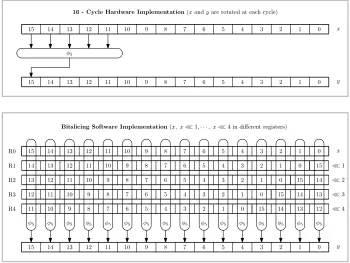
One the most useful features ofφfunctions is the extreme amount of implementation trade-offs allowed. Computation of an×n- bitφfunction can take anywhere from
1 (fully unrolled) toc×ncycles (serial implementation – here cis some constant), depending on target hardware platform. This is illustrated in Figure 3.
On software platform,φfunctions allow efficient implementation of large “S-boxes” via a Boolean sequence programming technique resembling bit-slicing [17]. Finding a good bit-slicing Boolean description for ann×1- bit function is much easier than for a genericn×n- bit S-Box.
Such straight-line code is resistant to cache-based side-channel timing attacks such as those reported against AES implementations [18–20].
π
Encryption. p.. c..
p0 c0 p1 c1
π d0
π π
d..
π
Absorbtions b
domain
barrier
h0 h..
Squeezing π
b
domain
barrier π IV
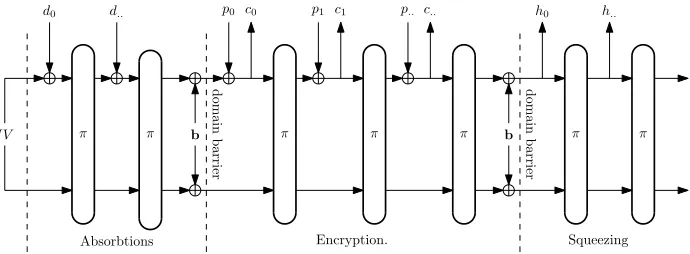
Fig. 2. A simplified view of a generic Sponge construction. The state is first loaded with an Initialization Vector or the final state of previous message. In CBEAM, the mixing function is
π=mx6. Then Secret Key, Nonce, and Associated Authenticated Data (AAD) are absorbed and
mixed - all represented bydwords.brepresents some domain separating padding mechanism.
3
CBEAM and its
π
Permutation
The design of CBEAM was driven by the following goals:
1. KISS: A simple design based on a single feebly one-way unkeyed permutation. 2. Fulfills all symmetric cryptographic needs of a communications security suite with
a single core primitive. Usable as a Pseudorandom Function, Authenticated En-cryption Algorithm, and a Collision-resistant Hash.
3. Have high performance on high-end CPUs, yet be efficiently implementable on low-end MCUs and lightweight hardware platforms such as RFID.
4. Have a high security level against attacks (2128).
CBEAM is based on the Sponge construction (Section 3.2) with a 256-bit state size and 64-bit data rate; data transfer generally occurs in 64-bit increments.
3.1 Mixing Functionmx
The basic building block of CBEAM ismx, which is a bijective transform on a 256-bit state variable. Six rounds ofmxmake upπ, the fundamental permutation of CBEAM.
The mixing functionmxis composed of addition of a round constantrcr, bit matrix transpose, linear mixingλ, and nonlinear mixingφ:
mxr(s) = (φ◦λ)(s⊕rcr)T. (1)
Practical software implementation notes are presented in Section 5.2 and a test trace of six rounds in Appendix A.
Formal definition. We index the state sinterchangeably as a16×16 - bit matrix s[ 0..15 ][ 0..15 ], a vector of 16-bit wordssw[ 0..15 ]withsw[i] =P15j=02js[i][j]
or as four quadwordssq[ 0..3 ]withsq[i] =P3j=0216jsw[ 4i+j]. All data is stored
in little-endian format.
In the following description modulo 16 arithmetic in indexing is equivalent to log-ical masking with 0xF; amod 16 is always in the range 0,1,· · ·,15. To evaluate π=mx6we compute six roundsr= 0. . .5of the following three steps:
1. Round Constantrcr. Let the individual round bits ber= 4r
2+ 2r1+r0. We have
s0[i][j] =s[i][j]for all0
≤i, j≤15except the following:
s0[ 0 ][ 0 ] =s[ 0 ][ 0 ]
⊕(r0∧ ¬r1)
s0[ 1 ][ 0 ] =s[ 1 ][ 0 ]⊕(r0∧r2)
s0[ 3 ][ 0 ] =s[ 3 ][ 0 ]⊕r0
s0[ 4 ][ 1 ] =s[ 4 ][ 1 ]⊕r0
s0[ 5 ][ 1 ] =s[ 5 ][ 1 ]⊕(r0∧ ¬r1)
s0[ 6 ][ 1 ] =s[ 6 ][ 1 ]⊕(r0∧r2)
s0[ 8 ][ 2 ] =s[ 8 ][ 2 ]
⊕(r0∧r1)
s0[ 10 ][ 2 ] =s[ 10 ][ 2 ]⊕r0
s0[ 11 ][ 2 ] =s[ 11 ][ 2 ]⊕(r0∧r2)
s0[ 13 ][ 3 ] =s[ 13 ][ 3 ]⊕r0
s0[ 14 ][ 3 ] =s[ 14 ][ 3 ]⊕(r0∧r1)
s0[ 15 ][ 3 ] =s[ 15 ][ 3 ]⊕(r0∧r2).
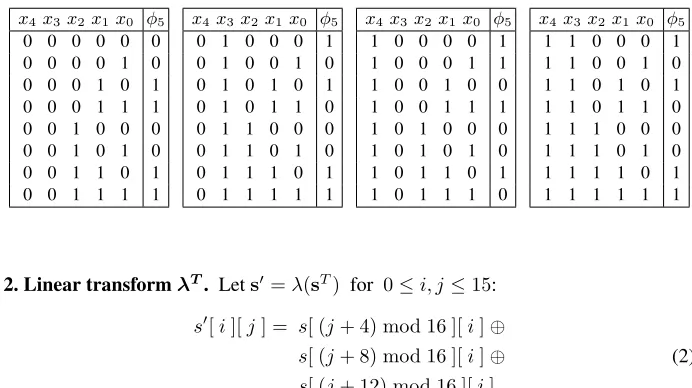
Table 1.Truth table forφ5(Equation 4.)
x4x3 x2x1x0 φ5
0 0 0 0 0 0
0 0 0 0 1 0
0 0 0 1 0 1
0 0 0 1 1 1
0 0 1 0 0 0
0 0 1 0 1 0
0 0 1 1 0 1
0 0 1 1 1 1
x4 x3 x2x1x0 φ5
0 1 0 0 0 1
0 1 0 0 1 0
0 1 0 1 0 1
0 1 0 1 1 0
0 1 1 0 0 0
0 1 1 0 1 0
0 1 1 1 0 1
0 1 1 1 1 1
x4 x3x2x1x0 φ5
1 0 0 0 0 1
1 0 0 0 1 1
1 0 0 1 0 0
1 0 0 1 1 1
1 0 1 0 0 0
1 0 1 0 1 0
1 0 1 1 0 1
1 0 1 1 1 0
x4 x3x2x1 x0 φ5
1 1 0 0 0 1
1 1 0 0 1 0
1 1 0 1 0 1
1 1 0 1 1 0
1 1 1 0 0 0
1 1 1 0 1 0
1 1 1 1 0 1
1 1 1 1 1 1
2. Linear transformλT. Lets0=λ(sT) for 0
≤i, j≤15:
s0[i][j] = s[ (j+ 4) mod 16 ][i]⊕
s[ (j+ 8) mod 16 ][i]⊕ (2) s[ (j+ 12) mod 16 ][i].
We note that theλT transform consists of a transpose of the matrix and a bit parity
oper-ation. The transpose and bit parity operations are individually involutions but applying their compound operationλT four times results in the original matrix.
3. Nonlinear transformφ. We defines0=φ(s)for0
≤i, j≤15as:
s0[i][j] =φ
5 s[i][j],
s[i][ (j−1) mod 16 ],
s[i][ (j−2) mod 16 ], (3) s[i][ (j−3) mod 16 ],
s[i][ (j−4) mod 16 ]
,
whereφ5is defined the following Algebraic Normal Form (ANF) polynomial inZ2:
φ5(x0, x1, x2, x3, x4) =x0x1x3x4+x0x2x3+x0x1x4+x1x2x3+x2x3x4+
x0x3+x1x3+x2x3+x2x4+x3x4+x1+x3+x4. (4)
Selection ofφ5is discussed in Section 4.1 and Table 1 gives its truth table.
3.2 Hashing and Authenticated Encryption
We claim thatπcan be used in all of the following proposed Sponge modes of operation. However, we suggest that unique message nonces or randomizers are always used for AE and MAC modes.
– Keyed Message Authentication Codes (MACs) [21].
– Collision resistant hashing [6].
– Tree hashing with SAKURA[22].
– Pseudorandom extractors (PRFs and PRNGs) [8].
– BLINKER two-party protocols [23].
For CBEAM described in this paperb= 256and a natural choice for rate isr= 64, leaving a capacity ofc = 192. This is more suitable for low-resource platforms and short messages than KECCAK with its 1600-bit state [1].
For SPONGEWRAPand other modes with frame bits it may be appropriate to have r = 65or66in order to not break input byte boundaries. For238bits of data per key
we claim2128security based on Theorems of [10], equivalent to AES-128 and suitable
for SECRET data. For246data we claim2112security, superior to 3DES / TDEA [24].
If even faster speeds are required and unique nonces are available, one may reduce the number of rounds tomx4or evenmx2and use theMONKEYDUPLEXconstruction of [25]. However, many of the security assurances will break down in this case.
φ5 0 1 2 3 4 5 6 7 8 9 10 11 12 13 14 15 x
16 - Cycle Hardware Implementation(xandyare rotated at each cycle)
0 1 2 3 4 5 6 7 8 9 10 11 12 13 14 15 y 0 1 2 3 4 5 6 7 8 9 10 11 12 13 14 15 0 1 2 3 4 5 6 7 8 9 10 11 12 13 14 0 1 2 3 4 5 6 7 8 9 10 11 12 13 0 1 2 3 4 5 6 7 8 9 10 11 12 0 1 2 3 4 5 6 7 8 9 10 11 15 14 15 13 14 15 12 13 14 15 0 1 2 3 4 5 6 7 8 9 10 11 12 13 14 15
φ5 φ5 φ5 φ5 φ5 φ5 φ5 φ5 φ5 φ5 φ5 φ5 φ5 φ5 φ5 φ5 Bitslicing Software Implementation(x, x≪1,· · ·, x≪4 in different registers)
≪1 ≪2 ≪3 ≪4 x y R0 R1 R2 R3 R4
4
Design and Analysis
Ignoring the round constant, themxtransform may be viewed as a transpose of a matrix followed by 16 parallel, independent invocations of a16- bit permutation,(φ◦λ)16.
We start with the most fundamental observation:
Theorem 1. Themxtransform is bijective (reversible).
Proof. Themxtransform is bijective as all of its component functions are individually
reversible. It is trivial to see that the linear transformλis bijective. Since convolution by a nonlinear Boolean function is generally not reversible, one may compute the216
-entry table ofφ16to verify that it is indeed bijective. ut
The choice of round constants was specially crafted to deter rotational [16] and slide [26, 27] attacks.
Theorem 2. Without the round constants themxtransform is shift-invariant both
hor-izontally and vertically. Lets0 =mx(s)andt0 =mx(t). If each elements[i][j ] =
t[ (i+ 4∆i) mod 16 ][ (j+∆j) mod 16 ]for some offsets∆iand∆j, thens0[i][j] =
t0[ (i+∆
j) mod 16 ][ (j+ 4∆i) mod 16 ].
Proof. The theorem follows form shift-invariant properties of all component functions.
Note the exchange of indices4∆iand∆jdue to transpose. ut
4.1 Selection ofφ5
We analyzed all225
= 232 five-input Boolean functions, searching for ones that
re-sult in invertible 16-bitφfunctions with particularly good properties. Five neighboring bits are used since rotation amounts that would yield better branching (such as the set {0,1,2,4,8}) didn’t result in any appropriate functions. Single left rotations are used as it is universally available (addition of number to self with carry flow-over to LSB).
There were 260 invertible functions, of which 56 were dependent on all five input bits in nonlinear fashion. Eight of these exhibited optimal differential and linear prop-erties. However there are three independent mirror symmetries (inversion of all input and output bits and the order of input bits) and therefore23 = 8equivalent functions.
Discounting these symmetries, there is only one optimal function,φ5(Equation 4).
Invertibilityφ5of for other word sizes besidesn= 16and the surprising properties
of these inverse functions are analyzed in Appendix D.
4.2 Differential and Linear Cryptanalysis
Sponge functions can be attacked with DC [13] and LC [14, 15] even though reasonable attack models are radically different from block ciphers.
For this analysis we view(φ◦ λ)16 row operation as a16×16- bit “S-Box”.
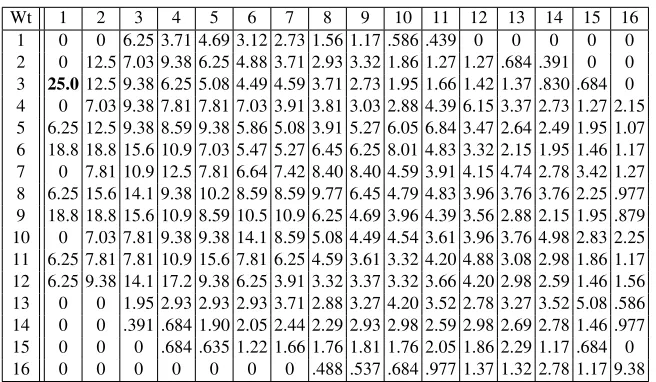
The highest-probability differential is 0CCC → 8001 and its rotational equivalents. The probability of this differential is 12032216 ≈ 0.1836. From Table 2 in Appendix C
we observe that a 1-bit input difference never yields a 1-bit output difference (branch number is greater than 2).
The best linear approximation for(φ◦λ)16 is0888 → 0001 and its rotational
equivalents, which have a bias of 16384216 = 14. The other best approximations are given
in Table 3. Significantly, all single bit approximations have 0 linear bias, as do 2-to-1 and 1-to-2 - bit approximations.
4.3 Algebraic Properties
The truth table forφ5Boolean function is given in Table 1. From its definition in
Equa-tion 4 one easily see that the degree ofφ5is 4 (and ANF weight 13), and that is also the
algebraic degree ofφstate transformmx(see Equation 3).
Themxfunction has been designed to have a significant amount of algebraic “one-wayness” in the sense discussed by Hiltgen [28]. The following somewhat surprising observation can be verified by examining the inverse ofφ16:
Observation 1 The algebraic degree of the φ−161 inverse function is 11. The weight
(number of nonzero terms) of the ANF polynomial for each output bit ofφ−161is 13465.
For a characterization of the Algebraic properties of the inverse ofφ−1
n forn6= 16,
we refer to Appendix D, where tables and conjectures are presented.
The algebraic degree ofmxnis bound by4n. We have verified that the output after
six invocations actually has a degree up to 256. If state bits are observed as a function of sq[ 0 ], the number of terms of each degree are distributed in a way that indicates
that CBEAM is not vulnerable tod-monomial distinguishers [29] or other traditional algebraic attacks.
Higher-degree inverse indicates high-degree iteration. Research by Boura and Can-teaut on the algebraic degree of iterated permutations seen as multivariate polynomials shows that the degree depends on the algebraic degree of theinverseof the permutation which is iterated [5]. This indicates exceptional algebraic security for our proposal.
5
Padding and Implementation Notes
A special padding mode of operation, BLINKER [23], is proposed together with CBEAM. This multi-use padding mode allows full encryption protocols to be built from CBEAM. We note that an early version of CBEAM and BLINKER was used in the HAGRAT aca-demic Remote Access Trojan [30], minimizing the size of the encryption component.
In hardware implementations, an invocation of themxn transform can take any-where between 1 and several thousand clock cycles, depending on the number of gates, peak energy and amount of surface area available. Figure 3 shows sixteen- and single clock versions of aφ16- type convolution.
5.1 Hardware Implementations
We have designed and written VHDL for two implementations, dubbed Serial-CBEAM and Block-CBEAM. These have been found to function correctly on a Xilinx Virtex 3E FPGA board with the ISE 14.4 design flow.
Serial Implementation. The Serial implementation assumes external 256-bit memory for the state and operates on that state one bit at a time. The implementation sacrifices a lot of clock cycles for reduction of gates and area. The implementation requires only 16 internal register bits in addition to address/clock counters. The implementation with a 1-bit data bus requires 256 read cycles and 256 write cycles for eachMXiteration, 3072 clocks in total for fullπ=mx6. We estimate that the implementation footprint is only
about 300 GE without the 256-bit external state memory.
Block Implementation. This is a 1 - cycle implementation of themxfunction (with e.g. 256 parallelφ5circuits). Depending on target platform and area, timing constraints,
it is possible to implement more than one round ofmx2 in a single cycle. Pipelined operation using SAKURA-like [22] hopping hash trees can also be considered with this
mxcore.
5.2 Implementing CBEAM in Software Without Matrix Transpose
Since transposing a binary matrix is generally slow in software, one would typically want to combine twomxoperations into a double-round with separate “vertical” and “horizontal” parts. We give some generic guidance on how to implementmx2in soft-ware this way. However, one should examine the reference 16-bit, 64-bit, and 256-bit implementations for architecture-specific optimizations.
rw[0] rw[1] rw[2] rw[3] rw[4] rw[5] rw[6] rw[7] rw[8] rw[9] rw[10]rw[11]rw[12]rw[13]rw[14]rw[15]
16×16 = 256 - bit stater YMM0
XMM0 XMM1
MMX0 MMX2 MMX3 MMX4
R0 R1 R2 R3 R4 R5 R6 R7
Step 1: Vertical linear transformλ. This step is easiest to implement by viewing the state as 64-bit words (“quadwords”)sq[0..3]withs= (sq[ 0 ], sq[ 1 ], sq[ 2 ], sq[ 3 ] ).
t=sq[ 0 ] ⊕ sq[ 1 ] ⊕ sq[ 2 ] ⊕ sq[ 3 ] s0= (s
q[ 0 ] ⊕ t, sq[ 1 ] ⊕ t, sq[ 2 ] ⊕ t, sq[ 3 ] ⊕ t). (5)
Step 2: Vertical nonlinear transform. An optimized bit-slicing method forφ5is used
(See Appendix B). Note that the input words may be stored in registers and contents of registers values in shifted for each new input word. For0≤i≤15:
s0w[i] =φ5 sw[i], sw[ (i−1) mod 16 ], sw[ (i−2) mod 16 ],
sw[ (i−3) mod 16 ], sw[ (i−4) mod 16 ]. (6)
Step 3: Round Constant. As the round constants are only active at odd rounds, they are in fact always applied between vertical and horizontal rounds in this type of imple-mentation. Written as transposed quadwords, the three nonzero round constants are:
rc1q =0x2000040000300009
rc3q =0x6000050000100008 (7)
rc3q =0xA0000C000070000B
Constants from Equation7are XORed over the first quadword of state at roundi:
s0q[ 0 ] =sq[ 0 ]⊕rciq. (8)
Step 4: Horizontal linear transformλ. This step is relatively slow in this type of im-plementation. There are many ways to do this; we note that each nibble oftis equivalent to each other. This step is also parallelizable. For0≤i≤15:
t=sw[i] ⊕ (sw[i]≪4) ⊕ (sw[i]≪8) ⊕ (sw[i]≪12)
s0w[i] =sw[i] ⊕ t. (9)
Step 5: Horizontal nonlinear transform. Again a bit-slicing implementation ofφ5
(Appendix B) is used, but on rotated values of each word. For0≤i≤15:
5.3 Latest Server/Desktop/Laptop Systems: x86-64 with AVX2
The Intel Haswell (Generation 4 Core) and later x86-64 CPUs support 256-bit AVX2 (Advanced Vector Extensions 2) SIMD instructions. The AVX2 platform provides shuf-fle and vector shift instructions for 16-bit vector sub-units in addition to 256-bit Boolean logic for the nonlinear function φ5 (Equation 4). We can implement full 256-bitφ5
with only eight instructions (Appendix B.1). This roughly doubles the overall execu-tion speed when compared to optimized 64-bit gcc versions.
The following speeds were measured on a MacBook Air (Q3/2013) with Intel Core i5 - 4250U CPU @1.30 GHz running Ubuntu Linux 13.04. The internal clock frequency was 1.90 GHz for all tests.
We compare to OpenSSL 1.0.1e AES implementation, which is the de facto stan-dard AES implementation. Generic assembler optimizations were enabled but we dis-abled the full hardware AES for fairness.
Implementation Troughput Cycles/Byte
CBEAM-GCC 58.5 MB/s 32.5
CBEAM-AVX2 117.5 MB/s 16.1
OpenSSL AES-128 106.5 MB/s 17.8
OpenSSL AES-192 86.0 MB/s 22.1
OpenSSL AES-256 71.9 MB/s 26.4
5.4 Sensors and Pervasive Devices: MSP430
Texas Instruments MSP430 is a well known family of low-cost and ultra-low power 16-bit SoC microcontrollers, widely used in sensor networks. CBEAM beats the more than dozen MSP430 encryption algorithm implementations reported in [31], often by an order of magnitude.
Our implementation ofπis able to execute entirely on 12 general-purpose registers without having to resort to stack (except the top value) and therefore the running RAM requirement is equivalent to the state size, 32 bytes. Theφ5function was realized with
nine logic instructions (Appendix B.2). Unfortunately the target only has 1-bit shifts and no multi-bit rotation instructions, which results in a bottleneck for “horizontal”λ.
The cipher is as fast as the very fastest AES implementations on this platform but has significantly smaller implementation footprint. The following numbers are only for cores, modes of operation not included. The IAIK [32] implementation is commercial and written in hand-optimized assembly. The Texas Instruments [33] implementation is recommended by the SoC vendor.
Code Flash Ram Encryption Decryption Cycles/Byte
CBEAM 386 32 4369 4404 550.5
AES-128 [32] 2536 ? 5432 8802 550.1
AES-128 [33] 2423 80 6600 8400 525.0
6
Conclusions
We propose the use of novel rotation-invariantφfunctions in cryptographic primitives such as hashes and authenticated encryption. These functions have fascinating and at-tractive properties such as “feeble one-wayness”; the Boolean complexity of inversion appears to be much higher than the Boolean complexity of computing the permutation in forward direction. We have experimentally verified that the polynomial degree for the inverse of aφ5function grows linearly as the number of input bits grows, while it
remains constant in forward direction. Hence the function and its inverse are in different complexity classes (linear vs. polynomial or super-polynomial).
In a Sponge construction a large and efficient cryptographic permutation is required. The permutation needs to be computed only in one direction during normal operation. It has been shown that complexity of inversion makes collision search and other attacks more difficult. Here an asymmetricφfunction is an ideal choice. This motivates us to propose a new 256-bit Sponge function, CBEAM, which can be used for cryptographic hashing, authenticated encryption, and other purposes.
In addition to the theoretical side, the main attractive feature of CBEAM is its ex-treme implementation flexibility; a single word encryption operation may require any-where between 1 to thousands of cycles, depending on the area and energy requirements of the implementation. We also demonstrate that it is approximately as fast as AES on both high-end CPUs and low-end MCUs, while having a significantly smaller imple-mentation footprint.
Acknowledgements. The author wishes to thank Kudelski Security, University of Haifa, and Nanyang Technological University for supporting his work. Program Com-mittee members of CT-RSA 2014 provided invaluable suggestions for improving the quality of this paper.
References
1. Bertoni, G., Daemen, J., Peeters, M., Assche, G.V.: The Keccak reference, version 3.0. NIST SHA3 Submission Document (January 2011)
2. NIST: NIST selects winner of secure hash algorithm (SHA-3) competition. NIST Tech Beat Newsletter (2 October 2012)
3. Daemen, J.: Cipher and Hash Function Design Strategies based on linear and differential cryptanalysis. PhD thesis, K.U. Leuven (March 1995)
4. Dinur, I., Dunkelman, O., Shamir, A.: New attacks on Keccak-224 and Keccak-256. In Canteaut, A., ed.: FSE 2012. Volume 7549 of LNCS., Springer (2012) 442–461
5. Boura, C., Canteaut, A.: On the influence of the algebraic degree ofF−1 on the algebraic
degree ofG◦F. IEEE Transactions on Information Theory59(1) (January 2013)
6. Bertoni, G., Daemen, J., Peeters, M., Assche, G.V.: Sponge functions. In: Ecrypt Hash Workshop 2007. (May 2007)
8. Bertoni, G., Daemen, J., Peeters, M., Assche, G.V.: Sponge-based pseudo-random number generators. In Mangard, S., Standaert, F.X., eds.: CHES 2010. Volume 6225 of LNCS., Springer (2010) 33–47
9. Bertoni, G., Daemen, J., Peeters, M., Assche, G.V.: Duplexing the sponge: Single-pass au-thenticated encryption and other applications. In Miri, A., Vaudenay, S., eds.: SAC 2011. Volume 7118 of LNCS., Springer (2011) 320–337
10. Bertoni, G., Daemen, J., Peeters, M., Assche, G.V.: Cryptographic sponge functions, version 0.1. http://sponge.noekeon.org/, STMicroelectronics and NXP Semiconductors (January 2011)
11. Saarinen, M.J.O.: Related-key attacks against full Hummingbird-2. In: FSE 2013: 20th Inter-national Workshop on Fast Software Encryption. 11-13 March 2013, Singapore, Singapore. (2013) To Appear.
12. Beaulieu, R., Shors, D., Smith, J., Treatman-Clark, S., Weeks, B., Wingers, L.: The
SI-MON and SPECK families of lightweight block ciphers. IACR ePrint 2013/404, http:
//eprint.iacr.org/2013/404(June 2013)
13. Biham, E., Shamir, A.: Differential Cryptanalysis of the Data Encryption Standard. Springer (1993)
14. Matsui, M.: Linear cryptoanalysis method for DES cipher. In Helleseth, T., ed.: EURO-CRYPT ’93. Volume 765 of LNCS., Springer (1994) 386–397
15. Matsui, M.: The first experimental cryptanalysis of the data encryption standard. In Desmedt, Y., ed.: CRYPTO ’94. Volume 839 of LNCS., Springer (1994) 1–11
16. Khovratovich, D., Nikoli´c, I.: Rotational cryptanalysis of ARX. In Hong, S., Iwata, T., eds.: FSE 2010. Volume 6147 of LNCS., Springer (2010) 333–346
17. Biham, E.: A fast new DES implementation in software. In Biham, E., ed.: FSE 1997. Volume 1267 of LNCS., Springer (1997) 260–272
18. Bernstein, D.J.: Cache-timing attacks on AES. Technical report, University of Chigaco (2005)
19. Acıiçmez, O., Schindler, W., Ç. K. Koç: Cache based remote timing attack on the AES. In Abe, M., ed.: CT-RSA 2007. Volume 4377 of LNCS., Springer (2007) 271–286
20. Weiß, M., Heinz, B., Stumpf, F.: A cache timing attack on AES in virtualization environ-ments. In Keromytis, A., ed.: FC 2012. Volume 7397 of LNCS., Springer (2013) 314–328 21. Bertoni, G., Daemen, J., Peeters, M., Assche, G.V.: On the security of the keyed sponge
construction. In: SKEW 2011 Symmetric Key Encryption Workshop. (February 2011) 22. Bertoni, G., Daemen, J., Peeters, M., Assche, G.V.: Sakura: a flexible coding for tree hashing.
IACR ePrint 2013/213,http://eprint.iacr.org/2013/213(April 2013)
23. Saarinen, M.J.O.: Beyond modes: Building a secure record protocol from a cryptographic sponge permutation. In: CT-RSA 2014: Cryptographers’ Track, RSA Conference USA, 25– 28 February 2014, San Francisco, USA, Springer (2014) To Appear.
24. NIST: Recommendation for the Triple Data Encryption Algorithm (TDEA) block cipher, revision 1. NIST Special Publication 800-67 (January 2012)
25. Bertoni, G., Daemen, J., Peeters, M., Assche, G.V.: Permutation-based encryption,
au-thentication and authenticated encryption. In: DIAC 2012. (2012)http://keccak.
noekeon.org/KeccakDIAC2012.pdf.
26. Biryukov, A., Wagner, D.: Slide attacks. In Knudsen, L.R., ed.: FSE 1999. Volume 1636 of LNCS., Springer (1999) 245–259
27. Biryukov, A., Wagner, D.: Advanced slide attacks. In Preneel, B., ed.: EUROCRYPT 2000. Volume 1807 of LNCS., Springer (2000) 589–606
29. Saarinen, M.J.O.: Chosen-IV statistical attacks against eSTREAM ciphers. In: Proc. SE-CRYPT 2006, International Conference on Security and Cryptography, Setubal, Portugal, August 7-10, 2006. (2006)
30. Saarinen, M.J.O.: Developing a grey hat C2 and RAT for APT security training and assess-ment. In: GreHack 2013 Hacking Conference, 15 November 2013, Grenoble, France. (2013) To Appear.
31. Cazorla, M., Marquet, K., Minier, M.: Survey and benchmark of lightweight block ciphers
for wireless sensor networks. In: SECRYPT 2013. (May 2013)http://eprint.iacr.
org/2013/295.
32. IAIK: AES for Texas Instruments MSP430 microcontrollers. Technical report, IAIK SIC T.
U. Graz http://jce.iaik.tugraz.at/sic/Products/Crypto_Software_
for_Microcontrollers.
33. TI: AES128 - A C implementation for encryption and decryption. Technical
Re-port SLAA397A, Texas Instruments (July 2009) http://www.ti.com/lit/an/
slaa397a/slaa397a.pdf.
A
Trace of Execution for CBEAM
A trace (test vector) of six rounds of computation for theπ=mx6function:
b= (0123, 1234, 2345, 3456, 4567, 5789, 6789, 789A,
89AB, 9ABC, ABCD, BCDE, CDEF, DEF0, EF01, F012)
mx(b) = (88A8, 3333, BDBD, BFC1, DD5D, B87B, BF7D, A3B5,
88A8, CCCC, F6F6, FF06, 5555, 9999, EDED, FE0D)
mx2(b) = (6F0D, E713, 4B47, B151, 25BD, 929F, 2540, 7780,
4985, 511D, 818C, A135, 8426, 9911, FB65, 3991)
mx3(b) = (E50C, EAE4, 07F3, B08A, 6476, 2138, D90D, F629,
3919, 3071, 1E59, 1458, DEEC, 15F3, 96DF, 1FB2)
mx4(b) = (8922, B751, 6648, 0EED, C285, 89E5, 2DFC, DBBF,
4310, 77FA, 3494, 7F13, 47D9, 6DD3, 1E59, E502)
mx5(b) = (2CA0, 67B3, 4F96, 0A46, B209, AC7E, 5C64, A125,
CF7C, B46F, EB8A, FAED, 1130, 934D, CC02, 0D67)
mx6(b) =π(b) = (5432, 281E, B184, 9481, AAF0, C9BE, A028, 4C79,
4B69, 53BF, 53C0, CFE8, 8839, 9D2A, 89E3, 1300)
B
Bit-Slicing for
φ
5The ANSI C reference implementationcbref/mx6-gcc.cimplementsφ5as a macro
as follows:
Here we put our trust to compiler for common subexpression elimination of(~x3 & x4) and(~x2 & x3). One can assign these to temporary variables if necessary. We have exhaustively verified thatφ5cannot be implemented with less than eight logical
instruc-tions (ANDN(~x & y)is a single op).
B.1 AVX 2
Here is a code snippet written in AVX2 C intrinsics for implementing theφ5function
with 8 logical instructions on 256-bit registers:
// t0 = Phi5(x0,x1,x2,x3,x4) t0 = _mm256_andnot_si256(x3, x4); t1 = _mm256_andnot_si256(x2, x3); t2 = _mm256_andnot_si256(x2, t0); t3 = _mm256_or_si256(x1, t1); t0 = _mm256_xor_si256(t0, t1); t1 = _mm256_and_si256(x0, t0); t0 = _mm256_andnot_si256(t1, t3); t0 = _mm256_xor_si256(t0, t2);
Please see the reference implementation filecbref/mx6-avx2.cfor tricks on how to implementλand various shifts efficiently on this platform.
B.2 MSP430
TI MSP430 has only two-operand machine instructions and hence the code is slightly longer with 9 instructions on 16-bit registers:
/* r14 = Phi5(r15,r14,r13,r12,r11) */
bic r12, r11
inv r13
and r13, r12
and r11, r13
xor r12, r11
and r11, r15
bis r12, r14
bic r15, r14
xor r13, r14
The MSP430 reference implementationcbeam430/mx430.scan computeπ=mx6
C
Auxiliary Tables
Table 2.Probabilities (%) of best differentials for(λ◦φ)16with specific input weight (rows) and output weight (columns). The best overall differential and the best differential with output weight 1 are emphasized.
Wt 1 2 3 4 5 6 7 8 9 10 11 12 13 14 15 16
1 0 0 1.07 .513 .635 .562 .385 .330 .140 .137 .064 .021 .003 0 0 0
2 0 4.30 2.15 2.54 2.15 1.37 .592 .443 .284 .256 .116 .098 .037 .027 .006 .006
3 17.25.47 5.47 3.91 1.78 .922 .787 .476 .330 .195 .177 .119 .079 .052 .027 .003
4 .009 1.46 3.37 5.15 1.95 1.32 .903 .439 .305 .375 .232 .159 .101 .064 .049 .021
5 .684 2.93 6.74 2.49 2.20 1.76 .885 .635 .446 .363 .266 .192 .140 .085 .064 .021
6 7.0318.45.47 3.91 2.34 1.37 .894 .702 .412 .354 .214 .168 .131 .128 .052 .018
7 .928 2.00 4.17 2.12 3.09 1.64 1.14 .671 .470 .299 .247 .223 .165 .101 .040 .024
8 2.93 3.22 3.22 4.15 3.12 1.95 1.20 .732 .522 .360 .220 .256 .140 .070 .049 .034
9 8.20 4.00 11.1 4.59 3.52 1.95 1.28 .885 .525 .366 .253 .171 .134 .101 .067 .024
10 .598 1.39 1.66 2.73 1.46 2.27 1.44 .781 .586 .323 .220 .208 .131 .153 .043 .021
11 .964 2.44 3.27 2.05 3.96 2.22 1.27 .879 .403 .232 .266 .192 .165 .092 .037 .027
12 .781 5.57 2.83 6.74 2.34 1.86 .696 .439 .290 .296 .198 .171 .128 .058 .040 .031
13 0 .122 .159 .323 .247 .269 .327 .317 .272 .214 .223 .119 .082 .058 .031 .009
14 0 .018 .073 .150 .177 .250 .269 .424 .235 .275 .140 .104 .061 .052 .024 .015
15 0 0 .003 .006 .079 .064 .122 .058 .076 .064 .055 .037 .043 .034 .021 0
16 0 0 0 0 0 .006 .006 .049 .024 .055 .031 .058 .015 .021 0 .012
Table 3.Absolute biases (%) of best linear approximations for(λ◦φ)16with specific input mask weight (rows) and output weight (columns).
Wt 1 2 3 4 5 6 7 8 9 10 11 12 13 14 15 16
1 0 0 6.25 3.71 4.69 3.12 2.73 1.56 1.17 .586 .439 0 0 0 0 0
2 0 12.5 7.03 9.38 6.25 4.88 3.71 2.93 3.32 1.86 1.27 1.27 .684 .391 0 0
3 25.012.5 9.38 6.25 5.08 4.49 4.59 3.71 2.73 1.95 1.66 1.42 1.37 .830 .684 0
4 0 7.03 9.38 7.81 7.81 7.03 3.91 3.81 3.03 2.88 4.39 6.15 3.37 2.73 1.27 2.15
5 6.25 12.5 9.38 8.59 9.38 5.86 5.08 3.91 5.27 6.05 6.84 3.47 2.64 2.49 1.95 1.07
6 18.8 18.8 15.6 10.9 7.03 5.47 5.27 6.45 6.25 8.01 4.83 3.32 2.15 1.95 1.46 1.17
7 0 7.81 10.9 12.5 7.81 6.64 7.42 8.40 8.40 4.59 3.91 4.15 4.74 2.78 3.42 1.27
8 6.25 15.6 14.1 9.38 10.2 8.59 8.59 9.77 6.45 4.79 4.83 3.96 3.76 3.76 2.25 .977
9 18.8 18.8 15.6 10.9 8.59 10.5 10.9 6.25 4.69 3.96 4.39 3.56 2.88 2.15 1.95 .879
10 0 7.03 7.81 9.38 9.38 14.1 8.59 5.08 4.49 4.54 3.61 3.96 3.76 4.98 2.83 2.25
11 6.25 7.81 7.81 10.9 15.6 7.81 6.25 4.59 3.61 3.32 4.20 4.88 3.08 2.98 1.86 1.17
12 6.25 9.38 14.1 17.2 9.38 6.25 3.91 3.32 3.37 3.32 3.66 4.20 2.98 2.59 1.46 1.56
13 0 0 1.95 2.93 2.93 2.93 3.71 2.88 3.27 4.20 3.52 2.78 3.27 3.52 5.08 .586
14 0 0 .391 .684 1.90 2.05 2.44 2.29 2.93 2.98 2.59 2.98 2.69 2.78 1.46 .977
15 0 0 0 .684 .635 1.22 1.66 1.76 1.81 1.76 2.05 1.86 2.29 1.17 .684 0
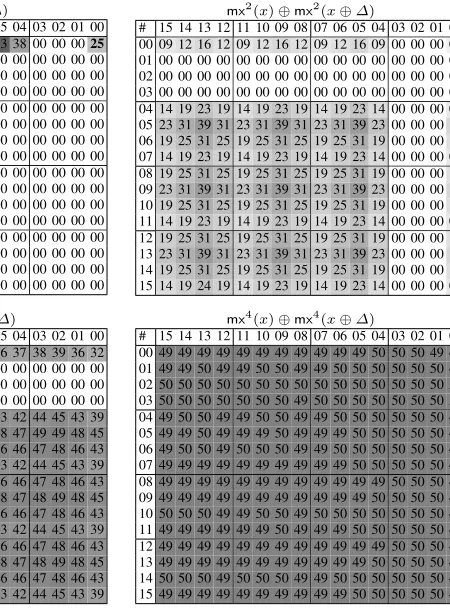
Table 4.Progression of differentials in consecutive invocations ofmx. Here the zeroth bit has been flipped;∆= 0255||1
. We observe that the full state is affected and there is no detectable bias aftermx4. Theπtransform has six rounds by default.
mx(x)⊕mx(x⊕∆)
# 15 14 13 12 11 10 09 08 07 06 05 04 03 02 01 00 00 38 50 63 50 37 50 62 50 37 50 63 38 00 00 0025 01 00 00 00 00 00 00 00 00 00 00 00 00 00 00 00 00 02 00 00 00 00 00 00 00 00 00 00 00 00 00 00 00 00 03 00 00 00 00 00 00 00 00 00 00 00 00 00 00 00 00 04 00 00 00 00 00 00 00 00 00 00 00 00 00 00 00 00 05 00 00 00 00 00 00 00 00 00 00 00 00 00 00 00 00 06 00 00 00 00 00 00 00 00 00 00 00 00 00 00 00 00 07 00 00 00 00 00 00 00 00 00 00 00 00 00 00 00 00 08 00 00 00 00 00 00 00 00 00 00 00 00 00 00 00 00 09 00 00 00 00 00 00 00 00 00 00 00 00 00 00 00 00 10 00 00 00 00 00 00 00 00 00 00 00 00 00 00 00 00 11 00 00 00 00 00 00 00 00 00 00 00 00 00 00 00 00 12 00 00 00 00 00 00 00 00 00 00 00 00 00 00 00 00 13 00 00 00 00 00 00 00 00 00 00 00 00 00 00 00 00 14 00 00 00 00 00 00 00 00 00 00 00 00 00 00 00 00 15 00 00 00 00 00 00 00 00 00 00 00 00 00 00 00 00
mx2(x)⊕mx2(x⊕∆)
# 15 14 13 12 11 10 09 08 07 06 05 04 03 02 01 00 00 09 12 16 12 09 12 16 12 09 12 16 09 00 00 00 06 01 00 00 00 00 00 00 00 00 00 00 00 00 00 00 00 00 02 00 00 00 00 00 00 00 00 00 00 00 00 00 00 00 00 03 00 00 00 00 00 00 00 00 00 00 00 00 00 00 00 00 04 14 19 23 19 14 19 23 19 14 19 23 14 00 00 00 09 05 23 31 39 31 23 31 39 31 23 31 39 23 00 00 00 16 06 19 25 31 25 19 25 31 25 19 25 31 19 00 00 00 12 07 14 19 23 19 14 19 23 19 14 19 23 14 00 00 00 09 08 19 25 31 25 19 25 31 25 19 25 31 19 00 00 00 13 09 23 31 39 31 23 31 39 31 23 31 39 23 00 00 00 16 10 19 25 31 25 19 25 31 25 19 25 31 19 00 00 00 13 11 14 19 23 19 14 19 23 19 14 19 23 14 00 00 00 09 12 19 25 31 25 19 25 31 25 19 25 31 19 00 00 00 12 13 23 31 39 31 23 31 39 31 23 31 39 23 00 00 00 16 14 19 25 31 25 19 25 31 25 19 25 31 19 00 00 00 12 15 14 19 24 19 14 19 23 19 14 19 23 14 00 00 00 09
mx3(x)⊕mx3(x⊕∆)
# 15 14 13 12 11 10 09 08 07 06 05 04 03 02 01 00 00 33 34 33 32 33 34 33 32 33 36 36 37 38 39 36 32 01 00 00 00 00 00 00 00 00 00 00 00 00 00 00 00 00 02 00 00 00 00 00 00 00 00 00 00 00 00 00 00 00 00 03 00 00 00 00 00 00 00 00 00 00 00 00 00 00 00 00 04 40 42 41 39 40 42 41 39 40 43 43 42 44 45 43 39 05 47 48 47 45 47 49 47 45 46 48 48 47 49 49 48 45 06 44 46 45 43 44 46 45 43 44 46 46 46 47 48 46 43 07 40 42 41 39 40 42 41 39 40 43 43 42 44 45 43 39 08 44 46 45 43 44 46 45 43 44 46 46 46 47 48 46 43 09 46 48 47 45 47 49 47 45 46 48 48 47 48 49 48 45 10 44 46 45 43 44 46 45 42 44 46 46 46 47 48 46 43 11 40 42 41 39 40 42 41 39 40 42 43 42 44 45 43 39 12 44 46 45 43 44 46 45 43 44 46 46 46 47 48 46 43 13 46 48 47 45 47 49 47 45 46 48 48 47 48 49 48 45 14 44 46 45 43 44 46 45 43 44 46 46 46 47 48 46 43 15 40 42 41 39 40 42 41 39 40 43 43 42 44 45 43 39
mx4(x)⊕mx4(x⊕∆)
# 15 14 13 12 11 10 09 08 07 06 05 04 03 02 01 00 00 49 49 49 49 49 49 49 49 49 49 49 50 50 50 49 49 01 49 49 50 49 49 50 50 49 49 50 50 50 50 50 50 49 02 50 50 50 50 50 50 50 50 50 50 50 50 50 50 50 50 03 50 50 50 50 50 50 50 49 50 50 50 50 50 50 50 50 04 49 50 50 49 49 50 50 49 49 50 50 50 50 50 50 49 05 49 49 50 49 49 49 50 49 49 49 50 50 50 50 50 49 06 49 50 50 49 50 50 50 49 49 50 50 50 50 50 50 49 07 49 49 49 49 49 49 49 49 49 49 50 50 50 50 50 49 08 49 49 49 49 49 49 49 49 49 49 49 49 50 50 50 49 09 49 49 49 49 49 49 49 49 49 49 49 50 50 50 50 49 10 50 50 50 49 49 50 50 49 50 50 50 50 50 50 50 49 11 49 49 49 49 49 49 50 49 49 49 50 50 50 50 50 49 12 49 49 49 49 49 49 49 49 49 49 49 49 50 50 50 49 13 49 49 49 49 49 49 49 49 49 49 49 50 50 50 50 49 14 50 50 50 49 50 50 50 49 49 50 50 50 50 50 50 49 15 49 49 49 49 49 49 49 49 49 49 50 50 50 50 50 49
Progression of differentials in consecutive invocations of inverse functionmx−1. Here again the zeroth bit is flipped. After third round there is no longer any detectable bias.
mx−1(x)⊕mx−1(x⊕∆)
# 15 14 13 12 11 10 09 08 07 06 05 04 03 02 01 00 00 00 00 00 00 00 00 00 00 00 00 00 00 50 50 5050 01 00 00 00 00 00 00 00 00 00 00 00 00 50 50 50 50 02 00 00 00 00 00 00 00 00 00 00 00 00 50 50 50 50 03 00 00 00 00 00 00 00 00 00 00 00 00 50 50 50 50 04 00 00 00 00 00 00 00 00 00 00 00 00 50 50 50 50 05 00 00 00 00 00 00 00 00 00 00 00 00 50 50 50 50 06 00 00 00 00 00 00 00 00 00 00 00 00 50 50 50 50 07 00 00 00 00 00 00 00 00 00 00 00 00 50 50 50 50 08 00 00 00 00 00 00 00 00 00 00 00 00 50 50 50 50 09 00 00 00 00 00 00 00 00 00 00 00 00 50 50 50 50 10 00 00 00 00 00 00 00 00 00 00 00 00 50 50 50 50 11 00 00 00 00 00 00 00 00 00 00 00 00 50 50 50 50 12 00 00 00 00 00 00 00 00 00 00 00 00 50 50 50 50 13 00 00 00 00 00 00 00 00 00 00 00 00 50 50 50 50 14 00 00 00 00 00 00 00 00 00 00 00 00 50 50 50 50 15 00 00 00 00 00 00 00 00 00 00 00 00 50 50 50 50
mx−2(x)⊕mx−2(x⊕∆)
D
Tables and Conjectures on Algebraic Properties of
φ
−n1Theφ5(Equations 4 and 10) Boolean mapping also defines reversiblen×n- bit shift-invariant functions for othernapart fromn= 16.
Each forward function has degree 4. The characteristics of the Algebraic Normal Form of inverse functions up ton= 32are given below. Each column contains the number of monomials of given degree; the last column has the number of nonzero terms for all degrees.
Conjecture 1. The inverse ofφnis defined for eachn≥5withn6= 0 (mod 3)anddegφ−n1=
2 3n
.
Conjecture 2. Computation ofφ−1
n has at least polynomial complexity (with degree≥2).
The computation ofφnhas linear complexityO(n)but the complexity ofφn−1is at leastO(n2)since the number of input bits grows with
nas per observation in Conjecture 1. Super-polynomial complexity has not been ruled out as we do not know a polynomial time algorithm forφ−1
n . Based on current evidence we are reluctant to believe in exponential complexity, however.
n 1 2 3 4 5 6 7 8 9 10 11 12 13 14 15 16 17 18 19 20 21 22 Poly n.z.t.
6 Nonsurjective.
7 4 11 17 15 6 53
8 3 9 13 13 9 2 49
9 Nonsurjective.
10 5 21 55 91 95 56 14 337
11 4 18 45 75 88 69 28 4 331
12 Nonsurjective.
13 6 34 125 303 502 565 408 168 30 2141
14 5 30 106 253 433 543 471 252 72 8 2173
15 Nonsurjective.
16 7 50 236 753 1705 2797 3293 2686 1430 446 62 13465
17 6 45 205 640 1456 2504 3236 3017 1912 766 172 16 13975
18 Nonsurjective.
19 8 69 397 1570 4506 9678 15684 19001 16832 10532 4402 1104 126 83909
20 7 63 351 1356 3866 8472 14450 18965 18645 13266 6554 2114 396 32 88537
21 Nonsurjective.
22 9 91 617 2910 10112 26816 55170 88281 109077 102570 71834 36250 12464 2618 254 519073 23 8 84 553 2548 8750 23352 49428 83181 110136 112723 87302 49868 20260 5510 892 64 554659
24 Nonsurjective.
25 10 116 905 4956 20216 63770 158824 315095 498190 624397 614364 467824 269904 114084 33356 6036 510 3192557 26 9 108 820 4390 17654 55622 140638 288151 477827 636095 671875 555352 353222 168890 58546 13834 1980 128 3445141
27 Nonsurjective.
28 11 144 1270 7918 37078 135562 396082 936523 1801051 2816653 3568633 3638674 2956588 1887016 925480 336844 85766 13646 1022 19545961 29 10 135 1161 7083 32664 118764 349392 843177 1676448 2740338 3661044 3966297 3452310 2386518 1289610 532002 161404 33822 4348 256 21256783
30 Nonsurjective.