Lightweight Diffusion Layer from the
k
throot of the
MDS Matrix
Souvik Kolay1, Debdeep Mukhopadhyay1
1
Dept. of Computer Science and Engineering Indian Institute of Technology Kharagpur, India {souvik1809,debdeep.mukhopadhyay}@gmail.com
Abstract. The Maximum Distance Separable (MDS) mapping, used in cryptog-raphy deploys complex Galois field multiplications, which consume lots of area in hardware, making it a costly primitive for lightweight cryptography. Recently in lightweight hash function: PHOTON, a matrix denoted as ‘Serial’, which re-quired less area for multiplication, has been multiplied 4 times to achieve a lightweight MDS mapping. But no efficient method has been proposed so far to synthesize such a serial matrix or to find the required number of repetitive multiplications needed to be performed for a given MDS mapping. In this pa-per, first we provide an generic algorithm to find out a low-cost matrix, which can be multipliedktimes to obtain a given MDS mapping. Further, we optimize the algorithm for using in cryptography and show an explicit case study on the MDS mapping of the hash function PHOTON to obtain the ‘Serial’. The work also presents quite a few results which may be interesting for lightweight imple-mentation.
Keywords:MDS Matrix,kthRoot of a Matrix, Lightweight Diffusion Layer
1
Introduction
With several resource constrained devices requiring support for cryptographic algo-rithms, the need for lightweight cryptographyis imperative. Several block ciphers, like Kasumi[19], mCrypton[24], HIGHT[20], DESL and DESXL[23], CLEFIA[34], Present[8], Puffin[11], MIBS[22], KATAN[9], Klein[14], TWINE[36], LED[16], Pic-colo [33] etc and hash functions like PHOTON[33], SPONGENT[7], Quark [3] etc. have been developed specifically to ensure that sufficient security is provided at the cost of less area, less power etc. Designing lightweight ciphers brings several challenges to cryptographers: as classical cryptography depends on resource intensive mathematical operations which cannot be directly be adopted for lightweight platforms directly [27]. Recently another thread of research in the domain of lightweight ciphers have started to evolve: to design lightweight crypto-primitives which can be used to design a family of secured but efficient solutions. One of the fundamental properties of ciphers are their
in the ciphers, MDS matrices are multiplied inGF(2n)to provide diffusion or mix the input bits to this transformation. Famous examples of such applications areblock ciphers like AES [13], Twofish [32], and Camellia [2]. Popular stream ciphers like Mugi [39] and hash functions like WHIRLPOOL [4] also employ such mappings. How-ever in the lightweight literature of ciphers, the initial constructions like HIGHT[20], mCrypton[24], PRESENT [8] do not employ such mappings. Though the use of MDS matrices for diffusion provides good security, but it is costly for hardware implemen-tation. For example, the most compact implementation of AES [26] consumes almost
11%of the total GE only for diffusion layer, which is aGF(28)multiplication of an MDS matrix. Due to this problem, MDS matrices were not so popular initially for com-pact implementations and in particular for lightweight cryptography. However in the more recent constructions like the block cipher Klein, MIBS, PICCOLO, LED and the hash function PHOTON the use of MDS mappings can be observed. In Klein, MIBS and PICCOLO a circulant MDS mapping is used and the MDS mapping is defined in a smaller GF(24)field instead ofGF(28), while in the block cipher LED and hash function PHOTON the MDS mapping has been realized by iterating a different matrix, which is easy to implement. While in the former case, using of the smaller field does not provide the same security guarantees and requires re-evaluation, in the later construc-tion no algorithm or constructive methodology is provided to find out such lightweight matrices which can be iterated to generate the MDS mappings.
Many recent works try to explore new MDS matrices with different features. There are few works where authors construct MDS matrices from Companion matrices [17], Vandermonde matrices [30] and Cauchy matrices [40] which have good cryptographic property and can be implemented efficiently in hardware. In a recent work [31], authors show that it is possible to find some MDS matrices, which can be realized using a re-cursive Feistel network. In the design of lightweight hash function: PHOTON [15], an instance of MDS matrix is shown which can be obtained from a lightweight matrix, defined asSerial(1,2,1,4)(refer Section 2). These serial matrices [15] can be imple-mented efficiently in hardware due to its structure. For compact diffusion layer, authors in [15] suggest repetitive multiplications of the serial matrix to get an MDS matrix. Hence, the MDS matrix is denoted asM =Serial(z0, . . . , zd−1)k, wherekdenotes, number of timesSerial(z0, . . . , zd−1)needs to be multiplied. But, by picking any ran-dom serial matrix and repetitively multiplying will not necessarily produce an MDS matrix with good cryptographic properties. To search for such a serial matrix authors in [15] used an exhaustive search technique using MAGMA and picked the most com-pact candidate, such thatSerial(z0, . . . , zd−1)k is an MDS matrix. To the best of our knowledge no efficient method has been proposed so far to obtain such a serial matrix from a given MDS matrix.
In this paper, we investigate the possibility of the existence of a lightweight matrix which can be iterated to realize a MDS mapping using a generalized methodology to compute thekthroot of the given MDS mapping. The paper is organized as follows.
Some preliminaries on coding theory, linear algebra and finite fields are discussed in section 2. Section 3 presents an algorithm for findingkthroot of a matrix, whose
Further, we show some interesting results obtained using our algorithm. Finally, we summarize the work done and conclude in section 7.
2
Preliminaries
In this section we present a preliminary overview on the theory of linear block codes, linear algebra and finite field, which will be useful to understand the subsequent sec-tions.
2.1 Preliminaries on Linear Block Code
In cryptography, diffusion is an important property which makes the data bits depend on one another. Due to certain properties of MDS matrix, it is used in cryptography to guarantee a perfect diffusion. In this section, we provide some preliminaries of linear block code for the clarification of the use of MDS matrix in cryptography. For more details on coding theory the readers are referred to [25,29]
Definition 1. Linear Code:A block code of lengthnand 2k codewords is called a
linear(n, k)code if and only if its2k codewords form ak-dimensional subspace of the
vector space of all then-tuples over the fieldGF(2).
Definition 2. Binary Block Code:A binary block code is linear iff the modulo-2sum
of two codewords is also a codeword.
Definition 3. (n,k,d) Code:TheHamming distancedof a system of codewords
deter-mines the number of errors that can be detected and corrected. If(n−k)check bits are appended tokinformation bits to get a distance-dcode, it is called(n, k, d)code[25].
Definition 4. MDS Code:For a linear(n, k, d)code over any field,d≤n−k+ 1.
Codes withd=n−k+ 1are called Maximum Distance Separable (MDS) codes.
Definition 5. MDS Matrix:Anm×nmatrix over a finite fieldKis an MDS matrix if
it is the transformation matrix of an MDS code. In other words, an(n, k, d)code with generator matrixG= [I|A], whereAis ak×(n−k)matrix is MDS iff every square submatrix (formed from anyirows and anyicolumns) fromi= 1,2, . . . , min(k, n−k)
ofAis non-singular.
2.2 Preliminaries on Linear Algebra in Galois Field
As the work concentrate on the finding thekthroot of a matrix, where the elements of
the matrix is in Galois fields, in this section, some basic concepts of linear algebra and Galois field has been discussed. For more details the readers are referred to [18,21]
Definition 6. Galois field:A field with finite number of elements is said to beGalois
fieldorfinite field. Following are some properties ofGalois field:
– Theorderof a Galois field is always a prime or power of a prime. Galois fields or finite fields are therefore represented byGF(q), where q = pm,pis a prime
number andmis a positive integer.
– Any element,k of GF(q) can be represented by a polynomial, where the coef-ficients of the polynomial are elements of GF(p) and maximum degree of the polynomial ism. For example, the polynomial representation of35inGF(38)is :
1×33+ 0×32+ 2×31+ 2×30⇒x3+ 2x+ 2.
– Addition or multiplication of two elements in finite field is done by the polyno-mial addition and polynopolyno-mial multiplications respectively and the coefficients of the polynomials follow the arithmetic ofGF(p).
– Ifp= 2, the field is often called asbinary field.
Definition 7. Subfield:A subsetS of a fieldF is said to be asubfieldofF, if the
elements ofSsatisfy the fivefield properties1.
Definition 8. Extension Field:A fieldKis said to be an extension of a fieldF, denoted
byK/F ifF is a subfield ofK.GF(k)/GF(q)represents thatGF(k)is an extension field ofGF(q).
Definition 9. Characteristic Polynomial:IfMnis a matrix of ordern×n, then the
characteristic polynomialof the matrix is defined as follows:
det(Mn− In·x)
whereIndenotes the identity matrix of ordern×n.
Definition 10. Eigenvalues and Eigenvectors:The roots of thecharacteristic
equa-tionare known aseigenvaluesof the matrix. For each eigenvalueλ, there is a eigen-vectorX which satisfies the following equation:
(Mn− Inλ)× X = 0 (1)
Definition 11. Diagonal Matrix:Adiagonal matrix,Dnis a square matrix of order
n×nof the form:
Dn=
λ1 0 . . . 0 0 λ2 . . . 0 .
.
. ... . .. ... 0 0 . . . λn
where λi is the eigenvalue of the matrix. A diagonal matrix Dn is often denoted as diag(λ1, λ2,· · ·, λn)
Theorem 1. A matrix isdiagonalizableif and only if all the eigenvalues of the matrix
are distinct.
1
Theorem 2. LetDnbe a diagonal matrix, then the following relation holds for anyk:
Dk
n= (diag(λ1, λ2,· · · , λn))k=diag(λk1, λ
k
2,· · ·, λ
k n)
Theorem 3. Eigen Decomposition:LetPbe a matrix of eigenvectors of a given square
matrixAandDbe a diagonal matrix with the corresponding eigenvalues on the diago-nal. Then, ifPis a square matrix,Acan be written as the follow decomposition, known as Eigen Decomposition:
A=P × D × P−1
Theorem 4. LetA=P × D × P−1, then the following relation exists for anyk:
Ak =P × Dk× P−1
Here are some special types of matrices, which have been used in the subsequent sections.
Definition 12. Companion Matrix:Letp(t) =c0+c1t+· · ·+cn−1tn−1+tnbe a
polynomial with coefficients over an arbitrary field. Then the matrix
C(p) =
0 0. . .0 −c0 1 0. . .0 −c1 0 1. . .0 −c2
. .
. ... . .. ... ... 0 0. . .1−cn−1
is called the companion matrix of the polynomialp(t)since its characteristic polyno-mial isp(t).
Definition 13. Serial:Serial(z0, . . . , zd−1)is defined as follows:
Serial(z0, . . . , zd−1) =
0 1 0 . . . 0 0 0 0 1 . . . 0 0 .
.
. ... ... . .. ... ... 0 0 0 . . . 1 0 0 0 0 . . . 0 1 z0 z1z2. . . zd−2 zd−1
wherez0, z1, z2, . . . ,∈F2n, for somen. It may be noted that Serial is the transpose of
the companion matrix.
2.3 Lightweight matrix
In this section, first we discuss the alternative options to implement an MDS matrix. Then we suggest some properties by which we can say whether the matrix is lightweight or not, i.e whether the matrix can be implemented in a compact way.
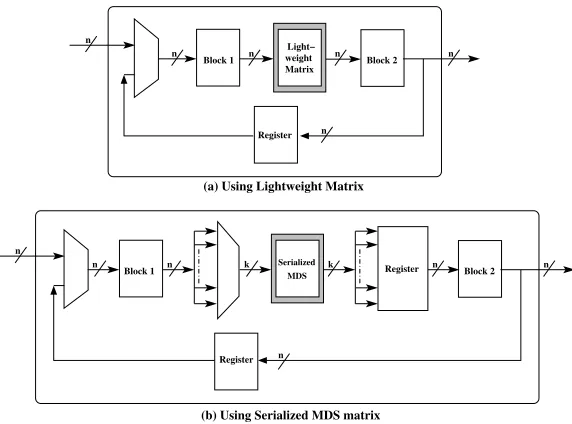
amount of data is processed in each clock cycle. Thus, a smaller hardware can be used repetitively in some clock cycles to process the whole data. Now, in case of any crypto-algorithm there are also other operations along with the MDS mapping. Let ‘Block1’ and ‘Block2’ denotes the hardware for the operations need to be performed before and after the MDS mapping respectively. The other alternative is to follow the approach adopted by the designers of PHOTON. In this case, without splitting the data path a serial matrix, which can be implemented efficiently in hardware, is multiplied in some clock cycles to obtain the desired MDS matrix.Figure 2shows the basic structural dif-ference between architecture of two approaches: (a) Using a lightweight matrix and (b) Using serialized MDS matrix. In standard serialization techniques, (seefigure 2(b)), a multiplexer is required before the MDS mapping for splitting the datapath and a register is required after the MDS mapping to hold and accumulate the processed data. ‘Seral-ized MDS’ denotes the smaller hardware, which can process the splitted datapath in one clock cycle. The additional register requirement may be overcome using the techniques mentioned in [33]. While, in case of ‘Lightweight matrix’ based implementation, the lightweight matrix of same datapath width is multiplied in each clock cycles. As the size of the datapath remains the same, no extra multiplexer or register is required (see
figure 2(b)).
Now, suppose there are two matrixS andL.Sis a serial matrix andSk =M
S, while Lis not a serial matrix, but requires same hardware resource as S andLk =
ML. BothMS andML are MDS matrices with desired cryptographic properties. In this case, if we want to implement both the two matrices in hardware withink clock cycle, both will require the exact same resource. But if we want to apply the traditional lightweight implementation techniques, to obtain more compact implementation, these two cases may not produce the same result. For example, suppose we want to split the data path in 4 parts, i.e we will compute one byte in each clock cycle. So, we only require the hardware to process each byte in a clock cycle and4 clock cycle is required to complete the multiplication of a single instance. Now forS, we will require the exact same hardware resources, what is required for the normal implementation (non-serialized). This is because of the fact that by definition serialize matrix carries all the weight in last row. So, the implementation of first three rows will be just a wiring, no gates are required for that, but for the last row, we require the exact same hardware, what was required for the normal implementation. In contrary, for L the weights are distributed in all the rows. So, the hardware to implement each rows can be shared. In this case, the hardware requirement can be less that or equal to the normal implementation.
n
n
Block 1 n k k Register n Block 2 n
Register n MDS Serialized
Block 1 Block 2
Register n
n n n n
n
(b) Using Serialized MDS matrix (a) Using Lightweight Matrix
Matrix Light− weight
Fig. 1. Lightweight Implementation Techniques for MDS Mapping
3
Finding
k
throot of a matrix with elements in
GF
(
p
m)
In this section, we discuss the algorithm to find out the thekthroots of a given matrix,
where the elements of the matrix are in finite field or Galois field. Algorithm 1 provides the steps in brief. Currently the algorithm works for diagonalizable matrix.
Letq=pm, wherepis a prime number andmis an integer.M
n(q)denotes ann×n
matrix with elements inGF(q). The characteristic polynomial of the matrixMn(q)is
defined asCMn(x) =det(Mn(q)− In·x), whereInis the identity matrix of order n×nanddet(A)denotes the determinant of matrixA.CMn(x)is a polynomial of degreenand all the operations is done according toGF(q)arithmetic. The roots of the polynomialCMn(x)are the eigenvalues of the matrixMn(q).
The roots of the polynomial can be found by factoring the polynomialCMn(x).
Berlekamp’s algorithm [6] andCantor-Zassenhaus algorithm[10] are two most popular probabilistic algorithm for factoring polynomial over finite fields. Berlekamp’s algorithm is faster but it has higher space complexity compare toCantor-Zassenhaus. On the other hand,Ben-Or’s algorithm[5] is slightly faster thanCantor-Zassenhaus, without using extra space complexity. For this reason, we chooseBen-Or’s algorithm
deterministic algorithm[35] for polynomial factorization in finite field but it has a slow performance compared to the other techniques. The output returned by any of these algorithms will be as follows:
CMn(x) =f e1 1 (x).f
e2 2 (x).f
e2
3 (x)· · ·f
es s (x)
wherefi(x), is an irreducible polynomial ofGF(q)andPei=n,1≤i≤s.
– Iffi(x)is a polynomial of degree 1, then there is a root inGF(q), which is the additive inverse of the constant of the polynomialfi(x).
– Else the roots are in the extension fieldGF(qdi)/
GF(q), w.r.t the primitive polyno-mialfi(x), wherediis the degree of the polynomial.xis the trivial root offi(x)as xsatisfies the equationfi(x) = 0. Other roots are(xq)j
, where1≤j ≤(di−1). InGF(qdi),xis the polynomial representation ofq. Hence, the roots offi(x)are q,(qq)1
,(qq)2
· · ·(qq)di−1. These roots can be computed using any of the
expo-nentiation by squaring and multiplicationmethod.
Subsequently, finding the roots of allfi(x),1 ≤i ≤s, the eigenvalues of the matrix Mn(q)can be computed. Eigen vector corresponding to different eigenvalues can be
computed using the equation 1.
Let the eigenvalues be:λ1, λ2,· · · , λnand the eigenvectors corresponding to them areX1,X2,· · ·,Xnrespectively, where Xi ={x1i, x2i,· · ·, xni}. Now, according to
Eigen Decomposition Theorem,Mn(q)can be written as follows:
Mn(q) =Pn(qm)× Dn(qm)× Pn−1(q m)
where m =maximum degree of the factors of CMn(x),P
−1
n (qm) is the inverse of
Pn(qm)and
Pn(qm) =
x11 x12. . . x1n
x21 x22. . . x2n
..
. ... . .. ... xn1xn2. . . xnn
Dn(qm) =
λ1 0 0 0 0 λ2 . . . 0 ..
. ... . .. ... 0 0 . . . λn
Finally, from the theorem 4Mk
n(q)can be computed as follows:
Mk
n(q) = (Pn(qm)× Dn(qm)× Pn−1(qm))k =Pn(qm)× Dnk(q
m)
× Pn−1(q m)
=Pn(qm)×(diag(λ1, λ2,· · ·, λn))k× Pn−1(q m)
=Pn(qm)×diag(λk1, λ
k
2,· · ·, λ
k n)× P
−1
n (q
m) (2)
when0< k <1, equation 2 returns thekthroot of the matrixMk n(q).
3.1 Complexity of the Algorithm
Algorithm 1:Finding thekthroot of the MatrixMn(q)
Input: MDS Matrix:Mn(q),k
Output:kth
root of the MatrixMn(q):M
1
k
n(q)
/* Compute the characteristic polynomial(CMn(x)) */
CMn(x) =det(Mn(q)− In·x)
/* Find the factors of CMn(x)) using Ben-Or’s algorithm */
CMn(x) =f
e1 1 (x).f
e2 2 (x).f
e2 3 (x)· · ·f
es
s (x)
/* Find the roots of the factors in the extension field of
GF(q) using the procedure mentioned in section 3 */
CMn(x) = (x−λ1).(x−λ2)· · ·(x−λn)
/* λi is the eigenvalue of Mn(q) in GF(qm), where m is the
maximum degree of the factor */
{λ1, λ2· · ·λn}=Eigenvalues[CMn(x)]
/* Xi is the eigenvector w.r.t the eigenvalue λi */
Xi={x1i, x2i,· · ·, xni}T =Eigenvector[CMn(x), λi]
/* Construct Pn(qm) and Dn(qm) */
Pn(qm) =
x11 x12 . . . x1n
x21 x22 . . . x2n
..
. ... . .. ... xn1xn2 . . . xnn
Dn(qm) =
λ1 0 0 0 0 λ2. . . 0
..
. ... . .. ... 0 0 . . . λn
/* Compute the inverse of Pn(qm) */
P−1
n (q m ) =
x11 x12 . . . x1n
x21 x22 . . . x2n
..
. ... . .. ... xn1 xn2. . . xnn
−1
/* Compute the D
1
k
n(qm) */
D 1
k
n(qm) =
λ 1 k
1 0 0 0 0 λ
1
k
2 . . . 0 ..
. ... . .. ... 0 0 . . . λ
1 k n
M1k
n(qm) =Pn(qm)× D
1
k
n(qm)× Pn−1(qm)
1. Characteristic polynomial can be computed in O(n3) using Hessenberg
algo-rithm[12].
2. Factorization of polynomial using Ben-Or’s algorithm required expected time complexity ofO(n2. log n . log log n . log q)which is less thanO(n3)ifq=O(n). 3. Computation of the eigenvalues requiresO(log q)multiplications using the
expo-nentiation by squaringmethod.
4. Eigen vectors can be obtained using theGaussian-Elimination method, which requires complexity ofO(n3)in finite field [38].
Hence, the overall complexity of the algorithm isO(n3).
4
Optimization of the algorithm for Cryptography
Further this generic algorithm for finding thekthroot of any matrix whose elements are Galois field, can be optimized for cryptography. Because, in cryptography4×4MDS matrices are used for diffusion, where each element of the matrix is represented in GF(28). For findingkthroot of the MDS matrix, all the computations should be done inGF(28)and its extension field GF(28m)/GF(28), where2 ≤ m ≤ 4. For binary field (GF(28)) both addition and subtraction is exclusive OR(⊕)and multiplication is bitwise AND(·).
Letq = 28andM
4(q)denotes an4×4matrix with the elements inGF(q). The characteristic polynomial of the matrixM4(q),CM4(x) =det(M4(q)⊕ I4·x)can be factored using any of the algorithm discussed in section 3.
– If a factor is of degree1, then there is a root inGF(28), which is the constant part of the factor.
– Else the roots are256,256256,256512 · · ·256256×(di−1)in
GF(28×di)/
GF(28), wherediis the degree of the factor. All thediroots of the factor can be computed using8squarings and(di−2)multiplications. As,dican be at most4, so, all the roots can be found by only8squarings and(di−2)multiplications.
Let Xi be the eigenvector corresponding to the eigenvalueλi of the matrix M4(q),
where
M4(q) =
m11m12m13m14 m21m22m23m24 m31m32m33m34 m41m42m43m44
Xi=
x1i
x2i
x3i
x4i
Now, from equation 1
m11⊕λi m12 m13 m14 m21 m22⊕λi m23 m24 m31 m32 m33⊕λi m34 m41 m42 m43 m44⊕λi
×
x1i
x2i
x3i
x4i
=
0 0 0 0
(m11⊕λi).x1i⊕m12.x2i⊕m13.x3i⊕m14.x1i= 0 (3)
m21.x1i⊕(m22⊕λi).x2i⊕m23.x3i⊕m24.x1i= 0 (4)
m31.x1i⊕m32.x2i⊕(m33⊕λi).x3i⊕m34.x1i= 0 (5)
m41.x1i⊕m42.x2i⊕m43.x3i⊕(m44⊕λi).x1i= 0 (6)
By the definition of eigenvalues,λi,det(M4(q)− I4·λi) = 0. So, there must be
non-trivial solution for equation 3, 4, 5 and 6. A non-non-trivial solution can be found using the
Gaussian-Elimination method[38].
Further we can use theEigen decomposition theoremto represent the matrix in the following form:
Finally, using equation 2, Mk
4(q) can be obtained. Note that if all the elements of Mk
4(q), where0 < k < 1 are inGF(28), thenkthroot of the matrixM4(q)exists inGF(28), else thekthroot is in the extension field of
GF(28).
The above algorithm can be used to determine thekthroot of a given MDS
map-ping. In the absence of such an algorithm an exhaustive search needs to be performed to iterate a chosen lightweight matrix, and compute at which power it becomes MDS. However, such a method may be infeasible because of the large number of possible choices for lightweight matrices. Thus the designers of PHOTON, restrict their choice to only Serial matrices as lightweight. In the following example, we show the applica-tion of the above theory to determine the4throot of the MDS matrix of PHOTON. One
may note that the choice ofk= 4is assumed to be known. However, one may vary that depending on the allowed no of clock cycles which is typically small, as mentioned in section 5.
Example 1. LetM4(q)represent the MDS matrix of PHOTON and the Serial matrix S4(q) =Serial(1,2,1,4)be such thatSK
4 (q) =M4(q). The objective of this exercise is thus to computeS4(q)givenM4(q).
M4(q) =
1 2 1 4 4 9 6 17 17 38 24 66 66 149 100 11
V
S4(q) =
0 1 0 0 0 0 1 0 0 0 0 1 1 2 1 4
VThe characteristic polynomial ofM4(q)is:
CM4(x) =det(M4(q)⊕ I4·x)
=x4⊕27x3⊕x2⊕16x⊕1
= (x⊕37)(x⊕217)(x2⊕231x⊕30)
Hence,37and217are two eigenvalues, which are inGF(28)and the other two eigen-values are in GF(28)2. As explained in section 4, the roots ofx2⊕231x⊕30 =
0 are 256 and256256 = 487, which are in
GF(28)2. So, the four eigenvalues are
37,217,256,487.
Gaussian-Elimination method has been used to find out the following eigenvectors corresponding to the eigenvalues.
Eigenvalues Eigenvectors
37 {232,228,94,1}
217 {181,133,146,1}
256 {11003,43997,53119,1}
487 {10920,43960,53169,1}
P4(q2) =
232 181 11003 10920 228 133 43997 43960 94 146 53119 53169
1 1 1 1
P
−1 4 (q
2) =
234 62 81 38 43 218 243 199 48831 60741 54807 28627 48766 60883 54965 28467
D4(q2) =
37 0 0 0 0 217 0 0 0 0 256 0 0 0 0 487
D
1 4 4(q
2) =
97 0 0 0 0 50 0 0 0 0 43041 0 0 0 0 43126
Hence from equation 2,
M14
4(q) =P4(q 2
)× D14 4(q
2
)× P4−1(q2)
=
232 181 11003 10920 228 133 43997 43960 94 146 53119 53169
1 1 1 1
×
97 0 0 0 0 50 0 0 0 0 43041 0 0 0 0 43126
×
234 62 81 38 43 218 243 199 48831 60741 54807 28627 48766 60883 54965 28467
=
228 133 43997 43960 94 146 53119 53169
1 1 1 1
97 50 43041 43126 ×
234 62 81 38 43 218 243 199 48831 60741 54807 28627 48766 60883 54965 28467
=
0 1 0 0 0 0 1 0 0 0 0 1 1 2 1 4
= S4(q)
Thus, using the steps of the algorithm 1, we can get the Serial matrix,S4(q)from the actual MDS matrix used in PHOTON.
So far, we have seen the way to computeM
1
k
4(q), where isM4(q)denotes the gen-eral MDS matrix used in cryptography. Now, we need to guess the possible values ofk,
for whichS4(q) =M 1
k
4(q)is a lightweight matrix.
5
Guessing the
k
and finding the lightweight matrix
In this section, first we compare the advantages of our work with the alternative options available for lightweight implementations and then propose some heuristics to guess the possible values ofk, so that the advantages can be maximized.
We are trying to find alightweightmatrixS4(q)(which can be a serial matrix or not), such thatSk
4(q)is an MDS matrixM4(q).
Alternately a lightweight solution can be achieved using the standard hardware se-rialization techniques. In these cases, the size of the datapath is splitted, so that smaller amount of data is being processed in each clock cycle. Thus, a smaller hardware can be used repetitively in some clock cycles to process the whole data.
5.1 Comparison between two paradigms
performed before and after the MDS mapping respectively.Figure 2shows the basic structural difference between architecture of two approaches: (a) Using a lightweight matrix (defined later in section 5.2) and (b) Using serialized MDS matrix2. To compare these two approaches first we fix the metrics for area and throughput.
Metric for Area:As all the computations should be done in GF(28), so the entire
MDS matrix multiplication can be performed using only XORs. Due to this reason, we have chosen the XORs count of the circuit to measure the area requirement.
Metric for Throughput:The maximum frequency forlightweightdevices is
gener-ally very low (around100KHz) [8] because higher frequency requires more power, which is not available for these resource constrained devices. Thus, we can assume that whatever may be the delay of the critical path of the diffusion layer, it will be still faster enough to support the maximum frequency of theselightweightdevices. Hence, the number of clock cycle required plays the most important role on the throughput. For this reason, we consider the number of clock cycles as a measure of the throughput.
n
n
Block 1 n k k Register n Block 2 n
Register n
MDS Serialized
Block 1 Block 2
Register n
n n n n
n
(b) Using Serialized MDS matrix (a) Using Lightweight Matrix
Matrix Light− weight
Fig. 2. Lightweight Implementation Techniques for MDS Mapping
– In standard serialization techniques, (see figure 2(b)), a multiplexer is required before the MDS mapping for splitting the datapath and a register is required after the MDS mapping to hold and accumulate the processed data. ‘Serialized MDS’
2
denotes the smaller hardware, which can process the splitted datapath in one clock cycle. The additional register requirement may be overcome using the techniques mentioned in [33].
– In case of ‘Lightweight matrix’ based implementation, the lightweight matrix of same datapath width is multiplied in each clock cycles. As the size of the datapath remains the same, no extra multiplexer or register is required (seefigure 2(b)).
5.2 Area Requirement for a Matrix to be ‘Lightweight’
Let the number of XORs required forS4(q)be#X ORS4(q)and the number of XORs required forM4(q)be#X ORM4(q). Now, if we try to serialize the implementation of M4(q)‘using serialized MDS matrix’, which requireskclock cycles and area require-mentASerialize(M4(q)), then ideally the following holds:
ASerialize(M4(q), k)=Area
#X OR
M4(q) k
+Area(k: 1)MUX of widthn k
(7)
wherenis the actual bit width of the datapath.
But usingS4(q),ktimes to getM4(q)have the following advantages:
– This does not need additional MUX, because we are not modifying the size of the datawidth, i.e the same size matrix is being multiplied each time with the column vectors.
– The estimation provided in equation 7 is only a lower bound. In actual scenario, this can be violated significantly because it is not always possible to use all the shared hardware(XORs) in each of the clock cycle, which also leads to some extra MUX in the design. Note that the different rows in MDS mapping can not be implemented without extra MUX. Whereas in case of lightweight matrix based implementation, as the matrix to be multiplied is always the same, all the XORs are being used in each of the clock cycle. Hence, we do not need any extra MUX.
Hence a matrix, obtained from the algorithm 1 can only be considered as a lightweight matrix, if it takes lesser area than its serialized implementation i.e if #X ORS4(q) equals to or nearly equals to theASerialize(M4(q), k).
5.3 Choosing the proper value ofk
Keeping these facts in mind, we recommend to pickk, such that gate equivalent of
#X ORS4(q)equals to or nearly equals to theASerialize(M4(q), k). Generally, for stan-dard lightweight implementation k should be small else the number of clock cycle required will be high. For our experiments, we keep k in the range [2,6]. Hence, a lightweight matrixS4(q)can be obtained from a given MDS matrixM4(q)using the following steps:
1. Compute the number of XORs(#X ORM4(q)) required for the hardware imple-mentation of the MDS matrixM4(q).
2. Initializekas2
3. Apply algorithm 1 to computeS4(q) =M1k
4. Compute the XOR requirement,#X ORS4for the matrixS4(q)
5. Estimate the area requirementASerialize(M4(q), k)for the standard hardware seri-alization techniques using equation.
6. If Area(#X ORS4(q)) is less thanASerialize(M4(q), k), add the matrixS4(q)as a probable lightweight solution.
7. Increment the value ofkby one and go to step 3 untilkequals to6
8. If there are more than one lightweight matrix, by the repetitive multiplication of which, the original matrix can be obtained, then choose the one which is best suited in terms of metrics for area and throughput.
6
Results
Though the proposed algorithm can also be used to find out a ‘Serial Matrix’ (if exists) from a given MDS matrix. One can point out that the output of the algorithm will not always produce a ‘Serial’ matrix but it is actually an advantage of the algorithm.
Any4×4‘Serial’ matrix can never produce an MDS matrix if it is multiplied less than four times.
LetSbe a ‘Serial’ matrix, then the following holds.
S=
0 1 0 0 0 0 1 0 0 0 0 1 x1x2x3x4
S2=
0 0 1 0 0 0 0 1 x1x2x3x4
x5x6x7x8
S3=
0 0 0 1
x1 x2 x3 x4
x5 x6 x7 x8
x9x10x11x12
Now any4∗4matrix must have all non-zero element to be an MDS matrix[17] (nec-essary but not sufficient condition). HenceS,S2andS3cannot be an MDS. Whereas using the proposed algorithm, we can find a lightweight matrix which can be multiplied less than four times to get an MDS matrix.
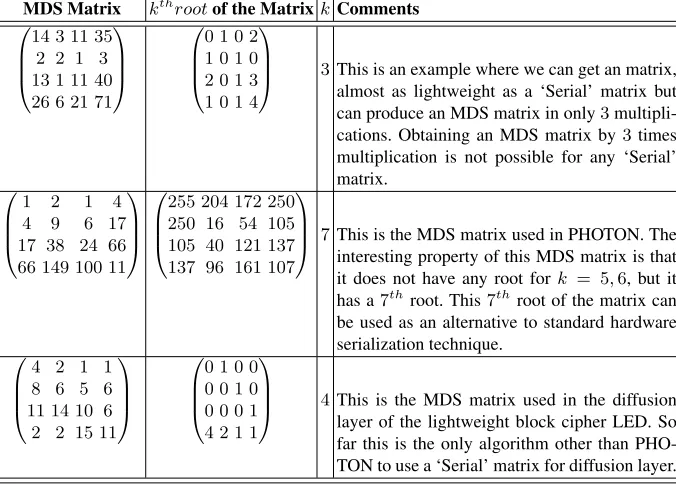
We picked some number of random4×4MDS matrices whose elements are inGF(28) and used the proposed algorithm to find the kth root of the matrix. Table 1 shows some of the interesting results obtained. It may also be noted that serialized hardware is a popular technique for lightweight cipher implementation. However the implementation becomes efficient in the context of the MDS mapping when the matrix has the rows with similar computation overheads. However it can be observed that the Serial matrix has only one row with the entire computation whereas the other rows do not have any computation. Hence a serialized approach does not provide any benefit in that case. This motivates further the search for other lightweight matrices which can be iterated to obtain an MDS mapping. The second example in Table 1 illustrates this point for PHOTON, where our algorithm in addition to the Serial matrix provides a 7throot
lightweight matrix (which is not a Serial matrix) but because of its uniform distribution is more amenable to hardware serialization.
7
Conclusion
In this paper, we proposed an efficient technique to computekthroot of a diagonalizable
Table 1.Some interesting MDS matrices
MDS Matrix kthrootof the MatrixkComments
14 3 11 35 2 2 1 3 13 1 11 40 26 6 21 71
0 1 0 2 1 0 1 0 2 0 1 3 1 0 1 4
3This is an example where we can get an matrix, almost as lightweight as a ‘Serial’ matrix but can produce an MDS matrix in only3 multipli-cations. Obtaining an MDS matrix by3times multiplication is not possible for any ‘Serial’ matrix.
1 2 1 4 4 9 6 17 17 38 24 66 66 149 100 11
255 204 172 250 250 16 54 105 105 40 121 137 137 96 161 107
7This is the MDS matrix used in PHOTON. The interesting property of this MDS matrix is that it does not have any root fork = 5,6, but it has a7throot. This7throot of the matrix can be used as an alternative to standard hardware serialization technique.
4 2 1 1 8 6 5 6 11 14 10 6 2 2 15 11
0 1 0 0 0 0 1 0 0 0 0 1 4 2 1 1
4This is the MDS matrix used in the diffusion layer of the lightweight block cipher LED. So far this is the only algorithm other than PHO-TON to use a ‘Serial’ matrix for diffusion layer.
the kth root of the matrix, sayS, we can estimate the hardware requirement for S.
References
1. S. C. Althoen and R. McLaughlin. Gauss-jordan reduction: a brief history. Am. Math. Monthly, 94(2):130–142, Feb. 1987.
2. K. Aoki, T. Ichikawa, M. Kanda, M. Matsui, A. M. Matsui, S. Moriai, J. Nakajima, and T. Tokita. Camellia: A 128-bit block cipher suitable for multiple platforms - design and analysis, 2000.
3. J.-P. Aumasson, L. Henzen, W. Meier, and M. Naya-Plasencia. Quark: A lightweight hash. J. Cryptology, 26(2):313–339, 2013.
4. P. S. L. M. Barreto and V. Rijmen. Whirlpool. In H. C. A. van Tilborg and S. Jajodia, editors, Encyclopedia of Cryptography and Security (2nd Ed.), pages 1384–1385. Springer, 2011. 5. M. Ben-Or. Probabilistic algorithms in finite fields.Foundations of Computer Science, IEEE
Annual Symposium on, 0:394–398, 1981.
6. E. R. Berlekamp. Factoring polynomials over finite fields. InBell System Technical Journal, page 18531859, 1967.
7. A. Bogdanov, M. Knezevic, G. Leander, D. Toz, K. Varici, and I. Verbauwhede. Spon-gent: The design space of lightweight cryptographic hashing. IEEE Trans. Computers, 62(10):2041–2053, 2013.
8. A. Bogdanov, L. R. Knudsen, G. Leander, C. Paar, A. Poschmann, M. J. B. Robshaw, Y. Seurin, and C. Vikkelsoe. Present: An ultra-lightweight block cipher. In P. Paillier and I. Verbauwhede, editors,CHES, volume 4727 ofLecture Notes in Computer Science, pages 450–466. Springer, 2007.
9. C. D. Canni`ere, O. Dunkelman, and M. Knezevic. Katan and ktantan - a family of small and efficient hardware-oriented block ciphers. In C. Clavier and K. Gaj, editors,CHES, volume 5747 ofLecture Notes in Computer Science, pages 272–288. Springer, 2009.
10. D. G. Cantor and H. Zassenhaus. A new algorithm for factoring polynomials over finite fields. InMathematics of Computation, Vol 36. American Mathematical Society.
11. H. Cheng, H. M. Heys, and C. Wang. Puffin: A novel compact block cipher targeted to embedded digital systems. InDSD, pages 383–390, 2008.
12. H. Cohen.A Course in Computational Algebraic Number Theory. Springer, 1993.
13. J. Daemen and V. Rijmen. The block cipher rijndael. In Quisquater and Schneier [28], pages 277–284.
14. Z. Gong, S. Nikova, and Y. W. Law. Klein: A new family of lightweight block ciphers. In RFIDSec, pages 1–18, 2011.
15. J. Guo, T. Peyrin, and A. Poschmann. The photon family of lightweight hash functions. In P. Rogaway, editor,CRYPTO, volume 6841 ofLecture Notes in Computer Science, pages 222–239. Springer, 2011.
16. J. Guo, T. Peyrin, A. Poschmann, and M. J. B. Robshaw. The led block cipher. InCHES, pages 326–341, 2011.
17. K. C. Gupta and I. G. Ray. On constructions of mds matrices from companion matrices for lightweight cryptography. In A. Cuzzocrea, C. Kittl, D. E. Simos, E. Weippl, L. Xu, A. Cuzzocrea, C. Kittl, D. E. Simos, E. Weippl, and L. Xu, editors,CD-ARES Workshops, volume 8128 ofLecture Notes in Computer Science, pages 29–43. Springer, 2013.
18. I. N. Herstein.Topics in Algebra. Wiley, June 20, 1975.
19. V. T. Hoang and P. Rogaway. Design principles of the kasumi block cipher.IACR Cryptology ePrint Archive, 2010:301, 2010.
21. R. A. Horn and C. R. Johnson.Matrix Analysis. Cambridge University Press, February 23, 1990.
22. M. Izadi, B. Sadeghiyan, S. S. Sadeghian, and H. A. Khanooki. Mibs: A new lightweight block cipher. InCANS, pages 334–348, 2009.
23. G. Leander, C. Paar, A. Poschmann, and K. Schramm. New lightweight des variants. InFSE, pages 196–210, 2007.
24. C. H. Lim and T. Korkishko. mcrypton - a lightweight block cipher for security of low-cost rfid tags and sensors. InWISA, pages 243–258, 2005.
25. F. J. MacWilliams. The Theory of Error-Correcting Codes. North-Holland Mathematical Library, 1977.
26. A. Moradi, A. Poschmann, S. Ling, C. Paar, and H. Wang. Pushing the limits: A very compact and a threshold implementation of aes. In K. G. Paterson, editor,EUROCRYPT, volume 6632 ofLecture Notes in Computer Science, pages 69–88. Springer, 2011.
27. A. Y. Poschmann.LIGHTWEIGHT CRYPTOGRAPHY. PhD thesis, February, 2009. 28. J.-J. Quisquater and B. Schneier, editors. Smart Card Research and Applications, This
In-ternational Conference, CARDIS ’98, Louvain-la-Neuve, Belgium, September 14-16, 1998, Proceedings, volume 1820 ofLecture Notes in Computer Science. Springer, 2000.
29. T. R. N. Rao and E. Fujiwara. Error-Control Coding for Computer Systems. Prentice Hall series in computer engineering, January 1989.
30. M. Sajadieh, M. Dakhilalian, H. Mala, and B. Omoomi. On construction of involutory mds matrices from vandermonde matrices in gf(2q). Des. Codes Cryptography, 64(3):287–308,
2012.
31. M. Sajadieh, M. Dakhilalian, H. Mala, and P. Sepehrdad. Recursive diffusion layers for block ciphers and hash functions. In A. Canteaut, editor,FSE, volume 7549 ofLecture Notes in Computer Science, pages 385–401. Springer, 2012.
32. B. Schneier and D. Whiting. Twofish on smart cards. In Quisquater and Schneier [28], pages 265–276.
33. K. Shibutani, T. Isobe, H. Hiwatari, A. Mitsuda, T. Akishita, and T. Shirai. Piccolo: An ultra-lightweight blockcipher. In B. Preneel and T. Takagi, editors,CHES, volume 6917 of Lecture Notes in Computer Science, pages 342–357. Springer, 2011.
34. T. Shirai, K. Shibutani, T. Akishita, S. Moriai, and T. Iwata. The 128-bit blockcipher clefia (extended abstract). InFSE, pages 181–195, 2007.
35. V. Shoup. Smoothness and factoring polynomials over finite fields. InMath. Comp, pages 398–406, 1996.
36. T. Suzaki, K. Minematsu, S. Morioka, and E. Kobayashi. Twine: A lightweight, versatile block cipher. InECRYPT Workshop on Lightweight Cryptography - November 2011, volume 2011, pages 148–169, 2011.
37. S. Vaudenay. On the need for multipermutations: Cryptanalysis of md4 and safer. In B. Pre-neel, editor, FSE, volume 1008 of Lecture Notes in Computer Science, pages 286–297. Springer, 1994.
38. F. R. W.Linear Least Squares Computations. Marcel Dekker, 1988.
39. D. Watanabe, S. Furuya, H. Yoshida, K. Takaragi, and B. Preneel. A new keystream generator mugi.IEICE Transactions, 87-A(1):37–45, 2004.